
Infants Children and Adolescents Laura E Berk 6
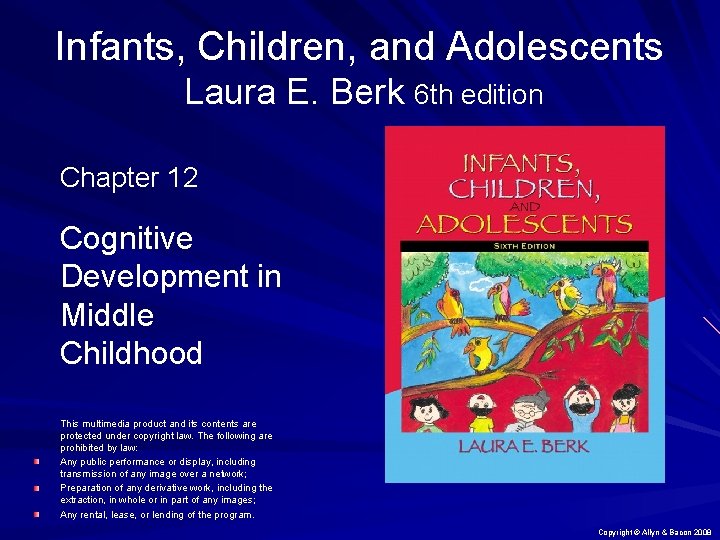
Infants, Children, and Adolescents Laura E. Berk 6 th edition Chapter 12 Cognitive Development in Middle Childhood This multimedia product and its contents are protected under copyright law. The following are prohibited by law: Any public performance or display, including transmission of any image over a network; Preparation of any derivative work, including the extraction, in whole or in part of any images; Any rental, lease, or lending of the program. Copyright © Allyn & Bacon 2008

Piaget’s Theory: The Concrete Operational Stage Conservation – Decentration – Reversibility Classification Seriation – Transitive inference Spatial Reasoning – Directions – Maps Copyright © Allyn & Bacon 2008
Piaget’s Theory: Limitations of Concrete Operational Thought Mental operations work best with objects that are concrete – Problems with abstract ideas Continuum of Acquisition – Master concrete operational tasks gradually Copyright © Allyn & Bacon 2008
Further Research on Concrete Operations Culture and schooling affect performance on tasks Neo-Piagetians suggest information processing helps – Automatic cognitive schemes free up working memory – Spread from central conceptual structure to wide range of situations Copyright © Allyn & Bacon 2008
Key Information Processing Improvements Increase in information -processing speed and capacity Gains in inhibition Both may be related to brain development Copyright © Allyn & Bacon 2008
Attention in Middle Childhood Attention becomes more: Selective Adaptable Planful Copyright © Allyn & Bacon 2008

Development of Attention Strategies 1. Production deficiency 2. Control deficiency 3. Utilization deficiency 4. Effective strategy use Copyright © Allyn & Bacon 2008
Steps in Planning Postponing action to weigh alternatives Organizing task materials n. Remembering steps of plan n. Monitoring how well plan works n. Revising if necessary Copyright © Allyn & Bacon 2008
Children With ADHD Symptoms – Cannot stay focused on a task for more than a few minutes. Often ignore social rules and lash out when frustrated. Origins – Highly heritable, can also be caused by environmental factors. The disease is highly correlated with a stressful home life. Treatment – Stimulant medication reduces symptoms in 70% of children who take them, however, these drugs have risks. Medication combined with interventions that model and reinforce appropriate behavior work best. Copyright © Allyn & Bacon 2008
Development of Memory Strategies Rehearsal – early grade school Organization – soon after rehearsal – Knowledge base helps organization Elaboration – end of middle childhood – Meaningful chunks of information • Schooling promotes using these memory strategies Copyright © Allyn & Bacon 2008
Theory of Mind in Middle Childhood See mind as active, constructive Understand more about sources of knowledge – Mental inferences – False beliefs Consider interactions of variables Schooling promotes developing theory of mind Copyright © Allyn & Bacon 2008
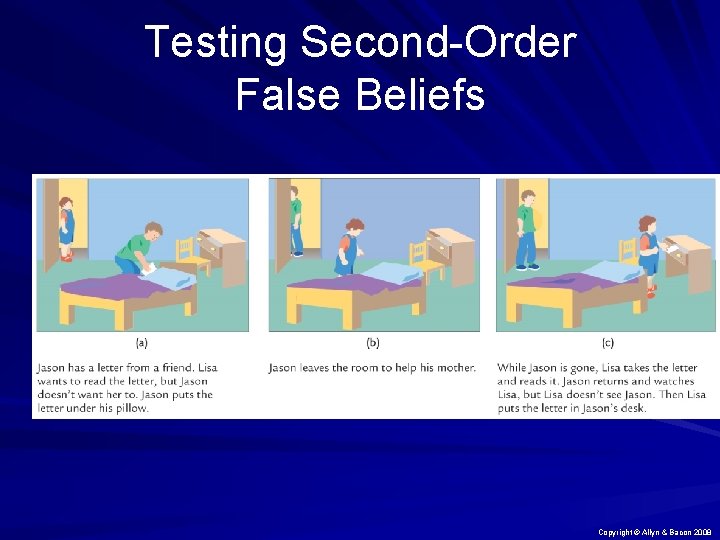
Testing Second-Order False Beliefs Copyright © Allyn & Bacon 2008
Promoting Cognitive Self-Regulation Point out special demands of tasks Encourage use of strategies Emphasize value of selfcorrection Self-regulatory skills help develop a sense of academic self-efficacy Copyright © Allyn & Bacon 2008
Information Processing and Academic Learning Reading – Whole-language approach – Phonological awareness A combination of the two approaches, along with excellent teaching practices, shows the best results in literacy progress for 1 st graders. Copyright © Allyn & Bacon 2008
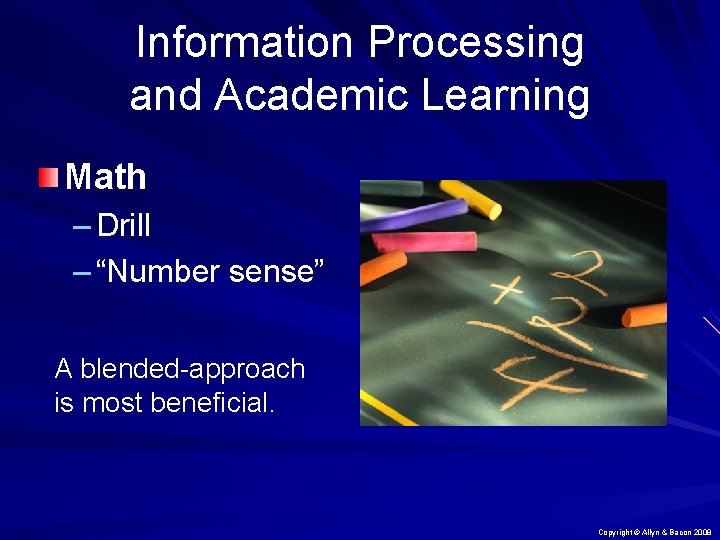
Information Processing and Academic Learning Math – Drill – “Number sense” A blended-approach is most beneficial. Copyright © Allyn & Bacon 2008

IQ Tests Group Tests Allow testing of large groups Require little training to administer Useful for instructional planning Identify students who need individual testing Individually. Administered Tests Examiners need training & experience – Provide insights about accuracy of score Identify highly intelligent and children with learning problems Copyright © Allyn & Bacon 2008
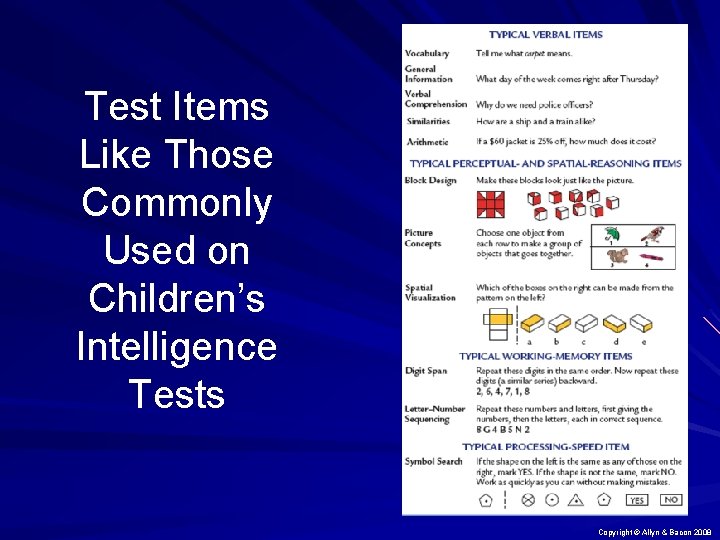
Test Items Like Those Commonly Used on Children’s Intelligence Tests Copyright © Allyn & Bacon 2008
Types of Tests Stanford-Binet Intelligence Scales, Fifth Edition – Assesses general knowledge, quantitative reasoning, visual-spatial processing, working memory, and basic information processing Wechsler Intelligence Scale for Children-IV – Measures verbal reasoning, perceptual (or visual-spatial) reasoning, working memory, and processing speed Copyright © Allyn & Bacon 2008
Recent Efforts to Define Intelligence Processing speed is correlated with IQ scores. Inhibition, selective attention, and sustained attention are among the other predictors of IQ. Copyright © Allyn & Bacon 2008
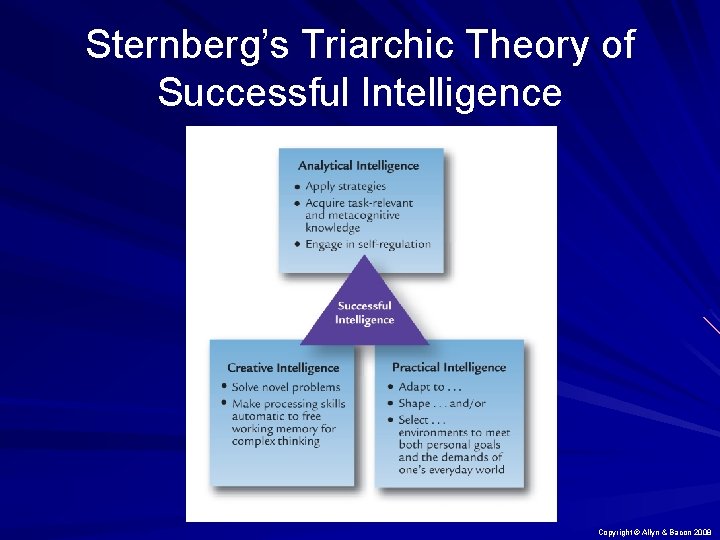
Sternberg’s Triarchic Theory of Successful Intelligence Copyright © Allyn & Bacon 2008
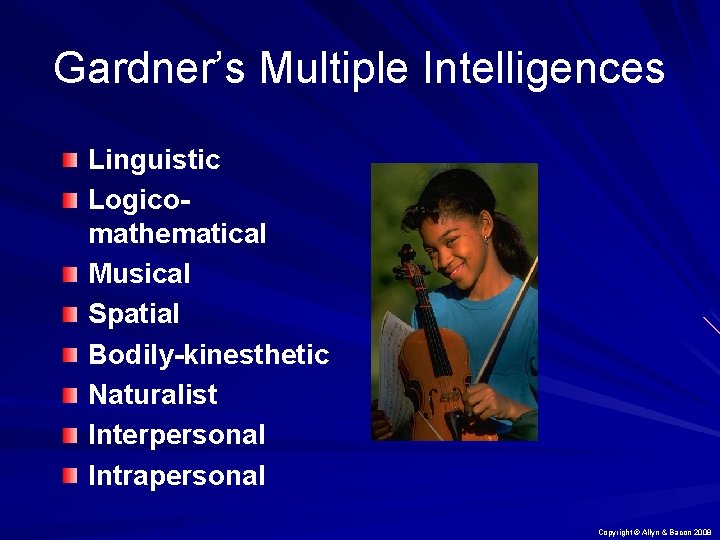
Gardner’s Multiple Intelligences Linguistic Logicomathematical Musical Spatial Bodily-kinesthetic Naturalist Interpersonal Intrapersonal Copyright © Allyn & Bacon 2008
Explaining Differences in IQ Genetics – Accounts for about half of differences Environment – SES – Culture Communication styles Cultural bias in test content Copyright © Allyn & Bacon 2008
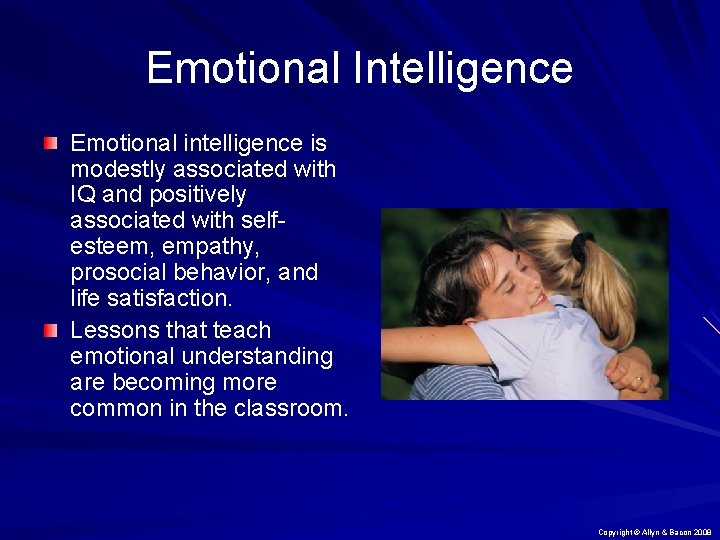
Emotional Intelligence Emotional intelligence is modestly associated with IQ and positively associated with selfesteem, empathy, prosocial behavior, and life satisfaction. Lessons that teach emotional understanding are becoming more common in the classroom. Copyright © Allyn & Bacon 2008
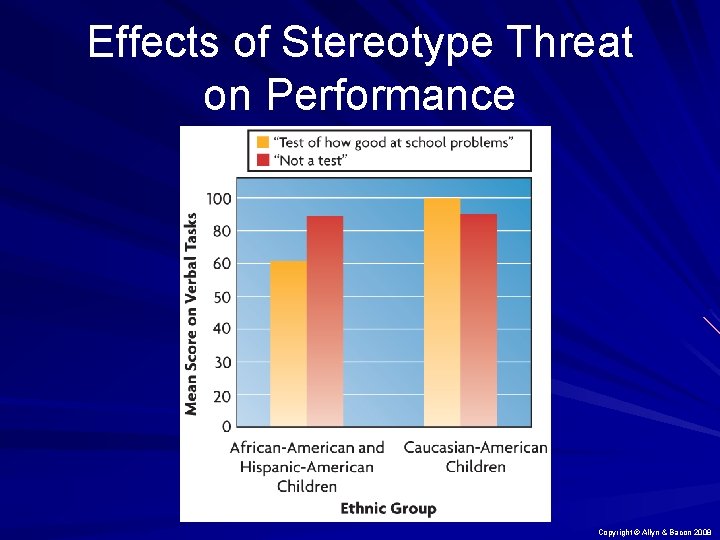
Effects of Stereotype Threat on Performance Copyright © Allyn & Bacon 2008
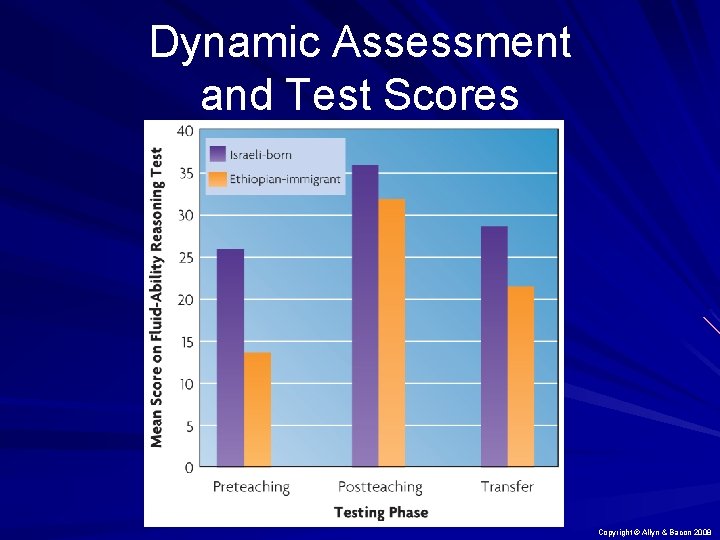
Dynamic Assessment and Test Scores Copyright © Allyn & Bacon 2008
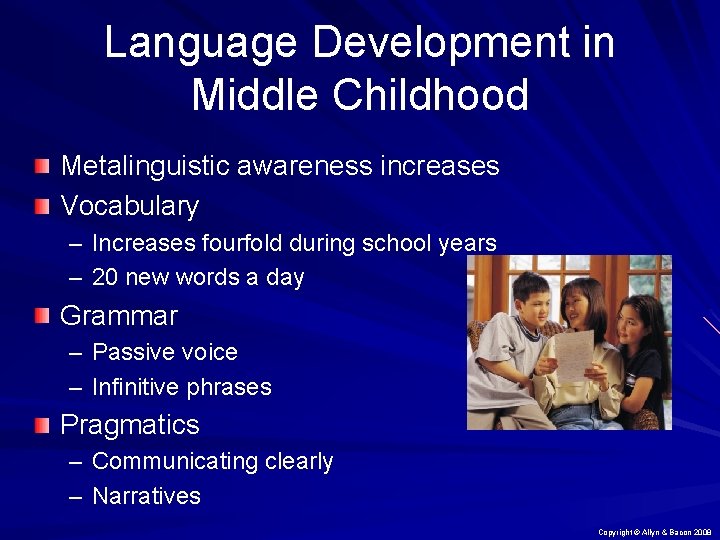
Language Development in Middle Childhood Metalinguistic awareness increases Vocabulary – Increases fourfold during school years – 20 new words a day Grammar – Passive voice – Infinitive phrases Pragmatics – Communicating clearly – Narratives Copyright © Allyn & Bacon 2008
Learning Two Languages Bilingual Development – Learn both languages at the same time – Learn first language, then second – Sensitive period: childhood Bilingual Education – Language immersion – Bilingual education Copyright © Allyn & Bacon 2008
Academic Achievement and Class Size Children in smaller classes, especially minority children, score higher than those in larger classes. Teachers have more time for individual attention. Children show better concentration, higher -quality class participation, and more favorable attitudes toward school. Copyright © Allyn & Bacon 2008
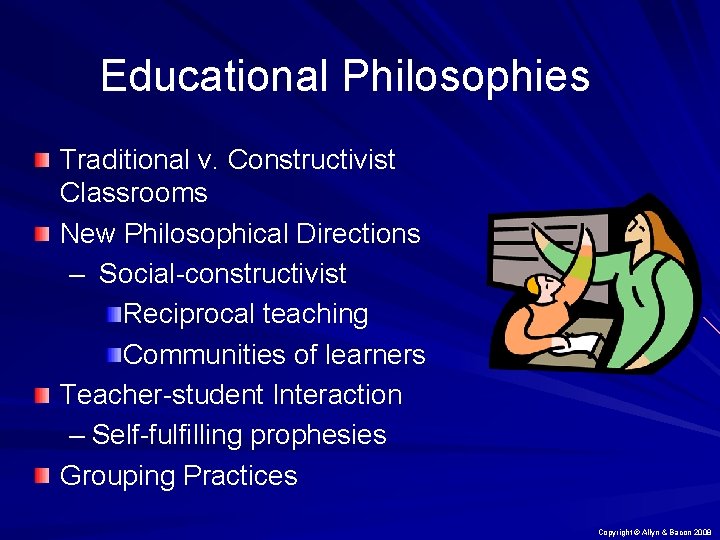
Educational Philosophies Traditional v. Constructivist Classrooms New Philosophical Directions – Social-constructivist Reciprocal teaching Communities of learners Teacher-student Interaction – Self-fulfilling prophesies Grouping Practices Copyright © Allyn & Bacon 2008
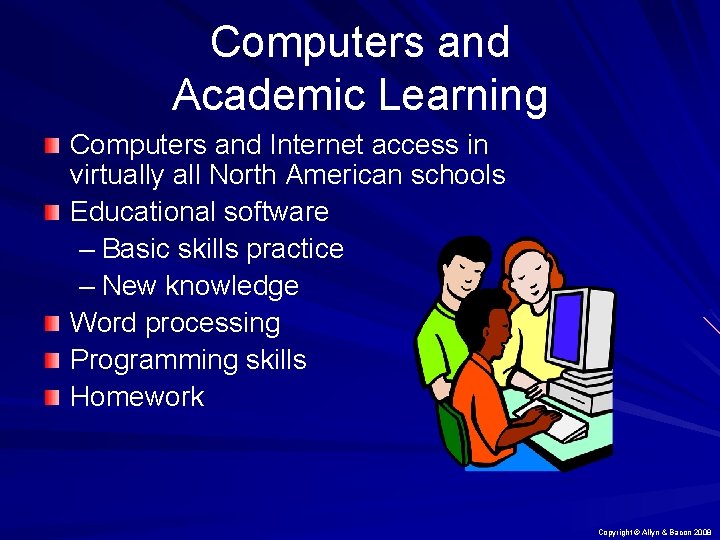
Computers and Academic Learning Computers and Internet access in virtually all North American schools Educational software – Basic skills practice – New knowledge Word processing Programming skills Homework Copyright © Allyn & Bacon 2008
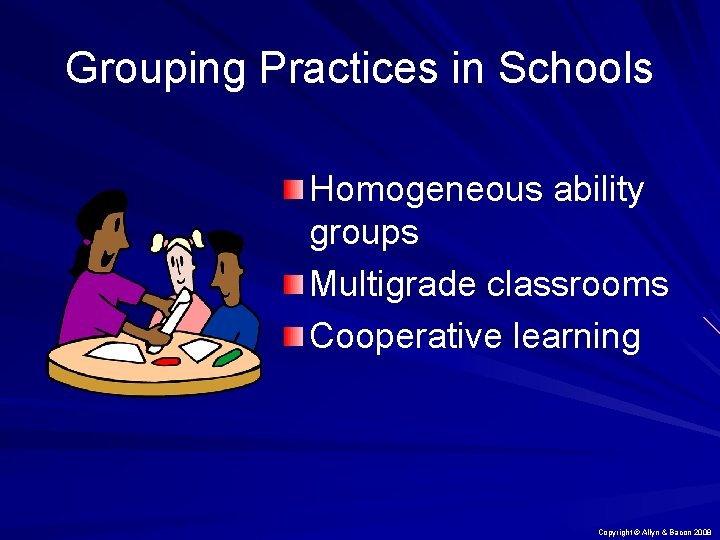
Grouping Practices in Schools Homogeneous ability groups Multigrade classrooms Cooperative learning Copyright © Allyn & Bacon 2008
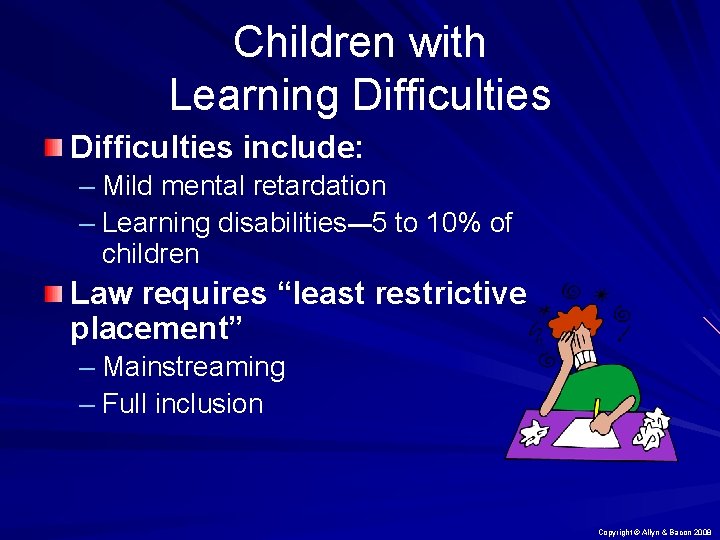
Children with Learning Difficulties include: – Mild mental retardation – Learning disabilities— 5 to 10% of children Law requires “least restrictive placement” – Mainstreaming – Full inclusion Copyright © Allyn & Bacon 2008
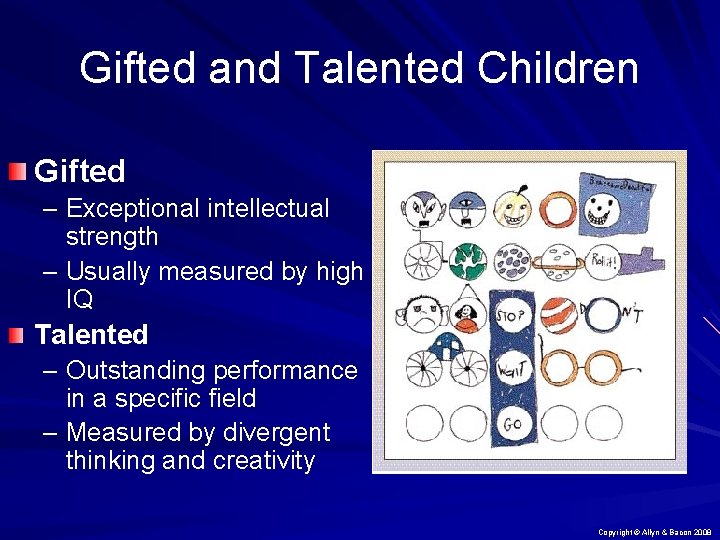
Gifted and Talented Children Gifted – Exceptional intellectual strength – Usually measured by high IQ Talented – Outstanding performance in a specific field – Measured by divergent thinking and creativity Copyright © Allyn & Bacon 2008
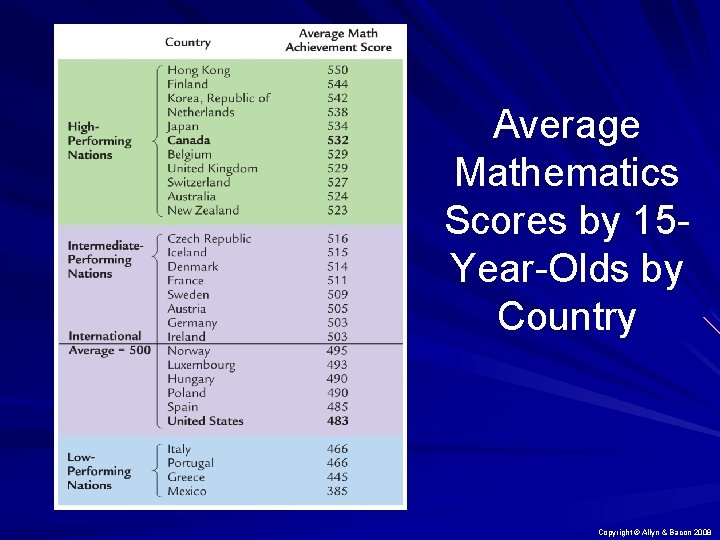
Average Mathematics Scores by 15 Year-Olds by Country Copyright © Allyn & Bacon 2008

Asian Schools Versus North American Schools Asian schools show more: Cultural valuing of academic achievement Emphasis on effort High-quality education for all Time devoted to instruction Copyright © Allyn & Bacon 2008
- Slides: 35