
Infant weighing scale o principles of operation function



- Slides: 16
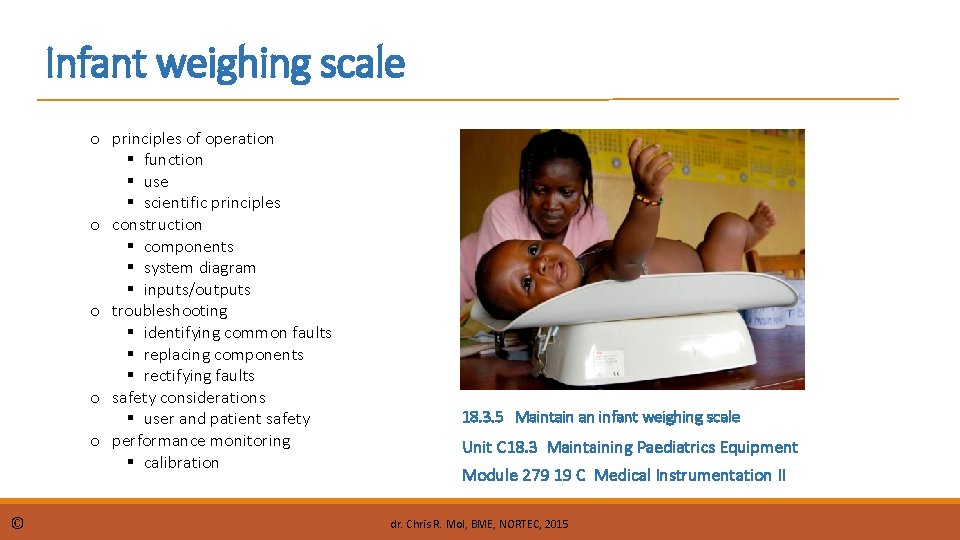
Infant weighing scale o principles of operation function use scientific principles o construction components system diagram inputs/outputs o troubleshooting identifying common faults replacing components rectifying faults o safety considerations user and patient safety o performance monitoring calibration © 18. 3. 5 Maintain an infant weighing scale Unit C 18. 3 Maintaining Paediatrics Equipment Module 279 19 C Medical Instrumentation II dr. Chris R. Mol, BME, NORTEC, 2015
Function: measure weight What is a scale ? A scale is an accurate and precise instrument used to measure the weight (mass) of a material. The ability to measure material as large as 50 kg and as small as 10μg makes them quite common. Why is it important ? In the hospital, many materials have to be measured, incl. patients, new-born babies, pharmaceutical drugs, …. to track the health situation (diagnosis) or apply therapies. In what units do we The unit of the mass is the kilogram [kg]. It is equal to the mass of the measure mass and weight ? international prototype kilogram and therefore fixed. The unit of weight is the Newton, the force with which gravity exerts on a kg mass. Weight = Mass x Gravity Constant. This varies by up to 0. 5% at different locations on Earth. dr. Chris R. Mol, BME, NORTEC, 2015 Maintain a scale
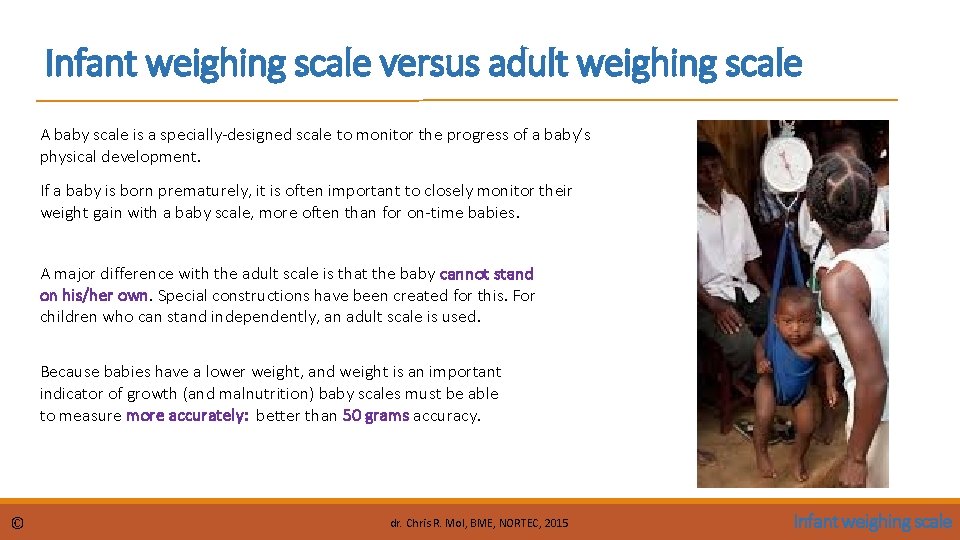
Infant weighing scale versus adult weighing scale A baby scale is a specially-designed scale to monitor the progress of a baby’s physical development. If a baby is born prematurely, it is often important to closely monitor their weight gain with a baby scale, more often than for on-time babies. A major difference with the adult scale is that the baby cannot stand on his/her own. Special constructions have been created for this. For children who can stand independently, an adult scale is used. Because babies have a lower weight, and weight is an important indicator of growth (and malnutrition) baby scales must be able to measure more accurately: better than 50 grams accuracy. © dr. Chris R. Mol, BME, NORTEC, 2015 Infant weighing scale
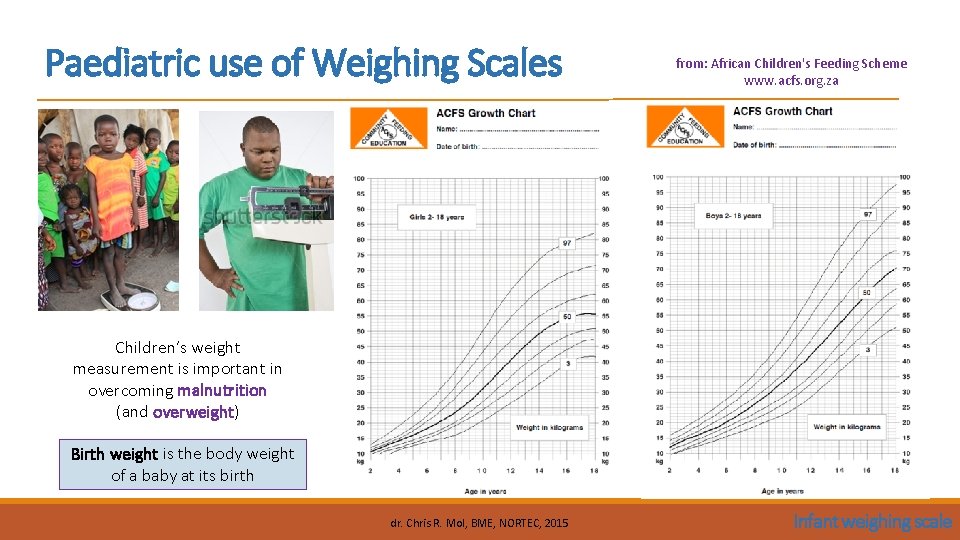
Paediatric use of Weighing Scales from: African Children's Feeding Scheme www. acfs. org. za Children’s weight measurement is important in overcoming malnutrition (and overweight) Birth weight is the body weight of a baby at its birth dr. Chris R. Mol, BME, NORTEC, 2015 Infant weighing scale
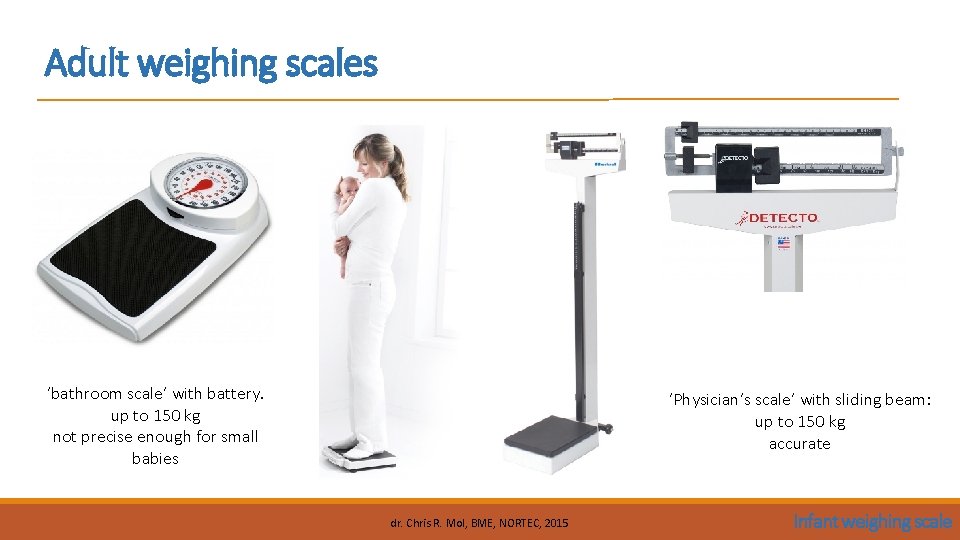
Adult weighing scales ‘bathroom scale’ with battery. up to 150 kg not precise enough for small babies ‘Physician’s scale’ with sliding beam: up to 150 kg accurate dr. Chris R. Mol, BME, NORTEC, 2015 Infant weighing scale
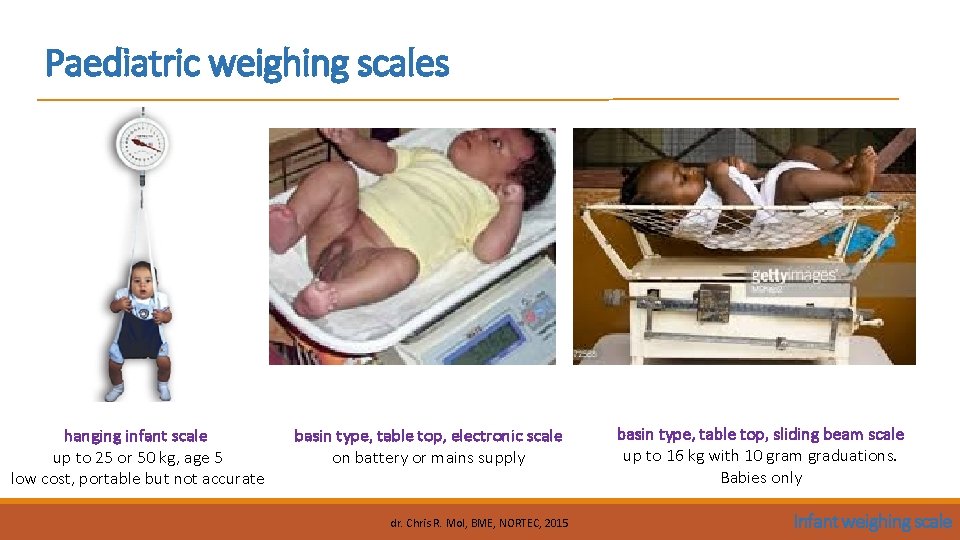
Paediatric weighing scales hanging infant scale up to 25 or 50 kg, age 5 low cost, portable but not accurate basin type, table top, electronic scale on battery or mains supply dr. Chris R. Mol, BME, NORTEC, 2015 basin type, table top, sliding beam scale up to 16 kg with 10 gram graduations. Babies only Infant weighing scale
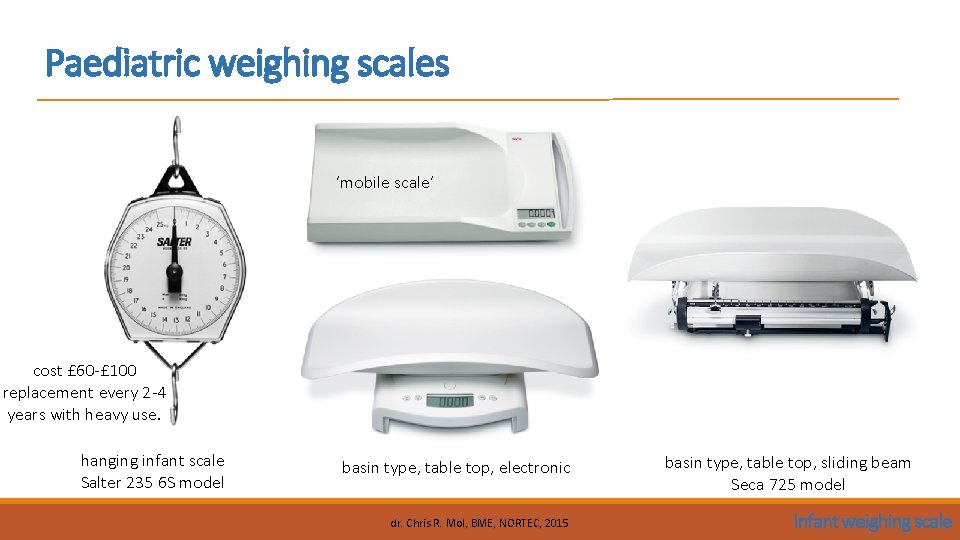
Paediatric weighing scales ‘mobile scale’ cost £ 60 -£ 100 replacement every 2 -4 years with heavy use. hanging infant scale Salter 235 6 S model basin type, table top, electronic dr. Chris R. Mol, BME, NORTEC, 2015 basin type, table top, sliding beam Seca 725 model Infant weighing scale
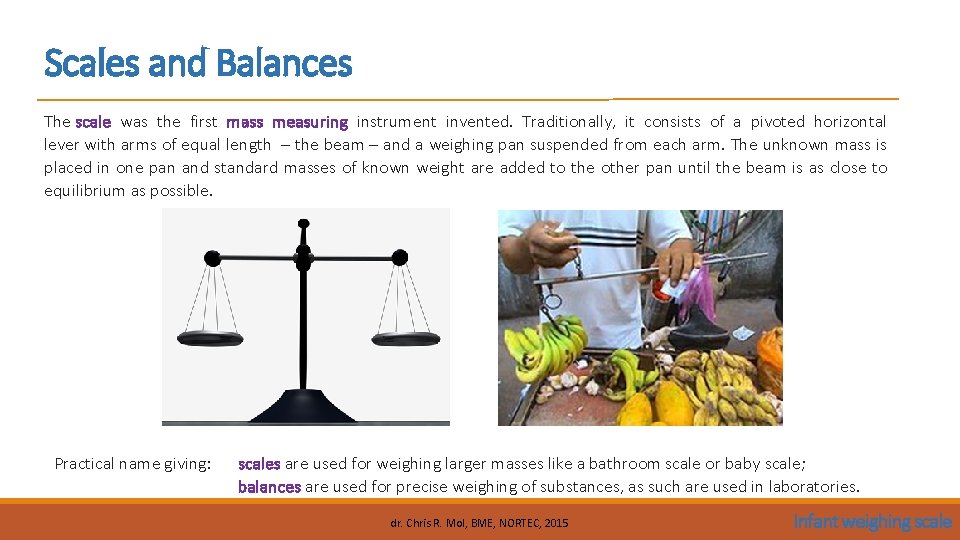
Scales and Balances The scale was the first mass measuring instrument invented. Traditionally, it consists of a pivoted horizontal lever with arms of equal length – the beam – and a weighing pan suspended from each arm. The unknown mass is placed in one pan and standard masses of known weight are added to the other pan until the beam is as close to equilibrium as possible. Practical name giving: scales are used for weighing larger masses like a bathroom scale or baby scale; balances are used for precise weighing of substances, as such are used in laboratories. dr. Chris R. Mol, BME, NORTEC, 2015 Infant weighing scale
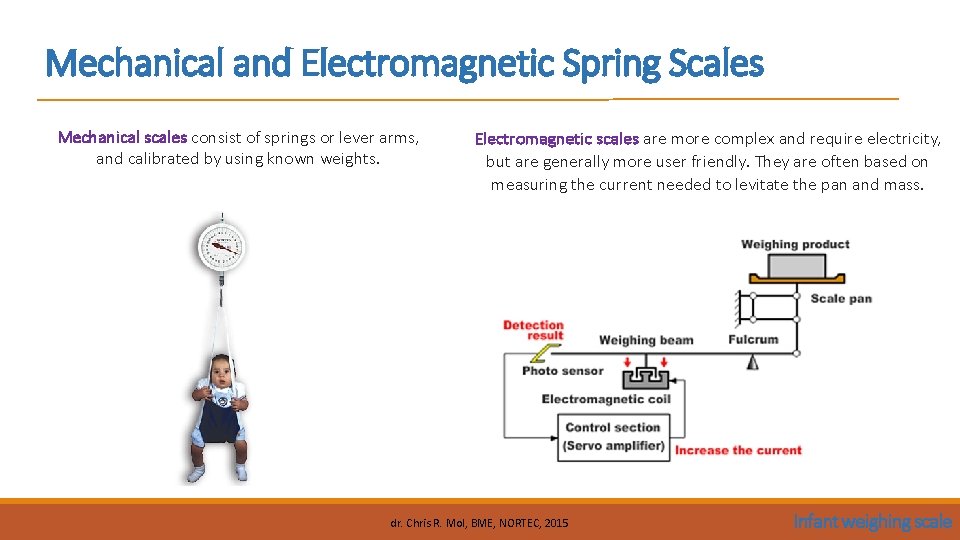
Mechanical and Electromagnetic Spring Scales Mechanical scales consist of springs or lever arms, and calibrated by using known weights. Electromagnetic scales are more complex and require electricity, but are generally more user friendly. They are often based on measuring the current needed to levitate the pan and mass. dr. Chris R. Mol, BME, NORTEC, 2015 Infant weighing scale
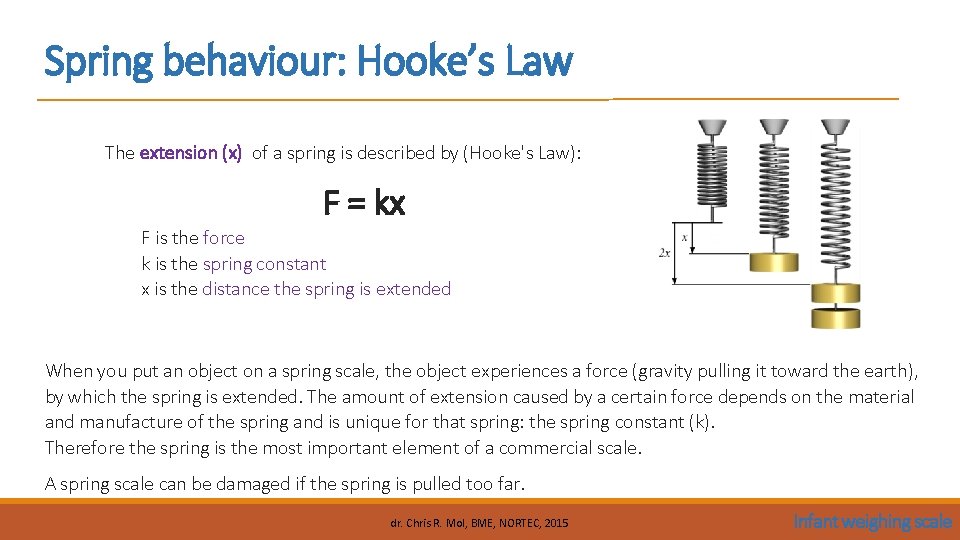
Spring behaviour: Hooke’s Law The extension (x) of a spring is described by (Hooke's Law): F = kx F is the force k is the spring constant x is the distance the spring is extended When you put an object on a spring scale, the object experiences a force (gravity pulling it toward the earth), by which the spring is extended. The amount of extension caused by a certain force depends on the material and manufacture of the spring and is unique for that spring: the spring constant (k). Therefore the spring is the most important element of a commercial scale. A spring scale can be damaged if the spring is pulled too far. dr. Chris R. Mol, BME, NORTEC, 2015 Infant weighing scale
Preventive Maintenance Little maintenance other than regular cleaning and calibration checks are required of the baby scales. dr. Chris R. Mol, BME, NORTEC, 2015 Infant weighing scale
Trouble shooting Mechanical scales are very reliable and rarely need major repairs. The most common problem with mechanical scales is • environmental factors: the movements of the mechanical scale must be free of dirt and other residue • maintenance requiring cleaning and lubrication of all moving parts. Electromagnetic spring scales The most common problems associated with an electromagnetic balance are the result of • environmental factors • temperature, • static electricity, • vibration / movement • out of level (tilted) • wind. • user error Internal problems with an electromagnetic scale cannot usually be repaired in the field. dr. Chris R. Mol, BME, NORTEC, 2015 Infant weighing scale
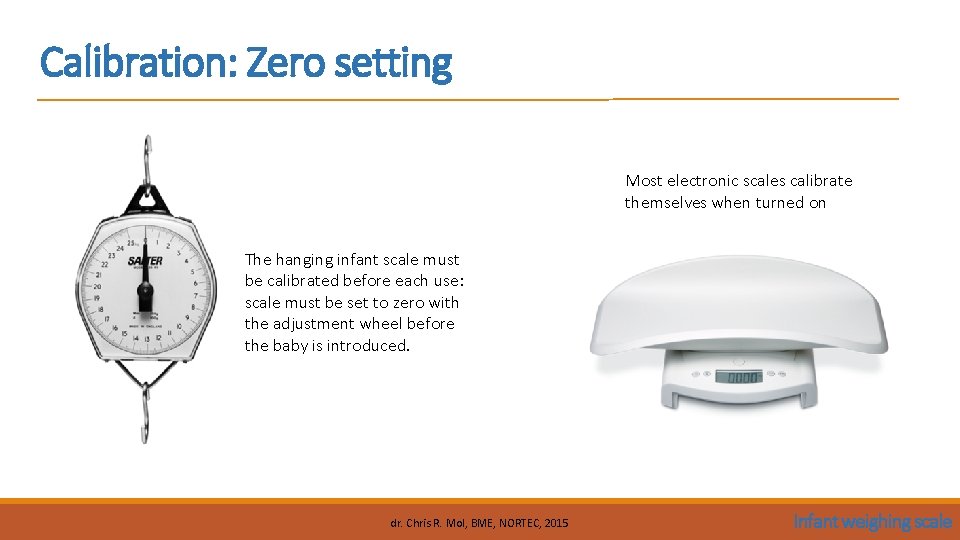
Calibration: Zero setting Most electronic scales calibrate themselves when turned on The hanging infant scale must be calibrated before each use: scale must be set to zero with the adjustment wheel before the baby is introduced. dr. Chris R. Mol, BME, NORTEC, 2015 Infant weighing scale
Calibration of the scales should be undertaken at least weekly and as required; for example if an error in a weight measurement is suspected. The scales can be checked by placing an approved weight on the scales e. g. 1 kg, 2 kg, 5 kg and 10 kg weights. It is recommended that checks be carried out at three weight points on scales, using: • a minimum of 80% of maximum weight capacity for the scale, and • a point about half of the above measurement (i. e. approximately 40% of max. ), and • a point much lower down the scale range © dr. Chris R. Mol, BME, NORTEC, 2015 Infant weighing scale
Safety Considerations: Infection A new paper towel should be placed on the scales between clients (Australia). The scales should be cleaned weekly at a minimum or as required with detergent / disinfectant wipes and allowed to air dry. © dr. Chris R. Mol, BME, NORTEC, 2015 Infant weighing scale
END The creation of this presentation was supported by a grant from THET: see https: //www. thet. org/