
Infant Learning By Bao Xiong Major Psychology Minor
Infant Learning By Bao Xiong Major: Psychology Minor: Public Health University of California, Merced
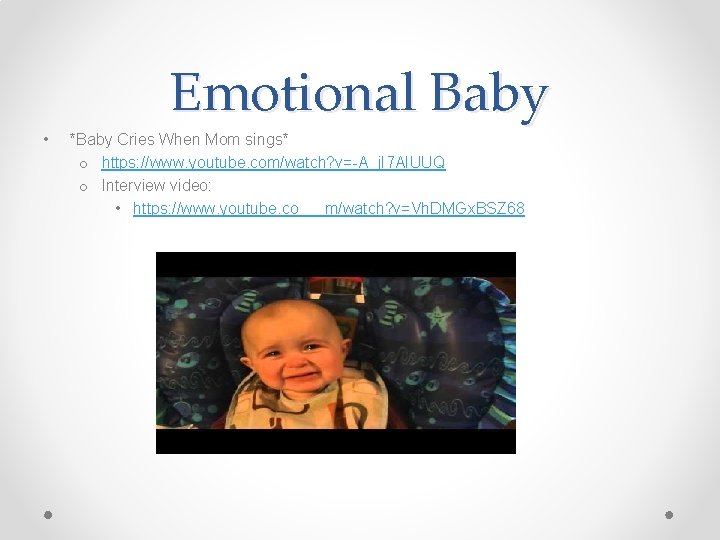
Emotional Baby • *Baby Cries When Mom sings* o https: //www. youtube. com/watch? v=-A_j. I 7 AIUUQ o Interview video: • https: //www. youtube. co m/watch? v=Vh. DMGx. BSZ 68
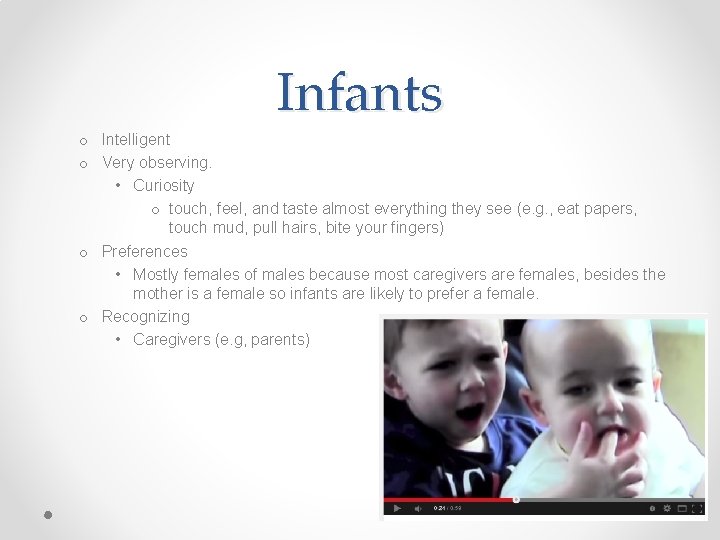
Infants o Intelligent o Very observing. • Curiosity o touch, feel, and taste almost everything they see (e. g. , eat papers, touch mud, pull hairs, bite your fingers) o Preferences • Mostly females of males because most caregivers are females, besides the mother is a female so infants are likely to prefer a female. o Recognizing • Caregivers (e. g, parents)
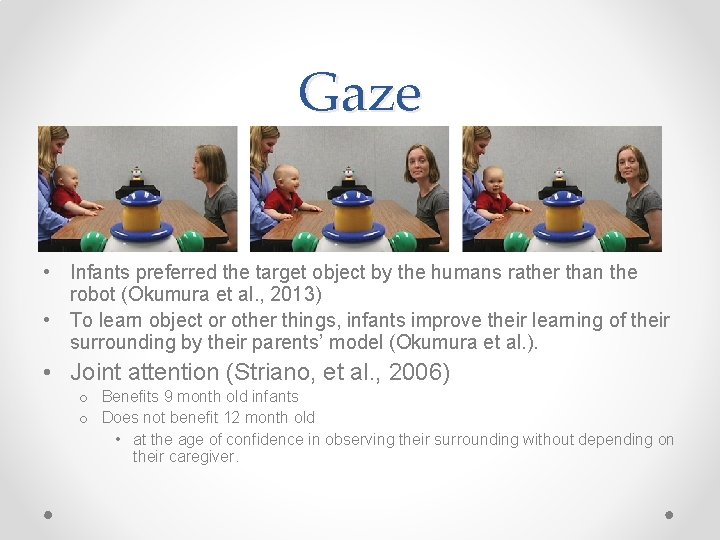
Gaze • Infants preferred the target object by the humans rather than the robot (Okumura et al. , 2013) • To learn object or other things, infants improve their learning of their surrounding by their parents’ model (Okumura et al. ). • Joint attention (Striano, et al. , 2006) o Benefits 9 month old infants o Does not benefit 12 month old • at the age of confidence in observing their surrounding without depending on their caregiver.
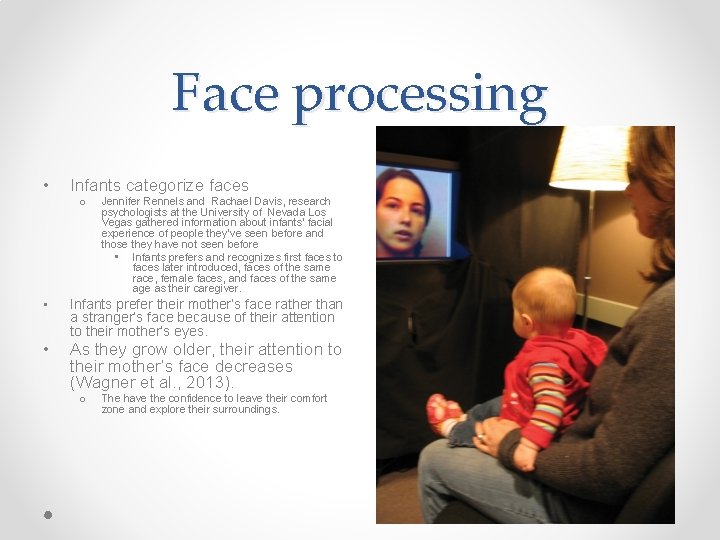
Face processing • Infants categorize faces o Jennifer Rennels and Rachael Davis, research psychologists at the University of Nevada Los Vegas gathered information about infants’ facial experience of people they’ve seen before and those they have not seen before • Infants prefers and recognizes first faces to faces later introduced, faces of the same race, female faces, and faces of the same age as their caregiver. • Infants prefer their mother’s face rather than a stranger’s face because of their attention to their mother’s eyes. • As they grow older, their attention to their mother’s face decreases (Wagner et al. , 2013). o The have the confidence to leave their comfort zone and explore their surroundings.
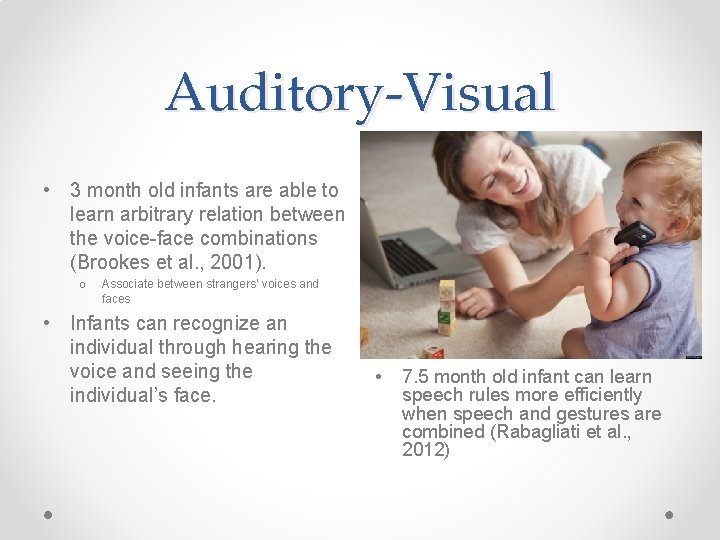
Auditory-Visual • 3 month old infants are able to learn arbitrary relation between the voice-face combinations (Brookes et al. , 2001). o Associate between strangers’ voices and faces • Infants can recognize an individual through hearing the voice and seeing the individual’s face. • 7. 5 month old infant can learn speech rules more efficiently when speech and gestures are combined (Rabagliati et al. , 2012)
• Proposal Type of research study: o • Location: o • Experiment room in the Social Science and Management building at University of California, Merced. Method: o o o • Longitudinal study that will focus on determining the role of social cues in infants’ learning from 9 months old to 24 months old, the typical age that infants learn to speak and walk, as well as confirming results with previous studies. Recruit thirty 9 months old infants. 3 sessions • routinely tested every six month until the age of 2 years old to determine changes in infants’ learning ability. Mother will interact with infants while being recorded • Focus will be on the duration of gaze, areas of gaze, and facial expressions. Results o o positive feedback to how effectively social cues plays a role in the infants’ early age learning. • mother’s voice, gaze, and facial expression cuing the infant’s visual attention recognition of how the mother looks like. alternate strategy is to look for the social cues that the infant use to learn faces, objects and many things in his/her surroundings at each age (e. g. , a 9 month old infants may have the ability to recognize and differentiate faces; at age 12 month, the infant may have the ability to learn how to speak such as da da ma ma).

Expenses Cost Facility Fees $5000 per year Compensation $100 per infant Assistants (2) $50 per hour Equipment (camera, curtains, sanitizer, etc) $1, 000 Object (toys) $100 Calculation $5000 x 2 years $100 x 3 session $50 x 45 hours $1000 x 1 time buy $100 x 3 session Total $ 16, 550. 00 Total $ 10, 000. 00 $ 3, 000. 00 $ 2, 250. 00 $ 1, 000. 00 $ 300. 00
• • References Brookes, H. , Slater. , Quinn, P. C. , Lewkowicz, D. J. , Hayes, R. , & Brown, E. (2001). Three month-old infants learn arbitrary auditory-visual pairings between voices and faces. Infant and Child Development, 10, 75 -82. Doi: 10/1002/icd. 249. Okumura, Y. , Kanakogi, Y. , Kanda, T. , Ishiguro, H. , & Itakura, S. (2013). The power of human gaze on infant learning. Cognition, 128, 127 -133. • Rabagliati, H. , Senghas, A. , Johnson, S. , & Marcus, G. F. (July 18, 2012). Infant rule learning: Advantage language, or advantage speech? PLo. S ONE, 7(7): e 40517, 1 -5. doi: 10. 1371/journal. pone. 0040517. • Rennels, J. L. and Davis, R. E. (2008). Facial experience during the first year. Infant behavior and Development, 31, 665 -678. • Striano, T. , Chen, X. , Cleveland, A. , & Bradshaw, S. (2006). Joint attention social cues influence infant learning. European journal of developmental psychology, 3(3), 289 -299. doi: 10. 1080/17405620600879779. • Wagner, J. B. , Luyster, R. J. , Yim, J. Y. , Flusberg, H. T. , & Nelson, C. A. (2013). The role of early visual attention in social development. International Journal of Behavioral Development, 37, 118 -124.
- Slides: 9