
Infant Growth and Development Standards 1 2 Workplace
- Slides: 8
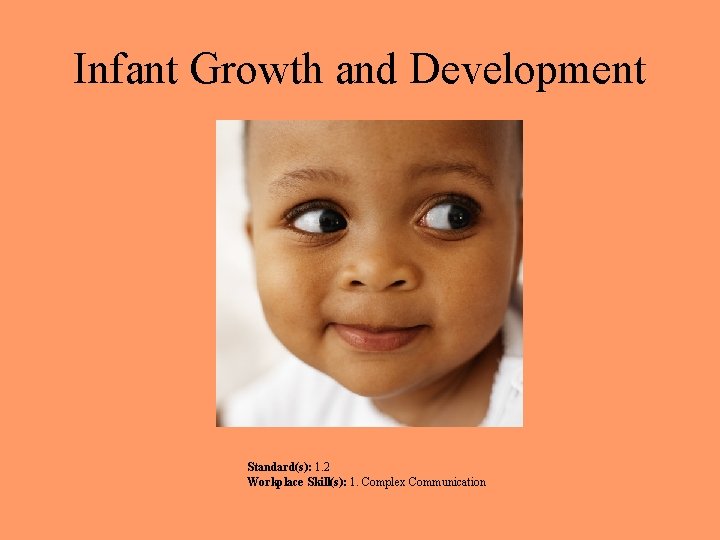
Infant Growth and Development Standard(s): 1. 2 Workplace Skill(s): 1. Complex Communication
Patterns of Physical Development • Head to Foot – Control over head movements first then moves to arms and hands and eventually to legs and feet • Near to Far – Development close to the body, first waving arms, then more precise hand finger control to grasp items • Simple to Complex – Develops large muscle group firsts for movement then smaller groups for complex control (ex. coloring)
Influences on Growth & Developmental milestones: key skills used to check a child’s progress – Heredity – Nutrition: essential for growth & health – Health: stimulate brain & muscle development – Experiences – Environment: stimulating environment, variety of things to see, taste, smell, hear & touch
Growth During the First Year Growth Charts show the average weight and height of girls and boys at various ages • Weight: is the best sign of good health. – Newborns lose 10% of their birth weight in the first five days – After that begin gaining 1 -2 pounds each month
Growth During the First Year Con’t • Length: bone growth is rapid, but heredity strongly influences height • Body Shapes: first born keep tightly curled position, but gradually stretch out over the first six months • Proportion: refers to the size relationship between different parts of the body – Compared to the rest of the body, a baby’s head and abdomen are large, and the legs and arms are short and small
Motor Skills • Motor skills, or muscle movement, is limited for infants • Most movements are due to reflexes – instinctive, automatic responses, such as grasping or sucking • Two categories of motor skills – Gross (Large) Motor skills: involve large muscles of body, such as shoulders and legs – Fine (Small) Motor Skills: involve small muscles of body such as fingers
Development During the First Year • • Vision Hearing Touch Smell & Taste Voice Motor skills Reflexes: sucking reflex, rooting reflex, other automatic reflexes • Hand-Eye Coordination
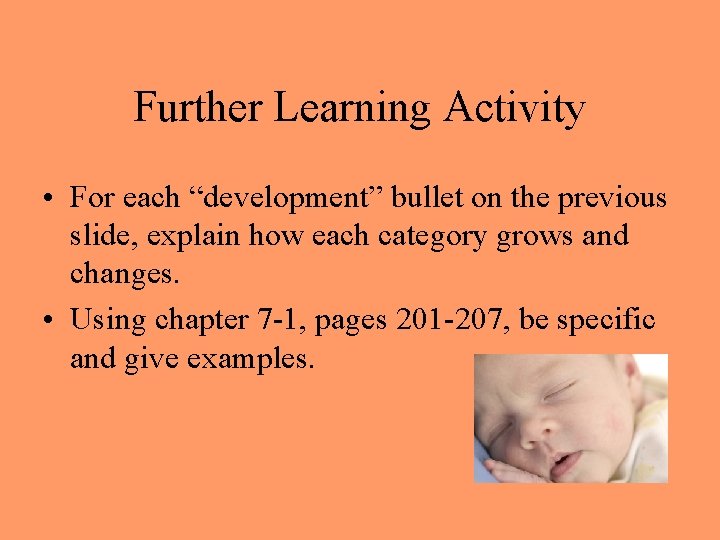
Further Learning Activity • For each “development” bullet on the previous slide, explain how each category grows and changes. • Using chapter 7 -1, pages 201 -207, be specific and give examples.