
Infant Cognitive Development Piagets Cognitive Developmental Theory n




- Slides: 15
Infant Cognitive Development
Piaget’s Cognitive Developmental Theory n Stage theory: qualitative change in thought that is universal What changes with development? n Schemes: way to make sense of experiences – Move from action to mental level How does cognitive change happen? Adaptation: schemes change by interacting with environment – Assimilation: use current schemes to interpret environment – Accomodation: change schemes to match environment n Organization: internal rearranging of schemes n When does cognitive change happen? Equilibrium: comfortable, steady state; little development n Disequilibrium: cognitive discomfort; rapid change n
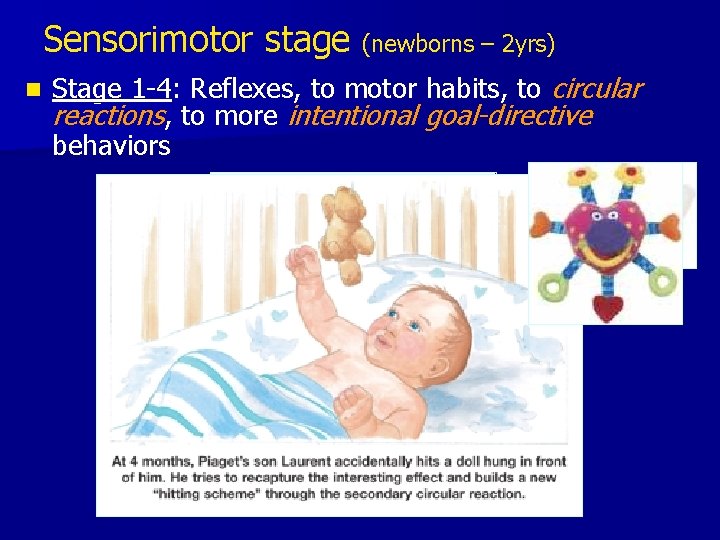
Sensorimotor stage (newborns – 2 yrs) n Stage 1 -4: Reflexes, to motor habits, to circular reactions, to more intentional goal-directive behaviors
n Object permanence (8 -12 mo): objects continue to exist, even when out of sight Methods
n Object permanence (8 -12 mo): objects continue to exist, even when out of sight Methods
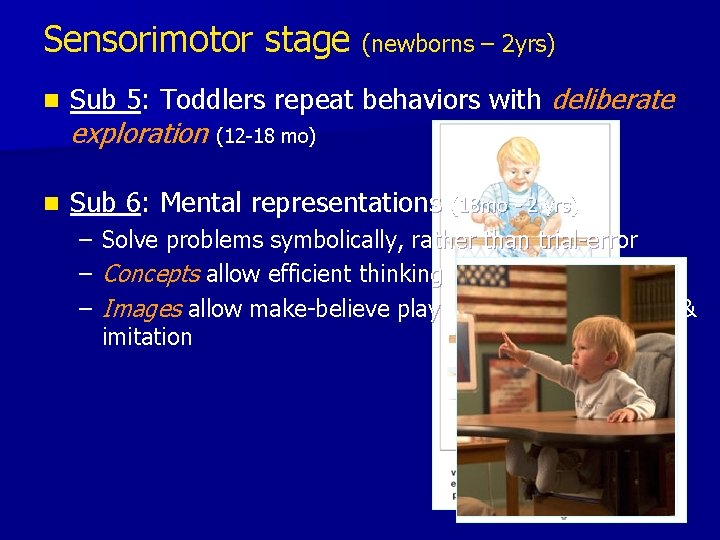
Sensorimotor stage (newborns – 2 yrs) n Sub 5: Toddlers repeat behaviors with deliberate n Sub 6: Mental representations (18 mo - 2 yrs) exploration (12 -18 mo) – – – Solve problems symbolically, rather than trial-error Concepts allow efficient thinking Images allow make-believe play imitation &
Evaluation of Piaget’s Sensorimotor Stage n Underestimated infant’s abilities – Object permanence found in 3 mo olds using violationof-expectation method (Baillargeon, 1991)
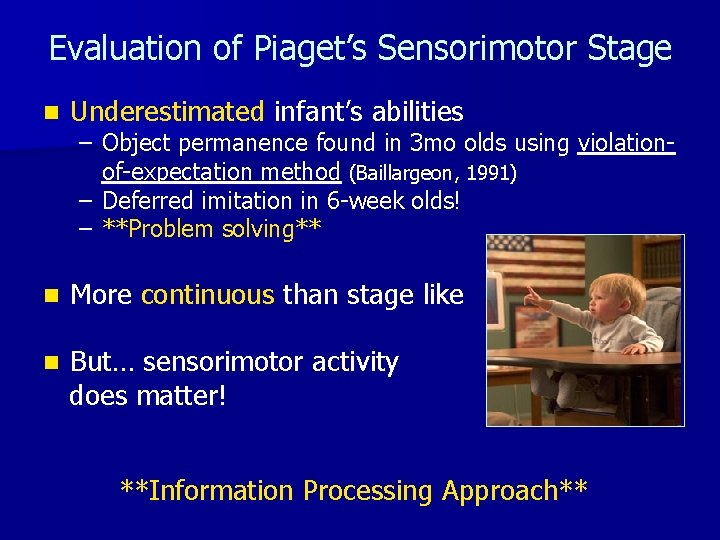
Evaluation of Piaget’s Sensorimotor Stage n Underestimated infant’s abilities n More continuous than stage like n But… sensorimotor activity does matter! – Object permanence found in 3 mo olds using violationof-expectation method (Baillargeon, 1991) – Deferred imitation in 6 -week olds! – **Problem solving** **Information Processing Approach**
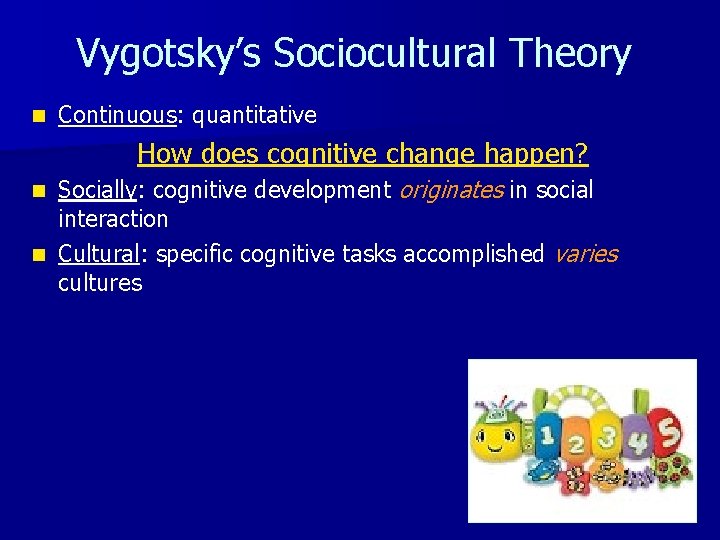
Vygotsky’s Sociocultural Theory n Continuous: quantitative How does cognitive change happen? Socially: cognitive development originates in social interaction n Cultural: specific cognitive tasks accomplished varies cultures n
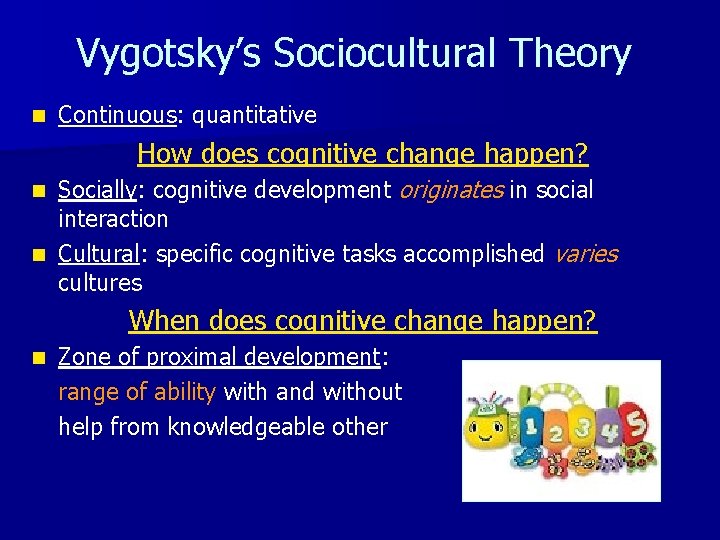
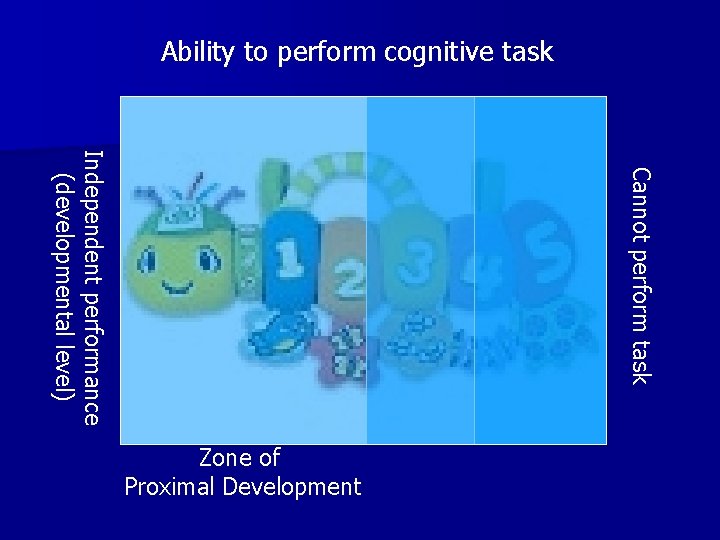
Vygotsky’s Sociocultural Theory n Continuous: quantitative How does cognitive change happen? Socially: cognitive development originates in social interaction n Cultural: specific cognitive tasks accomplished varies cultures n When does cognitive change happen? n Zone of proximal development: range of ability with and without help from knowledgeable other
Ability to perform cognitive task Cannot perform task Independent performance (developmental level) Zone of Proximal Development
In-class Activity 3 The purpose of this assignment is to evaluate whether the concepts discussed in the book and class about perceptual and cognitive development in infancy are implemented in the “real world” of infant toy development.