
Infancy Childhood Cognitive Development Early Neurological Development At



- Slides: 16
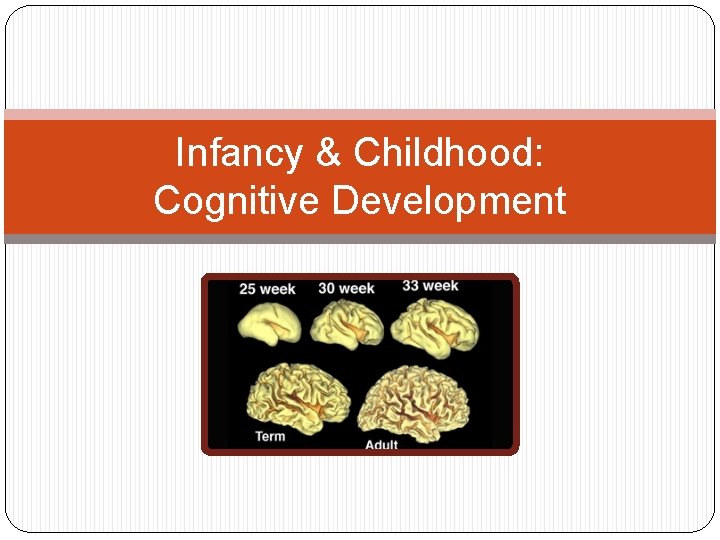
Infancy & Childhood: Cognitive Development
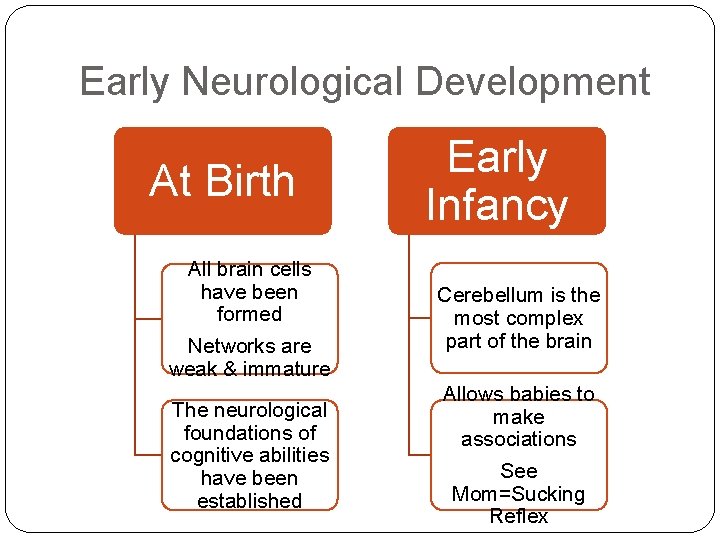
Early Neurological Development At Birth All brain cells have been formed Networks are weak & immature The neurological foundations of cognitive abilities have been established Early Infancy Cerebellum is the most complex part of the brain Allows babies to make associations See Mom=Sucking Reflex
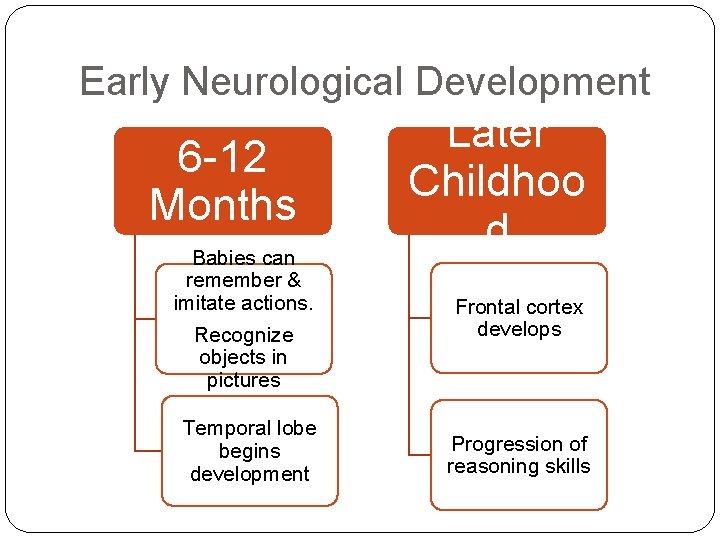
Early Neurological Development 6 -12 Months Babies can remember & imitate actions. Recognize objects in pictures Temporal lobe begins development Later Childhoo d Frontal cortex develops Progression of reasoning skills
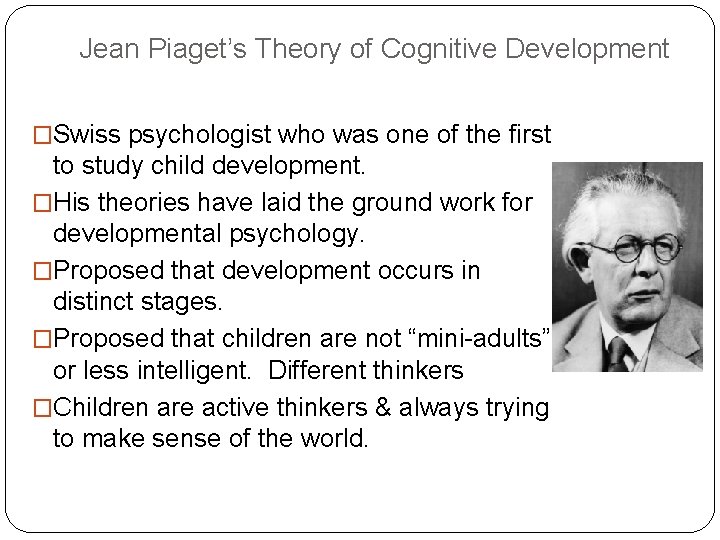
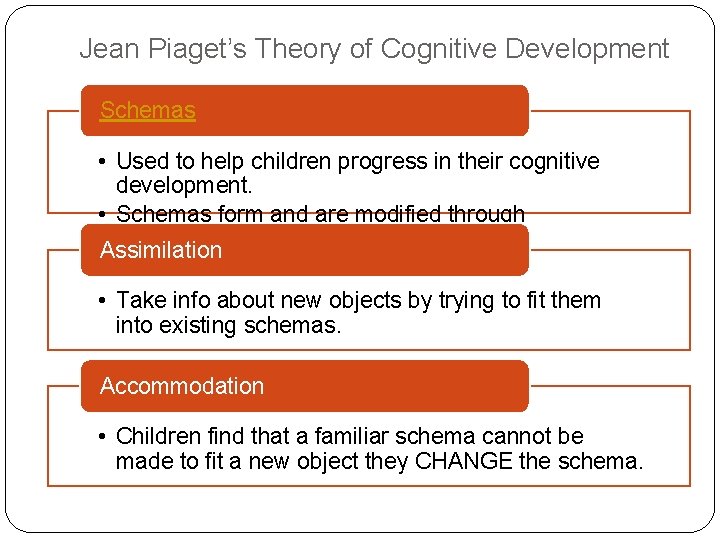
Jean Piaget’s Theory of Cognitive Development �Swiss psychologist who was one of the first to study child development. �His theories have laid the ground work for developmental psychology. �Proposed that development occurs in distinct stages. �Proposed that children are not “mini-adults” or less intelligent. Different thinkers �Children are active thinkers & always trying to make sense of the world.
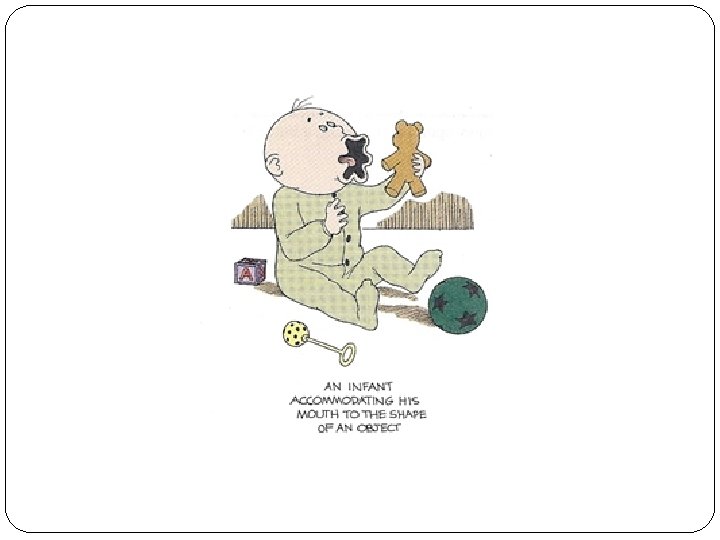
Jean Piaget’s Theory of Cognitive Development Schemas • Used to help children progress in their cognitive development. • Schemas form and are modified through experience. Assimilation • Take info about new objects by trying to fit them into existing schemas. Accommodation • Children find that a familiar schema cannot be made to fit a new object they CHANGE the schema.
Assimilation or Accommodation? When little Augustus is given his first vitamin pill, he says, “Yea!!! Candy!!!!” Baby Fedelia discovers a red chilipepper on the floor and says “ooooo…. candy!!!!” After she puts the chili-pepper in her mouth, she realizes that it is not at all like candy. Now when she sees a chili pepper she runs away.
Piaget’s Stages of Cognitive Development Stage 1: Sensorimotor • Birth to 2 yrs. • Mental activity (schemas) confined to sensory & motor functions. • Cannot form mental representations • Stage ends w/ the dev. of object permanence
Piaget’s Stages of Cognitive Development Stage 2: Preoperational • 2 -7 yrs. • Understand/create/use symbolic representations (Pretend Play) • Develop language skills • Begin to make intuitive guesses • Animism is evident in thinking • Egocentrism is evident in thinking
Piaget’s Stages of Cognitive Development Stage 3: Concrete Operational • 7 -11 yrs. • Develop conservation abilities. • Thinking is no longer dominated by appearance of objects. • Perform simple mental manipulations • Think logically about concrete objects
Piaget’s Stages of Cognitive Development Stage 4: Formal Operational • 11 yrs. & up • Engage in hypothetical thinking • Reason & think about possible strategies • Understand impact of the past/present/future. • Question social institutions & what the world ought to be • Consider consequences
Modifying Piaget’s Theory
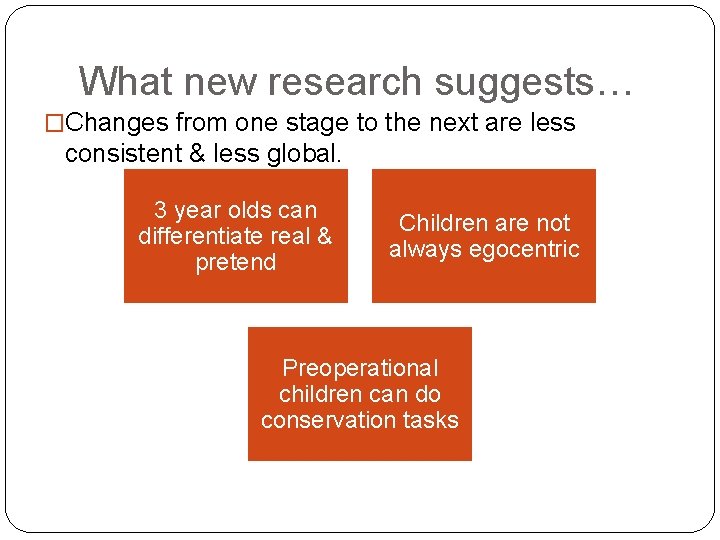
What new research suggests… �Changes from one stage to the next are less consistent & less global. 3 year olds can differentiate real & pretend Children are not always egocentric Preoperational children can do conservation tasks
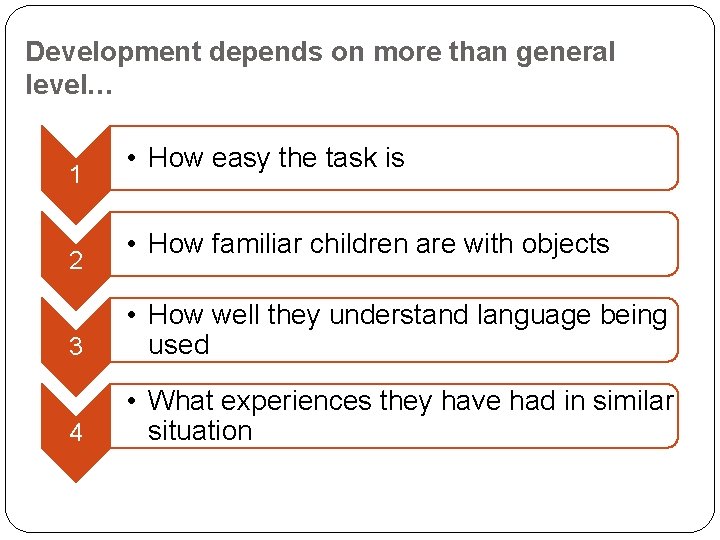
Development depends on more than general level… 1 2 • How easy the task is • How familiar children are with objects 3 • How well they understand language being used 4 • What experiences they have had in similar situation
Cognitive Development happens in “waves…” �Children develop different ways of thinking at different frequencies. �Development is not fixed or permanent. �Children tend to try many different solutions to problems, then gradually select the best.