
Infancy and Childhood Module 8 Garber 2018 1
Infancy and Childhood Module 8 Garber 2018 1
Infancy and Childhood § Physical Development § Cognitive Development § Social Development 2

3
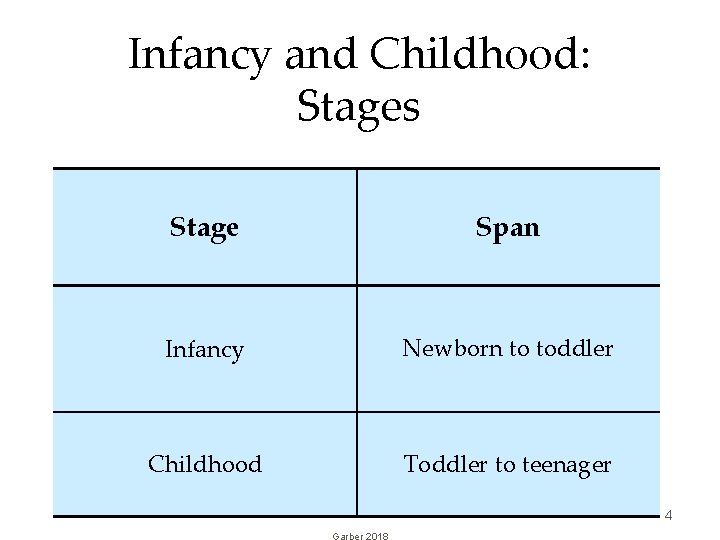
Infancy and Childhood: Stages Stage Span Infancy Newborn to toddler Childhood Toddler to teenager 4
Maturation Biological growth processes that enable orderly changes in behavior Preprogrammed Maturation sets the basic course of development, while experience adjusts it. 5
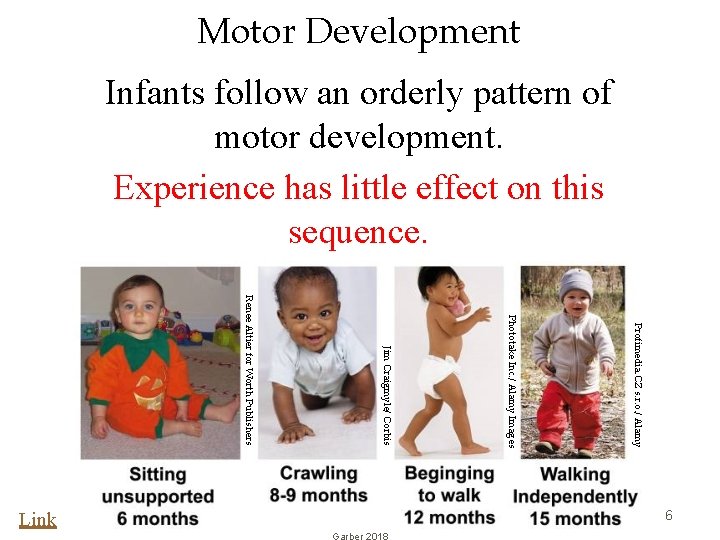
Motor Development Infants follow an orderly pattern of motor development. Experience has little effect on this sequence. Profimedia. CZ s. r. o. / Alamy Phototake Inc. / Alamy Images Jim Craigmyle/ Corbis Renee Altier for Worth Publishers Link 6

Averages for Americans… 7
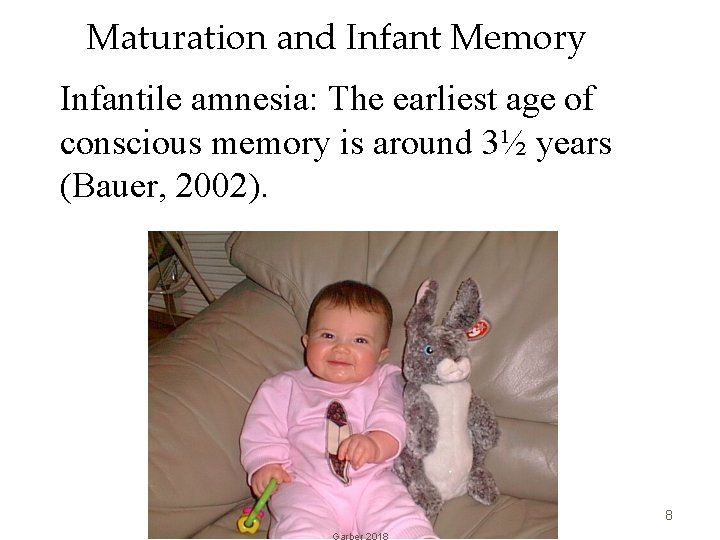
Maturation and Infant Memory Infantile amnesia: The earliest age of conscious memory is around 3½ years (Bauer, 2002). 8
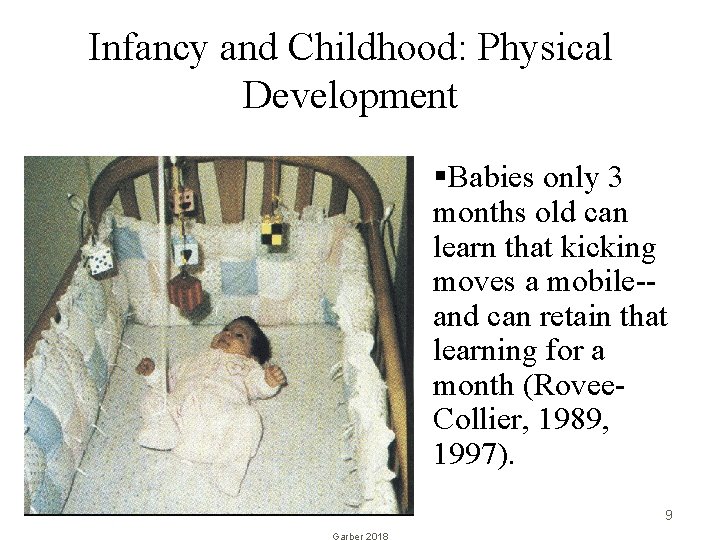
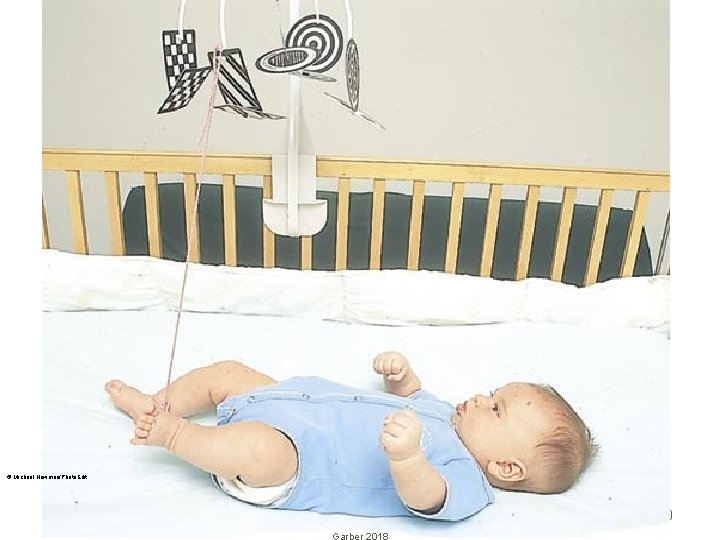
Infancy and Childhood: Physical Development §Babies only 3 months old can learn that kicking moves a mobile-and can retain that learning for a month (Rovee. Collier, 1989, 1997). 9
© Michael Newman/Photo. Edit 10
Infancy and Childhood: Cognitive Development • Cognition • all the mental activities associated with thinking, knowing, remembering, and communicating 11
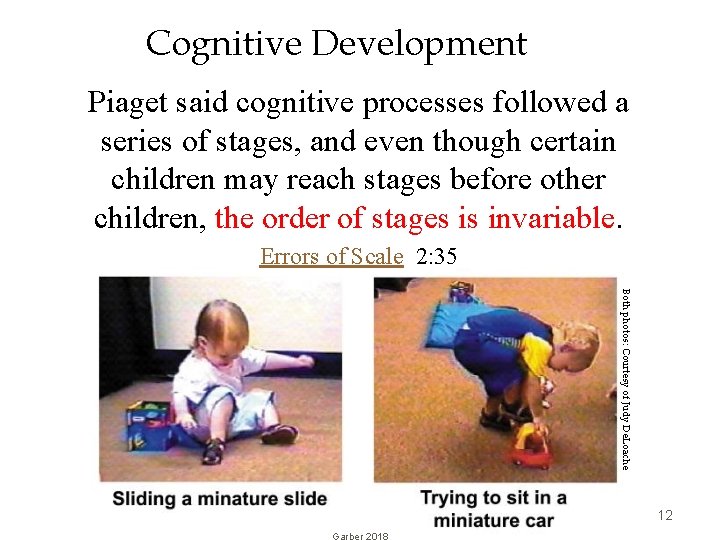
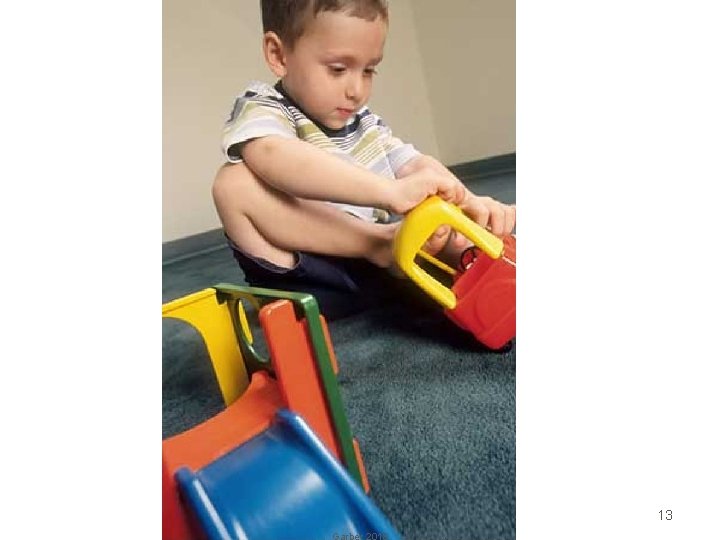
Cognitive Development Piaget said cognitive processes followed a series of stages, and even though certain children may reach stages before other children, the order of stages is invariable. Errors of Scale 2: 35 Both photos: Courtesy of Judy De. Loache 12
13
Infancy and Childhood: Cognitive Development §Schema • Generalizations that from as we experience the world. • Provide a framework for understanding future experiences. §Schema example 2: 23 14
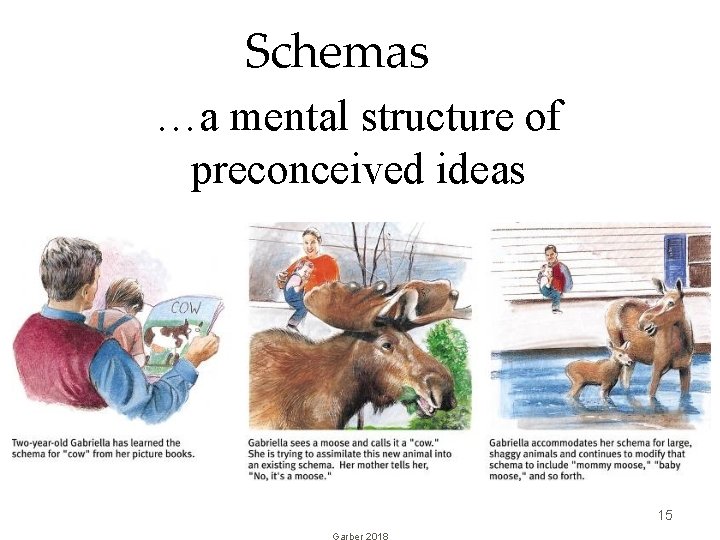
Schemas …a mental structure of preconceived ideas 15
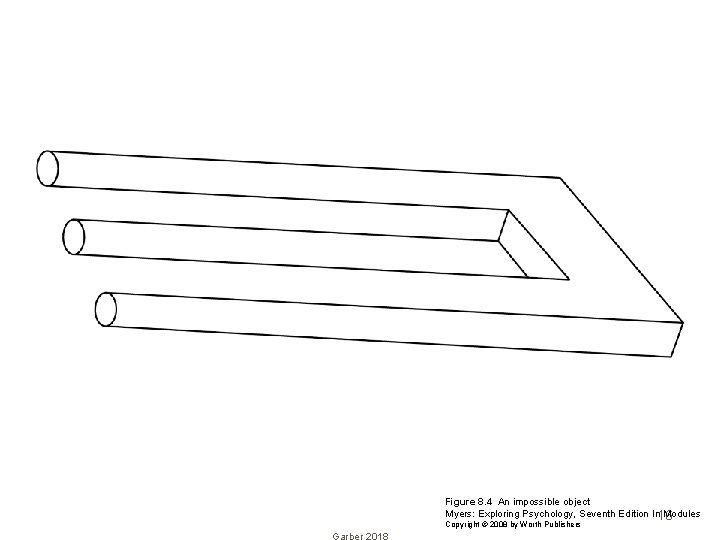
Figure 8. 4 An impossible object Myers: Exploring Psychology, Seventh Edition In 16 Modules Copyright © 2008 by Worth Publishers
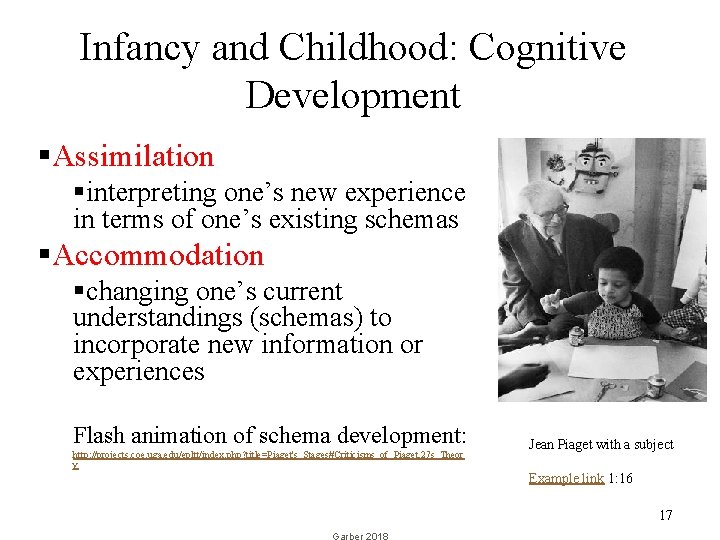
Infancy and Childhood: Cognitive Development §Assimilation §interpreting one’s new experience in terms of one’s existing schemas §Accommodation §changing one’s current understandings (schemas) to incorporate new information or experiences Flash animation of schema development: http: //projects. coe. uga. edu/epltt/index. php? title=Piaget's_Stages#Criticisms_of_Piaget. 27 s_Theor y Jean Piaget with a subject Example link 1: 16 17
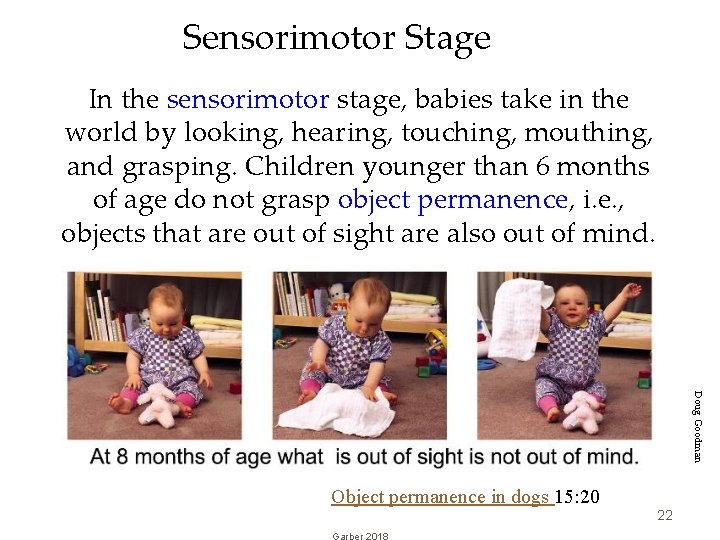
Sensorimotor Stage In the sensorimotor stage, babies take in the world by looking, hearing, touching, mouthing, and grasping. Children younger than 6 months of age do not grasp object permanence, i. e. , objects that are out of sight are also out of mind. Doug Goodman Object permanence in dogs 15: 20 22
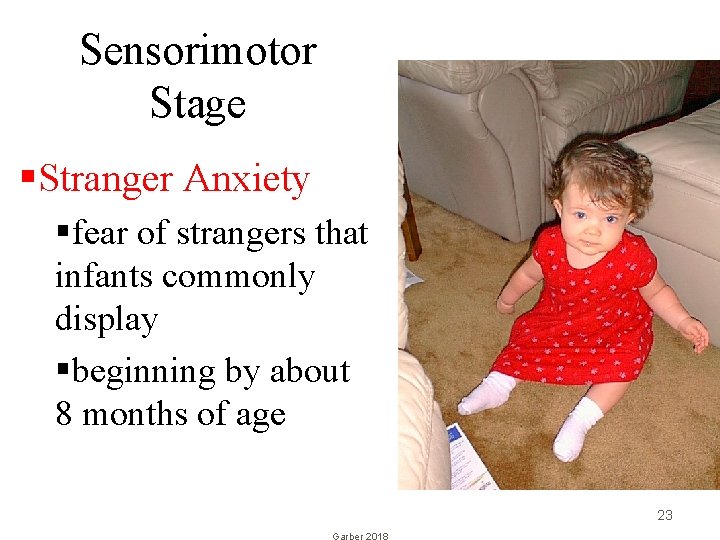
Sensorimotor Stage §Stranger Anxiety §fear of strangers that infants commonly display §beginning by about 8 months of age 23
Preoperational Stage Piaget suggested that from 2 years old to about 6 -7 years old, children are in the preoperational stage—too young to perform mental operations. 24
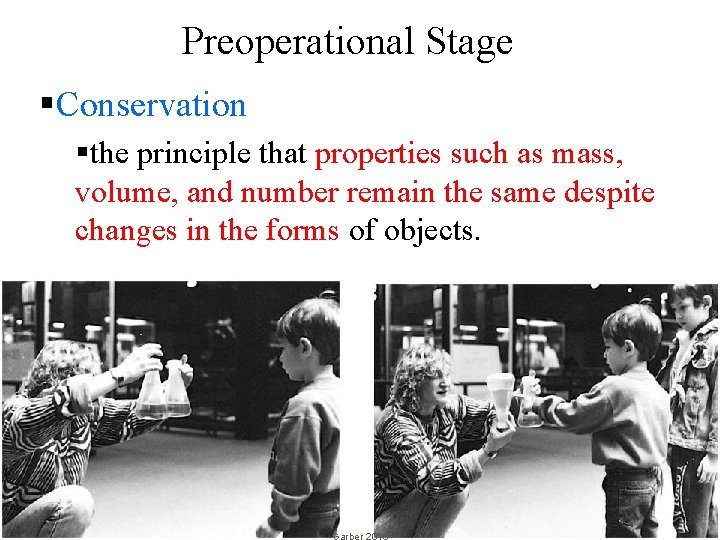
Preoperational Stage §Conservation §the principle that properties such as mass, volume, and number remain the same despite changes in the forms of objects. 25

26
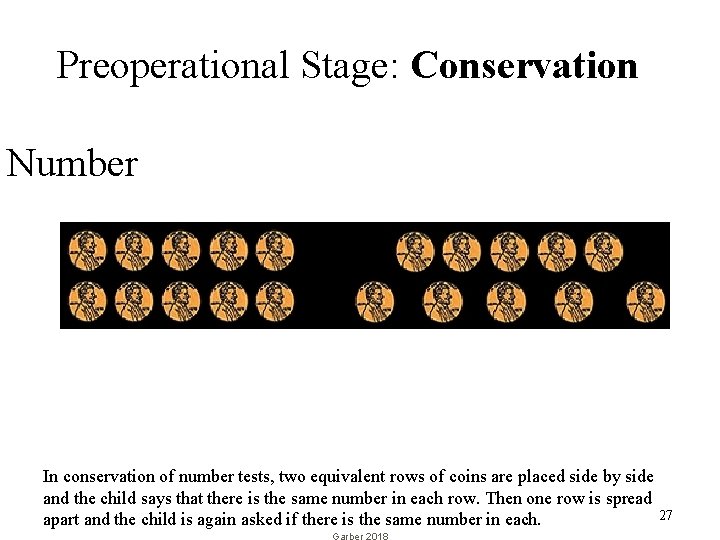
Preoperational Stage: Conservation Number In conservation of number tests, two equivalent rows of coins are placed side by side and the child says that there is the same number in each row. Then one row is spread 27 apart and the child is again asked if there is the same number in each.
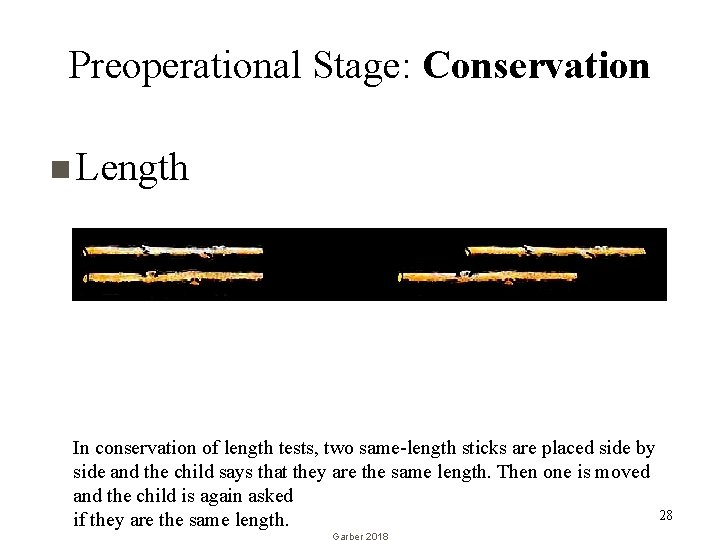
Preoperational Stage: Conservation n Length In conservation of length tests, two same-length sticks are placed side by side and the child says that they are the same length. Then one is moved and the child is again asked 28 if they are the same length.

Preoperational Stage: Conservation n Substance In conservation of substance tests, two identical amounts of clay are rolled into similar-appearing balls and the child says that they both have the same amount of clay. Then one ball is rolled out and the child is again asked if they have the 29 same amount.
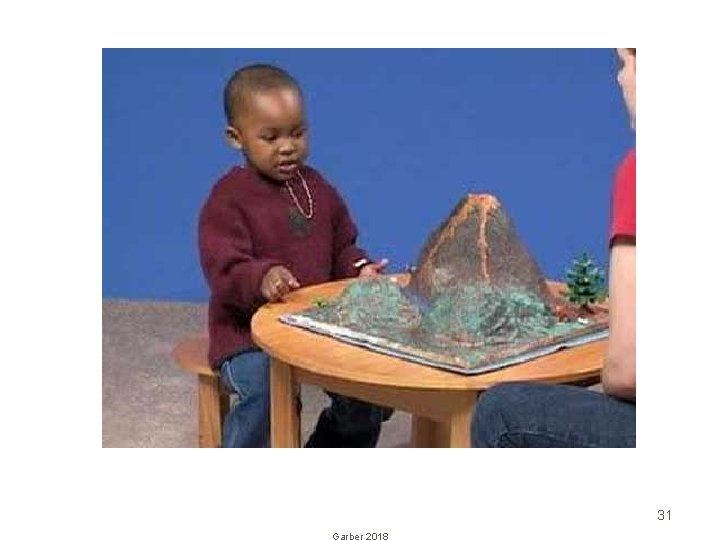
Preoperational Egocentrism Piaget concluded that preoperational children are egocentric. They cannot perceive things from another’s point of view. When asked to show her picture to mommy, 2 -yearold Gabriella holds the picture facing her own eyes, believing that her mother can see it through her eyes. 30
31
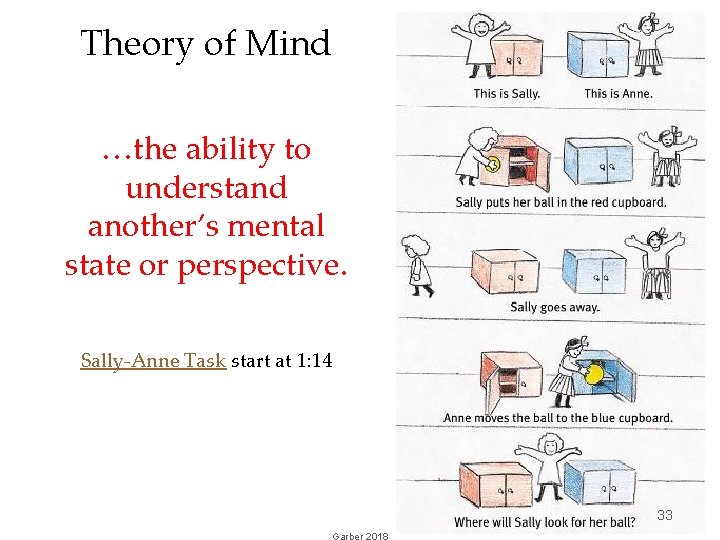
Theory of Mind …the ability to understand another’s mental state or perspective. Sally-Anne Task start at 1: 14 33
Concrete Operational Stage Given concrete materials, 6 to 7 year-olds grasp conservation problems and mentally pour liquids back and forth into glasses of different shapes conserving their quantities. Children in this stage are also able to transform mathematical functions. So, if 4 + 8 = 12, then a transformation, 12 – 4 = 8, is also easily doable. 34
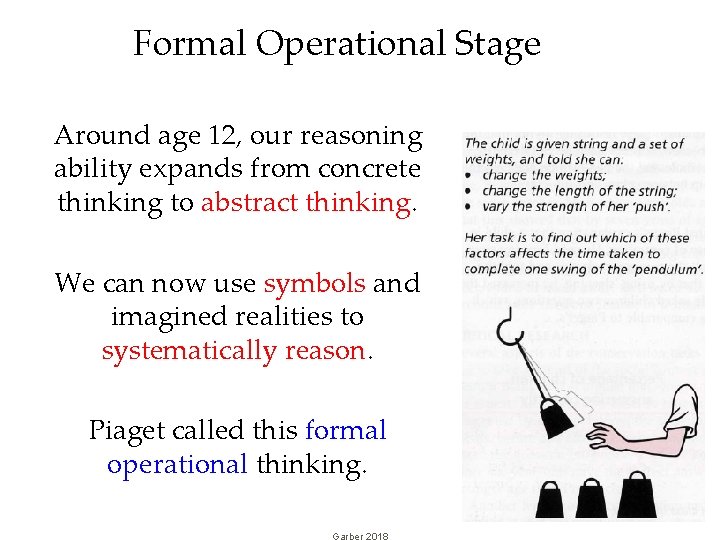
Formal Operational Stage Around age 12, our reasoning ability expands from concrete thinking to abstract thinking. We can now use symbols and imagined realities to systematically reason. Piaget called this formal operational thinking. 35
Piaget Criticisms You don’t have to write these down but they are fascinating. The gist of them is that Piaget may have underestimated children’s abilities. We have become more ingenious in the ways we “ask” them questions… 36
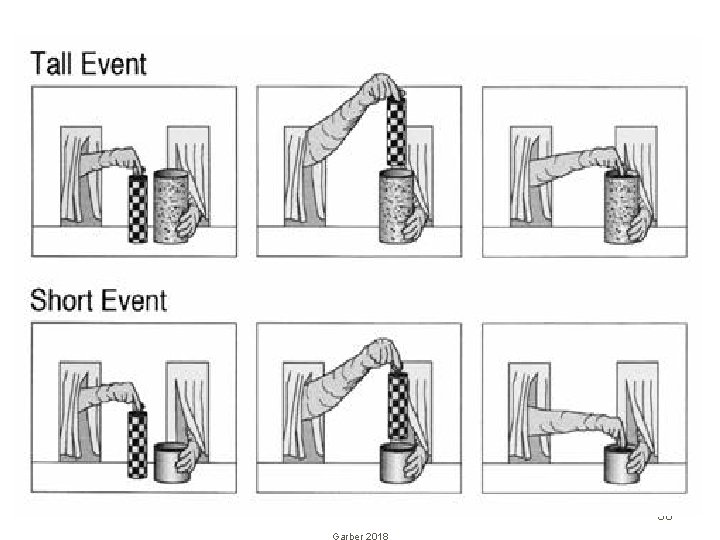
Sensorimotor Stage: Criticisms Piaget believed children in the sensorimotor stage could not think —they do not have any abstract concepts or ideas. However, recent research shows that children in the sensorimotor stage can think and count. 1. Children understand the basic laws of physics. They are amazed at how a ball can stop in midair or disappear. 37
38
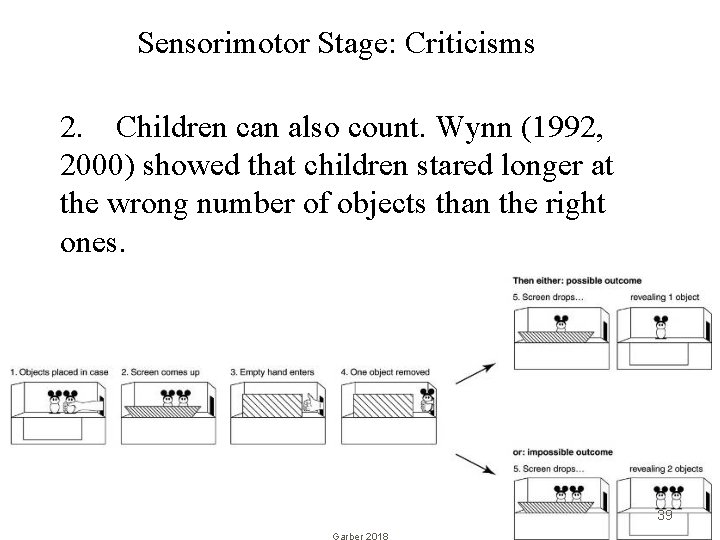
Sensorimotor Stage: Criticisms 2. Children can also count. Wynn (1992, 2000) showed that children stared longer at the wrong number of objects than the right ones. 39
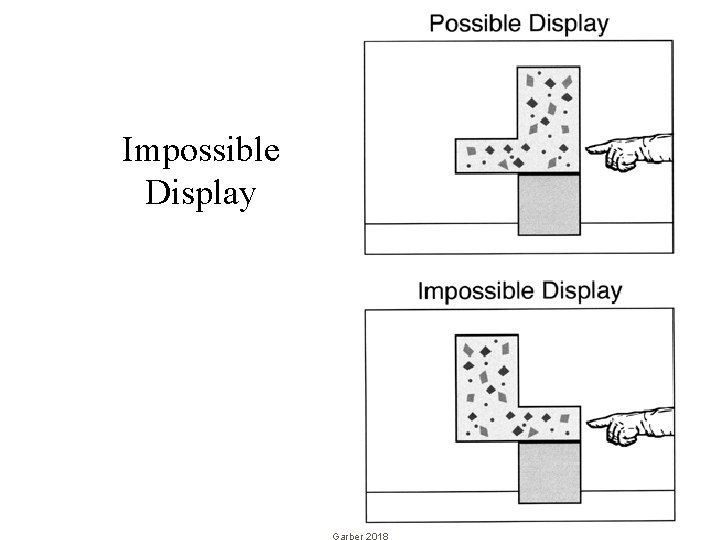
Impossible Display 40
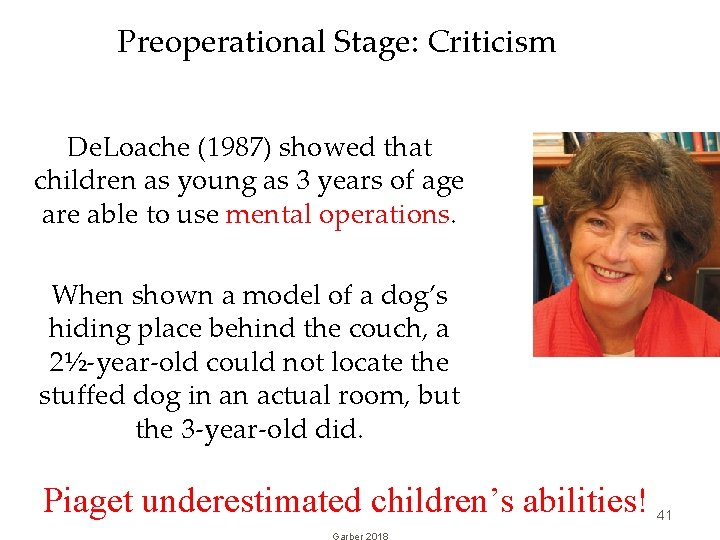
Preoperational Stage: Criticism De. Loache (1987) showed that children as young as 3 years of age are able to use mental operations. When shown a model of a dog’s hiding place behind the couch, a 2½-year-old could not locate the stuffed dog in an actual room, but the 3 -year-old did. Piaget underestimated children’s abilities! 41
Formal Operational Stage: Criticism Rudiments of such thinking begin earlier (age 7) than what Piaget suggested, since 7 -year-olds can solve this… (Suppes, 1982). If John is in school, Mary is in school. John is in school. What can you say about Mary? 43
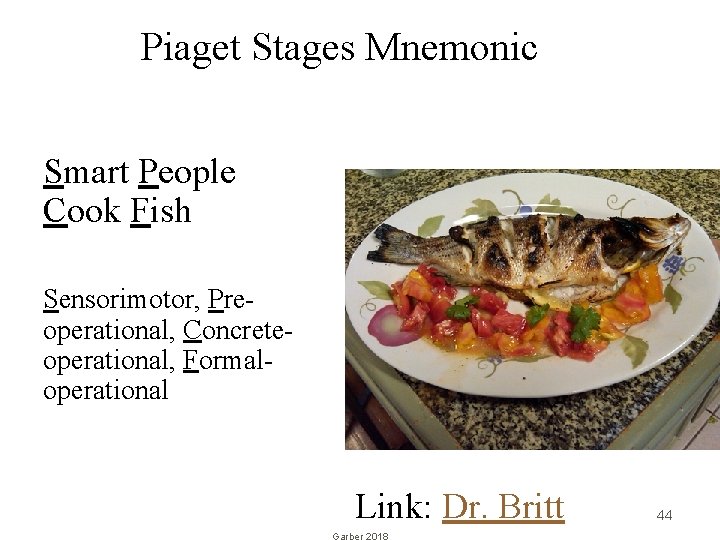
Piaget Stages Mnemonic Smart People Cook Fish Sensorimotor, Preoperational, Concreteoperational, Formaloperational Link: Dr. Britt 44
Reflecting on Piaget’s Theory Today’s researchers believe the following: 1. Development is a continuous process. 2. Children express their mental abilities and operations at an earlier age, changes between stages less consistent than Piaget thought. 3. Formal logic is a smaller part of cognition than Piaget thought. 45
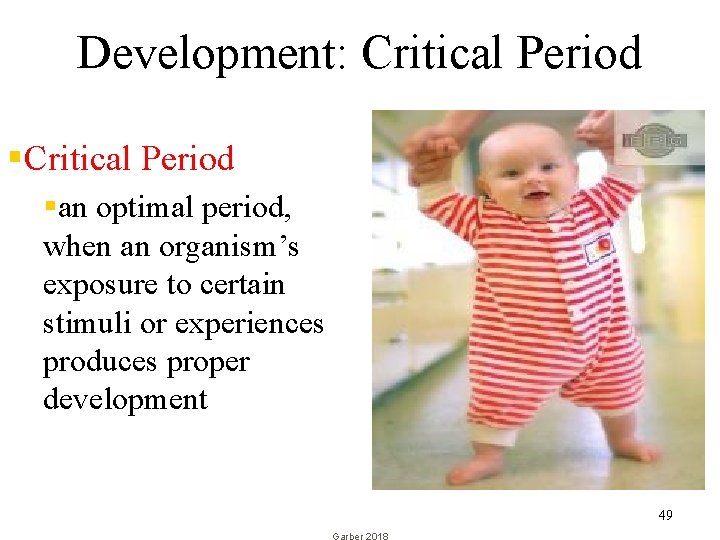
Development: Critical Period §an optimal period, when an organism’s exposure to certain stimuli or experiences produces proper development 49
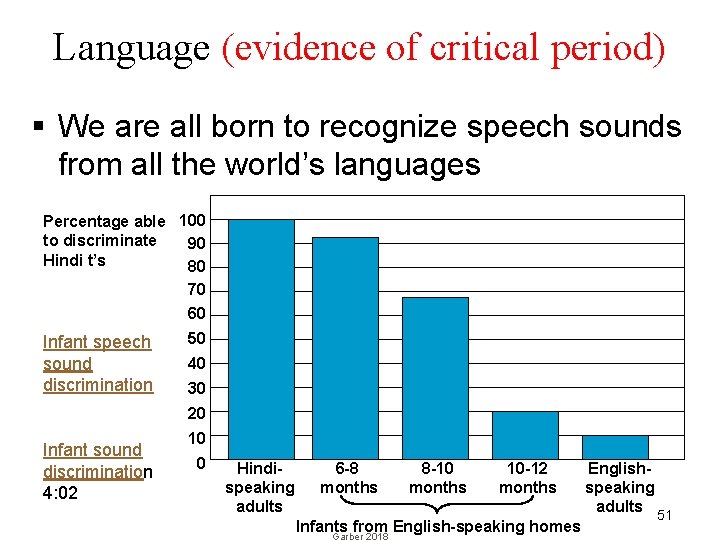
Language (evidence of critical period) § We are all born to recognize speech sounds from all the world’s languages Percentage able 100 to discriminate 90 Hindi t’s 80 70 60 Infant speech sound discrimination 50 40 30 20 Infant sound discrimination 4: 02 10 0 Hindispeaking adults 6 -8 months 8 -10 months 10 -12 months Infants from English-speaking homes Englishspeaking adults 51
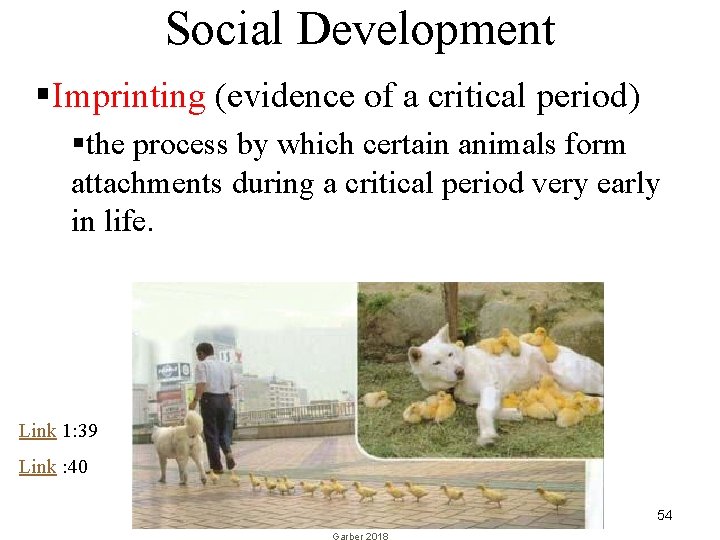
Social Development §Imprinting (evidence of a critical period) §the process by which certain animals form attachments during a critical period very early in life. Link 1: 39 Link : 40 54
Social Development: Attachment §an emotional tie with another person §shown in young children when they seek closeness to the caregiver and display distress on separation §So why do we become attached…. . 57
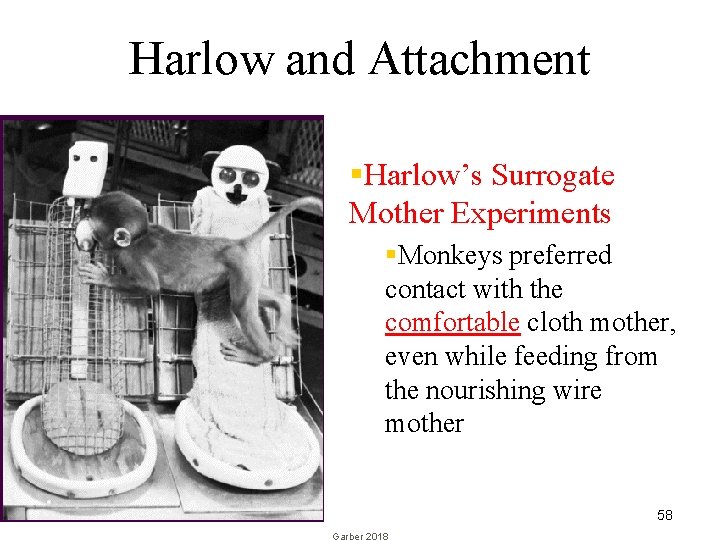
Harlow and Attachment §Harlow’s Surrogate Mother Experiments §Monkeys preferred contact with the comfortable cloth mother, even while feeding from the nourishing wire mother 58
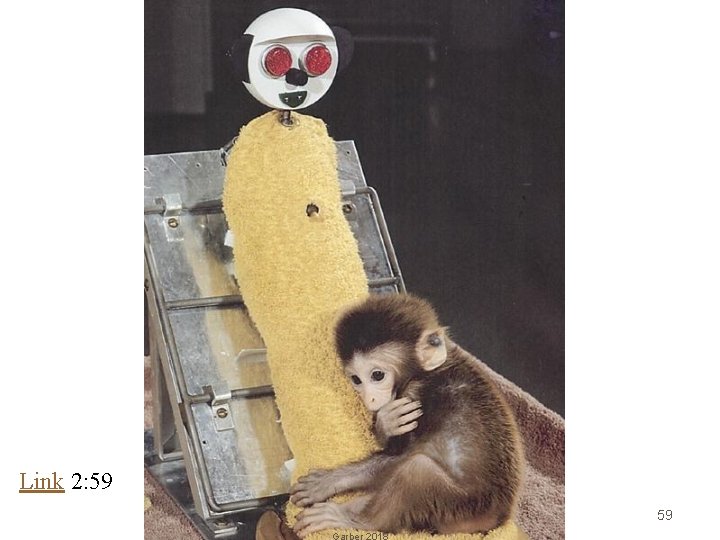
Link 2: 59 59
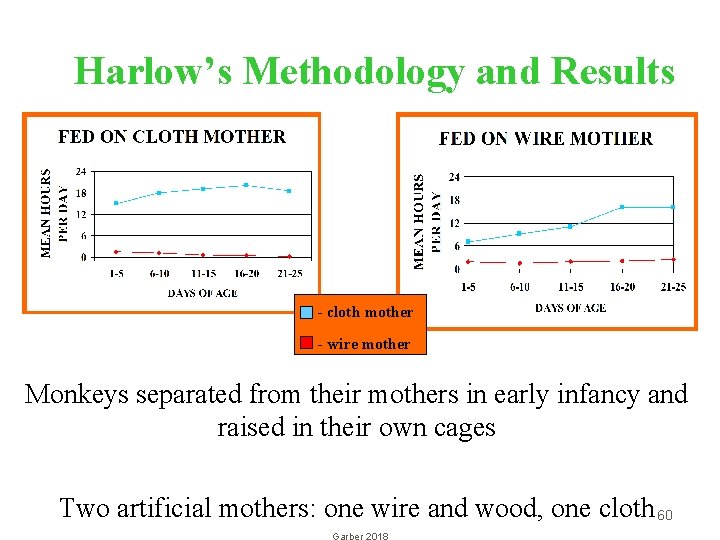
Harlow’s Methodology and Results - cloth mother - wire mother Monkeys separated from their mothers in early infancy and raised in their own cages Two artificial mothers: one wire and wood, one cloth 60
61
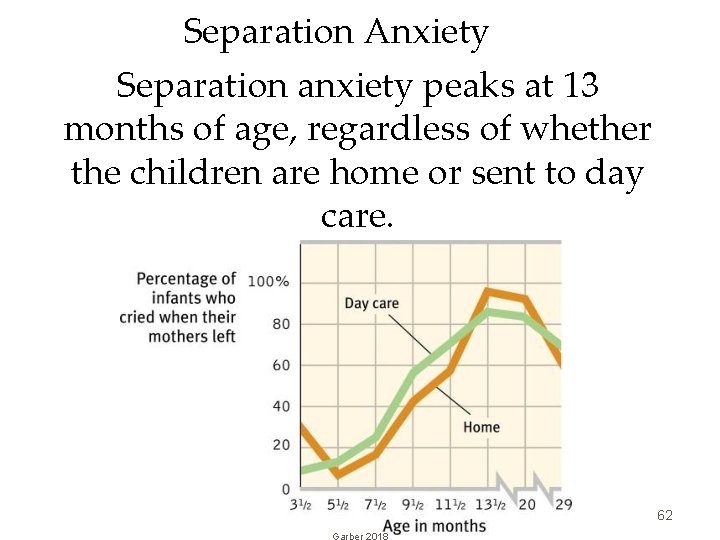
Separation Anxiety Separation anxiety peaks at 13 months of age, regardless of whether the children are home or sent to day care. 62
Attachment Mary Ainsworth – Strange situation How do the babies respond? Link 3: 15 Why do we care? Your attachment predicts your social competence! 63

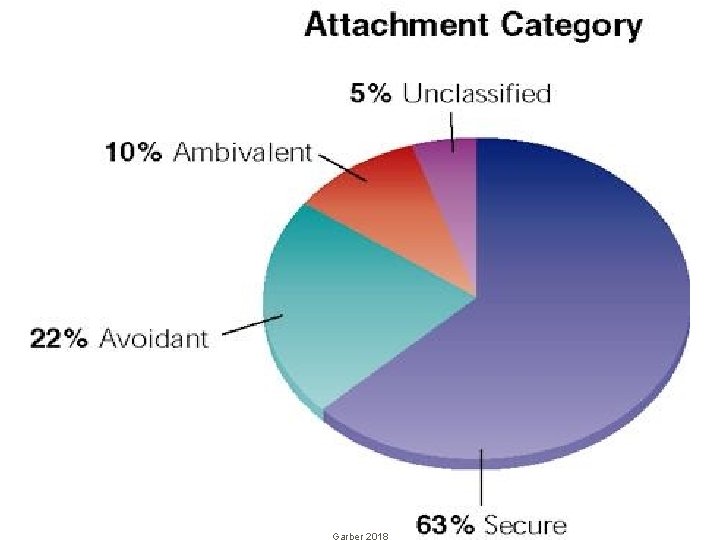
Secure Attachment Most children have secure attachment • Use mom as a home base and return periodically • Happy to see mom upon return • Most common in US. 60% …so far so good! 64
Insecure Attachment Some have insecure attachment, 30% Avoidant – avoid or ignore mother on return Ambivalent –upset when mom leaves, but vacillate between clingy and angry on return Disorganized – inconsistent, disturbed, disturbing – may reach out for mom while looking away (Moss 2004) Link 3: 38 start at 1: 58 65
66
Deprivation of Attachment In such circumstances children become: 1. Withdrawn 2. Frightened 3. Unable to develop speech Link 13: 20 Attachment Disorder 68
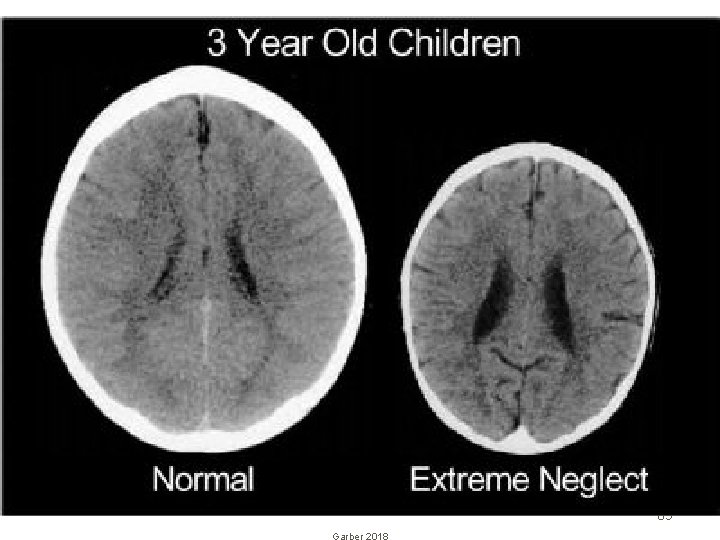
69

Your attachment could effect your sex life…wha……. …as adults they were unable to have normal sexual relations…. 70
Social Development §Basic Trust (Erikson) §a sense that the world is predictable and trustworthy §Self-Concept §a sense of one’s identity and personal worth 71
Social Development: Parenting Styles §Authoritarian §parents impose rules and expect obedience §“Don’t interrupt. ” “Why? Because I said so. ” §Permissive §submit to children’s desires, make few demands, use little punishment §Authoritative (the best one) §both demanding and responsive §set rules, but explain reasons and encourage open discussion §Rejecting-Neglecting §completely uninvolved; disengaged. Expect little and invest little 72
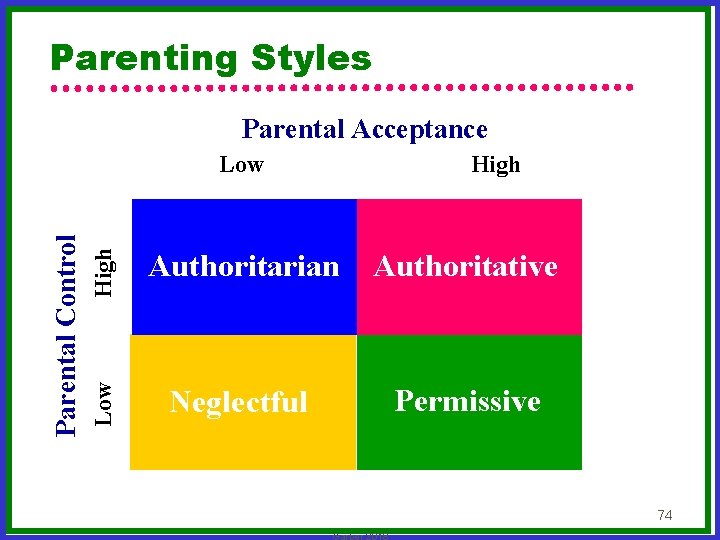
Parenting Styles Parental Acceptance High Authoritarian Authoritative Low Parental Control Low Neglectful Permissive 74
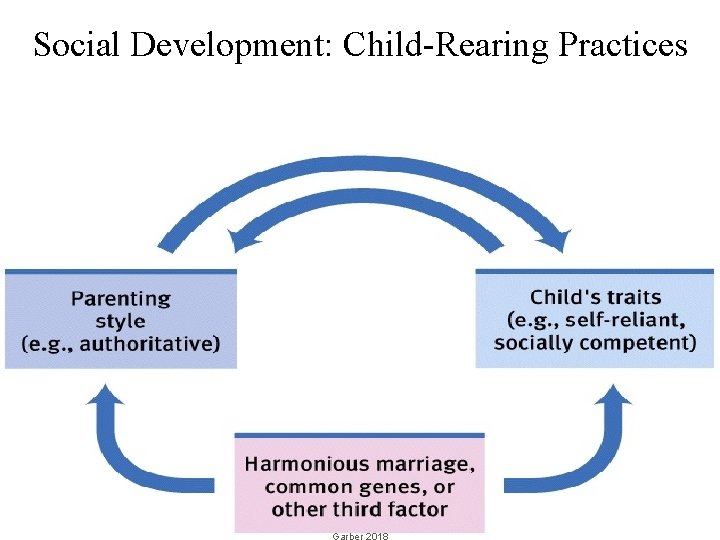
Social Development: Child-Rearing Practices 75

76

End 77
Preview Question Which of the following is typically cited as a characteristic of autistic children? A) Minor developmental delays in academic achievement B) Above-average performance on tests of creativity C) Severely impaired interpersonal communication D) Tendency to seek younger playmates E) Paranoia comparable with that experienced in schizophrenia
Preview Question Which of the following is typically cited as a characteristic of autistic children? A) Minor developmental delays in academic achievement B) Above-average performance on tests of creativity C) Severely impaired interpersonal communication D) Tendency to seek younger playmates E) Paranoia comparable with that experienced in schizophrenia
Preview Question Preschoolers often have trouble buttoning shirts due to less-developed (A) visual acuity (B) fine motor skills (C) balance (D) gross motor skills (E) hemispheric specialization
Preview Question Preschoolers often have trouble buttoning shirts due to less-developed (A) visual acuity (B) fine motor skills (C) balance (D) gross motor skills (E) hemispheric specialization
Preview Question A researcher dabs color on a 16 -month-old child’s face and places the child in front of a mirror. Which of the following developmental milestones has been reached if the child realizes that there is something wrong with its face? (A) Visual discrimination (B) Recognition of a human form (C) Recognition of self (D) Identification of the gender of the image (E) Perception of the image as a playmate
Preview Question A researcher dabs color on a 16 -month-old child’s face and places the child in front of a mirror. Which of the following developmental milestones has been reached if the child realizes that there is something wrong with its face? (A) Visual discrimination (B) Recognition of a human form (C) Recognition of self (D) Identification of the gender of the image (E) Perception of the image as a playmate
Preview Question Which of the following is typically cited as a characteristic of autistic children? (A) Minor developmental delays in academic achievement (B) Above-average performance on tests of creativity (C) Severely impaired interpersonal communication (D) Tendency to seek younger playmates (E) Paranoia comparable with that experienced in schizophrenia
Preview Question Which of the following is typically cited as a characteristic of autistic children? (A) Minor developmental delays in academic achievement (B) Above-average performance on tests of creativity (C) Severely impaired interpersonal communication (D) Tendency to seek younger playmates (E) Paranoia comparable with that experienced in schizophrenia

Preview Question A schema can be described as (A) An outer layer of the eye (B) A mental construct (C) A fissure between lobes of the brain (D) An optical illusion (E) A fixed response to a particular stimulus

Preview Question A schema can be described as (A) An outer layer of the eye (B) A mental construct (C) A fissure between lobes of the brain (D) An optical illusion (E) A fixed response to a particular stimulus
Preview Question In Jean Piaget’s theory of cognitive development, which of the following best exemplifies the concept of accommodation? (A) A newborn touched lightly on the right cheek turns his head to the right. (B) An infant reaches out toward the moon as if to grasp it. (C) An infant stops reaching for a toy as soon as it is covered by a cloth. (D) An infant acquires a fear of heights after learning to crawl. (E) An infant trying unsuccessfully to suck her fist opens her mouth wider and is successful.
Preview Question In Jean Piaget’s theory of cognitive development, which of the following best exemplifies the concept of accommodation? (A) A newborn touched lightly on the right cheek turns his head to the right. (B) An infant reaches out toward the moon as if to grasp it. (C) An infant stops reaching for a toy as soon as it is covered by a cloth. (D) An infant acquires a fear of heights after learning to crawl. (E) An infant trying unsuccessfully to suck her fist opens her mouth wider and is successful.
Preview Question Hypothetical and deductive thinking are characteristic of which of Jean Piaget’s stages of cognitive development? (A) Preoperational (B) Operational (C) Conservation (D) Concrete operations (E) Formal operations
Preview Question Hypothetical and deductive thinking are characteristic of which of Jean Piaget’s stages of cognitive development? (A) Preoperational (B) Operational (C) Conservation (D) Concrete operations (E) Formal operations
Preview Question A baby looks under the sofa for a ball that has just rolled underneath it. According to Jean Piaget, the baby's action shows development of (A) conservation of mass (B) Reversibility (C) Object permanence (D) Logical thinking (E) Metacognition
Preview Question A baby looks under the sofa for a ball that has just rolled underneath it. According to Jean Piaget, the baby's action shows development of (A) conservation of mass (B) Reversibility (C) Object permanence (D) Logical thinking (E) Metacognition

Preview Question Understanding that things continue to exists even when they are not within view is called A. mental representation B deep structure C a schema D. object permanence E. assimilation

Preview Question Understanding that things continue to exists even when they are not within view is called A. mental representation B deep structure C a schema D. object permanence E. assimilation
Preview Question Which developmental milestone must be reached before an infant experiences separation anxiety? (A) Imprinting (B) Theory of mind (C) Conservation (D) Egocentrism (E) Object permanence

Preview Question Which developmental milestone must be reached before an infant experiences separation anxiety? (A) Imprinting (B) Theory of mind (C) Conservation (D) Egocentrism (E) Object permanence
Preview Question When ten-month-old Frances throws her toy out of sight, she looks to see where it falls. Developmental psychologists would say that Frances’ behavior indicates that she has developed (A) centration (B) conservation (C) egocentrism (D) object permanence (E) Accommodation
Preview Question When ten-month-old Frances throws her toy out of sight, she looks to see where it falls. Developmental psychologists would say that Frances’ behavior indicates that she has developed (A) centration (B) conservation (C) egocentrism (D) object permanence (E) Accommodation
Preview Question Thea is in a clothing store with her mother. A man walks by and passes behind a clothing rack. Thea looks for him on the other side of the rack. Her behavior shows she has developed (A) conservation (B) egocentrism (C) object permanence (D) size constancy (E) decentration
Preview Question Thea is in a clothing store with her mother. A man walks by and passes behind a clothing rack. Thea looks for him on the other side of the rack. Her behavior shows she has developed (A) conservation (B) egocentrism (C) object permanence (D) size constancy (E) decentration
Preview Question Egocentrism, animism, and artificialism are characteristic of which of Jean Piaget’s stages of cognitive development? A. Sensorimotor B. Preoperational C. Postformal D. Concrete Operational E. Formal operations

Preview Question Egocentrism, animism, and artificialism are characteristic of which of Jean Piaget’s stages of cognitive development? A. Sensorimotor B. Preoperational C. Postformal D. Concrete Operational E. Formal operations
Preview Questions Which Piagetian stage of cognitive development is characterized by mastery of conversation tasks? (A) Sensorimotor (B) Preoperational (C) Concrete operations (D) Formal operations (E) Tertiary circular reactions
Preview Questions Which Piagetian stage of cognitive development is characterized by mastery of conversation tasks? (A) Sensorimotor (B) Preoperational (C) Concrete operations (D) Formal operations (E) Tertiary circular reactions
Preview Questions A young child shown a nine inch round bowl and a six inch round bowl containing equal amounts of popcorn says he is certain the smaller bowl has more popcorn than the larger bowl. This child has yet to acquire what Jean Piaget called A. object permanence B. equilibrium C. functional fixedness D. conservation E. circular reactions
Preview Questions A young child shown a nine inch round bowl and a six inch round bowl containing equal amounts of popcorn says he is certain the smaller bowl has more popcorn than the larger bowl. This child has yet to acquire what Jean Piaget called A. object permanence B. equilibrium C. functional fixedness D. conservation E. circular reactions
Preview Question According to Jean Piaget, what is the earliest stage at which a child is capable of using simple logic to think about objects and events? (A) Sensorimotor (B) Preoperational (C) Symbolic (D) Concrete operational (E) Formal operational
Preview Question According to Jean Piaget, what is the earliest stage at which a child is capable of using simple logic to think about objects and events? (A) Sensorimotor (B) Preoperational (C) Symbolic (D) Concrete operational (E) Formal operational
Preview Question Which Piagetian stage of cognitive development is characterized by mastery of conversation tasks? (A) Sensorimotor (B) Preoperational (C) Concrete operations (D) Formal operations (E) Tertiary circular reactions
Preview Question Which Piagetian stage of cognitive development is characterized by mastery of conversation tasks? (A) Sensorimotor (B) Preoperational (C) Concrete operations (D) Formal operations (E) Tertiary circular reactions
Preview Question Modern research on Jean Piaget’s stages of cognitive development indicates that (A) Piaget underestimated children’s abilities (B) Piaget overestimated children’s abilities (C) Piaget accurately reported children’s abilities (D) the order of Piaget’s stages is correct for boys only (E) the order of Piaget’s stages is correct for girls only
Preview Question Modern research on Jean Piaget’s stages of cognitive development indicates that (A) Piaget underestimated children’s abilities (B) Piaget overestimated children’s abilities (C) Piaget accurately reported children’s abilities (D) the order of Piaget’s stages is correct for boys only (E) the order of Piaget’s stages is correct for girls only
Preview Question The fact that imprinting is most certain to occur if the opportunity for imprinting is presented to the organism at a very specific age indicates the existence of (A) a schema (B) a reflex (C) an archetype (D) a critical period (E) an unconscious inference
Preview Question The fact that imprinting is most certain to occur if the opportunity for imprinting is presented to the organism at a very specific age indicates the existence of (A) a schema (B) a reflex (C) an archetype (D) a critical period (E) an unconscious inference
Preview Question The fact that imprinting is most certain to occur if the opportunity for imprinting is presented to the organism at a very specific age indicates the existence of (A) a schema (B) a reflex (C) an archetype (D) a critical period (E) an unconscious inference
Preview Question The fact that imprinting is most certain to occur if the opportunity for imprinting is presented to the organism at a very specific age indicates the existence of (A) a schema (B) a reflex (C) an archetype (D) a critical period (E) an unconscious inference
Preview Question Harry Harlow’s experiments with rhesus monkeys suggest which of the following as most important for infants when establishing an attachment to their mothers? A. The amount of time spent with the mother B. The mother’s ability to protect the infant from physical harm C. The mother’s ability to provide nourishment to the infant D. The tactile characteristics of the mother E. The particular vocalization of the mother
Preview Question Harry Harlow’s experiments with rhesus monkeys suggest which of the following as most important for infants when establishing an attachment to their mothers? A. The amount of time spent with the mother B. The mother’s ability to protect the infant from physical harm C. The mother’s ability to provide nourishment to the infant D. The tactile characteristics of the mother E. The particular vocalization of the mother
Preview Question The results of Harry Harlow’s experiments with infant monkeys and surrogate mothers show that (A) contact comfort was the primary basis of attachment for the infant monkeys (B) female infant monkeys are more independent than male infant monkeys (C) female infant monkeys are more obedient than male infant monkeys (D) food outranked all other factors In the development of the infant monkeys’ attachment to the mother (E) infant monkeys mimic the surrogate mothers’ behavior
Preview Question The results of Harry Harlow’s experiments with infant monkeys and surrogate mothers show that (A) contact comfort was the primary basis of attachment for the infant monkeys (B) female infant monkeys are more independent than male infant monkeys (C) female infant monkeys are more obedient than male infant monkeys (D) food outranked all other factors In the development of the infant monkeys’ attachment to the mother (E) infant monkeys mimic the surrogate mothers’ behavior
Preview Question Mary Ainsworth's Strange Situation paradigm is typically used to test young children's (A) Ego strength (B) Intelligence (C) Reaction time (D) Attachment (E) Incidental learning
Preview Question Mary Ainsworth's Strange Situation paradigm is typically used to test young children's (A) Ego strength (B) Intelligence (C) Reaction time (D) Attachment (E) Incidental learning
Preview Question In Mary Ainsworth’s Strange Situation experiment, infants who were classified as securely attached were more likely to (A) have a tantrum when the mother left the room (B) express happiness when the mother returned to the room (C) prevent the mother from leaving the room (D) try to play with the stranger when the mother left the room (E) notice when the mother returned to the room
Preview Question In Mary Ainsworth’s Strange Situation experiment, infants who were classified as securely attached were more likely to (A) have a tantrum when the mother left the room (B) express happiness when the mother returned to the room (C) prevent the mother from leaving the room (D) try to play with the stranger when the mother left the room (E) notice when the mother returned to the room
Preview Question Mary Ainsworth’s research indicates that a toddler with a secure attachment style is most likely to do which of the following when left with a caregiver, such as a babysitter, for the first time? (A) Show distress when left, calm down and play, and run to the mother when she returns (B) Cry when left and continue to cry until the mother returns (C) Not notice when the mother leaves and not seek attention from the mother when she returns (D) Play happily when the mother leaves but exhibit anger and rejection toward the mother when she returns (E) Show distress when the mother leaves and not seek attention when the mother returns
Preview Question Mary Ainsworth’s research indicates that a toddler with a secure attachment style is most likely to do which of the following when left with a caregiver, such as a babysitter, for the first time? (A) Show distress when left, calm down and play, and run to the mother when she returns (B) Cry when left and continue to cry until the mother returns (C) Not notice when the mother leaves and not seek attention from the mother when she returns (D) Play happily when the mother leaves but exhibit anger and rejection toward the mother when she returns (E) Show distress when the mother leaves and not seek attention when the mother returns
Preview Question Jeremy happily played with his colorful blocks while his mother was nearby. When his mother left the room, he became upset, but he quickly stopped crying and began to play with the blocks again. When his mother returned, he greeted her happily. Which of the following patterns of attachment reflects Jeremy’s actions? (A) Avoidant (B) Anxious ambivalent (C) Resistant (D) Secure (E) Disorganized disoriented
Preview Question Jeremy happily played with his colorful blocks while his mother was nearby. When his mother left the room, he became upset, but he quickly stopped crying and began to play with the blocks again. When his mother returned, he greeted her happily. Which of the following patterns of attachment reflects Jeremy’s actions? (A) Avoidant (B) Anxious ambivalent (C) Resistant (D) Secure (E) Disorganized disoriented
Preview Question A 14 -month-old toddler is placed in an unfamiliar situation with the child’s mother, who then leaves the room for a time. When the mother returns, the child squirms and tries to get away from the mother when picked up, but also seems distressed when placed back on the floor. Mary Ainsworth would consider this evidence of which of the following? (A) Hyperactivity (B) Narcissistic personality type (C) A resistant or ambivalent attachment style (D) Disorganized behavior (E) Avoidance
Preview Question A 14 -month-old toddler is placed in an unfamiliar situation with the child’s mother, who then leaves the room for a time. When the mother returns, the child squirms and tries to get away from the mother when picked up, but also seems distressed when placed back on the floor. Mary Ainsworth would consider this evidence of which of the following? (A) Hyperactivity (B) Narcissistic personality type (C) A resistant or ambivalent attachment style (D) Disorganized behavior (E) Avoidance
Preview Question Developmental research on the formation of attachment indicates that a child’s secure attachment to its mother during infancy is predictive of which of the following during its toddler years? A. Social Rejection B. Impulsive behavior C. Social competence D. Divergent thinking E. Shyness
Preview Question Developmental research on the formation of attachment indicates that a child’s secure attachment to its mother during infancy is predictive of which of the following during its toddler years? A. Social Rejection B. Impulsive behavior C. Social competence D. Divergent thinking E. Shyness
Preview Question Which parenting style is characterized by high demands for obedience and low warmth? (A) Permissive (B) Authoritarian (C) Authoritative (D) Neglectful (E) Indulgent
Preview Question Which parenting style is characterized by high demands for obedience and low warmth? (A) Permissive (B) Authoritarian (C) Authoritative (D) Neglectful (E) Indulgent
Preview Question The most well-adjusted and socially competent chi 1 dren tend to come from homes where parents employ which of the following parental styles? (A) Minimal supervision (B) Authoritarian (C) Authoritative (D) Indulgent (E) Permissive
Preview Question The most well-adjusted and socially competent chi 1 dren tend to come from homes where parents employ which of the following parental styles? (A) Minimal supervision (B) Authoritarian (C) Authoritative (D) Indulgent (E) Permissive
Preview Question Psychologists characterize parents who consistently demand their children’s compliance without discussion as (A) indifferent (B) permissive (C) indulgent (D) authoritative (E) Authoritarian
Preview Question Psychologists characterize parents who consistently demand their children’s compliance without discussion as (A) indifferent (B) permissive (C) indulgent (D) authoritative (E) Authoritarian
Preview Question Darien’s father dictated who Darien’s friends should be and what classes he should take, and he set an extremely early curfew. If Darien went against his father’s wishes, the repercussions were harsh and swift. What type of parenting did Darien experience? (A) Permissive (B) Rejecting-neglecting (C) Authoritative (D) Authoritarian (E) Self-regulation
Preview Question Darien’s father dictated who Darien’s friends should be and what classes he should take, and he set an extremely early curfew. If Darien went against his father’s wishes, the repercussions were harsh and swift. What type of parenting did Darien experience? (A) Permissive (B) Rejecting-neglecting (C) Authoritative (D) Authoritarian (E) Self-regulation
- Slides: 125