
INF 5120 and INF 9120 Modelbased System development
INF 5120 and INF 9120 ”Modelbased System development” Lecture 2: 26. 01. 2015 Arne-Jørgen Berre arneb@ifi. uio. no and Arne. J. Berre@sintef. no Telecom and Informatics 1
This Lecture, January 26, 2015 Business Model Innovation – Business Model Canvas and Value Proposition Canvas n Business Model Canvas – Osterwalder/Strategyzer. com n Guest lecture, Bjørn Haugland, CEO, Symphonical, The Symphonical environment n Introduction to OBLIGS 1 and 2, "Sense. IT" company with Mobile Apps for Bluetooth connected UV sensor etc. Telecom and Informatics 2
INF 5120 - Lecture plan - 2015 n n n n n 1 (19/1): Introduction – MDA principles, class models, EA, BAE, SAE, MDE 2 (26/1): BAE-1: BM, VDML, BMC/VPC, – Strategyzer, Oblig 1&2 intro, establish groups Guest lecture, Prof. Peter Lindgren, Aarhus University, Sensing Business Model 3: (2/2): MDE-1 Method Engineering, Essence, Process/Practices, Agile/Lean – Symphonical Guest lecture, Bjørn Haugland, CEO, Symphonical, The Symphonical environment 4 (9/2): BAE-2: EA, BPMN, VDML, Class/Term models- Magic. Draw and Cameo Enterprise 5 (16/2): BAE-3: Service Design – Smaply Guest lecture, Ragnhild Halvorsrud, SINTEF, Visual Service Design language 6 (23/2): BAE-4: User experience and UI Design – Balsamiq 7 (2/3): BAE-5: Agile user stories and use cases – Symphonical/MD&Cameo 8 (9/3): SAE-1 IFML and Webratio and Mobile App development, Oblig 2 intro 9 (16/3): SAE-2 Domain/information modeling – more IFML – Server development, Oblig 1 delivery and presentations 10(23/3): MDE-2 Metamodels, EMF EASTER 11(13/4): MDE-3 Graphical Editors – Sirius Oblig 2 delivery and presentations 12(20/4): MDE-4 Model transformations 13(27/4): SAE-3 Non functional requirements 14(4/5): SAE-4 Service modeling - Oblig 3 delivery and presentations 15(11/5): MDE-5: EA and DSL examples – future MDE 16(18/5): Conclusion – preparation for the exam Telecom and Informatics 3
Next Lecture, February 2, 2015 MDE-1 Method Engineering, Essence, Process/Practices, Agile/Lean – Symphonical n Guest Lecture – Prof. Dr. Peter Lindgren, Aarhus University – on Business Model Cube and Sensing Business Models n Discussion of OBLIGS 1 and 2 Telecom and Informatics 4
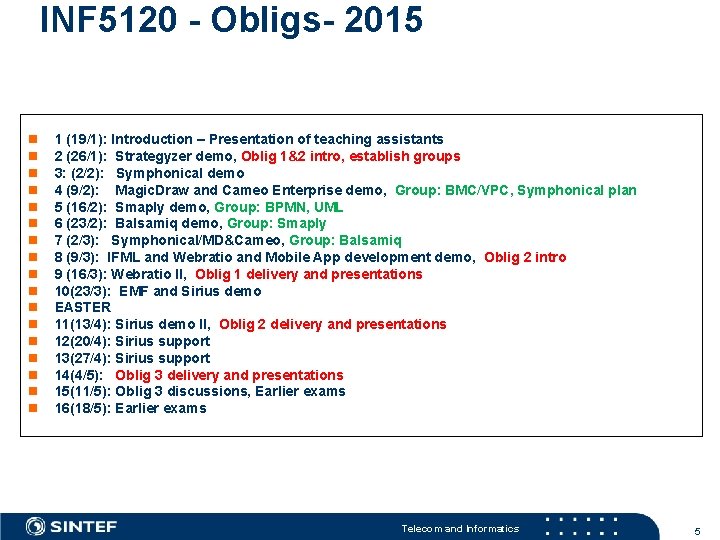
INF 5120 - Obligs- 2015 n n n n n 1 (19/1): Introduction – Presentation of teaching assistants 2 (26/1): Strategyzer demo, Oblig 1&2 intro, establish groups 3: (2/2): Symphonical demo 4 (9/2): Magic. Draw and Cameo Enterprise demo, Group: BMC/VPC, Symphonical plan 5 (16/2): Smaply demo, Group: BPMN, UML 6 (23/2): Balsamiq demo, Group: Smaply 7 (2/3): Symphonical/MD&Cameo, Group: Balsamiq 8 (9/3): IFML and Webratio and Mobile App development demo, Oblig 2 intro 9 (16/3): Webratio II, Oblig 1 delivery and presentations 10(23/3): EMF and Sirius demo EASTER 11(13/4): Sirius demo II, Oblig 2 delivery and presentations 12(20/4): Sirius support 13(27/4): Sirius support 14(4/5): Oblig 3 delivery and presentations 15(11/5): Oblig 3 discussions, Earlier exams 16(18/5): Earlier exams Telecom and Informatics 5
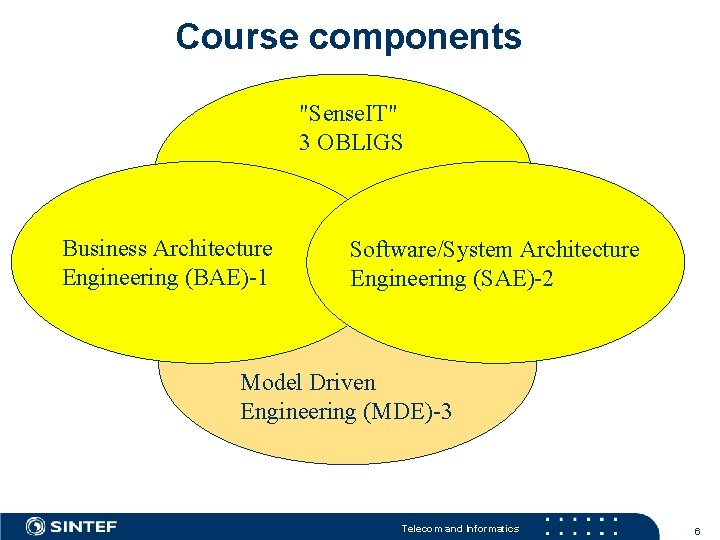
Course components "Sense. IT" 3 OBLIGS Business Architecture Engineering (BAE)-1 Software/System Architecture Engineering (SAE)-2 Model Driven Engineering (MDE)-3 Telecom and Informatics 6
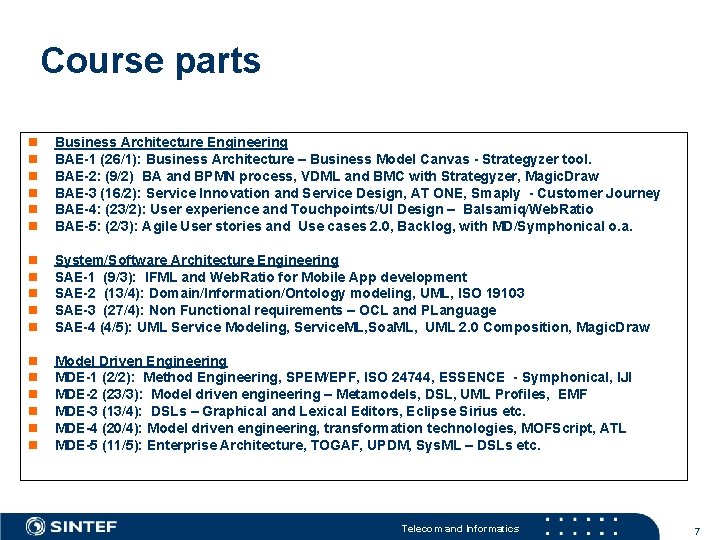
Course parts n n n Business Architecture Engineering BAE-1 (26/1): Business Architecture – Business Model Canvas - Strategyzer tool. BAE-2: (9/2) BA and BPMN process, VDML and BMC with Strategyzer, Magic. Draw BAE-3 (16/2): Service Innovation and Service Design, AT ONE, Smaply - Customer Journey BAE-4: (23/2): User experience and Touchpoints/UI Design – Balsamiq/Web. Ratio BAE-5: (2/3): Agile User stories and Use cases 2. 0, Backlog, with MD/Symphonical o. a. n n n System/Software Architecture Engineering SAE-1 (9/3): IFML and Web. Ratio for Mobile App development SAE-2 (13/4): Domain/Information/Ontology modeling, UML, ISO 19103 SAE-3 (27/4): Non Functional requirements – OCL and PLanguage SAE-4 (4/5): UML Service Modeling, Service. ML, Soa. ML, UML 2. 0 Composition, Magic. Draw n n n Model Driven Engineering MDE-1 (2/2): Method Engineering, SPEM/EPF, ISO 24744, ESSENCE - Symphonical, IJI MDE-2 (23/3): Model driven engineering – Metamodels, DSL, UML Profiles, EMF MDE-3 (13/4): DSLs – Graphical and Lexical Editors, Eclipse Sirius etc. MDE-4 (20/4): Model driven engineering, transformation technologies, MOFScript, ATL MDE-5 (11/5): Enterprise Architecture, TOGAF, UPDM, Sys. ML – DSLs etc. Telecom and Informatics 7
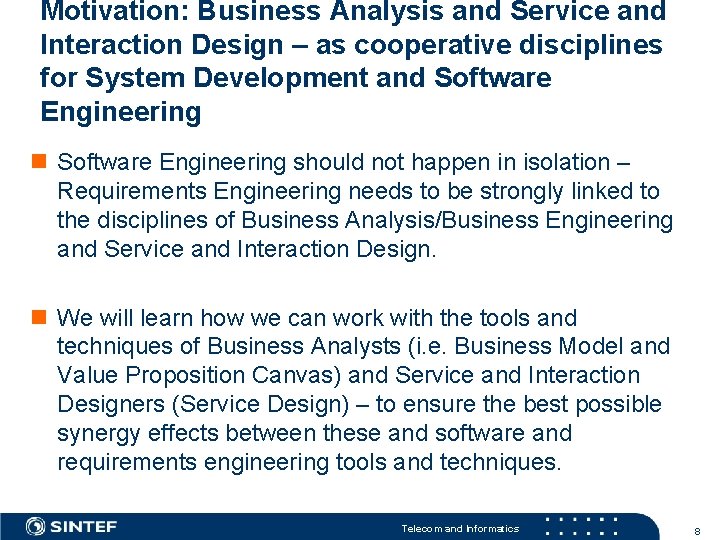
Motivation: Business Analysis and Service and Interaction Design – as cooperative disciplines for System Development and Software Engineering n Software Engineering should not happen in isolation – Requirements Engineering needs to be strongly linked to the disciplines of Business Analysis/Business Engineering and Service and Interaction Design. n We will learn how we can work with the tools and techniques of Business Analysts (i. e. Business Model and Value Proposition Canvas) and Service and Interaction Designers (Service Design) – to ensure the best possible synergy effects between these and software and requirements engineering tools and techniques. Telecom and Informatics 8
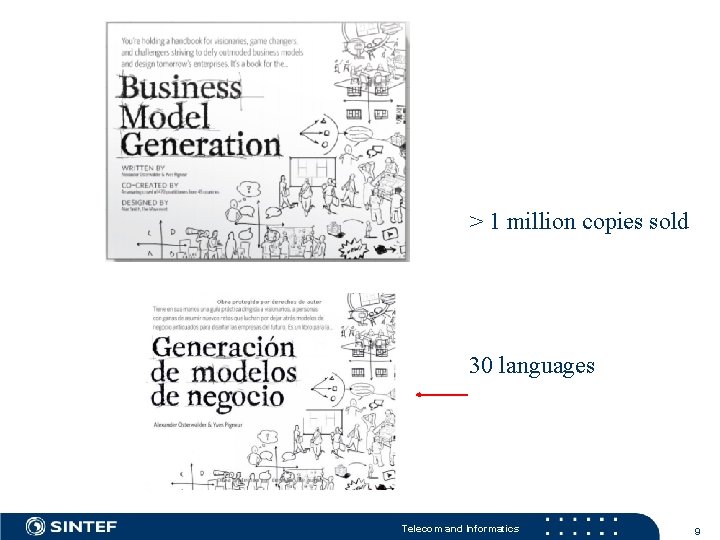
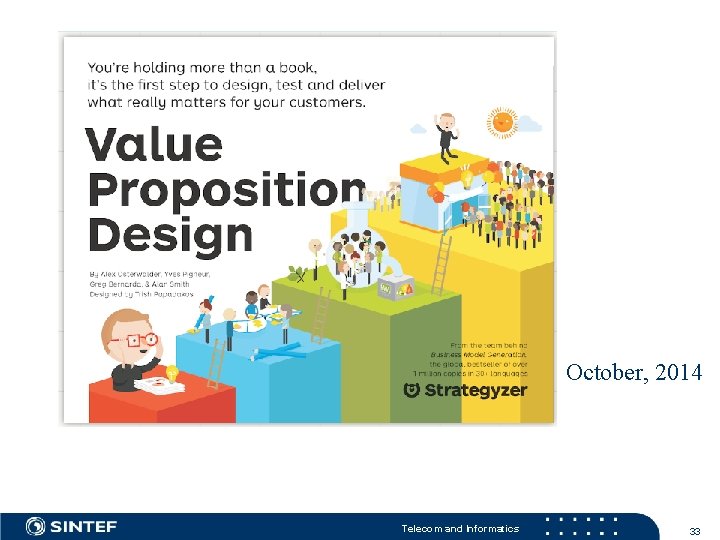
> 1 million copies sold 30 languages Telecom and Informatics 9
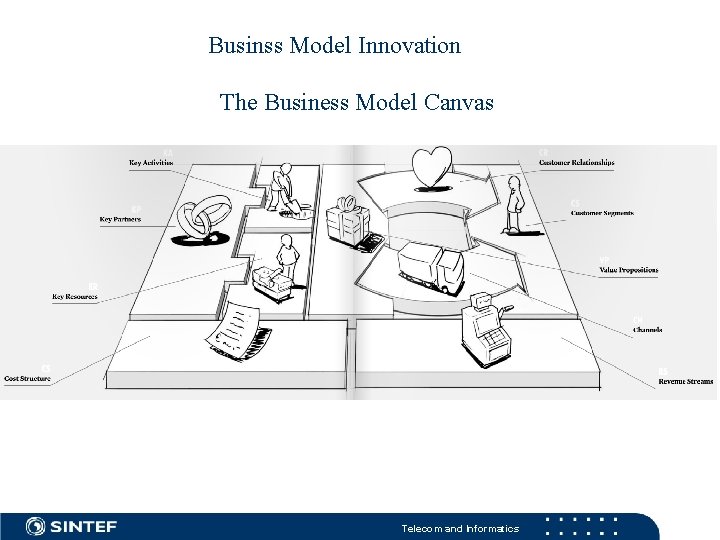
Businss Model Innovation The Business Model Canvas Telecom and Informatics
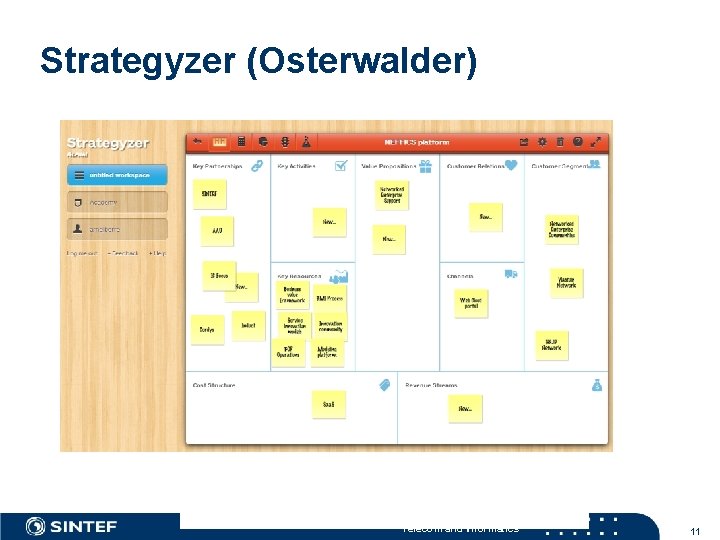
Strategyzer (Osterwalder) Telecom and Informatics 11
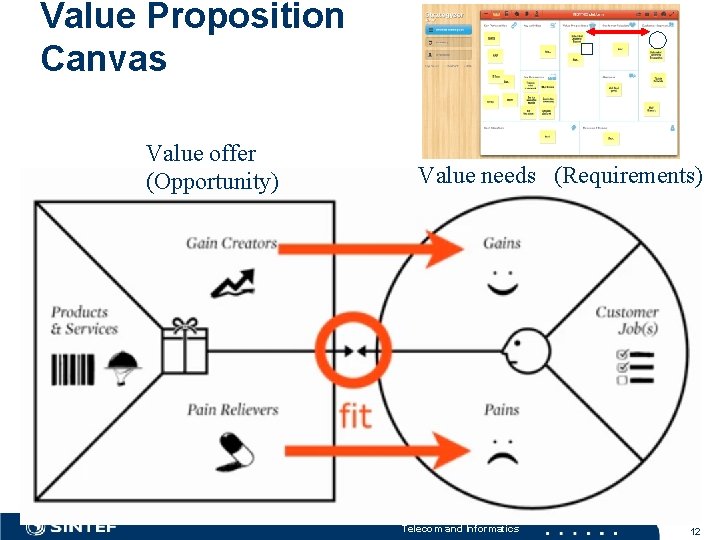
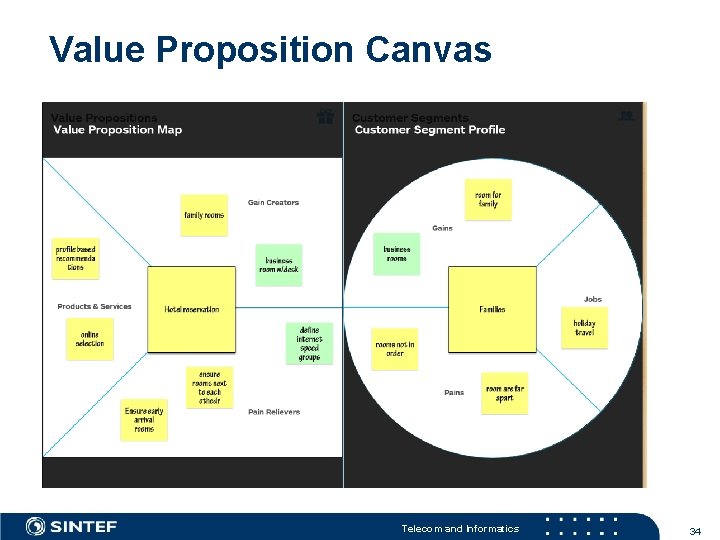
Value Proposition Canvas Value offer (Opportunity) Value needs (Requirements) Telecom and Informatics 12
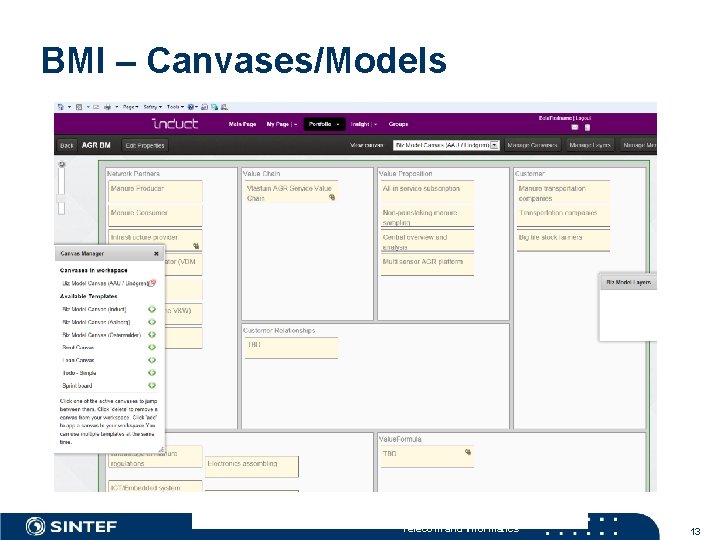
BMI – Canvases/Models Telecom and Informatics 13
Business Model Canvas and Value Proposition Canvas Resources n www. strategyzer. com n http: //www. alexandercowan. com/business-model-canvastemplates/ n Biz. Canvas App for the i. Pad n… Telecom and Informatics 14
Business Model (Definition) n A Business Model describes the rationale of how an organization creates, delivers and captures value. Telecom and Informatics 15
Reference examples in the course n Concierge: A company with a system/service that offers advice and recommendations to people with respect to current and upcoming events, concerts, exhibitions etc. n Travel. Advisor: A company with a system/service that offers advice and booking possibilities to travelers Telecom and Informatics 16
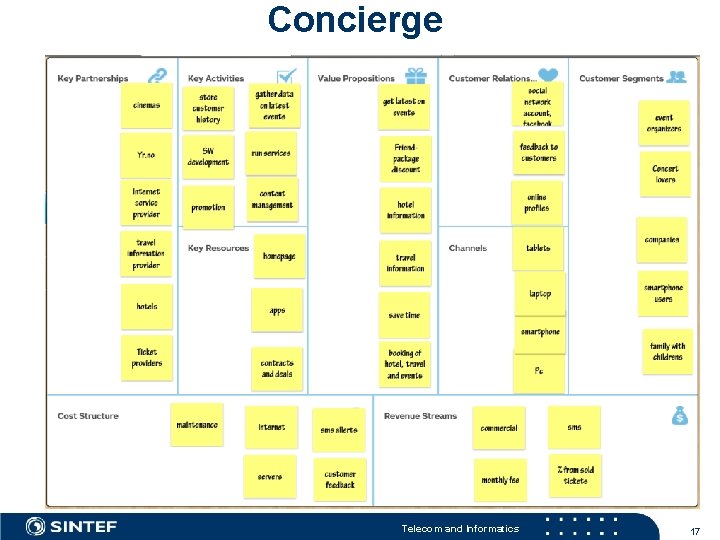
Concierge Telecom and Informatics 17
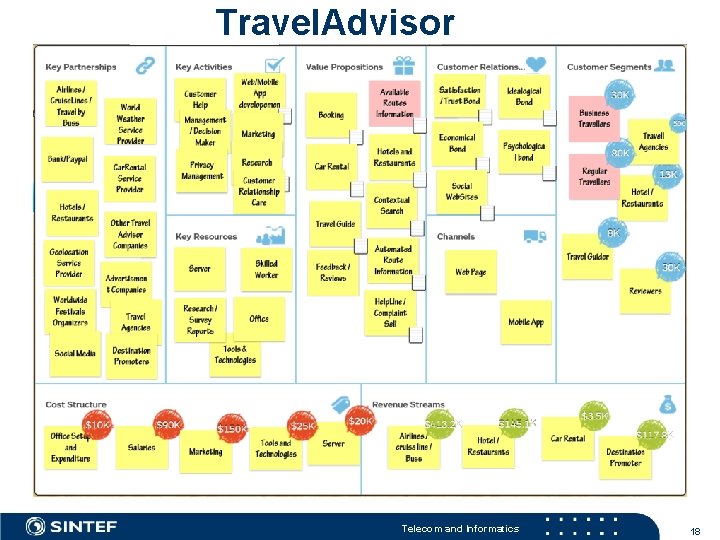
Travel. Advisor Telecom and Informatics 18
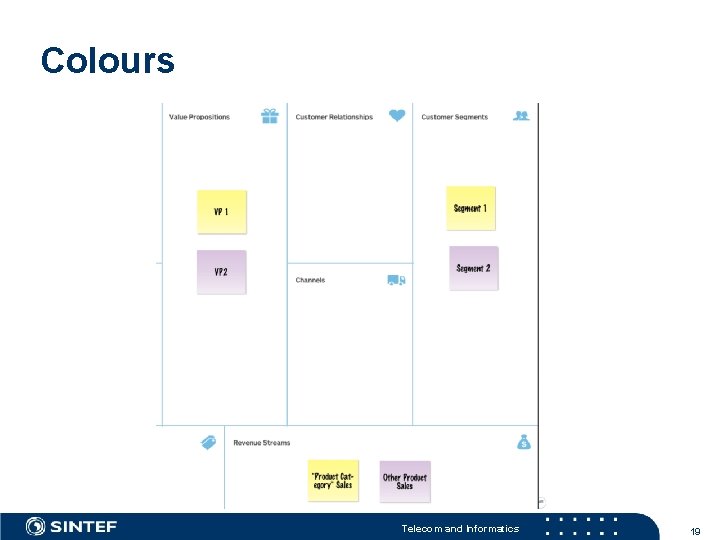
Colours Telecom and Informatics 19
Use of colours (not standardised) n 1. Relationship This is used with the same colors relating to a particular client/customer segment. 2. Prioritizing This is used to prioritize importance with Green, Yellow & Red markings only. The red notes are distinguished as immediate attention needed. 3. Distinguishing This is a further distinction from the above prioritization by also using a purple note as a higher level purpose (or instructional)note Telecom and Informatics 20
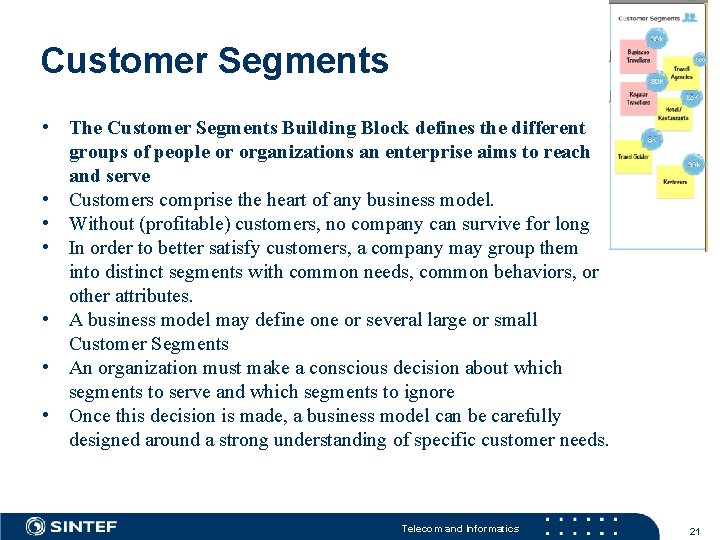
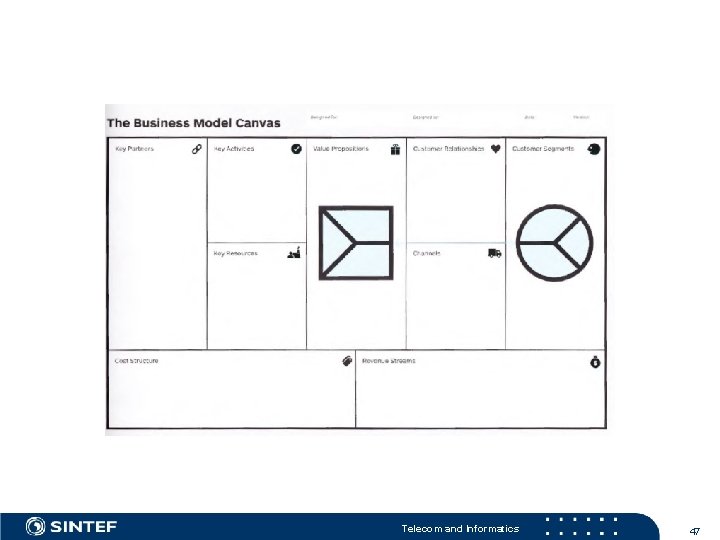
Customer Segments • The Customer Segments Building Block defines the different groups of people or organizations an enterprise aims to reach and serve • Customers comprise the heart of any business model. • Without (profitable) customers, no company can survive for long • In order to better satisfy customers, a company may group them into distinct segments with common needs, common behaviors, or other attributes. • A business model may define or several large or small Customer Segments • An organization must make a conscious decision about which segments to serve and which segments to ignore • Once this decision is made, a business model can be carefully designed around a strong understanding of specific customer needs. Telecom and Informatics 21
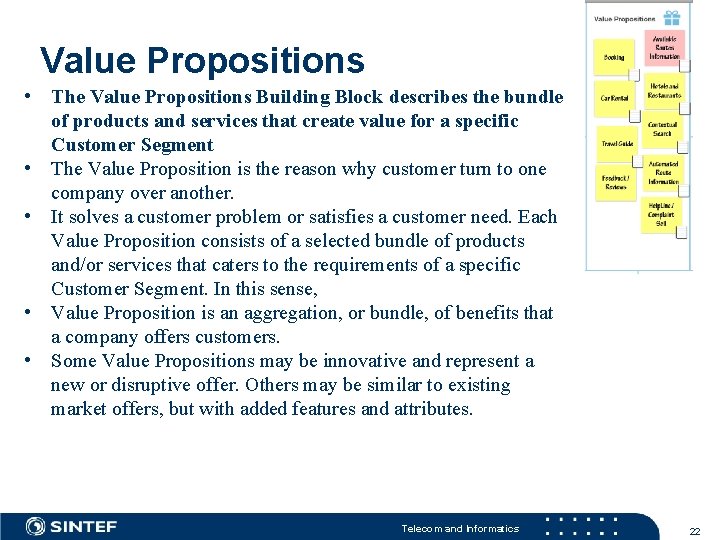
Value Propositions • The Value Propositions Building Block describes the bundle of products and services that create value for a specific Customer Segment • The Value Proposition is the reason why customer turn to one company over another. • It solves a customer problem or satisfies a customer need. Each Value Proposition consists of a selected bundle of products and/or services that caters to the requirements of a specific Customer Segment. In this sense, • Value Proposition is an aggregation, or bundle, of benefits that a company offers customers. • Some Value Propositions may be innovative and represent a new or disruptive offer. Others may be similar to existing market offers, but with added features and attributes. Telecom and Informatics 22
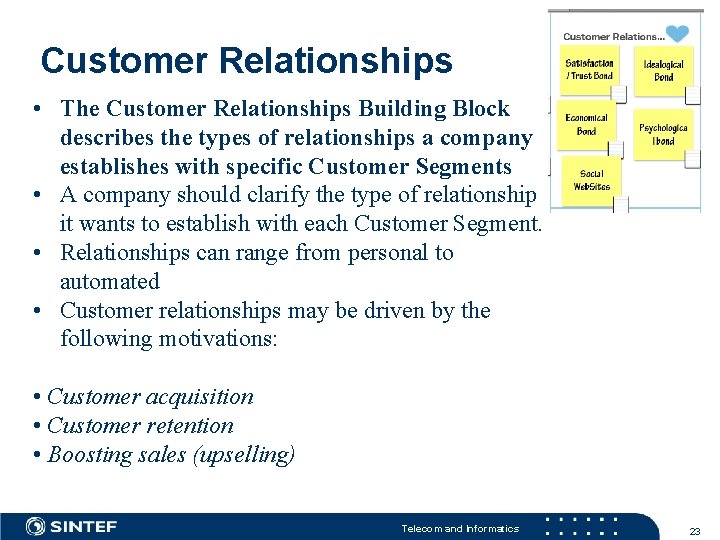
Customer Relationships • The Customer Relationships Building Block describes the types of relationships a company establishes with specific Customer Segments • A company should clarify the type of relationship it wants to establish with each Customer Segment. • Relationships can range from personal to automated • Customer relationships may be driven by the following motivations: • Customer acquisition • Customer retention • Boosting sales (upselling) Telecom and Informatics 23
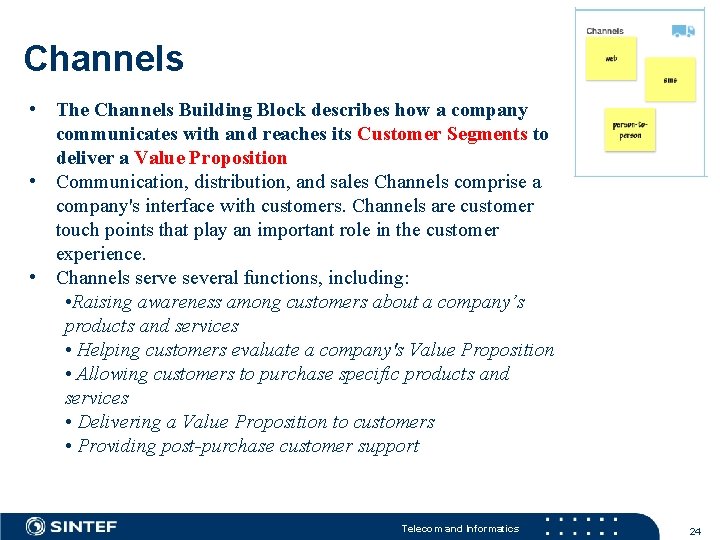
Channels • The Channels Building Block describes how a company communicates with and reaches its Customer Segments to deliver a Value Proposition • Communication, distribution, and sales Channels comprise a company's interface with customers. Channels are customer touch points that play an important role in the customer experience. • Channels serve several functions, including: • Raising awareness among customers about a company’s products and services • Helping customers evaluate a company's Value Proposition • Allowing customers to purchase specific products and services • Delivering a Value Proposition to customers • Providing post-purchase customer support Telecom and Informatics 24
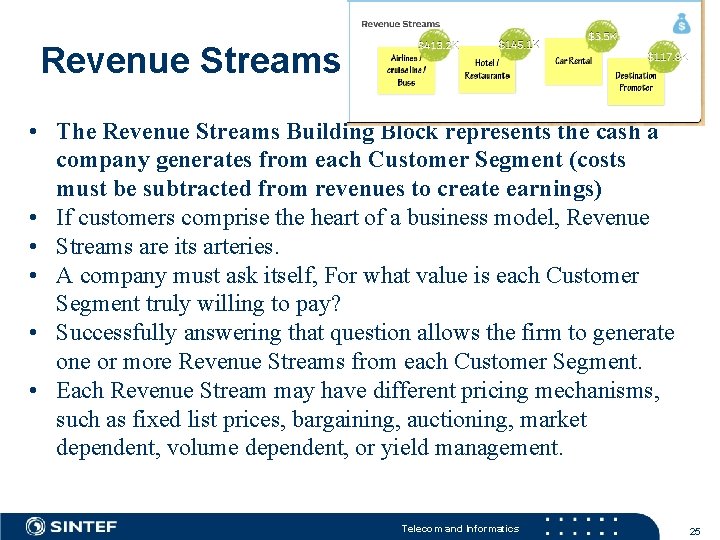
Revenue Streams • The Revenue Streams Building Block represents the cash a company generates from each Customer Segment (costs must be subtracted from revenues to create earnings) • If customers comprise the heart of a business model, Revenue • Streams are its arteries. • A company must ask itself, For what value is each Customer Segment truly willing to pay? • Successfully answering that question allows the firm to generate one or more Revenue Streams from each Customer Segment. • Each Revenue Stream may have different pricing mechanisms, such as fixed list prices, bargaining, auctioning, market dependent, volume dependent, or yield management. Telecom and Informatics 25
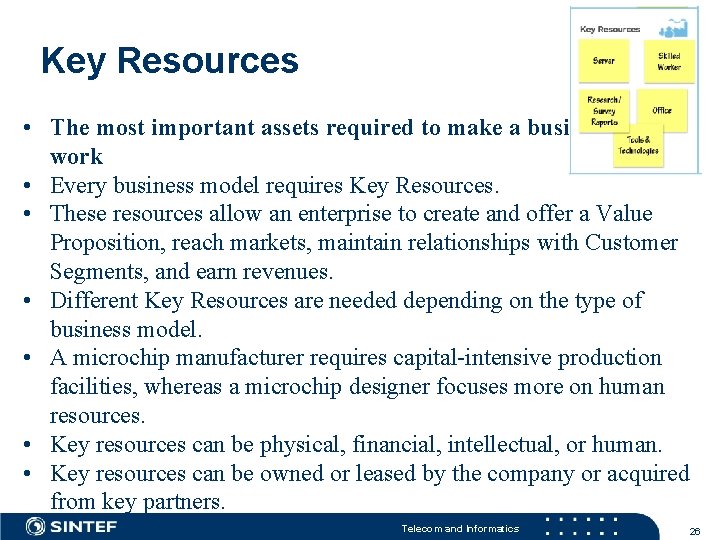
Key Resources • The most important assets required to make a business model work • Every business model requires Key Resources. • These resources allow an enterprise to create and offer a Value Proposition, reach markets, maintain relationships with Customer Segments, and earn revenues. • Different Key Resources are needed depending on the type of business model. • A microchip manufacturer requires capital-intensive production facilities, whereas a microchip designer focuses more on human resources. • Key resources can be physical, financial, intellectual, or human. • Key resources can be owned or leased by the company or acquired from key partners. Telecom and Informatics 26
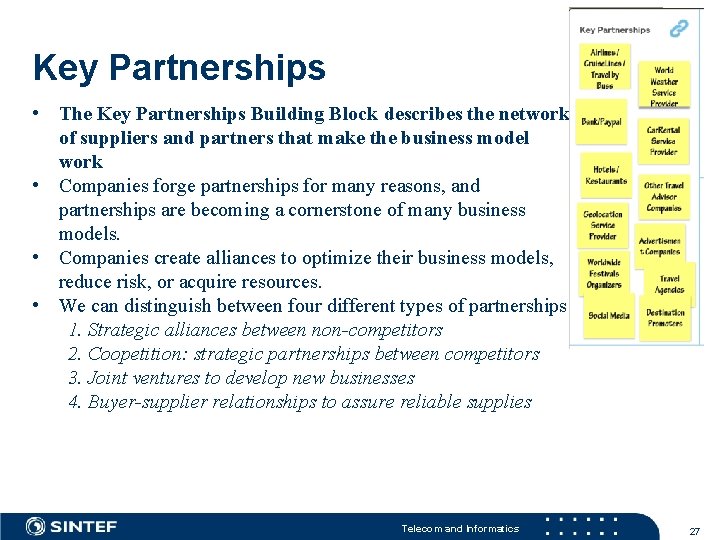
Key Partnerships • The Key Partnerships Building Block describes the network of suppliers and partners that make the business model work • Companies forge partnerships for many reasons, and partnerships are becoming a cornerstone of many business models. • Companies create alliances to optimize their business models, reduce risk, or acquire resources. • We can distinguish between four different types of partnerships: 1. Strategic alliances between non-competitors 2. Coopetition: strategic partnerships between competitors 3. Joint ventures to develop new businesses 4. Buyer-supplier relationships to assure reliable supplies Telecom and Informatics 27
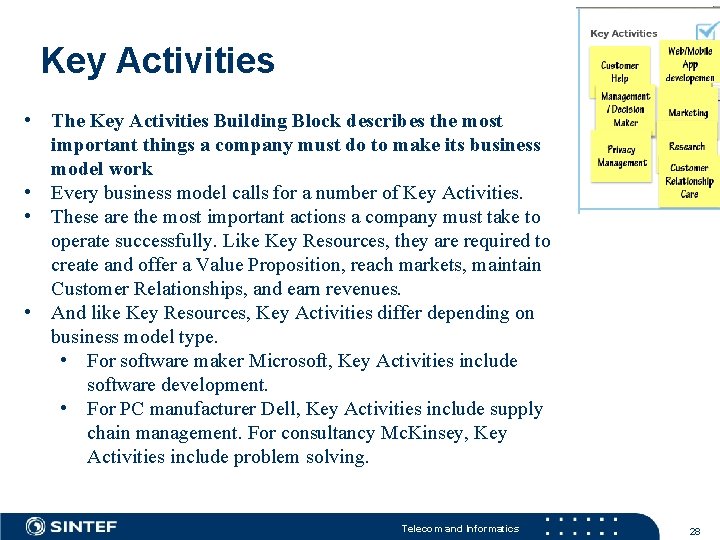
Key Activities • The Key Activities Building Block describes the most important things a company must do to make its business model work • Every business model calls for a number of Key Activities. • These are the most important actions a company must take to operate successfully. Like Key Resources, they are required to create and offer a Value Proposition, reach markets, maintain Customer Relationships, and earn revenues. • And like Key Resources, Key Activities differ depending on business model type. • For software maker Microsoft, Key Activities include software development. • For PC manufacturer Dell, Key Activities include supply chain management. For consultancy Mc. Kinsey, Key Activities include problem solving. Telecom and Informatics 28
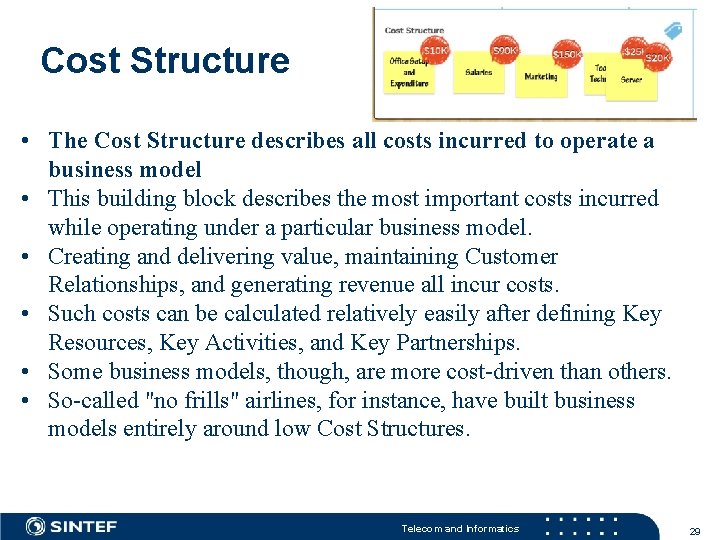
Cost Structure • The Cost Structure describes all costs incurred to operate a business model • This building block describes the most important costs incurred while operating under a particular business model. • Creating and delivering value, maintaining Customer Relationships, and generating revenue all incur costs. • Such costs can be calculated relatively easily after defining Key Resources, Key Activities, and Key Partnerships. • Some business models, though, are more cost-driven than others. • So-called "no frills" airlines, for instance, have built business models entirely around low Cost Structures. Telecom and Informatics 29
Business Model Patterns n n n Unbundling Business Models The Long Tail Multi-Sided Platforms Free as a Business Model Open Business Models Telecom and Informatics 30
Business Model Design Techniques n n n Customer Insight Ideation Visual Thinking Prototyping Storytelling Scenarios Telecom and Informatics 31
Business Model Design Process Phases n n n Mobilize Understand Design Implement Manage Telecom and Informatics 32
October, 2014 Telecom and Informatics 33
Value Proposition Canvas Telecom and Informatics 34
Customer Profile • Use the customer profile to visualize what matters to customers. • Specify their jobs, pains, and gains. • Communicate the profile across your organization as a onepage actionable document that creates a shared customer understanding. • Apply it as a "scoreboard" to track if assumed customer jobs, pains, and gains exist when you talk to real customers. Telecom and Informatics 35
Customer Jobs • Jobs describe things your customers are trying to get done in their work or in their life. • A customer job could be the tasks they are trying to perform and complete, the problems they are trying to solve, or the needs they are trying to satisfy. • Make sure you take the customer’s perspective when investigating jobs. • What you think of as important from your perspective might not be a job customers are actually trying to get done. ' • Distinguish between three main types of customer jobs to be done and supporting jobs: Telecom and Informatics 36
Customer Jobs Functional jobs • When your customers try to perform or complete a specific task or solve a specific problem, for example, mow the lawn, eat healthy as a consumer, write a report, or help clients as a professional. Social jobs • When your customers want to look good or gain power or status. These jobs describe how customers want to be perceived by others, for example, look trendy as a consumer or be perceived as competent as a professional. Personal/emotional jobs • When your customers seek a specific emotional state, such as feeling good or secure, for example, seeking peace of mind regarding one's investments as a consumer or achieving the feeling of job security at one's workplace. Telecom and Informatics 37
Customer Jobs Supporting jobs • Customers also perform supporting jobs in the context of purchasing and consuming value ether as consumers or as professionals. These jobs arise from three different roles: • BUYER OF VALUE: jobs related to buying value, such as comparing offers, deciding which, products to buy, standing in a checkout line, completing a purchase, or taking delivery of a product or service. . • COCREATOR OF VALUE: jobs related to cocreating value with your organization, such as posting product reviews and feedback or even participating in the design of a product or service. • TRANSFERRER OF VALUE: jobs related to the end of a value proposition's life cycle, such as canceling a subscription, disposing of a product transferring it to others, or reselling it. Telecom and Informatics 38
Job Context • Customer jobs often depend on the specific context in which they are performed. The context may impose certain constraints or limitations. • For example, calling somebody on the fly is different when you are traveling on a train than when you are driving a car. Likewise, going to the movies with your kids is different than going with your partner. Telecom and Informatics 39
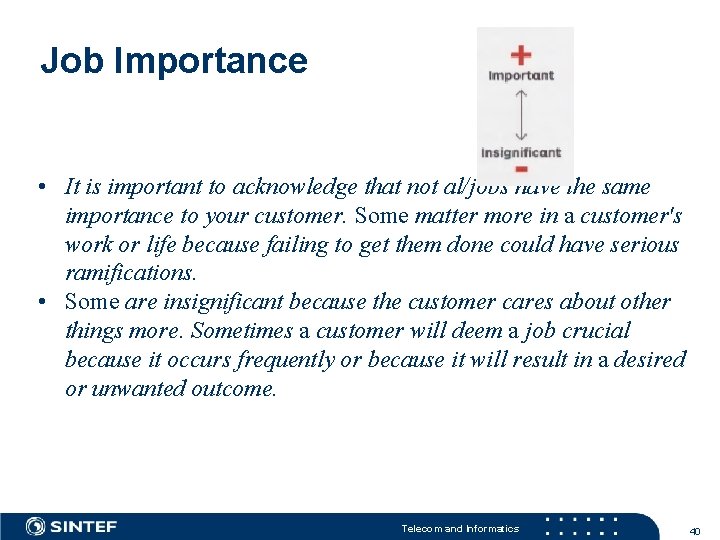
Job Importance • It is important to acknowledge that not al/jobs have the same importance to your customer. Some matter more in a customer's work or life because failing to get them done could have serious ramifications. • Some are insignificant because the customer cares about other things more. Sometimes a customer will deem a job crucial because it occurs frequently or because it will result in a desired or unwanted outcome. Telecom and Informatics 40
Customer Gains • Gains describe the outcomes and benefits your customers want. Some gains ore required, expected, or desired by customers. and some would surprise them. • Gains include functional utility. social gains, positive emotions. and cost savings • Seek to idenify fourtypes of customer gains in terms of outcomes and benefits. Required gains • These are gains without which a solution wouldn’t work. • For example. the most basic expectation that we have from smartphones is that we can make a call with it. Expected gains • These are relatively basic gains that we expect from a solution. Even if it could work without them. • For example. since Apple launched the i. Phone. We expect phones to be welldesigned and look good. Desired gains • These are gains that go beyond what we expect from a solution but would love to have if we could. • These are usually gains that customers would come up with if you asked them For example. We desire smartphones to be seamlessly integrated with our other devices. Telecom and Informatics 41
Gains Unexpected gains • These are gains that go beyond customer expectations and desires. They wouldn't even come up with them if you asked them. • Before Apple brought touch screens and the App Store to the mainstream. nobody really thought of them as part of a phone Gain relevance • A customer gain can feel essential or nice to have. Just like pains can • feel extreme or moderate to them. Tip: Make gains concrete. • As with pains. it's better to describe gains as concretely as possible to clearly differentiate jobs. pains. and gains from one another. • Ask how much they'd expect or dream of when a customer indicates "better performance" as a desired gain. • That way you can note "would love an increased performance of more than x. " When you understand how exactly customers measure gains (i. e. , outcomes and benefits). you can design better gain creators in your value proposition. Telecom and Informatics 42
Trigger questions – Gains: • Which savings would make your customers happy? Which savings in terms of time, money, and effort would they value' • What quality levels do they expect. and what would they wish for more or less of? • How do current value propositions delight your customers? Which specific features do they enjoy? What performance and quality do they expect? • What would make your customers’ jobs or lives easier? Could there be a flatter learning curve, more services. or lower costs of ownership? • What positive social consequences do your customers desire? What makes them look good? What increases their power or their status' • What are customers looking for most? Are they searching for good design. guarantees, specific or more features? What do customers dream about? What do they aspire to achieve, or what would be a big relief to them? • How do your customers measure success and failure? How do they gauge performance or cost? • What would increase your customers’ likelihood of adopting a value proposition? Do they desire lower cost. less investment. lower risk. or better quality? Telecom and Informatics 43
Customer Pains • Pains describe anything that annoys your customers before, during, and after trying to get a job done or simply prevents them from getting a job don • Pains also describe risks, that is, potential bad outcomes, related to getting a job done badly or not at all. • Seek to identify three types of customer pains and how severe customers find them: • Undesired outcomes, problems, and characteristics • Pains ore functional (e. g. . a solution doesn't work, doesn't work well. or hos negative side effects), social ("I look bad doing this. . ” ), emotional ("I feel • bod every time I do this"), or ancillary (. . It's annoying to go to the store for this. . ). • This may also involve undesired choroctenst 1 cs customers don’t like (e. g. , "Running at the gym is boring, " or This design is ugly"). Telecom and Informatics 44
Risks (undesired potential outcomes) • What could go wrong and have important negative consequences (e. g. "I might lose credibility when using this type of solution. " or "A security breach would be disastrous for us"). Pain severity • A customer pam con be extreme or moderate. similar to how jobs can be important or ms 1 gn 1 f 1 cant to the customer Tip: Make pains concrete. • To clearly differenciate iobs. pains. and gains. describe them as concrete as possible. • For example. when a customer soils "waiting in line was a waste of time. ask afte how many minutes exactly it began to feel like wasted time. That way you can note “wasting more than x minutes standing in line” When you understand how exactly customers measure pain severity, you can design better pain relievers in your value proposition Telecom and Informatics 45
Trigger Questions think of different potential customer pains: • • • How do your customers define too costly? Takes a lot of time, costs too much money or requires substantial efforts? What makes your customers feel bad? What are their frustrations. annoyances. or things that give them a headache? How ore current value proposition underperforming for your customers? Which features are they missing? Are there performance issues that annoy them or malfunctions they cite? What are the main difficulties and challenges your customers encounter? Do they understand how things work. have difficulties getting certain things done. or resist particular Jobs for specific reasons? What negative social consequences do your customers encounter or fear? Are they afraid of a loss of face, power. trust, or status? What risks do your customers fear? Are they afraid of financial. social, or technical risks. or are they asking themselves what could go wrong? What's keeping your customers awake at night? What are their big issues. concerns. and worries? What common mistakes do your customers make? Are they using of solution the wrong way? What barriers ore keeping your customers from adopting a value proposition? Are there upfront investment costs. a steep learning curve. Or other obstacles preventing adoption? Telecom and Informatics 46
Telecom and Informatics 47
Products and Services • This is simply a list of what you offer. • Think of it as all the items your customer can see in your shop window-- metaphorically speaking. • It's enumeration of all the products and services your value proposition builds on • This bundle of products and services help your customers complete either functional, social, or emotional jobs or help them satisfy basic needs. • It is crucial to acknowledge that products and services don't create value alone-only in relationship to a specific customer segment and their jobs, pains, and gains. Telecom and Informatics 48
Products and Services (Cont’d) • Your list of products and services may also include supporting ones that help your customers perform the roles of: • buyer (those that help customers compare offers, decide, and buy), • co-creator (those that help customs co-design value propositions), and • transferrer (those that help customers dopose of a product). Telecom and Informatics 49
Products and Services (cont’d) • Your value proposition is likely to be composed of various types of products and services: Physical/tangible • Goods, such as manufactured products. Intangible • Products such as copyrights or services such as after-sales assistance Digital • Products such as music downloads or services such as online recommendations Financial • Products such as investment funds and insurances or services such as the financing of a purchase. Relevance • It is essential to acknowledge that not all products and services have the same relevance to your customers. • Some products and services are essential to your value proposition. some are merely nice to hove. Telecom and Informatics 50
Pain Relievers • Pain relievers describe how exactly you products and services alleviate specific customer pains. • They explicitly outline how you intend to eliminate or reduce some of the things that annoy your customers before, during, or after they are trying to complete a job or that prevent them from doing so. • Great value propositions focus on pains that matter to customers, in particular extreme pains. • You don't need to come up with a pain reliever for every pain you’ve identified in the customer profile- no value proposition can do this. • Great value propositions often focus only on few pains that they alleviate extremely well. Telecom and Informatics 51
Trigger questions – help alleviate pains Ask yourself: Could your products and services … • produce savings? In terms of time, money, or efforts. • make your customers feel better? By killing frustrations, annoyances. and other things that give customers a headache • fix underperforming solutions? By introducing new features. better performance. or enhanced quality • put an end to difficulties and challenges your customers encounter? By making things easier or eliminating obstacles • wipe out negative social consequences your customers encounter or fear? In terms of loss of face or lost power. trust. or status. • eliminate risks your customers fear? In terms of • financial, social. technical risks. or things that could potentially go wrong. • help your customers better sleep at night? By addressing significant issues. Diminishing concerns or eliminating worries. • limit or eradicate common mistakes customers make? By helping them use a solution the right way • Eliminating barries that are keeping your customer from adoptong value propostions? etc Telecom and Informatics 52
Relevance • A pain reliever can be more or less valuable to the customer. • Make sure you differentiate between essential pain relievers and ones that are nice to have • The former relieve extreme issues, often in a radical • way and create a lot of value. • The latter merely relieve moderate pain. Telecom and Informatics 53
Gain Creators • Gain creators describe how your product and services create customer gains. • They explicitly outline how you intend to produce outcomes and benefits that your customer expects, desires, or would be surprised by, including functional utility, social gains, positive emotions, and cost savings. • As with pain relievers, gain creators don't need to address every gain identified in the customer profile. • Focus on those that are relevant to customers and where your products and services can make a difference. Telecom and Informatics 54
Gain creator – trigger questions • • • create savings that please your customers? In terms of time. money, and effort. produce outcomes your customers expect or that exceed their expectations? By offering quality levels. more of something, or less of something. outperform current value propositions and delight your customers? Regarding specific features. performance, or quality. make your customers’ work or life easier? Via better usability. accessibility, more services or lower cost of ownership. create positive social consequences? By making them look good or producing an increase in power or status do something specific that customers are looking for? In terms of good design, guarantees or specific or more features. fulfill a desire customers dream about? By helping them achieve their aspirations or getting relief from a hardship? produce positive outcomes matching your customers· success and failure criteria? In terms of better performance or lower cost. help make adoption easier? Through lower cost, fewer investments. lower risk, better quality, improved performance. or better design. Telecom and Informatics 55
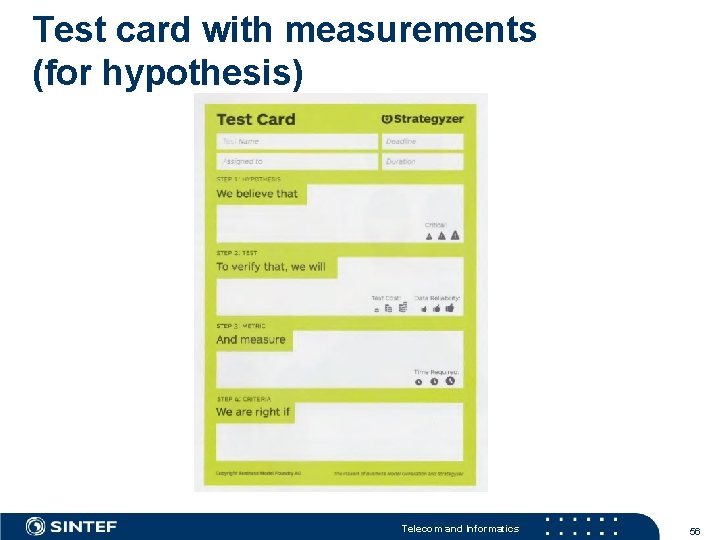
Test card with measurements (for hypothesis) Telecom and Informatics 56
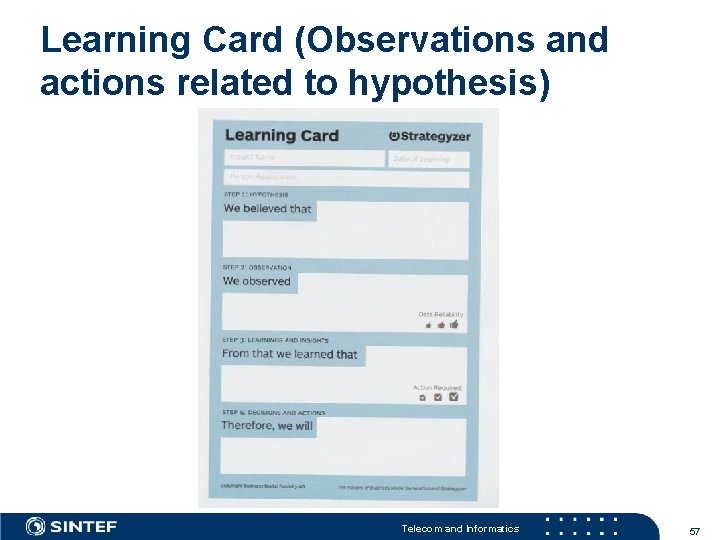
Learning Card (Observations and actions related to hypothesis) Telecom and Informatics 57
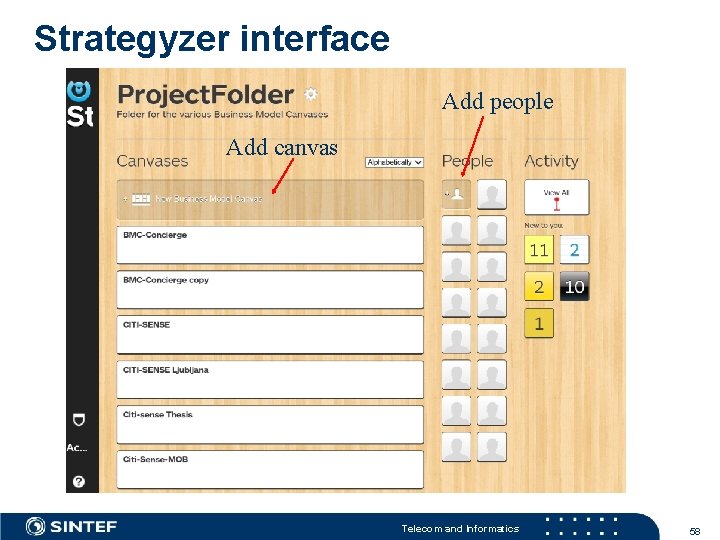
Strategyzer interface Add people Add canvas Telecom and Informatics 58
- Slides: 58