
INF 5071 Performance in Distributed Systems Introduction Motivation
INF 5071 – Performance in Distributed Systems Introduction, Motivation & Assignment 1 September 30, 2020
The course § Course content The course looks at performance issues in distributed systems including server architectures, data placement, scheduling, high performance file systems, resource handling in operating systems, and protocols and mechanisms for distribution and delivery of data. There will be a strong focus on applications that require time dependent delivery. The practical work in the course will improve the understanding of system architectures, operating system improvements and hardware support that are meant in particular for dedicated servers and distribution systems. § Learning outcomes The students will learn about demands and solutions with respect to performance in distributed systems. They will learn and gain experience in designing and performing experiments. Students will learn about and experiment with algorithms and architectures. They will get practical experience in evaluating and improving performance. Students and teachers will present and discuss results. University of Oslo INF 5071 – Carsten Griwodz & Pål Halvorsen
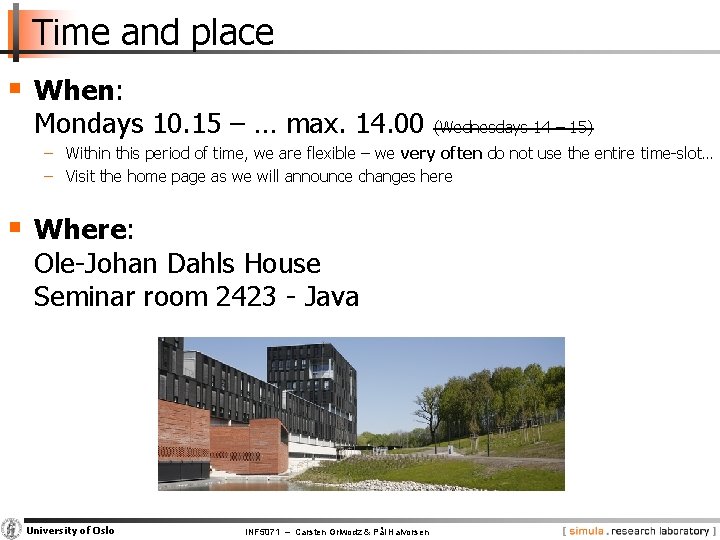
Time and place § When: Mondays 10. 15 – … max. 14. 00 (Wednesdays 14 – 15) − Within this period of time, we are flexible – we very often do not use the entire time-slot… − Visit the home page as we will announce changes here § Where: Ole-Johan Dahls House Seminar room 2423 - Java University of Oslo INF 5071 – Carsten Griwodz & Pål Halvorsen
(New) Format § Traditional lectures (INF 5071) Interactive discussions (INF 507 x) § 4 selected topics during the semester – subject to your grade − − assignment 1: 2: 3: 4: TCP protocol simulations TCP protocol emulations HTTP streaming Distributed processing, Hadoop (Map. Reduce) § several discussion topics § guest lectures by industry people (Como. Yo (Telenor), Microsoft, Funcom, Dolphine, …) University of Oslo INF 5071 – Carsten Griwodz & Pål Halvorsen – – simulation emulation real-world experiment
Evaluation – Grades § No written or oral exam!!! § Present experiment results and deliver reports − perform experiments in 2 -person groups − the report should • be maximum 4 pages following the ACM format: http: //www. acm. org/sigs/publications/proceedings-templates • contain problem statement, experiment setup, description of the used metrics, presentation and discussion of the results and conclusions (you may read and cite related papers, but this is no requirement) − the first 2 reports may be submitted for feedback − at the end of the course, the 4 reports will be evaluated to give you a grade ("mappe-evaluering") • note that the report can be modified for the final delivery (26. November) University of Oslo INF 5071 – Carsten Griwodz & Pål Halvorsen
Lecturers, or better discussion leaders… § Carsten Griwodz − email: griff @ ifi − office: Simula § Pål Halvorsen − email: paalh @ ifi − office: Simula § And guests … University of Oslo INF 5071 – Carsten Griwodz & Pål Halvorsen
Why is PERFORMANCE important? Huge amounts of data: • • billions of web-pages (google: 1 trillion, indexable web pages August 2009) billions of downloadable articles thousands of movies (estimated 65000 in 1995!! H/Bollywood = ca. 500/1000 per year) data from TV-series, sport clips, news, live events, … games and virtual worlds music home made media data shared on the Internet ? … ce? n a orm f r e p Challenges in a distributed system • different requirements • different architectures • different devices • different capabilities • … • and it keeps growing!!!! University of Oslo INF 5071 – Carsten Griwodz & Pål Halvorsen
Failing to meet the Technical Challenges… …results in § delayed or aborted transactions § long response times §… annoyed users! University of Oslo INF 5071 – Carsten Griwodz & Pål Halvorsen
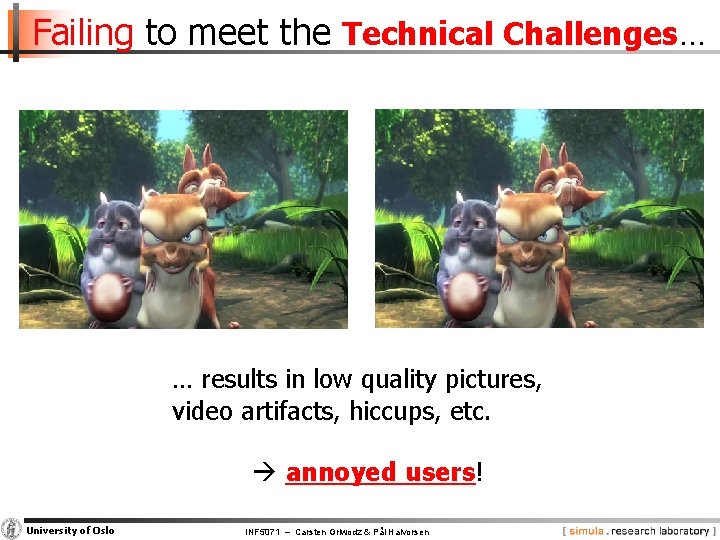
Failing to meet the Technical Challenges… … results in low quality pictures, video artifacts, hiccups, etc. annoyed users! University of Oslo INF 5071 – Carsten Griwodz & Pål Halvorsen
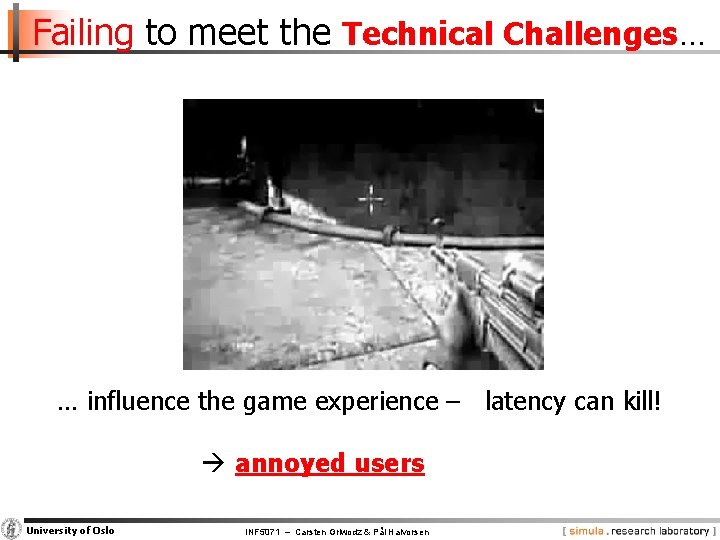
Failing to meet the Technical Challenges… … influence the game experience – latency can kill! annoyed users University of Oslo INF 5071 – Carsten Griwodz & Pål Halvorsen
INF 5071 – Performance in Distributed Systems Data transport
Qo. S vs. Non-Qo. S Approaches § Internet with network Qo. S support − Application must specify their needs − Internet infrastructure must change – negotiation of Qo. S parameters − Routers need more features • Keep Qo. S-related information • Identify packets as Qo. S-worthy or not • Treat packets differently keep routing consistent § Internet without network Qo. S support − Internet applications must cope with networking problems • Application itself or middleware • "Cope with" means either … § … “adapt to” which must deal with TCP-like service variations § … “don’t care about” which is considered “unfair” and cannot work with TCP University of Oslo INF 5071 – Carsten Griwodz & Pål Halvorsen
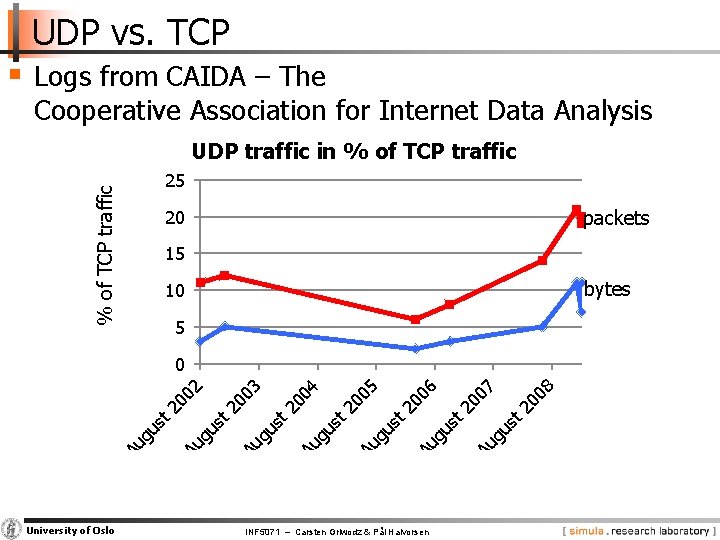
UDP vs. TCP § Logs from CAIDA – The Cooperative Association for Internet Data Analysis UDP traffic in % of TCP traffic 25 packets 20 15 bytes 10 5 University of Oslo INF 5071 – Carsten Griwodz & Pål Halvorsen st 20 0 8 7 Au gu st 20 0 6 Au gu st 20 0 5 Au gu st 20 0 4 Au gu st 20 0 Au gu 20 03 st Au gu st 20 0 2 0
TCP Friendliness: The definition of good Internet behavior § TCP Congestion Control § TCP limits sending rate as a function of perceived network congestion − little traffic – increase sending rate − much traffic – reduce sending rate § Congestion algorithm has three major “components”: − additive-increase, multiplicative-decrease (AIMD) − slow-start − reaction to timeout events University of Oslo INF 5071 – Carsten Griwodz & Pål Halvorsen
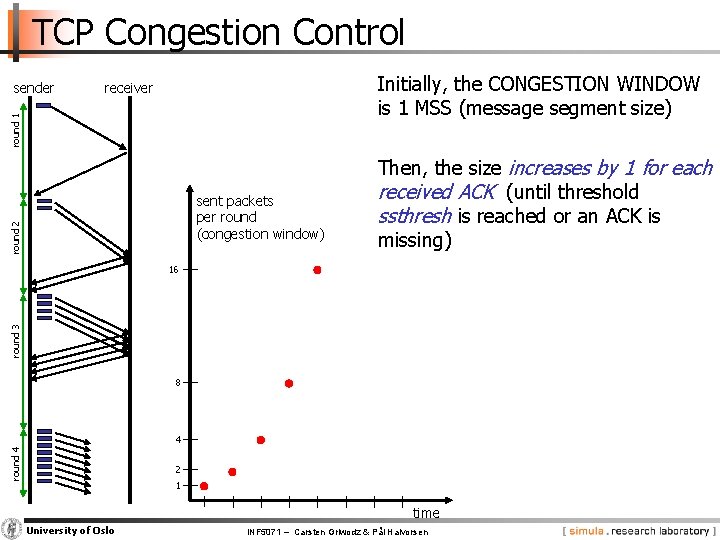
TCP Congestion Control Initially, the CONGESTION WINDOW is 1 MSS (message segment size) receiver round 1 sender round 2 sent packets per round (congestion window) Then, the size increases by 1 for each received ACK (until threshold ssthresh is reached or an ACK is missing) round 3 16 8 round 4 4 2 1 time University of Oslo INF 5071 – Carsten Griwodz & Pål Halvorsen
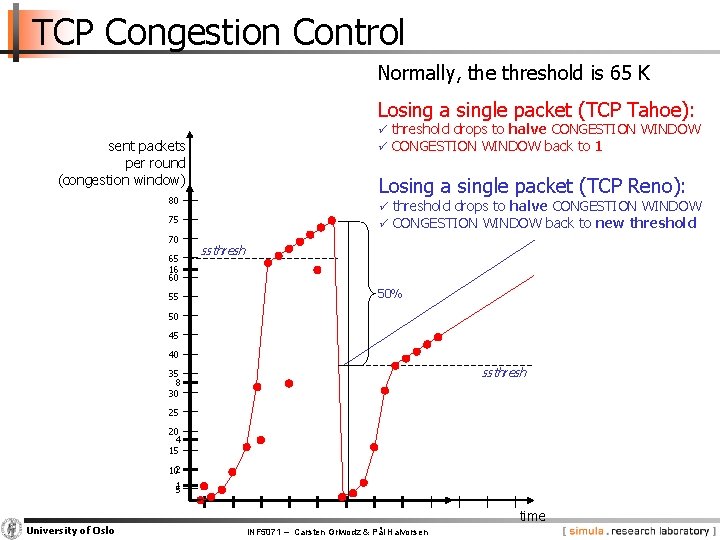
TCP Congestion Control Normally, the threshold is 65 K Losing a single packet (TCP Tahoe): ü threshold drops to halve CONGESTION WINDOW ü CONGESTION WINDOW back to 1 sent packets per round (congestion window) Losing a single packet (TCP Reno): 80 ü threshold drops to halve CONGESTION WINDOW ü CONGESTION WINDOW back to new threshold 75 70 65 16 60 55 ssthresh 50% 50 45 40 ssthresh 35 8 30 25 20 4 15 102 1 5 University of Oslo time INF 5071 – Carsten Griwodz & Pål Halvorsen
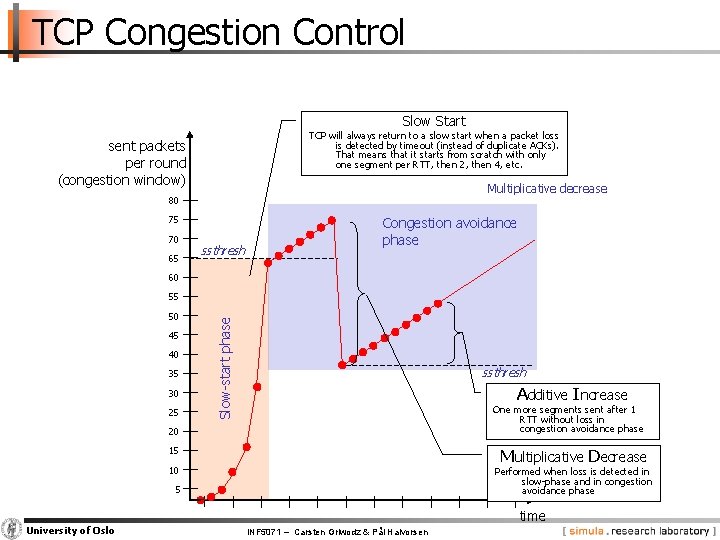
TCP Congestion Control Slow Start TCP will always return to a slow start when a packet loss is detected by timeout (instead of duplicate ACKs). That means that it starts from scratch with only one segment per RTT, then 2, then 4, etc. sent packets per round (congestion window) Multiplicative decrease 80 75 70 65 ssthresh Congestion avoidance phase 60 50 45 40 35 30 25 Slow-start phase 55 ssthresh Additive Increase One more segments sent after 1 RTT without loss in congestion avoidance phase 20 15 Multiplicative Decrease 10 Performed when loss is detected in slow-phase and in congestion avoidance phase 5 University of Oslo time INF 5071 – Carsten Griwodz & Pål Halvorsen
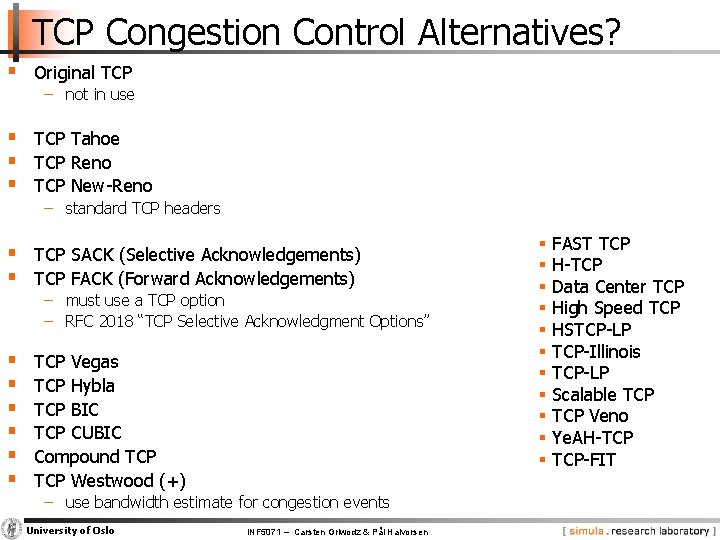
TCP Congestion Control Alternatives? § Original TCP − not in use § TCP Tahoe § TCP Reno § TCP New-Reno − standard TCP headers § TCP SACK (Selective Acknowledgements) § TCP FACK (Forward Acknowledgements) − must use a TCP option − RFC 2018 “TCP Selective Acknowledgment Options” § § § TCP Vegas TCP Hybla TCP BIC TCP CUBIC Compound TCP Westwood (+) − use bandwidth estimate for congestion events University of Oslo INF 5071 – Carsten Griwodz & Pål Halvorsen § § § FAST TCP H-TCP Data Center TCP High Speed TCP HSTCP-LP TCP-Illinois TCP-LP Scalable TCP Veno Ye. AH-TCP TCP-FIT
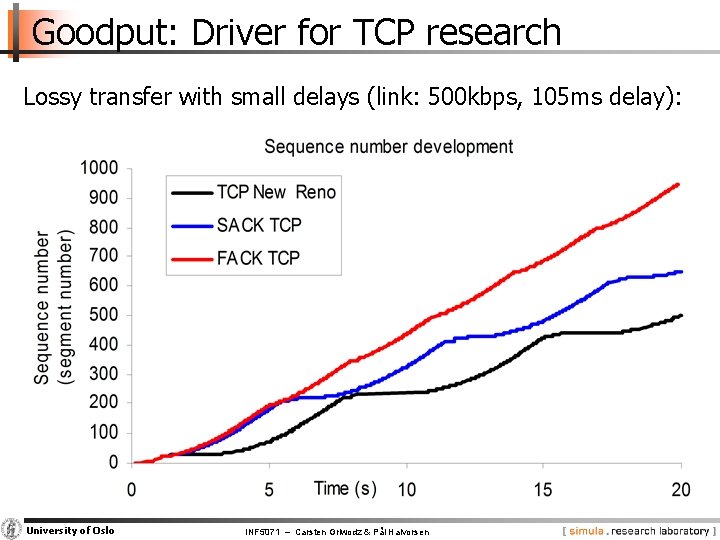
Goodput: Driver for TCP research Lossy transfer with small delays (link: 500 kbps, 105 ms delay): University of Oslo INF 5071 – Carsten Griwodz & Pål Halvorsen
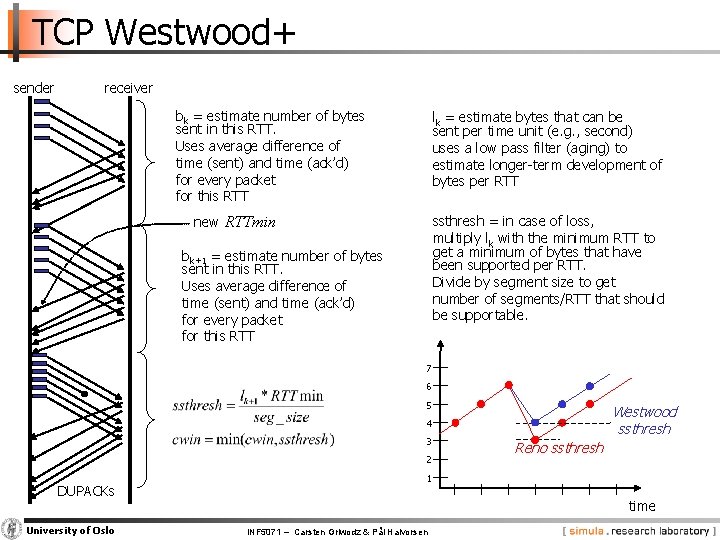
TCP Westwood+ sender receiver bk = estimate number of bytes sent in this RTT. Uses average difference of time (sent) and time (ack’d) for every packet for this RTT lk = estimate bytes that can be sent per time unit (e. g. , second) uses a low pass filter (aging) to estimate longer-term development of bytes per RTT ssthresh = in case of loss, multiply lk with the minimum RTT to get a minimum of bytes that have been supported per RTT. Divide by segment size to get number of segments/RTT that should be supportable. new RTTmin bk+1 = estimate number of bytes sent in this RTT. Uses average difference of time (sent) and time (ack’d) for every packet for this RTT 7 6 5 Westwood ssthresh 4 3 2 DUPACKs University of Oslo Reno ssthresh 1 time INF 5071 – Carsten Griwodz & Pål Halvorsen
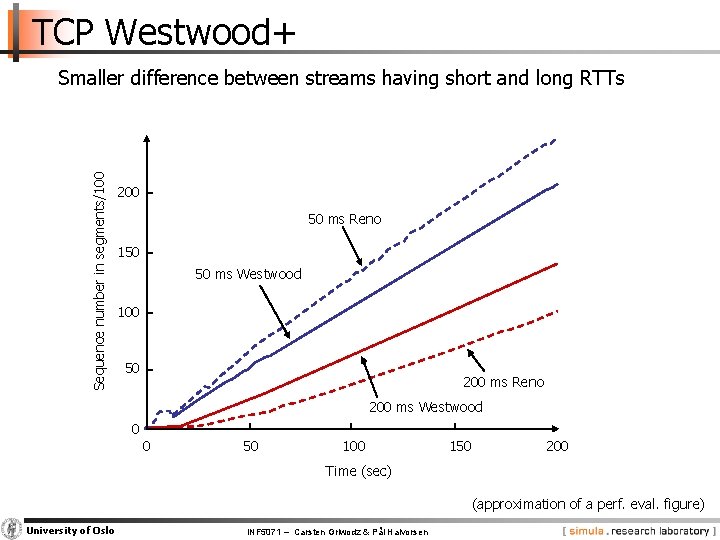
TCP Westwood+ Sequence number in segments/100 Smaller difference between streams having short and long RTTs 200 50 ms Reno 150 50 ms Westwood 100 50 200 ms Reno 200 ms Westwood 0 0 50 100 150 200 Time (sec) (approximation of a perf. eval. figure) University of Oslo INF 5071 – Carsten Griwodz & Pål Halvorsen
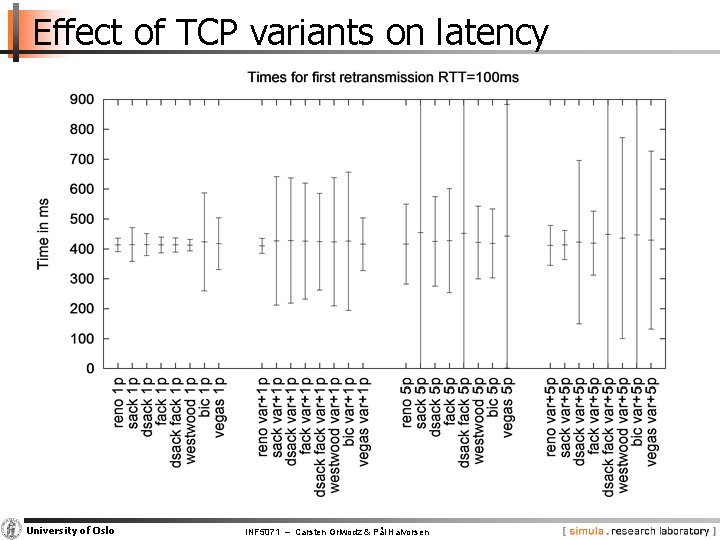
Effect of TCP variants on latency University of Oslo INF 5071 – Carsten Griwodz & Pål Halvorsen
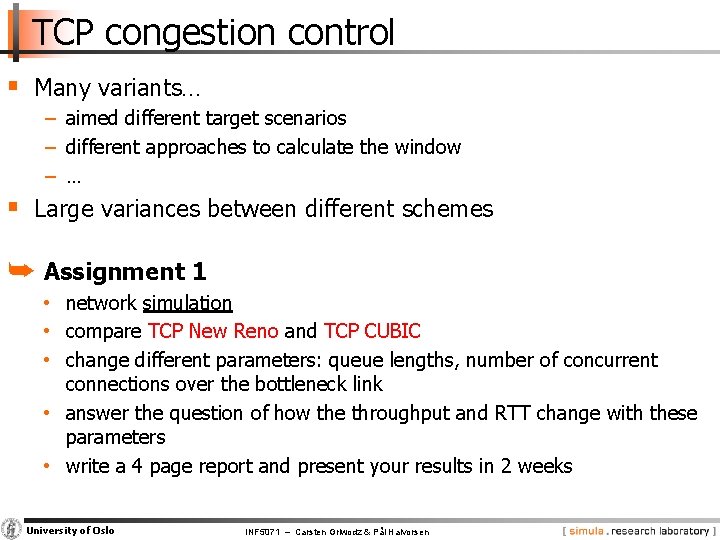
TCP congestion control § Many variants… − aimed different target scenarios − different approaches to calculate the window −… § Large variances between different schemes ➥ Assignment 1 • network simulation • compare TCP New Reno and TCP CUBIC • change different parameters: queue lengths, number of concurrent connections over the bottleneck link • answer the question of how the throughput and RTT change with these parameters • write a 4 page report and present your results in 2 weeks University of Oslo INF 5071 – Carsten Griwodz & Pål Halvorsen
- Slides: 23