
INF 5070 Media Servers and Distribution Systems Distribution
INF 5070 – Media Servers and Distribution Systems: Distribution – Part I 17/10 – 2005
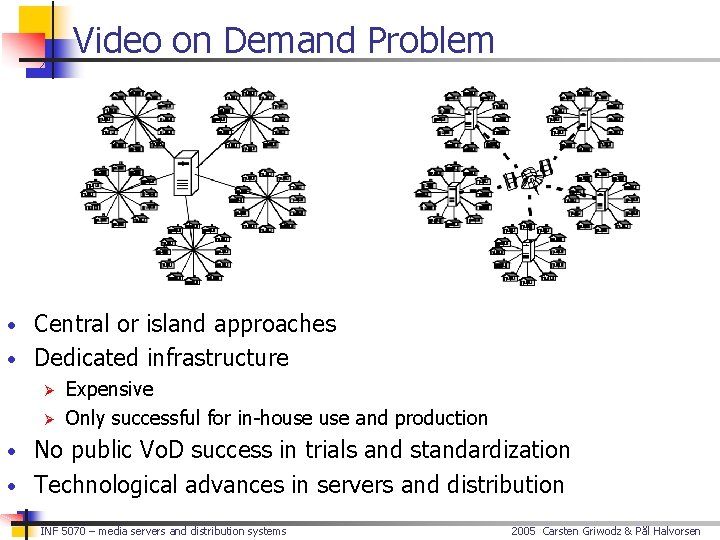
Video on Demand Problem • Central or island approaches • Dedicated infrastructure Ø Expensive Ø Only successful for in-house and production • No public Vo. D success in trials and standardization • Technological advances in servers and distribution INF 5070 – media servers and distribution systems 2005 Carsten Griwodz & Pål Halvorsen
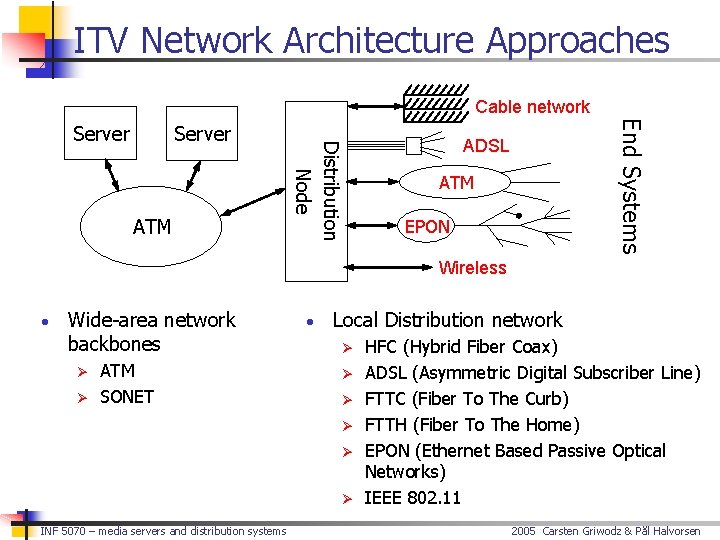
ITV Network Architecture Approaches Cable network ATM End Systems Server Distribution Node Server ADSL ATM EPON Wireless • Wide-area network backbones Ø Ø ATM SONET • Local Distribution network Ø Ø Ø INF 5070 – media servers and distribution systems HFC (Hybrid Fiber Coax) ADSL (Asymmetric Digital Subscriber Line) FTTC (Fiber To The Curb) FTTH (Fiber To The Home) EPON (Ethernet Based Passive Optical Networks) IEEE 802. 11 2005 Carsten Griwodz & Pål Halvorsen
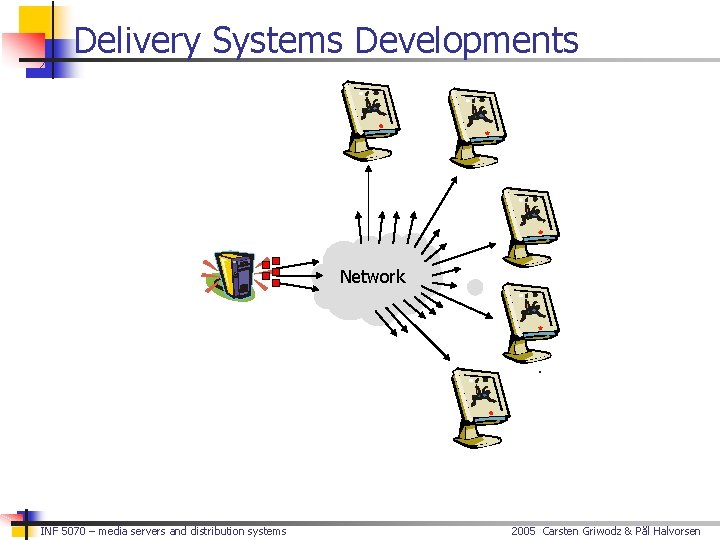
Delivery Systems Developments Network INF 5070 – media servers and distribution systems 2005 Carsten Griwodz & Pål Halvorsen
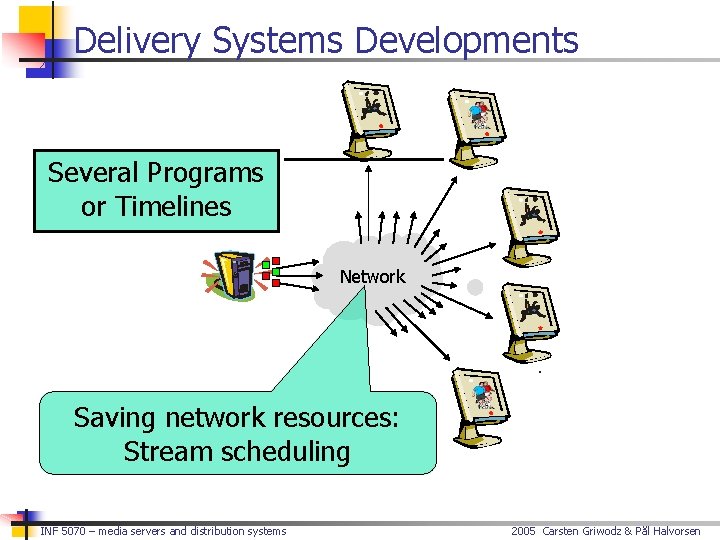
Delivery Systems Developments Several Programs or Timelines Network Saving network resources: Stream scheduling INF 5070 – media servers and distribution systems 2005 Carsten Griwodz & Pål Halvorsen
![From Broadcast to True Media-on-Demand [Little, Venkatesh 1994] • Broadcast (No-Vo. D) Ø Traditional,](http://slidetodoc.com/presentation_image/9173bdae06bc8aa9fe1d7e1ba2d1cefb/image-6.jpg "From Broadcast to True Media-on-Demand [Little, Venkatesh 1994] • Broadcast (No-Vo. D) Ø Traditional,")
From Broadcast to True Media-on-Demand [Little, Venkatesh 1994] • Broadcast (No-Vo. D) Ø Traditional, no control • Pay-per-view (PPV) Ø Paid specialized service • Quasi Video On Demand (Q-Vo. D) Ø Distinction into interest groups Ø Temporal control by group change • Near Video On Demand (N-Vo. D) Ø Same media distributed in regular time intervals Ø Simulated forward / backward • True Video On Demand (T-Vo. D) Ø Full control for the presentation, VCR capabilities Ø Bi-directional connection INF 5070 – media servers and distribution systems 2005 Carsten Griwodz & Pål Halvorsen
Optimized delivery scheduling • Background/Assumption: Ø Performing all delivery steps for each user wastes resources Ø Scheme to reduce (network & server) load needed Ø Terms n n n Ø Stream: a distinct multicast stream at the server Channel: allocated server resources for one stream Segment: non-overlapping pieces of a video Combine several user requests to one stream • Mechanisms Ø Type I: Delayed on-demand delivery Ø Type II: Prescheduled delivery Ø Type III: Client-side caching INF 5070 – media servers and distribution systems 2005 Carsten Griwodz & Pål Halvorsen
Type I: Delayed On Demand Delivery
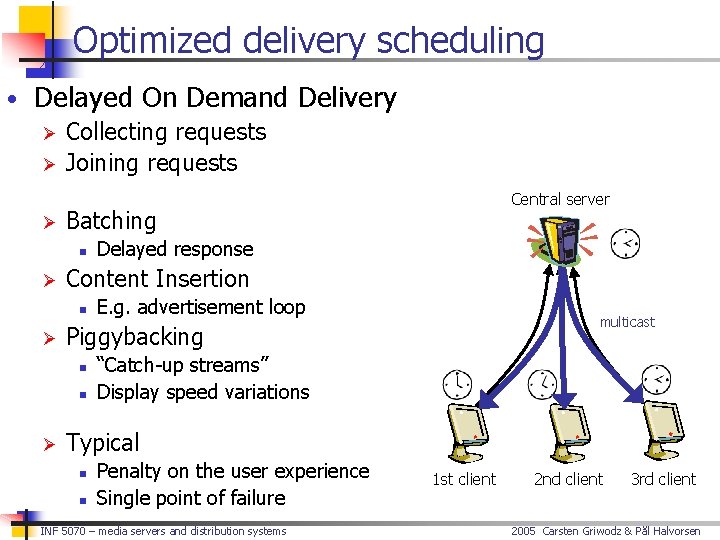
Optimized delivery scheduling • Delayed On Demand Delivery Ø Collecting requests Ø Joining requests Ø Batching n Ø E. g. advertisement loop multicast Piggybacking n n Ø Delayed response Content Insertion n Ø Central server “Catch-up streams” Display speed variations Typical n n Penalty on the user experience Single point of failure INF 5070 – media servers and distribution systems 1 st client 2 nd client 3 rd client 2005 Carsten Griwodz & Pål Halvorsen
![Batching & Content Insertion • Batching Operation [Dan, Sitaram, Shahabuddin 1994] Ø Ø Delay](http://slidetodoc.com/presentation_image/9173bdae06bc8aa9fe1d7e1ba2d1cefb/image-10.jpg "Batching & Content Insertion • Batching Operation [Dan, Sitaram, Shahabuddin 1994] Ø Ø Delay")
Batching & Content Insertion • Batching Operation [Dan, Sitaram, Shahabuddin 1994] Ø Ø Delay response Collect requests for same title • Batching Features Ø Simple decision process Ø Can consider popularity • Drawbacks Ø Obvious service delays Ø Limited savings INF 5070 – media servers and distribution systems • Content Insertion [Krishnan, Venkatesh, Little 1997] Ø Ø Reserve news or ad channels Fill gaps from ad channel • Content Insertion Features Ø Exploits user perception Ø Fill start gaps Ø Force stream joins by insertion Ø Increase forced joining after server crashes 2005 Carsten Griwodz & Pål Halvorsen
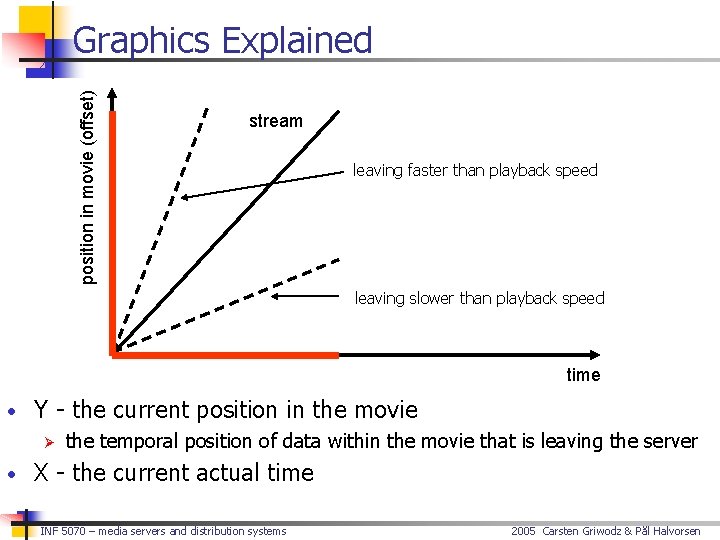
position in movie (offset) Graphics Explained stream leaving faster than playback speed leaving slower than playback speed time • Y - the current position in the movie Ø the temporal position of data within the movie that is leaving the server • X - the current actual time INF 5070 – media servers and distribution systems 2005 Carsten Griwodz & Pål Halvorsen
![Piggybacking [Golubchik, Lui, Muntz 1995] • Save resources by joining streams Ø Server resources](http://slidetodoc.com/presentation_image/9173bdae06bc8aa9fe1d7e1ba2d1cefb/image-12.jpg "Piggybacking [Golubchik, Lui, Muntz 1995] • Save resources by joining streams Ø Server resources")
Piggybacking [Golubchik, Lui, Muntz 1995] • Save resources by joining streams Ø Server resources Ø Network resources • Approach Ø Exploit limited user perception Ø Change playout speed n Up to +/- 5% are considered acceptable • Only minimum and maximum speed make sense Ø i. e. playout speeds n n 0 +10% INF 5070 – media servers and distribution systems 2005 Carsten Griwodz & Pål Halvorsen
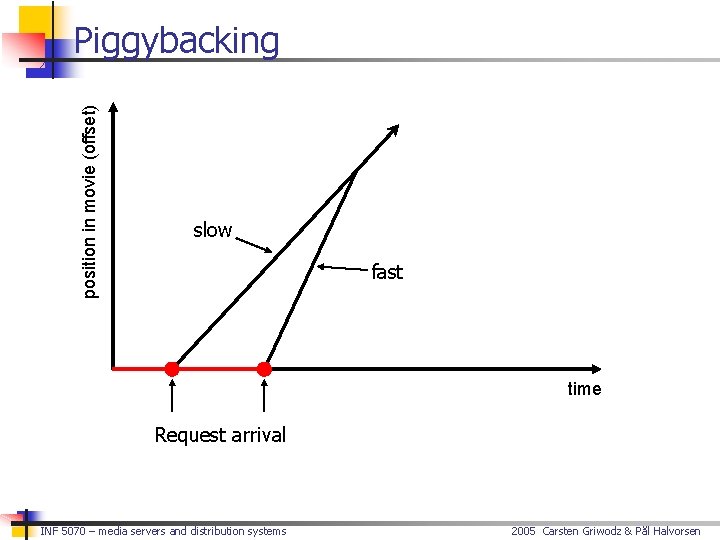
position in movie (offset) Piggybacking slow fast time Request arrival INF 5070 – media servers and distribution systems 2005 Carsten Griwodz & Pål Halvorsen
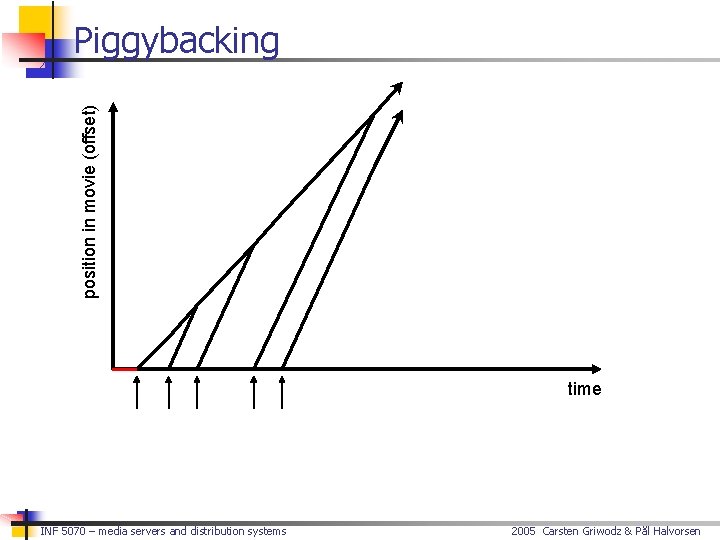
position in movie (offset) Piggybacking time INF 5070 – media servers and distribution systems 2005 Carsten Griwodz & Pål Halvorsen
![position in movie (offset) Adaptive Piggybacking time [Aggarwal, Wolf, Yu 1996] INF 5070 –](http://slidetodoc.com/presentation_image/9173bdae06bc8aa9fe1d7e1ba2d1cefb/image-15.jpg "position in movie (offset) Adaptive Piggybacking time [Aggarwal, Wolf, Yu 1996] INF 5070 –")
position in movie (offset) Adaptive Piggybacking time [Aggarwal, Wolf, Yu 1996] INF 5070 – media servers and distribution systems 2005 Carsten Griwodz & Pål Halvorsen
Type II: Prescheduled Delivery
Optimized delivery scheduling • Prescheduled Delivery Ø No back-channel Ø Non-linear transmission Ø Client buffering and re-ordering Ø Video segmentation Ø Examples n Ø Staggered broadcasting, Pyramid b. , Skyscraper b. , Fast b. , Pagoda b. , Harmonic b. , … Typical n n n Good theoretic performance High resource requirements Single point of failure INF 5070 – media servers and distribution systems 2005 Carsten Griwodz & Pål Halvorsen
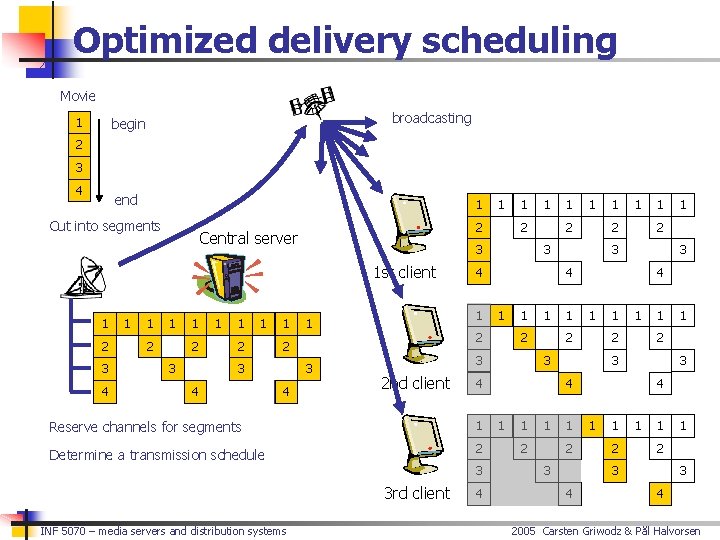
Optimized delivery scheduling Movie 1 broadcasting begin 2 3 4 end 1 Cut into segments 2 Central server 2 3 4 1 1 1 2 3 1 1 1 2 1 4 3 4 Determine a transmission schedule 2 3 3 rd client 4 1 2 1 1 1 2 3 1 1 1 2 2 1 3 1 2 3 3 4 1 1 2 1 1 1 2 3 4 1 2 4 1 1 4 3 1 1 2 4 4 1 1 3 3 Reserve channels for segments INF 5070 – media servers and distribution systems 2 2 2 nd client 1 4 1 1 2 3 1 st client 1 1 3 4 2005 Carsten Griwodz & Pål Halvorsen
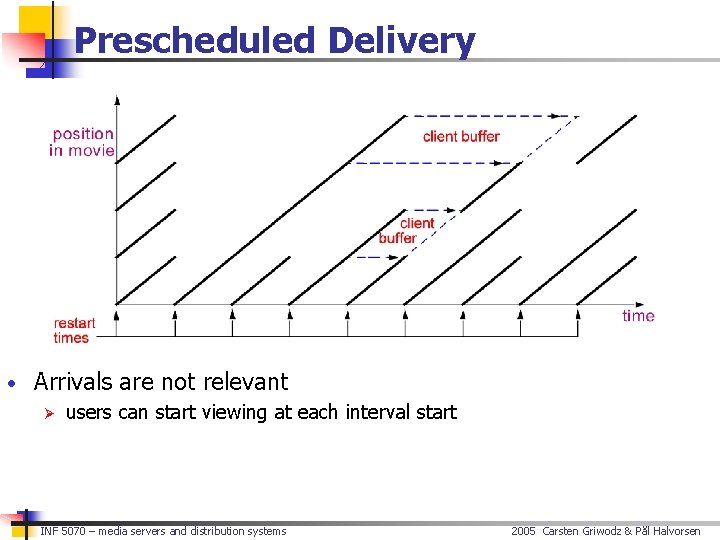
Prescheduled Delivery • Arrivals are not relevant Ø users can start viewing at each interval start INF 5070 – media servers and distribution systems 2005 Carsten Griwodz & Pål Halvorsen
![Staggered Broadcasting position in movie (offset) [Almeroth, Ammar 1996] Jump forward Continue Pause time](http://slidetodoc.com/presentation_image/9173bdae06bc8aa9fe1d7e1ba2d1cefb/image-20.jpg "Staggered Broadcasting position in movie (offset) [Almeroth, Ammar 1996] Jump forward Continue Pause time")
Staggered Broadcasting position in movie (offset) [Almeroth, Ammar 1996] Jump forward Continue Pause time Phase offset • Near Video-on-Demand Ø Applied in real systems Ø Limited interactivity is possible (jump, pause) Ø Popularity can be considered change phase offset INF 5070 – media servers and distribution systems 2005 Carsten Griwodz & Pål Halvorsen
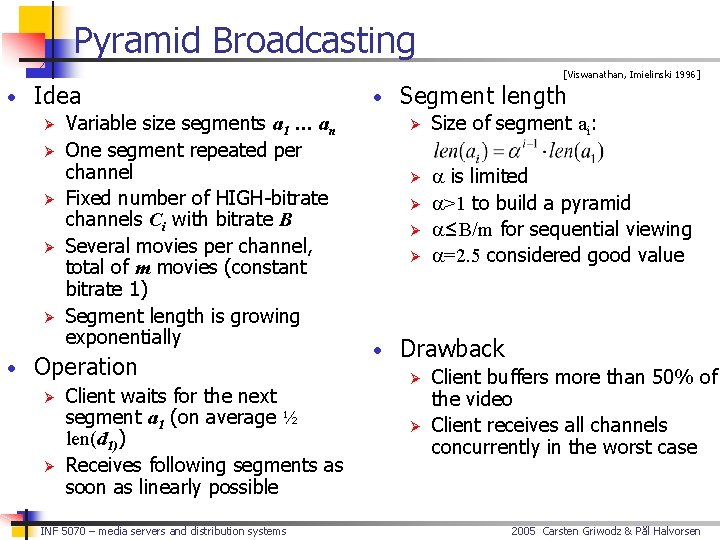
Pyramid Broadcasting • Idea Ø Variable size segments a 1 … an Ø One segment repeated per channel Ø Fixed number of HIGH-bitrate channels Ci with bitrate B Ø Several movies per channel, total of m movies (constant bitrate 1) Ø Segment length is growing exponentially • Operation Ø Client waits for the next segment a 1 (on average ½ len(d 1)) Ø Receives following segments as soon as linearly possible INF 5070 – media servers and distribution systems [Viswanathan, Imielinski 1996] • Segment length Ø Size of segment ai: Ø Ø a is limited a>1 to build a pyramid a≤B/m for sequential viewing a=2. 5 considered good value • Drawback Ø Client buffers more than 50% of the video Ø Client receives all channels concurrently in the worst case 2005 Carsten Griwodz & Pål Halvorsen
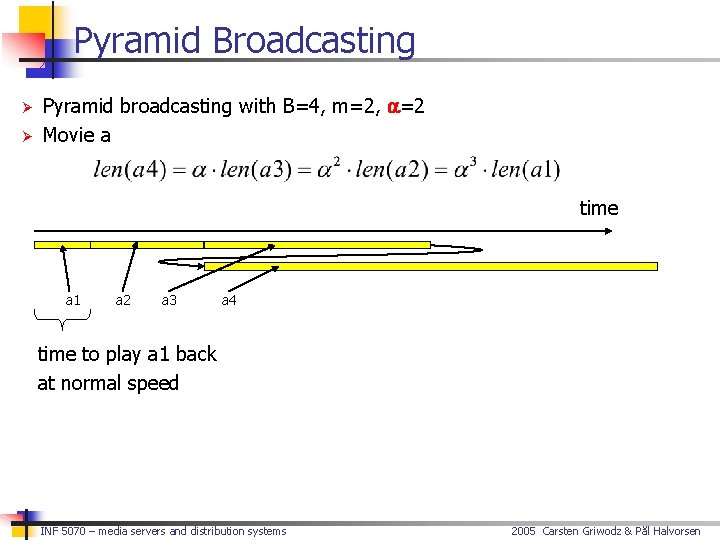
Pyramid Broadcasting Ø Ø Pyramid broadcasting with B=4, m=2, a=2 Movie a time a 1 a 2 a 3 a 4 time to play a 1 back at normal speed INF 5070 – media servers and distribution systems 2005 Carsten Griwodz & Pål Halvorsen
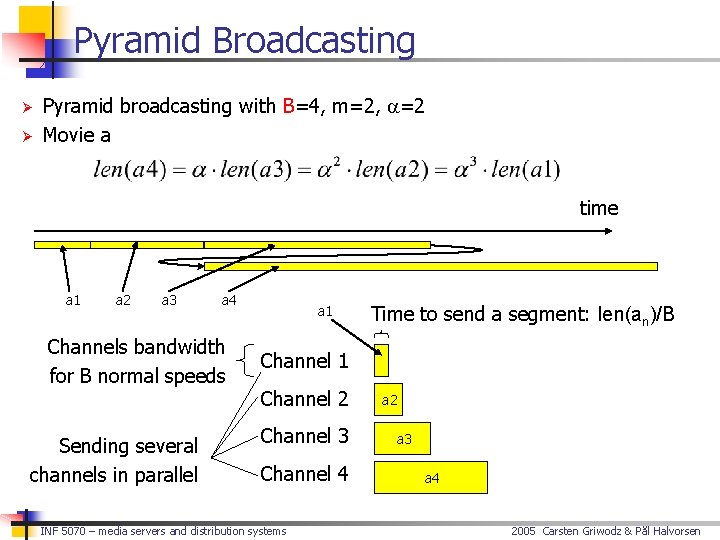
Pyramid Broadcasting Ø Ø Pyramid broadcasting with B=4, m=2, a=2 Movie a time a 1 a 2 a 3 a 4 Channels bandwidth for B normal speeds Sending several channels in parallel a 1 Time to send a segment: len(an)/B Channel 1 Channel 2 Channel 3 Channel 4 INF 5070 – media servers and distribution systems a 2 a 3 a 4 2005 Carsten Griwodz & Pål Halvorsen
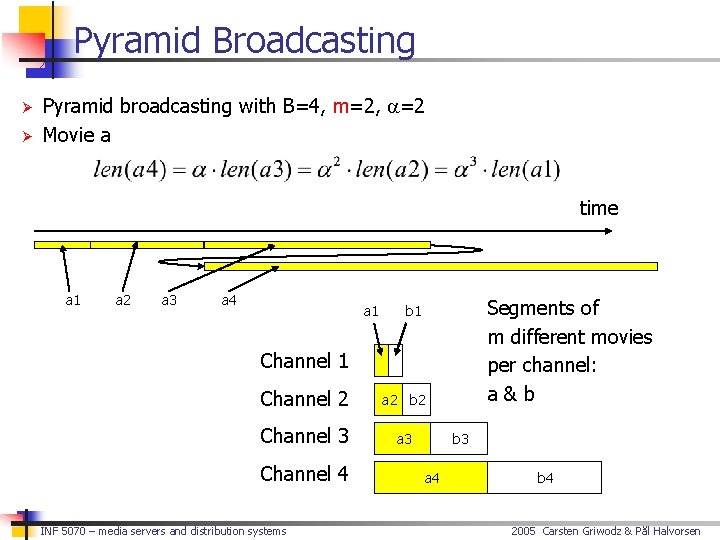
Pyramid Broadcasting Ø Ø Pyramid broadcasting with B=4, m=2, a=2 Movie a time a 1 a 2 a 3 a 4 a 1 Segments of m different movies per channel: a&b b 1 Channel 2 a 2 b 2 Channel 3 a 3 Channel 4 INF 5070 – media servers and distribution systems b 3 a 4 b 4 2005 Carsten Griwodz & Pål Halvorsen
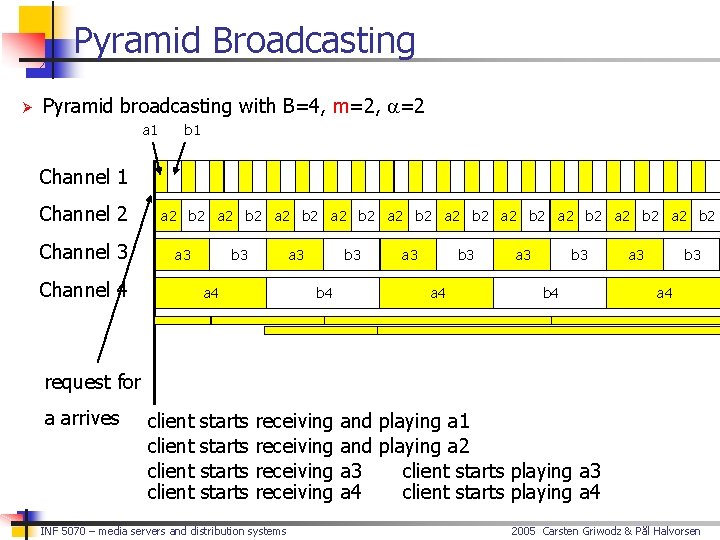
Pyramid Broadcasting Ø Pyramid broadcasting with B=4, m=2, a=2 a 1 b 1 Channel 2 Channel 3 a 2 b 2 a 2 b 2 a 2 b 2 a 3 Channel 4 b 3 a 4 b 3 b 4 a 3 b 3 a 4 a 3 b 3 a 4 request for a arrives client starts receiving INF 5070 – media servers and distribution systems and playing a 1 and playing a 2 a 3 client starts playing a 3 a 4 client starts playing a 4 2005 Carsten Griwodz & Pål Halvorsen
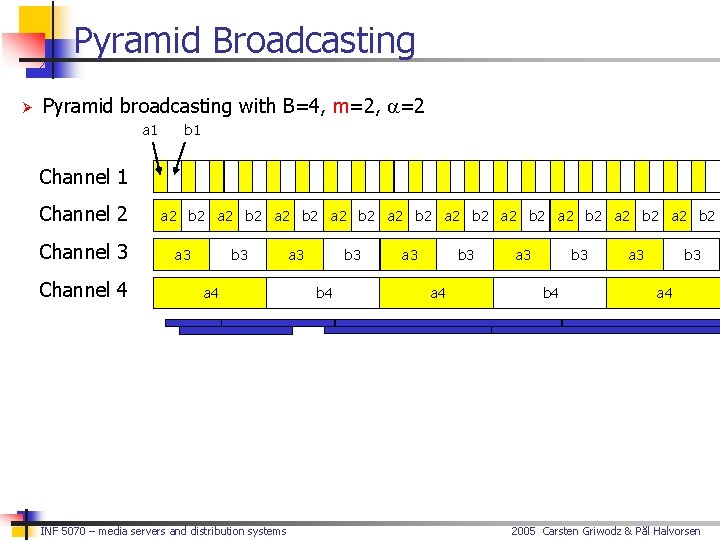
Pyramid Broadcasting Ø Pyramid broadcasting with B=4, m=2, a=2 a 1 b 1 Channel 2 Channel 3 Channel 4 a 2 b 2 a 2 b 2 a 2 b 2 a 3 b 3 a 4 INF 5070 – media servers and distribution systems a 3 b 3 b 4 a 3 b 3 a 4 2005 Carsten Griwodz & Pål Halvorsen
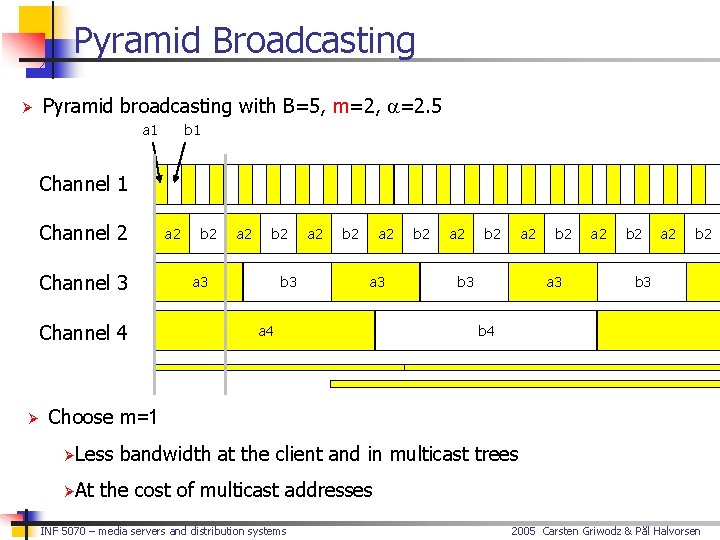
Pyramid Broadcasting Ø Pyramid broadcasting with B=5, m=2, a=2. 5 a 1 b 1 Channel 2 Channel 3 Channel 4 Ø a 2 b 2 a 3 b 3 a 2 b 2 a 3 a 4 b 2 a 2 b 3 b 2 a 3 a 2 b 2 b 3 b 4 Choose m=1 ØLess ØAt bandwidth at the client and in multicast trees the cost of multicast addresses INF 5070 – media servers and distribution systems 2005 Carsten Griwodz & Pål Halvorsen
![Skyscraper Broadcasting [Hua, Sheu 1997] • Idea Ø Fixed size segments Ø More than](http://slidetodoc.com/presentation_image/9173bdae06bc8aa9fe1d7e1ba2d1cefb/image-28.jpg "Skyscraper Broadcasting [Hua, Sheu 1997] • Idea Ø Fixed size segments Ø More than")
Skyscraper Broadcasting [Hua, Sheu 1997] • Idea Ø Fixed size segments Ø More than one segment per channel Ø Channel bandwidth is playback speed Ø Segments in a channel keep order Ø Channel allocation series n Ø Ø 1, 2, 2, 5, 5, 12, 25, 52, . . . Client receives at most 2 channels Client buffers at most 2 segments • Operation Ø Client waits for the next segment a 1 Ø Receive following segments as soon as linearly possible INF 5070 – media servers and distribution systems 2005 Carsten Griwodz & Pål Halvorsen
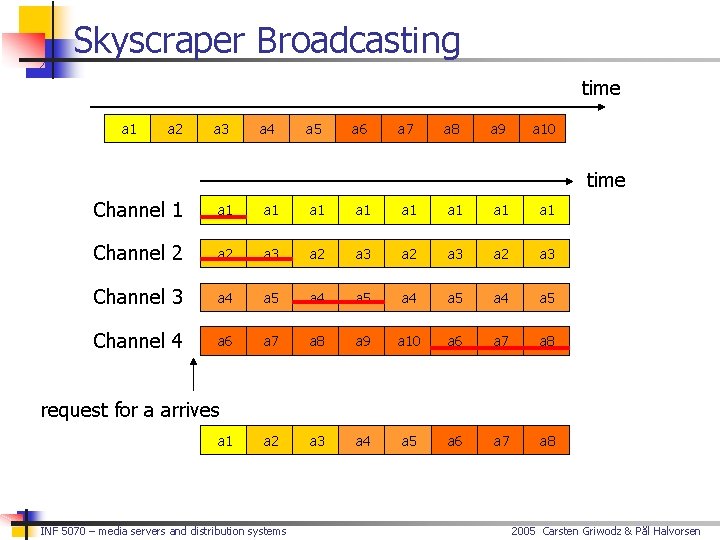
Skyscraper Broadcasting time a 1 a 2 a 3 a 4 a 5 a 6 a 7 a 8 a 9 a 10 time Channel 1 a 1 a 1 Channel 2 a 3 a 2 a 3 Channel 3 a 4 a 5 Channel 4 a 6 a 7 a 8 a 9 a 10 a 6 a 7 a 8 a 2 a 3 a 4 a 5 a 6 a 7 a 8 request for a arrives a 1 INF 5070 – media servers and distribution systems 2005 Carsten Griwodz & Pål Halvorsen
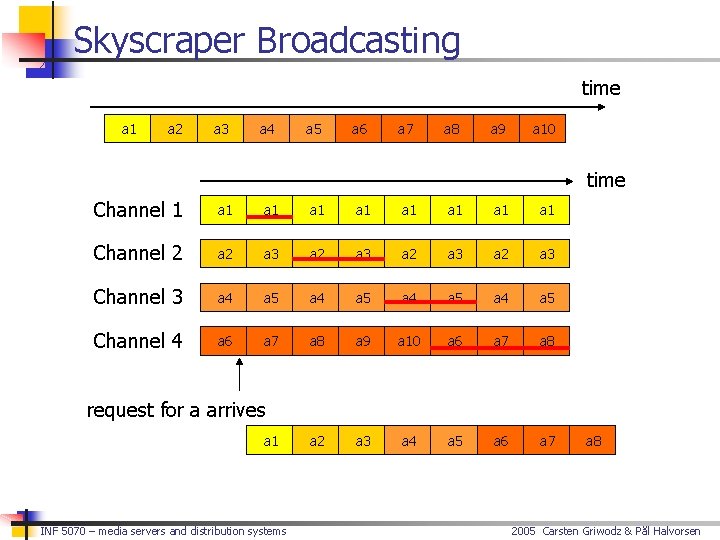
Skyscraper Broadcasting time a 1 a 2 a 3 a 4 a 5 a 6 a 7 a 8 a 9 a 10 time Channel 1 a 1 a 1 Channel 2 a 3 a 2 a 3 Channel 3 a 4 a 5 Channel 4 a 6 a 7 a 8 a 9 a 10 a 6 a 7 a 8 a 2 a 3 a 4 a 5 a 6 a 7 request for a arrives a 1 INF 5070 – media servers and distribution systems a 8 2005 Carsten Griwodz & Pål Halvorsen
![Other Pyramid Techniques [Juhn, Tseng 1998] • Fast Broadcasting Ø Many more, smaller segments](http://slidetodoc.com/presentation_image/9173bdae06bc8aa9fe1d7e1ba2d1cefb/image-31.jpg "Other Pyramid Techniques [Juhn, Tseng 1998] • Fast Broadcasting Ø Many more, smaller segments")
Other Pyramid Techniques [Juhn, Tseng 1998] • Fast Broadcasting Ø Many more, smaller segments n n Ø Channel allocation series n Ø Ø Ø Similar to previous Sequences of fixed-sized segments instead of different sized segments Exponential series: 1, 2, 4, 8, 16, 32, 64, . . . Segments in a channel keep order Shorter client waiting time for first segment Channel bandwidth is playback speed Client must receive all channels Client must buffer 50% of all data INF 5070 – media servers and distribution systems 2005 Carsten Griwodz & Pål Halvorsen
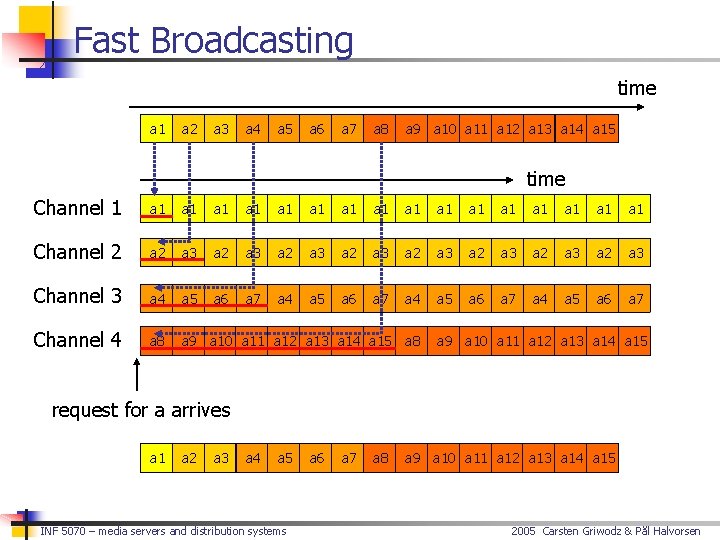
Fast Broadcasting time a 1 a 2 a 3 a 4 a 5 a 6 a 7 a 8 a 9 a 10 a 11 a 12 a 13 a 14 a 15 time Channel 1 a 1 a 1 a 1 a 1 Channel 2 a 3 a 2 a 3 a 2 a 3 Channel 3 a 4 a 5 a 6 a 7 Channel 4 a 8 a 9 a 10 a 11 a 12 a 13 a 14 a 15 request for a arrives a 1 a 2 a 3 a 4 a 5 INF 5070 – media servers and distribution systems a 6 a 7 a 8 a 9 a 10 a 11 a 12 a 13 a 14 a 15 2005 Carsten Griwodz & Pål Halvorsen
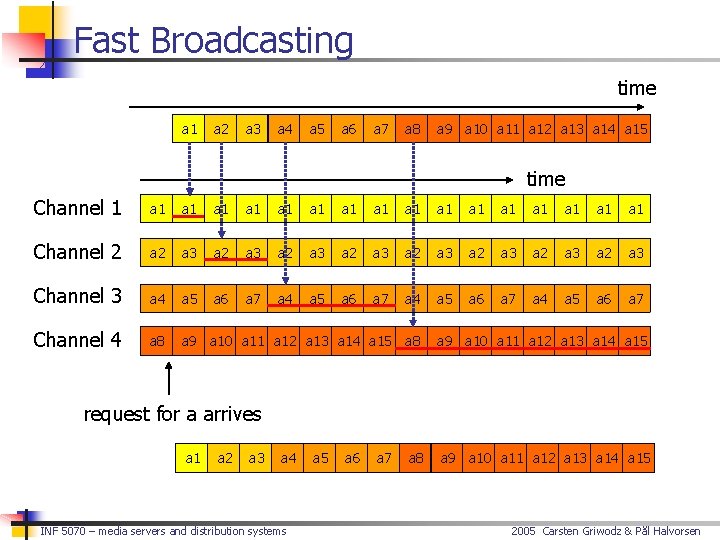
Fast Broadcasting time a 1 a 2 a 3 a 4 a 5 a 6 a 7 a 8 a 9 a 10 a 11 a 12 a 13 a 14 a 15 time Channel 1 a 1 a 1 a 1 a 1 Channel 2 a 3 a 2 a 3 a 2 a 3 Channel 3 a 4 a 5 a 6 a 7 Channel 4 a 8 a 9 a 10 a 11 a 12 a 13 a 14 a 15 request for a arrives a 1 a 2 a 3 a 4 INF 5070 – media servers and distribution systems a 5 a 6 a 7 a 8 a 9 a 10 a 11 a 12 a 13 a 14 a 15 2005 Carsten Griwodz & Pål Halvorsen
![Other Pyramid Techniques [Paris, Carter, Long 1999] • Pagoda Broadcasting Ø Channel allocation series](http://slidetodoc.com/presentation_image/9173bdae06bc8aa9fe1d7e1ba2d1cefb/image-34.jpg "Other Pyramid Techniques [Paris, Carter, Long 1999] • Pagoda Broadcasting Ø Channel allocation series")
Other Pyramid Techniques [Paris, Carter, Long 1999] • Pagoda Broadcasting Ø Channel allocation series n Ø Ø Ø 1, 3, 5, 15, 25, 75, 125 Segments are not broadcast linearly Consecutive segments appear on pairs of channels Client must receive up to 7 channels n For more channels, a different series is needed ! Ø Client must buffer 45% of all data Ø Based on the following n n n Segment … 1 2 3 4 – – needed every round at least every 2 nd round at least every 3 rd round at least every 4 th round INF 5070 – media servers and distribution systems 2005 Carsten Griwodz & Pål Halvorsen
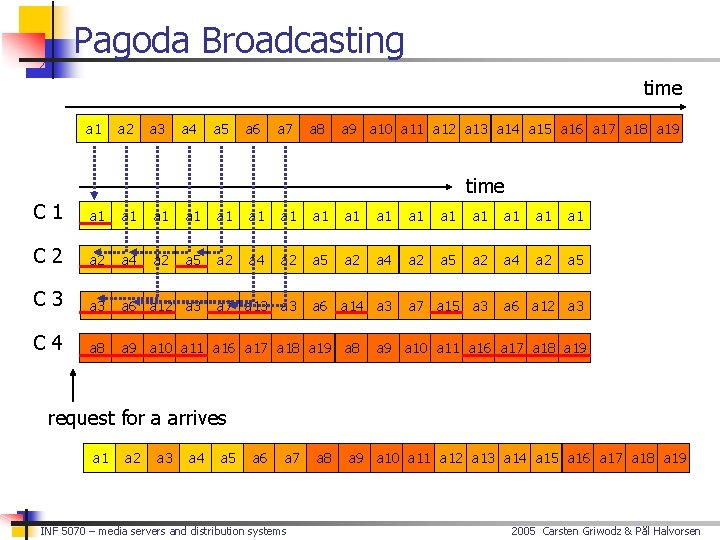
Pagoda Broadcasting time a 1 a 2 a 3 a 4 a 5 a 6 a 7 a 8 a 9 a 10 a 11 a 12 a 13 a 14 a 15 a 16 a 17 a 18 a 19 time C 1 a 1 a 1 a 1 a 1 C 2 a 4 a 2 a 5 a 2 a 4 a 2 a 5 C 3 a 6 a 12 a 3 C 4 a 8 a 9 a 10 a 11 a 16 a 17 a 18 a 19 a 8 a 7 a 13 a 6 a 14 a 3 a 7 a 15 a 3 a 6 a 12 a 3 a 9 a 10 a 11 a 16 a 17 a 18 a 19 request for a arrives a 1 a 2 a 3 a 4 a 5 a 6 a 7 INF 5070 – media servers and distribution systems a 8 a 9 a 10 a 11 a 12 a 13 a 14 a 15 a 16 a 17 a 18 a 19 2005 Carsten Griwodz & Pål Halvorsen
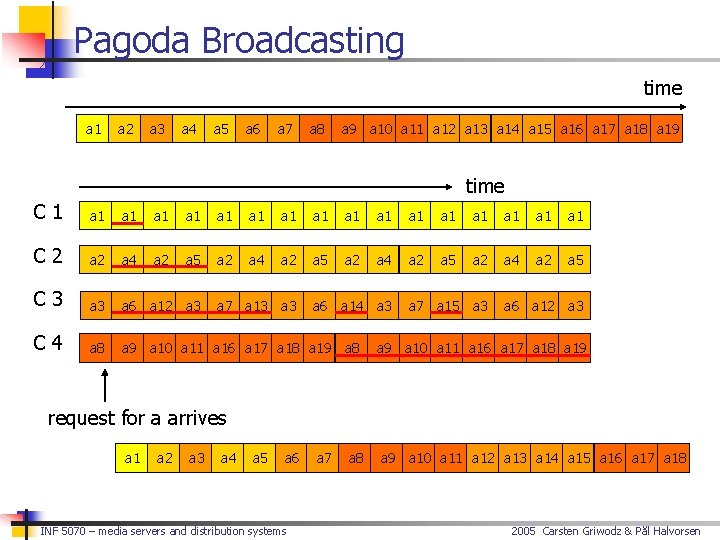
Pagoda Broadcasting time a 1 a 2 a 3 a 4 a 5 a 6 a 7 a 8 a 9 a 10 a 11 a 12 a 13 a 14 a 15 a 16 a 17 a 18 a 19 time C 1 a 1 a 1 a 1 a 1 C 2 a 4 a 2 a 5 a 2 a 4 a 2 a 5 C 3 a 6 a 12 a 3 C 4 a 8 a 9 a 10 a 11 a 16 a 17 a 18 a 19 a 8 a 7 a 13 a 6 a 14 a 3 a 7 a 15 a 3 a 6 a 12 a 3 a 9 a 10 a 11 a 16 a 17 a 18 a 19 request for a arrives a 1 a 2 a 3 a 4 a 5 a 6 INF 5070 – media servers and distribution systems a 7 a 8 a 9 a 10 a 11 a 12 a 13 a 14 a 15 a 16 a 17 a 18 2005 Carsten Griwodz & Pål Halvorsen
Harmonic Broadcasting • Idea Ø Fixed size segments Ø One segment repeated per channel Ø Later segments can be sent at lower bitrates Ø Receive all other segments concurrently Ø Harmonic series determines bitrates n n [Juhn, Tseng 1997] Bitrate(ai) = Playout-rate(ai)/i Bitrates 1/1, 1/2, 1/3, 1/4, 1/5, 1/6, … • Consideration Ø Size of a 1 determines client start-up delay Ø Growing number of segments allows smaller a 1 Ø Required server bitrate grows very slowly with number of segments • Drawback Ø Client buffers about 37% of the video for >=20 channels Ø (Client must re-order small video portions) Ø Complex memory cache for disk access necessary INF 5070 – media servers and distribution systems 2005 Carsten Griwodz & Pål Halvorsen
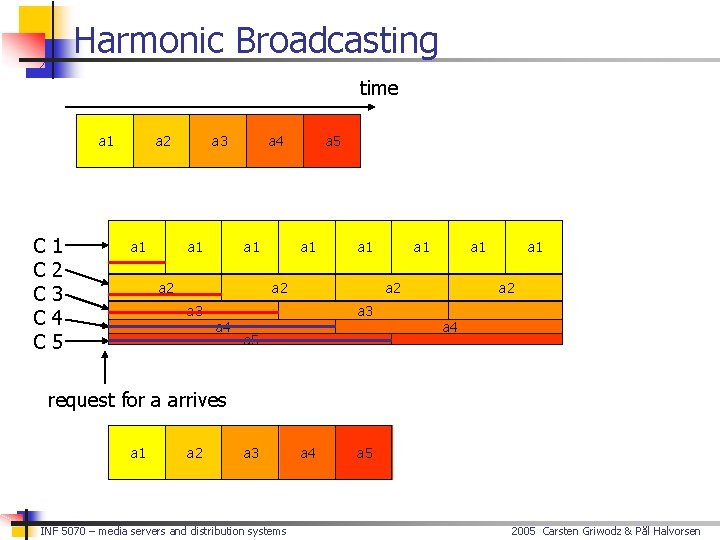
Harmonic Broadcasting time a 1 C C C 1 2 3 4 5 a 2 a 1 a 3 a 1 a 4 a 1 a 2 a 5 a 1 a 2 a 3 a 4 a 1 a 2 a 3 a 5 a 1 a 2 a 4 request for a arrives a 1 a 2 a 3 INF 5070 – media servers and distribution systems a 4 a 5 2005 Carsten Griwodz & Pål Halvorsen
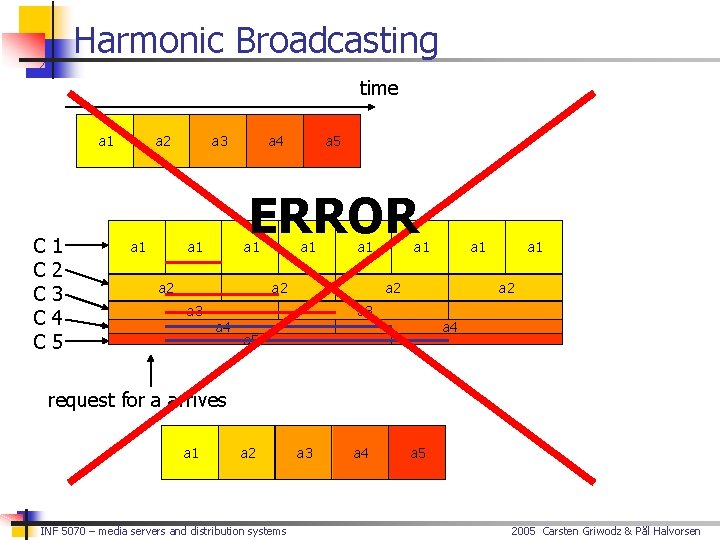
Harmonic Broadcasting time a 1 C C C 1 2 3 4 5 a 2 a 1 a 3 a 4 a 5 ERROR a 1 a 1 a 2 a 3 a 4 a 1 a 2 a 3 a 4 a 5 request for a arrives a 1 a 2 INF 5070 – media servers and distribution systems a 3 a 4 a 5 2005 Carsten Griwodz & Pål Halvorsen
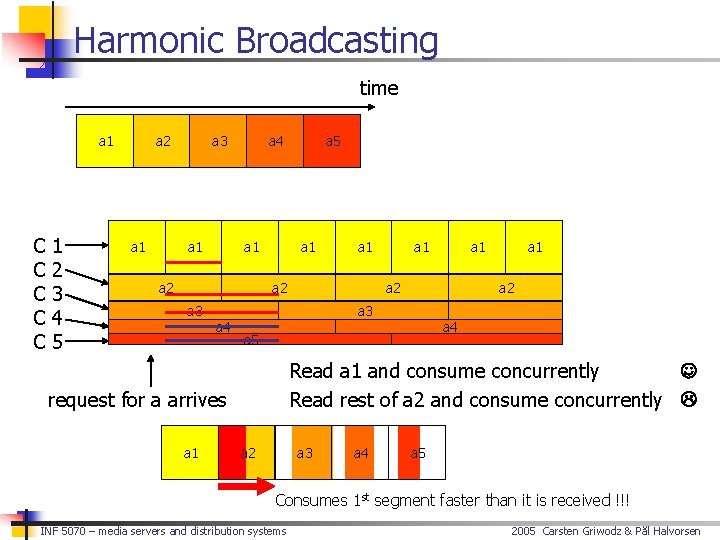
Harmonic Broadcasting time a 1 C C C 1 2 3 4 5 a 2 a 1 a 3 a 1 a 4 a 1 a 2 a 5 a 1 a 2 a 3 a 4 a 5 Read a 1 and consume concurrently Read rest of a 2 and consume concurrently request for a arrives a 1 a 2 a 3 a 4 a 5 Consumes 1 st segment faster than it is received !!! INF 5070 – media servers and distribution systems 2005 Carsten Griwodz & Pål Halvorsen
![Other Harmonic Techniques [By Paris, Long, …] • Delayed Harmonic Broadcasting Ø Wait until](http://slidetodoc.com/presentation_image/9173bdae06bc8aa9fe1d7e1ba2d1cefb/image-41.jpg "Other Harmonic Techniques [By Paris, Long, …] • Delayed Harmonic Broadcasting Ø Wait until")
Other Harmonic Techniques [By Paris, Long, …] • Delayed Harmonic Broadcasting Ø Wait until a 1 is fully buffered Ø All segments will be completely cached before playout Ø Fixes the bug in Harmonic Broadcasting • Cautious Harmonic Broadcasting Ø Wait an additional a 1 time Ø Starts the harmonic series with a 2 instead of a 1 Ø Fixes the bug in Harmonic Broadcasting INF 5070 – media servers and distribution systems 2005 Carsten Griwodz & Pål Halvorsen
Other Harmonic Techniques • Polyharmonic Broadcasting Ø Generalizes CHB waiting time to m>=1 times for a 1 Ø Client starts buffering immediately Ø Reduce bandwidth on subsequent channels b/(m+i-1) instead of b/i Ø Converges to standard Harmonic Broadcasting behavior INF 5070 – media servers and distribution systems 2005 Carsten Griwodz & Pål Halvorsen
Prescheduled Delivery Evaluation • Techniques Ø Video segmentation Ø Varying transmission speeds Ø Re-ordering of data Ø Client buffering • Advantage Ø Achieve server resource reduction • Problems Ø Tend to require complex client processing Ø May require large client buffers Ø Are incapable (or not proven) to work with user interactivity n Ø Current research to work with VCR controls Guaranteed bandwidth required INF 5070 – media servers and distribution systems 2005 Carsten Griwodz & Pål Halvorsen
Type III: Client Side Caching
Optimized delivery scheduling • Client Side Caching Ø On-demand delivery Ø Client buffering Ø Multicast complete movie Ø Unicast start of movie for latecomers (patch) • Examples Ø Stream Tapping, Patching, Hierarchical Streaming Merging, … • Typical Ø Considerable client resources Ø Single point of failure INF 5070 – media servers and distribution systems 2005 Carsten Griwodz & Pål Halvorsen
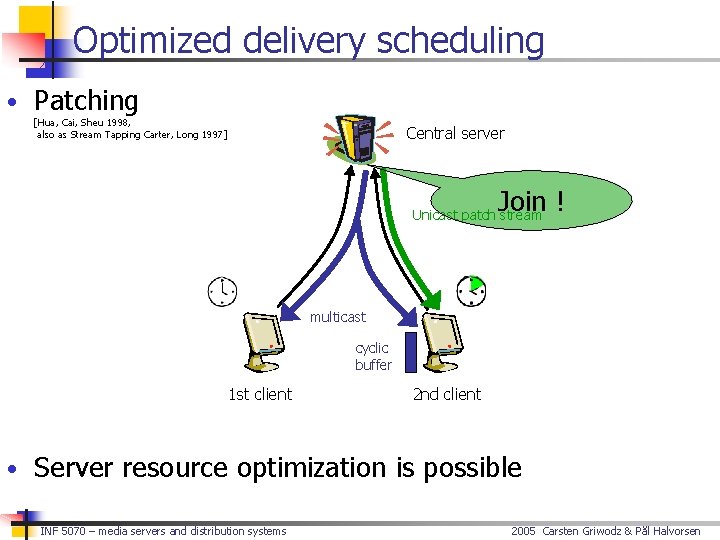
Optimized delivery scheduling • Patching [Hua, Cai, Sheu 1998, also as Stream Tapping Carter, Long 1997] Central server Join ! Unicast patch stream multicast cyclic buffer 1 st client 2 nd client • Server resource optimization is possible INF 5070 – media servers and distribution systems 2005 Carsten Griwodz & Pål Halvorsen
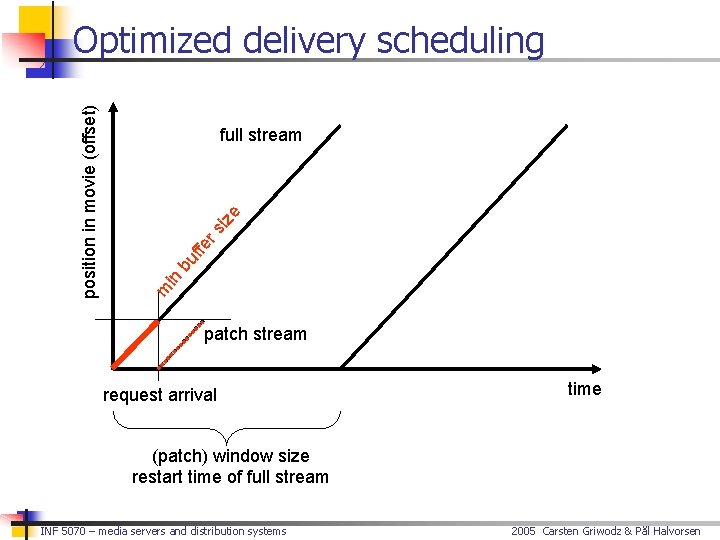
in bu f fe rs ize full stream m position in movie (offset) Optimized delivery scheduling patch stream request arrival time (patch) window size restart time of full stream INF 5070 – media servers and distribution systems 2005 Carsten Griwodz & Pål Halvorsen
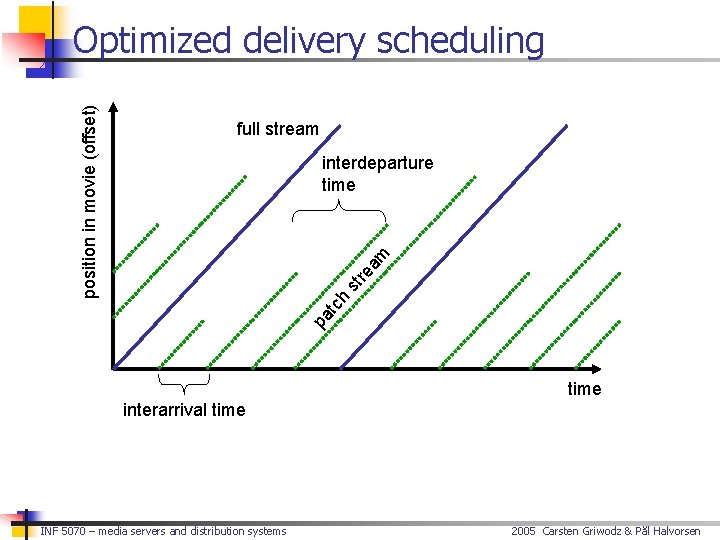
full stream h st re am interdeparture time pa tc position in movie (offset) Optimized delivery scheduling time interarrival time INF 5070 – media servers and distribution systems 2005 Carsten Griwodz & Pål Halvorsen
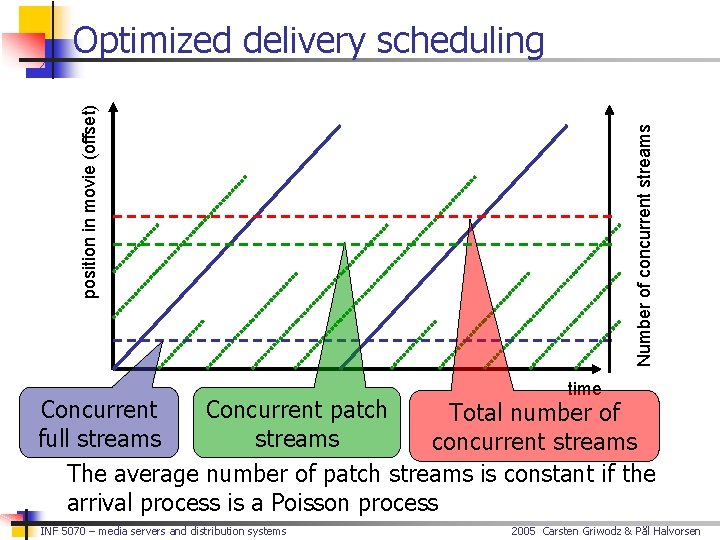
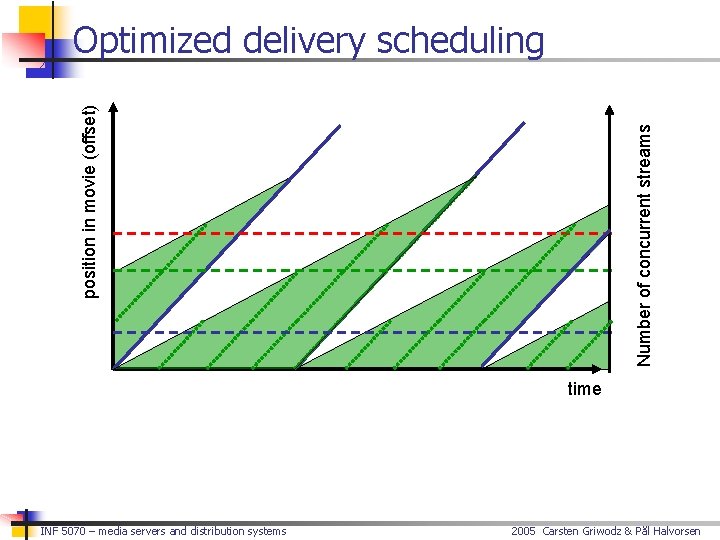
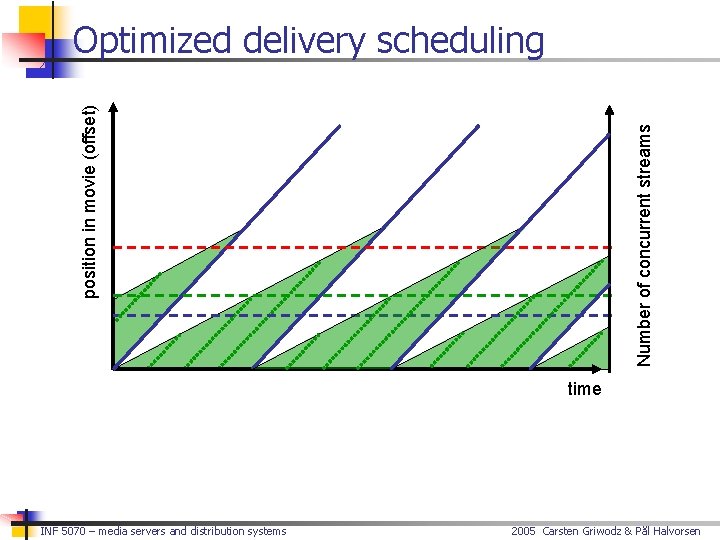
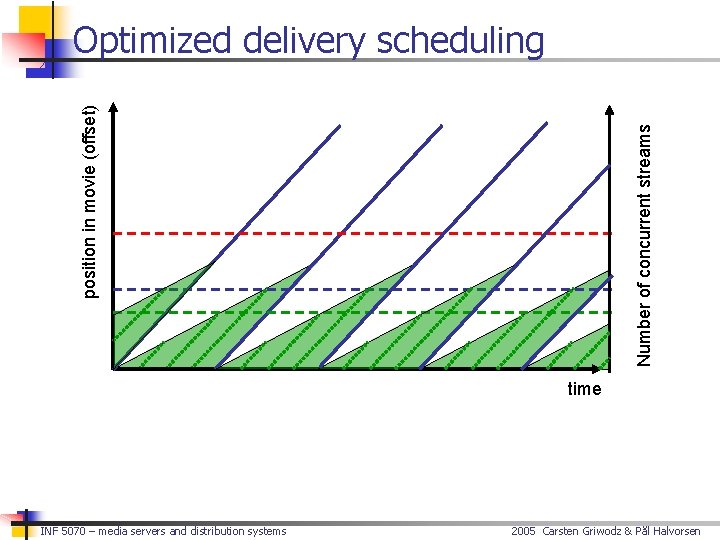
Number of concurrent streams position in movie (offset) Optimized delivery scheduling time Concurrent patch Total number of full streams concurrent streams The average number of patch streams is constant if the arrival process is a Poisson process INF 5070 – media servers and distribution systems 2005 Carsten Griwodz & Pål Halvorsen
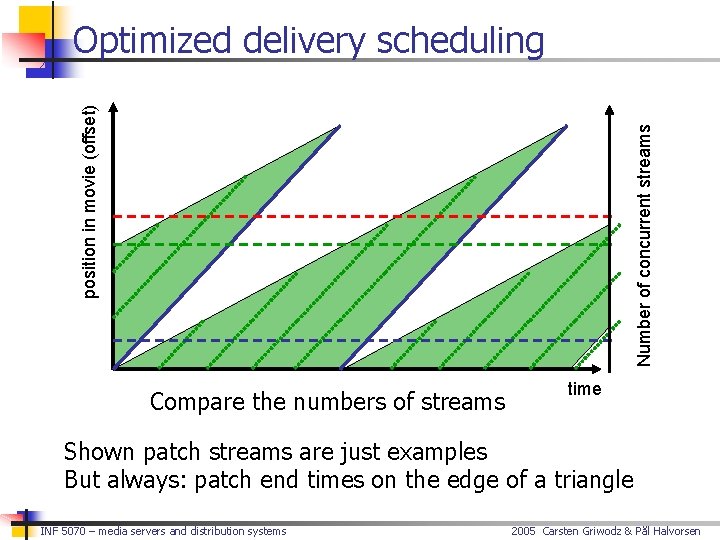
Number of concurrent streams position in movie (offset) Optimized delivery scheduling Compare the numbers of streams time Shown patch streams are just examples But always: patch end times on the edge of a triangle INF 5070 – media servers and distribution systems 2005 Carsten Griwodz & Pål Halvorsen
Number of concurrent streams position in movie (offset) Optimized delivery scheduling time INF 5070 – media servers and distribution systems 2005 Carsten Griwodz & Pål Halvorsen
Number of concurrent streams position in movie (offset) Optimized delivery scheduling time INF 5070 – media servers and distribution systems 2005 Carsten Griwodz & Pål Halvorsen
Number of concurrent streams position in movie (offset) Optimized delivery scheduling time INF 5070 – media servers and distribution systems 2005 Carsten Griwodz & Pål Halvorsen
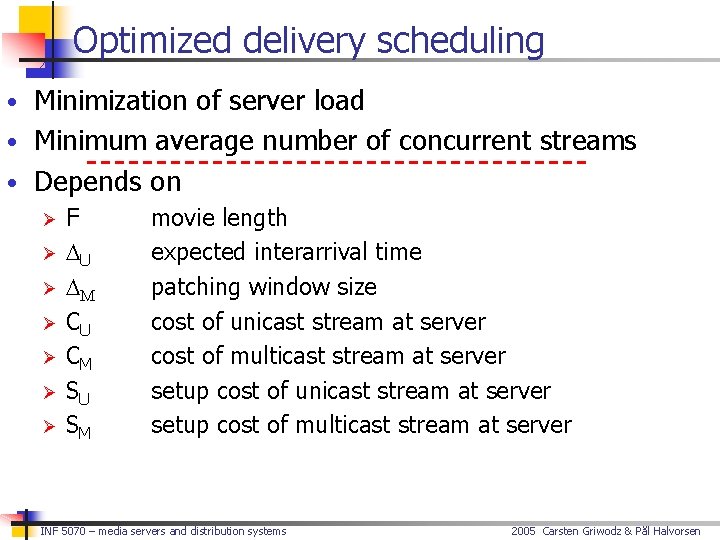
Optimized delivery scheduling • Minimization of server load • Minimum average number of concurrent streams • Depends Ø F Ø DU Ø DM Ø CU Ø CM Ø SU Ø SM on movie length expected interarrival time patching window size cost of unicast stream at server cost of multicast stream at server setup cost of unicast stream at server setup cost of multicast stream at server INF 5070 – media servers and distribution systems 2005 Carsten Griwodz & Pål Halvorsen
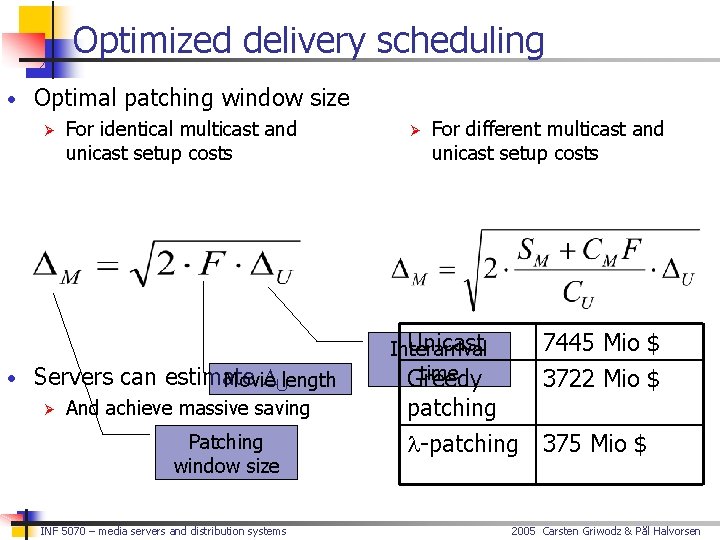
Optimized delivery scheduling • Optimal patching window size Ø For identical multicast and unicast setup costs • Servers can estimate DUlength Movie Ø And achieve massive saving Patching window size INF 5070 – media servers and distribution systems Ø For different multicast and unicast setup costs Unicast Interarrival time Greedy 7445 Mio $ 3722 Mio $ patching l-patching 375 Mio $ 2005 Carsten Griwodz & Pål Halvorsen
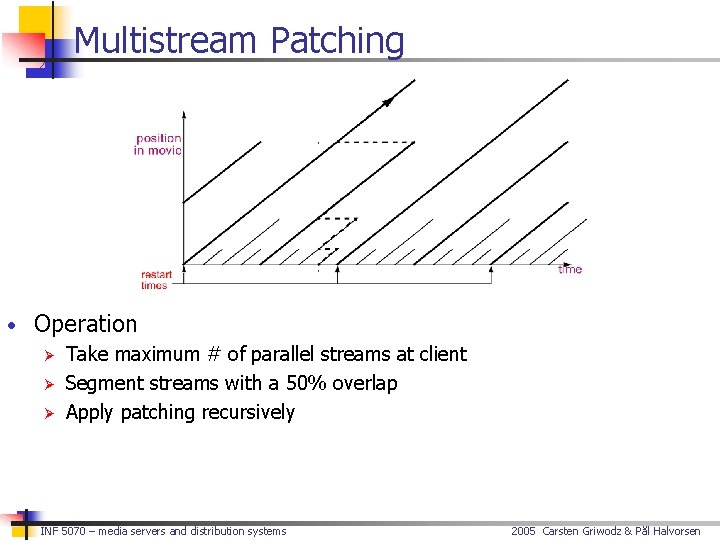
Multistream Patching • Operation Ø Take maximum # of parallel streams at client Ø Segment streams with a 50% overlap Ø Apply patching recursively INF 5070 – media servers and distribution systems 2005 Carsten Griwodz & Pål Halvorsen
![HMSM • Hierarchical Multicast Stream Merging [Eager, Vernon, Zahorjan 2001] • Key ideas Ø](http://slidetodoc.com/presentation_image/9173bdae06bc8aa9fe1d7e1ba2d1cefb/image-57.jpg "HMSM • Hierarchical Multicast Stream Merging [Eager, Vernon, Zahorjan 2001] • Key ideas Ø")
HMSM • Hierarchical Multicast Stream Merging [Eager, Vernon, Zahorjan 2001] • Key ideas Ø Each data transmission uses multicast Ø Clients accumulate data faster than their playout rate n n Ø Ø multiple streams accelerated streams Clients are merged in large multicast groups Merged clients continue to listen to the same stream to the end • Combines Ø Dynamic skyscraper Ø Piggybacking Ø Patching INF 5070 – media servers and distribution systems 2005 Carsten Griwodz & Pål Halvorsen
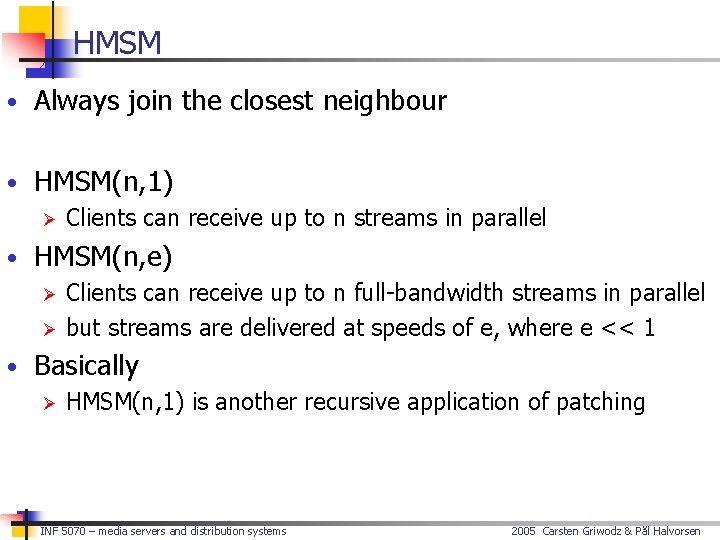
HMSM • Always join the closest neighbour • HMSM(n, 1) Ø Clients can receive up to n streams in parallel • HMSM(n, e) Ø Clients can receive up to n full-bandwidth streams in parallel Ø but streams are delivered at speeds of e, where e << 1 • Basically Ø HMSM(n, 1) is another recursive application of patching INF 5070 – media servers and distribution systems 2005 Carsten Griwodz & Pål Halvorsen
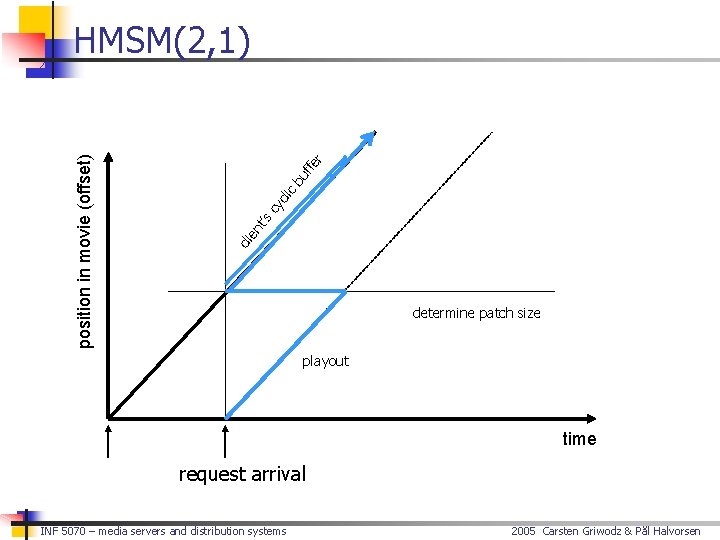
ffe r bu c cli cy ’s en t cli position in movie (offset) HMSM(2, 1) determine patch size playout time request arrival INF 5070 – media servers and distribution systems 2005 Carsten Griwodz & Pål Halvorsen
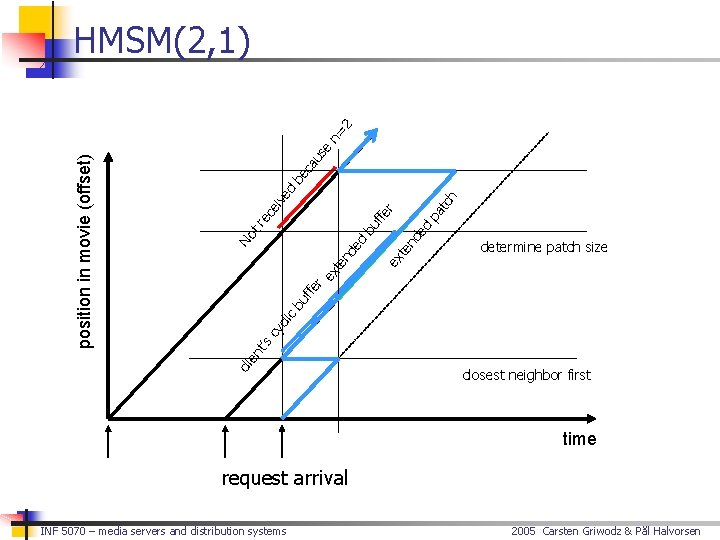
us ca be d ex te n de d bu d nd e cy cli c bu ffe r ex te pa ffe r tc h ce ive re No t determine patch size en t’s cli position in movie (offset) e n= 2 HMSM(2, 1) closest neighbor first time request arrival INF 5070 – media servers and distribution systems 2005 Carsten Griwodz & Pål Halvorsen
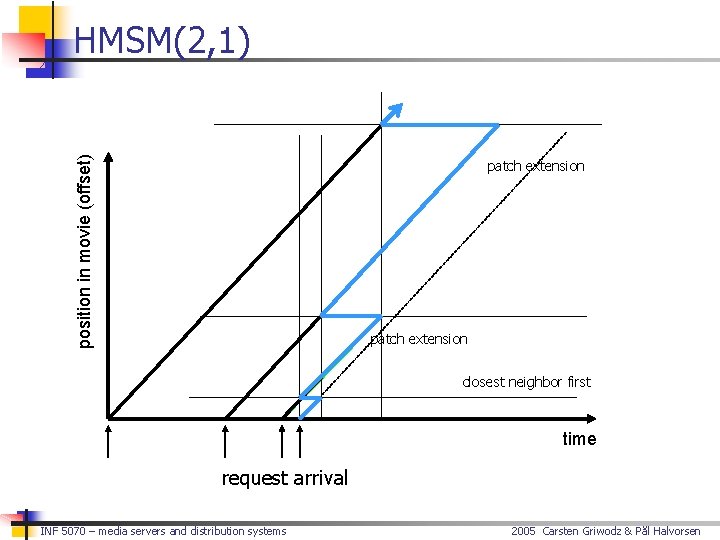
position in movie (offset) HMSM(2, 1) patch extension closest neighbor first time request arrival INF 5070 – media servers and distribution systems 2005 Carsten Griwodz & Pål Halvorsen
Client Side Caching Evaluation • Techniques Ø Video segmentation Ø Parallel reception of streams Ø Client buffering • Advantage Ø Achieves server resource reduction Ø Achieves True Vo. D behaviour • Problems Ø Optimum can not be achieved on average case Ø Needs combination with prescheduled technique for high-popularity titles Ø May require large client buffers Ø Are incapable (or not proven) to work with user interactivity Ø Guaranteed bandwidth required INF 5070 – media servers and distribution systems 2005 Carsten Griwodz & Pål Halvorsen
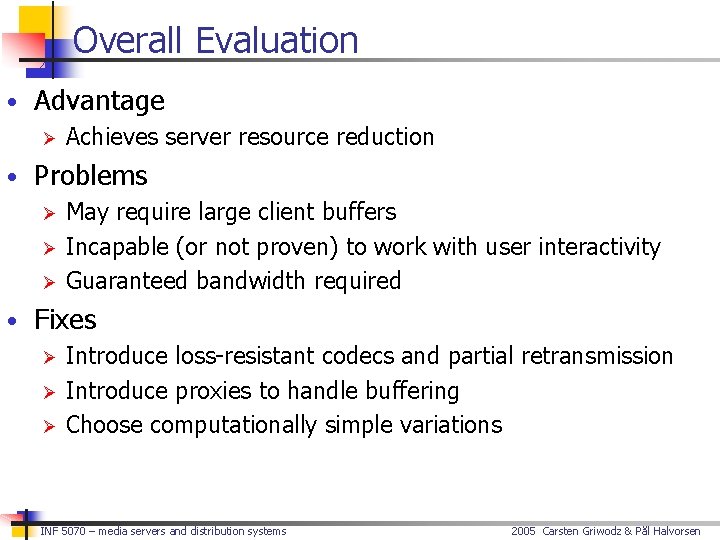
Overall Evaluation • Advantage Ø Achieves server resource reduction • Problems Ø May require large client buffers Ø Incapable (or not proven) to work with user interactivity Ø Guaranteed bandwidth required • Fixes Ø Introduce loss-resistant codecs and partial retransmission Ø Introduce proxies to handle buffering Ø Choose computationally simple variations INF 5070 – media servers and distribution systems 2005 Carsten Griwodz & Pål Halvorsen
- Slides: 63