
INF 111 CSE 121 Software Tools and Methods


- Slides: 23
INF 111 / CSE 121: Software Tools and Methods Lecture Notes for Fall Quarter, 2007 Michele Rousseau Set 12 (Some slides adapted from Sommerville 2000 & Scott Miller) Topic 12
Announcements Quiz #2 – Still on Monday 10/29/07 ● WILL INCLUDE: ◘ All readings assigned since the last quiz not in the “WILL NOT INCLUDE LIST” ◘ The lecture on 10/12 (except the MMM) ◘ Lectures from 10/12 – 10/26 (today) • (Slide sets 7 through slide set 12) ● WILL NOT INCLUDE: ◘ Ch 2 from “The Mythical Man-Month” ◘ Van Vliet Ch. 4 will not be included on this quiz Quiz #1 – Regrades need to be turned in by next Wednesday ● Come to my office hours tomorrow from 10: 3011: 30 a if you have questions on regrades ● Will regrades be accepted after Wednesday Topic 12 2
Announcements (2) Assignment #1 is due next week ● If you are having technical difficulties with Checkmate ● Make sure you notify me before the deadline ● Homework submissions made after the deadline will not be accepted ◘ …Without a good excuse ◘ If you have a good excuse then it is essential you notify us prior to the deadline ◘ … if possible ● Please don’t submit it the next day and say “ I couldn’t get checkmate to work here’s my assignment” because ◘ … I can’t fairly give you credit and I don’t like having to not give you credit Topic 12 3
Previously in INF 111… More on Testing ● Test Adequacy ◘ Coverage Based Testing Topic 12 4
Today’s Lecture Equivalence Partitioning & Boundary Value Analysis Integration Testing ● Top-Down ● Bottom Up Topic 12 5
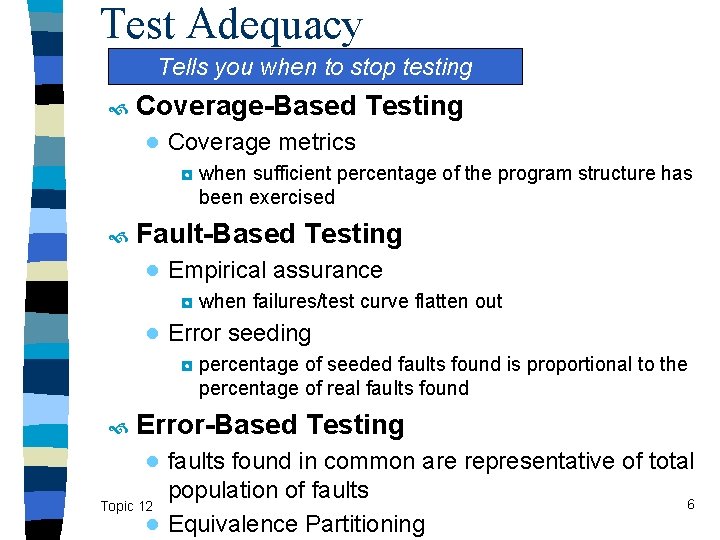
Test Adequacy Tells you when to stop testing Coverage-Based Testing ● Coverage metrics ◘ when sufficient percentage of the program structure has been exercised Fault-Based Testing ● Empirical assurance ◘ when failures/test curve flatten out ● Error seeding ◘ percentage of seeded faults found is proportional to the percentage of real faults found Error-Based Testing ● faults found in common are representative of total population of faults 6 Topic 12 ● Equivalence Partitioning
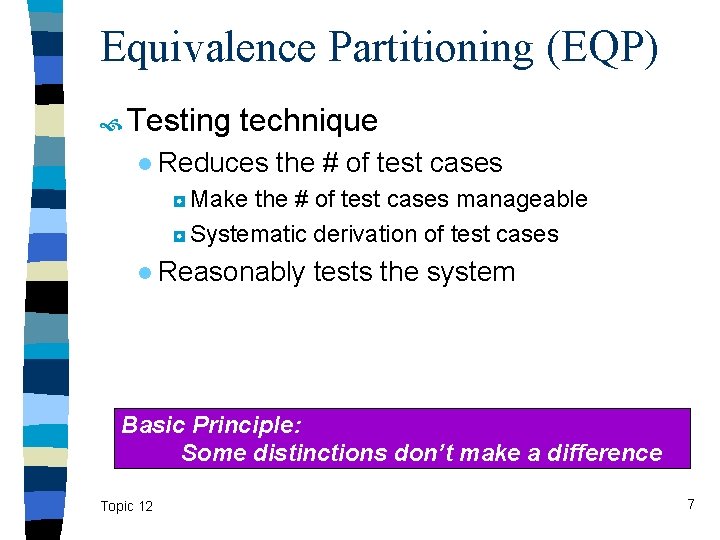
Equivalence Partitioning (EQP) Testing technique ● Reduces the # of test cases ◘ Make the # of test cases manageable ◘ Systematic derivation of test cases ● Reasonably tests the system Basic Principle: Some distinctions don’t make a difference Topic 12 7
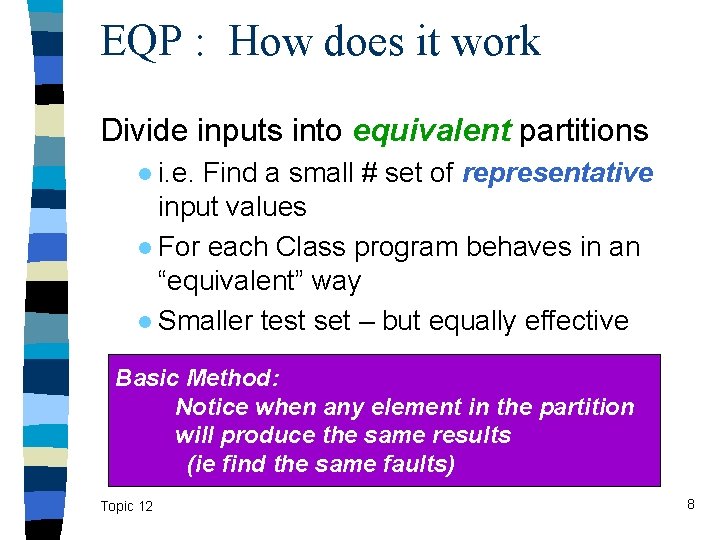
EQP : How does it work Divide inputs into equivalent partitions ● i. e. Find a small # set of representative input values ● For each Class program behaves in an “equivalent” way ● Smaller test set – but equally effective Basic Method: Notice when any element in the partition will produce the same results (ie find the same faults) Topic 12 8
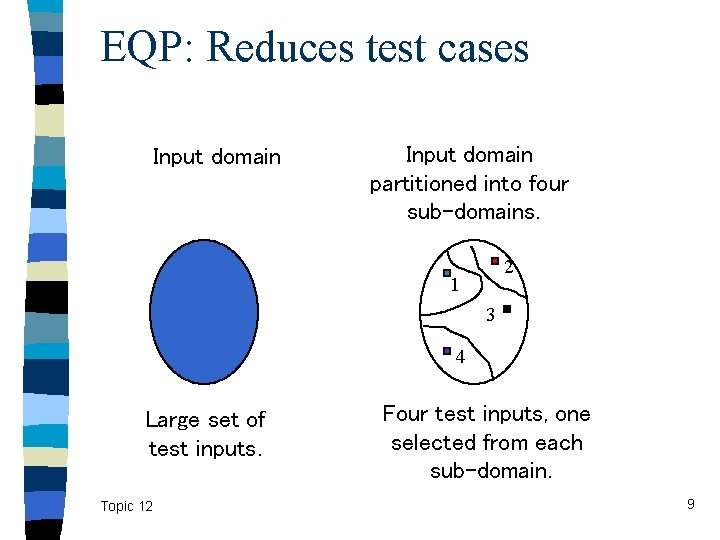
EQP: Reduces test cases Input domain partitioned into four sub-domains. 2 1 3 4 Large set of test inputs. Topic 12 Four test inputs, one selected from each sub-domain. 9
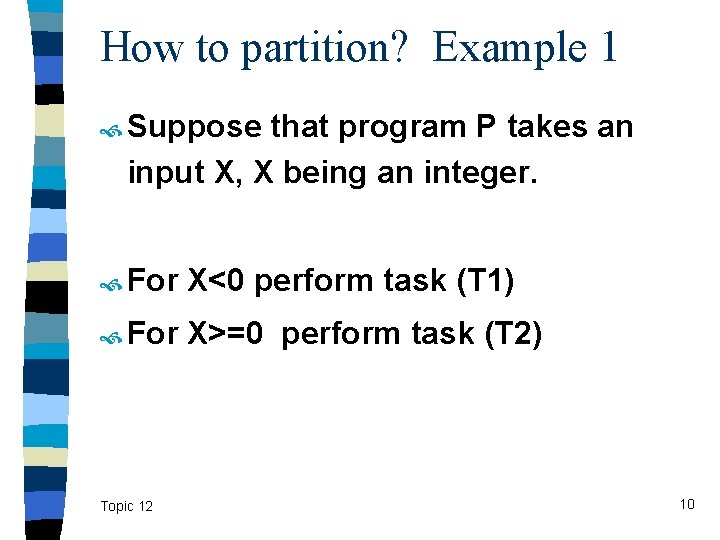
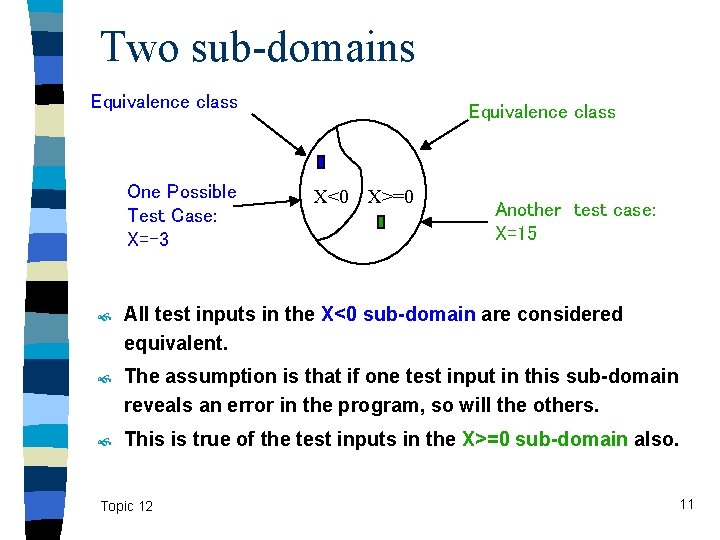
How to partition? Example 1 Suppose that program P takes an input X, X being an integer. For X<0 perform task (T 1) For X>=0 perform task (T 2) Topic 12 10
Two sub-domains Equivalence class One Possible Test Case: X=-3 Equivalence class X<0 X>=0 Another test case: X=15 All test inputs in the X<0 sub-domain are considered equivalent. The assumption is that if one test input in this sub-domain reveals an error in the program, so will the others. This is true of the test inputs in the X>=0 sub-domain also. Topic 12 11
EQP: Basic Process First you must break the input into subdomains (partitions) ● ● ● Look at input and determine common properties Values with in defined range Values outside of the defined range Extremes Try to include input that will force incorrect output ◘ How well does the code perform exception handling If the sub-domains are well done ● should be able to create a few (or ideally) one test case that will represent the entire domain Topic 12 12
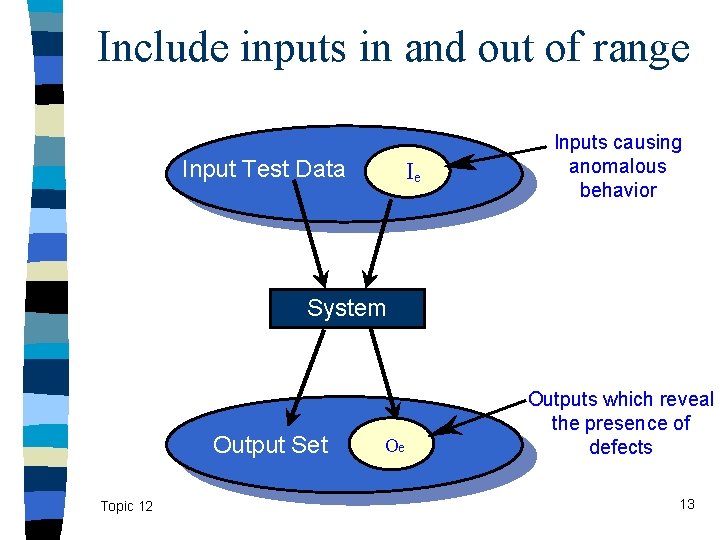
Include inputs in and out of range Input Test Data Ie Inputs causing anomalous behavior System Output Set Topic 12 Oe Outputs which reveal the presence of defects 13
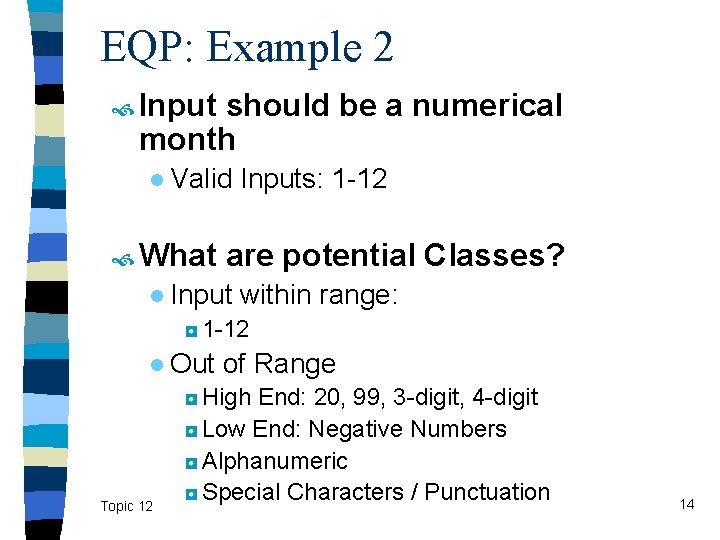
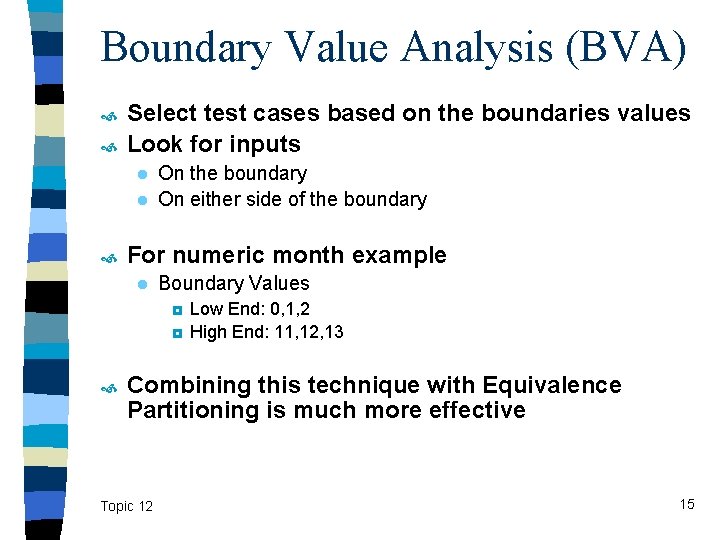
EQP: Example 2 Input should be a numerical month ● Valid Inputs: 1 -12 What are potential Classes? ● Input within range: ◘ 1 -12 ● Out of Range Topic 12 1 -12 ◘ High End: 20, 99, 3 -digit, 4 -digit ◘ Low End: Negative Numbers ◘ Alphanumeric ◘ Special Characters / Punctuation 14
Boundary Value Analysis (BVA) Select test cases based on the boundaries values Look for inputs ● On the boundary ● On either side of the boundary For numeric month example ● Boundary Values ◘ Low End: 0, 1, 2 ◘ High End: 11, 12, 13 Combining this technique with Equivalence Partitioning is much more effective Topic 12 15
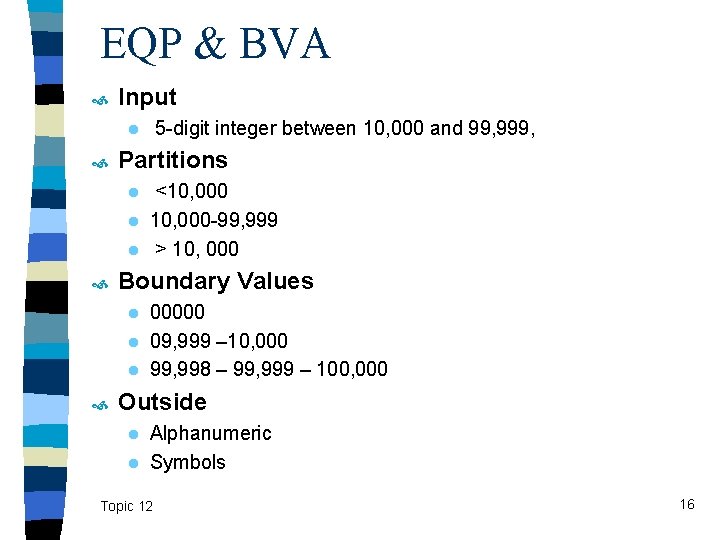
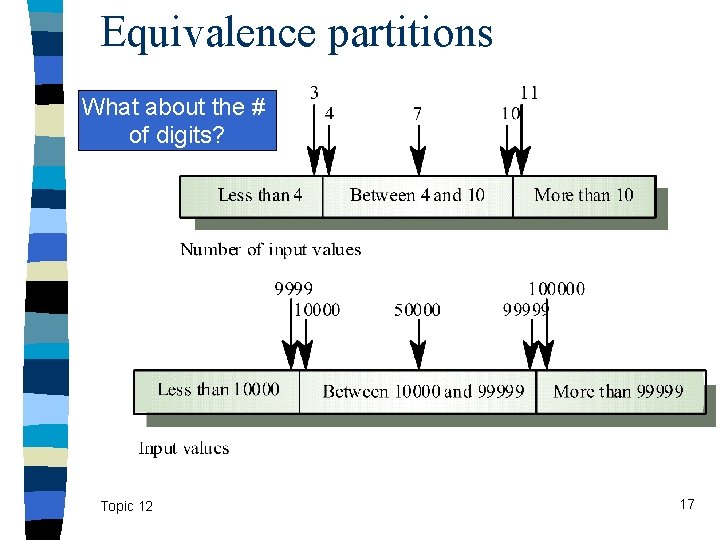
EQP & BVA Input ● 5 -digit integer between 10, 000 and 99, 999, Partitions ● <10, 000 ● 10, 000 -99, 999 ● > 10, 000 Boundary Values ● 00000 ● 09, 999 – 10, 000 ● 99, 998 – 99, 999 – 100, 000 Outside ● Alphanumeric ● Symbols Topic 12 16
Equivalence partitions What about the # of digits? Topic 12 17
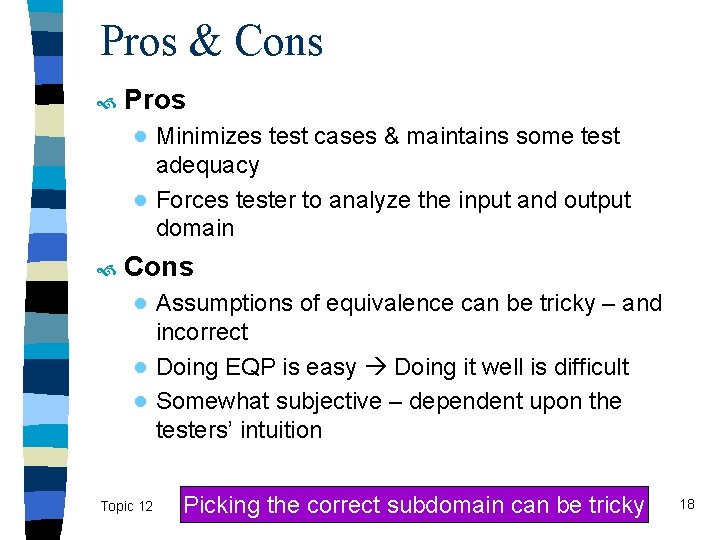
Pros & Cons Pros ● Minimizes test cases & maintains some test adequacy ● Forces tester to analyze the input and output domain Cons ● Assumptions of equivalence can be tricky – and incorrect ● Doing EQP is easy Doing it well is difficult ● Somewhat subjective – dependent upon the testers’ intuition Topic 12 Picking the correct subdomain can be tricky 18
Today’s Lecture Equivalence Partitioning & Boundary Value Analysis Integration Testing ● Top-Down ● Bottom Up Topic 12 19
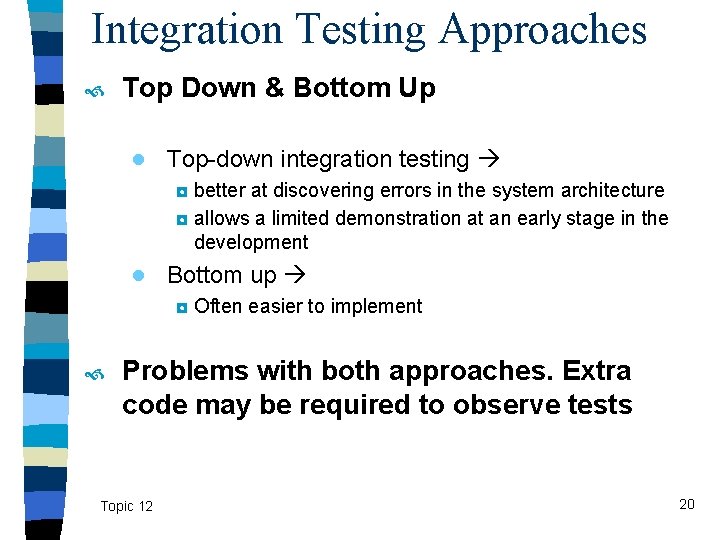
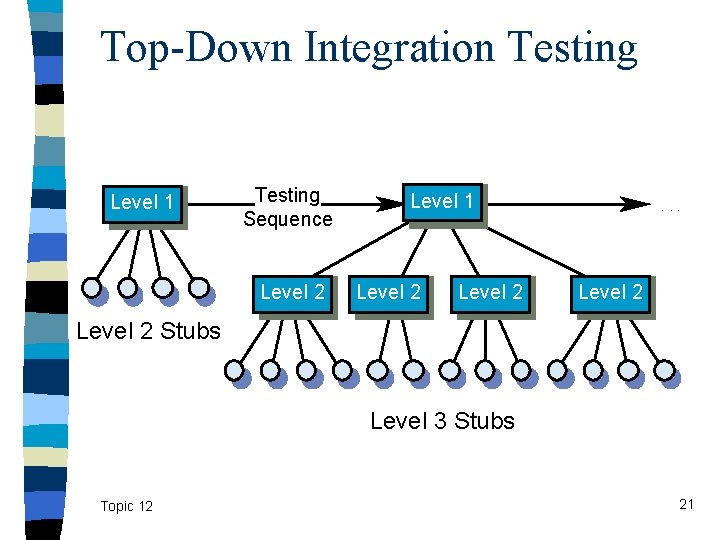
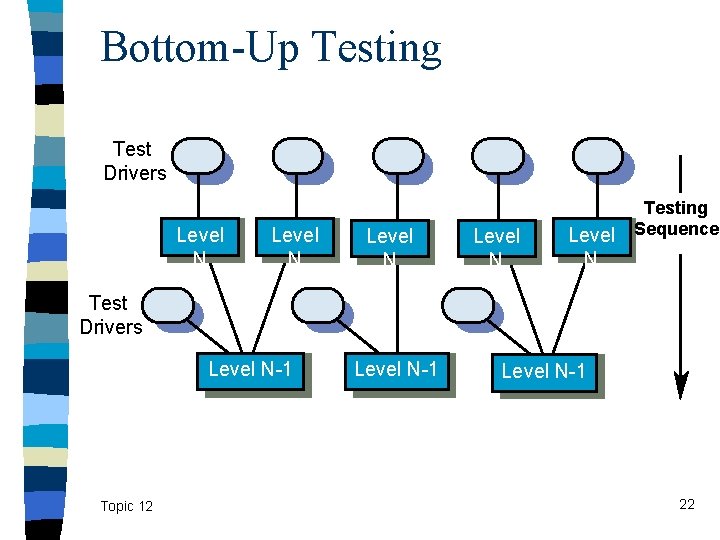
Integration Testing Approaches Top Down & Bottom Up ● Top-down integration testing ◘ better at discovering errors in the system architecture ◘ allows a limited demonstration at an early stage in the development ● Bottom up ◘ Often easier to implement Problems with both approaches. Extra code may be required to observe tests Topic 12 20
Top-Down Integration Testing Level 1 Testing Sequence Level 2 Level 1 Level 2 . . . Level 2 Stubs Level 3 Stubs Topic 12 21
Bottom-Up Testing Test Drivers Level N Level N Testing Sequence Test Drivers Level N-1 Topic 12 Level N-1 22
Which Approach to use? Top-Down or Bottom Up? In practice, most integration involves a combination of these strategies Topic 12 23