
Inertial Range Dynamics and Mixing Kinetic Theory Representation
- Slides: 23
Inertial Range Dynamics and Mixing Kinetic Theory Representation for Turbulence Modeling and Computation Hudong Chen Collaborators: S. Orszag, S. Succi, I. Staroselsky, V. Yakhot
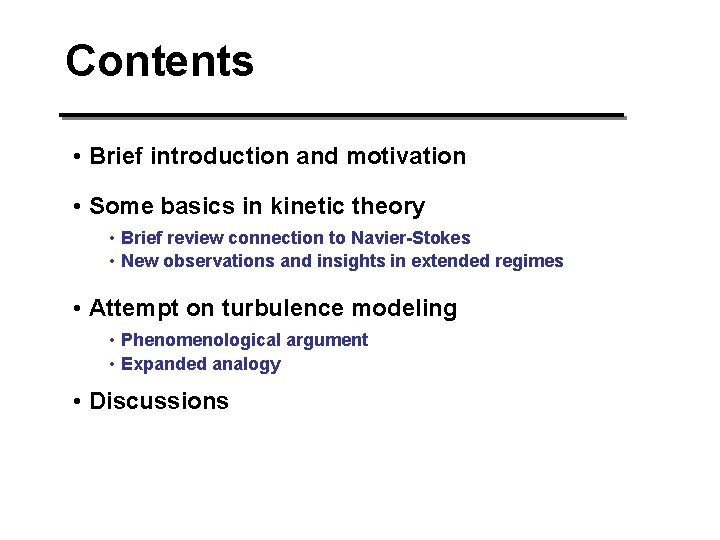
Contents • Brief introduction and motivation • Some basics in kinetic theory • Brief review connection to Navier-Stokes • New observations and insights in extended regimes • Attempt on turbulence modeling • Phenomenological argument • Expanded analogy • Discussions
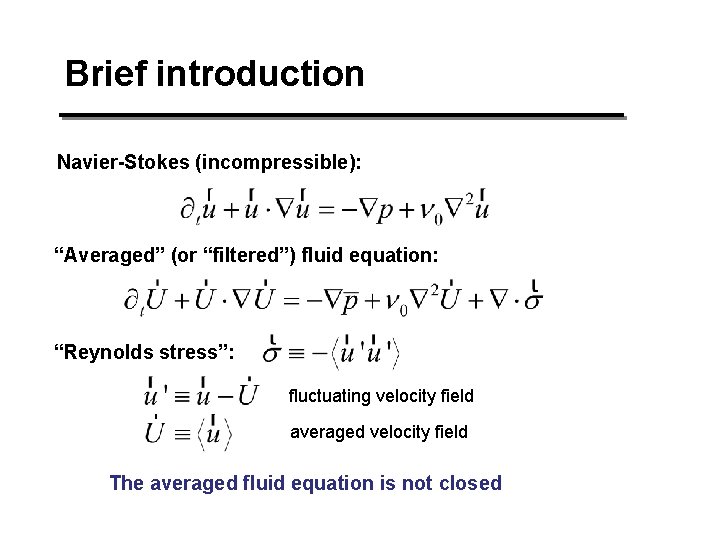
Brief introduction Navier-Stokes (incompressible): “Averaged” (or “filtered”) fluid equation: “Reynolds stress”: fluctuating velocity field averaged velocity field The averaged fluid equation is not closed
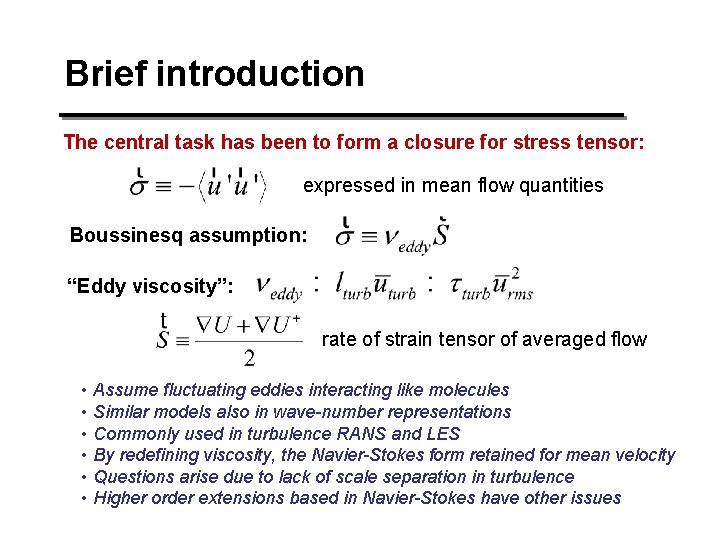
Brief introduction The central task has been to form a closure for stress tensor: expressed in mean flow quantities Boussinesq assumption: “Eddy viscosity”: rate of strain tensor of averaged flow • Assume fluctuating eddies interacting like molecules • Similar models also in wave-number representations • Commonly used in turbulence RANS and LES • By redefining viscosity, the Navier-Stokes form retained for mean velocity • Questions arise due to lack of scale separation in turbulence • Higher order extensions based in Navier-Stokes have other issues
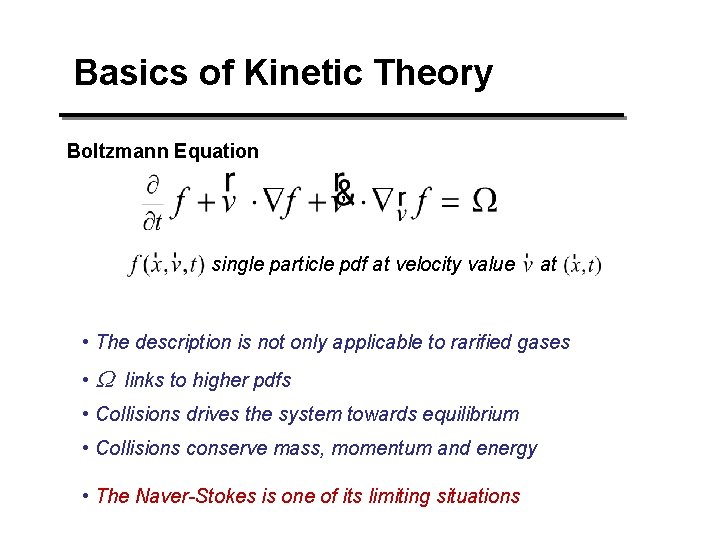
Basics of Kinetic Theory Boltzmann Equation single particle pdf at velocity value at • The description is not only applicable to rarified gases • W links to higher pdfs • Collisions drives the system towards equilibrium • Collisions conserve mass, momentum and energy • The Naver-Stokes is one of its limiting situations
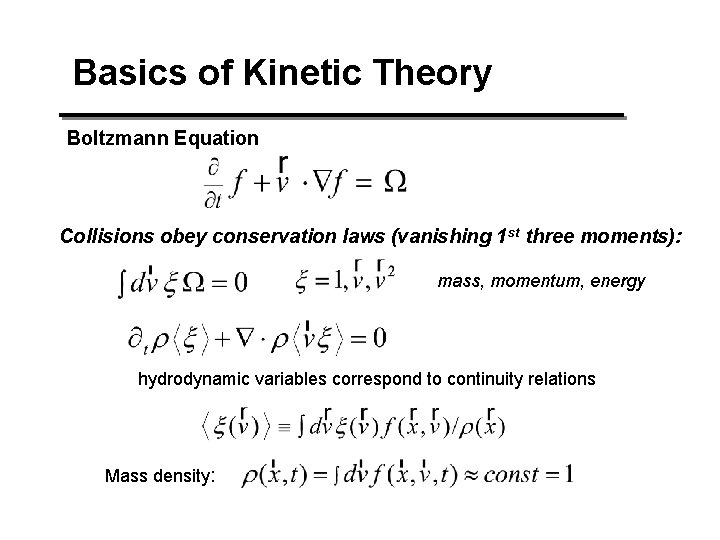
Basics of Kinetic Theory Boltzmann Equation Collisions obey conservation laws (vanishing 1 st three moments): mass, momentum, energy hydrodynamic variables correspond to continuity relations Mass density:
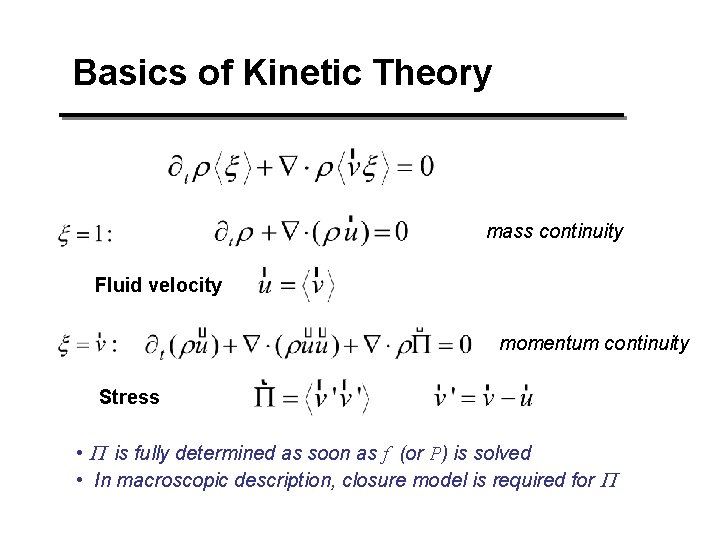
Basics of Kinetic Theory mass continuity Fluid velocity momentum continuity Stress • P is fully determined as soon as f (or P) is solved • In macroscopic description, closure model is required for P
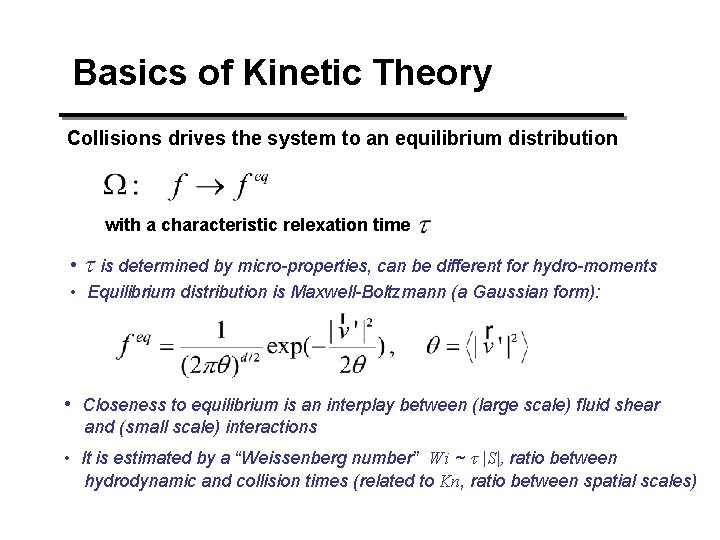
Basics of Kinetic Theory Collisions drives the system to an equilibrium distribution with a characteristic relexation time • t is determined by micro-properties, can be different for hydro-moments • Equilibrium distribution is Maxwell-Boltzmann (a Gaussian form): • Closeness to equilibrium is an interplay between (large scale) fluid shear and (small scale) interactions • It is estimated by a “Weissenberg number” Wi ~ t |S|, ratio between hydrodynamic and collision times (related to Kn, ratio between spatial scales)
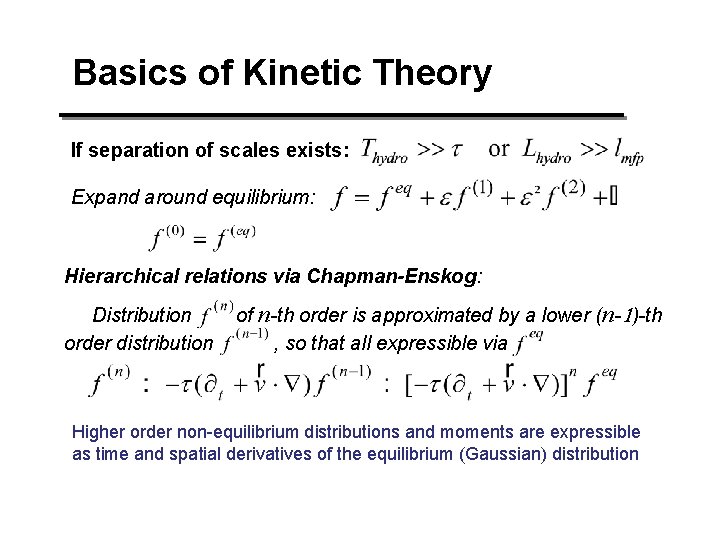
Basics of Kinetic Theory If separation of scales exists: Expand around equilibrium: Hierarchical relations via Chapman-Enskog: Distribution order distribution of n-th order is approximated by a lower (n-1)-th , so that all expressible via Higher order non-equilibrium distributions and moments are expressible as time and spatial derivatives of the equilibrium (Gaussian) distribution
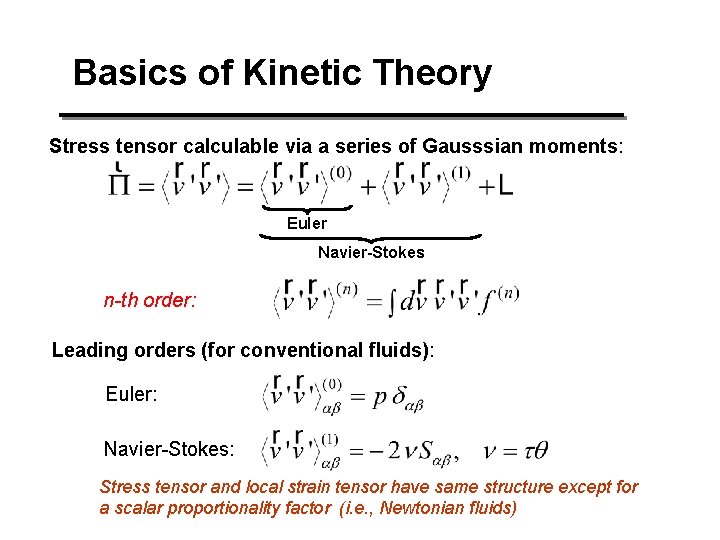
Basics of Kinetic Theory Stress tensor calculable via a series of Gausssian moments: Euler Navier-Stokes n-th order: Leading orders (for conventional fluids): Euler: Navier-Stokes: Stress tensor and local strain tensor have same structure except for a scalar proportionality factor (i. e. , Newtonian fluids)
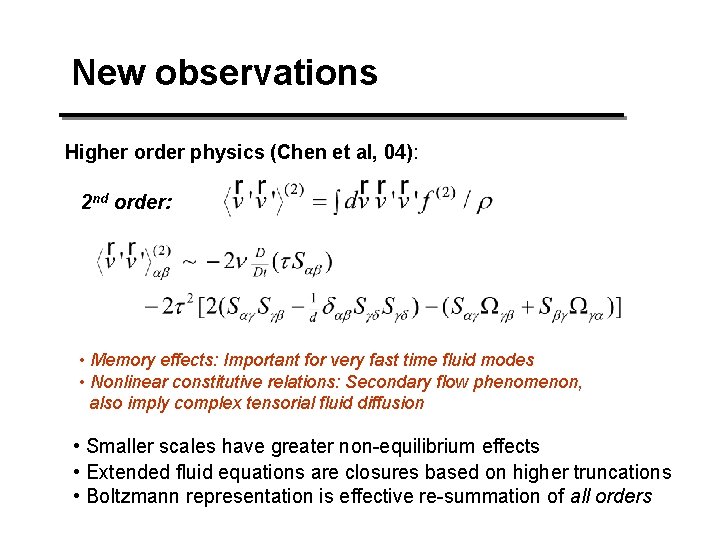
New observations Higher order physics (Chen et al, 04): 2 nd order: • Memory effects: Important for very fast time fluid modes • Nonlinear constitutive relations: Secondary flow phenomenon, also imply complex tensorial fluid diffusion • Smaller scales have greater non-equilibrium effects • Extended fluid equations are closures based on higher truncations • Boltzmann representation is effective re-summation of all orders
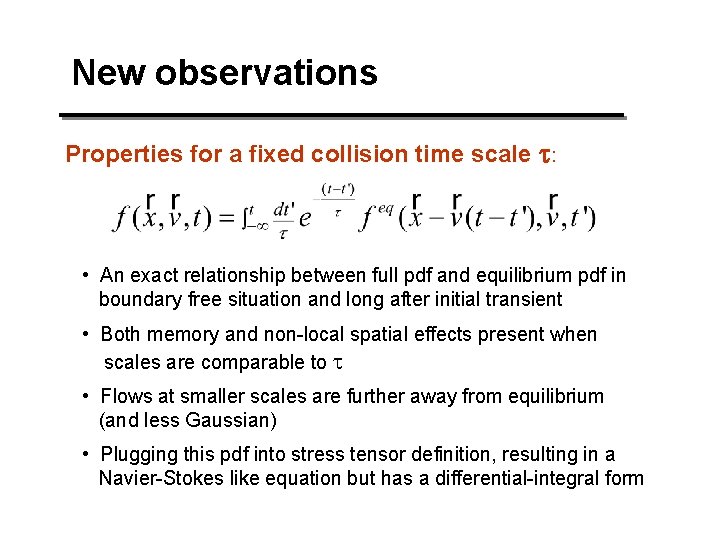
New observations Properties for a fixed collision time scale t: • An exact relationship between full pdf and equilibrium pdf in boundary free situation and long after initial transient • Both memory and non-local spatial effects present when scales are comparable to t • Flows at smaller scales are further away from equilibrium (and less Gaussian) • Plugging this pdf into stress tensor definition, resulting in a Navier-Stokes like equation but has a differential-integral form
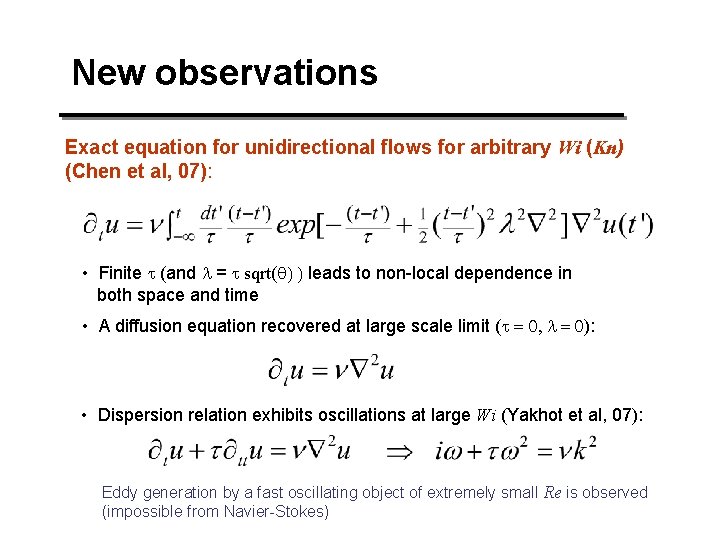
New observations Exact equation for unidirectional flows for arbitrary Wi (Kn) (Chen et al, 07): • Finite t (and l = t sqrt(q) ) leads to non-local dependence in both space and time • A diffusion equation recovered at large scale limit (t = 0, l = 0): • Dispersion relation exhibits oscillations at large Wi (Yakhot et al, 07): Eddy generation by a fast oscillating object of extremely small Re is observed (impossible from Navier-Stokes)
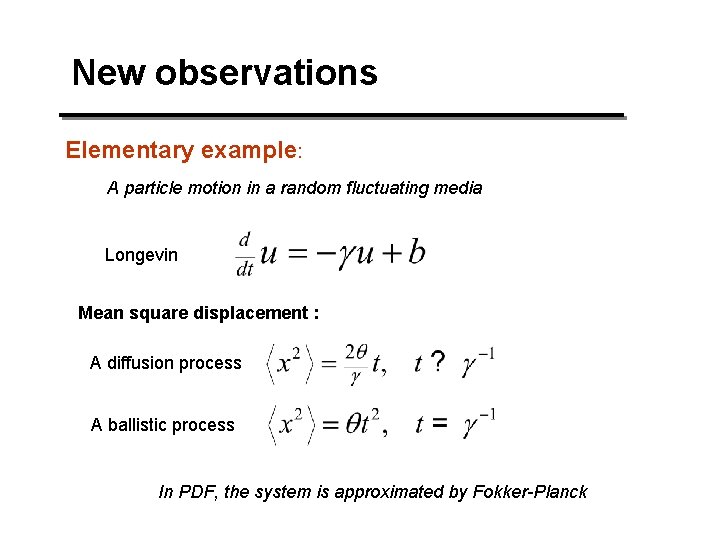
New observations Elementary example: A particle motion in a random fluctuating media Longevin Mean square displacement : A diffusion process A ballistic process In PDF, the system is approximated by Fokker-Planck
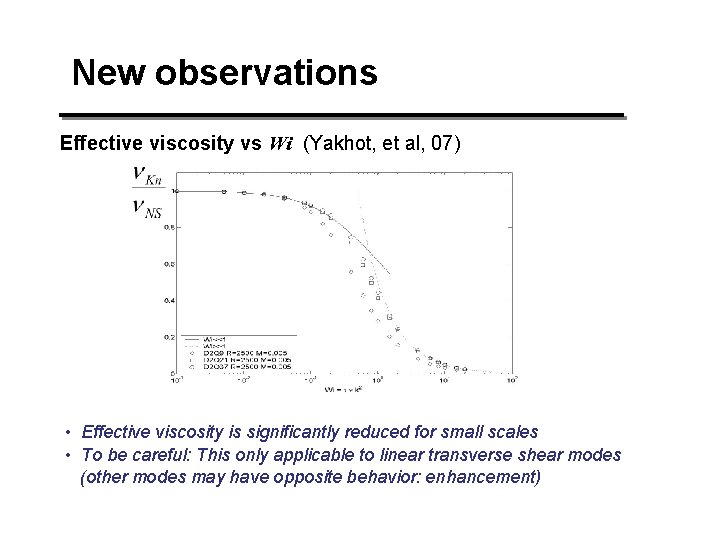
New observations Effective viscosity vs Wi (Yakhot, et al, 07) • Effective viscosity is significantly reduced for small scales • To be careful: This only applicable to linear transverse shear modes (other modes may have opposite behavior: enhancement)
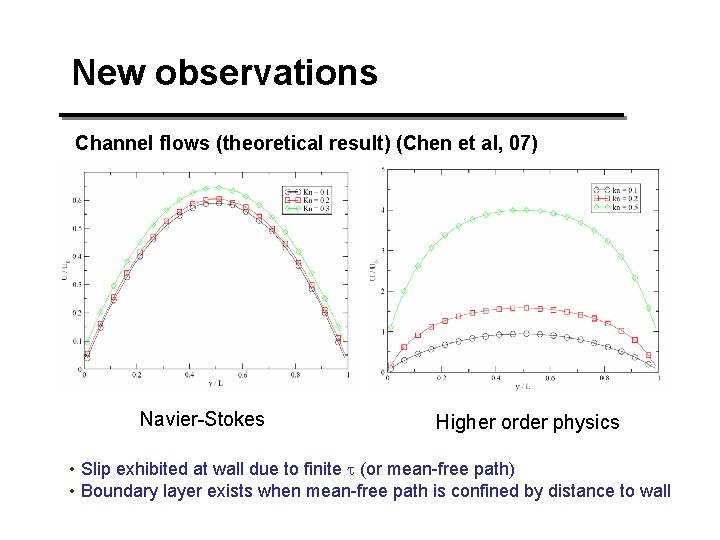
New observations Channel flows (theoretical result) (Chen et al, 07) Navier-Stokes Higher order physics • Slip exhibited at wall due to finite t (or mean-free path) • Boundary layer exists when mean-free path is confined by distance to wall
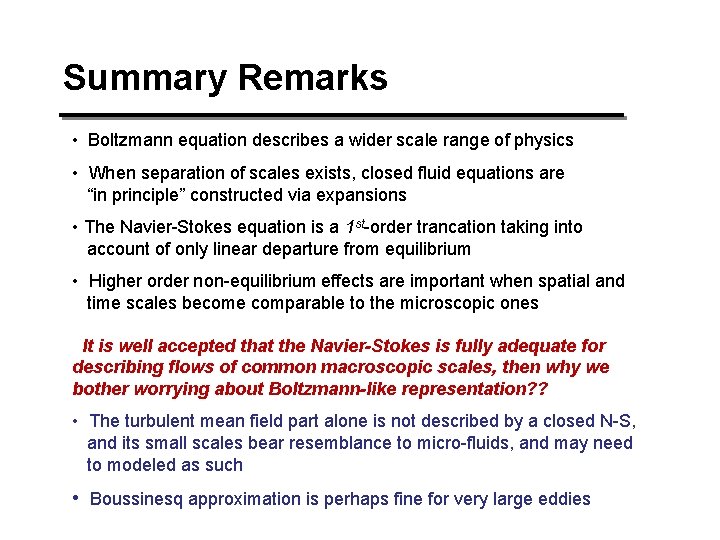
Summary Remarks • Boltzmann equation describes a wider scale range of physics • When separation of scales exists, closed fluid equations are “in principle” constructed via expansions • The Navier-Stokes equation is a 1 st-order trancation taking into account of only linear departure from equilibrium • Higher order non-equilibrium effects are important when spatial and time scales become comparable to the microscopic ones It is well accepted that the Navier-Stokes is fully adequate for describing flows of common macroscopic scales, then why we bother worrying about Boltzmann-like representation? ? • The turbulent mean field part alone is not described by a closed N-S, and its small scales bear resemblance to micro-fluids, and may need to modeled as such • Boussinesq approximation is perhaps fine for very large eddies
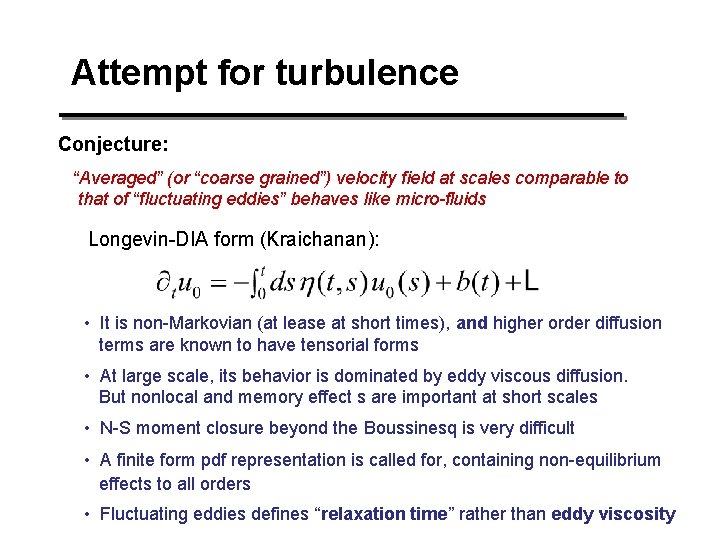
Attempt for turbulence Conjecture: “Averaged” (or “coarse grained”) velocity field at scales comparable to that of “fluctuating eddies” behaves like micro-fluids Longevin-DIA form (Kraichanan): • It is non-Markovian (at lease at short times), and higher order diffusion terms are known to have tensorial forms • At large scale, its behavior is dominated by eddy viscous diffusion. But nonlocal and memory effect s are important at short scales • N-S moment closure beyond the Boussinesq is very difficult • A finite form pdf representation is called for, containing non-equilibrium effects to all orders • Fluctuating eddies defines “relaxation time” rather than eddy viscosity
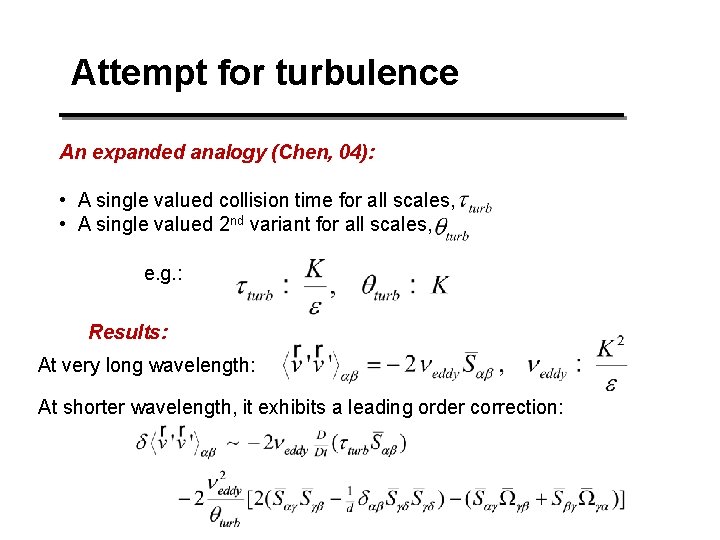
Attempt for turbulence An expanded analogy (Chen, 04): • A single valued collision time for all scales, • A single valued 2 nd variant for all scales, e. g. : Results: At very long wavelength: At shorter wavelength, it exhibits a leading order correction:
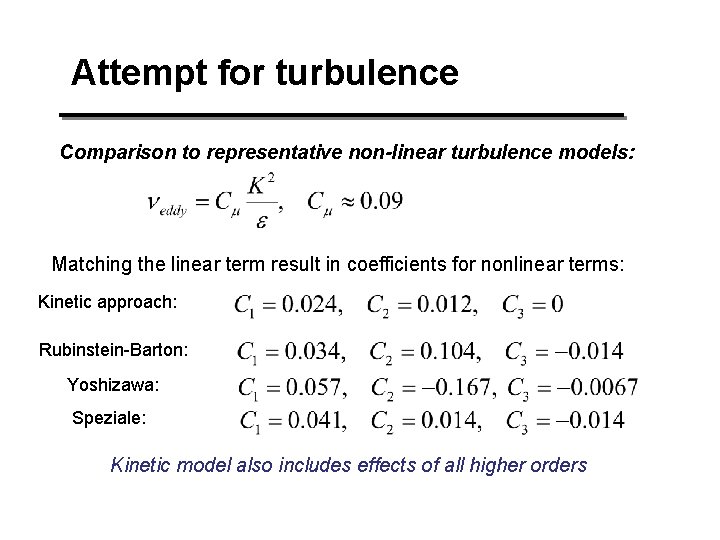
Attempt for turbulence Comparison to representative non-linear turbulence models: Matching the linear term result in coefficients for nonlinear terms: Kinetic approach: Rubinstein-Barton: Yoshizawa: Speziale: Kinetic model also includes effects of all higher orders
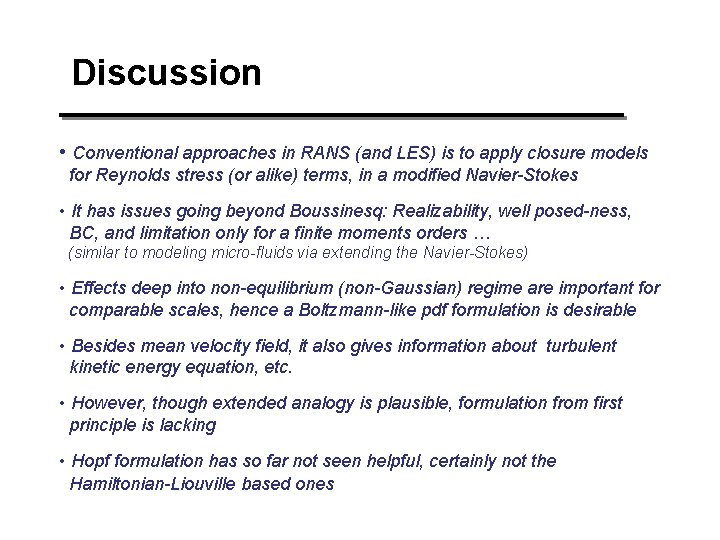
Discussion • Conventional approaches in RANS (and LES) is to apply closure models for Reynolds stress (or alike) terms, in a modified Navier-Stokes • It has issues going beyond Boussinesq: Realizability, well posed-ness, BC, and limitation only for a finite moments orders … (similar to modeling micro-fluids via extending the Navier-Stokes) • Effects deep into non-equilibrium (non-Gaussian) regime are important for comparable scales, hence a Boltzmann-like pdf formulation is desirable • Besides mean velocity field, it also gives information about turbulent kinetic energy equation, etc. • However, though extended analogy is plausible, formulation from first principle is lacking • Hopf formulation has so far not seen helpful, certainly not the Hamiltonian-Liouville based ones
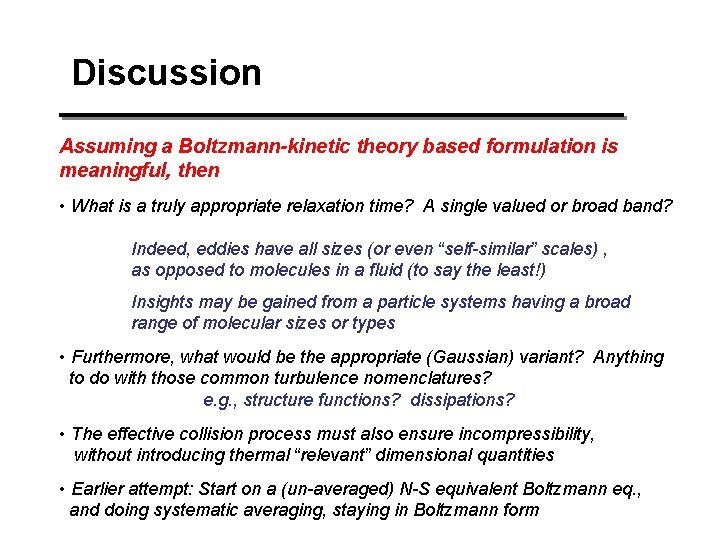
Discussion Assuming a Boltzmann-kinetic theory based formulation is meaningful, then • What is a truly appropriate relaxation time? A single valued or broad band? Indeed, eddies have all sizes (or even “self-similar” scales) , as opposed to molecules in a fluid (to say the least!) Insights may be gained from a particle systems having a broad range of molecular sizes or types • Furthermore, what would be the appropriate (Gaussian) variant? Anything to do with those common turbulence nomenclatures? e. g. , structure functions? dissipations? • The effective collision process must also ensure incompressibility, without introducing thermal “relevant” dimensional quantities • Earlier attempt: Start on a (un-averaged) N-S equivalent Boltzmann eq. , and doing systematic averaging, staying in Boltzmann form
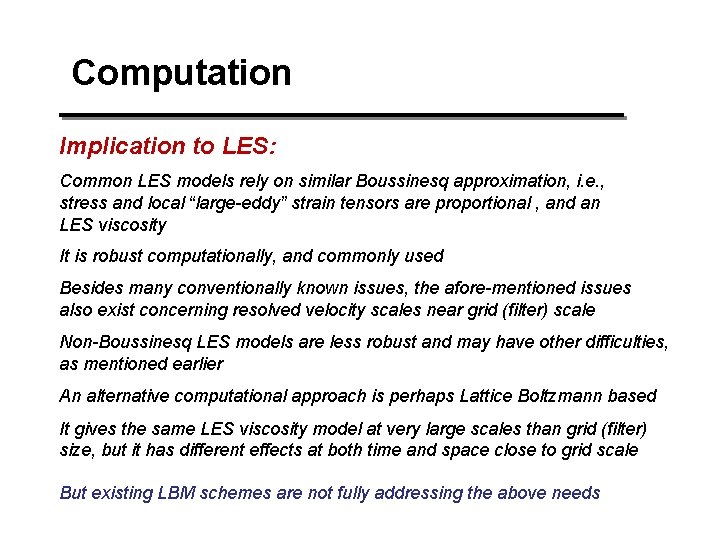
Computation Implication to LES: Common LES models rely on similar Boussinesq approximation, i. e. , stress and local “large-eddy” strain tensors are proportional , and an LES viscosity It is robust computationally, and commonly used Besides many conventionally known issues, the afore-mentioned issues also exist concerning resolved velocity scales near grid (filter) scale Non-Boussinesq LES models are less robust and may have other difficulties, as mentioned earlier An alternative computational approach is perhaps Lattice Boltzmann based It gives the same LES viscosity model at very large scales than grid (filter) size, but it has different effects at both time and space close to grid scale But existing LBM schemes are not fully addressing the above needs