
Inertial Measurement for planetary exploration Accelerometers and Gyros

- Slides: 21
Inertial Measurement for planetary exploration: Accelerometers and Gyros Bryan Wagenknecht bwagenkn@cmu. edu 3/30/2009 bwagenkn@cmu. edu 16 -722: Accelerometers and Gyros for Navigation 1
Significance of Inertial Measurement • Important to know “where am I? ” if you’re an exploration robot • Probably don’t have access to GPS or road signs to help you • Mass (inertia) is a property that holds regardless of environment (gravity or no) – Want to harness this for internal estimation of state (position and velocity) 3/30/2009 bwagenkn@cmu. edu 16 -722: Accelerometers and Gyros for Navigation 2
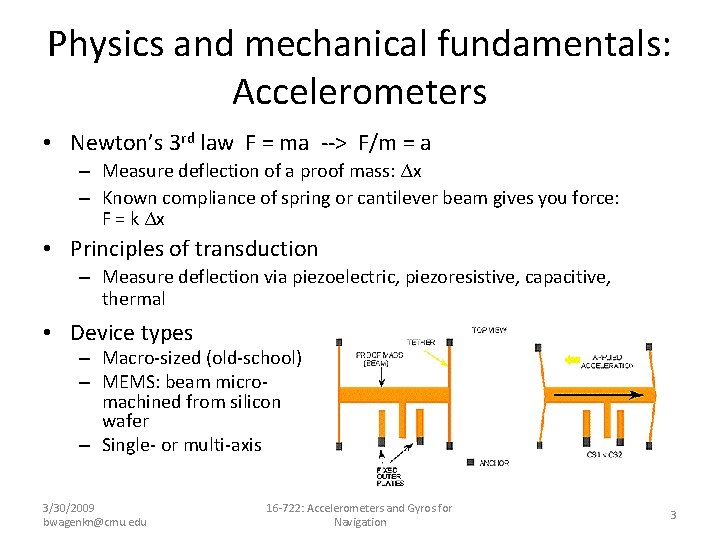
Physics and mechanical fundamentals: Accelerometers • Newton’s 3 rd law F = ma --> F/m = a – Measure deflection of a proof mass: Δx – Known compliance of spring or cantilever beam gives you force: F = k Δx • Principles of transduction – Measure deflection via piezoelectric, piezoresistive, capacitive, thermal • Device types – Macro-sized (old-school) – MEMS: beam micromachined from silicon wafer – Single- or multi-axis 3/30/2009 bwagenkn@cmu. edu 16 -722: Accelerometers and Gyros for Navigation 3
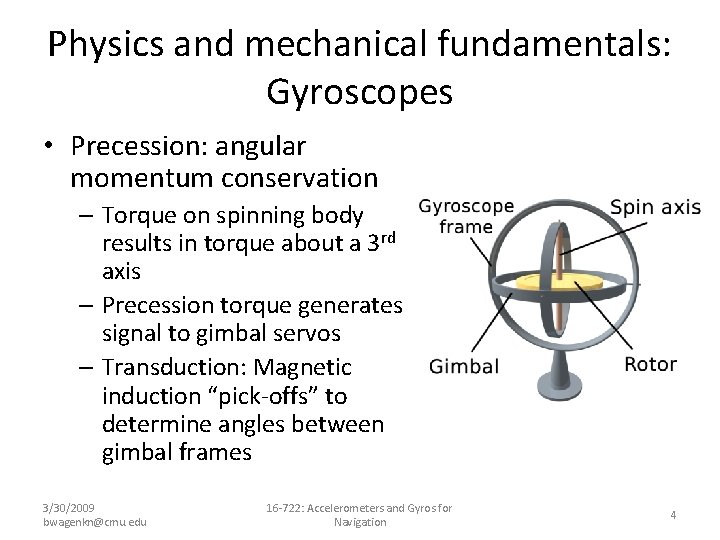
Physics and mechanical fundamentals: Gyroscopes • Precession: angular momentum conservation – Torque on spinning body results in torque about a 3 rd axis – Precession torque generates signal to gimbal servos – Transduction: Magnetic induction “pick-offs” to determine angles between gimbal frames 3/30/2009 bwagenkn@cmu. edu 16 -722: Accelerometers and Gyros for Navigation 4
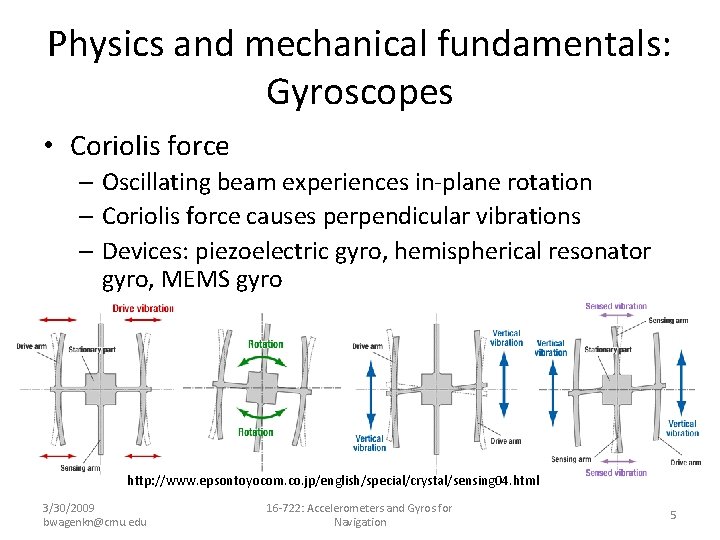
Physics and mechanical fundamentals: Gyroscopes • Coriolis force – Oscillating beam experiences in-plane rotation – Coriolis force causes perpendicular vibrations – Devices: piezoelectric gyro, hemispherical resonator gyro, MEMS gyro http: //www. epsontoyocom. co. jp/english/special/crystal/sensing 04. html 3/30/2009 bwagenkn@cmu. edu 16 -722: Accelerometers and Gyros for Navigation 5
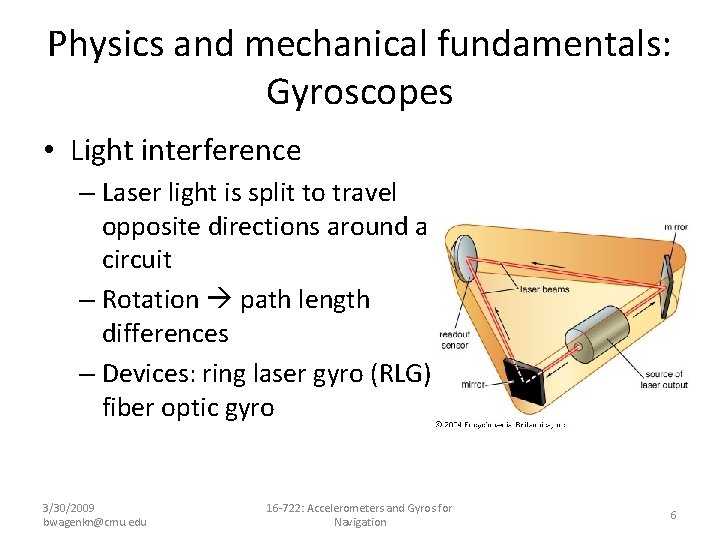
Physics and mechanical fundamentals: Gyroscopes • Light interference – Laser light is split to travel opposite directions around a circuit – Rotation path length differences – Devices: ring laser gyro (RLG), fiber optic gyro 3/30/2009 bwagenkn@cmu. edu 16 -722: Accelerometers and Gyros for Navigation 6
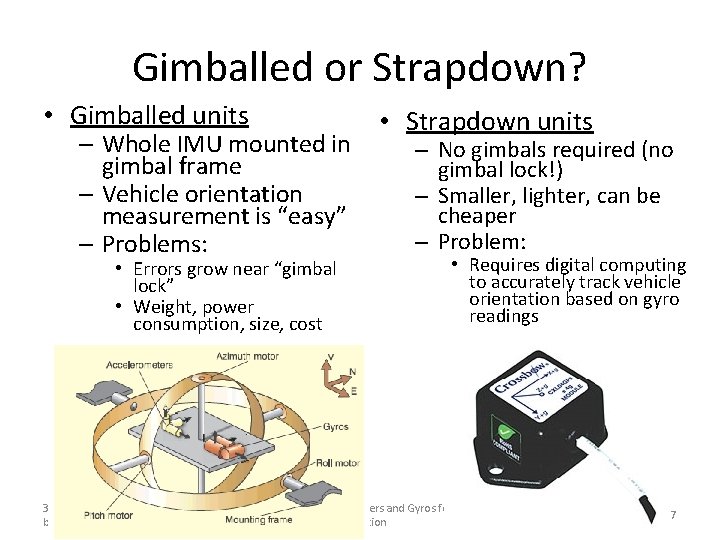
Gimballed or Strapdown? • Gimballed units – Whole IMU mounted in gimbal frame – Vehicle orientation measurement is “easy” – Problems: • Errors grow near “gimbal lock” • Weight, power consumption, size, cost 3/30/2009 bwagenkn@cmu. edu • Strapdown units – No gimbals required (no gimbal lock!) – Smaller, lighter, can be cheaper – Problem: • Requires digital computing to accurately track vehicle orientation based on gyro readings 16 -722: Accelerometers and Gyros for Navigation 7
Bring it together: IMU • • Sensor fusion IMU gives you Δv and Δθ Integrate readings (dead reckoning) Problems Accumulated error and drift Noise Gimbal lock Changing gravity direction (as traveling over surface of a planet – affects accelerometers) – Temperature effects – Cost of accuracy – – 3/30/2009 bwagenkn@cmu. edu 16 -722: Accelerometers and Gyros for Navigation 8
Bring it together: IMU • Solutions – Calibration – Redundancy and skew (multiple IMUs) – Filtering (Kalman, traditional) – Schuler tuning (for gravity direction changes) – Realignment using visual markers/fixes – Combine with other sensors (GPS, compass, airspeed, odometer) – Built-in temperature sensor with analog circuitry for correction 3/30/2009 bwagenkn@cmu. edu 16 -722: Accelerometers and Gyros for Navigation 9
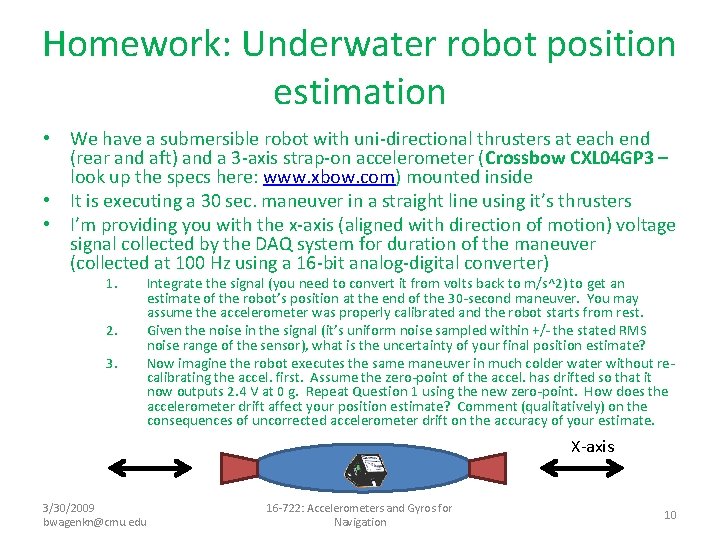
Homework: Underwater robot position estimation • We have a submersible robot with uni-directional thrusters at each end (rear and aft) and a 3 -axis strap-on accelerometer (Crossbow CXL 04 GP 3 – look up the specs here: www. xbow. com) mounted inside • It is executing a 30 sec. maneuver in a straight line using it’s thrusters • I’m providing you with the x-axis (aligned with direction of motion) voltage signal collected by the DAQ system for duration of the maneuver (collected at 100 Hz using a 16 -bit analog-digital converter) 1. 2. 3. Integrate the signal (you need to convert it from volts back to m/s^2) to get an estimate of the robot’s position at the end of the 30 -second maneuver. You may assume the accelerometer was properly calibrated and the robot starts from rest. Given the noise in the signal (it’s uniform noise sampled within +/- the stated RMS noise range of the sensor), what is the uncertainty of your final position estimate? Now imagine the robot executes the same maneuver in much colder water without recalibrating the accel. first. Assume the zero-point of the accel. has drifted so that it now outputs 2. 4 V at 0 g. Repeat Question 1 using the new zero-point. How does the accelerometer drift affect your position estimate? Comment (qualitatively) on the consequences of uncorrected accelerometer drift on the accuracy of your estimate. X-axis 3/30/2009 bwagenkn@cmu. edu 16 -722: Accelerometers and Gyros for Navigation 10
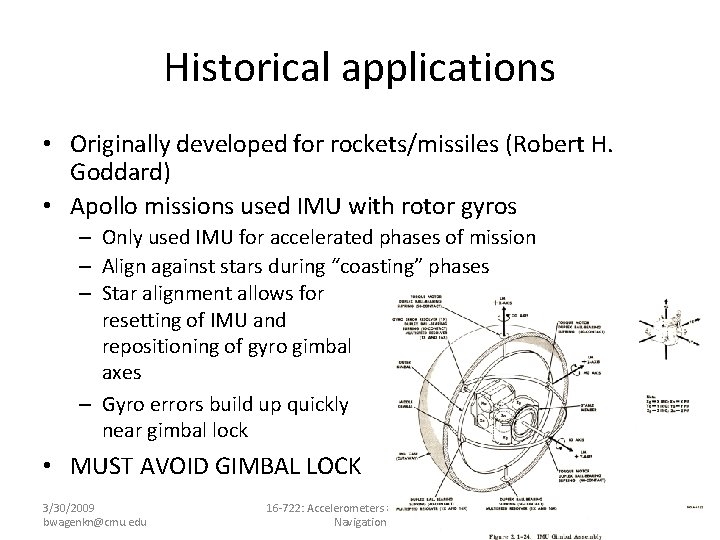
Historical applications • Originally developed for rockets/missiles (Robert H. Goddard) • Apollo missions used IMU with rotor gyros – Only used IMU for accelerated phases of mission – Align against stars during “coasting” phases – Star alignment allows for resetting of IMU and repositioning of gyro gimbal axes – Gyro errors build up quickly near gimbal lock • MUST AVOID GIMBAL LOCK 3/30/2009 bwagenkn@cmu. edu 16 -722: Accelerometers and Gyros for Navigation 11
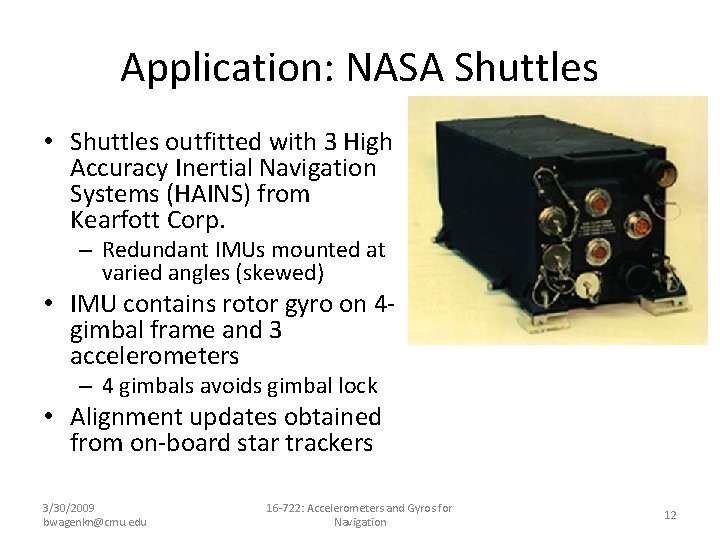
Application: NASA Shuttles • Shuttles outfitted with 3 High Accuracy Inertial Navigation Systems (HAINS) from Kearfott Corp. – Redundant IMUs mounted at varied angles (skewed) • IMU contains rotor gyro on 4 gimbal frame and 3 accelerometers – 4 gimbals avoids gimbal lock • Alignment updates obtained from on-board star trackers 3/30/2009 bwagenkn@cmu. edu 16 -722: Accelerometers and Gyros for Navigation 12
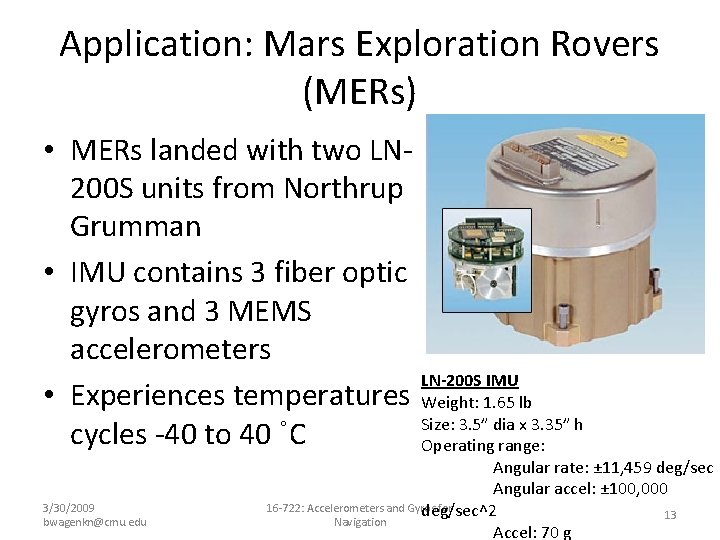
Application: Mars Exploration Rovers (MERs) • MERs landed with two LN 200 S units from Northrup Grumman • IMU contains 3 fiber optic gyros and 3 MEMS accelerometers LN-200 S IMU • Experiences temperatures Weight: 1. 65 lb Size: 3. 5” dia x 3. 35” h cycles -40 to 40 ˚C Operating range: 3/30/2009 bwagenkn@cmu. edu Angular rate: ± 11, 459 deg/sec Angular accel: ± 100, 000 16 -722: Accelerometers and Gyros for deg/sec^2 13 Navigation Accel: 70 g
Other Applications • • • Aircraft navigation Tactical missiles and smart munitions Submarine/naval navigation Spacecraft Land travel (cars, robots, tractors) 3/30/2009 bwagenkn@cmu. edu 16 -722: Accelerometers and Gyros for Navigation 14
Companies that make IMUs • Military/Government Contractors – Honeywell (UAVs, missiles) – Northrup Grumman (MERs) – BAE (missiles) – Kearfott Corporation (NASA shuttles) • Civilian Applications – Crossbow – Analog Devices 3/30/2009 bwagenkn@cmu. edu 16 -722: Accelerometers and Gyros for Navigation 15
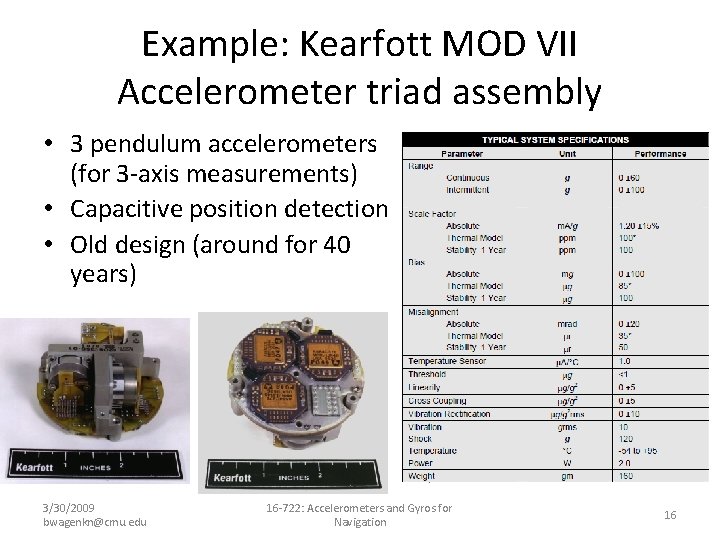
Example: Kearfott MOD VII Accelerometer triad assembly • 3 pendulum accelerometers (for 3 -axis measurements) • Capacitive position detection • Old design (around for 40 years) 3/30/2009 bwagenkn@cmu. edu 16 -722: Accelerometers and Gyros for Navigation 16
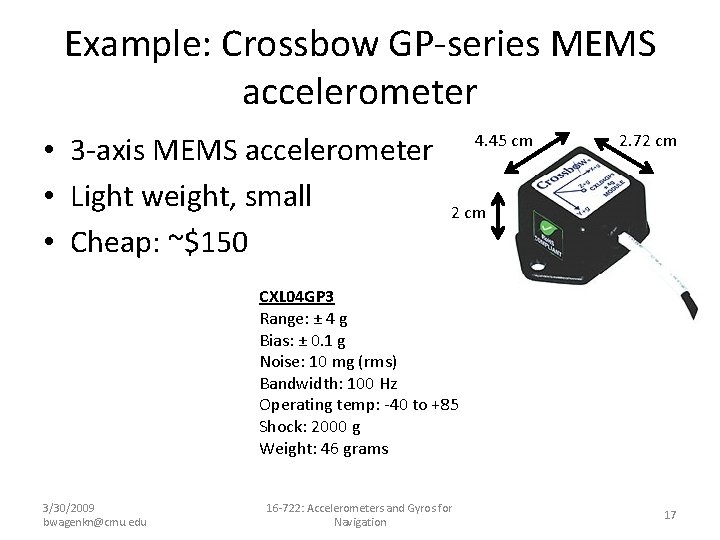
Example: Crossbow GP-series MEMS accelerometer • 3 -axis MEMS accelerometer • Light weight, small • Cheap: ~$150 4. 45 cm 2. 72 cm CXL 04 GP 3 Range: ± 4 g Bias: ± 0. 1 g Noise: 10 mg (rms) Bandwidth: 100 Hz Operating temp: -40 to +85 Shock: 2000 g Weight: 46 grams 3/30/2009 bwagenkn@cmu. edu 16 -722: Accelerometers and Gyros for Navigation 17
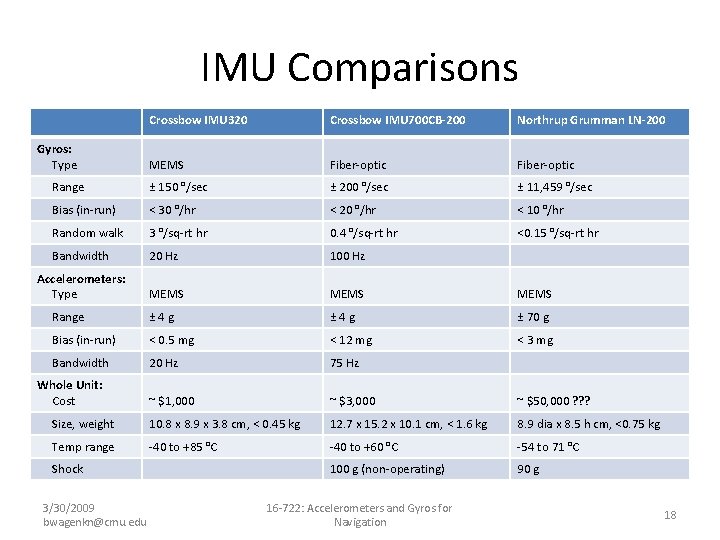
IMU Comparisons Crossbow IMU 320 Crossbow IMU 700 CB-200 Northrup Grumman LN-200 MEMS Fiber-optic Range ± 150 °/sec ± 200 °/sec ± 11, 459 °/sec Bias (in-run) < 30 °/hr < 20 °/hr < 10 °/hr Random walk 3 °/sq-rt hr 0. 4 °/sq-rt hr <0. 15 °/sq-rt hr Bandwidth 20 Hz 100 Hz Accelerometers: Type MEMS Range ± 4 g ± 70 g Bias (in-run) < 0. 5 mg < 12 mg < 3 mg Bandwidth 20 Hz 75 Hz ~ $1, 000 ~ $3, 000 ~ $50, 000 ? ? ? Size, weight 10. 8 x 8. 9 x 3. 8 cm, < 0. 45 kg 12. 7 x 15. 2 x 10. 1 cm, < 1. 6 kg 8. 9 dia x 8. 5 h cm, <0. 75 kg Temp range -40 to +85 °C -40 to +60 °C -54 to 71 °C 100 g (non-operating) 90 g Gyros: Type Whole Unit: Cost Shock 3/30/2009 bwagenkn@cmu. edu 16 -722: Accelerometers and Gyros for Navigation 18
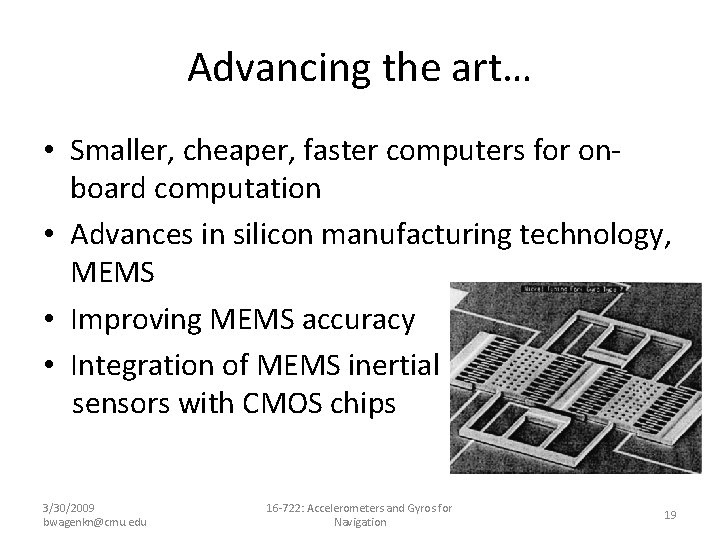
Advancing the art… • Smaller, cheaper, faster computers for onboard computation • Advances in silicon manufacturing technology, MEMS • Improving MEMS accuracy • Integration of MEMS inertial sensors with CMOS chips 3/30/2009 bwagenkn@cmu. edu 16 -722: Accelerometers and Gyros for Navigation 19
Institutions and labs on cutting edge • MEMS research still ongoing, but accel. and gyro research is old news – CMU’s own MEMS lab involved in MEMS/single chip integration (circa. 2003) • Aerospace companies seem to be leading advances in extremely accurate IMU’s • MEMS labs developing small/cheap integrated IMU’s 3/30/2009 bwagenkn@cmu. edu 16 -722: Accelerometers and Gyros for Navigation 20
References • • • King, A. D. “Inertial Navigation – Forty Years of Evolution” <http: //www. imarnavigation. de/download/inertial_navigation_introduction. pdf> Inertial Measurement Unit Market 2007 -2012 <http: //www. electronics. ca/reports/mems/imu_market. html> NASA Shuttle IMU Reference Guide <http: //spaceflight. nasa. gov/shuttle/reference/shutref/orbiter/avionics/gnc/imu. html> An integrated MEMS inertial measurement unit Cardarelli, D. ; Position Location and Navigation Symposium, 2002 IEEE, 15 -18 April 2002 Page(s): 314 - 319 Hoag, David. "Considerations of Apollo IMU Gimbal Lock. " Apollo Lunar Surface Journal (1963). NASA. <http: //history. nasa. gov/alsj/e-1344. htm>. Fraden, Jacob. Handbook of Modern Sensors, 2004 Northrup Grumman datasheets <http: //www. es. northropgrumman. com/> Kearfott datasheets <http: //www. astronautics. com> Crossbow datasheets <http: //www. xbow. com> 3/30/2009 bwagenkn@cmu. edu 16 -722: Accelerometers and Gyros for Navigation 21