
Inertia and Gravity Activity One Marble Lab Activity

Inertia and Gravity
Activity One Marble Lab Activity 1 1. Place the marble on the paper plate. Invert the plastic cup over the marble. 2. Move the cup in a rapid circular motion, causing the marble to move around the inside edge of the cup. 3. While the marble is moving rapidly in the cup, lift the cup straight up off the plate. 4. Record in your journal what happens to the marble. 5. Repeat the activity 3 times paying careful attention to the path of the marble takes after lifting the cup. 6. Explain the marble’s motion. 7. Draw an explanation of the marble’s motion in your journal; be sure to label the drawing. (Cup, Marble and Path of the marble
Marble Lab Questions to discuss Marble lab after looking at all illustrations. 1. What do all of the illustrations have in common? Ø 2. What kept the marble moving in a circular pattern? Ø 3. Inertia is an object’s resistance to a change in its motion. This means objects at rest will stay at rest, and objects that are moving will continue to move in a straight line unless they are acted on by an unbalance force. How does the concept of inertia apply to this activity? Ø Ø
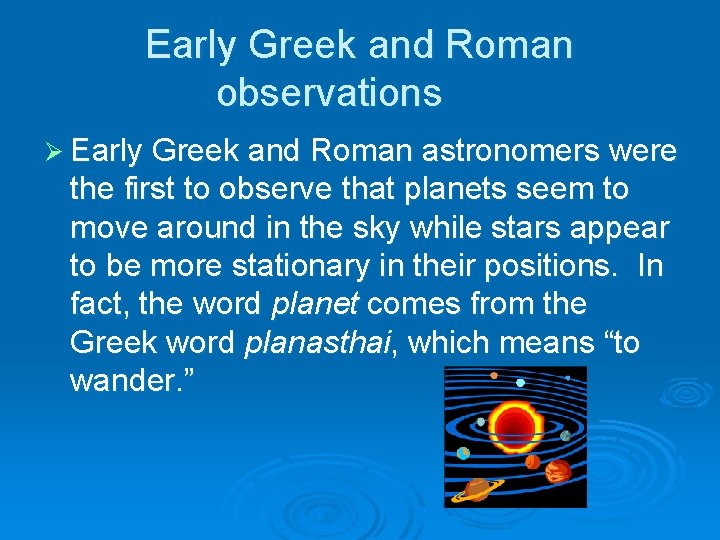
Early Greek and Roman observations Ø Early Greek and Roman astronomers were the first to observe that planets seem to move around in the sky while stars appear to be more stationary in their positions. In fact, the word planet comes from the Greek word planasthai, which means “to wander. ”
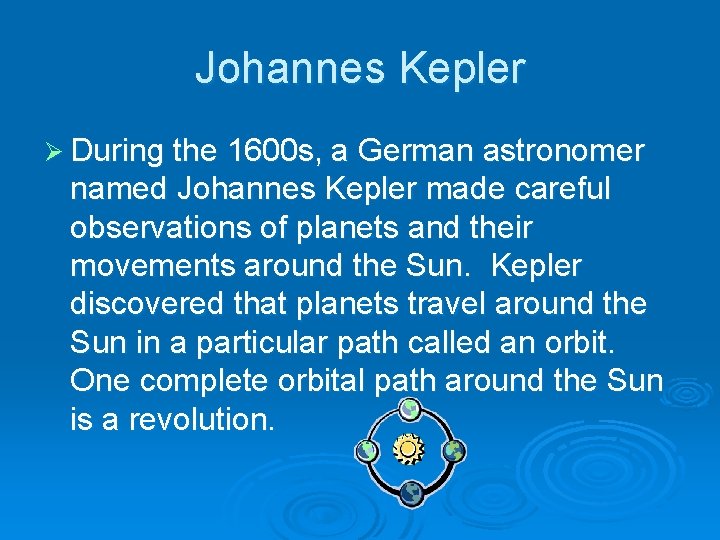
Johannes Kepler Ø During the 1600 s, a German astronomer named Johannes Kepler made careful observations of planets and their movements around the Sun. Kepler discovered that planets travel around the Sun in a particular path called an orbit. One complete orbital path around the Sun is a revolution.
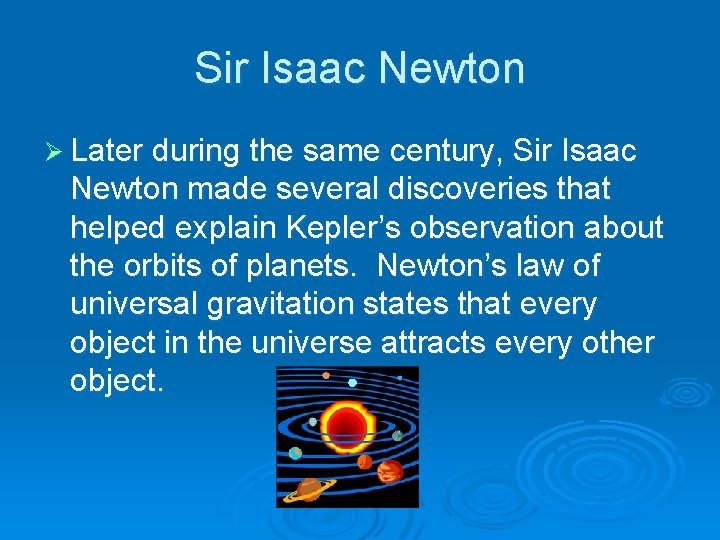
Sir Isaac Newton Ø Later during the same century, Sir Isaac Newton made several discoveries that helped explain Kepler’s observation about the orbits of planets. Newton’s law of universal gravitation states that every object in the universe attracts every other object.
Two Important Factors: How strongly objects pull on each other depends upon two factors: How much matter the objects have (mass) How far apart the objects are (distance)
Inertia Ø The Sun has a gravitational pull on planets. Inertia is an object’s resistance to any change in its motion. Objects at rest will stay at rest, and objects moving will continue to move in a straight line unless they are acted on by an unbalanced force. Without the gravitational force between the Sun and the planet, the planet would travel off into space in a straight line, (like your marble did)
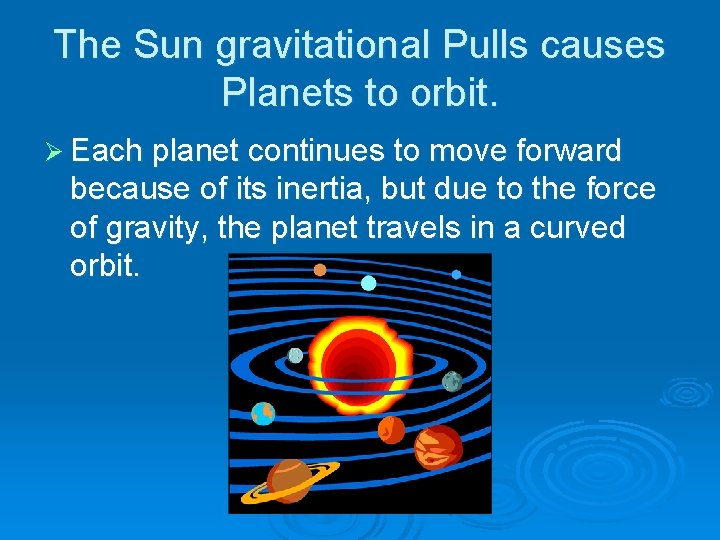
The Sun gravitational Pulls causes Planets to orbit. Ø Each planet continues to move forward because of its inertia, but due to the force of gravity, the planet travels in a curved orbit.
- Slides: 9