
Inequality and Immigration Challenges and opportunities arising from

- Slides: 27
Inequality and Immigration: Challenges and opportunities arising from low-status immigration in the wealthy West Richard Alba
Plan of talk • Overview of immigration in the U. S. , Canada, and four Western European countries. • Immigrants in the labor market. • The demographic transition to immigrationfueled diversity and its near-future labor-market significance. • The second generation in schools and the labor market. • Signs of change, as seen in the U. S. • Summing up: Achieving a balanced view.
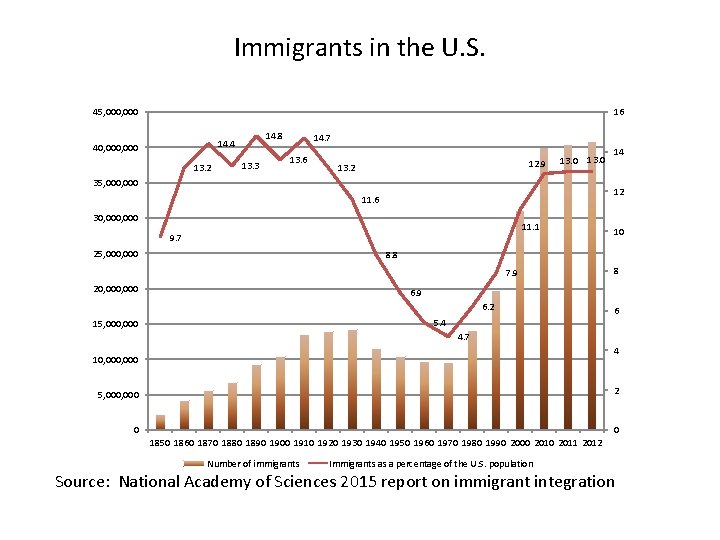
Immigrants in the U. S. 45, 000 16 14. 8 14. 4 40, 000 13. 2 13. 3 14. 7 13. 6 12. 9 13. 2 13. 0 35, 000 12 11. 6 30, 000 11. 1 9. 7 25, 000 14 10 8. 8 7. 9 20, 000 8 6. 9 6. 2 5. 4 15, 000 6 4. 7 4 10, 000 2 5, 000 0 0 1850 1860 1870 1880 1890 1900 1910 1920 1930 1940 1950 1960 1970 1980 1990 2000 2011 2012 Number of immigrants Immigrants as a percentage of the U. S. population Source: National Academy of Sciences 2015 report on immigrant integration
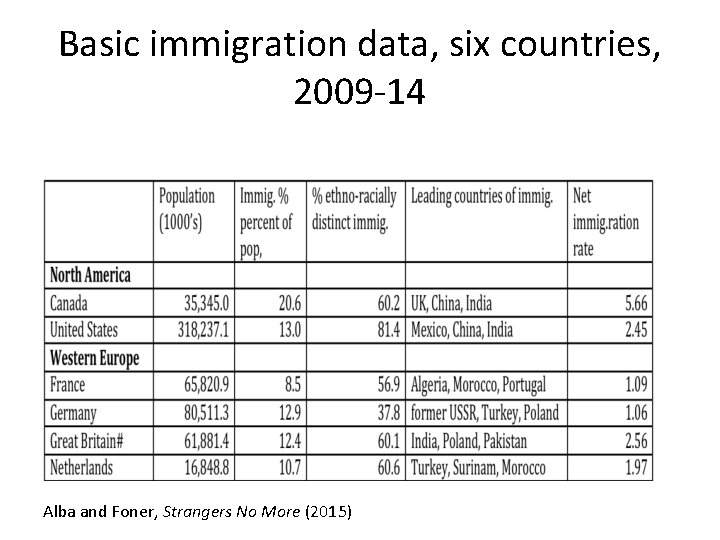
Basic immigration data, six countries, 2009 -14 Alba and Foner, Strangers No More (2015)
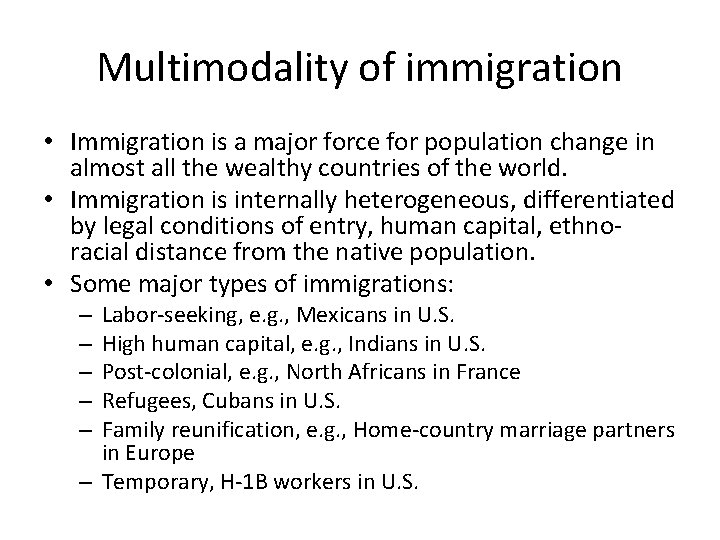
Multimodality of immigration • Immigration is a major force for population change in almost all the wealthy countries of the world. • Immigration is internally heterogeneous, differentiated by legal conditions of entry, human capital, ethnoracial distance from the native population. • Some major types of immigrations: Labor-seeking, e. g. , Mexicans in U. S. High human capital, e. g. , Indians in U. S. Post-colonial, e. g. , North Africans in France Refugees, Cubans in U. S. Family reunification, e. g. , Home-country marriage partners in Europe – Temporary, H-1 B workers in U. S. – – –
Low-status immigrations • Some immigrant groups arrive with considerable human capital, whose members often take well-paid and prestigious positions, for example, in medicine and engineering. • Focus here is on “low-status” immigrants: groups dominated by individuals g with low levels of education, who typically end up in poorly paid, sometimes off the books, jobs that are frequently dirty and sometimes dangerous and demeaning. These immigrants are also stigmatized because of their ethno-racial backgrounds. • The labor of low-status groups is still very much wanted because of the expansion “low skill” jobs, especially in service work, that most natives shun. • Yet they are also at the core of ethno-racial distinctions that are emerging or growing in the wealthy west.
The modes of entry of low-status immigrants • Often not desired as permanent settlers. • In continental Europe, they often entered initially as “guestworkers, ” who were expected to go home—e. g. , Turks in Germany and the Netherlands. • Also came from former colonies—Algerians in France—and treated as outsiders therefore. • In the U. S. , often disadvantaged by defective legal status—unauthorized or TPS.
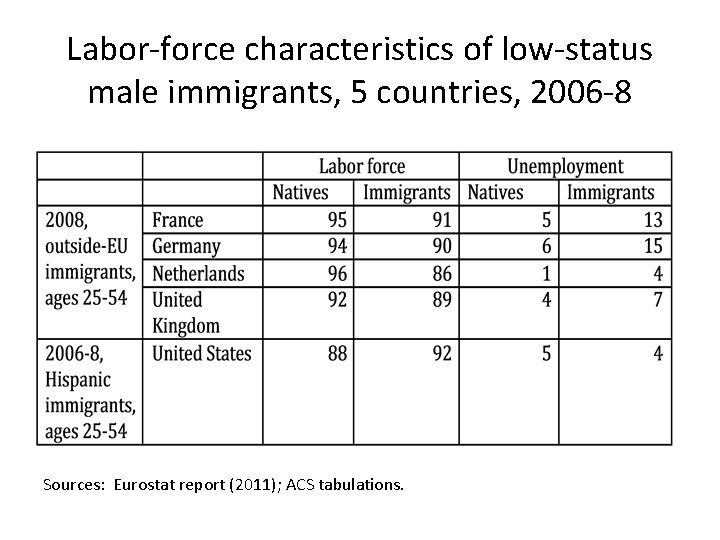
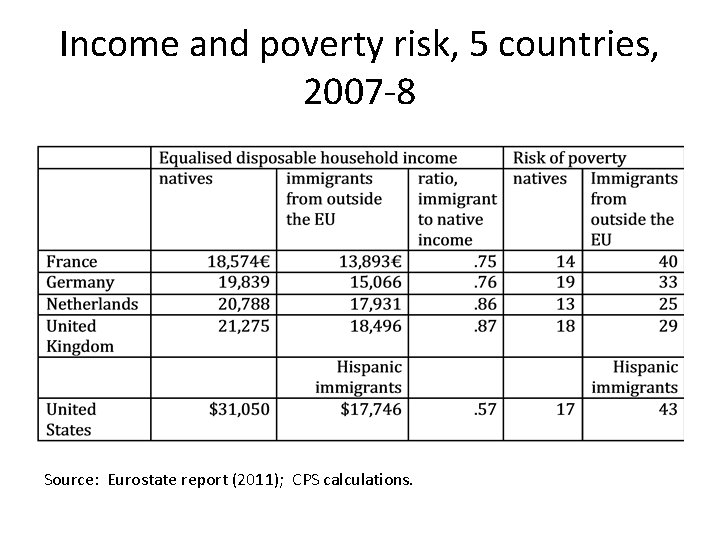
Low-status immigrants and the labor market • Low-status immigrants are typically found in lowwage sectors of the labor market; in some sectors, they have displaced native workers. • In some countries, they suffer higher rates of unemployment than native workers. • Their earnings are lower; their risk of poverty is higher. But the degree of inequality is variable. • These variations defy facile generalizations about liberal market (U. S. , U. K. )/social market economies (France, Germany).
Labor-force characteristics of low-status male immigrants, 5 countries, 2006 -8 Sources: Eurostat report (2011); ACS tabulations.
Income and poverty risk, 5 countries, 2007 -8 Source: Eurostate report (2011); CPS calculations.
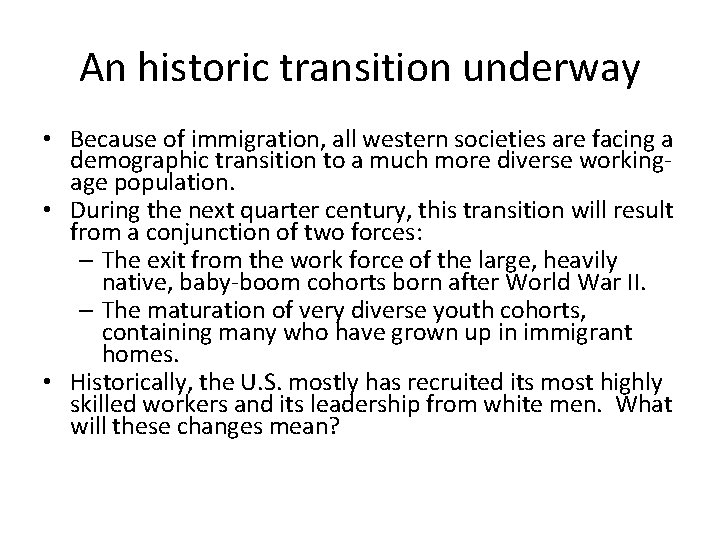
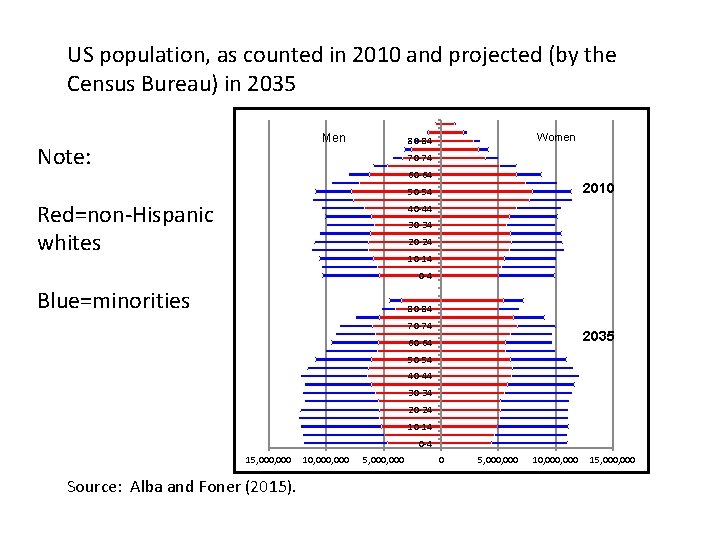
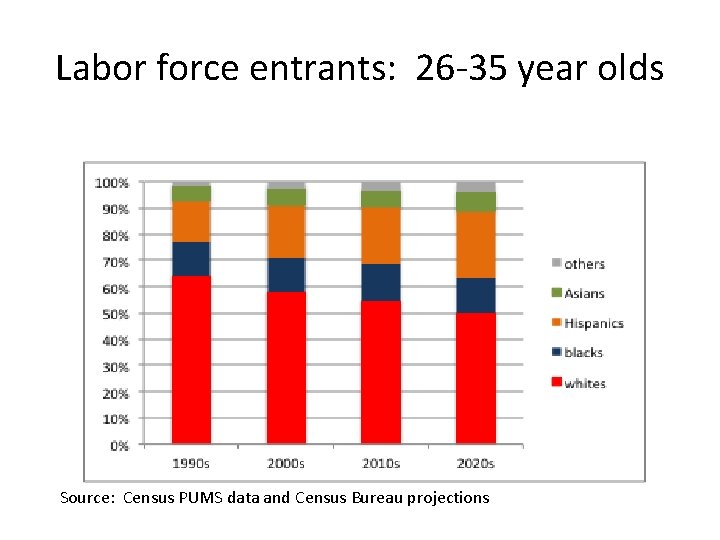
An historic transition underway • Because of immigration, all western societies are facing a demographic transition to a much more diverse workingage population. • During the next quarter century, this transition will result from a conjunction of two forces: – The exit from the work force of the large, heavily native, baby-boom cohorts born after World War II. – The maturation of very diverse youth cohorts, containing many who have grown up in immigrant homes. • Historically, the U. S. mostly has recruited its most highly skilled workers and its leadership from white men. What will these changes mean?
US population, as counted in 2010 and projected (by the Census Bureau) in 2035 Men Note: Women 80 -84 70 -74 60 -64 2010 50 -54 Red=non-Hispanic whites 40 -44 30 -34 20 -24 10 -14 0 -4 Blue=minorities 80 -84 70 -74 2035 60 -64 50 -54 40 -44 30 -34 20 -24 10 -14 0 -4 15, 000 Source: Alba and Foner (2015). 10, 000 5, 000, 000 10, 000 15, 000
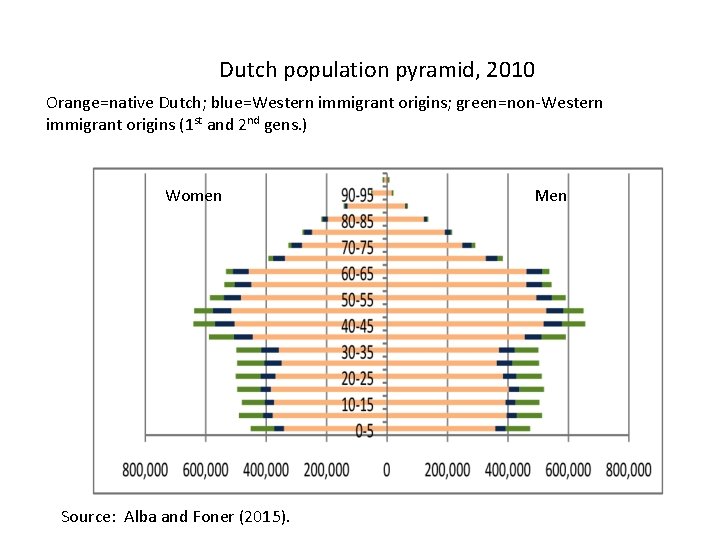
Dutch population pyramid, 2010 Orange=native Dutch; blue=Western immigrant origins; green=non-Western immigrant origins (1 st and 2 nd gens. ) Women Source: Alba and Foner (2015). Men
Next quarter century is crucial • The departure from the baby boom (born between 1946 and 1964 in the U. S. ) will create fluidity. • Generally, this group is made up largely of the native majority; and it was the first to experience mass higher education, • Highly placed in labor market, in numerous positions of civic leadership. • The native majority group is youthful cohorts is much smaller--Who will replace the baby boomers?
Immigrant-origin youth • In the U. S. , about a quarter of children are growing up in immigrant homes. • In the Netherlands, young people of immigrant origins account for almost a quarter (22. 5 percent) of youth under the age of 21 (Statistics Netherlands, 2009). • In France, about one-sixth (17 percent) of all children are growing up in immigrant homes. • In the United Kingdom, about a quarter of all children are now members of ethnic minority groups, mostly of post-1950 immigrant origin.
Low-status immigrations & the second generation • Two-thirds of immigrant-origin children in the Netherlands have non-western origins, most are in families that come from former colonies or Morocco or Turkey. • Sixty percent of such children in the US have Latin American or Caribbean origins. • Half of immigrant-origin children in France have African backgrounds.
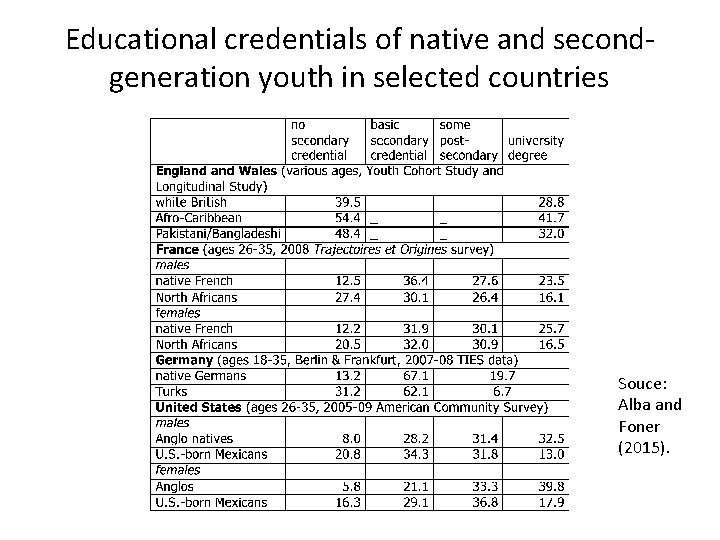
Educational credentials of native and secondgeneration youth in selected countries Souce: Alba and Foner (2015).
Second generation in labor market • Inadequate evidence, but: • In Britain, Bangladeshi and Pakistani second generations have higher unemployment, as well as relatively high employment by minority bosses (Sin Yi Cheung 2014). • In France, African and Turkish second generations also have high rates of unemployment and of employment in jobs below their qualifications (Silberman and Fournier, 2007). • In the U. S. , employment is less the issue than the quality of jobs. Luthra and Waldinger (2010) found that second-generation Mexicans are more likely to hold jobs with health and retirement benefits and to receive lower pay.
Period of ethno-racial fluidity? • Change = alteration to ethno-racial boundaries, not simply enhanced opportunities for some minority individuals – Example: mid-20 th century assimilation of white ethnics in the U. S. • My claim: Key is non-zero-sum mobility, a lessening of competition, which allows minorities to rise without threat to life chances of majority • Exodus of the baby boom from the labor market creates the prospect of non-zero-sum mobility during the next 25 -30 years, into the 2030 s
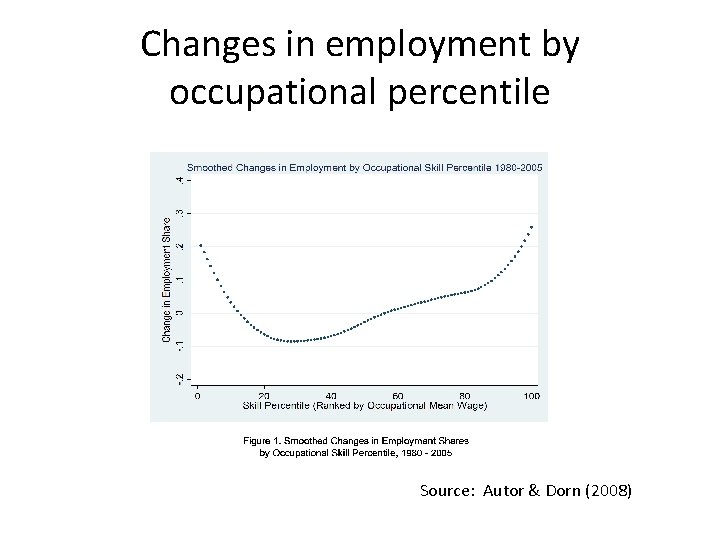
Changes in employment by occupational percentile Source: Autor & Dorn (2008)
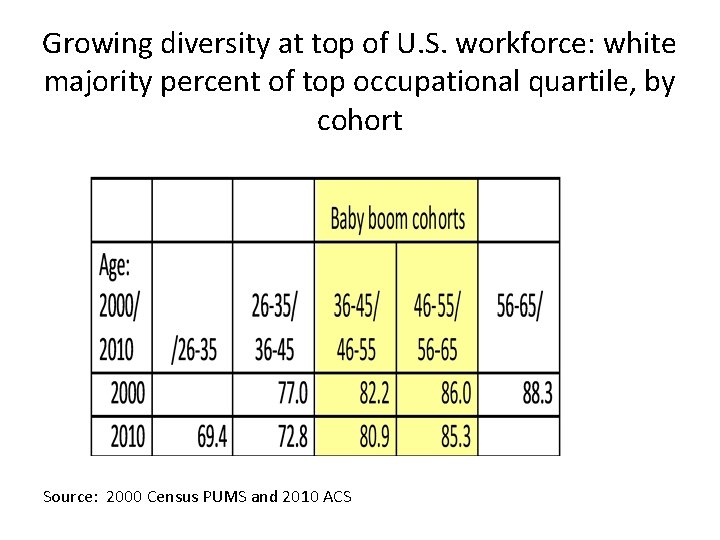
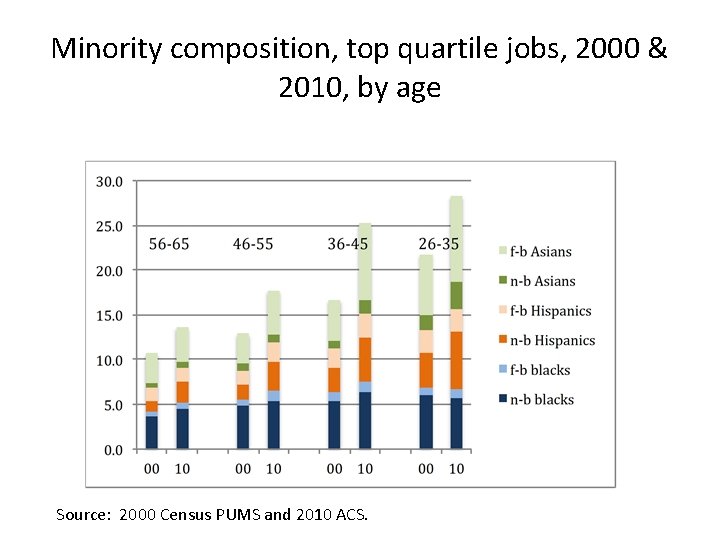
Analysis • Start with occupations scored by median incomes of full-time workers • Identify top quartile as the most highly paid occupations that account for one quarter of the full-time work force • Use 2000 PUMS and 2009 -11 ACS to analyze changes in the top quartile across a decade • Questions: Has increase in ethno-racial diversity at the top of the work force relented? Has white advantage intensified?
Growing diversity at top of U. S. workforce: white majority percent of top occupational quartile, by cohort Source: 2000 Census PUMS and 2010 ACS
Minority composition, top quartile jobs, 2000 & 2010, by age Source: 2000 Census PUMS and 2010 ACS.
Labor force entrants: 26 -35 year olds Source: Census PUMS data and Census Bureau projections
A paradoxical future: A changing economic mainstream • The top tier of workers in the U. S. gives insight into the economic mainstream: An inescapable shift appears underway from a top tier dominated by the native majority to one that is more diverse. This is likely happening elsewhere as well. • In the U. S. , the growing diversity is especially associated with immigrant-origin groups, Asians above all, but also Latinos and immigrant-origin blacks. The African-American presence is scarcely changing. • Limited economic growth does not appear able to prevent some degree of shift, though the magnitude of the shift will be larger if growth accelerates.
The paradox continued: White advantage is maintained, but with an asterisk • Ceteris paribus, members of the native majority are more likely to land best jobs. • But in the U. S. Asians are close behind and hold educational advantages over whites. • For Latinos in the U. S. , nativity and education make a huge difference. Latinos are well behind whites in terms of education. With education controlled, the disadvantages of native-born Latinos are moderate.
The challenges of the next quarter century • Large shift in ethno-racial composition of the workforce in wealthy Western countries. • Substantial shrinkage in the pool from which most high -level workers have historically been recruited: college -educated native majority men. • These countries need to: – Do a better job of bringing minority men and women to educational parity. – Ensure that those who are educationally successful find open pathways to leadership in worlds of work. • Failure means: declining excellence and innovation.