
IndustryUniversity Cooperative Research Center IUCRC Advanced Mammalian Biomanufacturing
Industry/University Cooperative Research Center (I/UCRC) Advanced Mammalian Biomanufacturing Innovation Center (AMBIC) Optimizing Nutrient Concentration Levels in Media and Feed Formulations November 19 th, 2019 Marc Donohue, Alan Stone, Michael Betenbaugh (Johns Hopkins University) A National Science Foundation-facilitated academic – industry – government consortia to advance precompetitive knowledge in biomanufacturing Contents are Proprietary to AMBIC and its Members Terms of Center Membership Agreement Apply
Outline • Experimental Updates • Computational Updates • GUI Distribution Updates
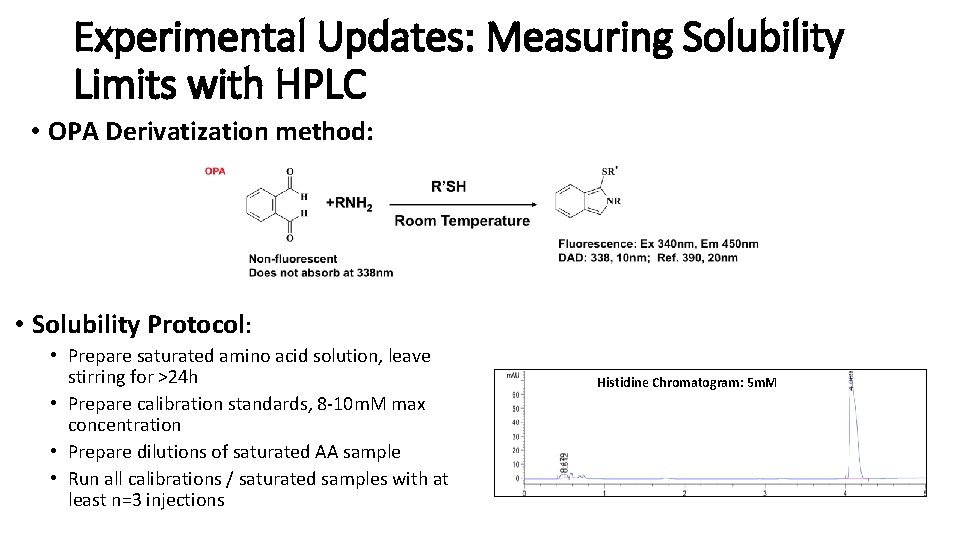
Experimental Updates: Measuring Solubility Limits with HPLC • OPA Derivatization method: • Solubility Protocol: • Prepare saturated amino acid solution, leave stirring for >24 h • Prepare calibration standards, 8 -10 m. M max concentration • Prepare dilutions of saturated AA sample • Run all calibrations / saturated samples with at least n=3 injections Histidine Chromatogram: 5 m. M
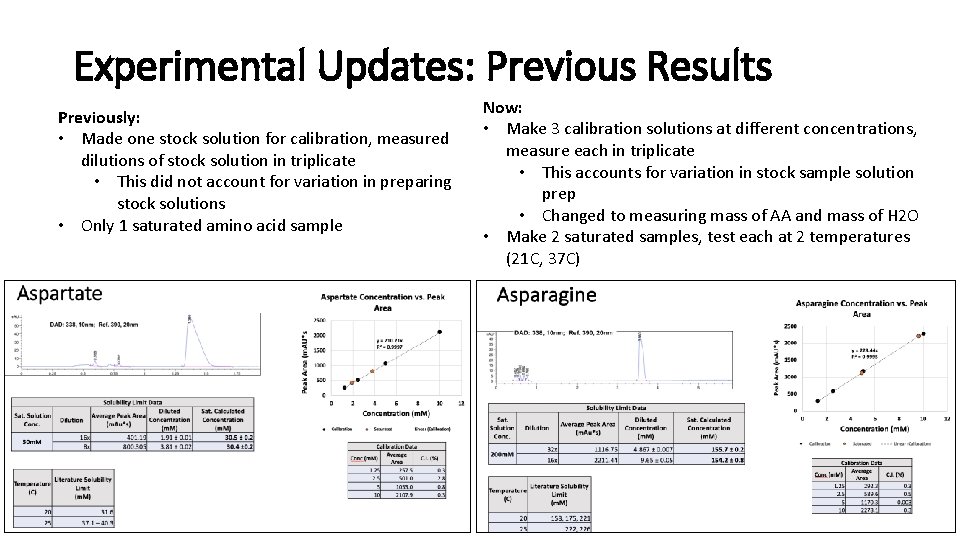
Experimental Updates: Previous Results Previously: • Made one stock solution for calibration, measured dilutions of stock solution in triplicate • This did not account for variation in preparing stock solutions • Only 1 saturated amino acid sample Now: • Make 3 calibration solutions at different concentrations, measure each in triplicate • This accounts for variation in stock sample solution prep • Changed to measuring mass of AA and mass of H 2 O • Make 2 saturated samples, test each at 2 temperatures (21 C, 37 C)
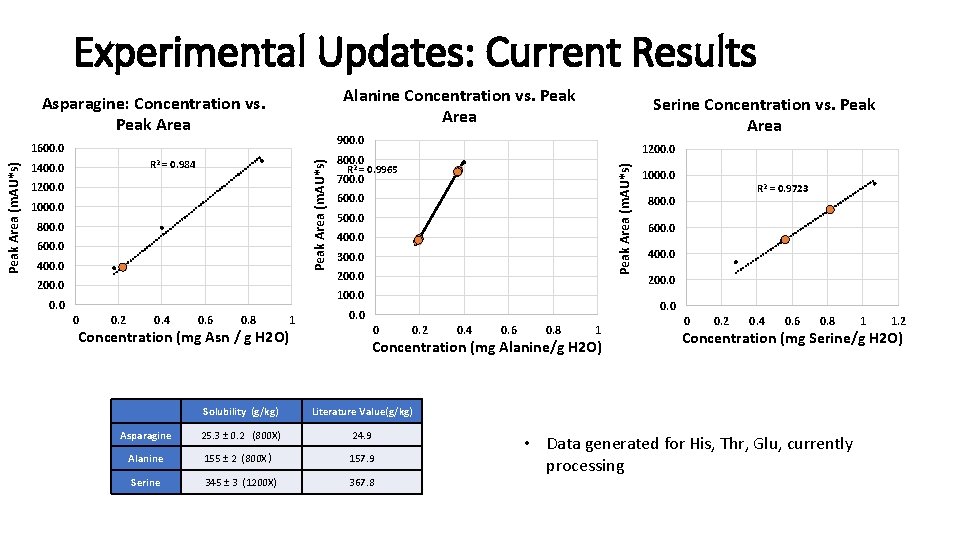
Experimental Updates: Current Results Alanine Concentration vs. Peak Area Asparagine: Concentration vs. Peak Area 900. 0 1200. 0 1000. 0 800. 0 600. 0 400. 0 200. 0 1200. 0 800. 0 R 2 = 0. 9965 Peak Area (m. AU*s) R 2 = 0. 984 Peak Area (m. AU*s) 1600. 0 1400. 0 Serine Concentration vs. Peak Area 700. 0 600. 0 500. 0 400. 0 300. 0 200. 0 100. 0 0 0. 2 0. 4 0. 6 0. 8 1 R 2 = 0. 9723 800. 0 600. 0 400. 0 200. 0 0 Concentration (mg Asn / g H 2 O) 1000. 0 0. 2 0. 4 0. 6 0. 8 1 Concentration (mg Alanine/g H 2 O) Solubility (g/kg) Literature Value(g/kg) Asparagine 25. 3 ± 0. 2 (800 X) 24. 9 Alanine 155 ± 2 (800 X) 157. 9 Serine 345 ± 3 (1200 X) 367. 8 0 0. 2 0. 4 0. 6 0. 8 1 1. 2 Concentration (mg Serine/g H 2 O) • Data generated for His, Thr, Glu, currently processing
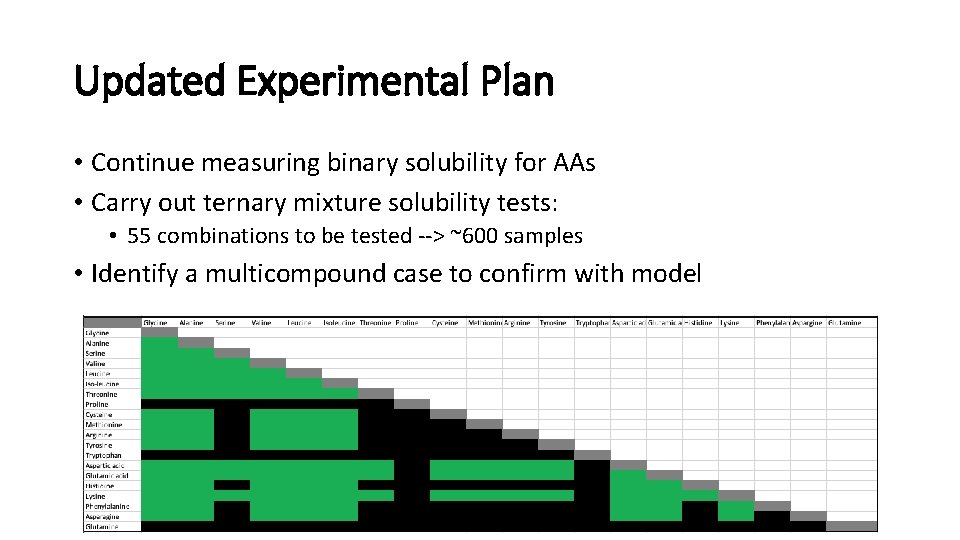
Updated Experimental Plan • Continue measuring binary solubility for AAs • Carry out ternary mixture solubility tests: • 55 combinations to be tested --> ~600 samples • Identify a multicompound case to confirm with model
Computational Updates Outline • Conceptual overview • Accomplishments and Future Modeling challenges • p. H Updates and Future Work
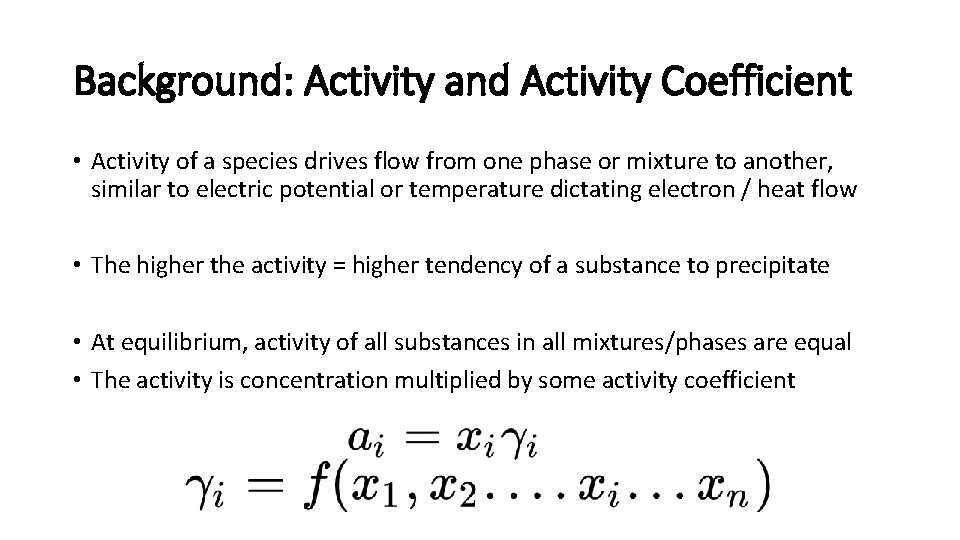
Background: Activity and Activity Coefficient • Activity of a species drives flow from one phase or mixture to another, similar to electric potential or temperature dictating electron / heat flow • The higher the activity = higher tendency of a substance to precipitate • At equilibrium, activity of all substances in all mixtures/phases are equal • The activity is concentration multiplied by some activity coefficient
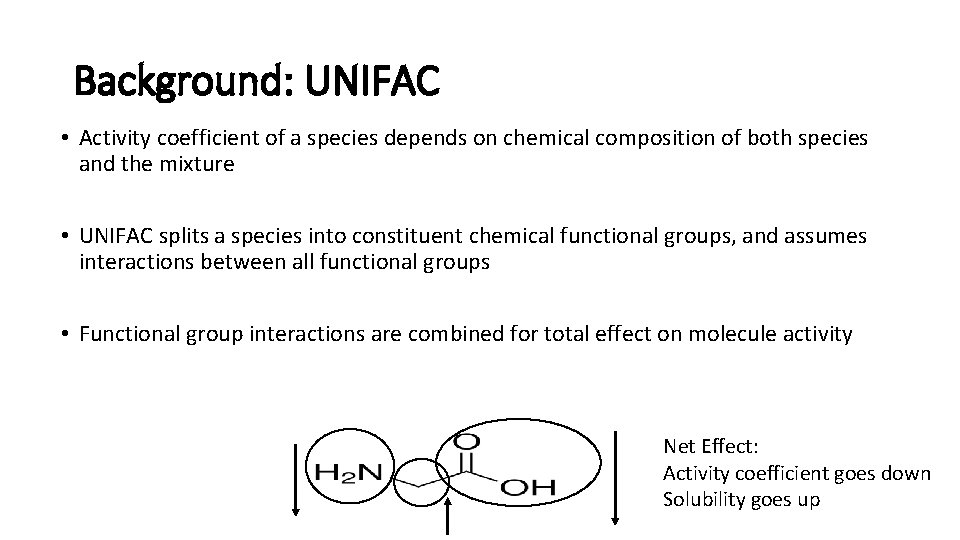
Background: UNIFAC • Activity coefficient of a species depends on chemical composition of both species and the mixture • UNIFAC splits a species into constituent chemical functional groups, and assumes interactions between all functional groups • Functional group interactions are combined for total effect on molecule activity Net Effect: Activity coefficient goes down Solubility goes up
Background: Work Up to June Conference and Feedback • Compiled literature AA data from various sources • Regressed UNIFAC interaction parameters for amino acid functional groups • Developed a GUI capable of predicting solubilities of multi-compound mixtures • Feedback: • Enable all AA solubility predictions. This required development of experimental methods for measuring solubilities • Model p. H effect on amino acid dependence. This required an expansion of the model and a new modeling approach.
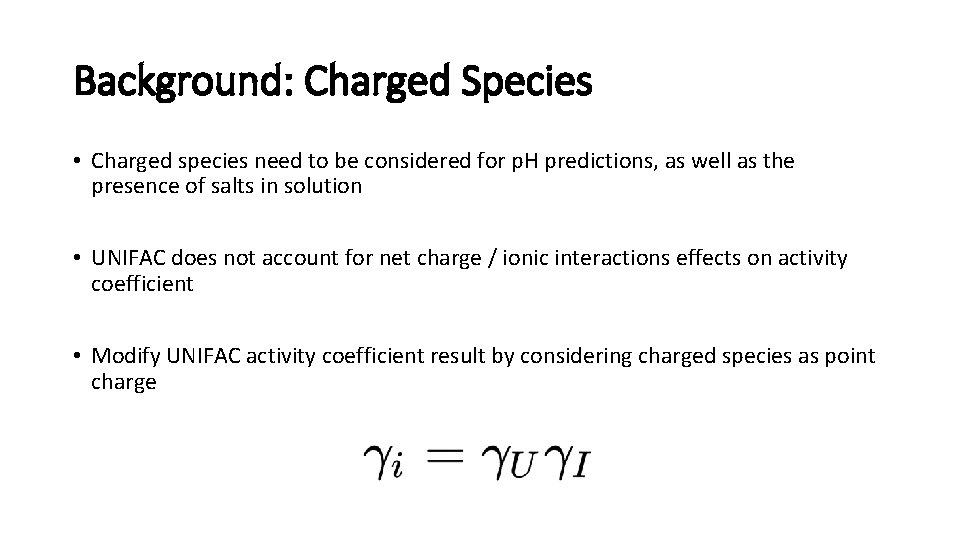
Background: Charged Species • Charged species need to be considered for p. H predictions, as well as the presence of salts in solution • UNIFAC does not account for net charge / ionic interactions effects on activity coefficient • Modify UNIFAC activity coefficient result by considering charged species as point charge
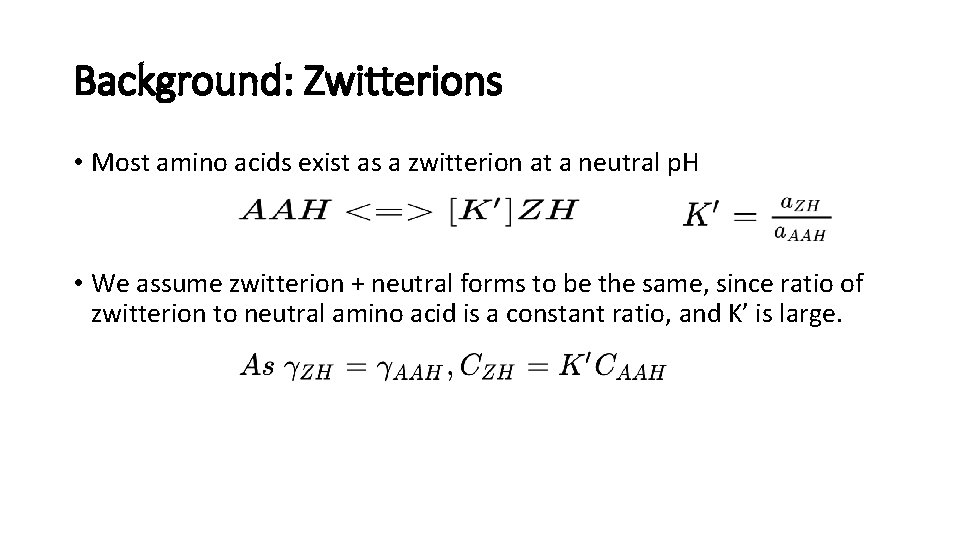
Background: Zwitterions • Most amino acids exist as a zwitterion at a neutral p. H • We assume zwitterion + neutral forms to be the same, since ratio of zwitterion to neutral amino acid is a constant ratio, and K’ is large.
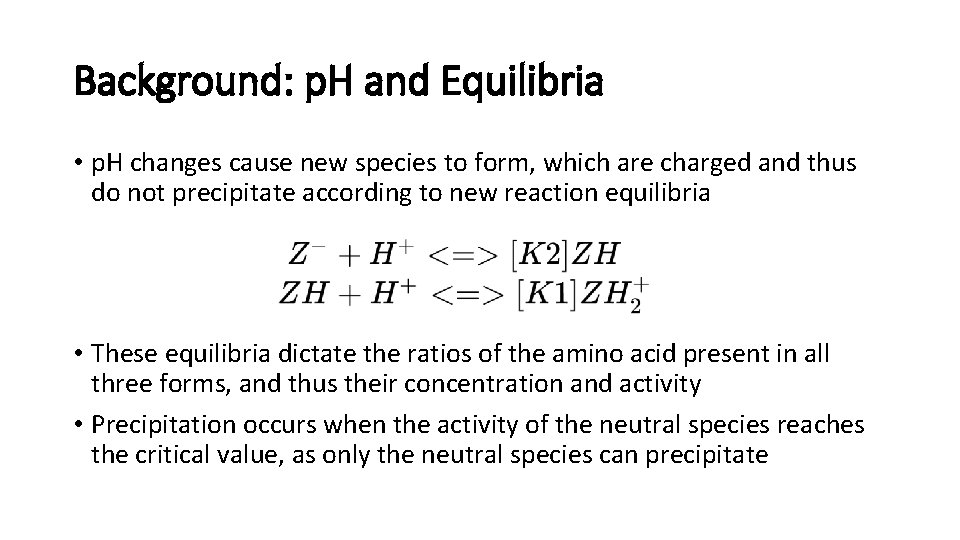
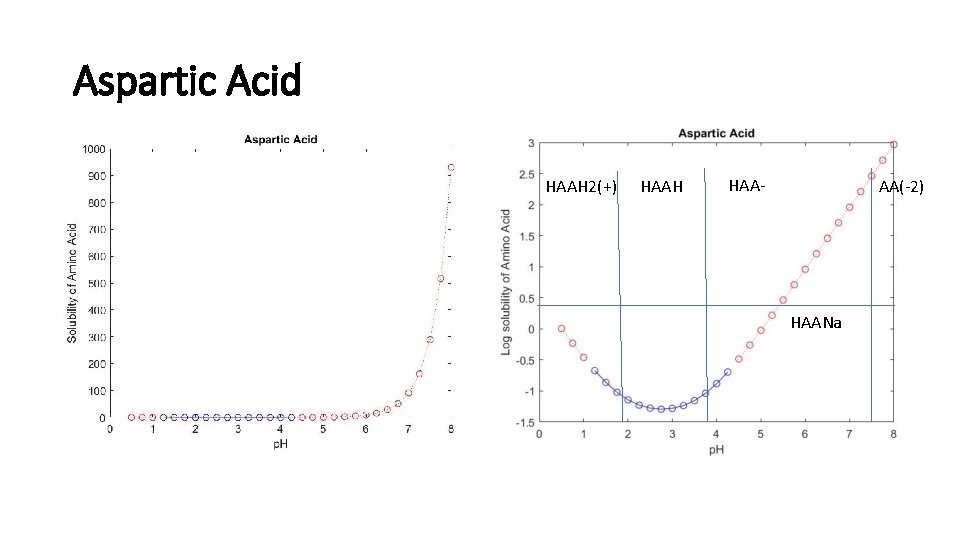
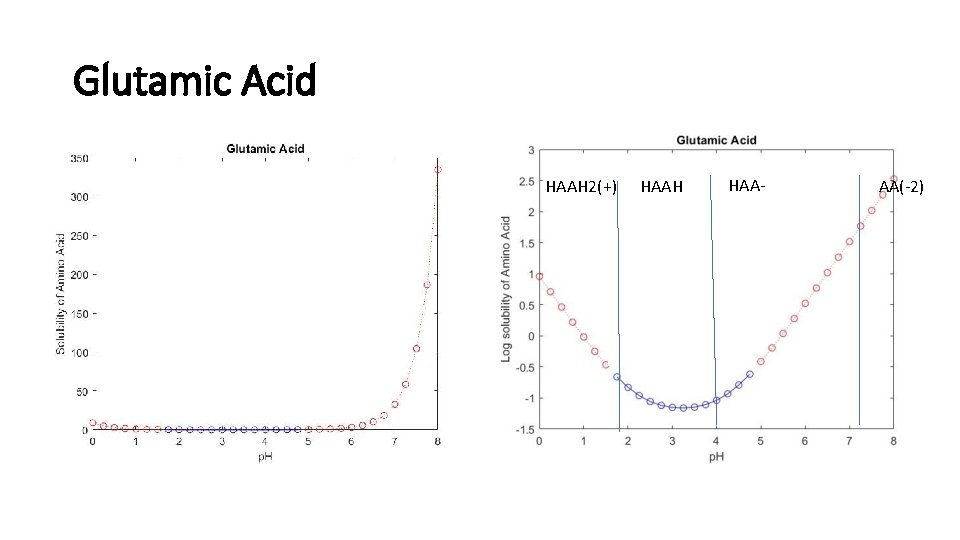
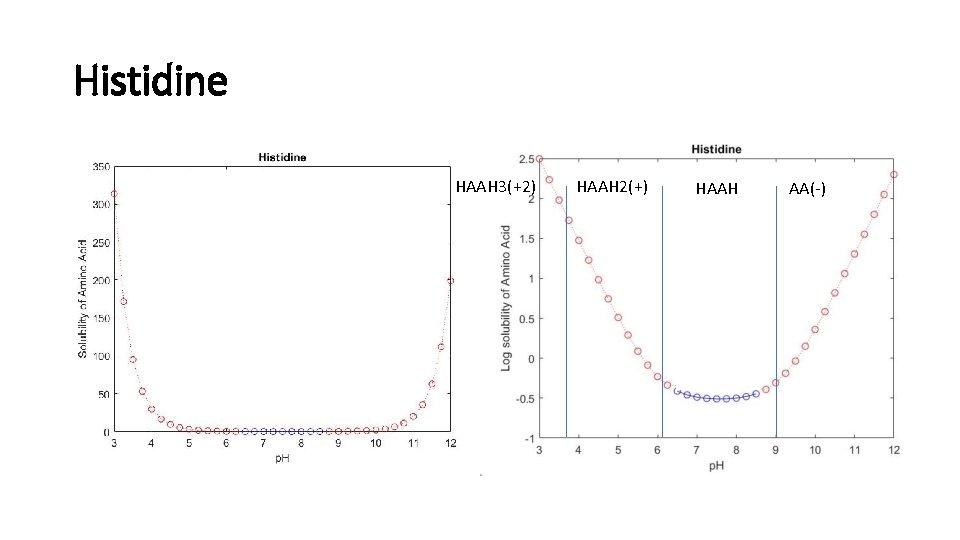
Background: p. H and Equilibria • p. H changes cause new species to form, which are charged and thus do not precipitate according to new reaction equilibria • These equilibria dictate the ratios of the amino acid present in all three forms, and thus their concentration and activity • Precipitation occurs when the activity of the neutral species reaches the critical value, as only the neutral species can precipitate
Background: Complexation and Scale • Including p. H increases complexity more than just zwitterion inclusion. In practice, p. H changes driven by HCl or Na. OH. • Counter ions also form amino acid salts, which likely precipitate earlier than the neutral amino acid • For media, other ions would also be present • For each counter-ion + AA pair, have to determine equilibrium ratios, a significant increase in project scope.
Background: Multicompound and Flexibility For predicting solubility with multiple species in media which can undergo complexation: • All the relevant equilibria (gathered in Dr. Stone’s chemical complexation project) has to be accessible • Based on input species, dynamically call equilibrium data, create problem to be called, and solve problem • This process would have to be automated to be scalable
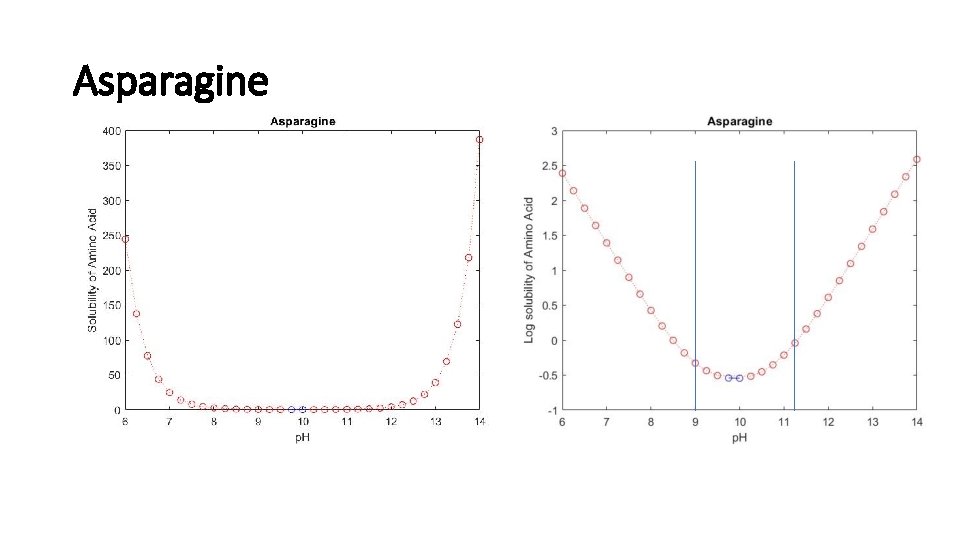
Computational Updates: p. H predictions • Modeled p. H predictions are available for all binary systems • Found interesting properties in Amino acids with acidic / basic side chains, causing us to model these slightly differently • Implemented an in-house solver for use in Python to address convergence issues with out-of-the-box solvers • Developed GUI-compatible code for neutral side-chain solubility predictions • By end of year, we will have code for all 3 types of amino acids implemented in python and incorporated in the GUI
Aspartic Acid cv HAAH 2(+) HAAH HAA- AA(-2) HAANa cv
Glutamic Acid HAAH 2(+) HAAH cv HAA- AA(-2)
Histidine HAAH 3(+2) HAAH 2(+) HAAH cv AA(-)
Asparagine
GUI Distribution Updates • We are sending out a notice to all AMBIC company disclosing the GUI • 60 days to respond, once response is received, then must ‘negotiate’ a non-exclusive, royalty-free license from JHU • Will be updated from current demo version.
- Slides: 21