
Industry and Competitive analysis Southwest Airlines Group 5
- Slides: 42
Industry and Competitive analysis: Southwest Airlines Group 5: Meghan Davidson Berklye Dominguez Justin Pickard Michael Simpson Andrew Vargas
Industry Characteristics �Service Industry �Air Transportation �Perishable �Available Seat Miles (ASMs) �Four Airline Categories: �International �National �Regional �Cargo/Air Freight
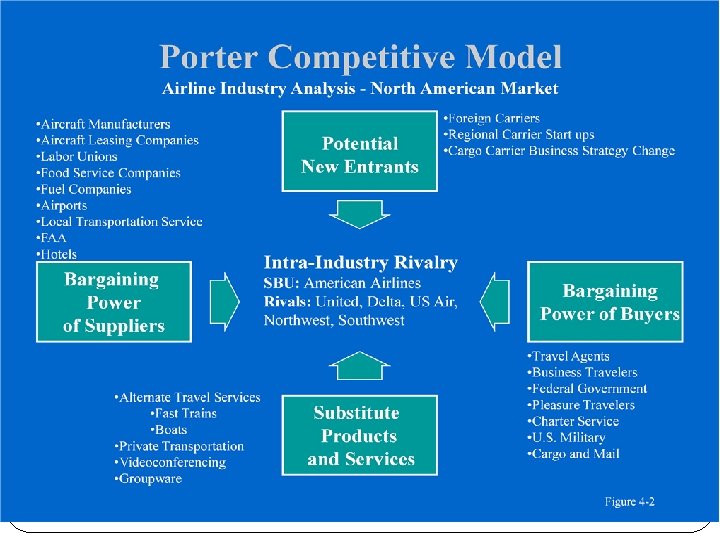
Industry Analysis �Environmental Scan �Economic �Political �Geographical �Social �Technological �Competitive �Porters 5 Forces
Economic Factors �Business Cycle �Short Booms & Long Busts �Investment �Capital intensive �Employment �Largest Expense �High Volume
Political Factors �Government Regulation �Civil Aeronautics Act, 1938 �Federal Aviation Act, 1958 �Deregulation �Airline Deregulation Act, 1978 �Southwest �Wright Amendment
Geographical Factors �Location �Dallas �Size �Large Area �Tactical �Hub and Spoke �Point to Point
Social Factors �Pollution caused by the airline industry �Airline industry contributes an estimated two-three percent of global greenhouse gas emissions �Emissions are released in a higher level of the atmosphere �Getting the Green Light for Aviation �Reduce and eliminate aviation impact on the environment �Aircraft is 60% more fuel efficient than 30 years ago
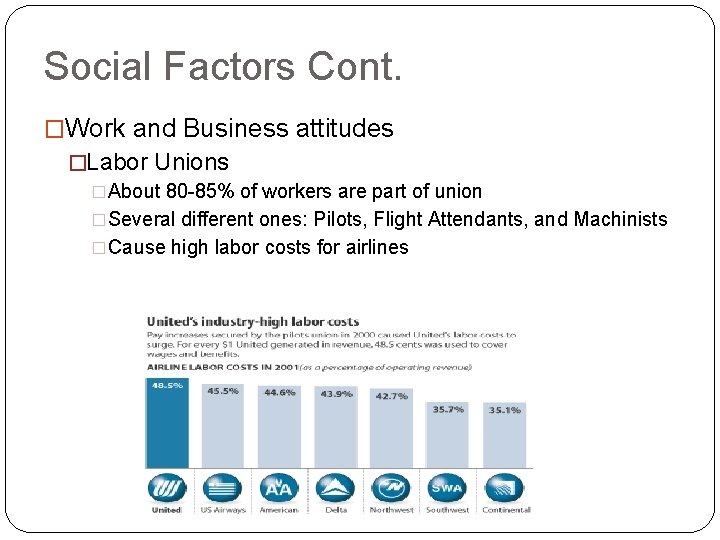
Social Factors Cont. �Work and Business attitudes �Labor Unions �About 80 -85% of workers are part of union �Several different ones: Pilots, Flight Attendants, and Machinists �Cause high labor costs for airlines
Technological Factors �Fuel Efficient aircraft and fuels are being developed �Technology development for lighter aircraft and fuel efficient engines �Air Traffic Control System �Next. Gen �Updated tracking and better routes
Technological Factors Cont. �Airlines Forecasting and Algorithms �Algorithms more accurate can have huge cost savings for companies �Better forecasting allows customers to receive better price �Life Cycle of an Aircraft �Average for Top 6 airlines is 13 years �Broadband to create Revenue �Market to grow to $986 million dollars �Ex. Southwest charging for internet use
Competitive Factors �Entry and Exit of Major Changes �Entry into the market requires high capital �Compete on small margins �Growth rate that is seen as good is 2 -3% �Competition Size �The largest seven airlines in US have more than 80% of market share � 11 major airlines
Competitive Factors Cont. �Competitive Edge �Fly as cheaply and quickly as possible with no mistakes �Price of Plane Tickets �No layovers and prefer point to point �No lost luggage �Discounts or specials �Good Customer Service �Market Segments �Locate in cities that have steady flow of traffic �Convenience of location
Business Altering Factor � 9/11 Attacks devastated the airline industry �Restrict air travel for the next four days �String of layoffs started to occur � 140, 000 announced layoffs would take place �Made Airlines restructure their business model �$15 billion dollar bailout was approved
Key Success Factors of Industry �Attracting and Maintaining customers �Satisfying new and potential passengers �Managing its fleet �Airplanes being fully utilized �Managing its people �Employees are happy and union is pleased �Handling its finances �Enough money is coming in from planes
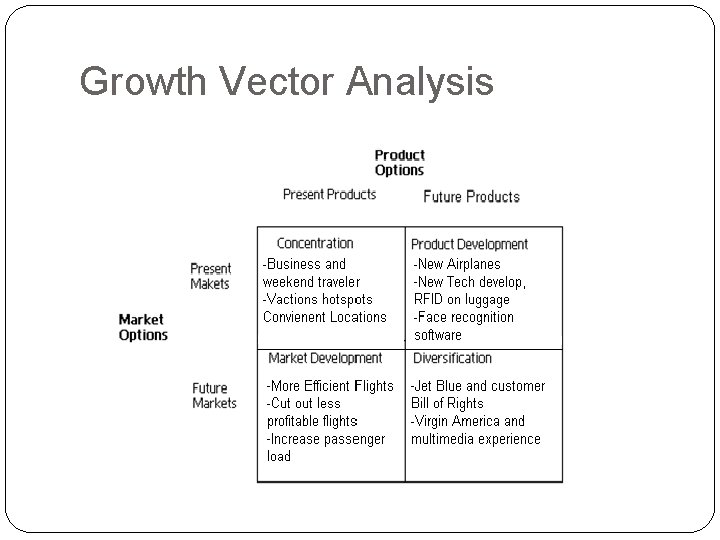
Growth Vector Analysis
Industry Rivalry �Competition �High �Deregulation �Price �Profits �Low
Threat of New Entrants �Regional Carrier startups �Barriers to Entry: �High Startup costs �Brand Name Recognition �Frequent Flyer Miles �Post-Entry Competition
Availability of Substitutes �These threats come from outside the Airline Industry �Automobiles �Trains �Buses �Other factors to consider �Cost �Time �Convenience
Availability of Substitutes �Telecommunications �Business Travelers �Net. Jets
Buyer/Supplier Power �Buyer Power �Low airline carrier buying power �Consumers �Supplier Power �Labor �Jet Fuel �Aircraft Manufacturers
History of Southwest Airlines �Southwest Airlines began in 1971 by Herb Kelleher and Rollin King. �It began in Texas flying between the triangle: Dallas, San Antonio, and Houston. �Since 1987, Southwest has had the lowest ratio of complaints per passenger boarded.
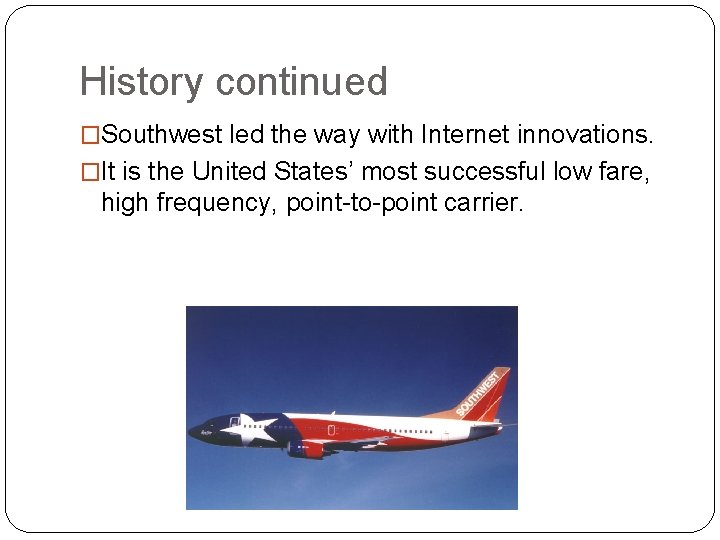
History continued �Southwest led the way with Internet innovations. �It is the United States’ most successful low fare, high frequency, point-to-point carrier.
Strategy and Performance �In 2007, Southwest implemented a new boarding system along with a Business Select product offering an improved Customer Airport Experience. �“NO-HIDDEN-FEE-ZONE” developed trust and commitment with customers. �In 2008 they made significant improvements in their network optimization capabilities and their revenue management. � 2008 proved to be another industry leading year. They led the airline industry in Customer Service and Operational Excellence.
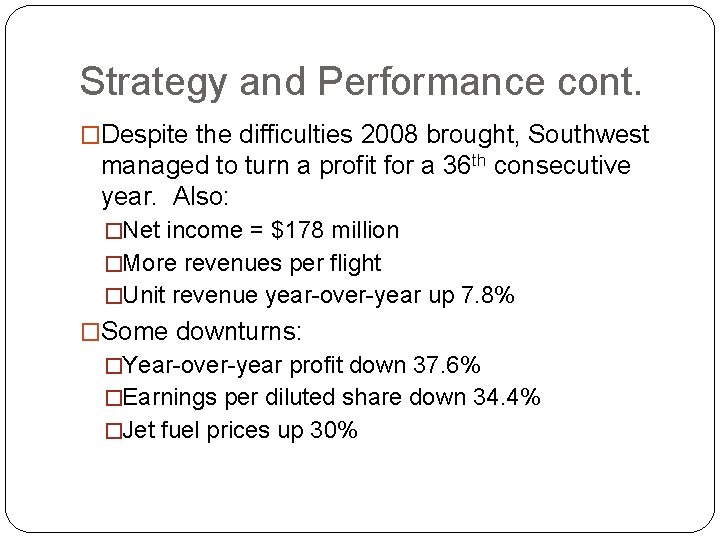
Strategy and Performance cont. �Despite the difficulties 2008 brought, Southwest managed to turn a profit for a 36 th consecutive year. Also: �Net income = $178 million �More revenues per flight �Unit revenue year-over-year up 7. 8% �Some downturns: �Year-over-year profit down 37. 6% �Earnings per diluted share down 34. 4% �Jet fuel prices up 30%
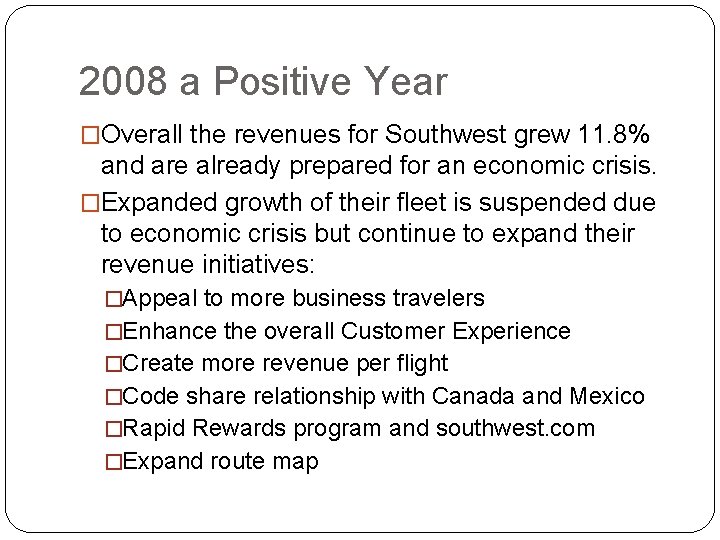
2008 a Positive Year �Overall the revenues for Southwest grew 11. 8% and are already prepared for an economic crisis. �Expanded growth of their fleet is suspended due to economic crisis but continue to expand their revenue initiatives: �Appeal to more business travelers �Enhance the overall Customer Experience �Create more revenue per flight �Code share relationship with Canada and Mexico �Rapid Rewards program and southwest. com �Expand route map
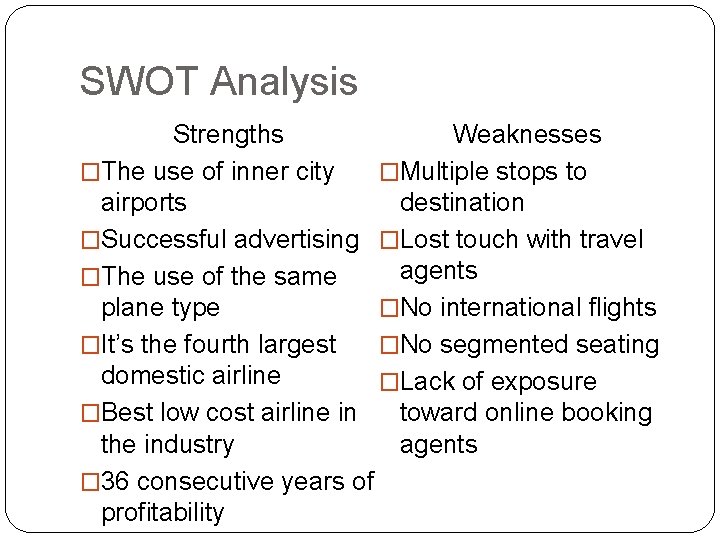
SWOT Analysis Strengths Weaknesses �The use of inner city �Multiple stops to airports destination �Successful advertising �Lost touch with travel agents �The use of the same �No international flights plane type �No segmented seating �It’s the fourth largest domestic airline �Lack of exposure toward online booking �Best low cost airline in agents the industry � 36 consecutive years of profitability
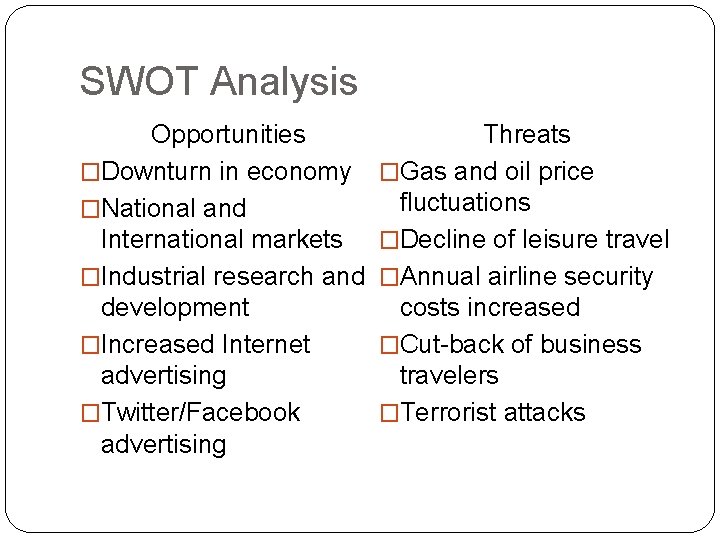
SWOT Analysis Opportunities �Downturn in economy �National and International markets �Industrial research and development �Increased Internet advertising �Twitter/Facebook advertising Threats �Gas and oil price fluctuations �Decline of leisure travel �Annual airline security costs increased �Cut-back of business travelers �Terrorist attacks
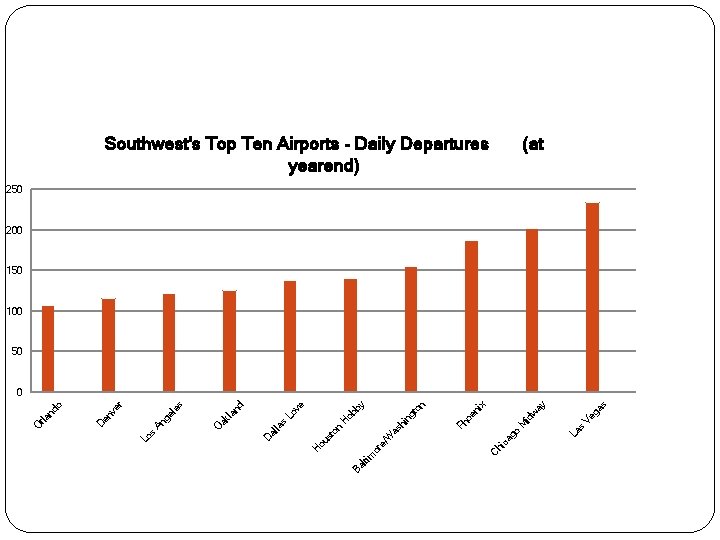
s ga Ve ay w M id La s go ca x oe ni gt on hi n by ob ve Lo H Ph as e/ W hi C m or Ba lti on st ou H s la an d ak l le s ge An O D al Lo s r ve en D o nd rla O Southwest's Top Ten Airports - Daily Departures yearend) (at 250 200 150 100 50 0
Assets to Southwest Airlines �Southwest Airlines’ assets that give it competitive strength: �Short flights to and from smaller airports �Provides easy online booking �The pilots don’t belong to a national union �The employees �“If they’re happy, satisfied, dedicated, and energetic, they’ll take real good care of the customers. When they customers are happy, they come back. And that makes the shareholders happy. ” Herb Kelleher
Some Awards � There are many awards that Southwest Airline has won. A few include: �Multiple times in the Top 5 in the Fortune Top 100 Best Businesses to Work For � 12 th on Fortune’s Most Admired list in 2007 �Forbes Platinum List in 2007 �ranked by Business Week as one of the 50 Best Places to Launch a Career �Most Admired Companies Among Women by Professional Women’s Magazine in 2006 � 100 Best Corporate Citizens by Business Ethics magazine �Corporate 100 by Hispanic magazine since 2000 �Top 100 Most Innovative Technology Organizations by Information. Week in July 2007
Relative Cost Position �In addition to their very successful fuel hedging program, there are several other projects in the works to reduce fuel consumption: �Jet engine washing �Obedience to planned cruise levels and efficient airspeeds �Portable electric ground power or Gate Services for aircraft �Install RNP/RNAV technology into their fleet
Relative Cost Position cont. � Also, in the face of this economic crisis, Southwest was able to raise their liquidity by $1. 1 billion in the fourth quarter of 2008 through multiple financing transactions. � They want to adapt to the constantly changing environment and at the end of 2008 they had a yearover-year available seat mile growth of nearly four percent and approximately 3, 200 daily departures. � During 2008 Southwest raised the number of their fleet by 17 Boeing 737 aircrafts to end up with 537. � The company improved its scheduling tools and can now optimize their schedules more often which shifts capacity to more demanding routes.
Managerial Factors �Social Responsibility �Strategic Analysis �Aggressiveness in Meeting Competition
Competitive Factors �Product Strength, Quality, Uniqueness �Customer Loyalty and Satisfaction �Market Share
Financial Factors �Access to Capital �Ease of exit from market � Profitability, ROI
Technical Factors �Product effectiveness and delivery schedules �Value Added to Service �Equipment
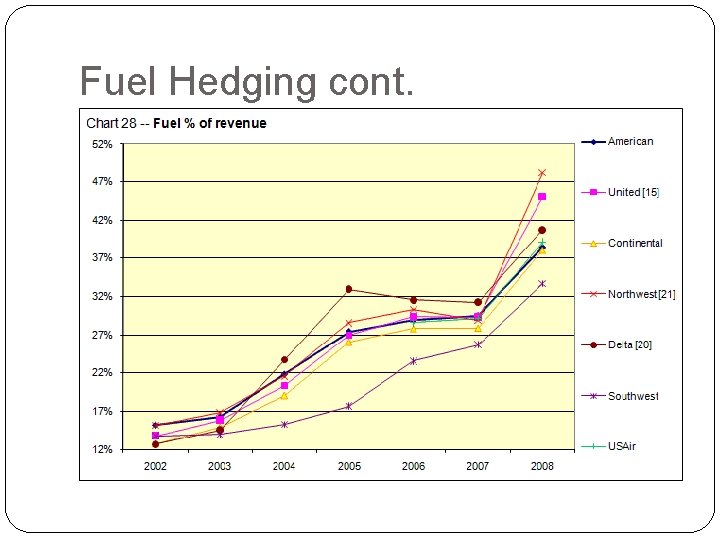
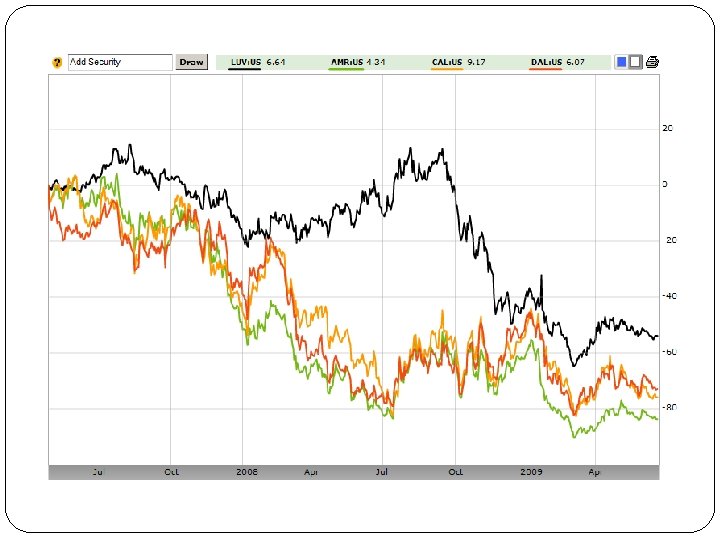
Fuel Hedging �The number 1 reason Southwest posted a profit in 2008 �Hedging is basically locking in the price of jet fuel for a certain time period. �In 2008, Southwest paid $51 a barrel for 70% of its oil, while its major competitors were paying over $140 a barrel.
Fuel Hedging cont.
Strategic Issues �In the past year Southwest added several more nonstop flights onto their list and they are hoping to add even more, further eliminating the multiple stops on their customers’ journeys. �They are hoping that they may break into the international market and create a whole new realm of opportunities for profit and growth. �Although they have had great success from their website, they want to still have the presence of the middlemen for older generations.
Strategic Issues cont. �Are entertaining the idea of changing long held ideas: �Deciding whether to assign seats �Serving in-flight meals is a possibility as well �Also thinking about adding a new aircraft if they do enter the international market.