
Industry Analysis The Fundamentals OUTLINE The objectives of
Industry Analysis: The Fundamentals OUTLINE • The objectives of industry analysis • From environmental analysis to industry analysis • Porter’s Five Forces Framework • Applying industry analysis • Industry & market boundaries • Identifying Key Success Factors
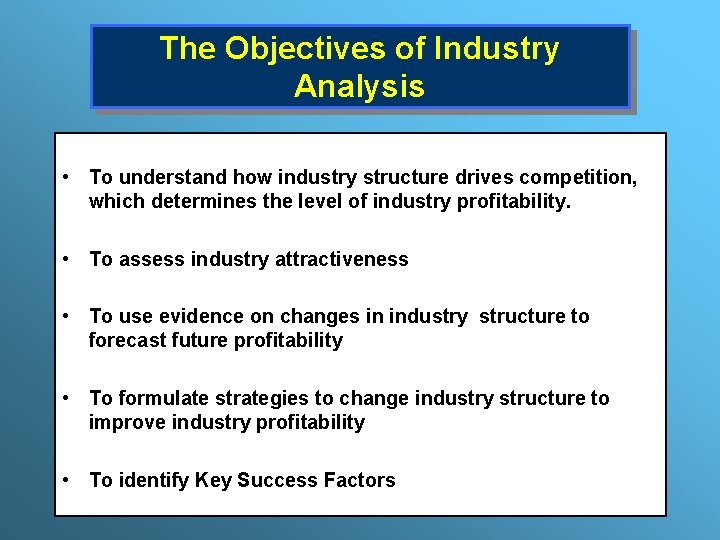
The Objectives of Industry Analysis • To understand how industry structure drives competition, which determines the level of industry profitability. • To assess industry attractiveness • To use evidence on changes in industry structure to forecast future profitability • To formulate strategies to change industry structure to improve industry profitability • To identify Key Success Factors

From Environmental Analysis to Industry Analysis The national/ international economy Technology Government & Politics The natural environment THE INDUSTRY ENVIRONMENT • Suppliers • Competitors • Customers Demographic structure Social structure • The Industry Environment lies at the core of the Macro Environment. • The Macro Environment impacts the firm through its effect on the Industry Environment.
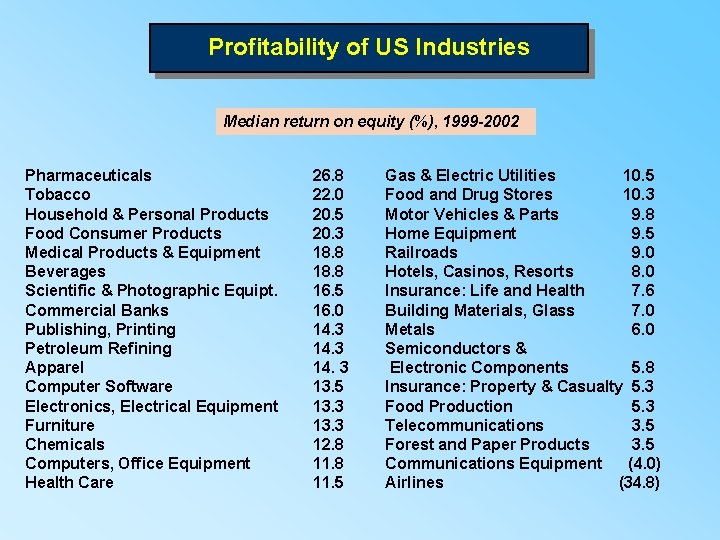
Profitability of US Industries Median return on equity (%), 1999 -2002 Pharmaceuticals Tobacco Household & Personal Products Food Consumer Products Medical Products & Equipment Beverages Scientific & Photographic Equipt. Commercial Banks Publishing, Printing Petroleum Refining Apparel Computer Software Electronics, Electrical Equipment Furniture Chemicals Computers, Office Equipment Health Care 26. 8 22. 0 20. 5 20. 3 18. 8 16. 5 16. 0 14. 3 13. 5 13. 3 12. 8 11. 5 Gas & Electric Utilities 10. 5 Food and Drug Stores 10. 3 Motor Vehicles & Parts 9. 8 Home Equipment 9. 5 Railroads 9. 0 Hotels, Casinos, Resorts 8. 0 Insurance: Life and Health 7. 6 Building Materials, Glass 7. 0 Metals 6. 0 Semiconductors & Electronic Components 5. 8 Insurance: Property & Casualty 5. 3 Food Production 5. 3 Telecommunications 3. 5 Forest and Paper Products 3. 5 Communications Equipment (4. 0) Airlines (34. 8)
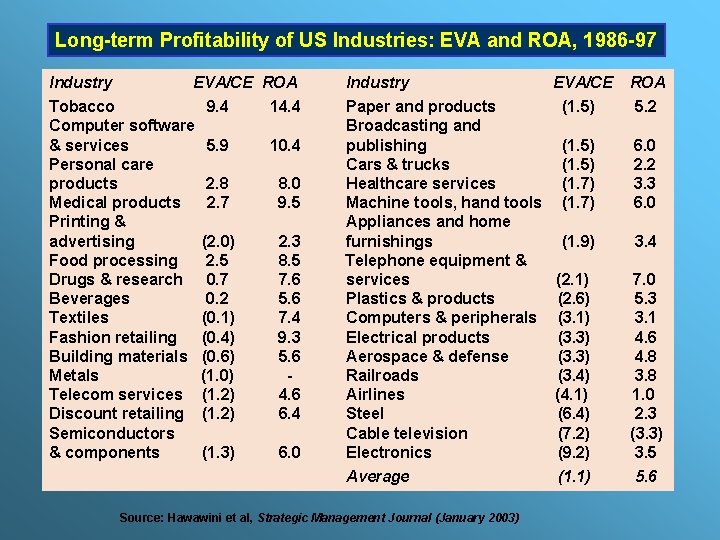
Long-term Profitability of US Industries: EVA and ROA, 1986 -97 Industry EVA/CE ROA Tobacco 9. 4 14. 4 Computer software & services 5. 9 10. 4 Personal care products 2. 8 8. 0 Medical products 2. 7 9. 5 Printing & advertising (2. 0) 2. 3 Food processing 2. 5 8. 5 Drugs & research 0. 7 7. 6 Beverages 0. 2 5. 6 Textiles (0. 1) 7. 4 Fashion retailing (0. 4) 9. 3 Building materials (0. 6) 5. 6 Metals (1. 0) Telecom services (1. 2) 4. 6 Discount retailing (1. 2) 6. 4 Semiconductors & components (1. 3) 6. 0 Industry Paper and products Broadcasting and publishing Cars & trucks Healthcare services Machine tools, hand tools Appliances and home furnishings Telephone equipment & services Plastics & products Computers & peripherals Electrical products Aerospace & defense Railroads Airlines Steel Cable television Electronics Average Source: Hawawini et al, Strategic Management Journal (January 2003) EVA/CE (1. 5) ROA 5. 2 (1. 5) (1. 7) 6. 0 2. 2 3. 3 6. 0 (1. 9) 3. 4 (2. 1) (2. 6) (3. 1) (3. 3) (3. 4) (4. 1) (6. 4) (7. 2) (9. 2) (1. 1) 7. 0 5. 3 3. 1 4. 6 4. 8 3. 8 1. 0 2. 3 (3. 3) 3. 5 5. 6
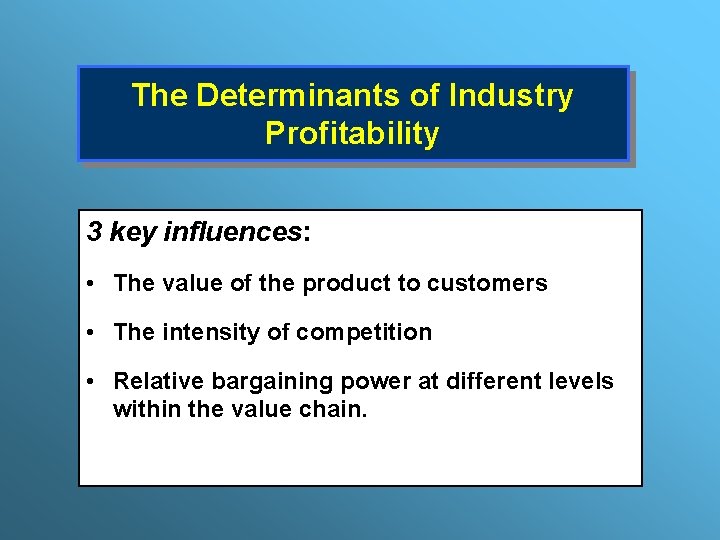
The Determinants of Industry Profitability 3 key influences: • The value of the product to customers • The intensity of competition • Relative bargaining power at different levels within the value chain.
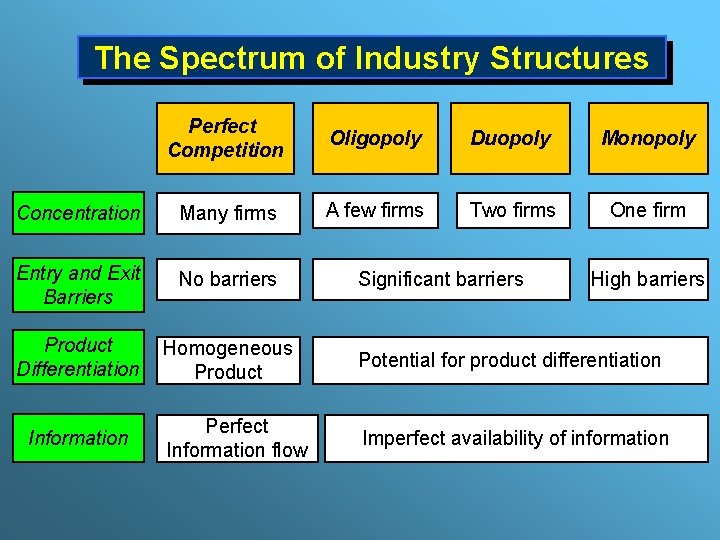
The Spectrum of Industry Structures Perfect Competition Oligopoly Duopoly Monopoly Concentration Many firms A few firms Two firms One firm Entry and Exit Barriers No barriers Product Differentiation Homogeneous Product Potential for product differentiation Perfect Information flow Imperfect availability of information Information Significant barriers High barriers
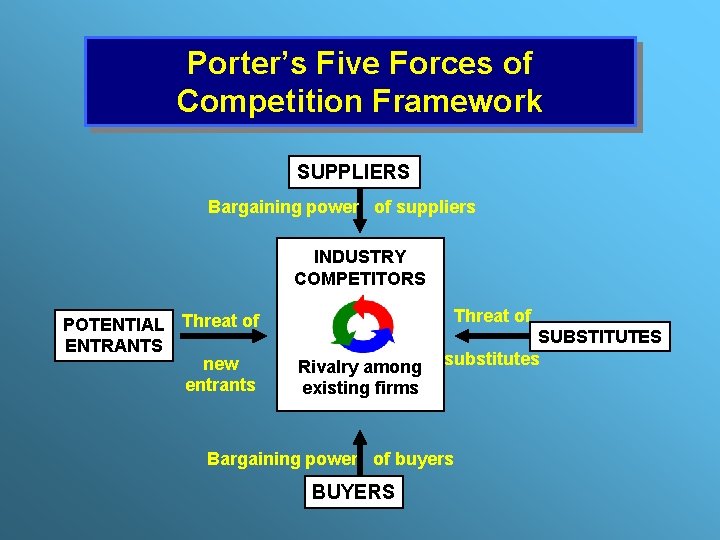
Porter’s Five Forces of Competition Framework SUPPLIERS Bargaining power of suppliers INDUSTRY COMPETITORS POTENTIAL Threat of ENTRANTS new entrants Threat of Rivalry among existing firms SUBSTITUTES substitutes Bargaining power of buyers BUYERS
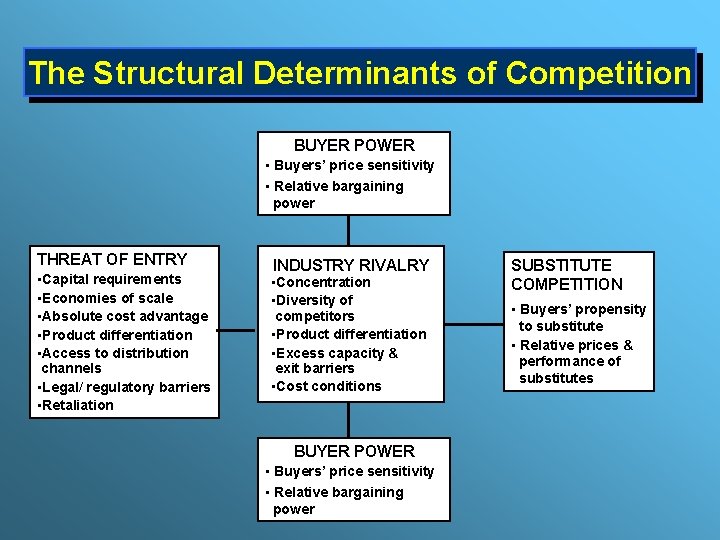
The Structural Determinants of Competition BUYER POWER • Buyers’ price sensitivity • Relative bargaining power THREAT OF ENTRY • Capital requirements • Economies of scale • Absolute cost advantage • Product differentiation • Access to distribution channels • Legal/ regulatory barriers • Retaliation INDUSTRY RIVALRY • Concentration • Diversity of competitors • Product differentiation • Excess capacity & exit barriers • Cost conditions BUYER POWER • Buyers’ price sensitivity • Relative bargaining power SUBSTITUTE COMPETITION • Buyers’ propensity to substitute • Relative prices & performance of substitutes
Threat of Substitutes Extent of competitive pressure from producers of substitutes depends upon: • Buyers’ propensity to substitute • The price-performance characteristics of substitutes.
The Threat of Entry Entrants’ threat to industry profitability depends upon the height of barriers to entry. The principal sources of barriers to entry are: • Capital requirements • Economies of scale • Absolute cost advantage • Product differentiation • Access to channels of distribution • Legal and regulatory barriers • Retaliation
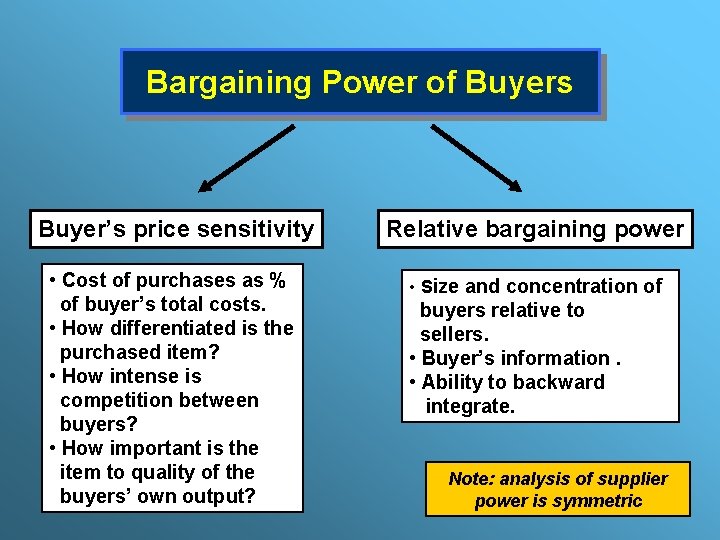
Bargaining Power of Buyers Buyer’s price sensitivity Relative bargaining power • Cost of purchases as % of buyer’s total costs. • How differentiated is the purchased item? • How intense is competition between buyers? • How important is the item to quality of the buyers’ own output? • Size and concentration of buyers relative to sellers. • Buyer’s information. • Ability to backward integrate. Note: analysis of supplier power is symmetric

Rivalry Between Established Competitors The extent to which industry profitability is depressed by aggressive price competition depends upon: • Concentration (number and size distribution of firms) • Diversity of competitors (differences in goals, cost structure, etc. ) • Product differentiation • Excess capacity and exit barriers • Cost conditions – Extent of scale economies – Ratio of fixed to variable costs
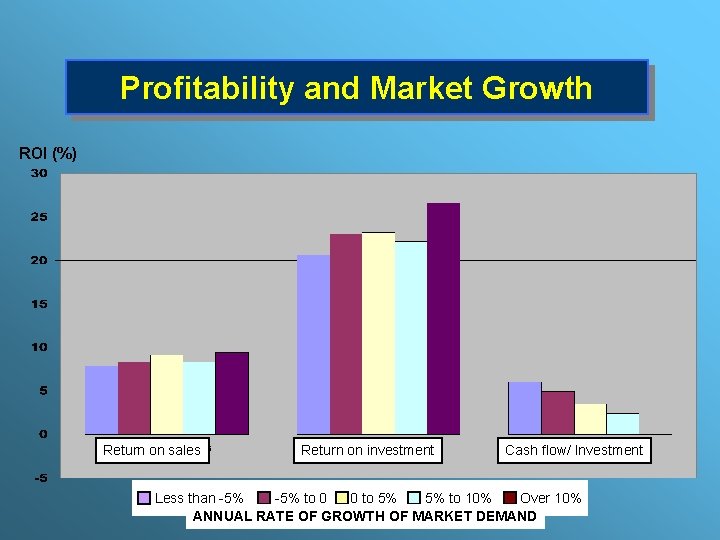
Profitability and Market Growth ROI (%) Return on sales Return on investment Cash flow/ Investment Less than -5% to 0 0 to 5% 5% to 10% Over 10% ANNUAL RATE OF GROWTH OF MARKET DEMAND
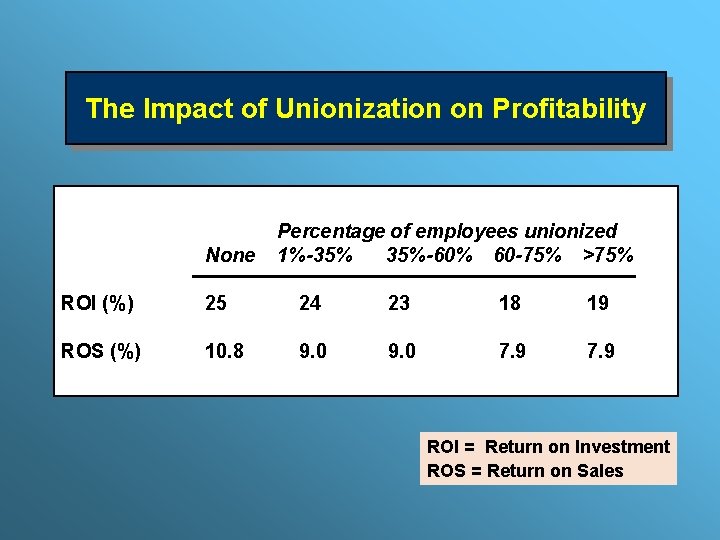
The Impact of Unionization on Profitability None Percentage of employees unionized 1%-35% 35%-60% 60 -75% >75% ROI (%) 25 24 23 18 19 ROS (%) 10. 8 9. 0 7. 9 ROI = Return on Investment ROS = Return on Sales
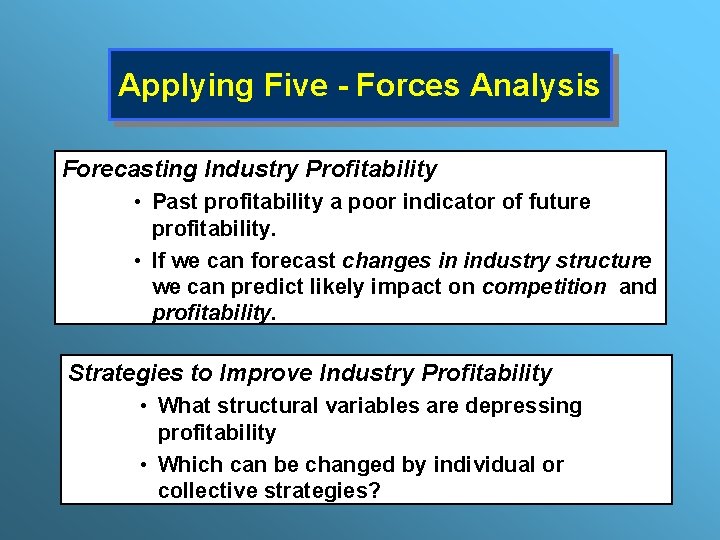
Applying Five - Forces Analysis Forecasting Industry Profitability • Past profitability a poor indicator of future profitability. • If we can forecast changes in industry structure we can predict likely impact on competition and profitability. Strategies to Improve Industry Profitability • What structural variables are depressing profitability • Which can be changed by individual or collective strategies?
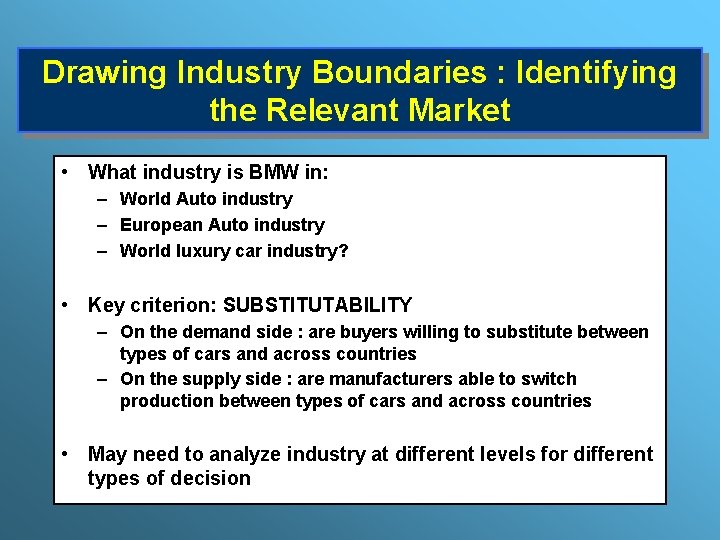
Drawing Industry Boundaries : Identifying the Relevant Market • What industry is BMW in: – World Auto industry – European Auto industry – World luxury car industry? • Key criterion: SUBSTITUTABILITY – On the demand side : are buyers willing to substitute between types of cars and across countries – On the supply side : are manufacturers able to switch production between types of cars and across countries • May need to analyze industry at different levels for different types of decision
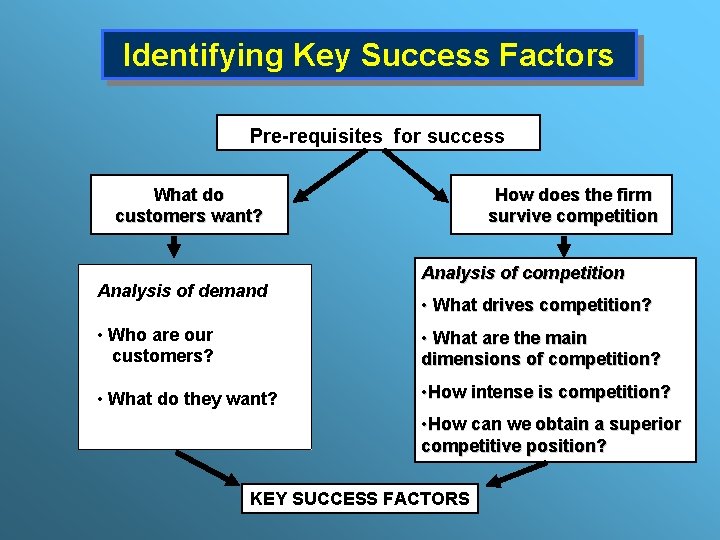
Identifying Key Success Factors Pre-requisites forsuccess Pre-requisites for What do customers want? Analysis of demand • Who are our customers? • What do they want? How does the firm survive competition Analysis of competition • What drives competition? What are drives • • What the competition? main • What are the dimensions of main competition? dimensions of competition? • • Howintenseis iscompetition? Howcan canwe weobtainaasuperior • • How superior competitive position? KEY SUCCESS FACTORS
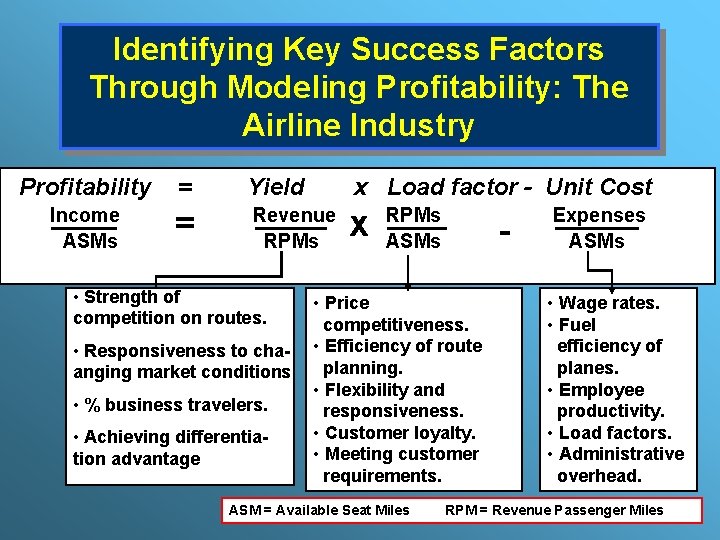
Identifying Key Success Factors Through Modeling Profitability: The Airline Industry Profitability = Yield x Load factor - Unit Cost Income ASMs = Revenue RPMs x • Strength of competition on routes. • Responsiveness to chaanging market conditions • % business travelers. • Achieving differentiation advantage RPMs ASMs - • Price competitiveness. • Efficiency of route planning. • Flexibility and responsiveness. • Customer loyalty. • Meeting customer requirements. ASM = Available Seat Miles Expenses ASMs • Wage rates. • Fuel efficiency of planes. • Employee productivity. • Load factors. • Administrative overhead. RPM = Revenue Passenger Miles
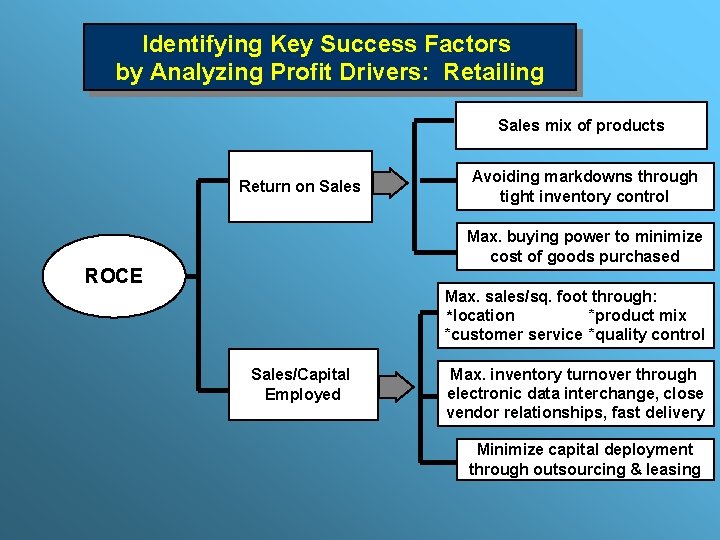
Identifying Key Success Factors by Analyzing Profit Drivers: Retailing Sales mix of products Return on Sales Avoiding markdowns through tight inventory control Max. buying power to minimize cost of goods purchased ROCE Max. sales/sq. foot through: *location *product mix *customer service *quality control Sales/Capital Employed Max. inventory turnover through electronic data interchange, close vendor relationships, fast delivery Minimize capital deployment through outsourcing & leasing
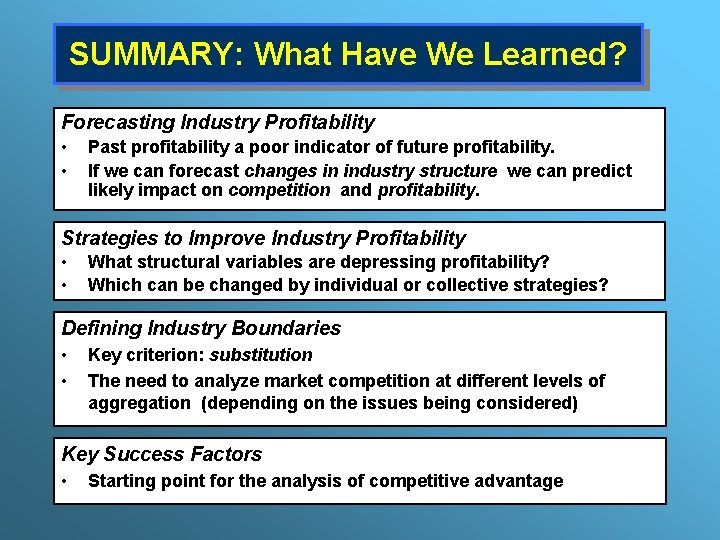
SUMMARY: What Have We Learned? Forecasting Industry Profitability • • Past profitability a poor indicator of future profitability. If we can forecast changes in industry structure we can predict likely impact on competition and profitability. Strategies to Improve Industry Profitability • • What structural variables are depressing profitability? Which can be changed by individual or collective strategies? Defining Industry Boundaries • • Key criterion: substitution The need to analyze market competition at different levels of aggregation (depending on the issues being considered) Key Success Factors • Starting point for the analysis of competitive advantage
- Slides: 21