
IndustrialManufacturing Engineering More efficient and more profitable business
Industrial/Manufacturing Engineering • More efficient and more profitable business practices • Better customer service and product quality • Improved efficiency • Increased ability to do more with less • Making work safer, faster, easier, and more rewarding • Helping companies produce more products quickly • Making the world safer through better designed products • Reducing costs associated with new technologies © Goodheart-Willcox Co. , Inc. Permission granted to reproduce for educational use only.
Manufacturing • Most things from daily life are manufactured • Process of changing raw materials to make them more useful • Trees have value • Harvested trees have more value • Baseball bats have more value • At each step of process, materials have more value © Goodheart-Willcox Co. , Inc. Permission granted to reproduce for educational use only.
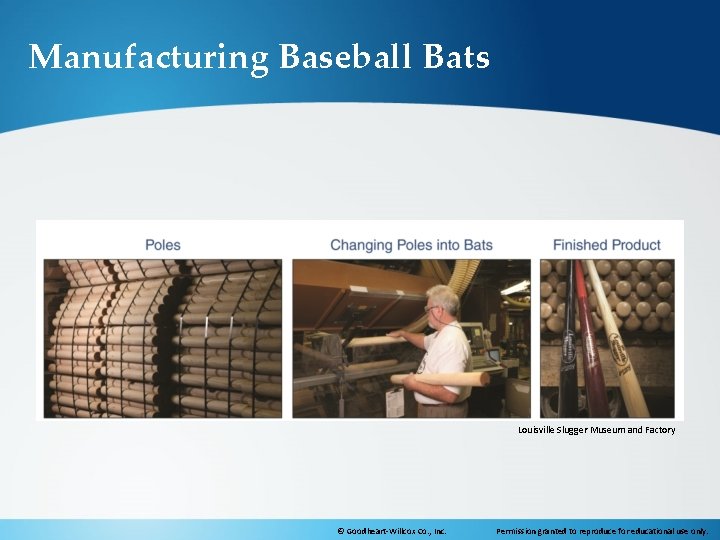
Manufacturing Baseball Bats Louisville Slugger Museum and Factory © Goodheart-Willcox Co. , Inc. Permission granted to reproduce for educational use only.
About Manufacturing Engineering • Design of machines, tools, and processes used to manufacture goods • Engineers solve complex manufacturing problems • Engineers design extensive manufacturing systems • Engineers work in coordination with other engineers © Goodheart-Willcox Co. , Inc. Permission granted to reproduce for educational use only.
Typical Education Requirements • Entry-level positions require bachelor’s degree in manufacturing engineering • Two-year associate’s degree programs can lead into four-year programs or qualify graduates for jobs as technicians or in manufacturing field © Goodheart-Willcox Co. , Inc. Permission granted to reproduce for educational use only.
Professional Organizations • Society of Manufacturing Engineers (SME) – Largest society for manufacturing engineers – Over 500, 000 members in more than 70 countries • • • Society of Automotive Engineers (SAE) Audio Engineering Society (AES) Society of Women Engineers (SWE) National Society of Professional Engineers Institute of Industrial Engineers © Goodheart-Willcox Co. , Inc. Permission granted to reproduce for educational use only.
Manufacturing Engineering Principles • Concern materials used to manufacture products • Concern processes used to change materials into useful products • Materials and processes are foundations of manufacturing © Goodheart-Willcox Co. , Inc. Permission granted to reproduce for educational use only.
Manufacturing Materials • • Metals Ceramics Polymers Composites © Goodheart-Willcox Co. , Inc. Permission granted to reproduce for educational use only.
Metals • • Inorganic (do not come from living matter) Good conductivity to heat and electricity Can be melted and are malleable Examples are iron, lead, copper, zinc, magnesium, calcium, and mercury • Two or more can form alloys © Goodheart-Willcox Co. , Inc. Permission granted to reproduce for educational use only.
Ceramics • Very hard, inorganic, refractory (high resistance to heat), nonmetallic materials with little electrical conductivity • Include clays, porcelain, abrasives, glass, plaster, gypsum, and cement • Can stay sharp longer than metal • Used in joint replacement, bone replacement, and dental restoration © Goodheart-Willcox Co. , Inc. Permission granted to reproduce for educational use only.
Polymers • • Organic (come from living matter) Primarily made up of carbon and hydrogen atoms Noncrystalline Synthetic polymers are plastic © Goodheart-Willcox Co. , Inc. Permission granted to reproduce for educational use only.
Types of Plastic • Thermoplastics – Can easily be reheated and reshaped with little or no damage • Thermoset plastics – Generally stronger than thermoplastics because they are cured with heat and pressure to crosslink chains – Cannot be heated and reshaped © Goodheart-Willcox Co. , Inc. Permission granted to reproduce for educational use only.
Locating Raw Materials • First step in manufacturing process after designs are approved • Natural resources found in earth, on earth, and in seas • Three techniques – Harvesting – Drilling – Mining © Goodheart-Willcox Co. , Inc. Permission granted to reproduce for educational use only.
Drilling • Used to extract water, natural gas, and oil from under earth’s surface • Performed by cutting circular hole into earth to desired depth • Drill head mounted on pipe turns to drill hole • Directional drilling allows access to multiple reserves from one location © Goodheart-Willcox Co. , Inc. Permission granted to reproduce for educational use only.
Mining • Used to extract materials from beneath earth’s surface • Surface mining – Soil and bedrock are removed till desired resources are exposed • Subsurface mining – Involves digging tunnels or shafts to reach desired resources © Goodheart-Willcox Co. , Inc. Permission granted to reproduce for educational use only.
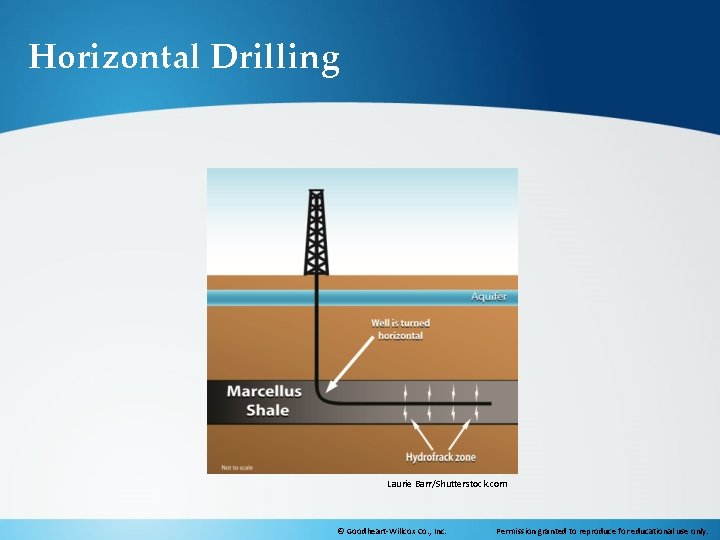
Horizontal Drilling Laurie Barr/Shutterstock. com © Goodheart-Willcox Co. , Inc. Permission granted to reproduce for educational use only.
Harvesting • Retrieving mature natural resources that grow on earth • Three methods used to harvest trees – Clear-cutting – Select cutting – Seed tree cutting © Goodheart-Willcox Co. , Inc. Permission granted to reproduce for educational use only.
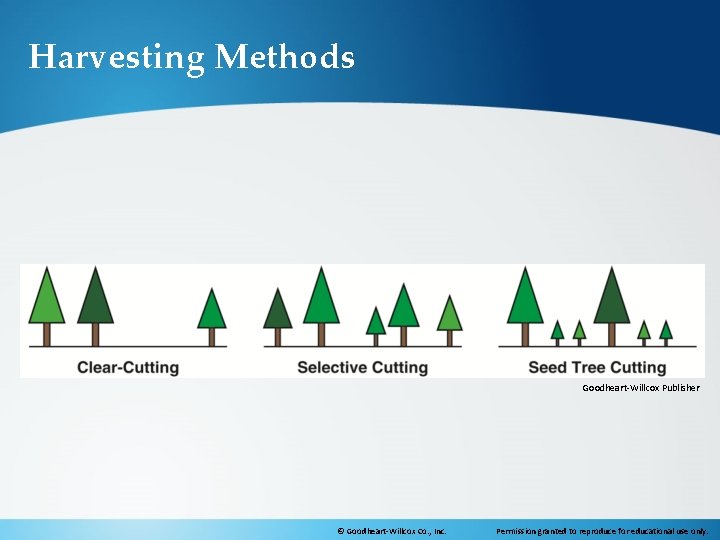
Harvesting Methods Goodheart-Willcox Publisher © Goodheart-Willcox Co. , Inc. Permission granted to reproduce for educational use only.
Going Green Environmentally Conscious Manufacturing (ECM) • Process concerned with entire life of product from gathering of raw materials to product disposal • Saving on energy costs directly affects energy consumption • Waste is being reduced and recycled © Goodheart-Willcox Co. , Inc. Permission granted to reproduce for educational use only.
Manufacturing Engineering Processes • Used to shape raw materials into standard stock • Used to shape standard stock into finished products • Two types of processing – Primary processing – Secondary processing © Goodheart-Willcox Co. , Inc. Permission granted to reproduce for educational use only.
Primary Processing • Raw materials are processed into standard stock • Standard stock describes size, shape, and characteristics of materials commonly available to consumers – Trees cut to standard size lumber – Metals formed into bars, rods, and sheets – Oil refined into gasoline, diesel fuel, or heating oil © Goodheart-Willcox Co. , Inc. Permission granted to reproduce for educational use only.
Secondary Processing • Standard stock materials made into useful products • Common secondary processing techniques – Separating – Casting and molding – Forming – Combining © Goodheart-Willcox Co. , Inc. Permission granted to reproduce for educational use only.
Separating • Process of cutting materials to desired size or shape • Mechanical separating – Involves cutting or chipping materials apart • Heat separating – Cutting torches separate metals • Chemical separating – Acidic material etches away unwanted materials © Goodheart-Willcox Co. , Inc. Permission granted to reproduce for educational use only.
Casting and Molding • Involves changing materials to liquid or plastic state, then shaping them in or around mold • Casting – Material changes to liquid state – Liquid is poured into mold until it solidifies • Molding – Material softened to plastic state – Material forced into or around mold © Goodheart-Willcox Co. , Inc. Permission granted to reproduce for educational use only.
Forming • Mechanical process used to change material shape • Compression – Materials are hammered through forging • Bending – Materials are bent till desired shape is reached • Stretching – Stock is drawn through holes smaller than stock © Goodheart-Willcox Co. , Inc. Permission granted to reproduce for educational use only.
Combining • Multiple parts are joined together through mechanical assembly and bonding • Adhesion – Bonding of two materials using glue or cement • Cohesion – Heat or pressure joins two materials © Goodheart-Willcox Co. , Inc. Permission granted to reproduce for educational use only.
Tools Manufacturing Engineering Tools • • • Drafting and design software Computer simulation Jigs and fixtures Stopwatches and timers Measuring tools Production charts and schedules © Goodheart-Willcox Co. , Inc. Permission granted to reproduce for educational use only.
Manufacturing Engineering Applications • Manufacturing engineers design and control manufacturing processes • Engineers decide on effective type of manufacturing • Engineers design system to be cost effective and meet quality specifications © Goodheart-Willcox Co. , Inc. Permission granted to reproduce for educational use only.
Production Management • Manufacturing engineers design all aspects of production from start to finish • Engineers must understand all characteristics of products to be made • Engineers must understand all specific requirements of products to be made © Goodheart-Willcox Co. , Inc. Permission granted to reproduce for educational use only.
Manufacturing Types • Continuous manufacturing – Produces highest number of products at highest quality and lowest cost • Intermittent manufacturing – Produces smaller batches of one part • Custom manufacturing – Produces single product or small number of products to meet customer needs © Goodheart-Willcox Co. , Inc. Permission granted to reproduce for educational use only.
Facility Engineering • Carried out by engineers with expertise in tools, materials, processes, and products to be manufactured • Production facilities are designed for efficient production of products • Facilities are designed for smooth, efficient flow through production © Goodheart-Willcox Co. , Inc. Permission granted to reproduce for educational use only.
Selecting and Sequencing Manufacturing Operations • Engineers are responsible for deciding what operations will be used to create products • Engineers are responsible for deciding order of operations to create products • Operations must be designed in efficient and economical way © Goodheart-Willcox Co. , Inc. Permission granted to reproduce for educational use only.
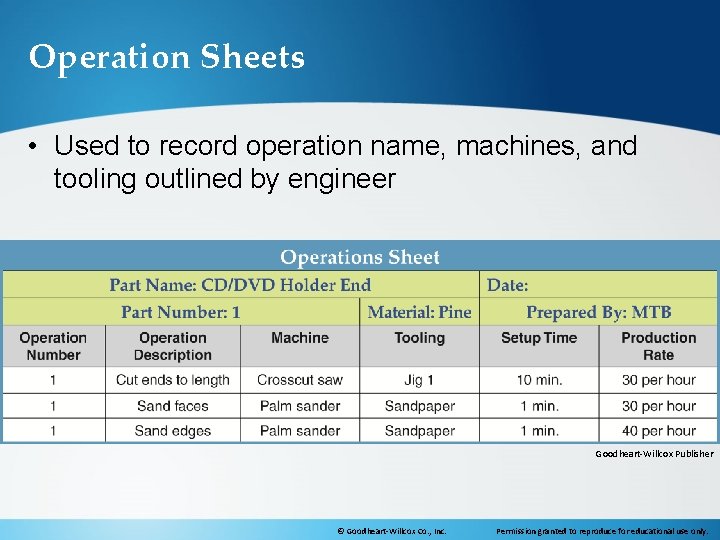
Operation Sheets • Used to record operation name, machines, and tooling outlined by engineer Goodheart-Willcox Publisher © Goodheart-Willcox Co. , Inc. Permission granted to reproduce for educational use only.
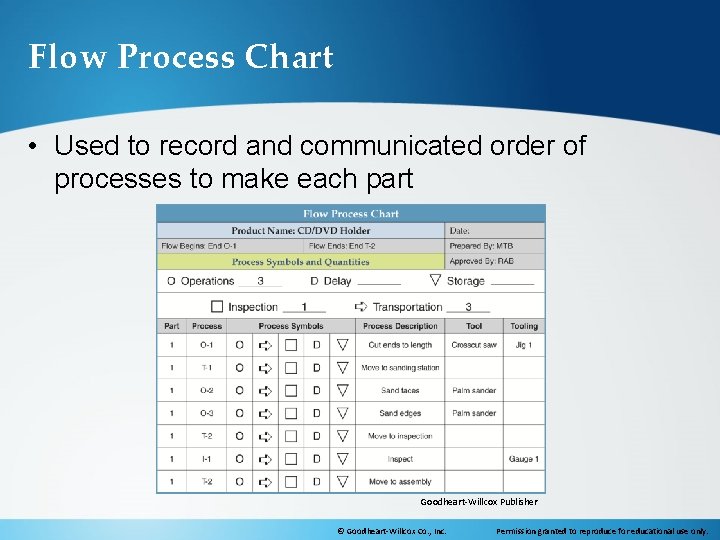
Flow Process Chart • Used to record and communicated order of processes to make each part Goodheart-Willcox Publisher © Goodheart-Willcox Co. , Inc. Permission granted to reproduce for educational use only.
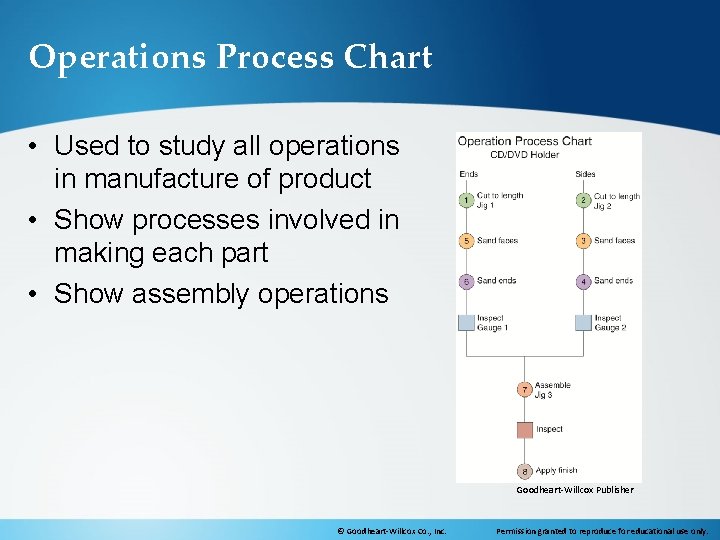
Operations Process Chart • Used to study all operations in manufacture of product • Show processes involved in making each part • Show assembly operations Goodheart-Willcox Publisher © Goodheart-Willcox Co. , Inc. Permission granted to reproduce for educational use only.
Plant Layout • Location of materials and how they are moved through plant • Most plans are designed using one of two methods – Process layout – Product layout © Goodheart-Willcox Co. , Inc. Permission granted to reproduce for educational use only.
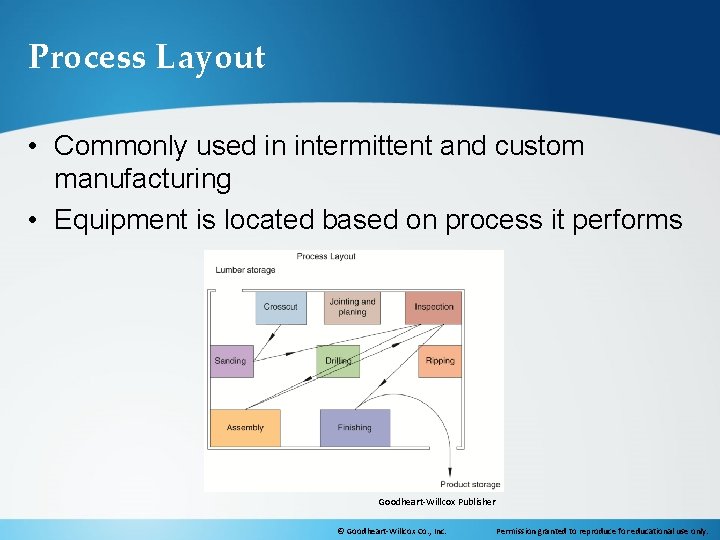
Process Layout • Commonly used in intermittent and custom manufacturing • Equipment is located based on process it performs Goodheart-Willcox Publisher © Goodheart-Willcox Co. , Inc. Permission granted to reproduce for educational use only.
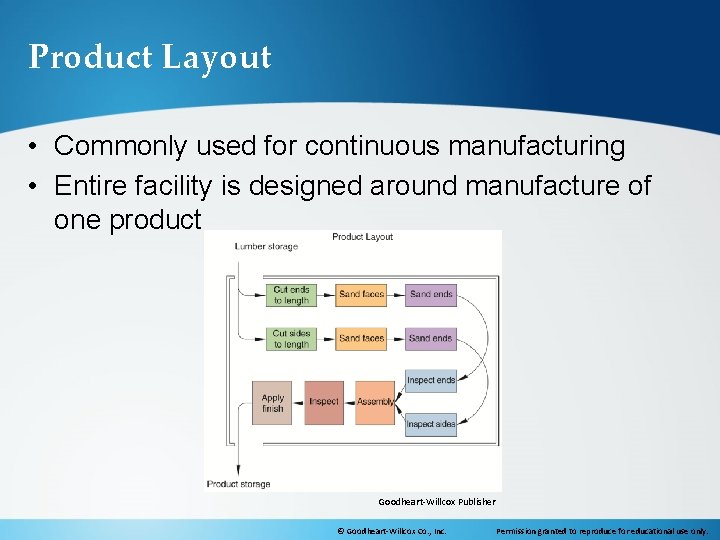
Product Layout • Commonly used for continuous manufacturing • Entire facility is designed around manufacture of one product Goodheart-Willcox Publisher © Goodheart-Willcox Co. , Inc. Permission granted to reproduce for educational use only.
Plant Layout Communications • Plant layouts are communicated through drawings and 3 -D models • Design must be communicated accurately • Equipment and utilities must be placed correctly © Goodheart-Willcox Co. , Inc. Permission granted to reproduce for educational use only.
Design for Manufacturing • Products are designed to meet specifications • Products are designed so they can be manufactured efficiently • Products may be designed to reduce amount of materials required • Designing for manufacturing can reduce costs © Goodheart-Willcox Co. , Inc. Permission granted to reproduce for educational use only.
Production Control • • • Lean manufacturing Material supply Materials handling Quality control Cost control Safety © Goodheart-Willcox Co. , Inc. Permission granted to reproduce for educational use only.
Lean Manufacturing • Looks to eliminate seven sources of waste – Overproduction – Overprocessing – Excess motion – Excess inventory – Defects – Transportation – Waiting © Goodheart-Willcox Co. , Inc. Permission granted to reproduce for educational use only.
Material Supply • Must have enough material to keep operations running • Too much material on hand is costly • Just-in-time (JIT) delivery systems – Provide material delivery exactly when needed – Complex system to manage © Goodheart-Willcox Co. , Inc. Permission granted to reproduce for educational use only.
Materials Handling • Movement of materials and products through plant • Materials must be moved from storage to workstation • Materials moved by conveyor, vehicle, or by hand • Systems must be efficient and cannot damage products © Goodheart-Willcox Co. , Inc. Permission granted to reproduce for educational use only.
Quality Control • System that ensures products meet or exceed specifications • People want and deserve quality • Inspection throughout manufacturing process • Centers on training and motivating workers • Workers give feedback on ideas for quality control © Goodheart-Willcox Co. , Inc. Permission granted to reproduce for educational use only.
Cost Control • • Products must be produced for specified price Material purchasing Machine scheduling Labor costs – Efficiency – Time and motion studies © Goodheart-Willcox Co. , Inc. Permission granted to reproduce for educational use only.
Safety • Safety programs are critical • Manufacturers value and ensure health and safety of employees • OSHA regulations must be followed • Process must be designed to ensure worker safety and health • Process must be compliant with safety regulations © Goodheart-Willcox Co. , Inc. Permission granted to reproduce for educational use only.
Manufacturing Engineering in Action • • Decisions about manufacturing types Decisions on manufacturing operations Plant layout based on efficient sequence Design, implementation, and overseeing quality control program • Constant monitoring of all aspects of production © Goodheart-Willcox Co. , Inc. Permission granted to reproduce for educational use only.
Videos • See the role industrial engineering plays at Disney. • Look at how industrial engineering benefits a variety of industries. • Watch a segment from "Today in America" that focuses on IIE and industrial engineering. • Take a look at some more videos about industrial engineering from the 2014 Industry Advisory Board's You. Tube student video contest: – First place: Oregon State University – Second place: Texas A&M University – Third place: University of Washington © Goodheart-Willcox Co. , Inc. Permission granted to reproduce for educational use only.
- Slides: 49