
Industrialization of a 500 MHz Solid State RF
- Slides: 11
Industrialization of a 500 MHz Solid State RF Amplifier CWRF Trieste 25. 09. 2020 1
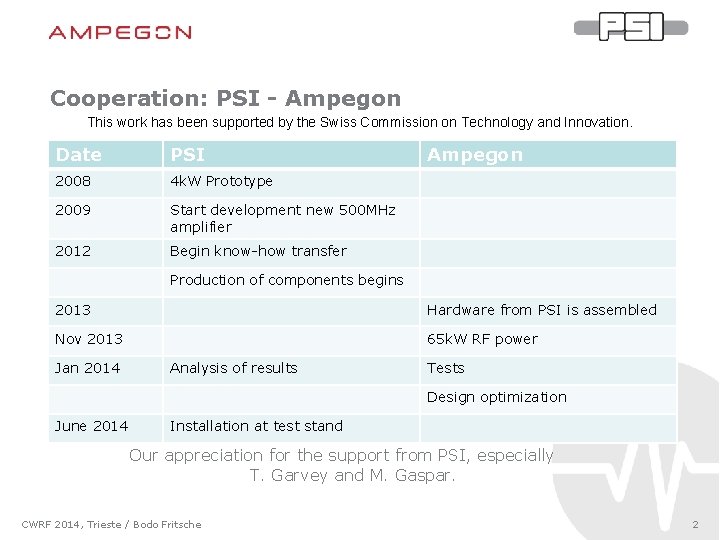
Cooperation: PSI - Ampegon This work has been supported by the Swiss Commission on Technology and Innovation. Date PSI 2008 4 k. W Prototype 2009 Start development new 500 MHz amplifier 2012 Begin know-how transfer Ampegon Production of components begins 2013 Hardware from PSI is assembled Nov 2013 65 k. W RF power Jan 2014 Analysis of results Tests Design optimization June 2014 Installation at test stand Our appreciation for the support from PSI, especially T. Garvey and M. Gaspar. CWRF 2014, Trieste / Bodo Fritsche 2
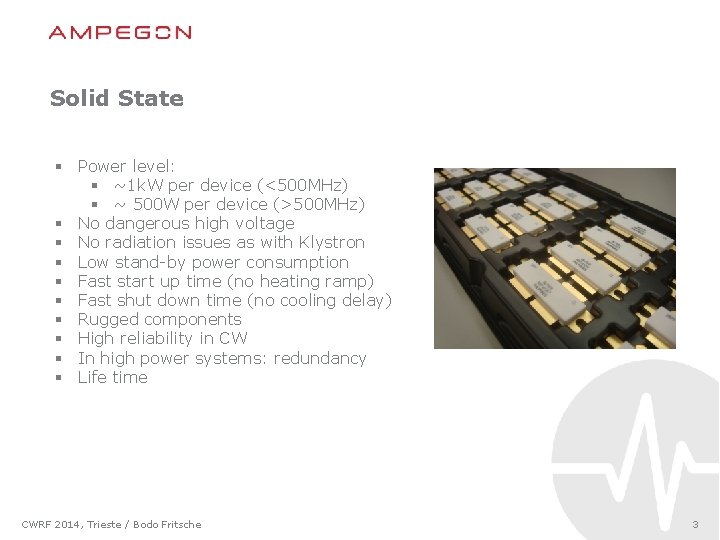
Solid State § Power level: § ~1 k. W per device (<500 MHz) § ~ 500 W per device (>500 MHz) § No dangerous high voltage § No radiation issues as with Klystron § Low stand-by power consumption § Fast start up time (no heating ramp) § Fast shut down time (no cooling delay) § Rugged components § High reliability in CW § In high power systems: redundancy § Life time CWRF 2014, Trieste / Bodo Fritsche 3
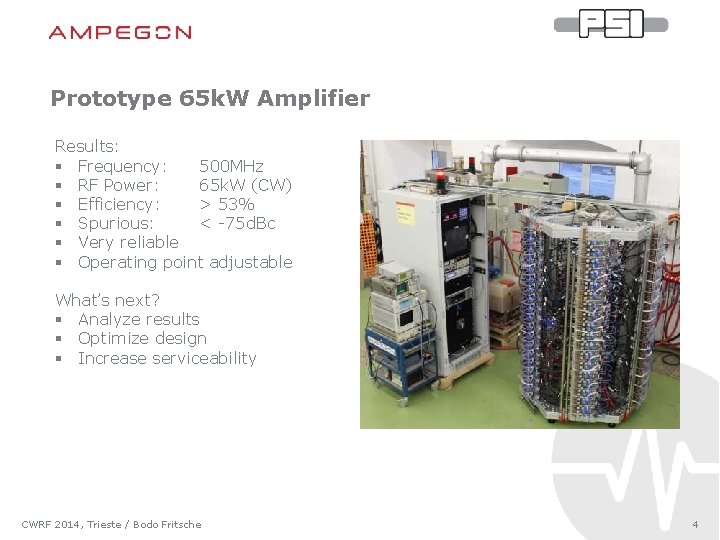
Prototype 65 k. W Amplifier Results: § Frequency: 500 MHz § RF Power: 65 k. W (CW) § Efficiency: > 53% § Spurious: < -75 d. Bc § Very reliable § Operating point adjustable What’s next? § Analyze results § Optimize design § Increase serviceability CWRF 2014, Trieste / Bodo Fritsche 4
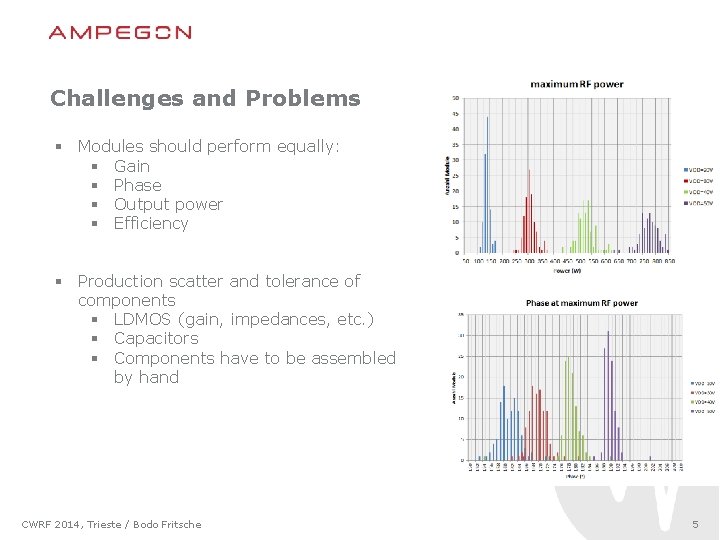
Challenges and Problems § Modules should perform equally: § Gain § Phase § Output power § Efficiency § Production scatter and tolerance of components § LDMOS (gain, impedances, etc. ) § Capacitors § Components have to be assembled by hand CWRF 2014, Trieste / Bodo Fritsche 5
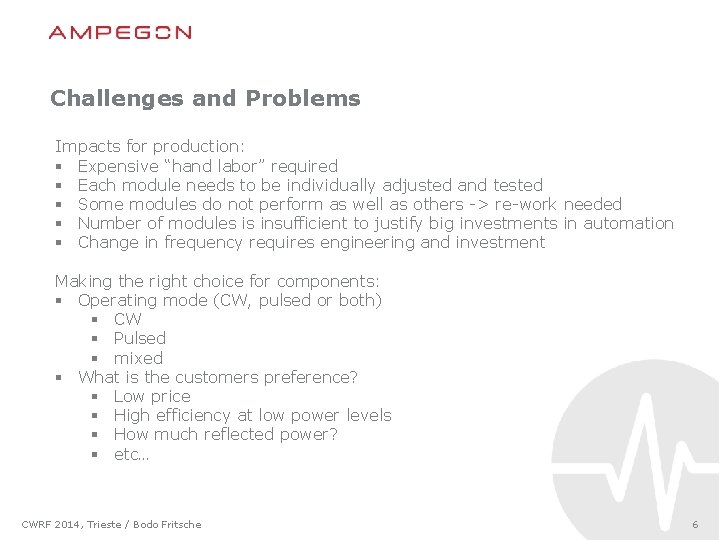
Challenges and Problems Impacts for production: § Expensive “hand labor” required § Each module needs to be individually adjusted and tested § Some modules do not perform as well as others -> re-work needed § Number of modules is insufficient to justify big investments in automation § Change in frequency requires engineering and investment Making the right choice for components: § Operating mode (CW, pulsed or both) § CW § Pulsed § mixed § What is the customers preference? § Low price § High efficiency at low power levels § How much reflected power? § etc… CWRF 2014, Trieste / Bodo Fritsche 6
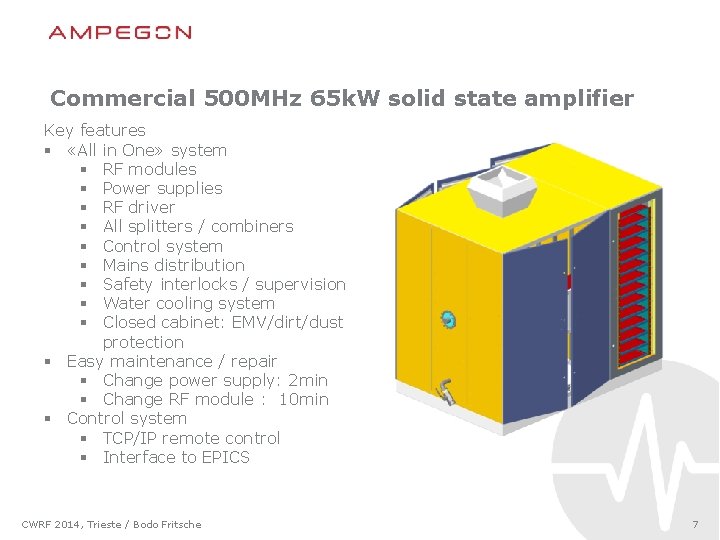
Commercial 500 MHz 65 k. W solid state amplifier Key features § «All in One» system § RF modules § Power supplies § RF driver § All splitters / combiners § Control system § Mains distribution § Safety interlocks / supervision § Water cooling system § Closed cabinet: EMV/dirt/dust protection § Easy maintenance / repair § Change power supply: 2 min § Change RF module : 10 min § Control system § TCP/IP remote control § Interface to EPICS CWRF 2014, Trieste / Bodo Fritsche 7
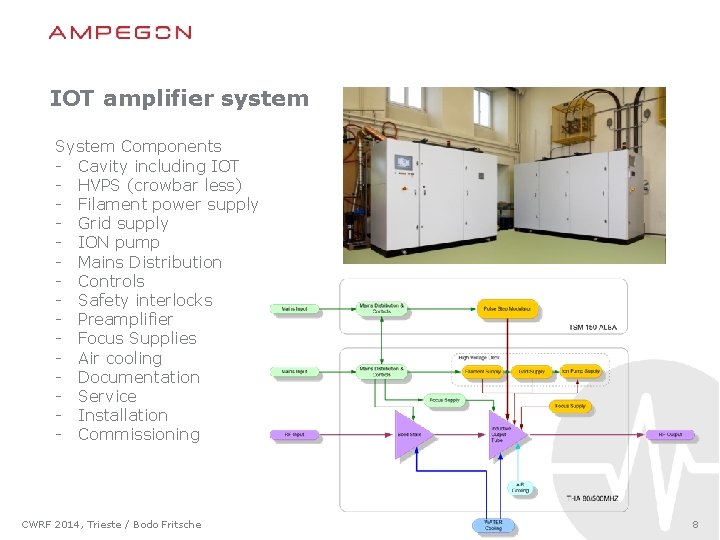
IOT amplifier system System Components - Cavity including IOT - HVPS (crowbar less) - Filament power supply - Grid supply - ION pump - Mains Distribution - Controls - Safety interlocks - Preamplifier - Focus Supplies - Air cooling - Documentation - Service - Installation - Commissioning CWRF 2014, Trieste / Bodo Fritsche 8
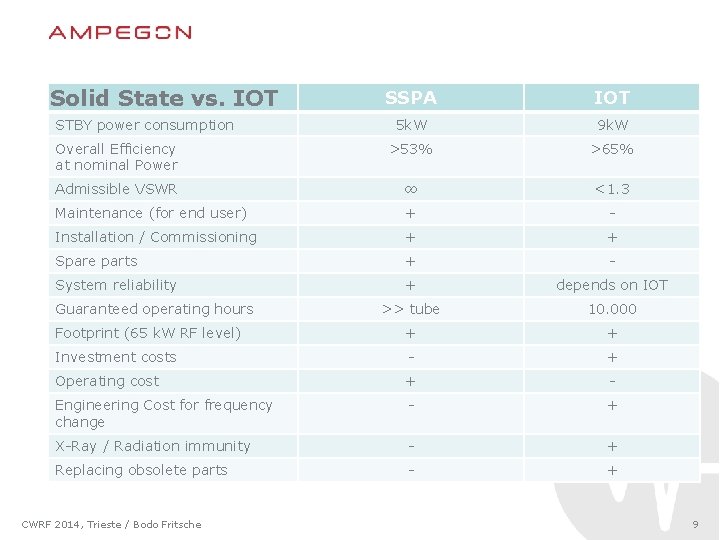
Solid State vs. IOT SSPA IOT 5 k. W 9 k. W Overall Efficiency at nominal Power >53% >65% Admissible VSWR ∞ <1. 3 Maintenance (for end user) + - Installation / Commissioning + + Spare parts + - System reliability + depends on IOT >> tube 10. 000 Footprint (65 k. W RF level) + + Investment costs - + Operating cost + - Engineering Cost for frequency change - + X-Ray / Radiation immunity - + Replacing obsolete parts - + STBY power consumption Guaranteed operating hours CWRF 2014, Trieste / Bodo Fritsche 9
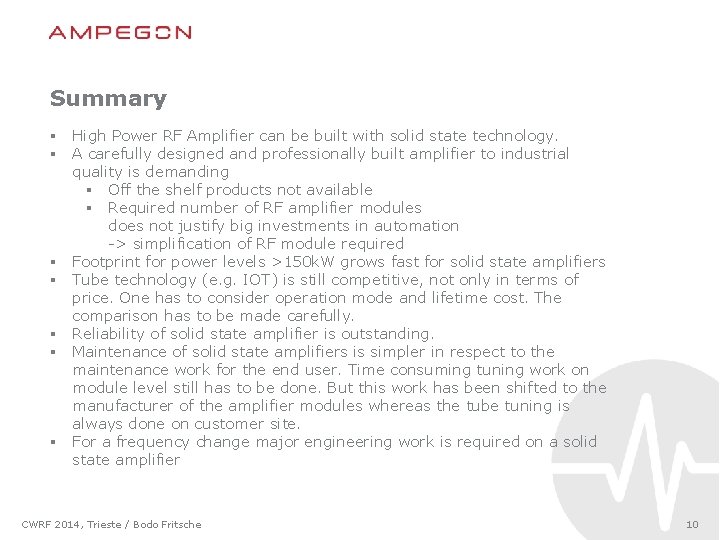
Summary § High Power RF Amplifier can be built with solid state technology. § A carefully designed and professionally built amplifier to industrial quality is demanding § Off the shelf products not available § Required number of RF amplifier modules does not justify big investments in automation -> simplification of RF module required § Footprint for power levels >150 k. W grows fast for solid state amplifiers § Tube technology (e. g. IOT) is still competitive, not only in terms of price. One has to consider operation mode and lifetime cost. The comparison has to be made carefully. § Reliability of solid state amplifier is outstanding. § Maintenance of solid state amplifiers is simpler in respect to the maintenance work for the end user. Time consuming tuning work on module level still has to be done. But this work has been shifted to the manufacturer of the amplifier modules whereas the tube tuning is always done on customer site. § For a frequency change major engineering work is required on a solid state amplifier CWRF 2014, Trieste / Bodo Fritsche 10
Thank you. CWRF 2014, Trieste / Bodo Fritsche 11