
Industrialization in Japan and the Meiji Restoration Japan

- Slides: 15
Industrialization in Japan and the Meiji Restoration Japan becomes a National Power
Tokugawa Isolation ©Prior to the arrival of Matthew Perry of the U. S. in 1854 Japan had been isolated for 200 years. ©In 1500’s Europeans had tried to trade with Japan ©Shoguns had control of Japan and banned contact with entire outside world.
Japanese Isolation ©Japan had ethnocentric society ©Japanese were not allowed to travel outside the nation ©Foreigners not allowed inside the nation ©By the 19 th Century U. S. and Europe were looking for markets to sell goods
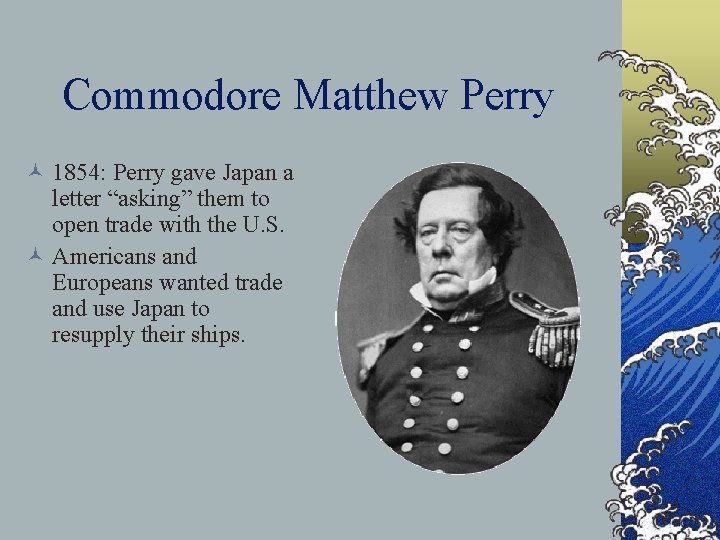
Commodore Matthew Perry © 1854: Perry gave Japan a letter “asking” them to open trade with the U. S. © Americans and Europeans wanted trade and use Japan to resupply their ships.
Treaty of Kanagawa © The Japanese shoguns impressed by American show of force. © Japan agreed to open its ports and signed the Treaty of Kanagawa. ©Gave trading rights to the U. S. ©Britain, France and Russia also soon gained trading rights.
Treaty of Kanagawa © The Treaty had a powerful impact on Japan. ©It weakened the power of the shogun because they gave in to foreigners ©It showed Japan had to modernize and industrialize to compete with the West ©The Japanese rebelled against and overthrew the Shogun, restored the emperor and began to modernize
The Meiji Restoration, 18681912 ©In 1867 the samurai led the rebellion to remove the Tokugawa shogun from power. ©In 1868 the emperor was established as the leader of Japan and began Meiji Restoration ©Meiji means “enlightened one”
Modernization and Industrialization ©Borrowing from the West ©The emperor sent advisors and government officials to western nations to study government, economics, technology, and customs. ©Foreign experts were also invited to Japan.
Modernization and Industrialization © Economics ©The Meiji government used western methods and machinery to industrialize Japan. ©The government built factories and then sold them to wealthy Japanese businessmen, know as zaibatsu. ©The government developed a banking system, built ports and railroads ©By 1890 the economy was strong, the population had grown, and peasants moved to the cities looking for jobs.
Modernization and Industrialization © Government ©The Meiji wanted a strong central government and used Germany as their model. ©The Meiji liked the strength of Germany’s constitution and that the government was run by only a few select men.
Modernization and Industrialization © Military ©Samurai are no longer the only warriors in Japan. ©Japan admired the discipline of the German army and the skill of the British navy. ©All men must join the military ©Japan develops a strong army/navy and defeats European powers in warfare.
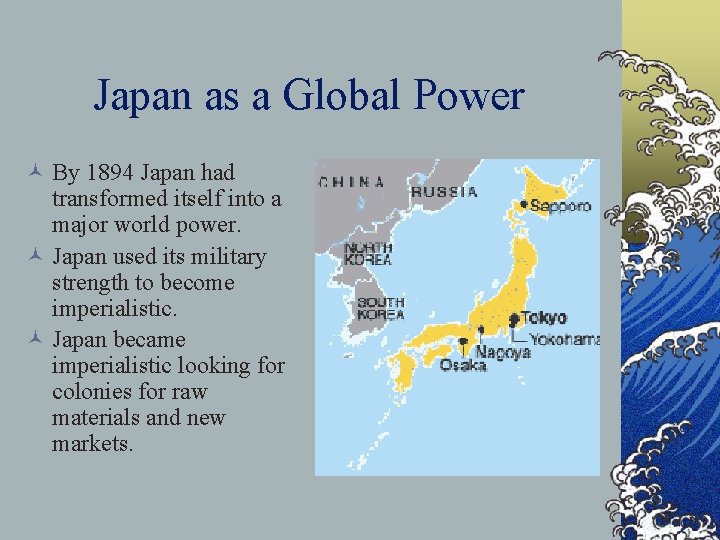
Japan as a Global Power © By 1894 Japan had transformed itself into a major world power. © Japan used its military strength to become imperialistic. © Japan became imperialistic looking for colonies for raw materials and new markets.
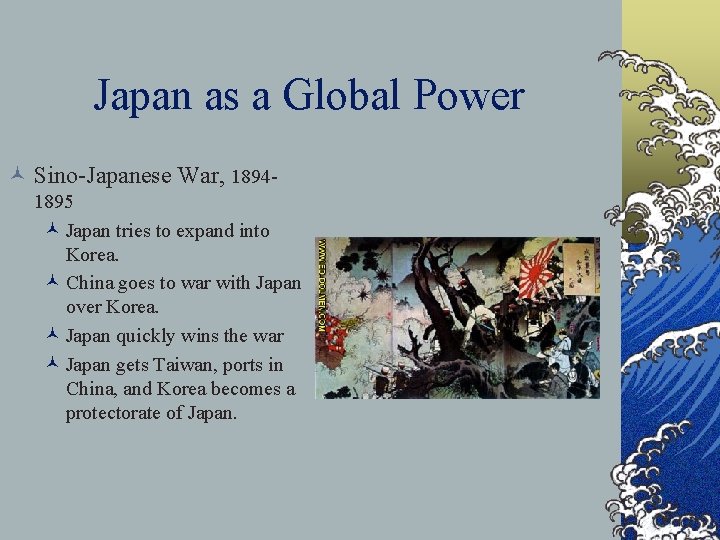
Japan as a Global Power © Sino-Japanese War, 18941895 © Japan tries to expand into Korea. © China goes to war with Japan over Korea. © Japan quickly wins the war © Japan gets Taiwan, ports in China, and Korea becomes a protectorate of Japan.
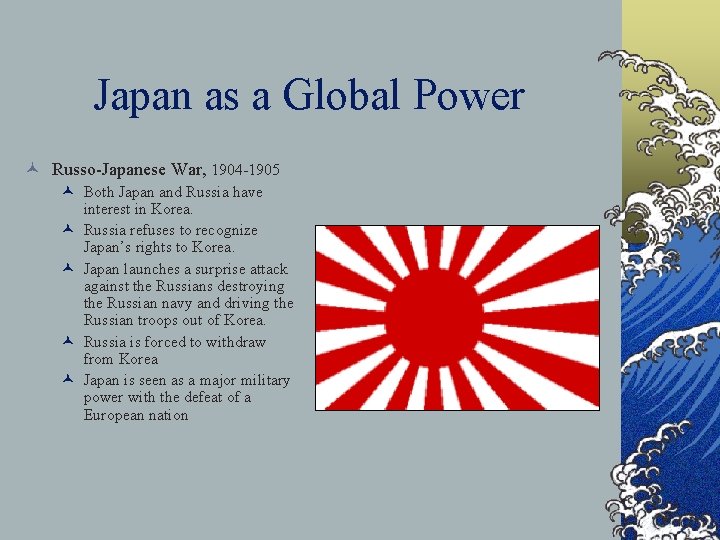
Japan as a Global Power © Russo-Japanese War, 1904 -1905 © Both Japan and Russia have interest in Korea. © Russia refuses to recognize Japan’s rights to Korea. © Japan launches a surprise attack against the Russians destroying the Russian navy and driving the Russian troops out of Korea. © Russia is forced to withdraw from Korea © Japan is seen as a major military power with the defeat of a European nation
Japan as a Global Power ©Dependence on a World Market ©Japan’s economy depended on trade. It needed new markets. ©Japan island lack many of the natural resources to keep their industrialization alive. ©For Japan to compete with the world market Japan would have to continue to be imperialistic.