
Industrialization Immigration and Gilded Age 1870 1900 Industrial
- Slides: 48
Industrialization, Immigration, and Gilded Age 1870 - 1900
Industrial Revolution • In the year 1800, 90% or more of the Am. population made money from agriculture. • People lived in the area they were born until they died (for the most part). • Families were large so the work got done. • When the sun went down, they went to bed. There was no light to work any longer. • Life in the city was much the same.
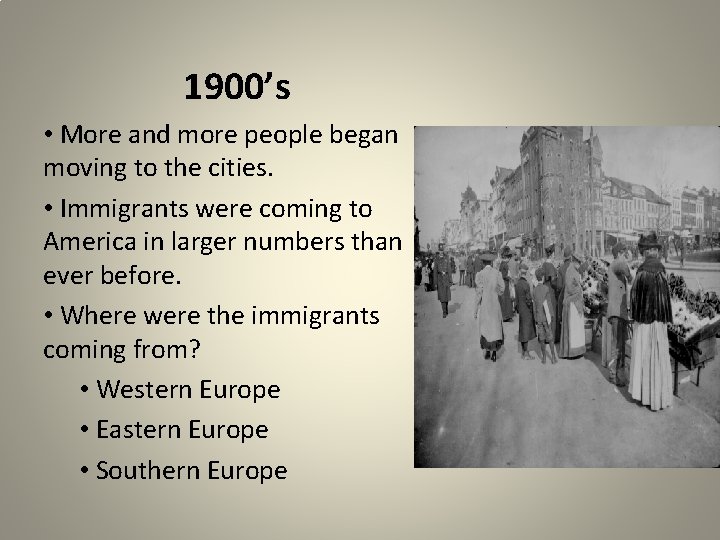
1900’s • More and more people began moving to the cities. • Immigrants were coming to America in larger numbers than ever before. • Where were the immigrants coming from? • Western Europe • Eastern Europe • Southern Europe
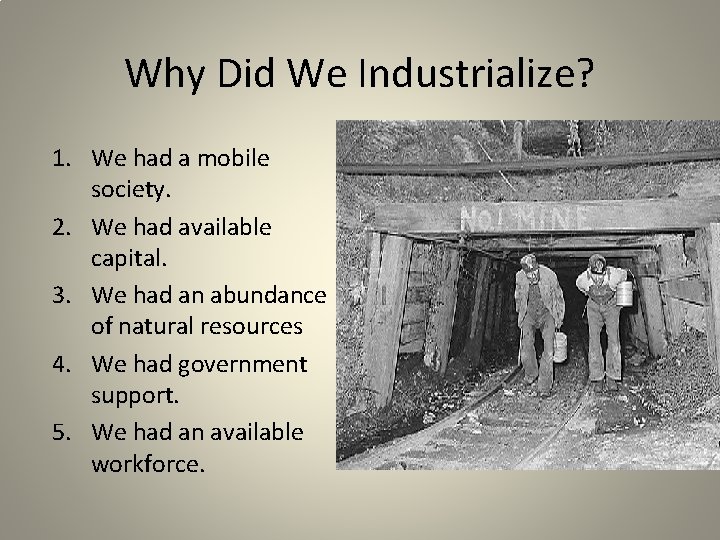
Why Did We Industrialize? 1. We had a mobile society. 2. We had available capital. 3. We had an abundance of natural resources 4. We had government support. 5. We had an available workforce.
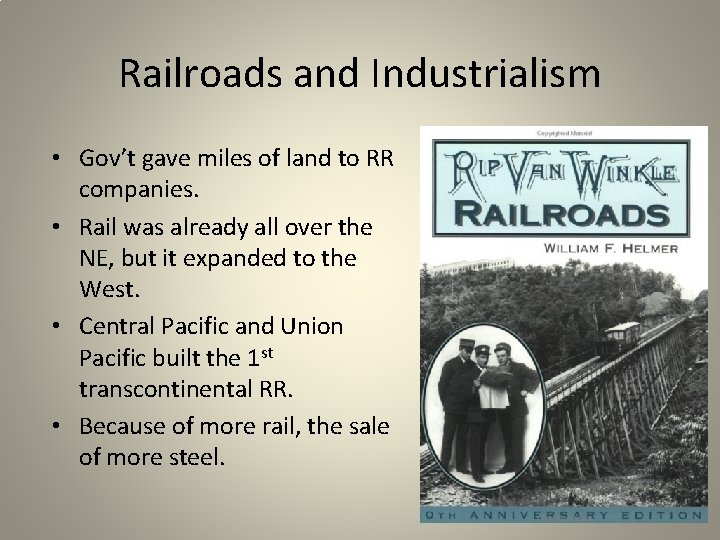
Railroads and Industrialism • Gov’t gave miles of land to RR companies. • Rail was already all over the NE, but it expanded to the West. • Central Pacific and Union Pacific built the 1 st transcontinental RR. • Because of more rail, the sale of more steel.
Building the Railroads • Often dangerous work done by immigrants • Indian raids as well as back -breaking labor. • Random explosions from unstable dynamite. • Thousands were killed each year.
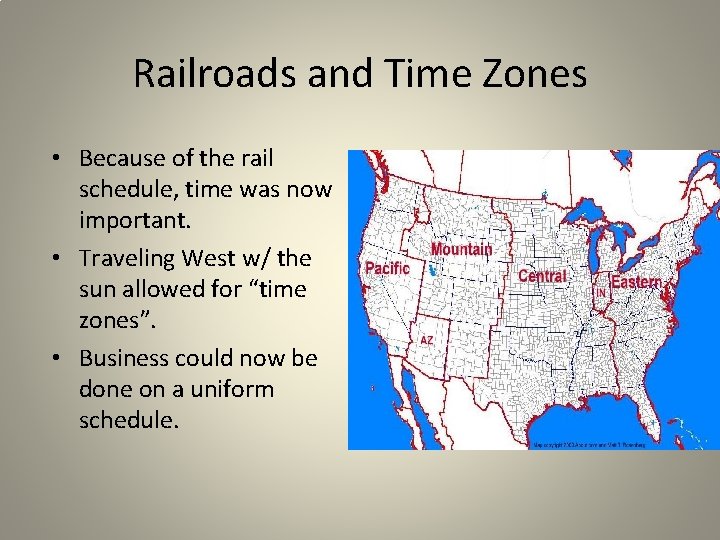
Railroads and Time Zones • Because of the rail schedule, time was now important. • Traveling West w/ the sun allowed for “time zones”. • Business could now be done on a uniform schedule.
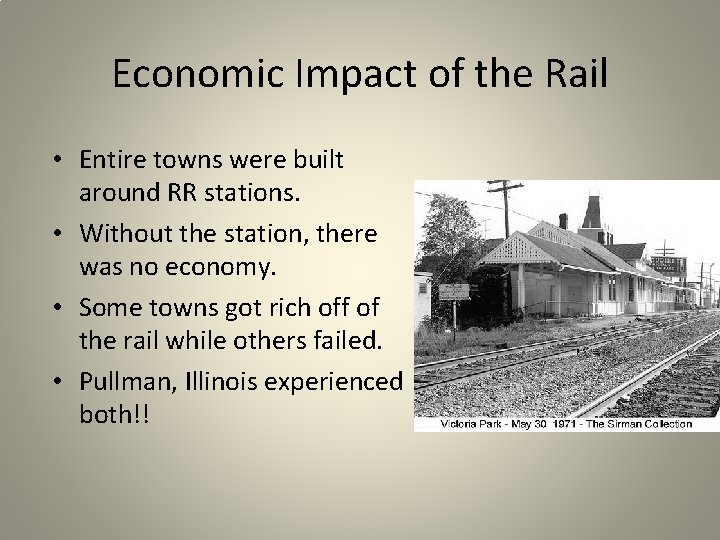
Economic Impact of the Rail • Entire towns were built around RR stations. • Without the station, there was no economy. • Some towns got rich off of the rail while others failed. • Pullman, Illinois experienced both!!
Scandals in the RR Industry • With millions of $ going to RR, scandal followed. • Despotic tycoons used their lines to bribe and extort entire towns. • Credit Mobilier scandal rocked the White House • Some RR policies led to violence – Pullman strike is example.
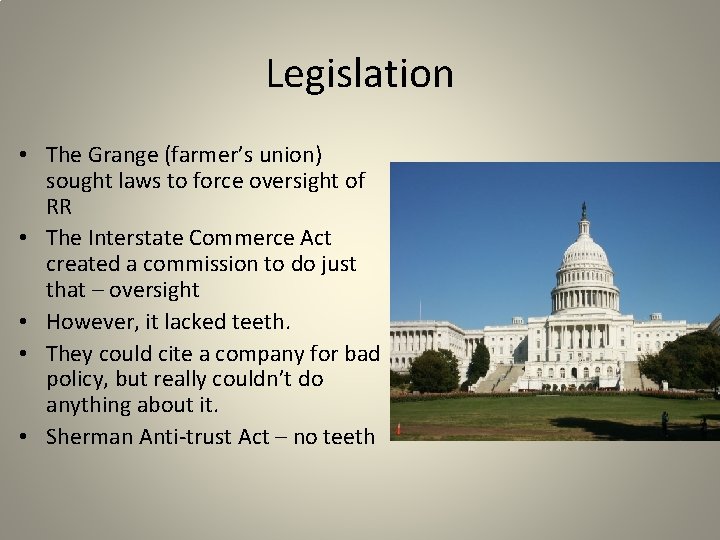
Legislation • The Grange (farmer’s union) sought laws to force oversight of RR • The Interstate Commerce Act created a commission to do just that – oversight • However, it lacked teeth. • They could cite a company for bad policy, but really couldn’t do anything about it. • Sherman Anti-trust Act – no teeth
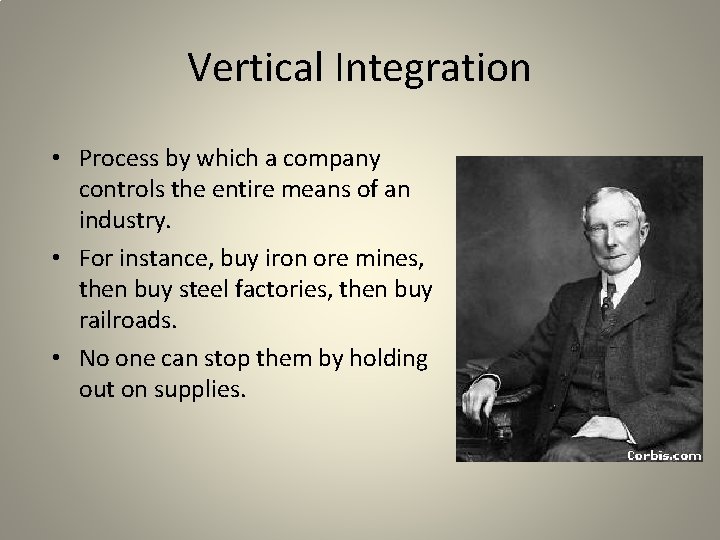
Vertical Integration • Process by which a company controls the entire means of an industry. • For instance, buy iron ore mines, then buy steel factories, then buy railroads. • No one can stop them by holding out on supplies.
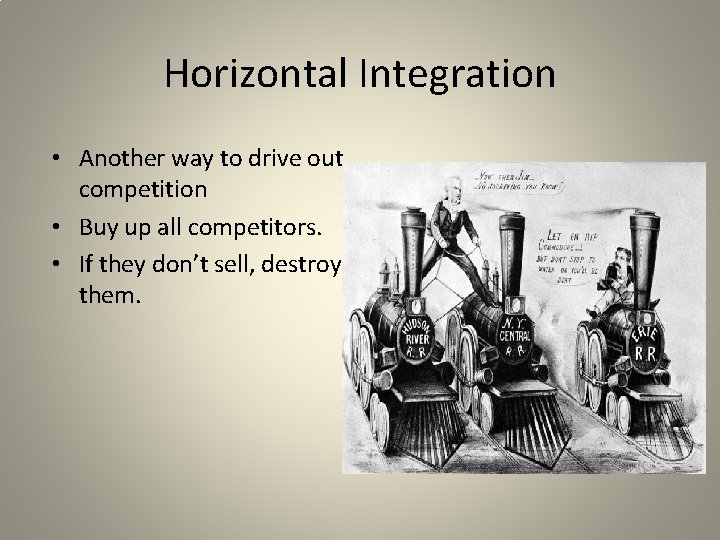
Horizontal Integration • Another way to drive out competition • Buy up all competitors. • If they don’t sell, destroy them.
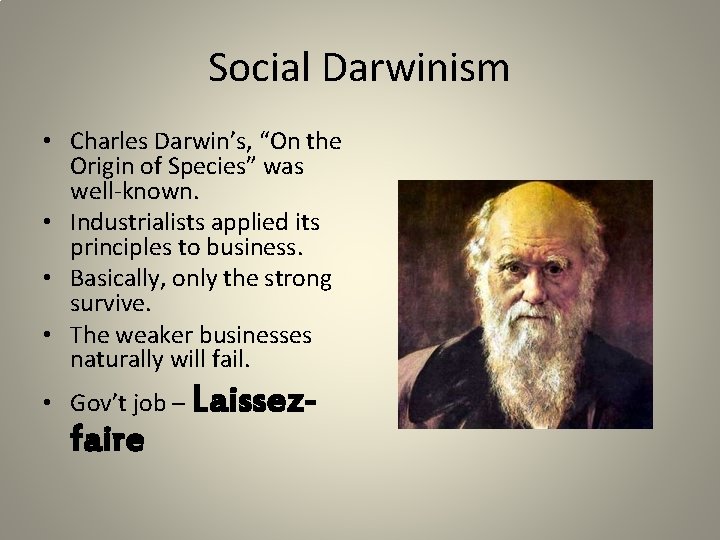
Social Darwinism • Charles Darwin’s, “On the Origin of Species” was well-known. • Industrialists applied its principles to business. • Basically, only the strong survive. • The weaker businesses naturally will fail. • Gov’t job – Laissez- faire
Economic Principles • Economists were trying to figure out how to measure this new economy. • One principle they understood was the business cycle. What goes up must come down. Boom and bust. • They also understood that the more one produced, the cheaper the cost. • This is known as economies of scale.
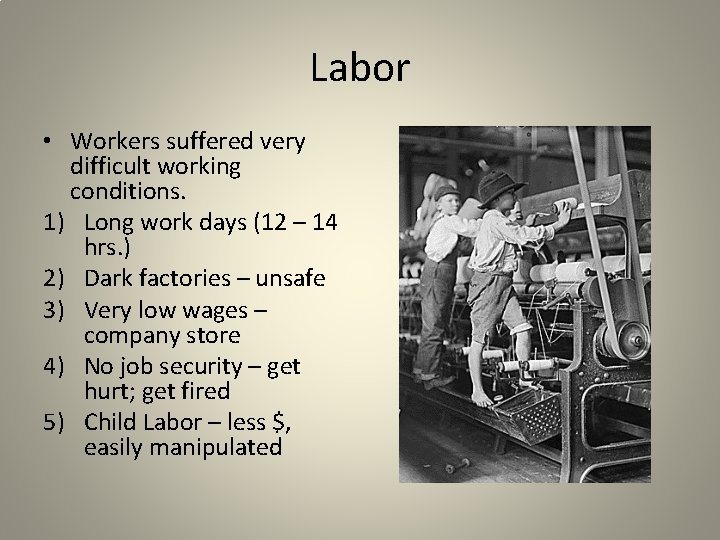
Labor • Workers suffered very difficult working conditions. 1) Long work days (12 – 14 hrs. ) 2) Dark factories – unsafe 3) Very low wages – company store 4) No job security – get hurt; get fired 5) Child Labor – less $, easily manipulated
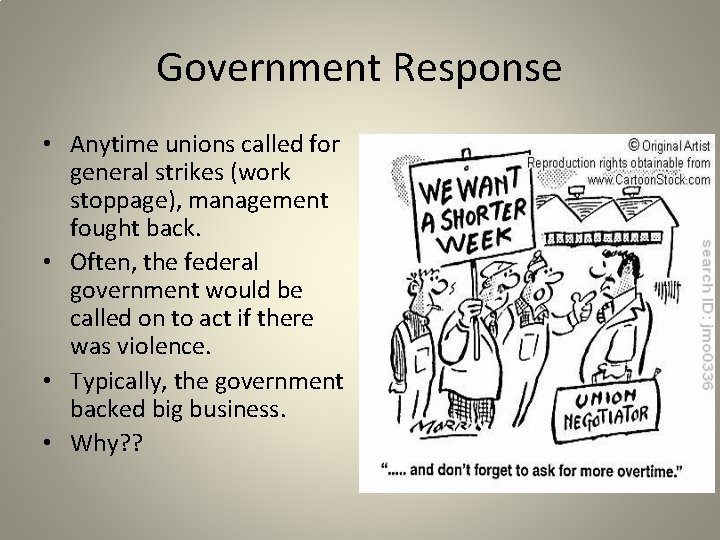
Labor • Workers tried to strike, but were rarely successful. • Unions were formed like the American Federation of Labor. Wanted more money, fewer hours. • It was only for the skilled worker. • Yellow dog contracts were used to keep the union out of the factory. • Workers went on strike in RR towns.
Government Response • Anytime unions called for general strikes (work stoppage), management fought back. • Often, the federal government would be called on to act if there was violence. • Typically, the government backed big business. • Why? ?
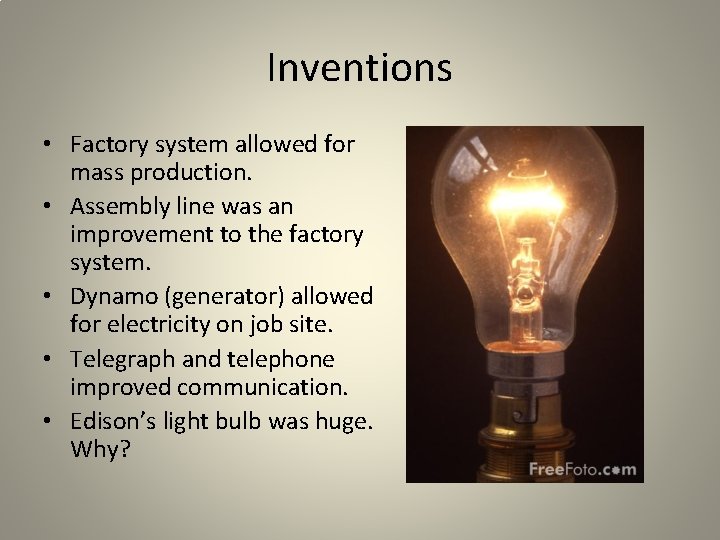
Inventions • Factory system allowed for mass production. • Assembly line was an improvement to the factory system. • Dynamo (generator) allowed for electricity on job site. • Telegraph and telephone improved communication. • Edison’s light bulb was huge. Why?
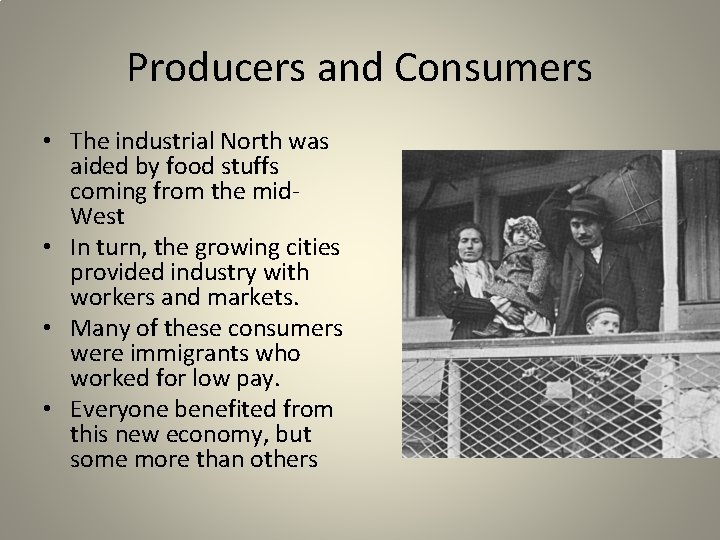
Producers and Consumers • The industrial North was aided by food stuffs coming from the mid. West • In turn, the growing cities provided industry with workers and markets. • Many of these consumers were immigrants who worked for low pay. • Everyone benefited from this new economy, but some more than others
Building a Business • Not everyone wanted to risk everything to get rich(er). • Corporations allowed for limited liability. • You could buy part ownership and share in the profits / losses. • Often times, corporations raised more capital by selling stocks.
Robber Barons / Captains of Industry • Cornelius Vanderbilt – Transportation • Andrew Carnegie – Carnegie Steel • JP Morgan – US Steel / Financier • John D. Rockefeller – Standard Oil
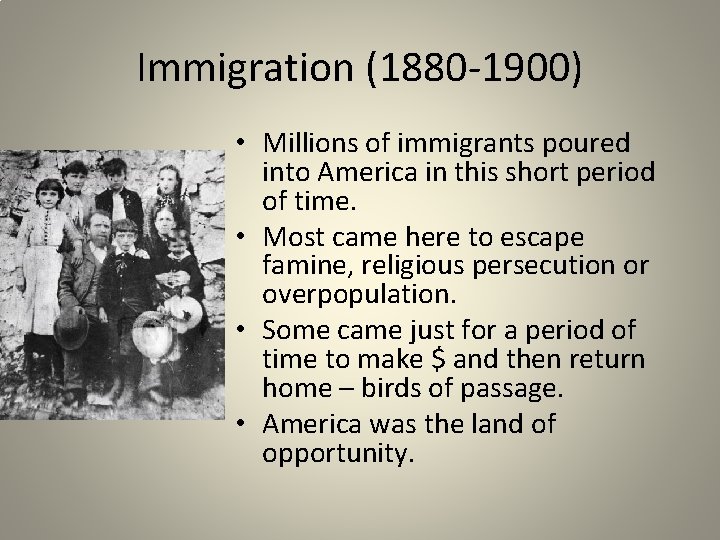
Immigration (1880 -1900) • Millions of immigrants poured into America in this short period of time. • Most came here to escape famine, religious persecution or overpopulation. • Some came just for a period of time to make $ and then return home – birds of passage. • America was the land of opportunity.
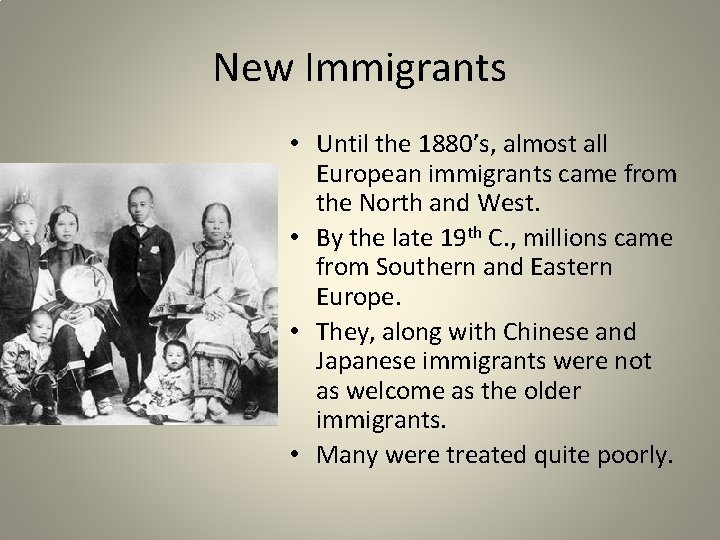
New Immigrants • Until the 1880’s, almost all European immigrants came from the North and West. • By the late 19 th C. , millions came from Southern and Eastern Europe. • They, along with Chinese and Japanese immigrants were not as welcome as the older immigrants. • Many were treated quite poorly.
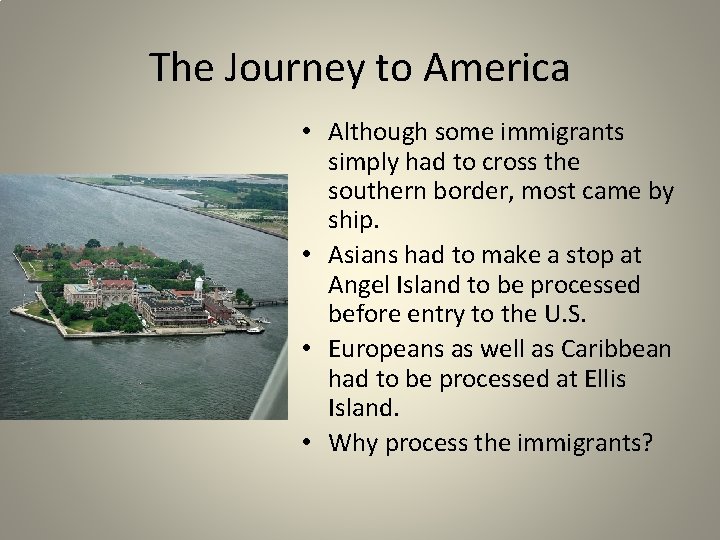
The Journey to America • Although some immigrants simply had to cross the southern border, most came by ship. • Asians had to make a stop at Angel Island to be processed before entry to the U. S. • Europeans as well as Caribbean had to be processed at Ellis Island. • Why process the immigrants?
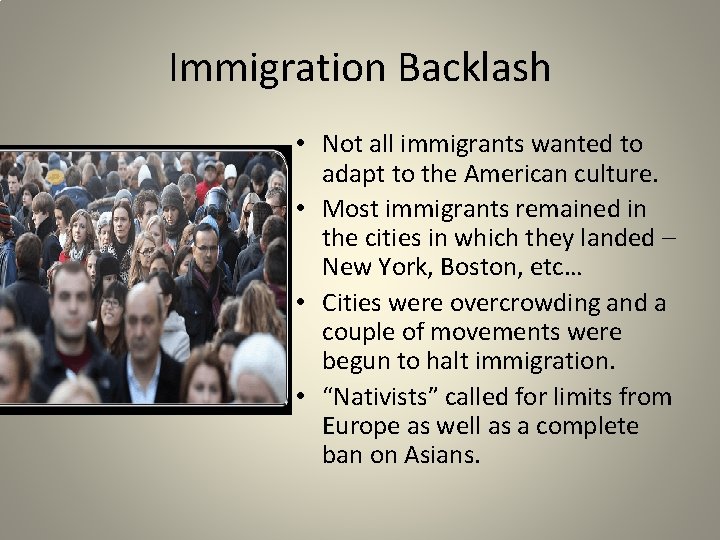
Immigration Backlash • Not all immigrants wanted to adapt to the American culture. • Most immigrants remained in the cities in which they landed – New York, Boston, etc… • Cities were overcrowding and a couple of movements were begun to halt immigration. • “Nativists” called for limits from Europe as well as a complete ban on Asians.
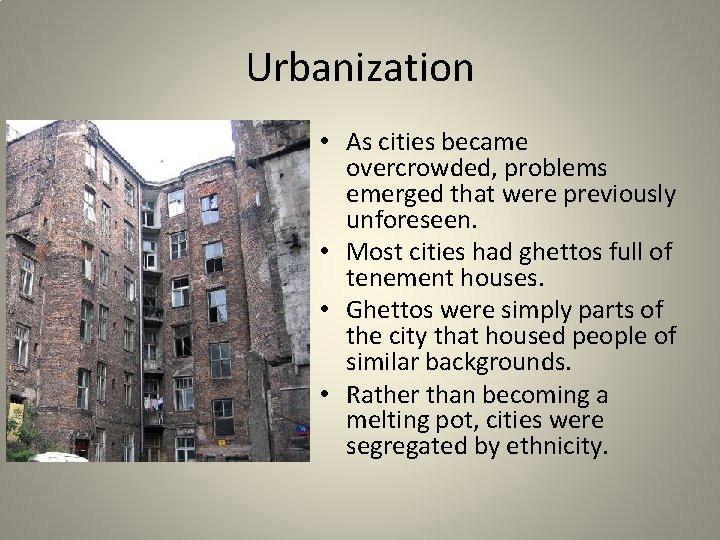
Urbanization • As cities became overcrowded, problems emerged that were previously unforeseen. • Most cities had ghettos full of tenement houses. • Ghettos were simply parts of the city that housed people of similar backgrounds. • Rather than becoming a melting pot, cities were segregated by ethnicity.
More Urban Growth • Not only did the late 19 th / early 20 th century see cities grow with immigrants, but with Americans as well. • Rural Americas were drawn to city life for multiple reasons. – Jobs with wages – Excitement – More luxuries
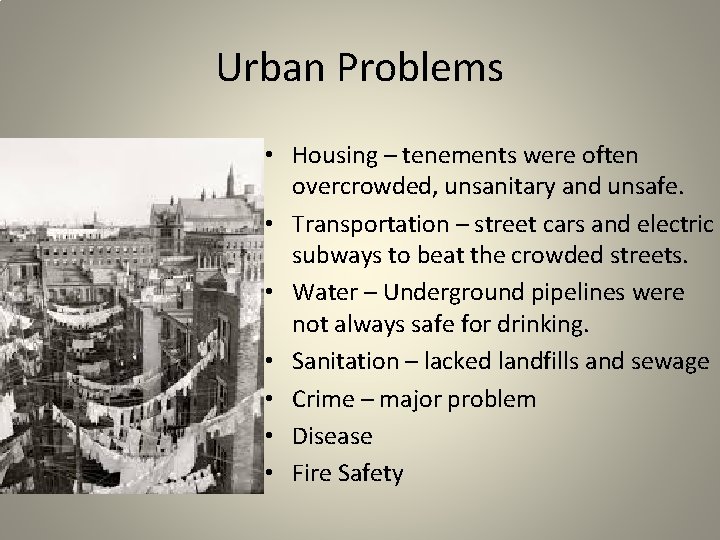
Urban Problems • Housing – tenements were often overcrowded, unsanitary and unsafe. • Transportation – street cars and electric subways to beat the crowded streets. • Water – Underground pipelines were not always safe for drinking. • Sanitation – lacked landfills and sewage • Crime – major problem • Disease • Fire Safety
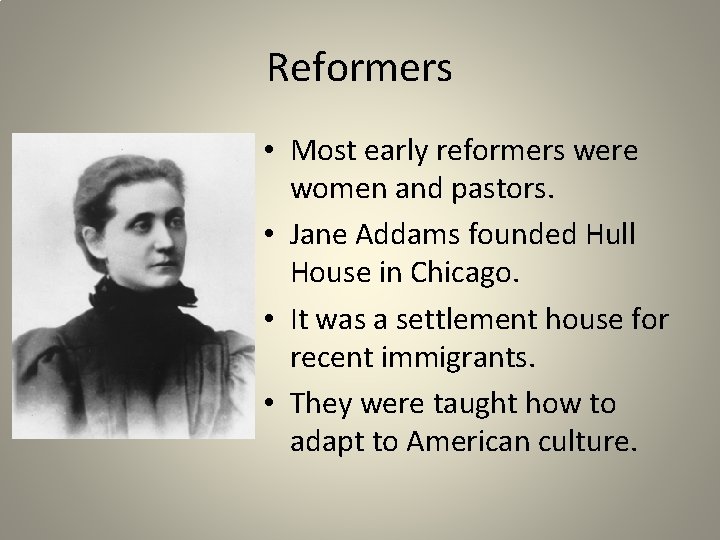
Reformers • Most early reformers were women and pastors. • Jane Addams founded Hull House in Chicago. • It was a settlement house for recent immigrants. • They were taught how to adapt to American culture.
Where are we in 1877? o America… 1. is now industrialized 2. has expanded out West. 3. is still an agrarian society. 4. is an emerging economic power 5. continues to welcome immigrants in large numbers. 6. may not be what it seems.
Gilded Age (1877 – 1900) or so • Mark Twain referred to this time pd. as the Gilded Age. • What does it mean to be gilded? • It is a thin layer of gold over a worthless metal. • It was not a pretty picture of America.
Politics of Business More and more Americans became wealthy during this time. How? 1. One could inherit great fortunes. 2. One could make great fortunes. • The number of wealthy climbed in America, but the number of poor climbed higher. • Too many people on bottom rung. •
Laissez-faire Policies In the late 1800’s, most gov’t policies helped business grow. Why? 1. Strong economy. 2. More people working. • Gov’t aided business by staying out of business. • Laissez-faire meant that gov’t would leave business to businesses. •
Politics of Business (part 2) • Railroads benefited from gov’t loans and grants. • They also supported political leaders. • Relationship between the two may have been a conflict of interest. • The Spoils system was used locally and on federal level. • Elected officials repaid supporters.
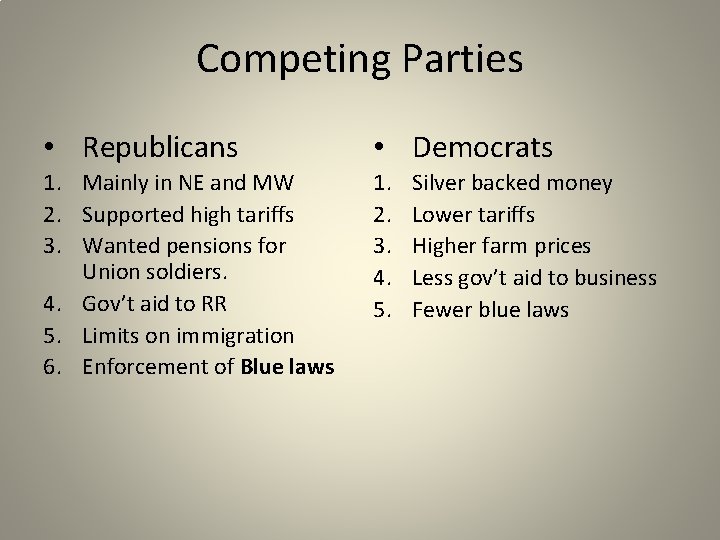
Competing Parties • Republicans • Democrats 1. Mainly in NE and MW 2. Supported high tariffs 3. Wanted pensions for Union soldiers. 4. Gov’t aid to RR 5. Limits on immigration 6. Enforcement of Blue laws 1. 2. 3. 4. 5. Silver backed money Lower tariffs Higher farm prices Less gov’t aid to business Fewer blue laws
Reforms • Republicans “waved the bloody shirt” for years to get elected. • Then, rewarded civil service jobs to friends (as did Dems) • Rutherford B. Hayes broke the tradition and offended his party. • Strengthened the country, but weakened the Republicans.
Election of 1880 • Republicans were split – Party loyalists – Half-breeds – reform spoils system – Stalwarts – Keep the same (spoils) • Garfield – halfbreed won the nomination and election. • Was assassinated in 1881. • Arthur became Pres. and ended spoils
Pendleton Civil Service Act • At the pressing of Arthur, Congress passed this act. • Civil Service jobs were to be awarded on merit, not party affiliation. • This effectively ended the spoils system started under Jackson.
Cleveland Takes Office • Dem. Pres. Cleveland took office in 1884. • To regulate unfair business practices, Congress created the ICC. • It failed to have teeth to force RR to comply to the laws. • The economy was floundering.
Harrison Wins in 1888 Cleveland was defeated by Harrison. He presided over the first billion $ Congress Surpluses turned into deficits. Harrison pleased his Republican friends by raising tariffs. • How do high tariffs help a hurting economy? • •
Coxey’s Army • Cleveland won again in 1892. • Unemployment was a problem and people marched on Washington. • Led by Jacob Coxey, they were arrested for trampling the grass.
City Life • Immigrants from abroad and from the farm were moving to the cities. • Some moved to the suburbs from the cities to escape overcrowding. • Tenement homes were built to house workers and their families. • Most people lived in poverty with little chance of making a better life. • Many lived in ghettos.
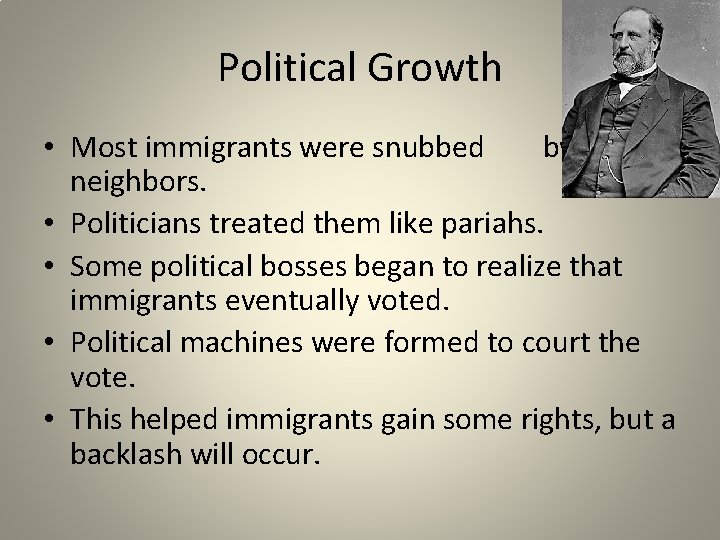
Political Growth • Most immigrants were snubbed by neighbors. • Politicians treated them like pariahs. • Some political bosses began to realize that immigrants eventually voted. • Political machines were formed to court the vote. • This helped immigrants gain some rights, but a backlash will occur.
Antiforeignism Americans grew weary and suspicious of new immigrants. • Especially southern Europeans. Why? 1. New ideas – socialism 2. Old religion – Catholicism • Our borders were being shut off to them as new laws were passed. •
Populism • Populism was the first movement for reform. • It is the predecessor of Progressivism. • 1850’s saw a movement in America known as the “nativist” mov’t. • They opposed immigration from anywhere to the U. S. • How many of them were truly natives?
Populist Platform • • Coin silver money Nationalize rails and phones Direct election of US Senators Increase prices of food and services Graduated income tax Federal loans to farmers 8 hour workday Limit immigration
Social Reforms • Some reformers sought to change society. • Prohibition was started by a movement in the 1800’s. – Temperence Mov’t • Women led this crusade as well as preachers • Comstock Laws sought to slow the growth of social “vices”. • Social gospel movement tried to apply teachings of Jesus to society.
Reformers • Jane Addams tried to help new immigrants adjust to a new country. • Started the Hull House to train and educate new immigrants. • This was the first well-known “settlement house” in the U. S. • Health clinics were also est. to help the poor • Ghettos were to become a thing of the past.