
INDUSTRIALIZATION CHAPTER 14 1865 1901 BEGINNINGS OF INDUSTRIAL
INDUSTRIALIZATION CHAPTER 14 1865 -1901
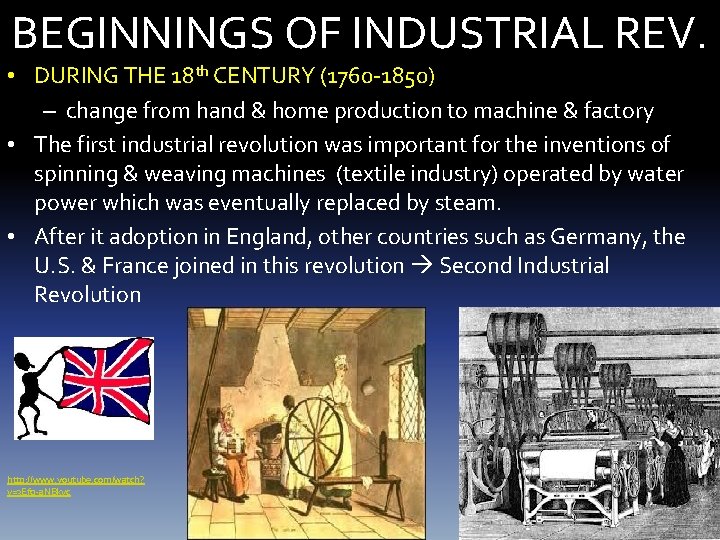
BEGINNINGS OF INDUSTRIAL REV. • DURING THE 18 th CENTURY (1760 -1850) – change from hand & home production to machine & factory • The first industrial revolution was important for the inventions of spinning & weaving machines (textile industry) operated by water power which was eventually replaced by steam. • After it adoption in England, other countries such as Germany, the U. S. & France joined in this revolution Second Industrial Revolution http: //www. youtube. com/watch? v=3 Efq-a. NBkvc
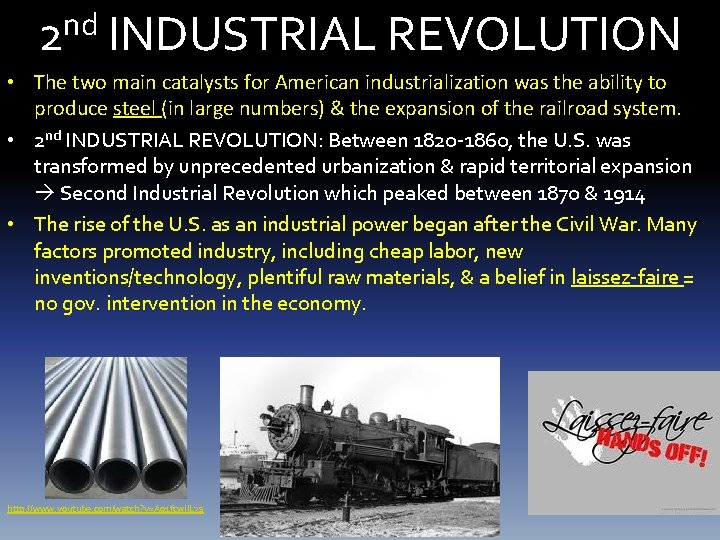
nd 2 INDUSTRIAL REVOLUTION • The two main catalysts for American industrialization was the ability to produce steel (in large numbers) & the expansion of the railroad system. • 2 nd INDUSTRIAL REVOLUTION: Between 1820 -1860, the U. S. was transformed by unprecedented urbanization & rapid territorial expansion Second Industrial Revolution which peaked between 1870 & 1914 • The rise of the U. S. as an industrial power began after the Civil War. Many factors promoted industry, including cheap labor, new inventions/technology, plentiful raw materials, & a belief in laissez-faire = no gov. intervention in the economy. http: //www. youtube. com/watch? v=Ao 1 fcwjl. L 3 s
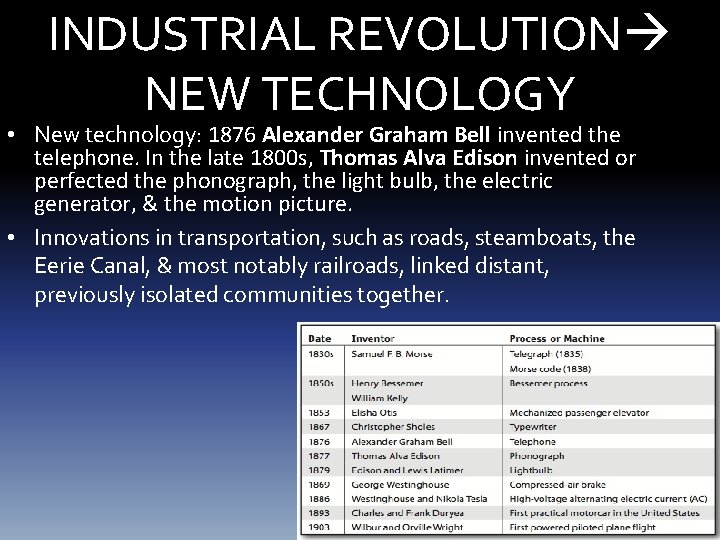
INDUSTRIAL REVOLUTION NEW TECHNOLOGY • New technology: 1876 Alexander Graham Bell invented the telephone. In the late 1800 s, Thomas Alva Edison invented or perfected the phonograph, the light bulb, the electric generator, & the motion picture. • Innovations in transportation, such as roads, steamboats, the Eerie Canal, & most notably railroads, linked distant, previously isolated communities together.
EFFECTS OF INDUSTRIAL REV. • BRIEF OVERVIEW: By the early 1900 s, the U. S. had become the world’s leading industrial nation. • As industries & factories arose, people moved from farms to cities issues including overcrowding & disease • Communication & transportation networks expanded • Inventions make life easier & increase productivity (ex: light bulb, telephone, automobile) • Railroads rapidly expanded • Government policies encouraged growth, & large corporations became an important part of the economy. • As industry expanded, workers tried to form unions to fight for better wages & working conditions.

THE RAILROADS • Main idea: After the Civil War, the rapid construction of railroads accelerated the nation’s industrialization & linked the country together. BEFORE: In the early 1800 s, most railways served only local needs, resulting in many unconnected rail lines. • A great catalyst for industrialization was the expansion of the Railroad system. • In 1862 President Abraham Lincoln signed the Pacific Railway Act, which provided for the construction of a transcontinental railroad by the Union Pacific and Central Pacific railroad companies, in which free land grants were given to those 2 railroad companies for constructing the railroad tracks. • The railroad system linked the nation & expanded the size of markets. • The railroad industry stimulated the economy by spending large amounts of money on steel, coal, and timber.
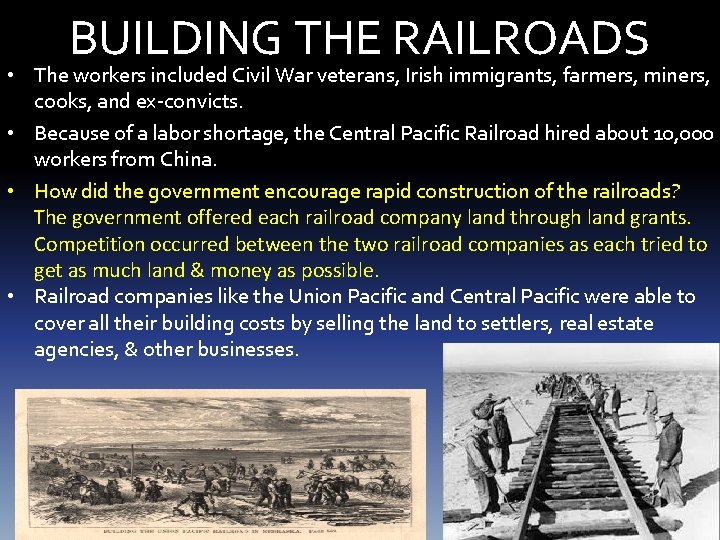
BUILDING THE RAILROADS • The workers included Civil War veterans, Irish immigrants, farmers, miners, cooks, and ex-convicts. • Because of a labor shortage, the Central Pacific Railroad hired about 10, 000 workers from China. • How did the government encourage rapid construction of the railroads? The government offered each railroad company land through land grants. Competition occurred between the two railroad companies as each tried to get as much land & money as possible. • Railroad companies like the Union Pacific and Central Pacific were able to cover all their building costs by selling the land to settlers, real estate agencies, & other businesses.
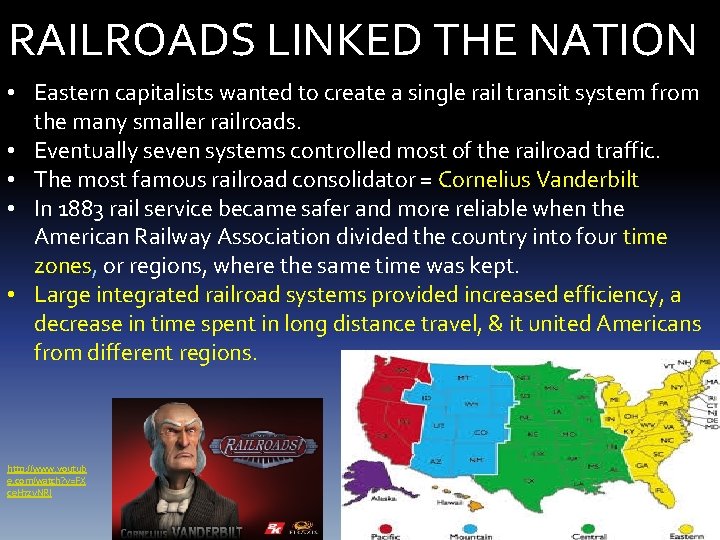
RAILROADS LINKED THE NATION • Eastern capitalists wanted to create a single rail transit system from the many smaller railroads. • Eventually seven systems controlled most of the railroad traffic. • The most famous railroad consolidator = Cornelius Vanderbilt • In 1883 rail service became safer and more reliable when the American Railway Association divided the country into four time zones, or regions, where the same time was kept. • Large integrated railroad systems provided increased efficiency, a decrease in time spent in long distance travel, & it united Americans from different regions. http: //www. youtub e. com/watch? v=FX ce. H 7 zv. NRI
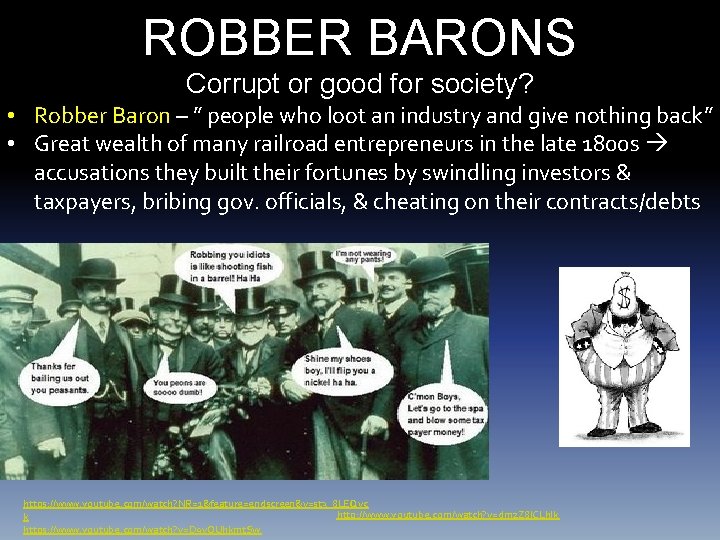
ROBBER BARONS Corrupt or good for society? • Robber Baron – ” people who loot an industry and give nothing back” • Great wealth of many railroad entrepreneurs in the late 1800 s accusations they built their fortunes by swindling investors & taxpayers, bribing gov. officials, & cheating on their contracts/debts https: //www. youtube. com/watch? NR=1&feature=endscreen&v=st 3_8 LEQvc http: //www. youtube. com/watch? v=dmz. Z 8 l. CLhlk k https: //www. youtube. com/watch? v=D 9 v. OUhkmt. Sw

BIG BUSINESS CORPORATIONS • Main idea: After the Civil War, big business assumed a more prominent role in American life. By 1900, big business dominated the economy of the U. S. • Laissez-faire (government stays out of economy) government policies encouraged growth & large corporations became important by providing jobs & spurring economic growth. • A corporation is an organization (a business) owned by many people; the ownership of the company is divided up by shareholders (or stockholders). – Issuing stock allows a corporation to raise large sums of money & allows them to spread out the financial risk. • Why were large corporations able to thrive when so many small companies were forced out of business? ECONOMIES OF SCALE. Large corporations were able to produce more goods cheaply & more efficiently. Large corporations could continue in poor economic times, & they could negotiate rebates from railroads. Small businesses with high operating costs were unable to compete with large corporations & were forced out of business
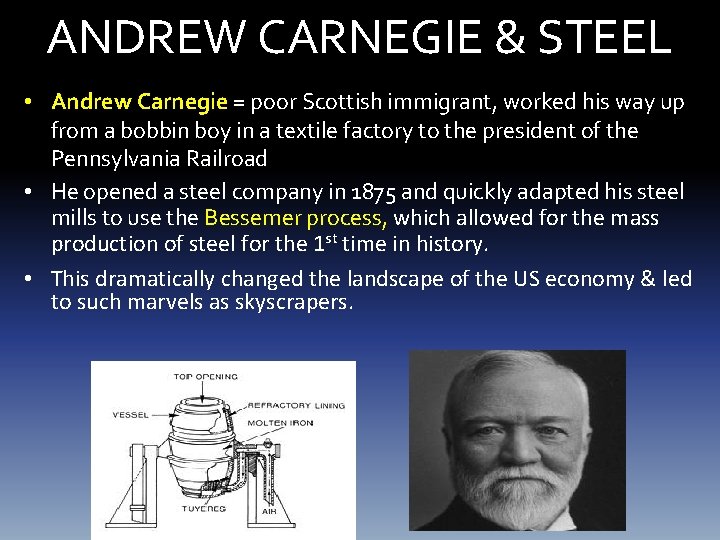
ANDREW CARNEGIE & STEEL • Andrew Carnegie = poor Scottish immigrant, worked his way up from a bobbin boy in a textile factory to the president of the Pennsylvania Railroad • He opened a steel company in 1875 and quickly adapted his steel mills to use the Bessemer process, which allowed for the mass production of steel for the 1 st time in history. • This dramatically changed the landscape of the US economy & led to such marvels as skyscrapers.
MONOPOLIES • In the late 1800 s, Americans became suspicious of large corporations and feared monopolies • A monopoly occurs when one company gains control of an entire market – Americans feared monopolies because a company with a monopoly could charge whatever price it wanted for a product • The Sherman Anti-Trust Act was created by the government to make monopolies illegal. • In 1882, John D. Rockefeller’s company, Standard Oil, formed the first trust, which merged businesses by allowing a person (from company A) to manage another person’s property (from company B); this was not illegal.
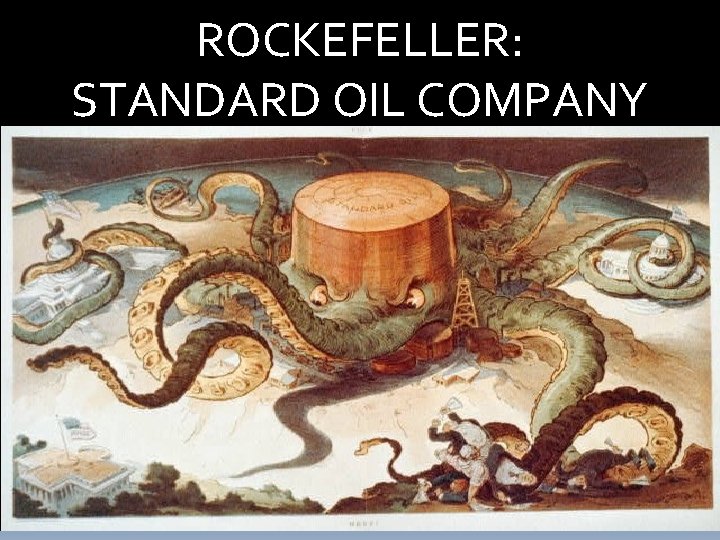
ROCKEFELLER: STANDARD OIL COMPANY
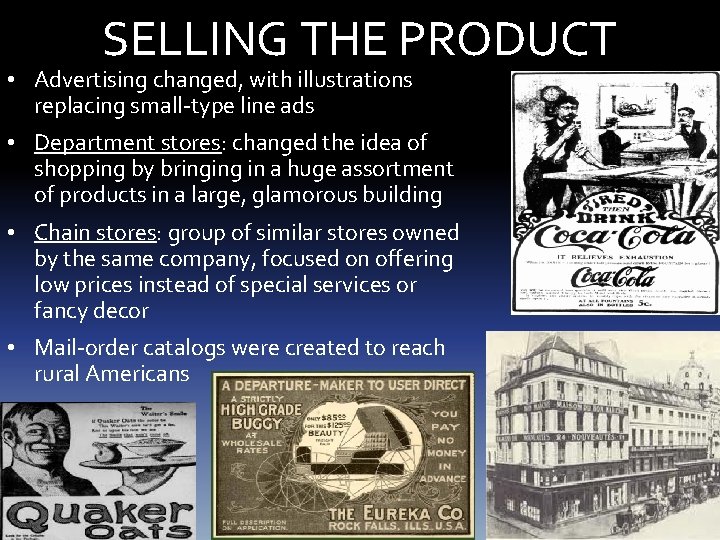
SELLING THE PRODUCT • Advertising changed, with illustrations replacing small-type line ads • Department stores: changed the idea of shopping by bringing in a huge assortment of products in a large, glamorous building • Chain stores: group of similar stores owned by the same company, focused on offering low prices instead of special services or fancy decor • Mail-order catalogs were created to reach rural Americans
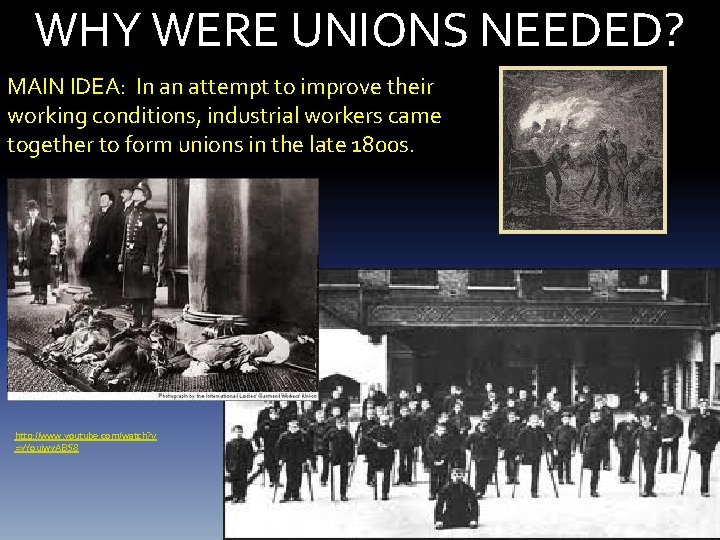
WHY WERE UNIONS NEEDED? MAIN IDEA: In an attempt to improve their working conditions, industrial workers came together to form unions in the late 1800 s. http: //www. youtube. com/watch? v =y. Youiwy. ABS 8
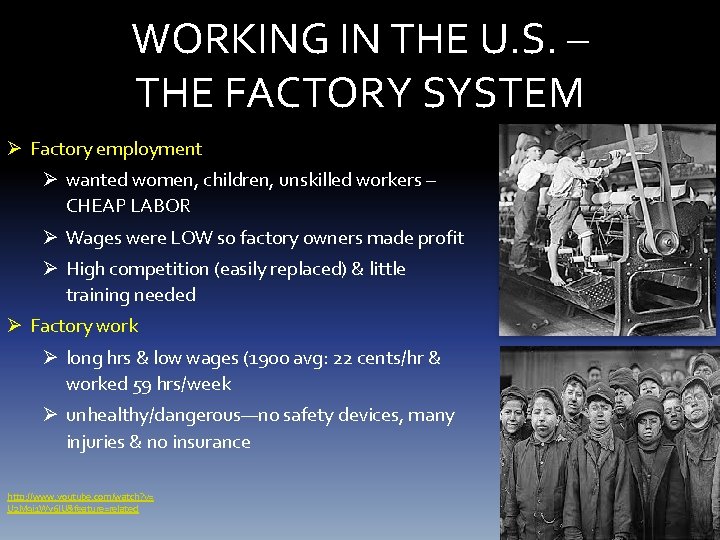
WORKING IN THE U. S. – THE FACTORY SYSTEM Ø Factory employment Ø wanted women, children, unskilled workers – CHEAP LABOR Ø Wages were LOW so factory owners made profit Ø High competition (easily replaced) & little training needed Ø Factory work Ø long hrs & low wages (1900 avg: 22 cents/hr & worked 59 hrs/week Ø unhealthy/dangerous—no safety devices, many injuries & no insurance http: //www. youtube. com/watch? v= U 2 M 9 i 1 Wy 6 IU&feature=related
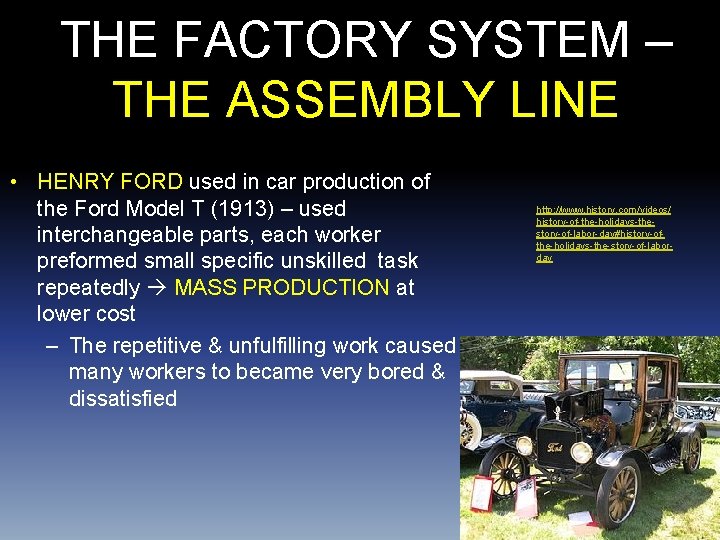
THE FACTORY SYSTEM – THE ASSEMBLY LINE • HENRY FORD used in car production of the Ford Model T (1913) – used interchangeable parts, each worker preformed small specific unskilled task repeatedly MASS PRODUCTION at lower cost – The repetitive & unfulfilling work caused many workers to became very bored & dissatisfied http: //www. history. com/videos/ history-of-the-holidays-thestory-of-labor-day#history-ofthe-holidays-the-story-of-laborday
• INDUSTRY OPPOSES UNIONS Industrial unions = united all craft workers & common laborers in a particular industry • Workers form unions to improve their working conditions – collective bargaining to negotiate higher wages and better working conditions • Companies try to prevent unions from forming – Require workers to take oaths/sign contracts promising not to join & hired detectives to go undercover & identify union organizers – Blacklist = list of “troublemakers” – if tried to organize/strike placed on list & could only get job if changed residence, trade, name – Lockout = used to break unions – locked workers out & refused to pay – Strikebreakers = scabs, replacement workers hired if union organized strike
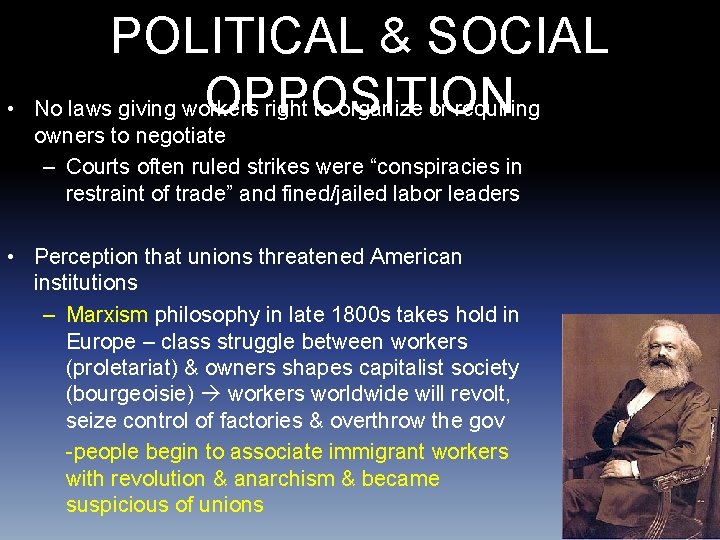
• POLITICAL & SOCIAL OPPOSITION No laws giving workers right to organize or requiring owners to negotiate – Courts often ruled strikes were “conspiracies in restraint of trade” and fined/jailed labor leaders • Perception that unions threatened American institutions – Marxism philosophy in late 1800 s takes hold in Europe – class struggle between workers (proletariat) & owners shapes capitalist society (bourgeoisie) workers worldwide will revolt, seize control of factories & overthrow the gov -people begin to associate immigrant workers with revolution & anarchism & became suspicious of unions
http: //www. youtube. com/watch? v=eut. UTVpd. WDc
- Slides: 22