
INDUSTRIAL WASTE RECOVERY BEST PRACTICES Associate Professor Dr
INDUSTRIAL WASTE RECOVERY BEST PRACTICES Associate Professor Dr. Sombat Teekasap Honorarium Chairman, Environmental Management Industry Club, Advisory Board Chairman, Renewable Energy Industry Club, and Vice Chairman, Executive Environment Institute Committee, Federation of Thai Industries, Dean of Engineering, Eastern Asia University 1
TOPICS l l Development and trends of industrial waste recovery in Thailand Waste recovery infrastructure Effective waste recovery system Technological development of industrial waste recovery 2
Development and trends of industrial waste recovery in Thailand 3
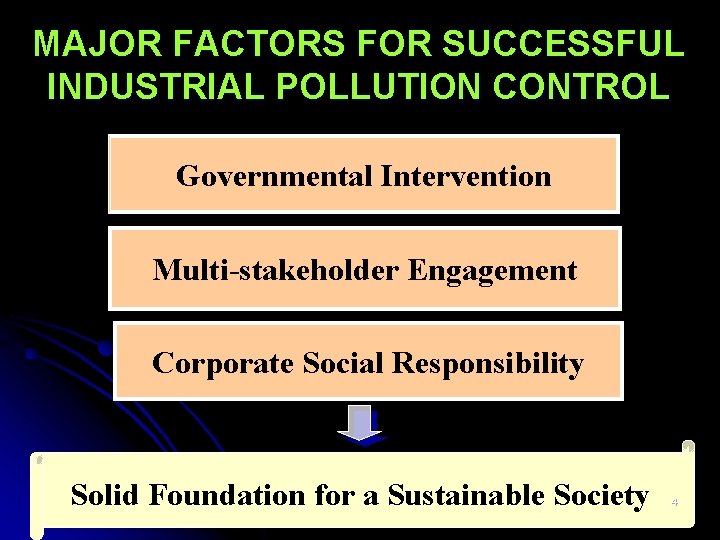
MAJOR FACTORS FOR SUCCESSFUL INDUSTRIAL POLLUTION CONTROL Governmental Intervention Multi-stakeholder Engagement Corporate Social Responsibility Solid Foundation for a Sustainable Society 4
SUSTAINABLE WASTE MANAGEMENT l Economically l Socially affordable acceptable l Environmentally effective 5
WASTE MANAGEMENT STRATEGY l Reduce amount of waste generated. l Develop Integrated Waste Management system to handle the inevitable waste produced - Reuse - Recycle 6
CHARACTERISTICS OF SUSTAINABLE WASTE MANAGEMENT SYSTEM l Integrated Holistic System Approach – waste materials, source of waste, collection methods, treatment methods (recycling, energy recovery, anaerobic digestion, composting, landfill) l l Market Oriented – materials and energy must have end use and generate income. Flexibility – appropriate adaptability and constant improvement. Scale Social Acceptability 7
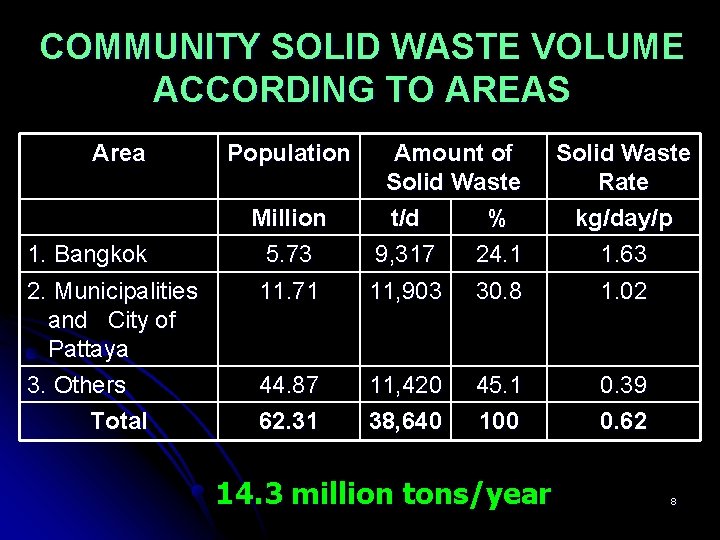
COMMUNITY SOLID WASTE VOLUME ACCORDING TO AREAS Area 1. Bangkok 2. Municipalities and City of Pattaya 3. Others Total Population Amount of Solid Waste t/d % Solid Waste Rate kg/day/p Million 5. 73 9, 317 24. 1 1. 63 11. 71 11, 903 30. 8 1. 02 44. 87 62. 31 11, 420 38, 640 45. 1 100 0. 39 0. 62 14. 3 million tons/year 8
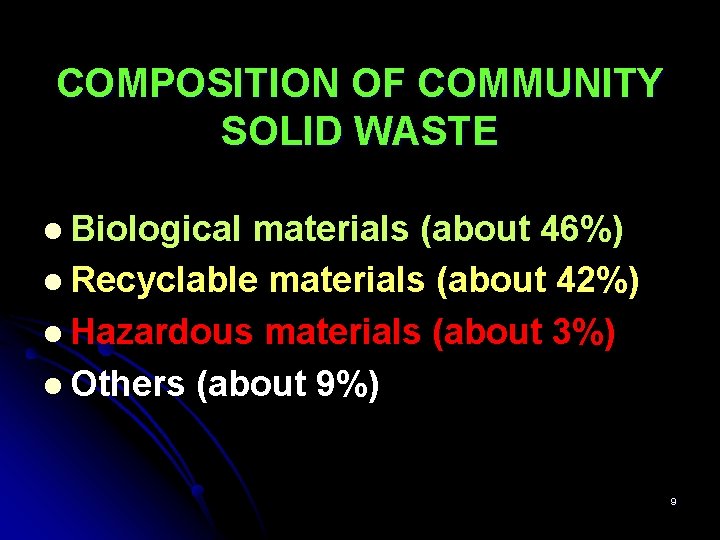
COMPOSITION OF COMMUNITY SOLID WASTE l Biological materials (about 46%) l Recyclable materials (about 42%) l Hazardous materials (about 3%) l Others (about 9%) 9
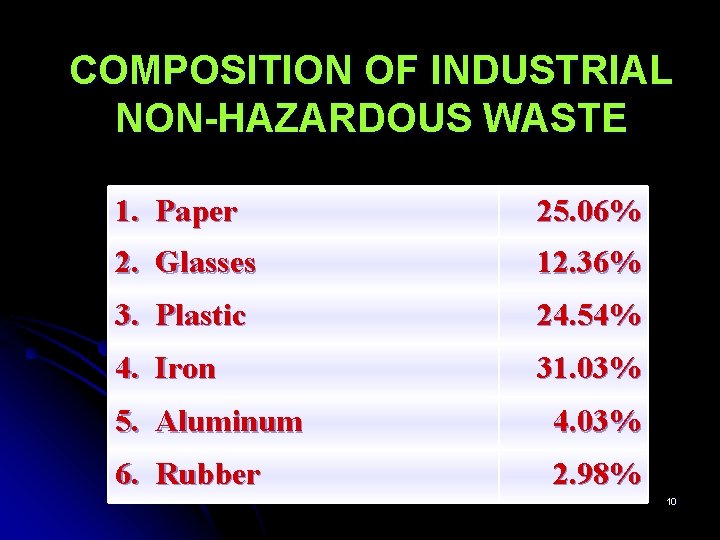
COMPOSITION OF INDUSTRIAL NON-HAZARDOUS WASTE 1. Paper 25. 06% 2. Glasses 12. 36% 3. Plastic 24. 54% 4. Iron 31. 03% 5. Aluminum 4. 03% 6. Rubber 2. 98% 10
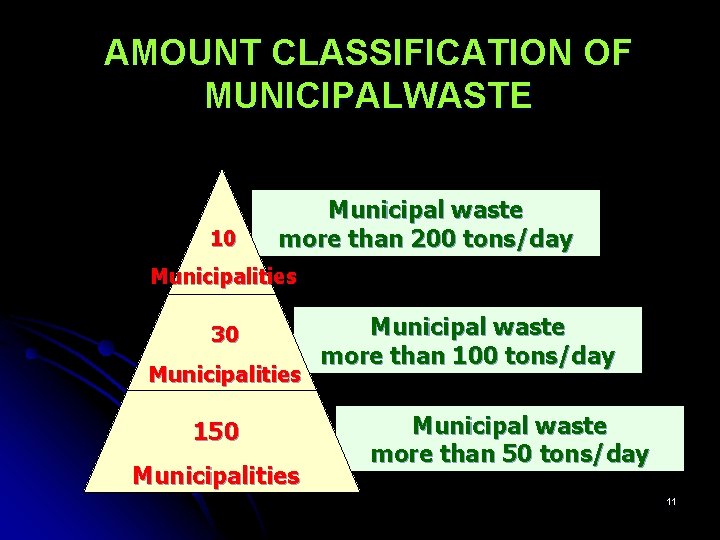
AMOUNT CLASSIFICATION OF MUNICIPALWASTE 10 Municipal waste more than 200 tons/day Municipalities 30 Municipalities 150 Municipalities Municipal waste more than 100 tons/day Municipal waste more than 50 tons/day 11
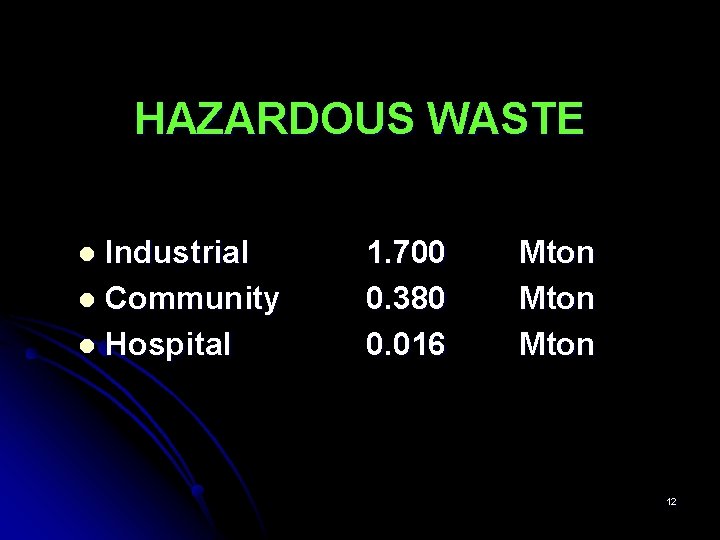
HAZARDOUS WASTE Industrial l Community l Hospital l 1. 700 0. 380 0. 016 Mton 12
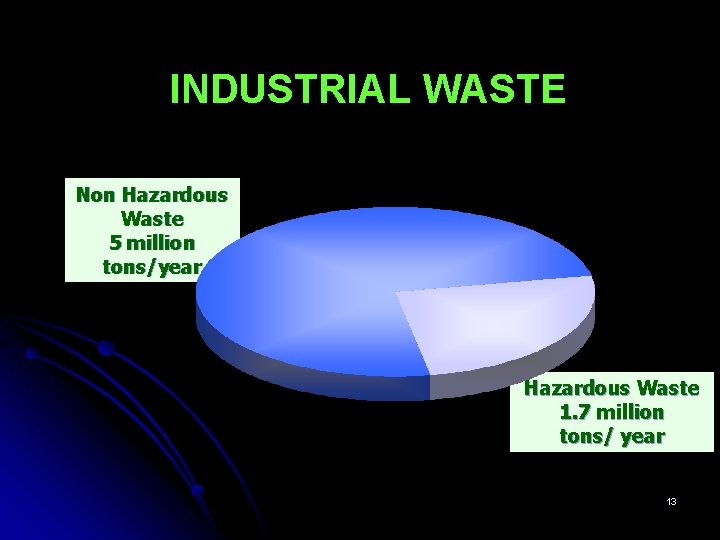
INDUSTRIAL WASTE Non Hazardous Waste 5 million tons/year Hazardous Waste 1. 7 million tons/ year 13
Waste recovery infrastructure 14
LAW ENFORCEMENT 1. Report on volume of industrial hazardous and non hazardous waste required by Ministry of Industry. 2. New law enforcement. 15
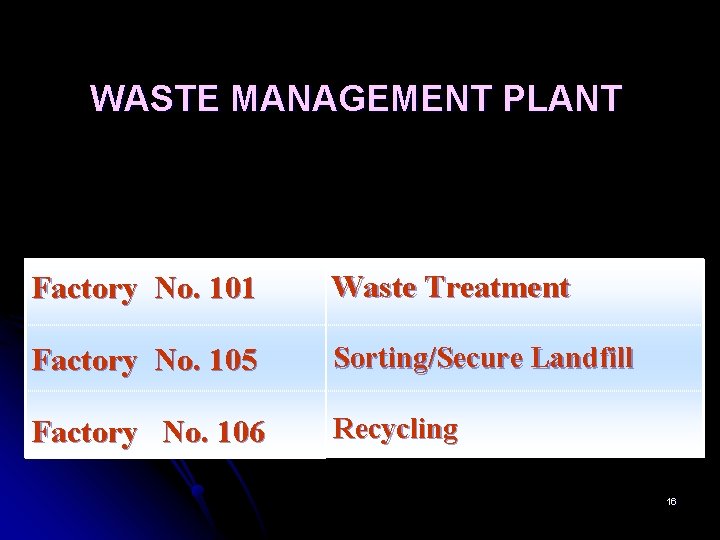
WASTE MANAGEMENT PLANT Factory No. 101 Waste Treatment Factory No. 105 Sorting/Secure Landfill Factory No. 106 Recycling 16
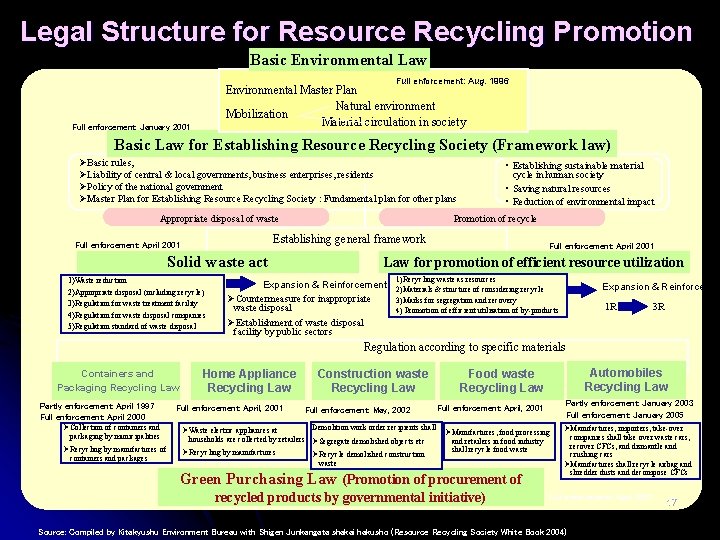
Legal Structure for Resource Recycling Promotion Basic Environmental Law Full enforcement: Aug. 1996 Environmental Master Plan Natural environment Mobilization Material circulation in society Full enforcement: January 2001 Basic Law for Establishing Resource Recycling Society (Framework law) ØBasic rules, • Establishing sustainable material cycle in human society ØLiability of central & local governments, business enterprises, residents ØPolicy of the national government • Saving natural resources ØMaster Plan for Establishing Resource Recycling Society : Fundamental plan for other plans • Reduction of environmental impact Appropriate disposal of waste Promotion of recycle Establishing general framework Full enforcement: April 2001 Solid waste act 1)Waste reduction 2)Appropriate disposal (including recycle) 3)Regulation for waste treatment facility 4)Regulation for waste disposal companies 5)Regulation standard of waste disposal Full enforcement: April 2001 Law for promotion of efficient resource utilization Expansion & Reinforcement ØCountermeasure for inappropriate waste disposal ØEstablishment of waste disposal facility by public sectors 1)Recycling waste as resources 2)Materials & structure of considering recycle 3)Marks for segregation and recovery 4) Promotion of efficient utilization of by-products Expansion & Reinforcemen 1 R 3 R Regulation according to specific materials Containers and Packaging Recycling Law Partly enforcement: April 1997 Full enforcement: April 2000 ØCollection of containers and packaging by municipalities ØRecycling by manufactures of containers and packages Home Appliance Recycling Law Full enforcement: April, 2001 Construction waste Recycling Law Full enforcement: May, 2002 Demolition work order recipients shall households are collected by retailers ØSegregate demolished objects etc ØRecycling by manufactures ØRecycle demolished construction waste ØWaste electric appliances at Automobiles Recycling Law Food waste Recycling Law Partly enforcement: January 2003 Full enforcement: January 2005 Full enforcement: April, 2001 ØManufactures, food processing and retailers in food industry shall recycle food waste Green Purchasing Law (Promotion of procurement of recycled products by governmental initiative) ØManufactures, importers, take-over companies shall take over waste cars, recover CFCs, and dismantle and crushing cars ØManufactures shall recycle airbag and shredder dusts and decompose CFCs Full enforcement: April 2001 Source: Compiled by Kitakyushu Environment Bureau with Shigen Junkangata shakai hakusho (Resource Recycling Society White Book 2004) 17
PRESENT STRUCTURE Ø Only few proper sorting plants are running. Ø Few solid community waste incinerators are still running. Ø Most of solid waste sent to landfill site. Ø Some of landfill sites are still under standard. 18
Effective waste recovery system 19
PRACTICAL ACTIVITIES Develop laws and regulation to promote a total good practice in waste management. l Set up centers for complete solid waste management. l Do intensive public relation for wide spread acceptance of publics in supporting waste management practice. l Support private sectors to run waste management projects. l 20
TYPICAL PROJECTS l Sorting plants l Upgrading recyclable material plant l Electronic waste recycling plant l Hazardous waste recycle plant l Waste exchange program 21
TYPICAL PROJECTS Composting plant l Bio-liquid and compost earth wormiest system l l Individual house composting Bio-gas fermentation plant l Other Waste to Energy System (Gasification, Direct Burning, and etc. ) l 22
Technological development of industrial waste recovery 23
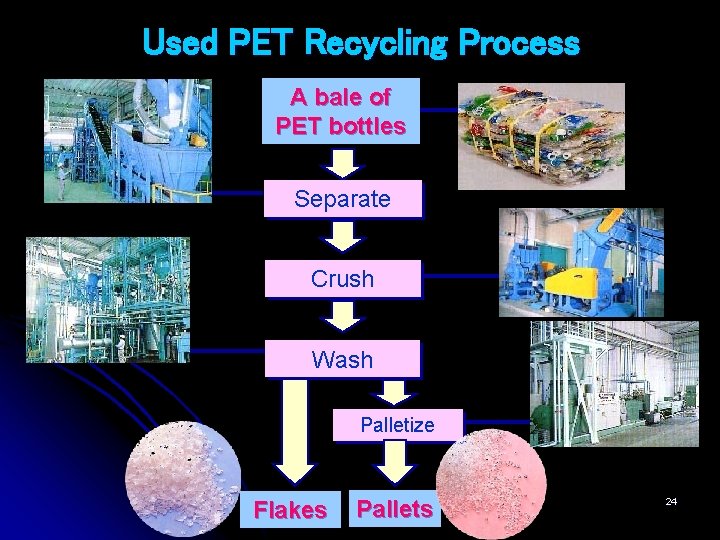
Used PET Recycling Process A bale of PET bottles Separate Crush Wash Palletize Flakes Pallets 24
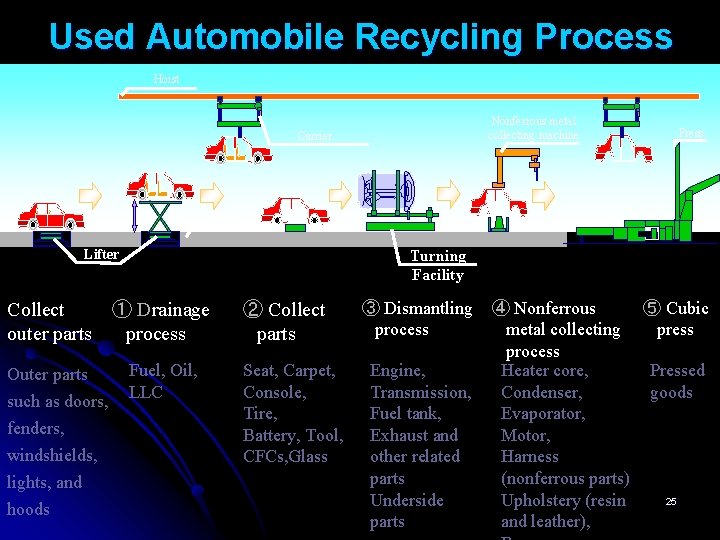
Used Automobile Recycling Process Hoist Car body conveyor system Nonferrous metal collecting machine Carrier Press Deck Lifter Turning Facility Collect ① Drainage outer parts process Outer parts such as doors, fenders, windshields, lights, and hoods Fuel, Oil, LLC ② Collect parts Seat, Carpet, Console, Tire, Battery, Tool, CFCs, Glass ③ Dismantling process Engine, Transmission, Fuel tank, Exhaust and other related parts Underside parts ④ Nonferrous ⑤ Cubic metal collecting press process Heater core, Pressed Condenser, goods Evaporator, Motor, Harness (nonferrous parts) 25 Upholstery (resin and leather),
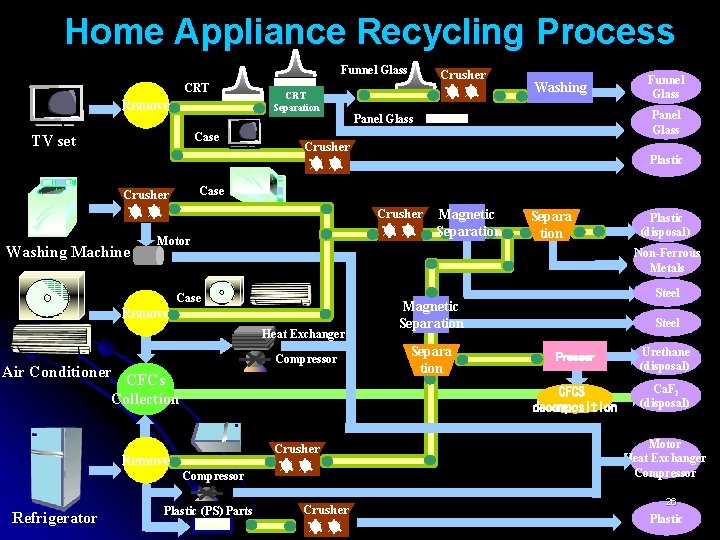
Home Appliance Recycling Process Funnel Glass CRT Remove Case TV set CRT Separation Crusher Washing Funnel Glass Panel Glass Crusher Plastic Case Crusher Washing Machine Motor Remove Heat Exchanger Compressor CFCs Collection Crusher Remove Compressor Refrigerator Plastic (PS) Parts Separa tion Plastic (disposal) Non-Ferrous Metals Case Air Conditioner Magnetic Separation Crusher Steel Magnetic Separation Separa tion Steel Presser Urethane (disposal) CFCS decomposition Ca. F 2 (disposal) Motor Heat Exchanger Compressor 26 Plastic
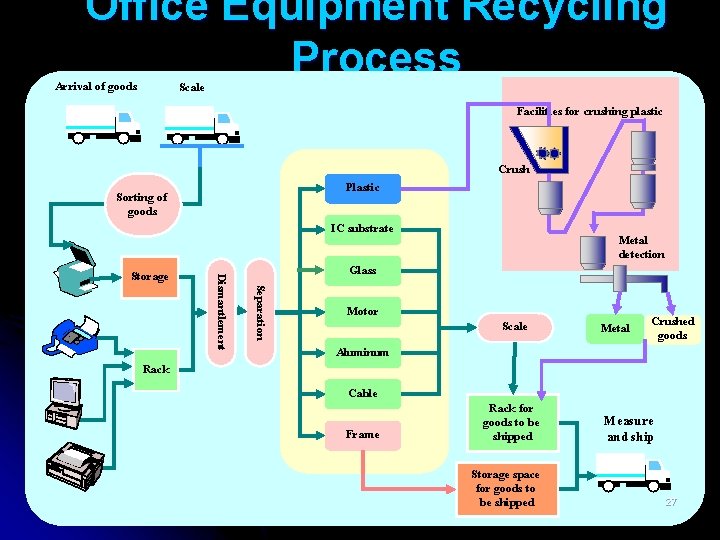
Office Equipment Recycling Process Arrival of goods Scale Facilities for crushing plastic Plastic Sorting of goods Metal detection Glass Separation Rack IC substrate Dismantlement Storage Crush Motor Scale Aluminum Cable Frame Rack for goods to be shipped Storage space for goods to be shipped Metal Crushed goods Measure and ship 27
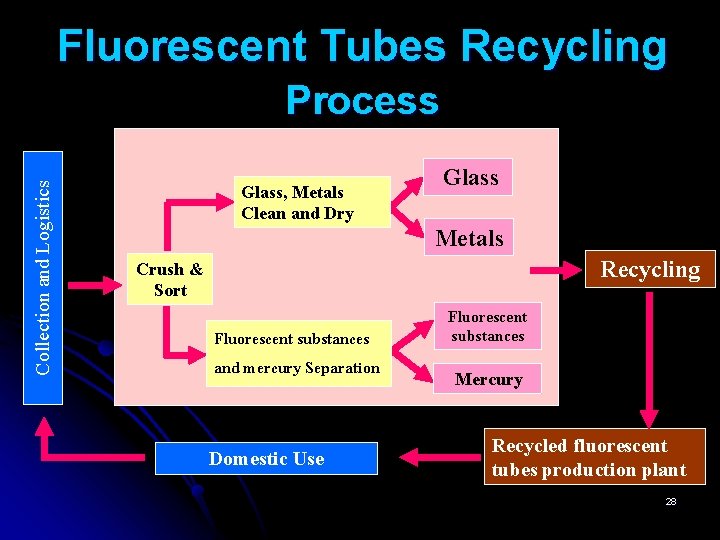
Fluorescent Tubes Recycling Collection and Logistics Process Glass, Metals Clean and Dry Glass Metals Recycling Crush & Sort Fluorescent substances and mercury Separation Domestic Use Fluorescent substances Mercury Recycled fluorescent tubes production plant 28
- Slides: 29