
Industrial Safety General Awareness Objectives To create understanding
Industrial Safety & General Awareness

Objectives • To create understanding of Industrial Safety • To create General Awareness of Industrial Safety • Labels and other forms of warnings • Material Safety Data Sheets (MSDS) • Information and training • Health Hazards
Properties of Hazardous & Toxic Chemicals Safe handling Procedure Causes & Prevention of accidents First Aid
Chemical Hazard • What is a Chemical Hazard? – Answer: Any chemical that can cause illness, injury, or an emergency. • Chemical Hazards – Physical – Health Industrial Safety Lecture Three 4 6/4/2021
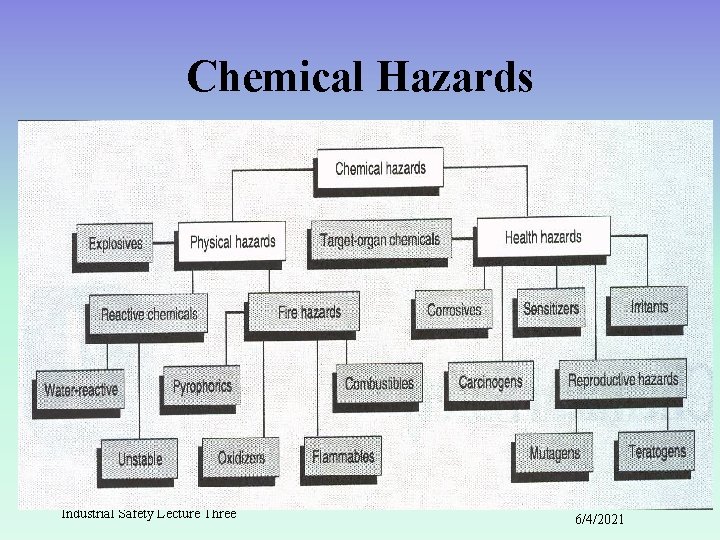
Chemical Hazards Industrial Safety Lecture Three 5 6/4/2021
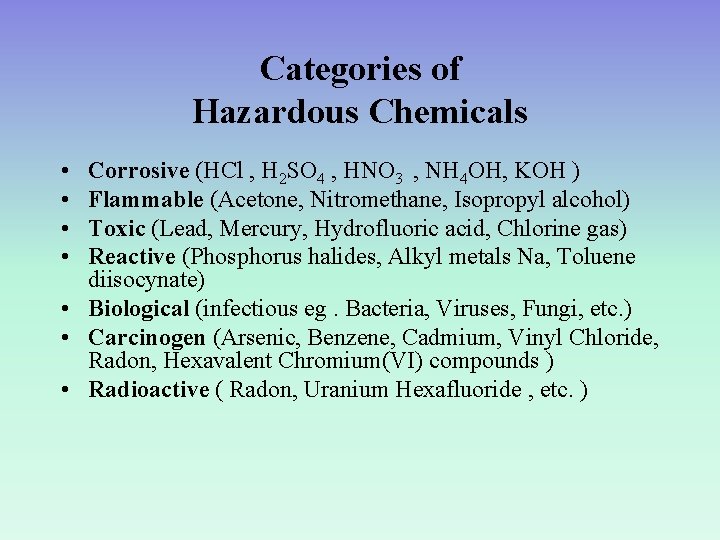
Categories of Hazardous Chemicals • • Corrosive (HCl , H 2 SO 4 , HNO 3 , NH 4 OH, KOH ) Flammable (Acetone, Nitromethane, Isopropyl alcohol) Toxic (Lead, Mercury, Hydrofluoric acid, Chlorine gas) Reactive (Phosphorus halides, Alkyl metals Na, Toluene diisocynate) • Biological (infectious eg. Bacteria, Viruses, Fungi, etc. ) • Carcinogen (Arsenic, Benzene, Cadmium, Vinyl Chloride, Radon, Hexavalent Chromium(VI) compounds ) • Radioactive ( Radon, Uranium Hexafluoride , etc. )
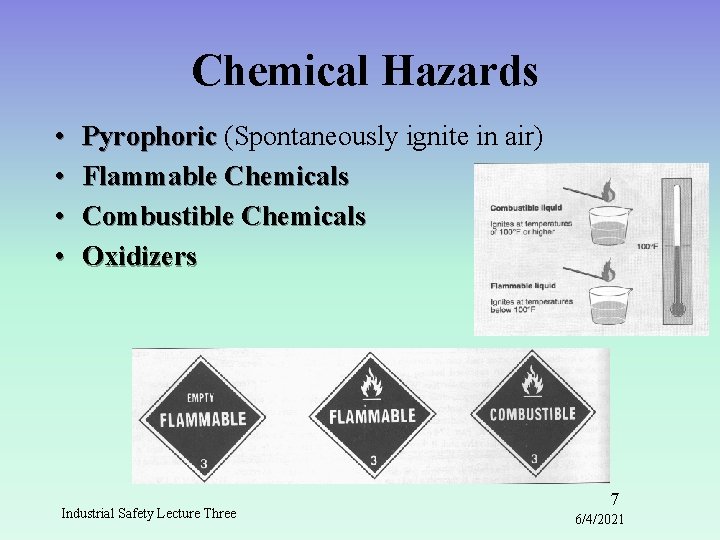
Chemical Hazards • • Pyrophoric (Spontaneously ignite in air) Flammable Chemicals Combustible Chemicals Oxidizers Industrial Safety Lecture Three 7 6/4/2021
Properties of Hazardous & toxic chemicals • Ignitability – liquids that have a flash point of less than 60◦C • Corrosivety –liquids have PH ≤ 2 or ≥ 12. 5 • Reactivity – substance that are unstable, react with violently with water. • Toxicity -
Chemical Exposure Severity & Duration • “Acute” effects usually occur rapidly as a result of short-term exposures, and are of short duration • “Chronic” effects generally occur as a result of long-term exposure, and are of long duration
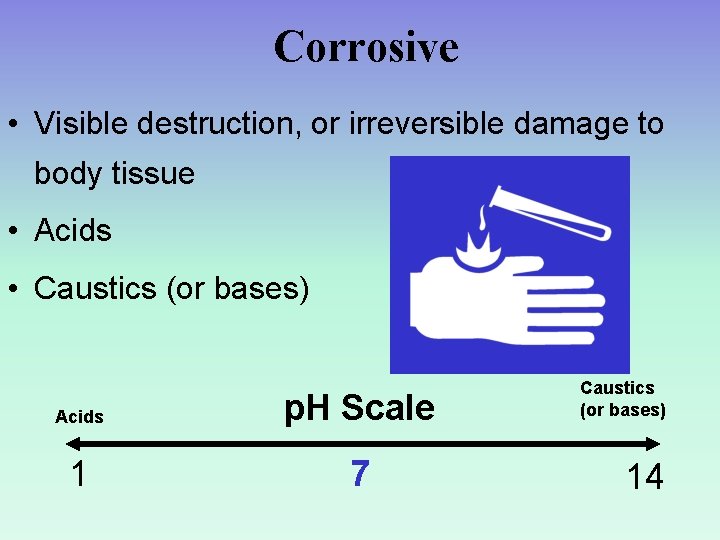
Corrosive • Visible destruction, or irreversible damage to body tissue • Acids • Caustics (or bases) Acids p. H Scale 1 7 Caustics (or bases) 14
Routes of Exposure • Inhalation - most common • Skin absorption • Ingestion • Injection

Health Hazards Toxicity vs. hazard - toxicity is used to describe the ability of the substance to cause a harmful effect. Everything is toxic at some dose.
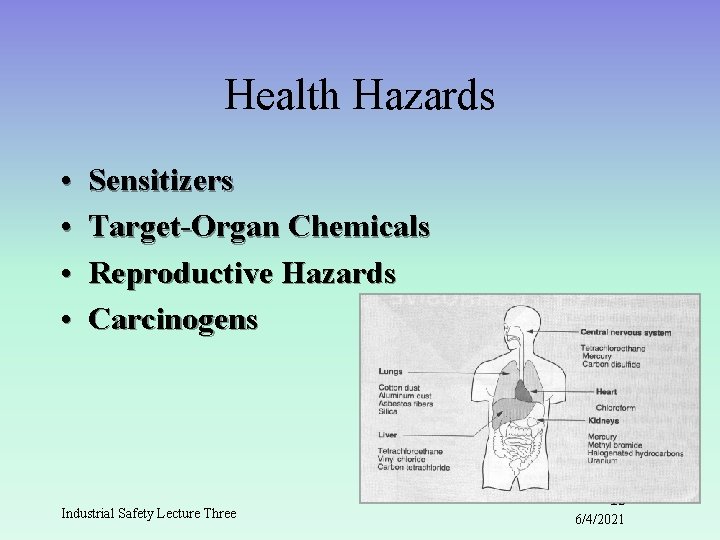
Health Hazards • • Sensitizers Target-Organ Chemicals Reproductive Hazards Carcinogens Industrial Safety Lecture Three 13 6/4/2021
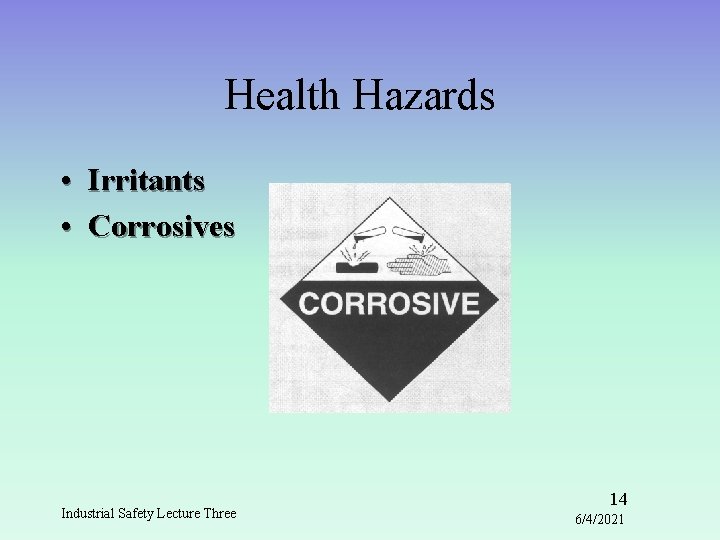
Health Hazards • Irritants • Corrosives Industrial Safety Lecture Three 14 6/4/2021
Chemical Health Effects • • Irritants: Inflame skin tissue on contact. Corrosives: Destroy skin tissue at point of contact. Sensitizers: Cause allergic reactions. Target-Organ Chemicals: Damage specific body organs and systems. • Reproductive Hazards: Change genetic information in egg or sperm cells and/or damage fetus after conception. (Mutagens- substance that change genetic mutation ) (Teratogen - substance that cause malformation of an embryo or birth defect ) • Carcinogens: Cause cancer. Industrial Safety Lecture Three 15 6/4/2021
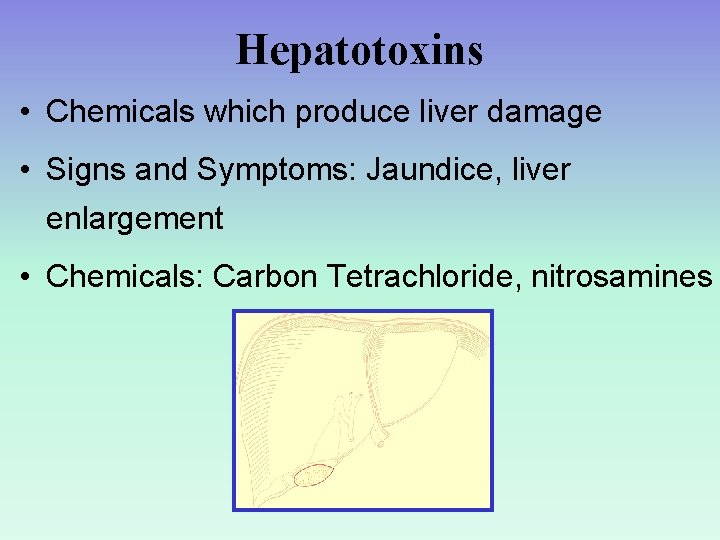
Hepatotoxins • Chemicals which produce liver damage • Signs and Symptoms: Jaundice, liver enlargement • Chemicals: Carbon Tetrachloride, nitrosamines
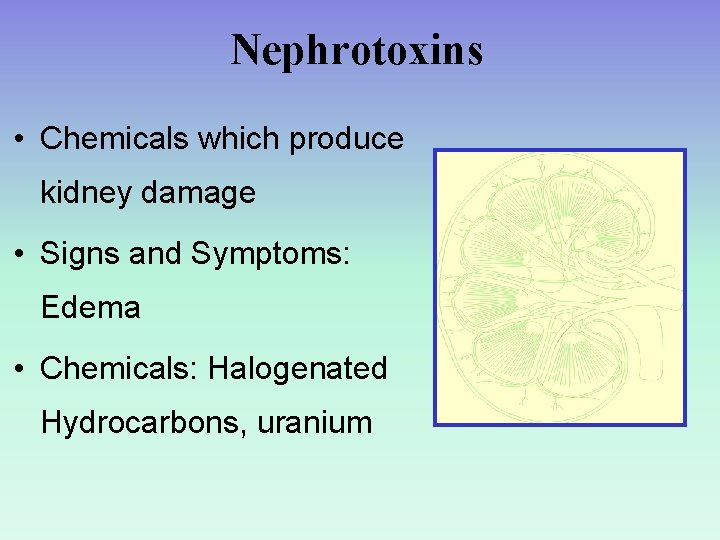
Nephrotoxins • Chemicals which produce kidney damage • Signs and Symptoms: Edema • Chemicals: Halogenated Hydrocarbons, uranium
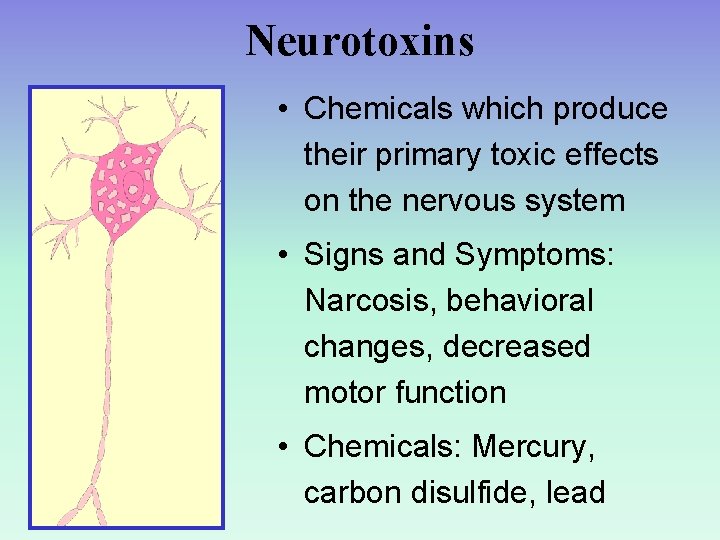
Neurotoxins • Chemicals which produce their primary toxic effects on the nervous system • Signs and Symptoms: Narcosis, behavioral changes, decreased motor function • Chemicals: Mercury, carbon disulfide, lead
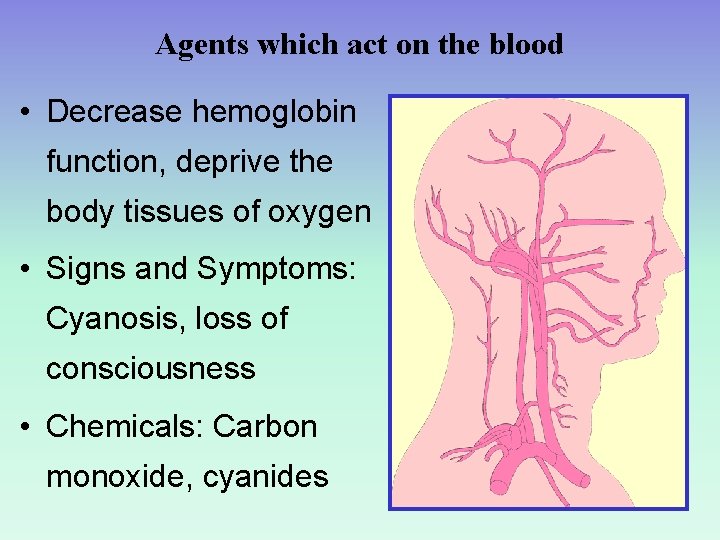
Agents which act on the blood • Decrease hemoglobin function, deprive the body tissues of oxygen • Signs and Symptoms: Cyanosis, loss of consciousness • Chemicals: Carbon monoxide, cyanides
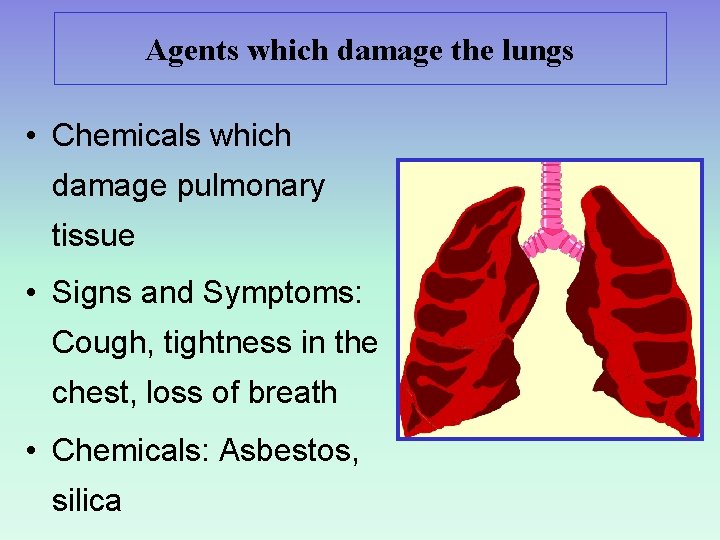
Agents which damage the lungs • Chemicals which damage pulmonary tissue • Signs and Symptoms: Cough, tightness in the chest, loss of breath • Chemicals: Asbestos, silica
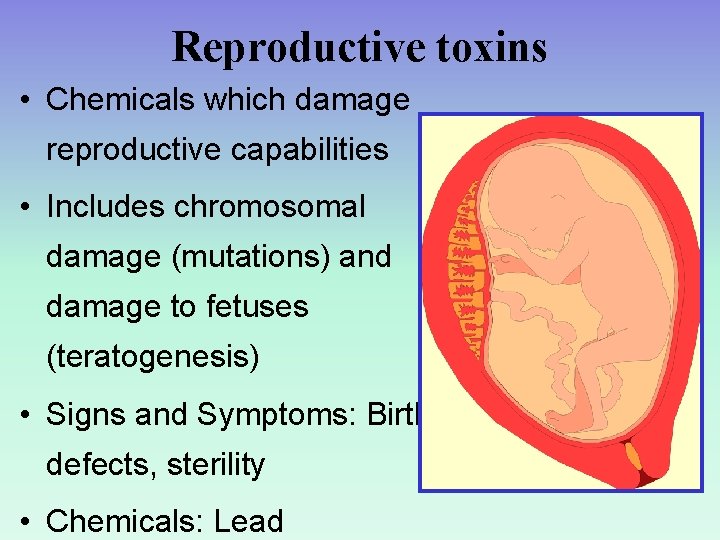
Reproductive toxins • Chemicals which damage reproductive capabilities • Includes chromosomal damage (mutations) and damage to fetuses (teratogenesis) • Signs and Symptoms: Birth defects, sterility • Chemicals: Lead
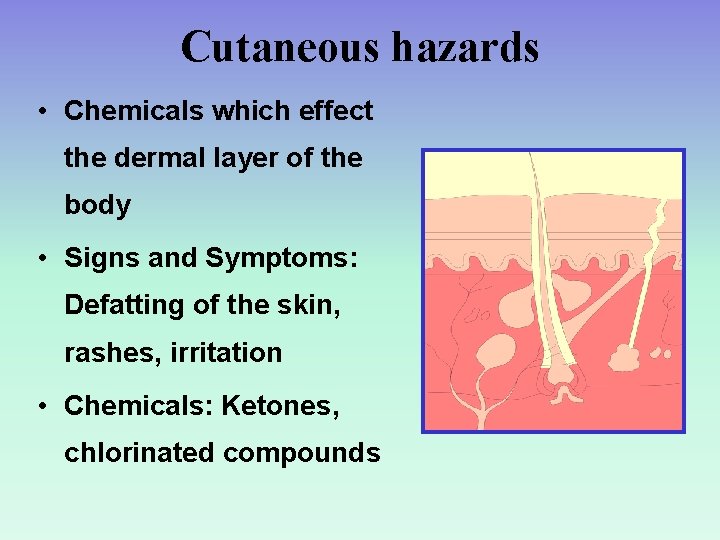
Cutaneous hazards • Chemicals which effect the dermal layer of the body • Signs and Symptoms: Defatting of the skin, rashes, irritation • Chemicals: Ketones, chlorinated compounds
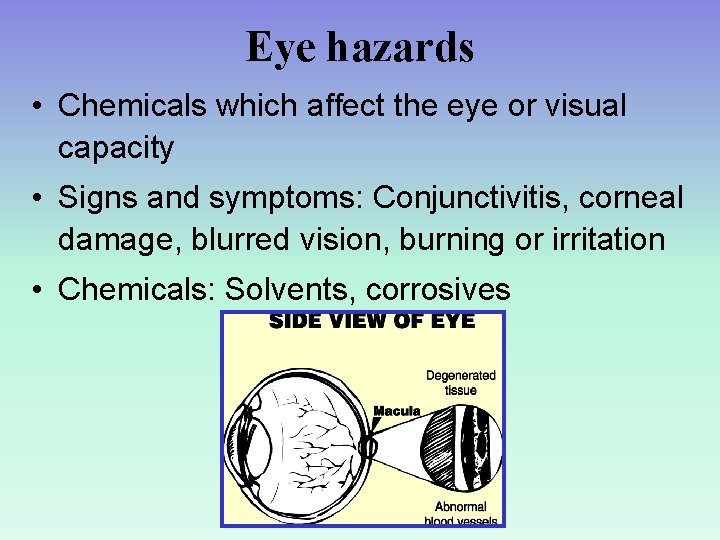
Eye hazards • Chemicals which affect the eye or visual capacity • Signs and symptoms: Conjunctivitis, corneal damage, blurred vision, burning or irritation • Chemicals: Solvents, corrosives
Material Safety Data Sheets (MSDS) are one of the most important tools available to employers for providing information, and protection to workers from hazardous chemicals which are used in the workplace.
1910. 1200 (g)(2) MSDS, required information • Identity of the chemical • Physical and chemical characteristics • Physical hazards • Chemical hazards • Primary routes of entry • PEL’s or other exposure limits • Control measures • Emergency procedures • Whether the hazardous chemical is listed in the National Toxicology Program (NTP) Annual Report on Carcinogens • precautions for safe handling and use • Date of preparation • Name, address and telephone of the manufacturer
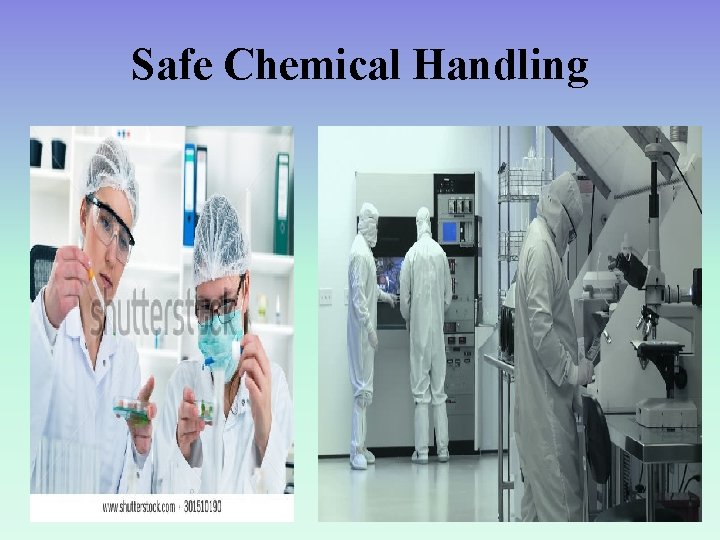
Safe Chemical Handling
Working with Toxic chemicals 1. Keep containers closed when not in use 2. Keep away from ignition sources 3. Avoid contact with incompatible materials (Substances that should not be stored near each other because any contact between them cause a explosion. Eg. Sodium metal with water, in which hydrogen gas form which is explosive ) 4. Only transfer to approved containers 5. Bond all (A certificate of debt) receiving containers. 6. Clean up spills and dispose of waste properly
Working with Toxic chemicals 7. An explosion occurs when a material undergoes a rapid reaction that result in a violent release of energy. 8. Use the minimum amounts of hazardous materials with adequate shielding and personal protection. 9. Keep emergency equipment at hand.
ACCIDENT & INJURY PREVENTION • a. An unexpected and undesirable event, especially one resulting in damage or harm: car accidents on icy roads. • b. An unforeseen incident: A series of happy accidents led to his promotion. • c. An instance of involuntary urination or defecation in one's clothing. • 2. Lack of intention; chance: ran into an old friend by accident. • 3. Logic A circumstance or attribute that is not essential to the nature of something.
Types of Accidents • FALL TO – same level – lower level • CAUGHT – in – on – between • CONTACT WITH – – chemicals electricity heat/cold radiation • BODILY REACTION FROM – voluntary motion – involuntary motion
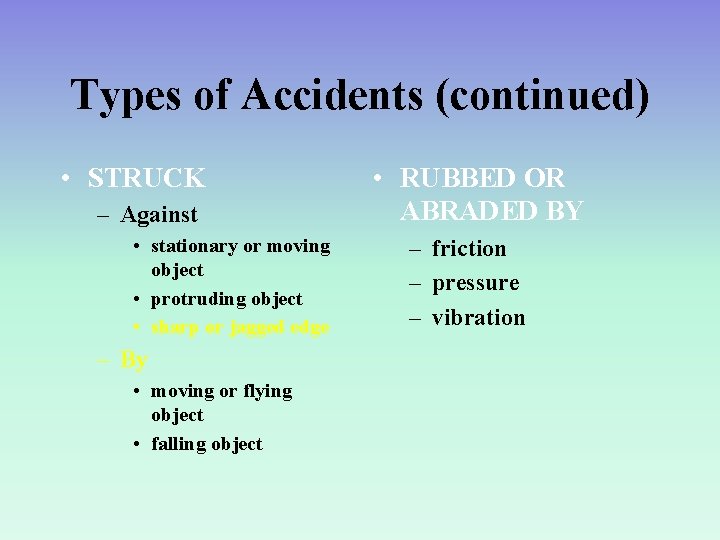
Types of Accidents (continued) • STRUCK – Against • stationary or moving object • protruding object • sharp or jagged edge – By • moving or flying object • falling object • RUBBED OR ABRADED BY – friction – pressure – vibration
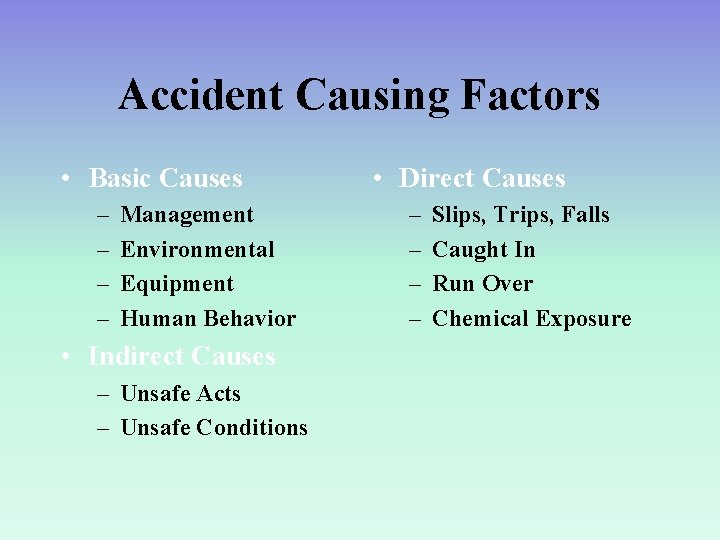
Accident Causing Factors • Basic Causes – – Management Environmental Equipment Human Behavior • Indirect Causes – Unsafe Acts – Unsafe Conditions • Direct Causes – – Slips, Trips, Falls Caught In Run Over Chemical Exposure
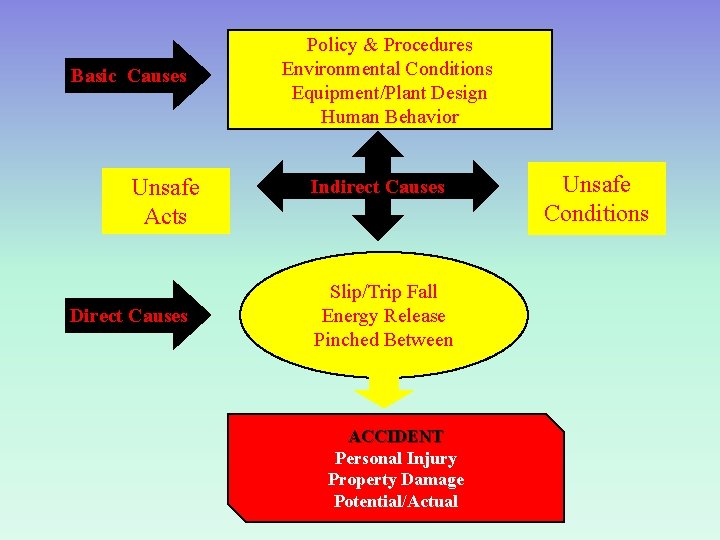
Basic Causes Unsafe Acts Direct Causes Policy & Procedures Environmental Conditions Equipment/Plant Design Human Behavior Indirect Causes Slip/Trip Fall Energy Release Pinched Between ACCIDENT Personal Injury Property Damage Potential/Actual Unsafe Conditions
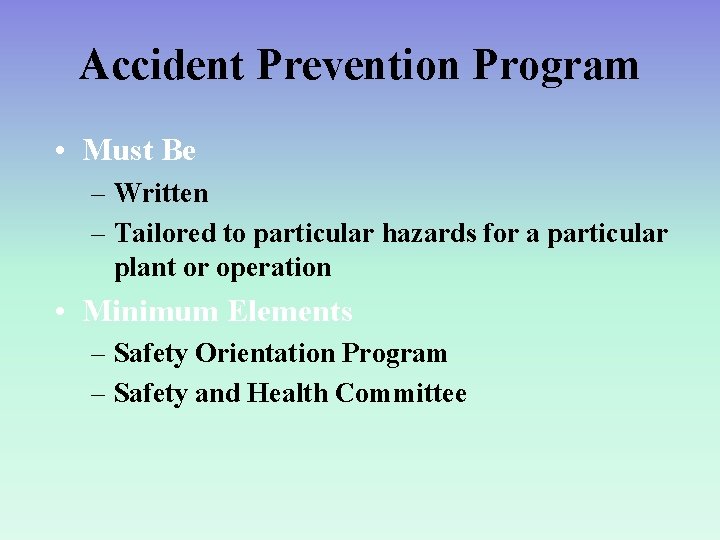
Accident Prevention Program • Must Be – Written – Tailored to particular hazards for a particular plant or operation • Minimum Elements – Safety Orientation Program – Safety and Health Committee
Accident Prevention Program • Safety Orientation – Description of Total Safety Program – Safe Practices for Initial Job Assignment – How and When to Report Injuries – Location of First Aid Facilities in Workplace – How to Report Unsafe Conditions & Practices – Use and Care of PPE – Emergency Actions – Identification of hazardous materials
Accident Prevention Program • Designated Safety and Health Committee – Management Representatives – Employee Elected Representatives • Max. 1 year • Must be equal # or more employee representatives than employer representatives – Elected Chairperson – Self-determine frequency of meetings • 1 hour or less unless majority votes – Minutes • Keep for 1 Year • Available for review by OSHA Personnel
Accident Prevention Program • Safety Meeting instead of Safety Committee – If less than 11 employees • Total • Per shift • Per location – Meet at least once/month – 1 Management Representative
Safety Meeting You Must – Review inspection reports – Evaluate accident investigations – Evaluate APP and discuss recommendations – Document attendance and topics
Safety Committees
Safety Committees Proactive Safety They should meet as often as necessary This will depend on volume of production and conditions such as • Number of employees • Size of workplace covered • Nature of work undertaken on site • Type of hazards and degree of risk Meetings should not be cancelled
Safety Committees The Goal of the committee is to facilitate a safe workplace Objectives that guide a committee towards the goal include: Motivate, educate and train at all levels to ID, Reduce, & Avoid Hazards Incorporate safety into every aspect of the organization Create a culture where each person is responsible for safety of self and others Encourage and utilize ideas from all sources
Four points to Remember: • Communication: Must be a loop system • Dedication: From everyone • Partnership: Between Management and Employees • Participation: An important part of team working.

How effective can a Committee be?
Safety Committee Policy Statement A written and publicized statement is an effective means of providing guidance and demonstrating commitment
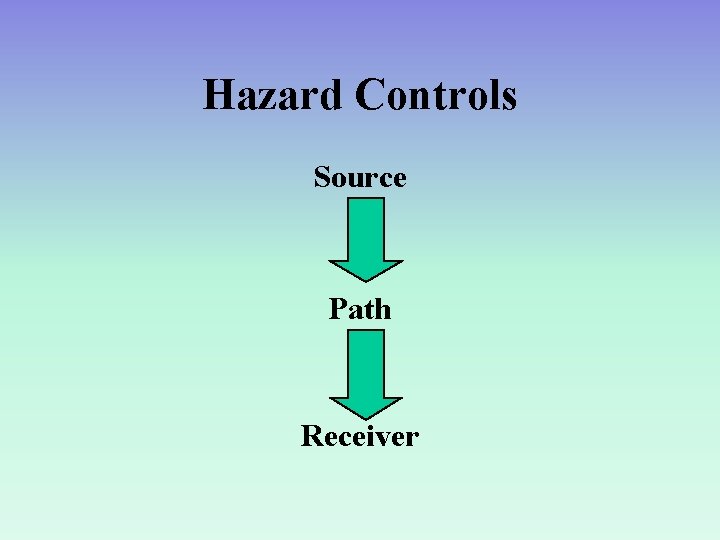
Hazard Controls Source Path Receiver
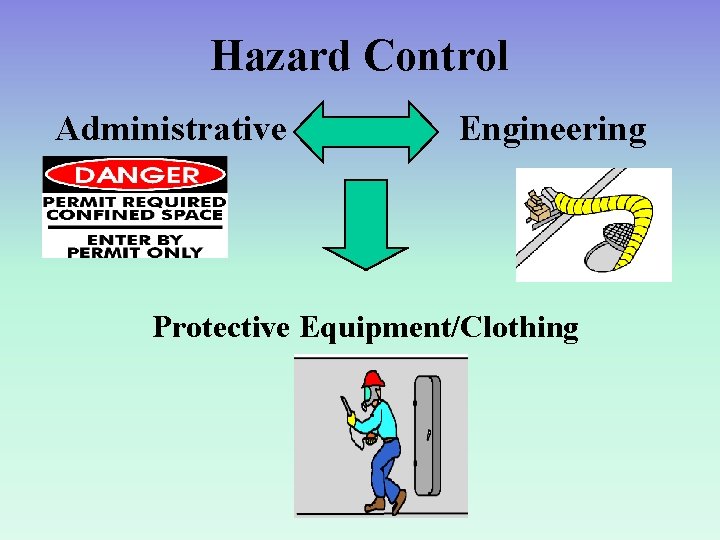
Hazard Control Administrative Engineering Protective Equipment/Clothing
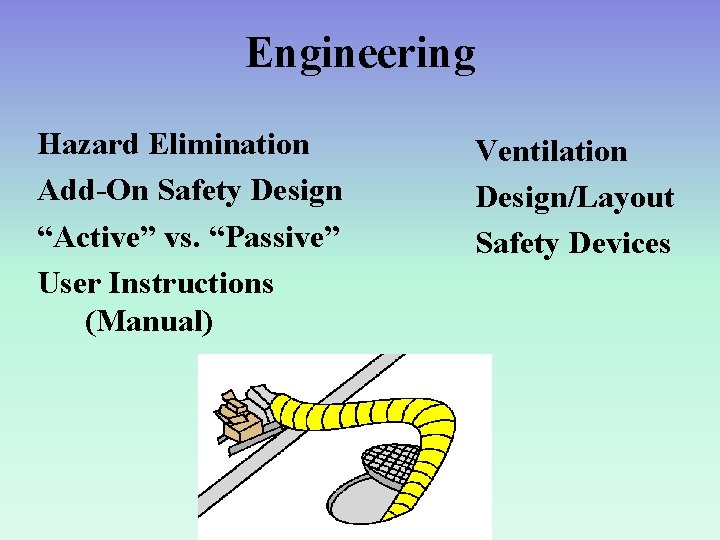
Engineering Hazard Elimination Add-On Safety Design “Active” vs. “Passive” User Instructions (Manual) Ventilation Design/Layout Safety Devices
Administrative • • • Safety Rules Disciplinary Policy - Accountability Preventative Maintenance Training Proficiency/Knowledge Demonstrations
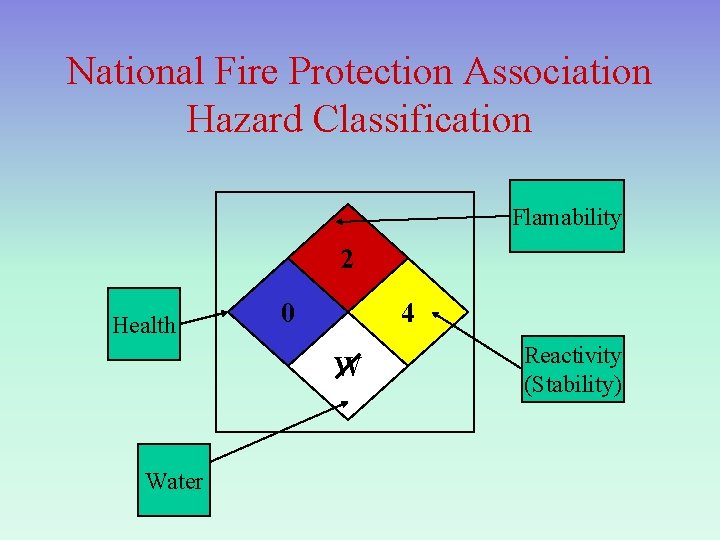
National Fire Protection Association Hazard Classification Flamability 2 Health 0 4 W Water Reactivity (Stability)
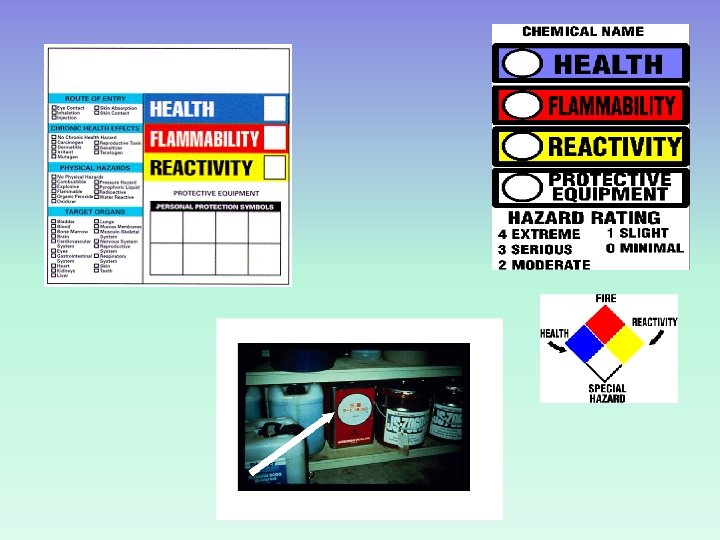
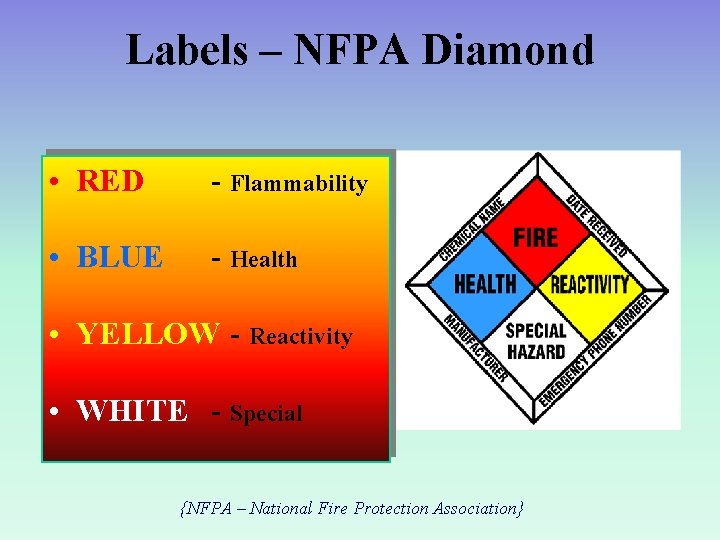
Labels – NFPA Diamond • RED - Flammability • BLUE - Health • YELLOW - Reactivity • WHITE - Special {NFPA – National Fire Protection Association}
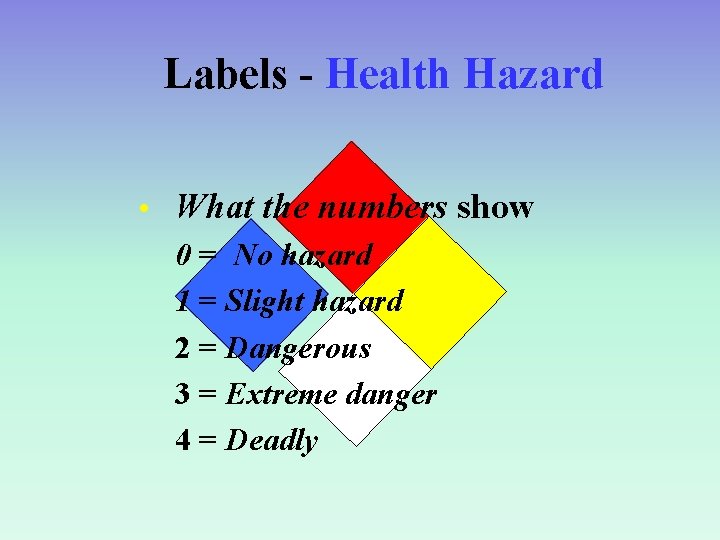
Labels - Health Hazard • What the numbers show 0 = No hazard 1 = Slight hazard 2 = Dangerous 3 = Extreme danger 4 = Deadly
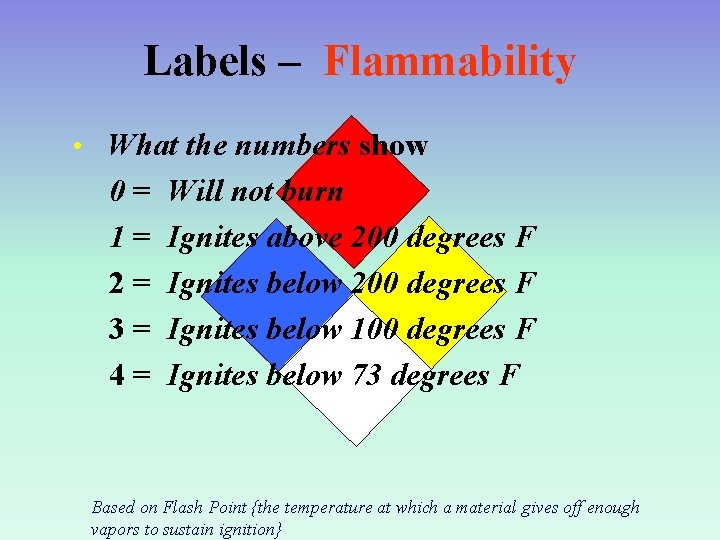
Labels – Flammability • What the numbers show 0= 1= 2= 3= 4= Will not burn Ignites above 200 degrees F Ignites below 100 degrees F Ignites below 73 degrees F Based on Flash Point {the temperature at which a material gives off enough vapors to sustain ignition}
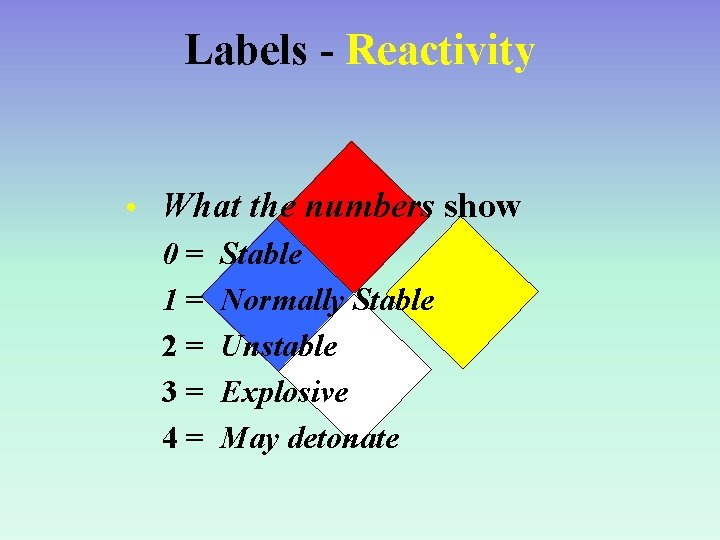
Labels - Reactivity • What the numbers show 0 = Stable 1 = Normally Stable 2 = Unstable 3 = Explosive 4 = May detonate
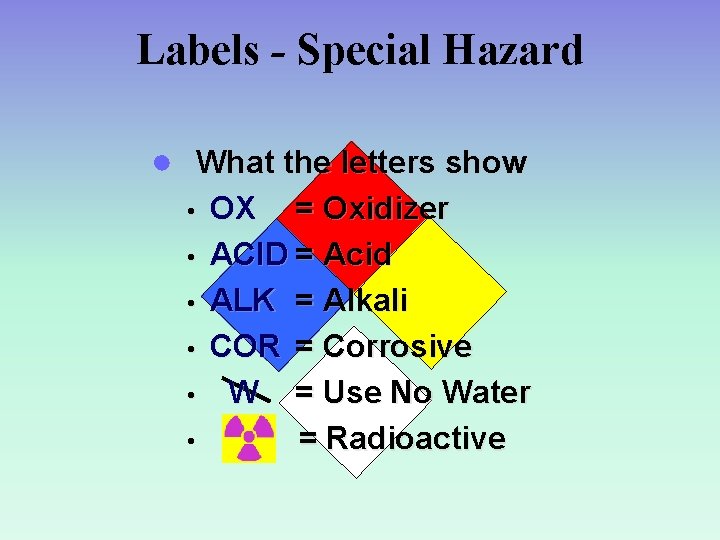
Labels - Special Hazard ● What the letters show • • • OX = Oxidizer ACID = Acid ALK = Alkali COR = Corrosive W = Use No Water = Radioactive
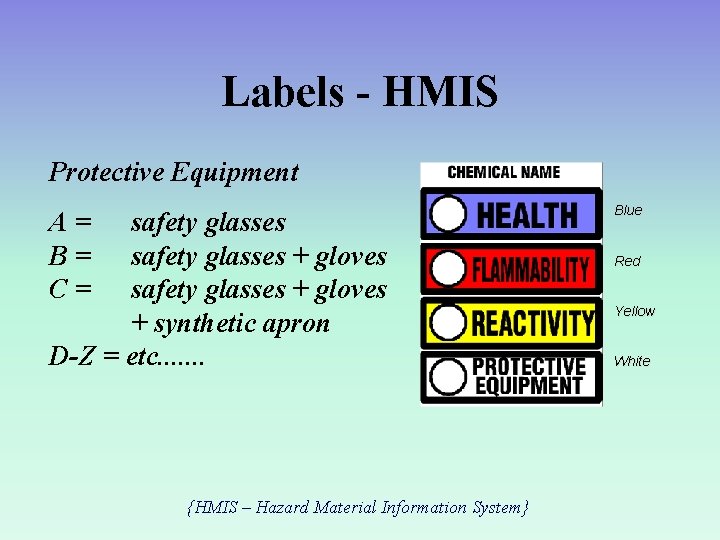
Labels - HMIS Protective Equipment A= B= C= safety glasses + gloves + synthetic apron D-Z = etc. . . . {HMIS – Hazard Material Information System} Blue Red Yellow White
First Aid Awareness University of California Office of the President
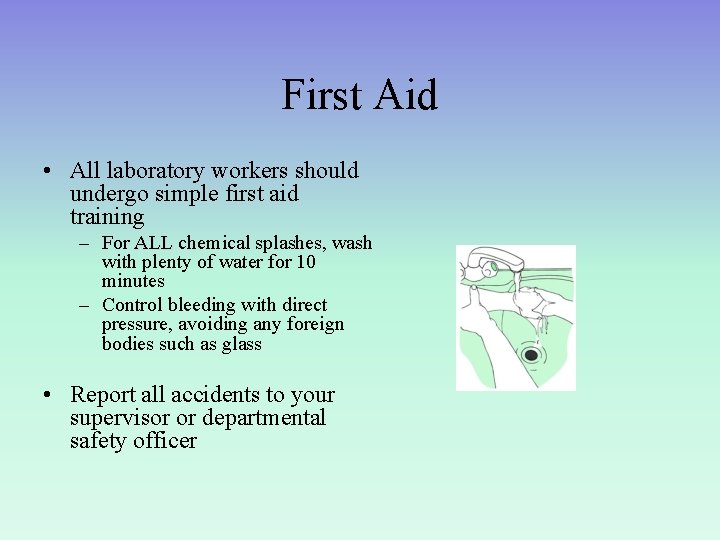
First Aid • All laboratory workers should undergo simple first aid training – For ALL chemical splashes, wash with plenty of water for 10 minutes – Control bleeding with direct pressure, avoiding any foreign bodies such as glass • Report all accidents to your supervisor or departmental safety officer
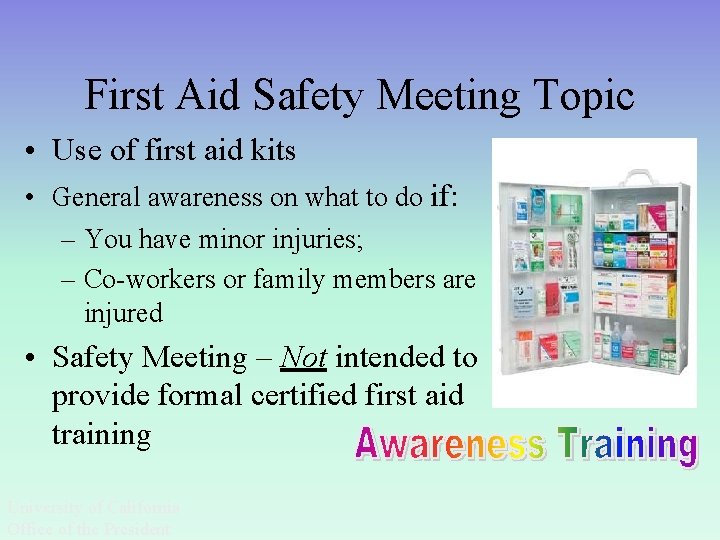
First Aid Safety Meeting Topic • Use of first aid kits • General awareness on what to do if: – You have minor injuries; – Co-workers or family members are injured • Safety Meeting – Not intended to provide formal certified first aid training University of California Office of the President
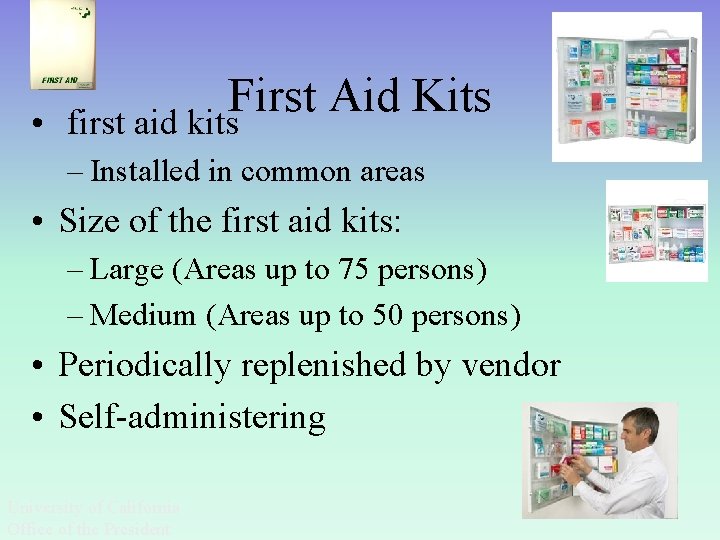
• First Aid Kits first aid kits – Installed in common areas • Size of the first aid kits: – Large (Areas up to 75 persons) – Medium (Areas up to 50 persons) • Periodically replenished by vendor • Self-administering University of California Office of the President
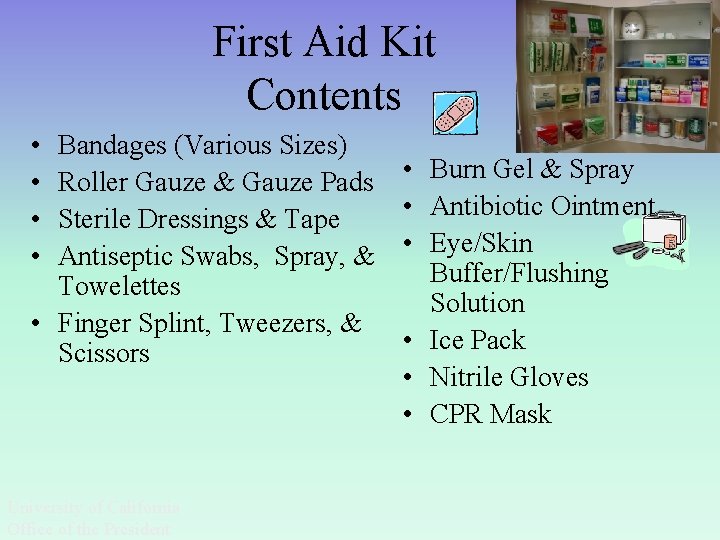
First Aid Kit Contents • • Bandages (Various Sizes) Roller Gauze & Gauze Pads Sterile Dressings & Tape Antiseptic Swabs, Spray, & Towelettes • Finger Splint, Tweezers, & Scissors University of California Office of the President • Burn Gel & Spray • Antibiotic Ointment • Eye/Skin Buffer/Flushing Solution • Ice Pack • Nitrile Gloves • CPR Mask
General Guidance for Injuries • Remain calm – Take time to assess the situation and hazards (Avoid tunnel vision) • Call 9 -1 -1 ASAP if serious – Using a Cell Phone call the ‘ 9 -1 -1 Equivalent’ local phone number • After calling 9 -1 -1 contact Building Security to initiate internal response University of California Office of the President
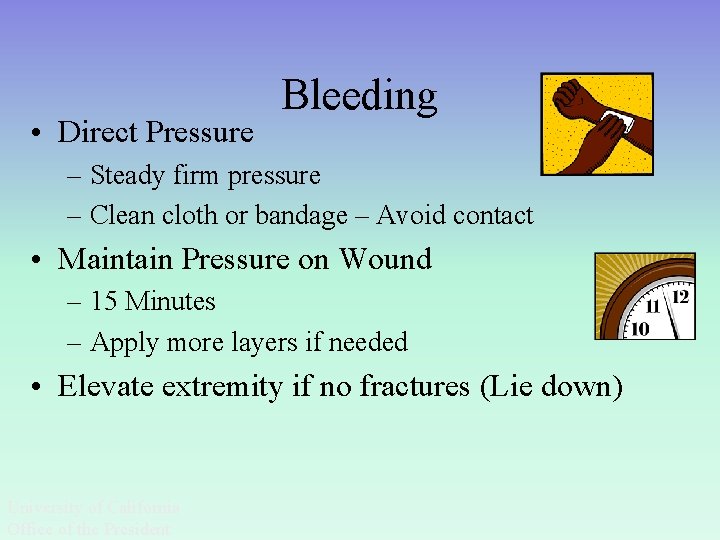
• Direct Pressure Bleeding – Steady firm pressure – Clean cloth or bandage – Avoid contact • Maintain Pressure on Wound – 15 Minutes – Apply more layers if needed • Elevate extremity if no fractures (Lie down) University of California Office of the President
Burns • First Degree Burn – Minor redness – Run cold water over burn for >5 minutes (No ice or ointments!) • Second Degree Burn – Blistered skin – Do Not Break the Blisters – If the Blisters Break: • Clean & apply antibiotic ointment • Cover with sterile dressing • Change dressing every day • Third Degree Burn – Charred skin – Call 9 -1 -1 immediately University of California Office of the President
Poisoning • Identify the ingested substance – Container or Clues: Stains, Odors, etc. • Contact Poison Control Center – 1 -800 -222 -1222 for Advice or 911 • Induce Vomiting? – Do NOT induce if unconscious or the person ingested corrosives or caustics • If Vomiting - Roll onto their side for drainage (Recovery period) University of California Office of the President
Review • 1. Give the names of the two chemical hazards. • 2. What name is given to a chemical which will burst into flame when contacted by air? • 3. What term is given to chemicals which can cause and /or support fire in other materials? • 4. What is a health hazard? • 5. Which kind of health hazard destroys skin on contact? • 6. Chemicals that cause sterility, fetal death, and birth defects are called ______. • 7. What is a carcinogen? • 8. Give three states in which a chemical can exist. • 9. Give three ways employees can be exposed to health hazards. • 10. What are the most common skin contact hazards? • 11. What is an MSDS? • 12. What kind of information is found on the MSDS? 66 Industrial Safety Lecture Three 6/4/2021
- Slides: 66