
Industrial Revolution Industrial Revolution Main Index Background information
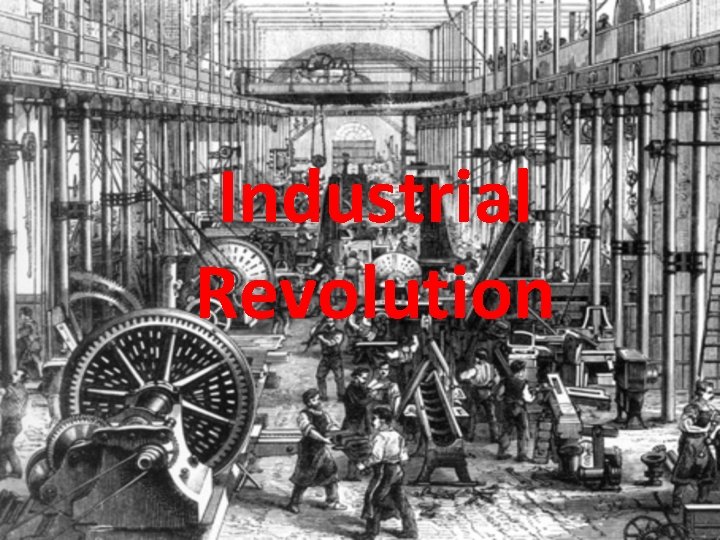
Industrial Revolution
Industrial Revolution – Main Index Background information Invention timeline Inventions Country information Add relevant picture here Before and After Effects of the Industrial Revolution Terms Sources
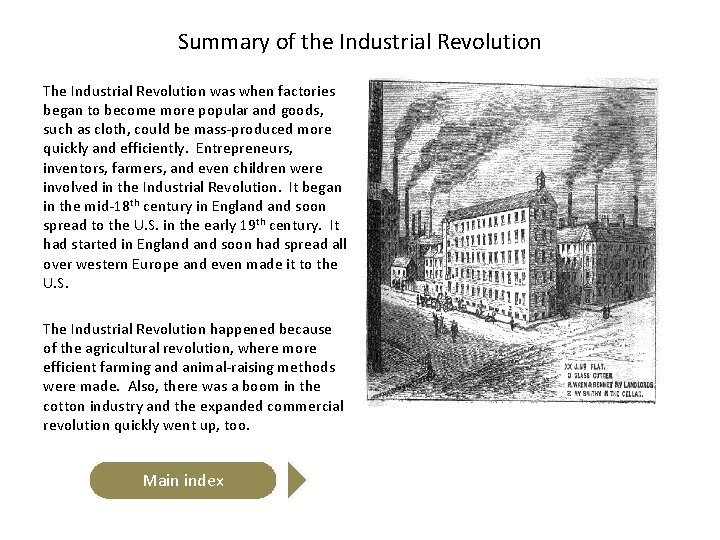
Summary of the Industrial Revolution The Industrial Revolution was when factories began to become more popular and goods, such as cloth, could be mass-produced more quickly and efficiently. Entrepreneurs, inventors, farmers, and even children were involved in the Industrial Revolution. It began in the mid-18 th century in England soon spread to the U. S. in the early 19 th century. It had started in England soon had spread all over western Europe and even made it to the U. S. The Industrial Revolution happened because of the agricultural revolution, where more efficient farming and animal-raising methods were made. Also, there was a boom in the cotton industry and the expanded commercial revolution quickly went up, too. Main index Add relevant picture here
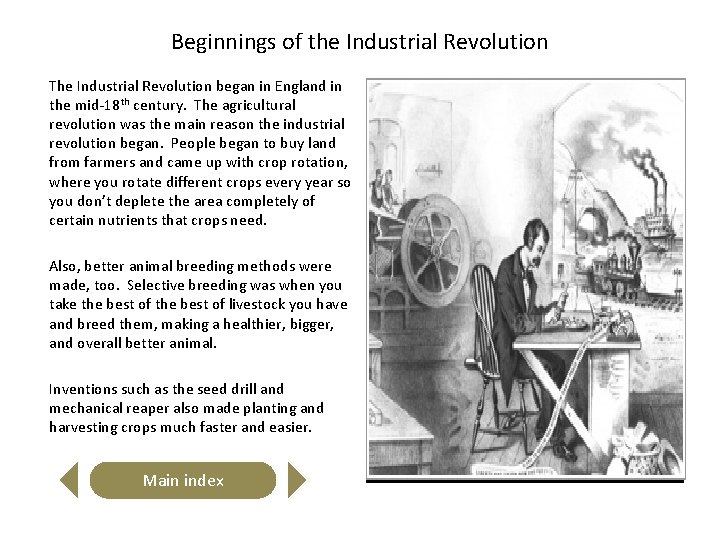
Beginnings of the Industrial Revolution The Industrial Revolution began in England in the mid-18 th century. The agricultural revolution was the main reason the industrial revolution began. People began to buy land from farmers and came up with crop rotation, where you rotate different crops every year so you don’t deplete the area completely of certain nutrients that crops need. Also, better animal breeding methods were made, too. Selective breeding was when you take the best of livestock you have and breed them, making a healthier, bigger, and overall better animal. Inventions such as the seed drill and mechanical reaper also made planting and harvesting crops much faster and easier. Main index Add relevant picture here
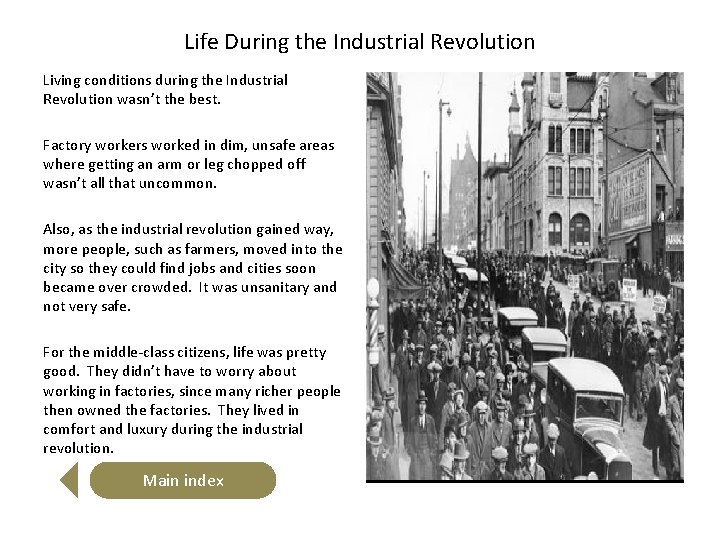
Life During the Industrial Revolution Living conditions during the Industrial Revolution wasn’t the best. Factory workers worked in dim, unsafe areas where getting an arm or leg chopped off wasn’t all that uncommon. Also, as the industrial revolution gained way, more people, such as farmers, moved into the city so they could find jobs and cities soon became over crowded. It was unsanitary and not very safe. For the middle-class citizens, life was pretty good. They didn’t have to worry about working in factories, since many richer people then owned the factories. They lived in comfort and luxury during the industrial revolution. Main index Add relevant picture here
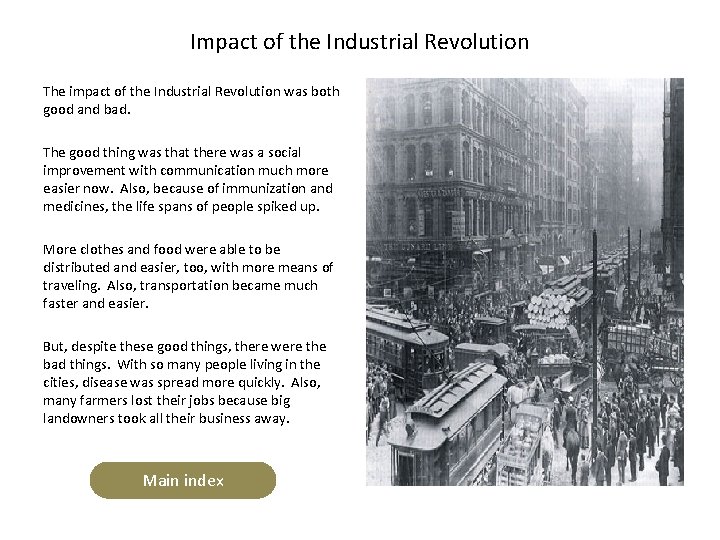
Impact of the Industrial Revolution The impact of the Industrial Revolution was both good and bad. The good thing was that there was a social improvement with communication much more easier now. Also, because of immunization and medicines, the life spans of people spiked up. More clothes and food were able to be distributed and easier, too, with more means of traveling. Also, transportation became much faster and easier. But, despite these good things, there were the bad things. With so many people living in the cities, disease was spread more quickly. Also, many farmers lost their jobs because big landowners took all their business away. Main index Add relevant picture here
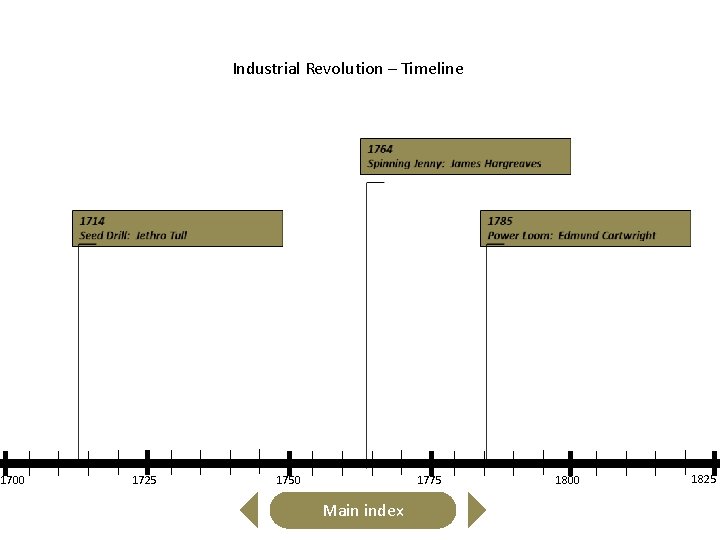
Industrial Revolution – Timeline 1700 1725 1750 1775 Main index 1800 1825
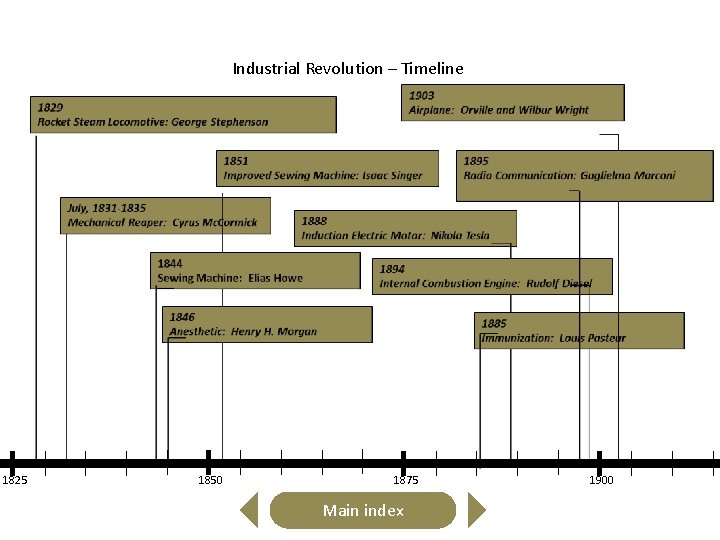
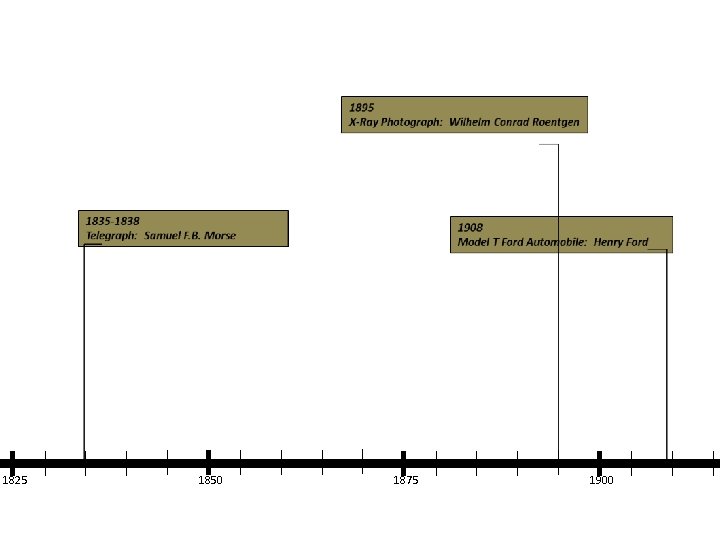
Industrial Revolution – Timeline 1825 1850 1875 Main index 1900
1825 1850 1875 1900
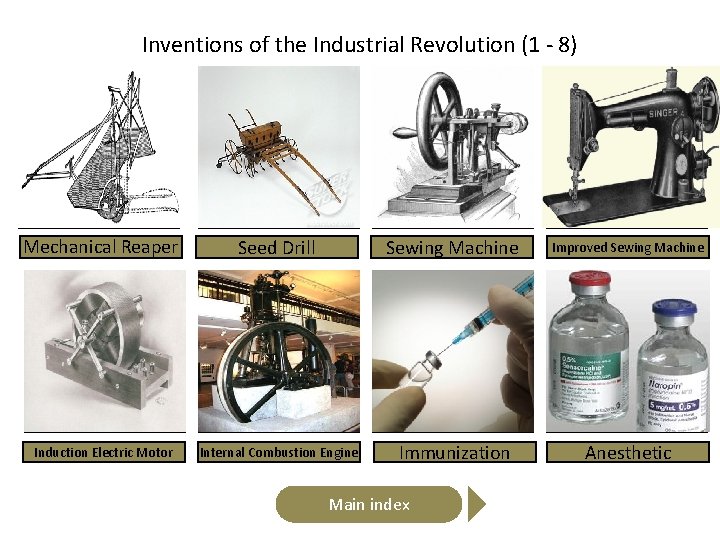
Inventions of the Industrial Revolution (1 - 8) Add relevant picture here Mechanical Reaper Seed Drill Sewing Machine Improved Sewing Machine Add relevant picture here Induction Electric Motor Internal Combustion Engine Immunization Anesthetic Main index
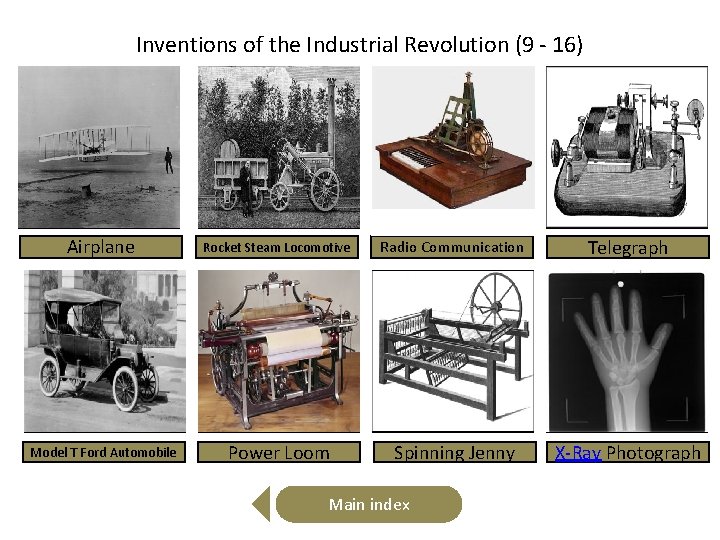
Inventions of the Industrial Revolution (9 - 16) Add relevant picture here Airplane Rocket Steam Locomotive Radio Communication Telegraph Add relevant picture here Model T Ford Automobile Power Loom Spinning Jenny X-Ray Photograph Main index
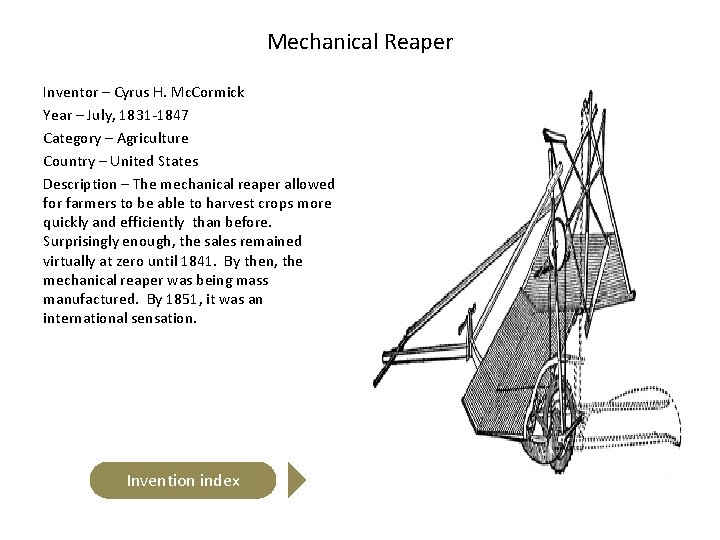
Mechanical Reaper Inventor – Cyrus H. Mc. Cormick Year – July, 1831 -1847 Category – Agriculture Country – United States Description – The mechanical reaper allowed for farmers to be able to harvest crops more quickly and efficiently than before. Surprisingly enough, the sales remained virtually at zero until 1841. By then, the mechanical reaper was being mass manufactured. By 1851, it was an international sensation. Invention index Add relevant picture here
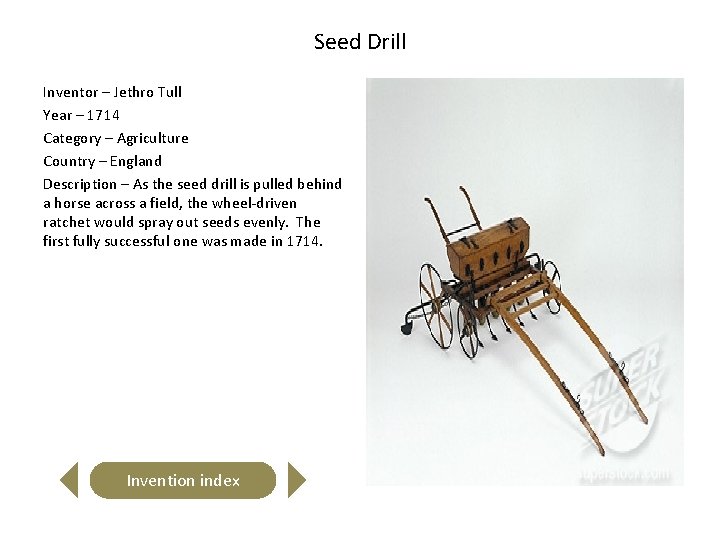
Seed Drill Inventor – Jethro Tull Year – 1714 Category – Agriculture Country – England Description – As the seed drill is pulled behind a horse across a field, the wheel-driven ratchet would spray out seeds evenly. The first fully successful one was made in 1714. Add relevant picture here Invention index
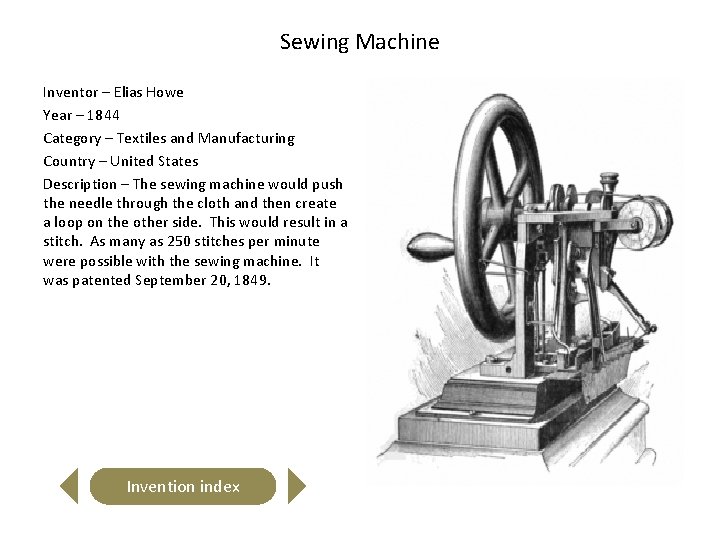
Sewing Machine Inventor – Elias Howe Year – 1844 Category – Textiles and Manufacturing Country – United States Description – The sewing machine would push the needle through the cloth and then create a loop on the other side. This would result in a stitch. As many as 250 stitches per minute were possible with the sewing machine. It was patented September 20, 1849. Invention index Add relevant picture here
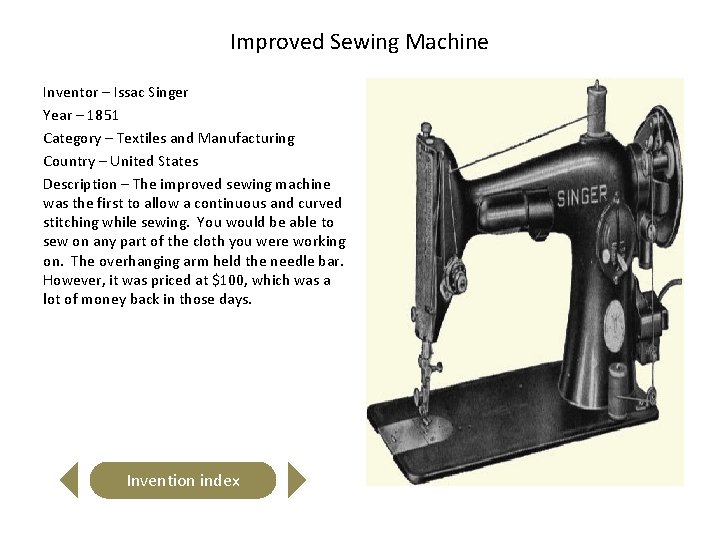
Improved Sewing Machine Inventor – Issac Singer Year – 1851 Category – Textiles and Manufacturing Country – United States Description – The improved sewing machine was the first to allow a continuous and curved stitching while sewing. You would be able to sew on any part of the cloth you were working on. The overhanging arm held the needle bar. However, it was priced at $100, which was a lot of money back in those days. Invention index Add relevant picture here
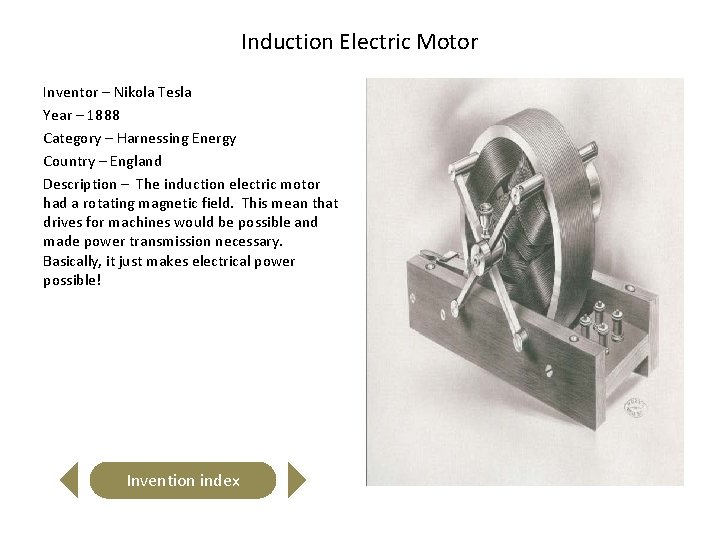
Induction Electric Motor Inventor – Nikola Tesla Year – 1888 Category – Harnessing Energy Country – England Description – The induction electric motor had a rotating magnetic field. This mean that drives for machines would be possible and made power transmission necessary. Basically, it just makes electrical power possible! Invention index Add relevant picture here
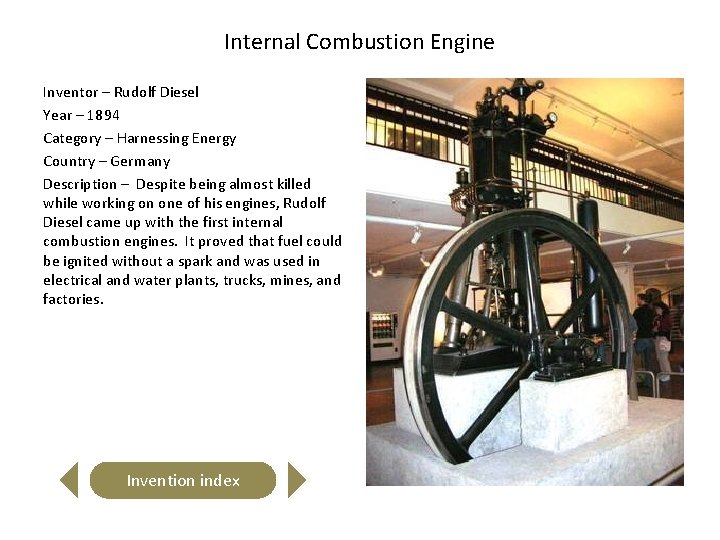
Internal Combustion Engine Inventor – Rudolf Diesel Year – 1894 Category – Harnessing Energy Country – Germany Description – Despite being almost killed while working on one of his engines, Rudolf Diesel came up with the first internal combustion engines. It proved that fuel could be ignited without a spark and was used in electrical and water plants, trucks, mines, and factories. Invention index Add relevant picture here
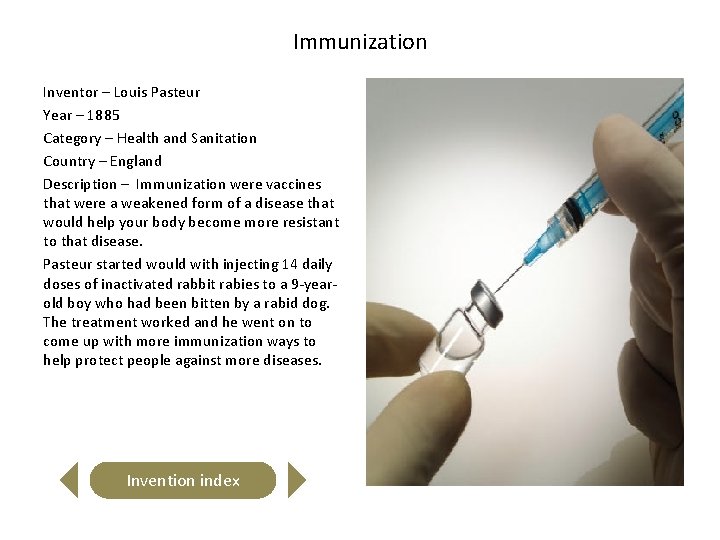
Immunization Inventor – Louis Pasteur Year – 1885 Category – Health and Sanitation Country – England Description – Immunization were vaccines that were a weakened form of a disease that would help your body become more resistant to that disease. Pasteur started would with injecting 14 daily doses of inactivated rabbit rabies to a 9 -yearold boy who had been bitten by a rabid dog. The treatment worked and he went on to come up with more immunization ways to help protect people against more diseases. Invention index Add relevant picture here
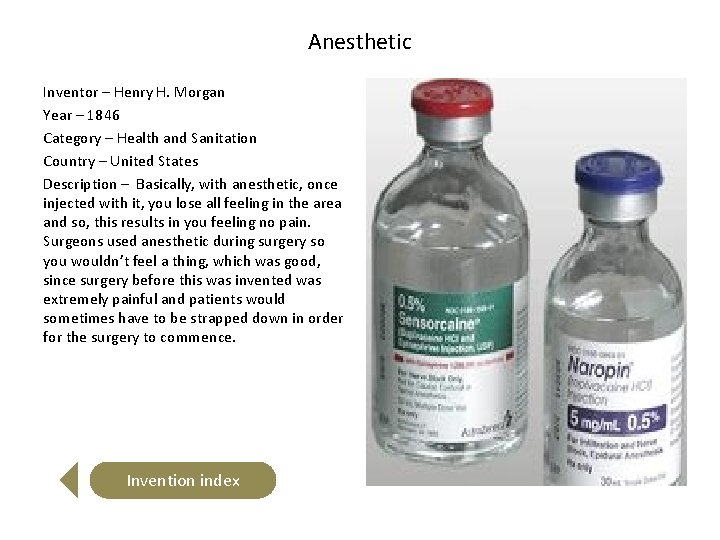
Anesthetic Inventor – Henry H. Morgan Year – 1846 Category – Health and Sanitation Country – United States Description – Basically, with anesthetic, once injected with it, you lose all feeling in the area and so, this results in you feeling no pain. Surgeons used anesthetic during surgery so you wouldn’t feel a thing, which was good, since surgery before this was invented was extremely painful and patients would sometimes have to be strapped down in order for the surgery to commence. Invention index Add relevant picture here
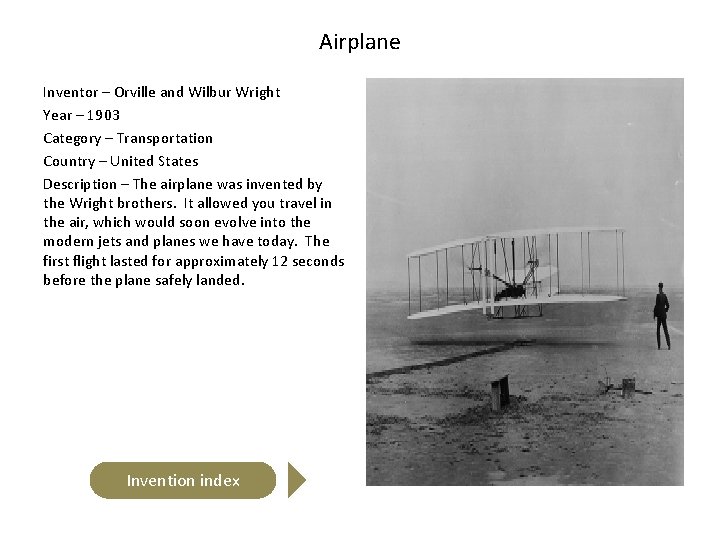
Airplane Inventor – Orville and Wilbur Wright Year – 1903 Category – Transportation Country – United States Description – The airplane was invented by the Wright brothers. It allowed you travel in the air, which would soon evolve into the modern jets and planes we have today. The first flight lasted for approximately 12 seconds before the plane safely landed. Invention index Add relevant picture here
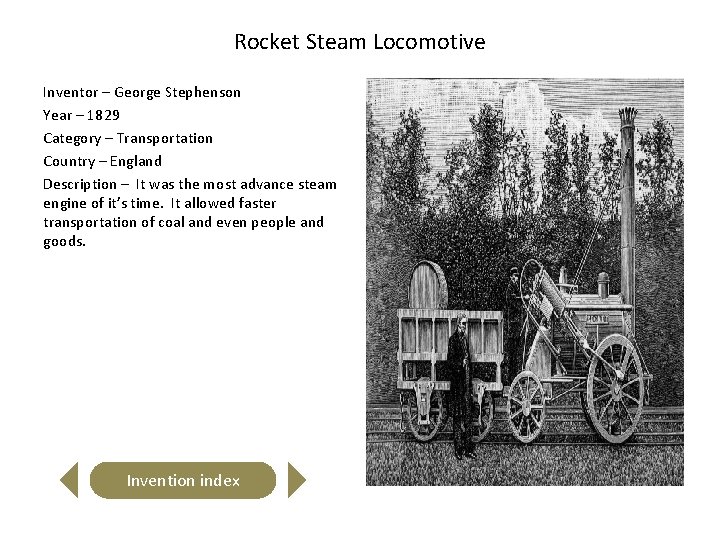
Rocket Steam Locomotive Inventor – George Stephenson Year – 1829 Category – Transportation Country – England Description – It was the most advance steam engine of it’s time. It allowed faster transportation of coal and even people and goods. Add relevant picture here Invention index
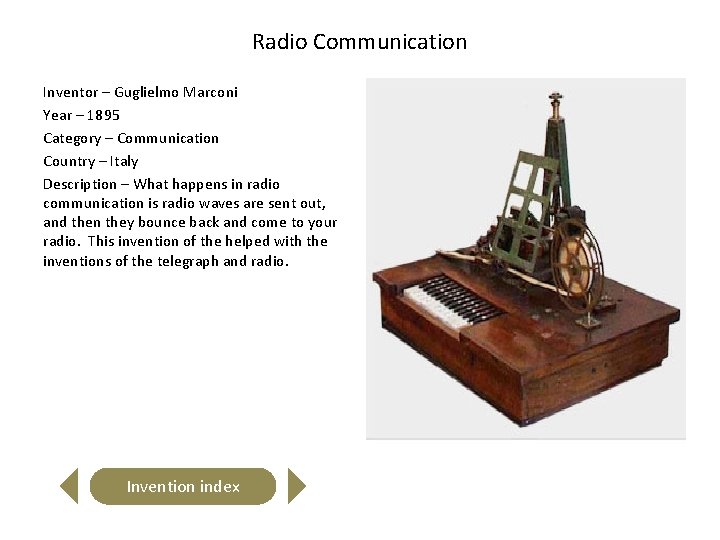
Radio Communication Inventor – Guglielmo Marconi Year – 1895 Category – Communication Country – Italy Description – What happens in radio communication is radio waves are sent out, and then they bounce back and come to your radio. This invention of the helped with the inventions of the telegraph and radio. Invention index Add relevant picture here
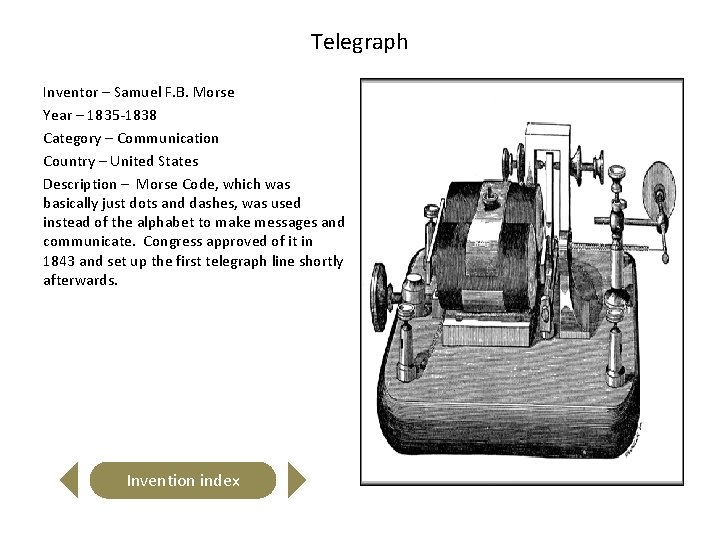
Telegraph Inventor – Samuel F. B. Morse Year – 1835 -1838 Category – Communication Country – United States Description – Morse Code, which was basically just dots and dashes, was used instead of the alphabet to make messages and communicate. Congress approved of it in 1843 and set up the first telegraph line shortly afterwards. Invention index Add relevant picture here
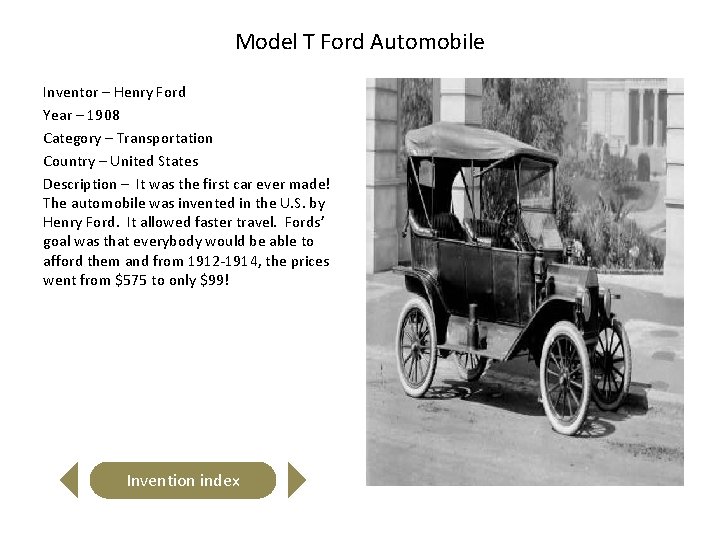
Model T Ford Automobile Inventor – Henry Ford Year – 1908 Category – Transportation Country – United States Description – It was the first car ever made! The automobile was invented in the U. S. by Henry Ford. It allowed faster travel. Fords’ goal was that everybody would be able to afford them and from 1912 -1914, the prices went from $575 to only $99! Invention index Add relevant picture here
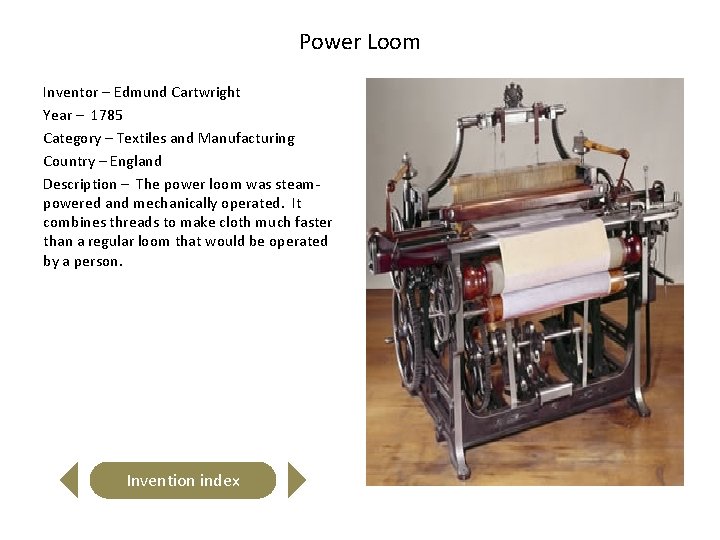
Power Loom Inventor – Edmund Cartwright Year – 1785 Category – Textiles and Manufacturing Country – England Description – The power loom was steampowered and mechanically operated. It combines threads to make cloth much faster than a regular loom that would be operated by a person. Invention index Add relevant picture here
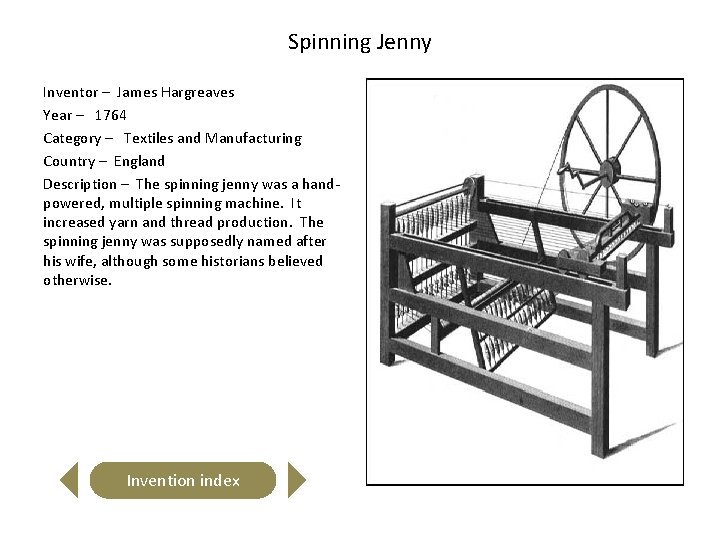
Spinning Jenny Inventor – James Hargreaves Year – 1764 Category – Textiles and Manufacturing Country – England Description – The spinning jenny was a handpowered, multiple spinning machine. It increased yarn and thread production. The spinning jenny was supposedly named after his wife, although some historians believed otherwise. Invention index Add relevant picture here
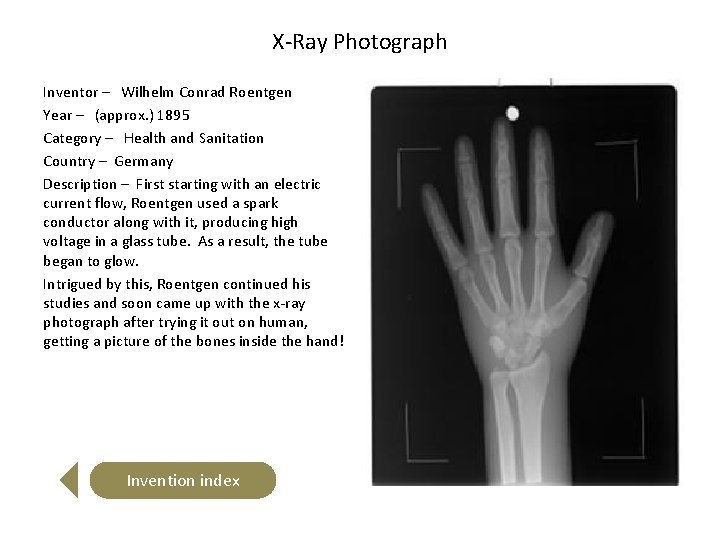
X-Ray Photograph Inventor – Wilhelm Conrad Roentgen Year – (approx. ) 1895 Category – Health and Sanitation Country – Germany Description – First starting with an electric current flow, Roentgen used a spark conductor along with it, producing high voltage in a glass tube. As a result, the tube began to glow. Intrigued by this, Roentgen continued his studies and soon came up with the x-ray photograph after trying it out on human, getting a picture of the bones inside the hand! Invention index Add relevant picture here
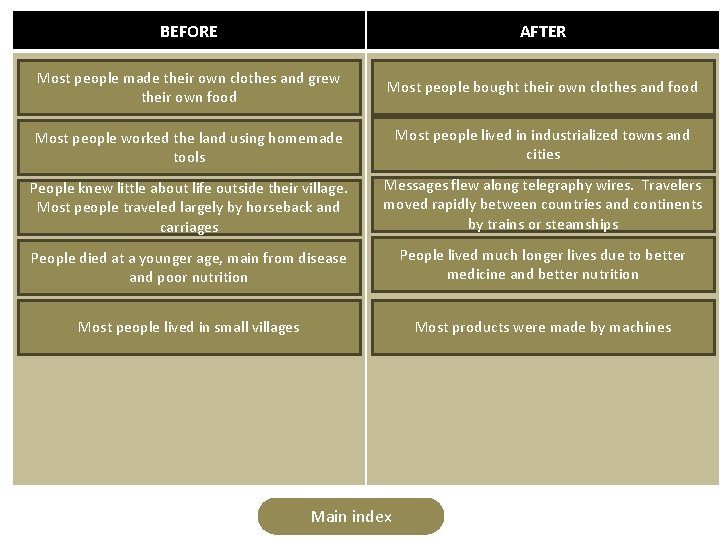
BEFORE AFTER Most people made their own clothes and grew their own food Most people bought their own clothes and food Most people worked the land using homemade tools Most people lived in industrialized towns and cities Messages flew along telegraphy wires. Travelers People knew little about life outside their village. moved rapidly between countries and continents Most people traveled largely by horseback and Central Powers and Allies by trains or steamships carriages People died at a younger age, main from disease and poor nutrition People lived much longer lives due to better medicine and better nutrition Most people lived in small villages Most products were made by machines Main index
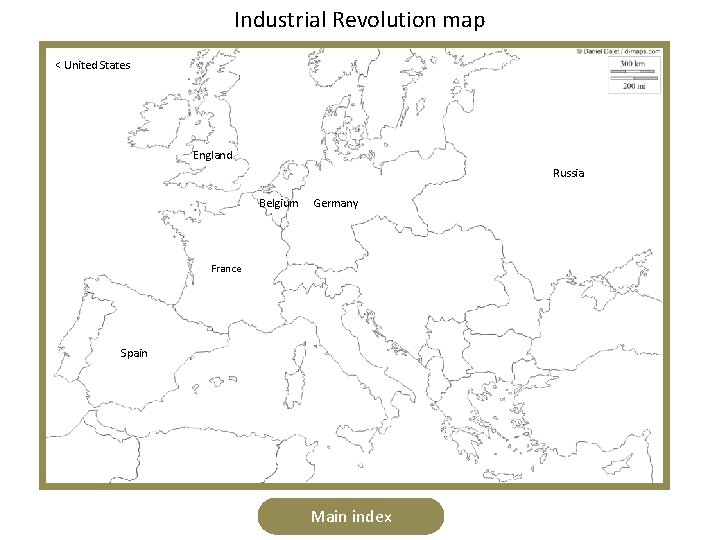
Industrial Revolution map < United States England Russia Belgium Germany France Spain Main index
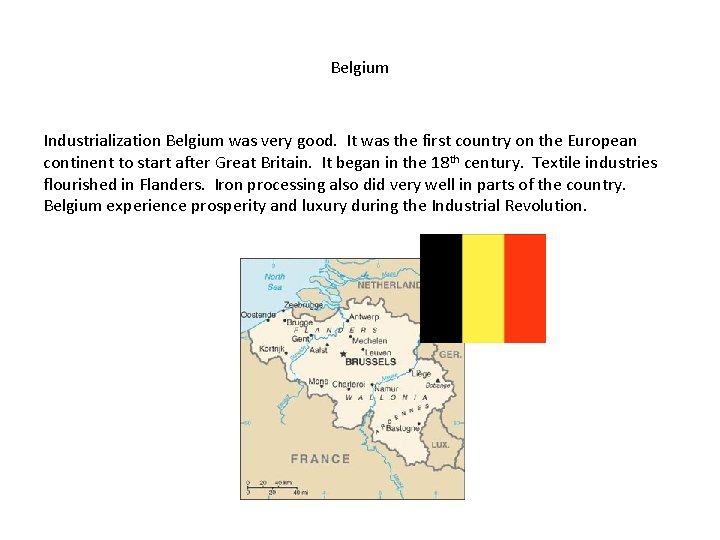
Belgium Industrialization Belgium was very good. It was the first country on the European continent to start after Great Britain. It began in the 18 th century. Textile industries flourished in Flanders. Iron processing also did very well in parts of the country. Belgium experience prosperity and luxury during the Industrial Revolution.
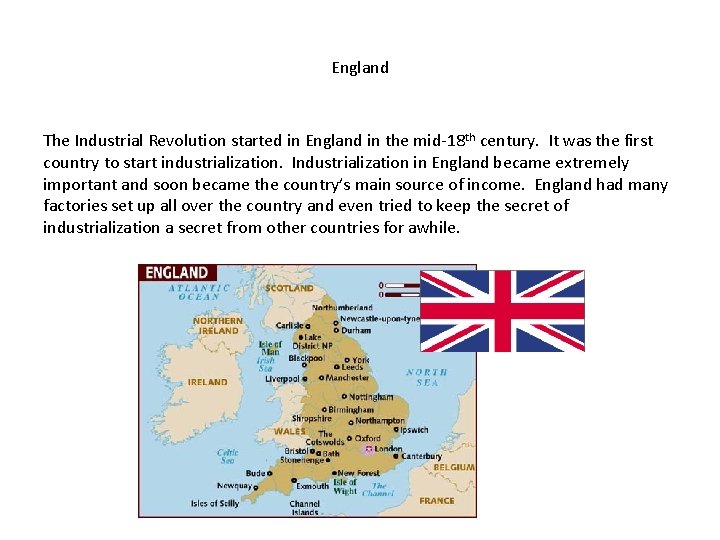
England The Industrial Revolution started in England in the mid-18 th century. It was the first country to start industrialization. Industrialization in England became extremely important and soon became the country’s main source of income. England had many factories set up all over the country and even tried to keep the secret of industrialization a secret from other countries for awhile.
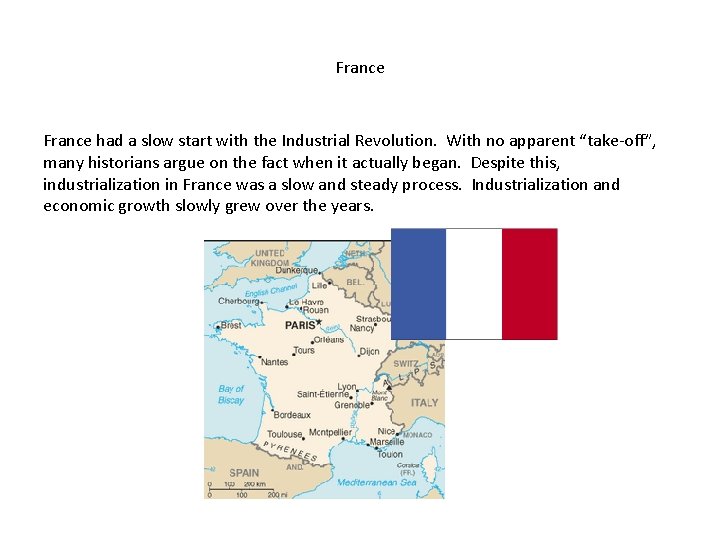
France had a slow start with the Industrial Revolution. With no apparent “take-off”, many historians argue on the fact when it actually began. Despite this, industrialization in France was a slow and steady process. Industrialization and economic growth slowly grew over the years.
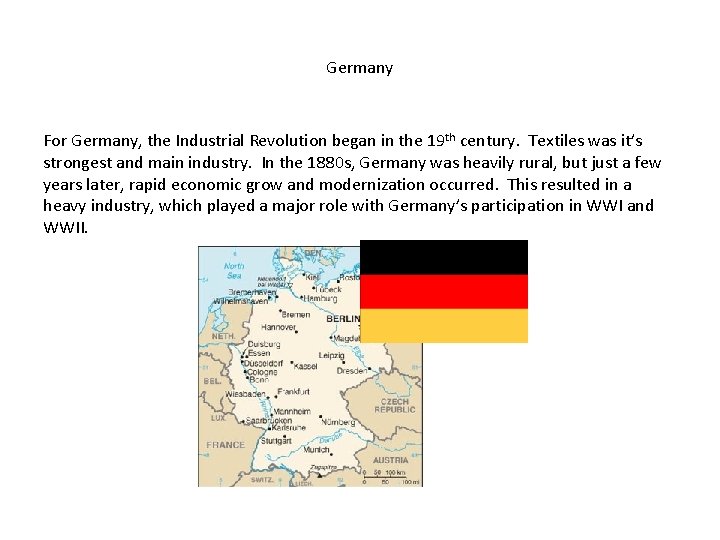
Germany For Germany, the Industrial Revolution began in the 19 th century. Textiles was it’s strongest and main industry. In the 1880 s, Germany was heavily rural, but just a few years later, rapid economic grow and modernization occurred. This resulted in a heavy industry, which played a major role with Germany’s participation in WWI and WWII.
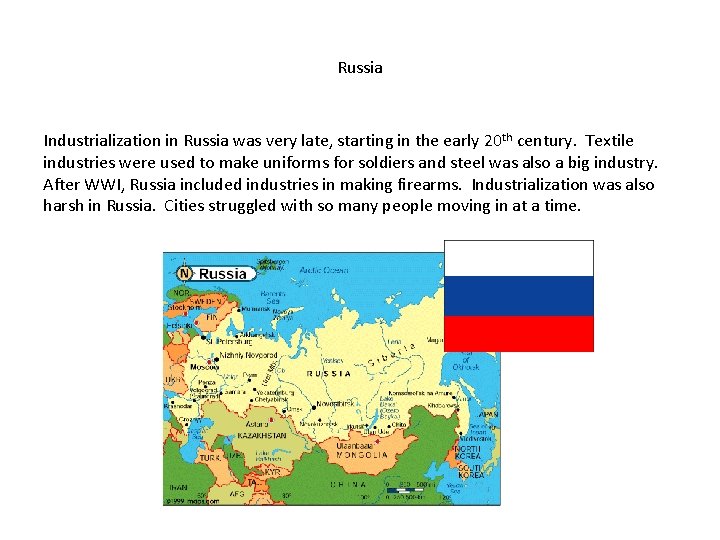
Russia Industrialization in Russia was very late, starting in the early 20 th century. Textile industries were used to make uniforms for soldiers and steel was also a big industry. After WWI, Russia included industries in making firearms. Industrialization was also harsh in Russia. Cities struggled with so many people moving in at a time.
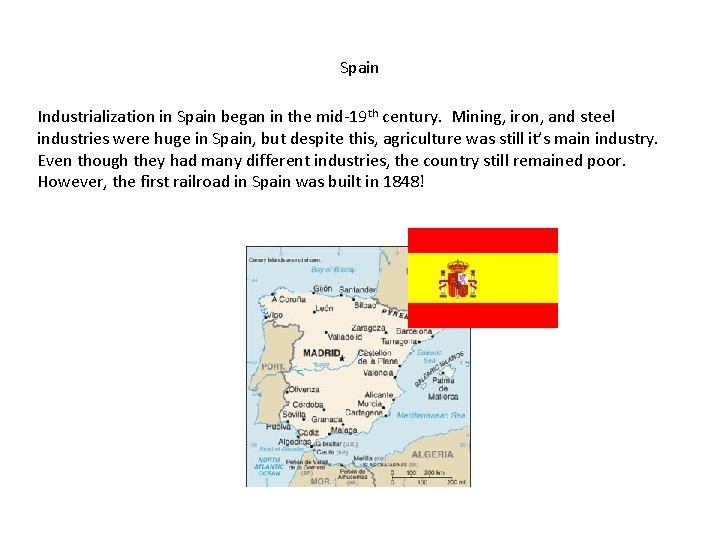
Spain Industrialization in Spain began in the mid-19 th century. Mining, iron, and steel industries were huge in Spain, but despite this, agriculture was still it’s main industry. Even though they had many different industries, the country still remained poor. However, the first railroad in Spain was built in 1848!
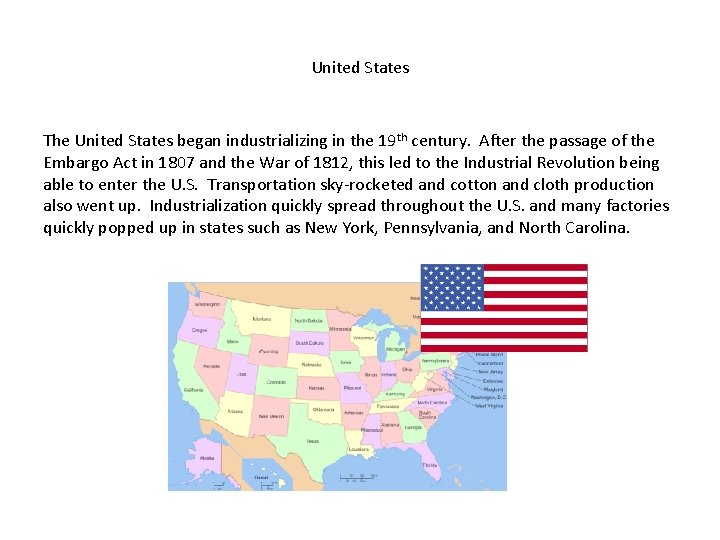
United States The United States began industrializing in the 19 th century. After the passage of the Embargo Act in 1807 and the War of 1812, this led to the Industrial Revolution being able to enter the U. S. Transportation sky-rocketed and cotton and cloth production also went up. Industrialization quickly spread throughout the U. S. and many factories quickly popped up in states such as New York, Pennsylvania, and North Carolina.
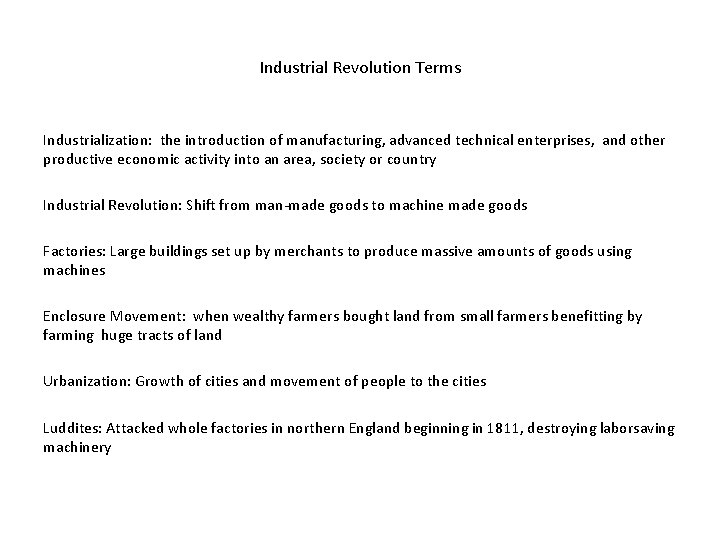
Industrial Revolution Terms Industrialization: the introduction of manufacturing, advanced technical enterprises, and other productive economic activity into an area, society or country Industrial Revolution: Shift from man-made goods to machine made goods Factories: Large buildings set up by merchants to produce massive amounts of goods using machines Enclosure Movement: when wealthy farmers bought land from small farmers benefitting by farming huge tracts of land Urbanization: Growth of cities and movement of people to the cities Luddites: Attacked whole factories in northern England beginning in 1811, destroying laborsaving machinery
- Slides: 37