
Industrial Revolution Industrial means businesses such as factories
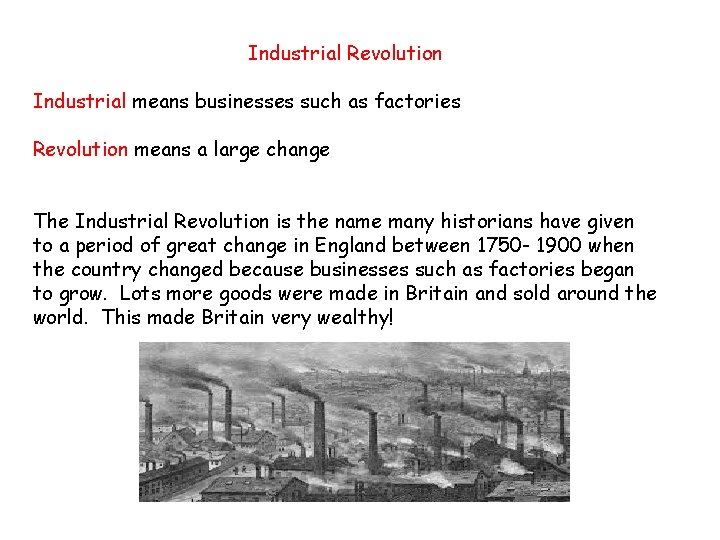
Industrial Revolution Industrial means businesses such as factories Revolution means a large change The Industrial Revolution is the name many historians have given to a period of great change in England between 1750 - 1900 when the country changed because businesses such as factories began to grow. Lots more goods were made in Britain and sold around the world. This made Britain very wealthy!
Contents Topic Slide numbers How did Britain change? 3 -7 How did the population grow? 8 -10 What were industrial towns like? Lousy Living…… 11 -12 What was it like for children in the factories? 14 -19 ‘Rocky Roads’ and turnpikes 20 -23 Who were the great inventors? 24 -30 Who were the chartists and what did they want? 31 -35
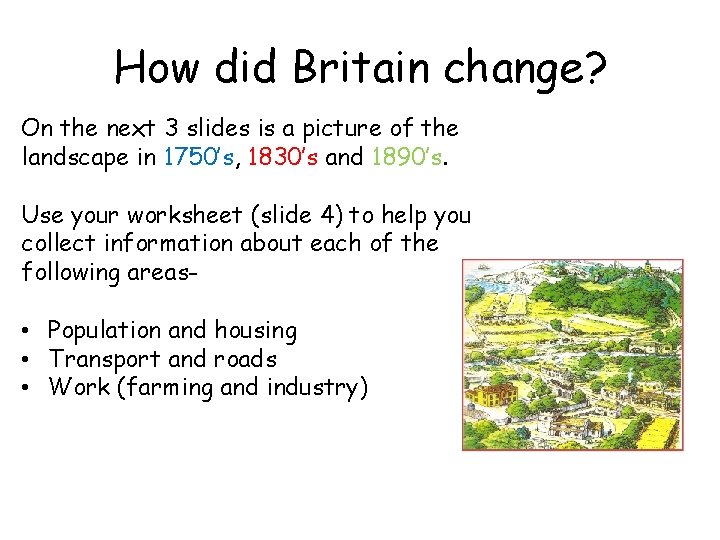
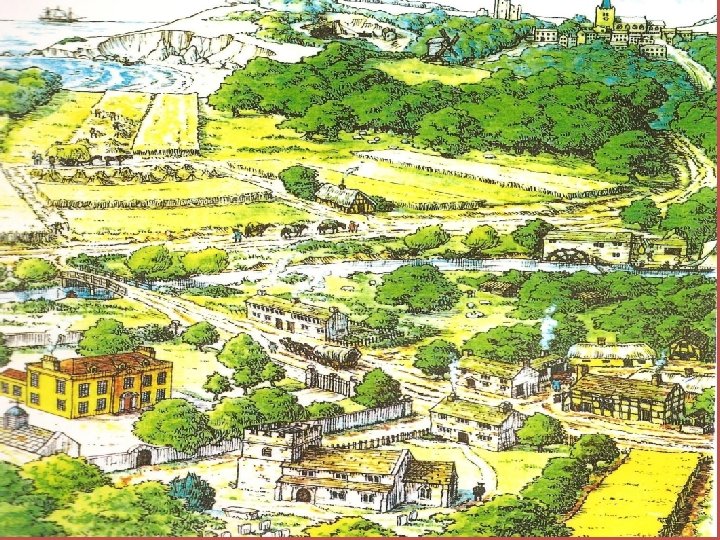
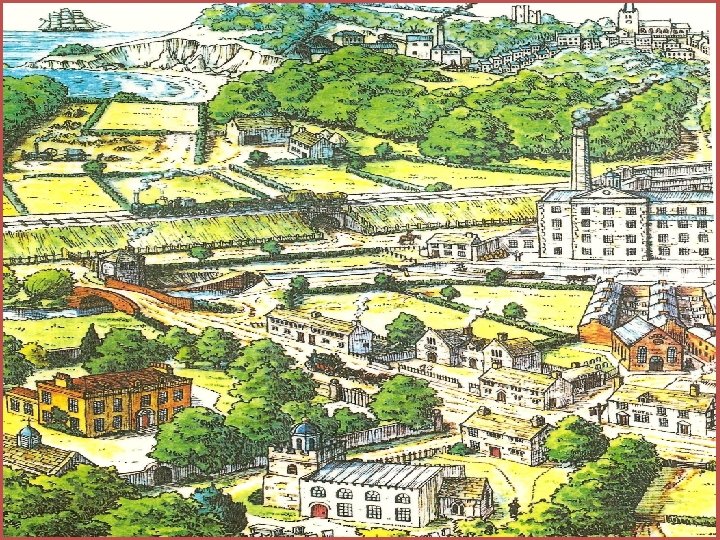
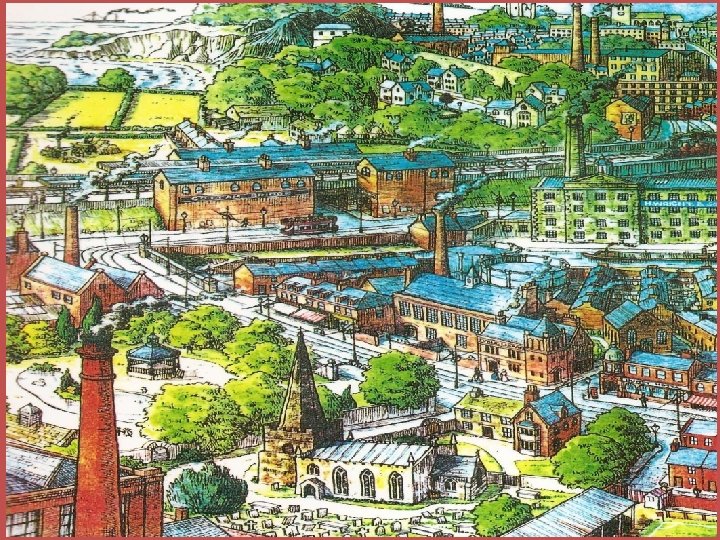
How did Britain change? On the next 3 slides is a picture of the landscape in 1750’s, 1830’s and 1890’s. Use your worksheet (slide 4) to help you collect information about each of the following areas- • Population and housing • Transport and roads • Work (farming and industry)
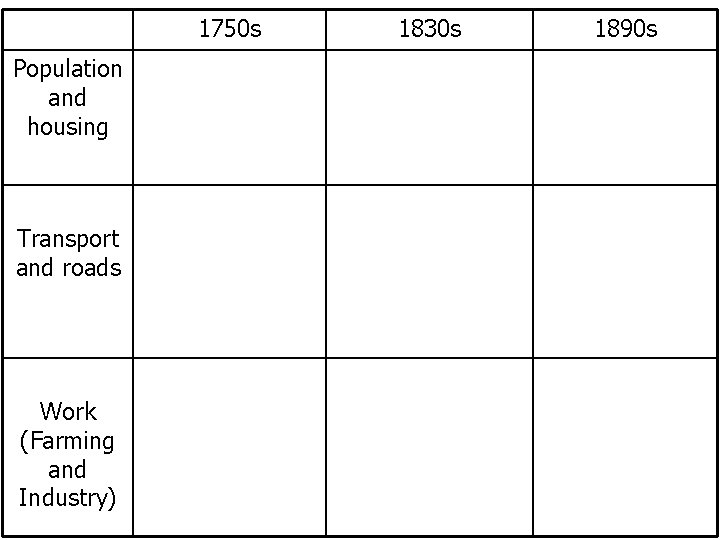
1750 s Population and housing Transport and roads Work (Farming and Industry) 1830 s 1890 s
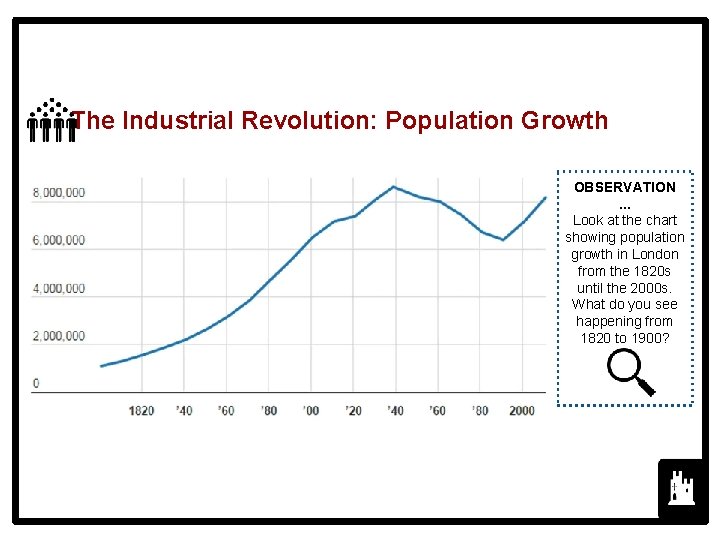
The Industrial Revolution: Population Growth OBSERVATION. . . Look at the chart showing population growth in London from the 1820 s until the 2000 s. What do you see happening from 1820 to 1900?
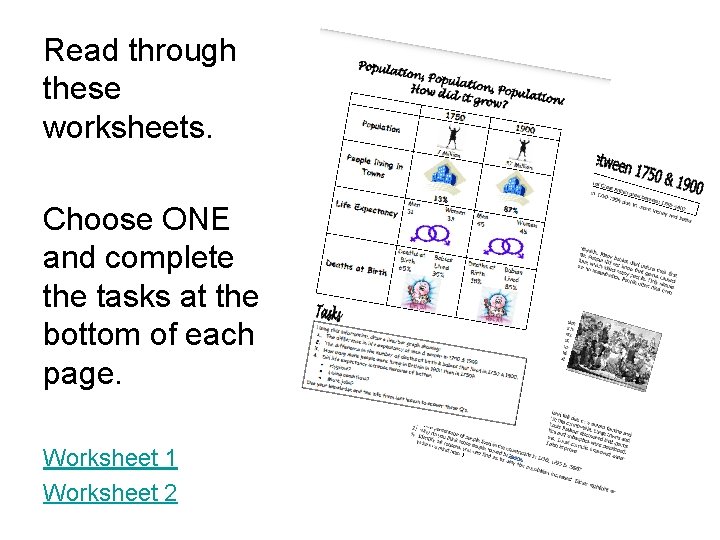
Read through these worksheets. Choose ONE and complete the tasks at the bottom of each page. Worksheet 1 Worksheet 2
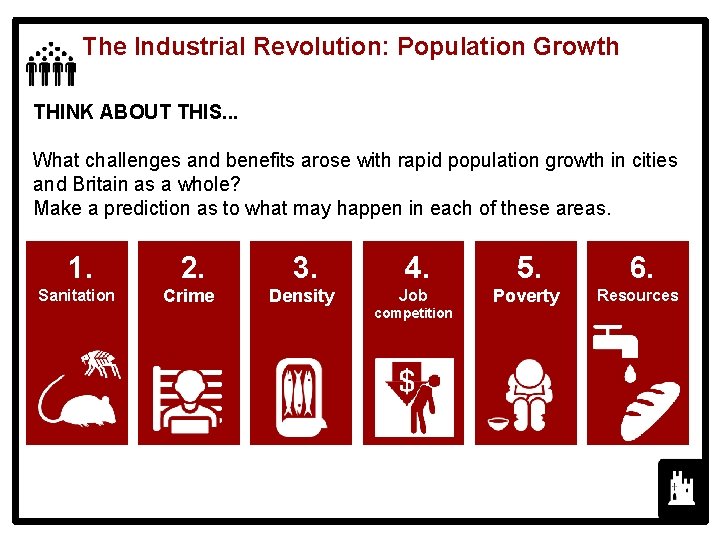
The Industrial Revolution: Population Growth THINK ABOUT THIS. . . What challenges and benefits arose with rapid population growth in cities and Britain as a whole? Make a prediction as to what may happen in each of these areas. 1. 2. 3. 4. 5. 6. Sanitation Crime Density Job Poverty Resources competition
Learning Objectives: To investigate public health in the nineteenth century. To evaluate which aspect of public health was the most damaging. 1. Copy the writing below in your exercise book. 2. Read the information on the next slide 3. Complete the task on this worksheet. 4. Extension: write a letter to the council outlining between 5 -10 steps of what you would do to improve towns. Worksheet 2. Challenge: How would it be paid for? 5. Extra watching: the worst jobs in History with Tony Robinson : https: //youtu. be/s 1 h 8 Jj. Omw 9 s Copy: Towns and cities were built so quickly during the Industrial Revolution that no planning took place and many houses were badly built, in poor conditions and this led to many diseases being spread throughout Britain.
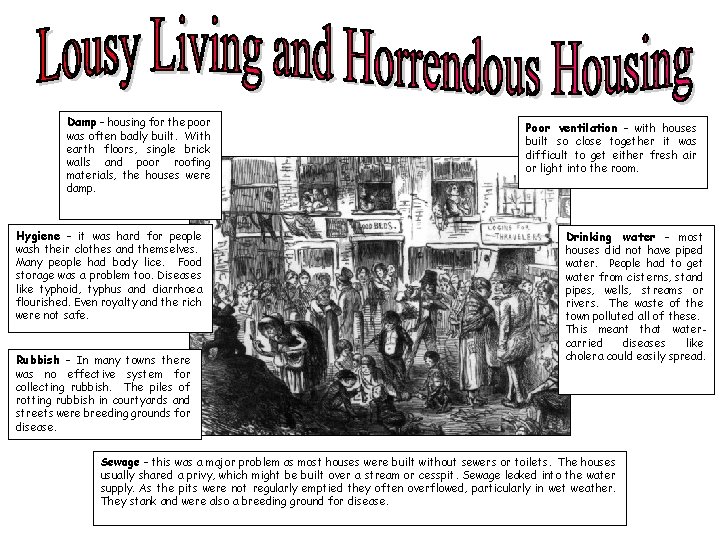
Damp – housing for the poor was often badly built. With earth floors, single brick walls and poor roofing materials, the houses were damp. Hygiene – it was hard for people wash their clothes and themselves. Many people had body lice. Food storage was a problem too. Diseases like typhoid, typhus and diarrhoea flourished. Even royalty and the rich were not safe. Rubbish – In many towns there Poor ventilation – with houses built so close together it was difficult to get either fresh air or light into the room. Drinking water – most houses did not have piped water. People had to get water from cisterns, stand pipes, wells, streams or rivers. The waste of the town polluted all of these. This meant that watercarried diseases like cholera could easily spread. was no effective system for collecting rubbish. The piles of rotting rubbish in courtyards and streets were breeding grounds for disease. Sewage – this was a major problem as most houses were built without sewers or toilets. The houses usually shared a privy, which might be built over a stream or cesspit. Sewage leaked into the water supply. As the pits were not regularly emptied they often overflowed, particularly in wet weather. They stank and were also a breeding ground for disease.
What was life like for children in the factories? 1) Copy out or print a copy of the worksheet on the next slide. 2) Read the information on the next 4 slides and sum up what each of them say about factory life for children on your sheet. 3) Watch the clip ‘The children who built Britain’ and compare to what you know (15 mins) 4) Extension/Challenge- source work on factory life on this worksheet 5) Extra watching: to watch the whole episode of ‘Children who built Britain’- follow this link https: //www. youtube. com/watch? v=l. Cg. Rdc. QSixg&f eature=youtu. be
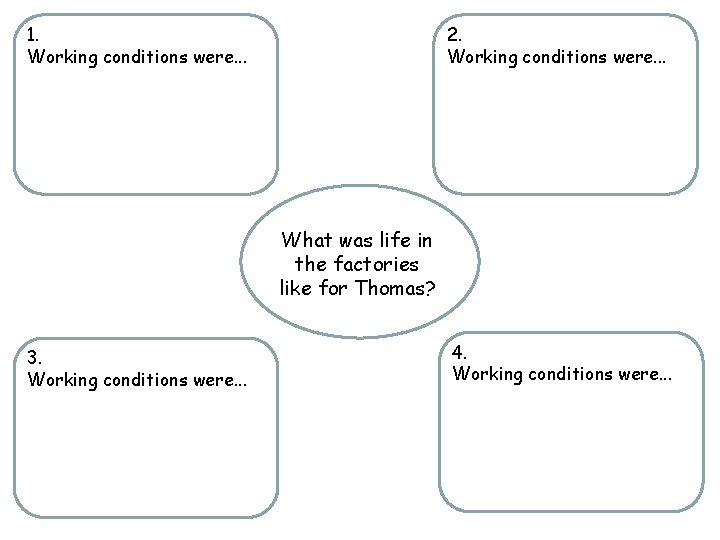
1. Working conditions were. . . 2. Working conditions were. . . What was life in the factories like for Thomas? 3. Working conditions were. . . 4. Working conditions were. . .
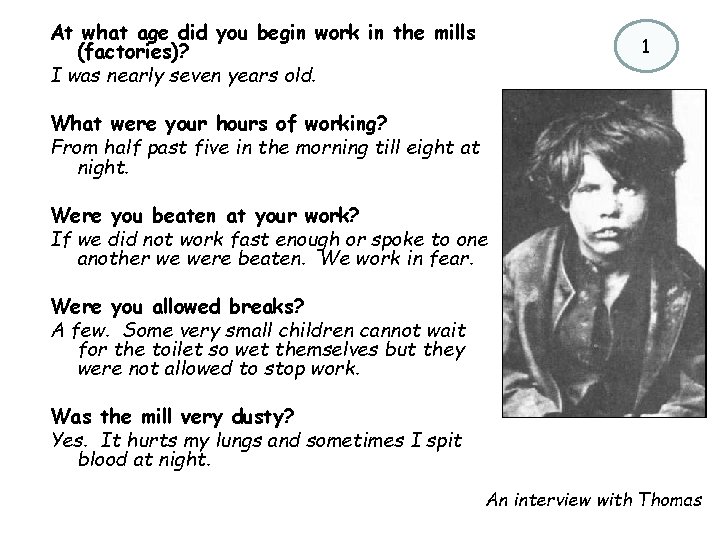
At what age did you begin work in the mills (factories)? I was nearly seven years old. 1 What were your hours of working? From half past five in the morning till eight at night. Were you beaten at your work? If we did not work fast enough or spoke to one another we were beaten. We work in fear. Were you allowed breaks? A few. Some very small children cannot wait for the toilet so wet themselves but they were not allowed to stop work. Was the mill very dusty? Yes. It hurts my lungs and sometimes I spit blood at night. An interview with Thomas
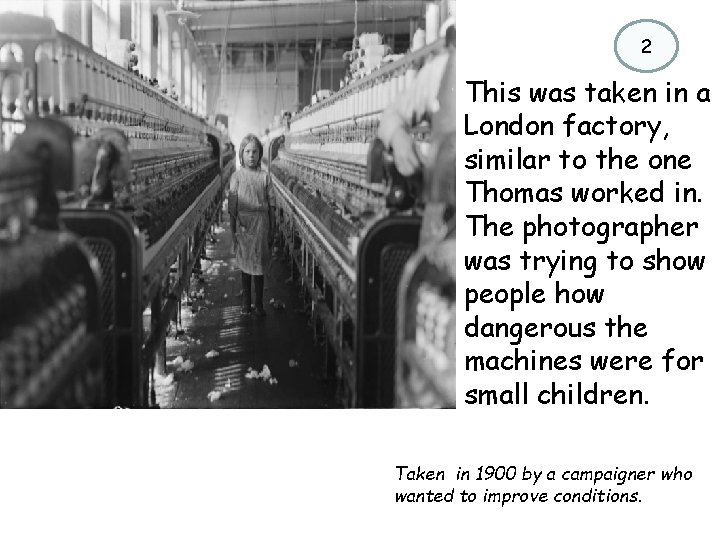
2 This was taken in a London factory, similar to the one Thomas worked in. The photographer was trying to show people how dangerous the machines were for small children. Taken in 1900 by a campaigner who wanted to improve conditions.
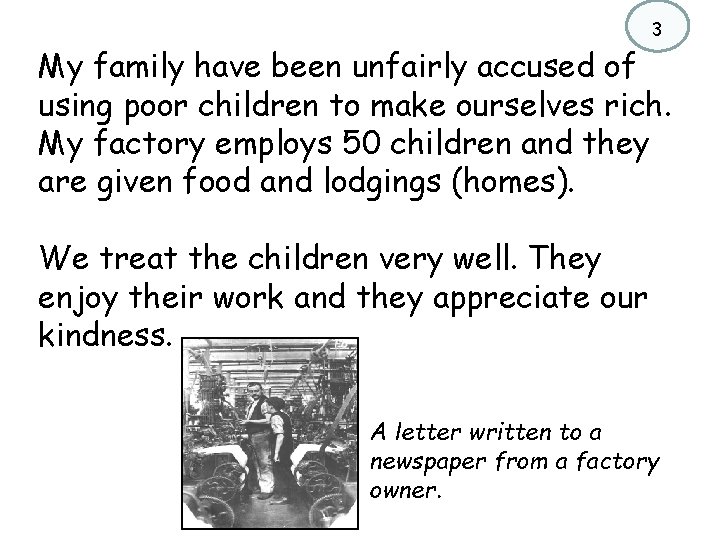
3 My family have been unfairly accused of using poor children to make ourselves rich. My factory employs 50 children and they are given food and lodgings (homes). We treat the children very well. They enjoy their work and they appreciate our kindness. A letter written to a newspaper from a factory owner.
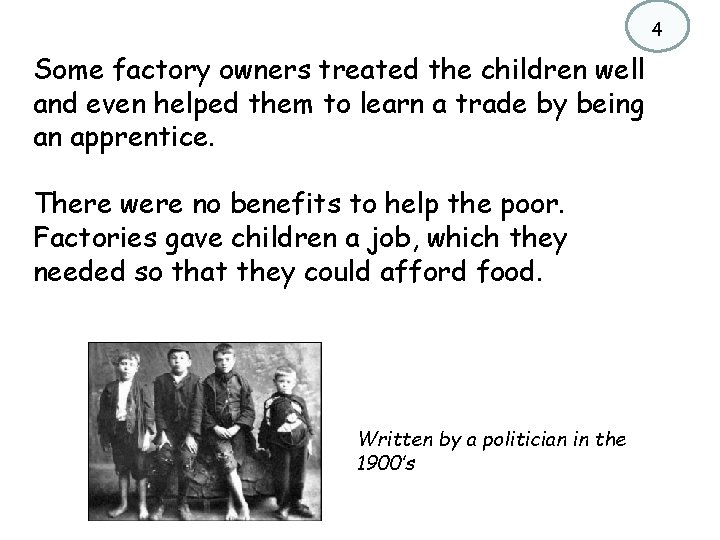
4 Some factory owners treated the children well and even helped them to learn a trade by being an apprentice. There were no benefits to help the poor. Factories gave children a job, which they needed so that they could afford food. Written by a politician in the 1900’s
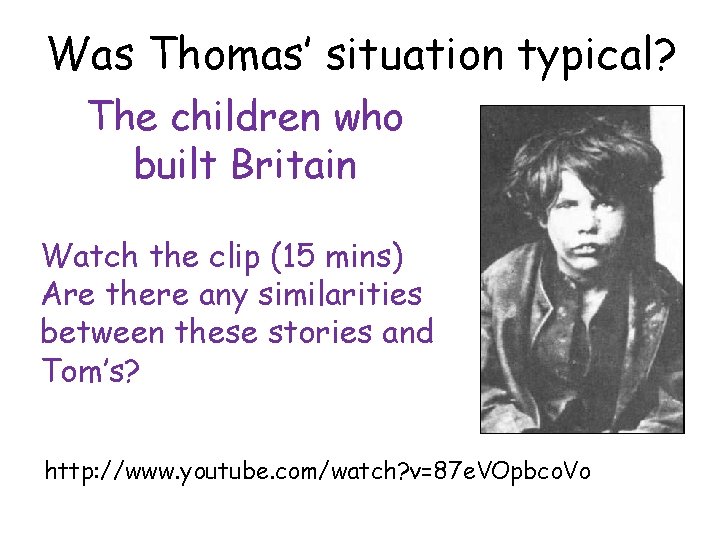
Was Thomas’ situation typical? The children who built Britain Watch the clip (15 mins) Are there any similarities between these stories and Tom’s? http: //www. youtube. com/watch? v=87 e. VOpbco. Vo
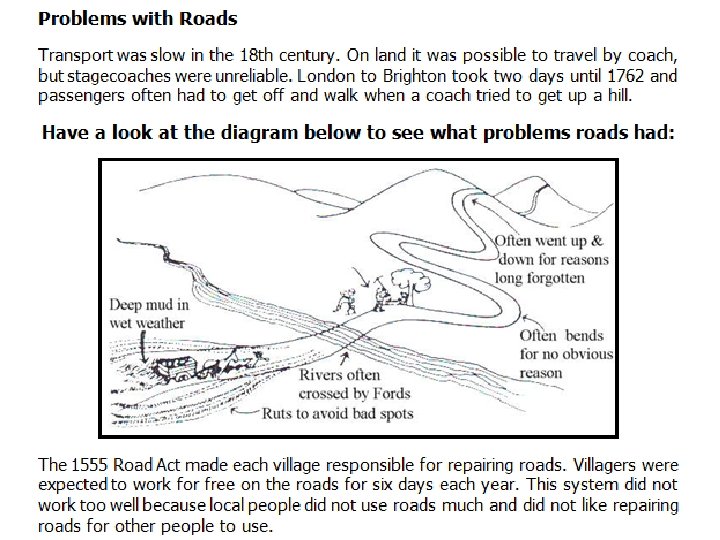
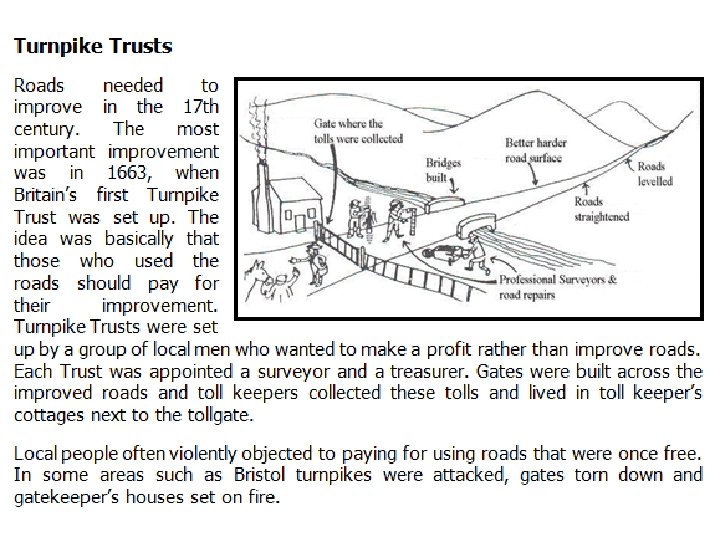
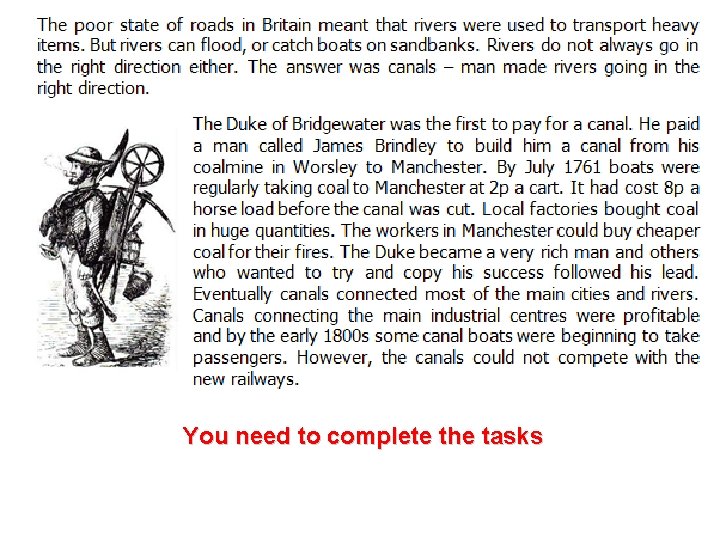
Rocky Roads-The arrival of Turnpikes LO: Understand the advantages and disadvantages of travelling by road and water in the eighteenth century. Tasks: Use the information on the next slides to complete these tasks 1. Look at the diagram showing early problems with roads. Make a list of these problems. 2. Why did people hate the 1555 Road Act? 3. What was important about 1663? 4. Draw and label a diagram of a Turnpike Trust. 5. Who paid for the first ever canal?
You need to complete the tasks
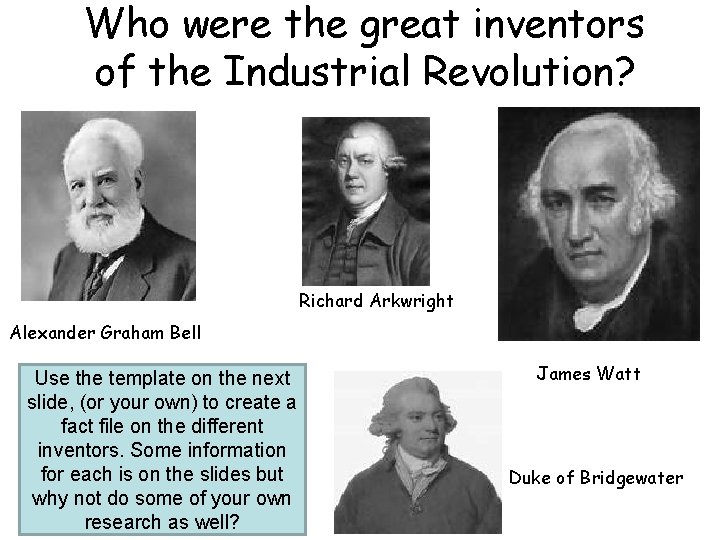
Who were the great inventors of the Industrial Revolution? Richard Arkwright Alexander Graham Bell Use the template on the next slide, (or your own) to create a fact file on the different inventors. Some information for each is on the slides but why not do some of your own research as well? James Watt Duke of Bridgewater
Title and introduction Who were the inventors, what was the industrial revolution Inventor 1 About the inventor Picture of the invention Why their invention was so significant Inventor 3 About the inventor Picture of the invention Why their invention was so significant Inventor 2 About the inventor Picture of the invention Why their invention was so significant Inventor 4 About the inventor Picture of the invention Why their invention was so significant Conclusion Which invention was the most significant? Consider. How it helped Who it helped What it changed Whether it still effects people today

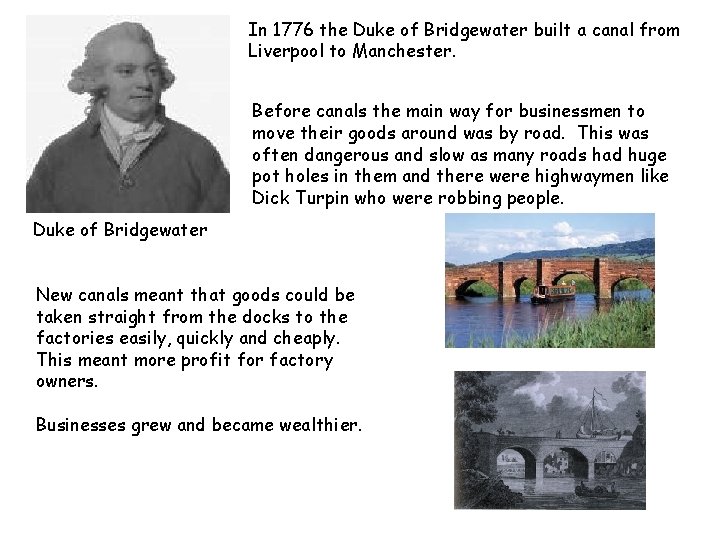
In 1776 the Duke of Bridgewater built a canal from Liverpool to Manchester. Before canals the main way for businessmen to move their goods around was by road. This was often dangerous and slow as many roads had huge pot holes in them and there were highwaymen like Dick Turpin who were robbing people. Duke of Bridgewater New canals meant that goods could be taken straight from the docks to the factories easily, quickly and cheaply. This meant more profit for factory owners. Businesses grew and became wealthier.
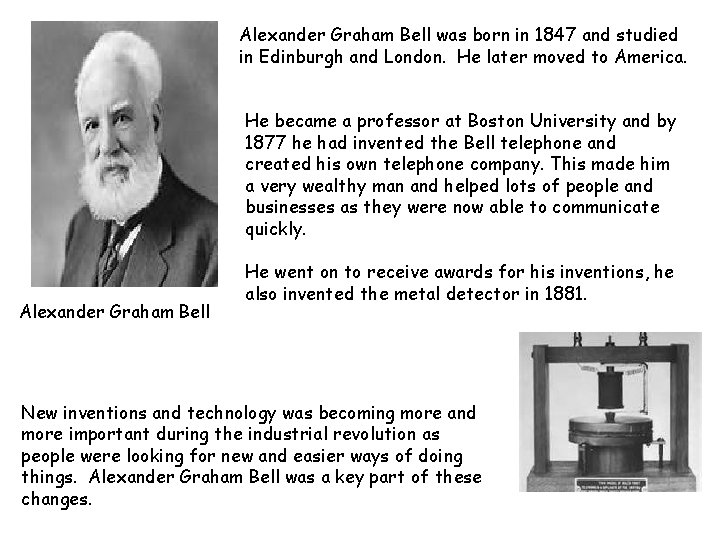
Alexander Graham Bell was born in 1847 and studied in Edinburgh and London. He later moved to America. He became a professor at Boston University and by 1877 he had invented the Bell telephone and created his own telephone company. This made him a very wealthy man and helped lots of people and businesses as they were now able to communicate quickly. Alexander Graham Bell He went on to receive awards for his inventions, he also invented the metal detector in 1881. New inventions and technology was becoming more and more important during the industrial revolution as people were looking for new and easier ways of doing things. Alexander Graham Bell was a key part of these changes.
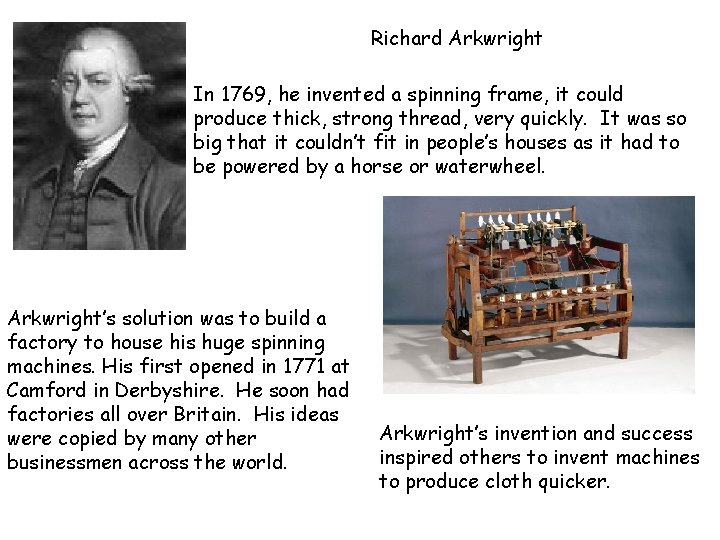
Richard Arkwright In 1769, he invented a spinning frame, it could produce thick, strong thread, very quickly. It was so big that it couldn’t fit in people’s houses as it had to be powered by a horse or waterwheel. Arkwright’s solution was to build a factory to house his huge spinning machines. His first opened in 1771 at Camford in Derbyshire. He soon had factories all over Britain. His ideas were copied by many other businessmen across the world. Arkwright’s invention and success inspired others to invent machines to produce cloth quicker.
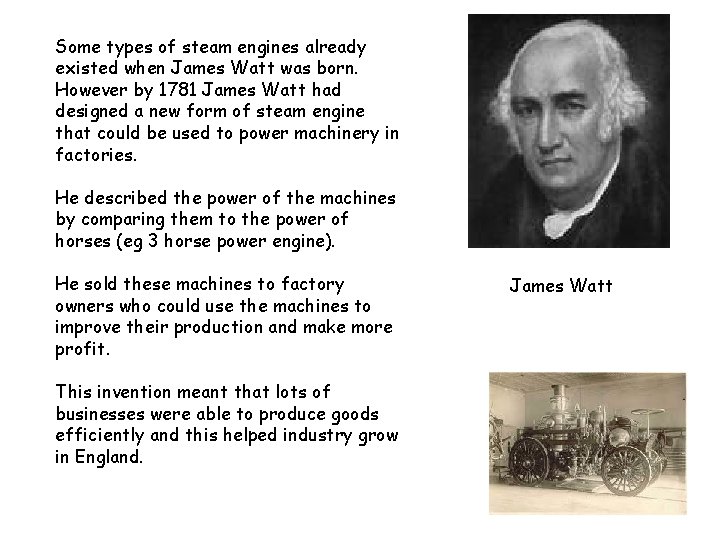
Some types of steam engines already existed when James Watt was born. However by 1781 James Watt had designed a new form of steam engine that could be used to power machinery in factories. He described the power of the machines by comparing them to the power of horses (eg 3 horse power engine). He sold these machines to factory owners who could use the machines to improve their production and make more profit. This invention meant that lots of businesses were able to produce goods efficiently and this helped industry grow in England. James Watt
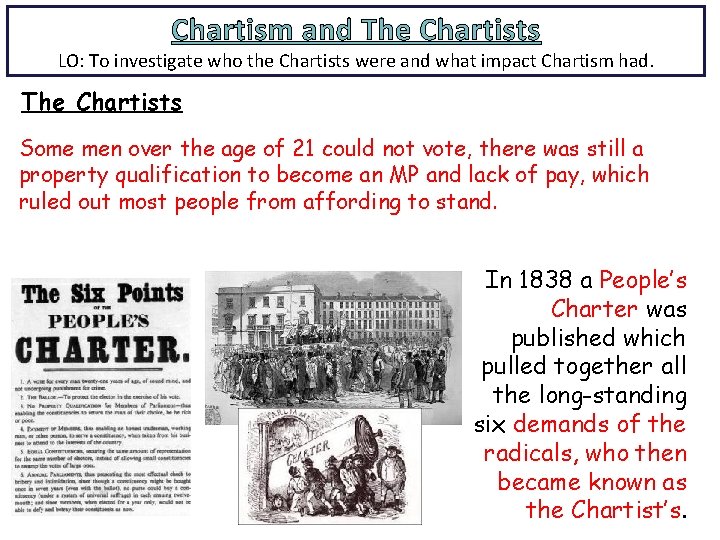
Chartism and The Chartists LO: To investigate who the Chartists were and what impact Chartism had. The Chartists Some men over the age of 21 could not vote, there was still a property qualification to become an MP and lack of pay, which ruled out most people from affording to stand. In 1838 a People’s Charter was published which pulled together all the long-standing six demands of the radicals, who then became known as the Chartist’s.
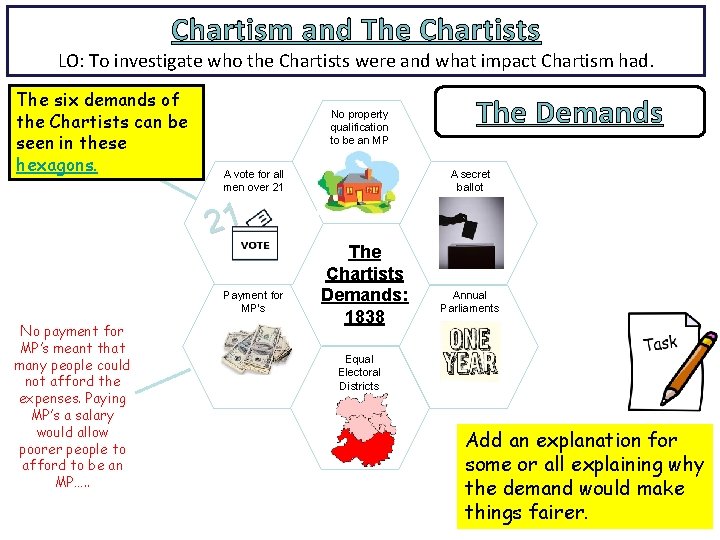
Chartism and The Chartists LO: To investigate who the Chartists were and what impact Chartism had. The six demands of the Chartists can be seen in these hexagons. No property qualification to be an MP Payment for MP’s No payment for MP’s meant that many people could not afford the expenses. Paying MP’s a salary would allow poorer people to afford to be an MP…. . A secret ballot A vote for all men over 21 21 The Demands The Chartists Demands: 1838 Annual Parliaments Equal Electoral Districts Add an explanation for some or all explaining why the demand would make things fairer.
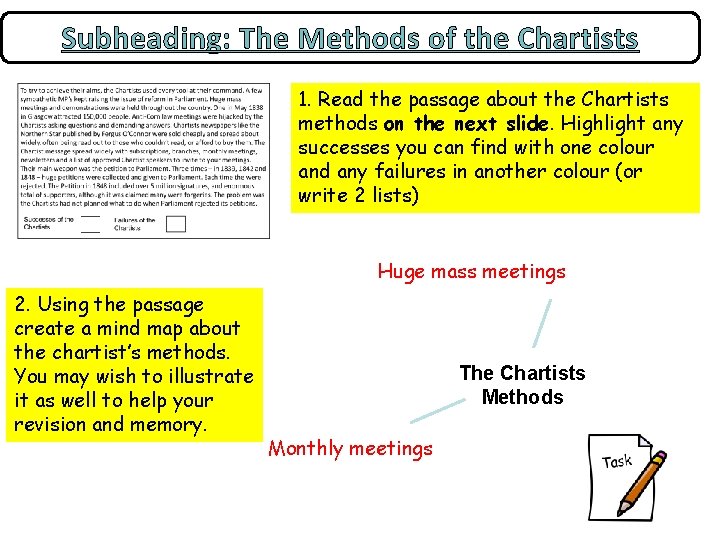
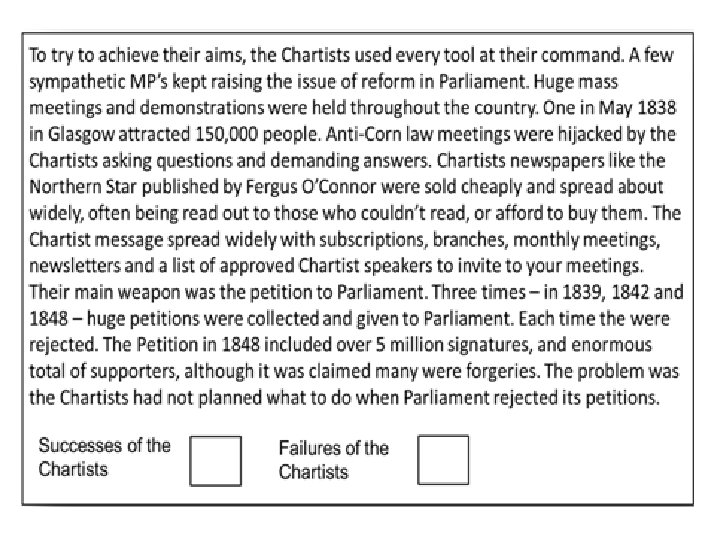
Subheading: The Methods of the Chartists 1. Read the passage about the Chartists methods on the next slide. Highlight any successes you can find with one colour and any failures in another colour (or write 2 lists) Huge mass meetings 2. Using the passage create a mind map about the chartist’s methods. You may wish to illustrate it as well to help your revision and memory. The Chartists Methods Monthly meetings
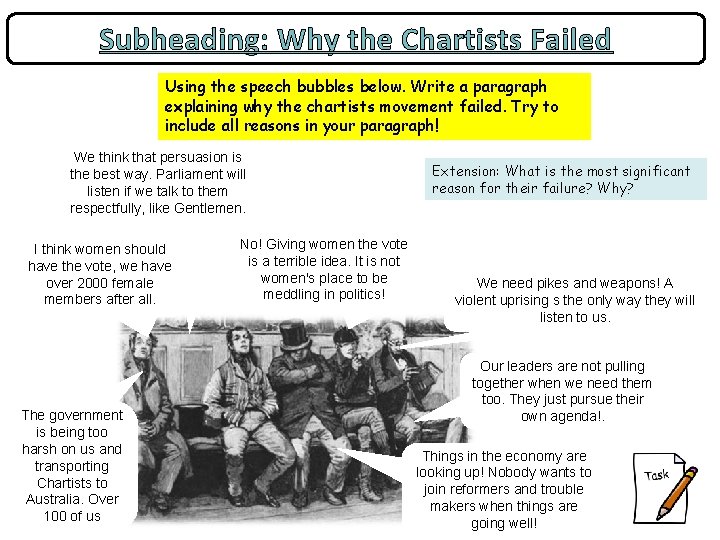
Subheading: Why the Chartists Failed Using the speech bubbles below. Write a paragraph explaining why the chartists movement failed. Try to include all reasons in your paragraph! We think that persuasion is the best way. Parliament will listen if we talk to them respectfully, like Gentlemen. I think women should have the vote, we have over 2000 female members after all. The government is being too harsh on us and transporting Chartists to Australia. Over 100 of us No! Giving women the vote is a terrible idea. It is not women's place to be meddling in politics! Extension: What is the most significant reason for their failure? Why? We need pikes and weapons! A violent uprising s the only way they will listen to us. Our leaders are not pulling together when we need them too. They just pursue their own agenda!. Things in the economy are looking up! Nobody wants to join reformers and trouble makers when things are going well!
- Slides: 35