
Industrial Revolution Business and Immigration Economic Growth http

Industrial Revolution, Business and Immigration

Economic Growth § http: //www. flixxy. com/200 -countries-200 years-4 -minutes. htm
Objectives § Know the basic factors needed to create a successful economy. § Understand the concept of Social Darwinism and its implications for workers. § Thesis: The belief in Social Darwinism led to the abuse of American workers during this period.
Class Notes § By the end of the next two classes, you should be able to answer the following questions: § What factors create economic growth and how does this growth change American society? § Why is a large influx of immigrants helpful to economic growth? § What is Social Darwinism and how does the belief in this concept impact American society?
What Factors Lead To A Successful Business/Economy? § Idea/Product § Capital § Labor § Natural Resources § Market
Idea/Products § New products invented in the US included: § § § Typewriter (1867) Barbed Wire (1874) Telephone (1876) Phonograph (1877) Electric Light (1879) Gas Automobile (1885)
Capital § American banks became a major source for supplying capital (money) to businesses that needed to expand. Bankers such as J P Morgan gained significant power due to his ability to supply capital to businesses in need. § Banks had a surplus of money to lend due to an influx of gold into the US (from other countries and from our discoveries).
Labor § The number of people moving to the US gave business a source of cheap and plentiful workers. § From an economics viewpoint, the supply for labor was significantly greater than the demand for labor. § What is the result of this imbalance?
Natural Resources § The US found and utilized an abundant supply of the following: § Oil § Iron Ore § Copper § Silver § Water § Coal § Lumber
Growth of the United States § According to the 12 th Census of the United States in 1900, the number of citizens had grown since 1860 as follows: § § § 1860 1870 1880 1890 1900 31. 4 million 33. 6 million 50. 2 million 62. 6 million 76. 8 million
Distribution of Goods § The distribution of goods to the consumer was made easier, by among other things, the growth of the railroads: § 1850 - 9000 miles of track § 1900 - 200, 000 miles of track § http: //www. mnn. com/greentech/transportation/stories/how-fast-couldyou-travel-across-the-us-in-the-1800 s
Growth of GNP § Between 1870 and 1916, the value of goods produced by American industry increased by approximately 10 times. This results in a huge increase in the standard of living for many Americans. § Source: www. puhsd. k 12. ca. us/chana/staffpages/eic hman/Adult_School/us/fall/industrialization/1 /us_industrialization. htm
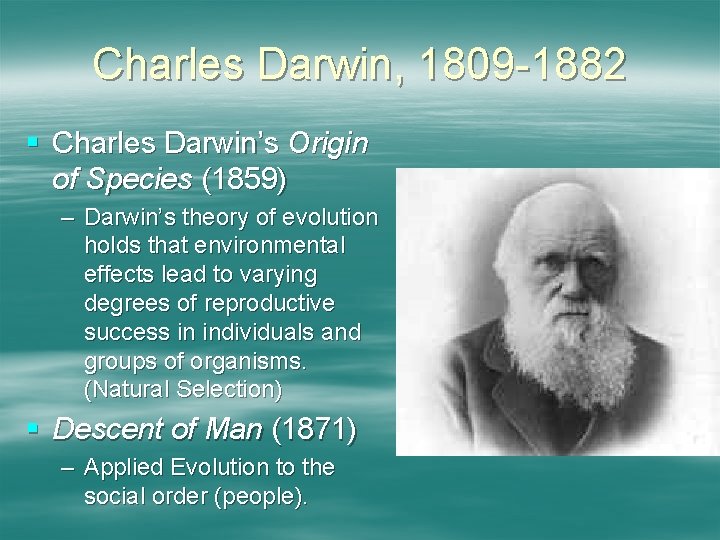
Charles Darwin, 1809 -1882 § Charles Darwin’s Origin of Species (1859) – Darwin’s theory of evolution holds that environmental effects lead to varying degrees of reproductive success in individuals and groups of organisms. (Natural Selection) § Descent of Man (1871) – Applied Evolution to the social order (people).
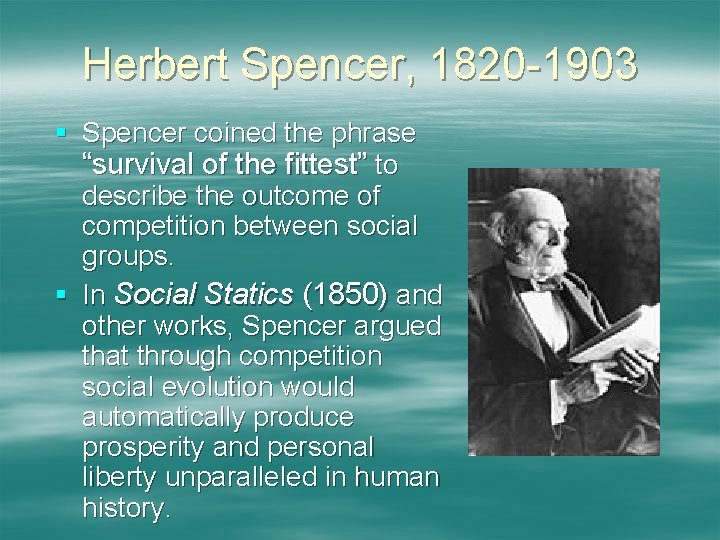
Herbert Spencer, 1820 -1903 § Spencer coined the phrase “survival of the fittest” to describe the outcome of competition between social groups. § In Social Statics (1850) and other works, Spencer argued that through competition social evolution would automatically produce prosperity and personal liberty unparalleled in human history.
Spencer’s Beliefs § Government intervention interfered with employer’s property rights § Argued against legislation that regulated working conditions, maximum hours, and minimum wages § Government should act as referee only § Source: Constitutional Rights Foundation; www. crf-usa. org
Beliefs Continued § Government has 2 Purposes only: § Defend nation against foreign invasion § Protect citizens and their properties against criminals
Andrew Carnegie § “And while the law (of competition) may be sometimes hard for the individual, it is best for the race, because it ensures the survival of the fittest in every department. ”
How Can We Tell Who Wins? § Social Darwinism-Measurement is by wealth: § Strongest and Best= Rich and Successful § Weaker= Poor and Unsuccessful § Weakest= Death
Laissez-Faire Capitalism § an economic system that allows businesses to operate with little or no government interference
Intersection § Social Darwinism § Immigration of Millions § Laissez Faire Capitalism
Impact of Social Darwinism § Immigration leads to an increase in workers; § This leads to an imbalance in workers and jobs; § Social Darwinism leads to a belief in “survival of the fittest”; § Laissez Faire Capitalism-leads to a lack of rules on business and their actions. This is consistent with the idea of Social Darwinism.
Big Business § Tremendous growth of business in the United States. § Few rules governing the actions of business owners. § Due to the ruthless approach to business by some, a few individuals succeeded in spectacular fashion, which led to monopolies.

Monopoly
Monopoly § Monopoly: A monopoly is an enterprise that is the only seller of a good or service. In the absence of government intervention, a monopoly is free to set any price it chooses and will usually set the price that yields the largest possible profit. § Monopoly: The Concise Encyclopedia of Economics | Library of Economics and Liberty
U. S. Capitalists § Robber Baron-a ruthlessly powerful U. S. capitalist or industrialist of the late 19 th century considered to have become wealthy by exploiting natural resources, corrupting legislators, or other unethical means. This is a very negative view. § Captain of Industry-the head of a large business firm, esp. of an industrial complex. This is a very positive view. § Source: Random House Unabridged Dictionary
John D Rockefeller § § § Born 1839 Started his first business in 1859 1870 Controlled 10% of American refining of oil By 1879 he controlled 90% of American refining of oil By 1883 he also controlled all the pipelines and set up the first significant Trust in the US.
Rockefeller § He gave away 10% of his income to charity § Estimated to have given away $550 million during his lifetime § Started the Rockefeller Foundation in 1913 “to promote the well-being of mankind throughout the world” § Source of information on Rockefeller: § www. notablebiographies. com/Pu-Ro/Rockefeller-John. D. html

Andrew Carnegie § Two Faces of Carnegie
Assignment § Please write an introductory paragraph including a strong thesis statement explaining the contradictions in Andrew Carnegie’s approach to his workers and society: § Ruthless with regard to his employees; § Generous with his money to benefit potentially those same employees. § Your thesis should make the connection between his actions and the concept of Social Darwinism. § Assignment is due Sept 20/21.
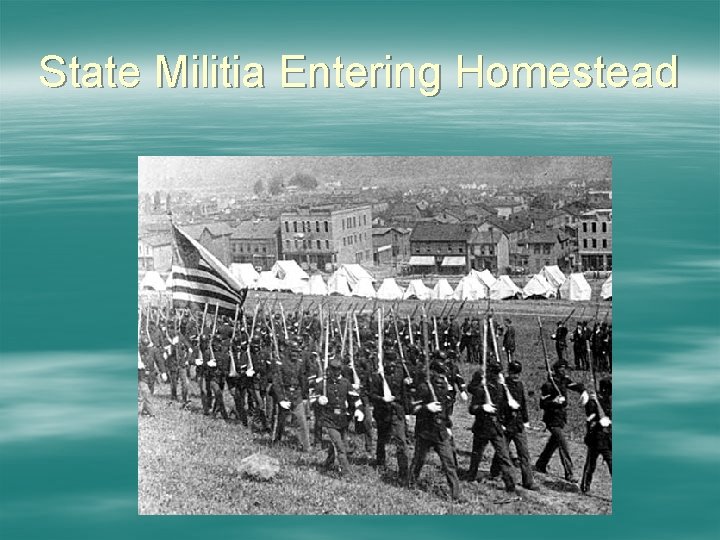
Ruthless Businessman § Homestead Strike (1892) : Instructions to Frick at the beginning of the strike- If the union does not accept your terms (wage cut), shut down the plant and wait for the workers to buckle.

Andrew Carnegie to Frick § “We approve of anything you do. ” § “We are with you to the end. ”
State Militia Entering Homestead
Philanthropist § Gospel of Wealth § Written June 1889 -three years prior to the Homestead strike
Carnegie’s Gospel of Wealth § “The problem of our age is the proper administration of wealth, so that the ties of brotherhood may still bind together the rich and poor in harmonious relationship. ” § “Much better this great irregularity than universal squalor. ” § “The poor enjoy what the rich could not before afford. ”
Carnegie’s Gospel of Wealth § “This, then, is held to be the duty of the man of Wealth: First, to set an example of modest, unostentatious living, … § To provide moderately for the legitimate wants of those dependent upon him; § And after doing so to consider all surplus revenues which come to him simply as trust funds, which he is called upon to administer… to produce the most beneficial results for the community…”
Carnegie and Philanthropy § Prior to his death, Andrew Carnegie gave away approximately $350 million (depending on the inflation rate used, this is the equivalent of $4 to 8 billion). § He is best known for building over 3000 libraries in 47 states and many foreign countries.
- Slides: 36