
Industrial Revolution Begins in Britain The American French
Industrial Revolution Begins in Britain • The American, French and Latin Revolutions ushered in new kinds of governments that differed from traditional monarchies (kings and queens) – Based on Enlightenment ideology – thinkers such as Locke, Voltaire, Rousseau, etc. • During the late 1700 s, a new revolution was taking place in England that would change the way people worked. • Industrial Revolution— Rural societies in Europe/America shift to machinery & factories during the 1700 s • Wealthy Landowners in England bought large amounts of land to created Enclosures— fields enclosed by fences – Enclosures Allowed experimentation with new farming methods – tested which strains of seeds produced better crops/techniques to plant and harvest seeds –Enclosures also forced tenant famers to give up their land move to the cities
Industrial Revolution Begins in Britain • Crop rotation—switching crops and fields each year to avoid depleting the soil – Increased food supply One method was called – Keep planting crops in same field = no yields (no nutrients left) – Earlier form of crop rotation came during the Middle Ages – Three field system (Two fields are planted, one is allowed to fallow or rest) • Livestock breeders become selective about the pedigree of their animals - Allow only the best livestock to breed = Improves food supply – Ex. Farmers would get their bigger/healthier cows, sheep, etc. to breed and produce more of that kind of animal – That animal would later be sold to be butchered for meat or used to breed on other farms • Industrialization—Move to machine production of goods – Began in Britain –Despite being a small island country, Britain had abundant resources and a substantial population –Natural resources - Coal, iron, rivers, harbors –Expanding economy in Britain encourages investment –Factors of production—land, labor, capital (money)
Inventions Spur Industrialization • Scientific advancements during the Scientific Revolution (which was also happening during the 1700 s) brought inventions that changed industry • Textile industry was first to change; Weavers produce textiles faster with the invention of the spinning jennies – In 1733, a Machinist named John Kay made a shuttle that sped back and forth on wheels – this flying shuttle, which was boat shaped piece of wood attached to a piece of yarn, Doubled the work weavers could do in a day – Prizes were actually awarded to those who could improve the spinning jenny/shuttle • Problem: machines are too big to maintain in a house • Solution: People build Factories to contain machinery for manufacturing • Textile industry grew at amazing rate – England needed another source cotton • Invention of the Cotton gin boosts American cotton production to meet British demand for more textile production – went to trading with other countries
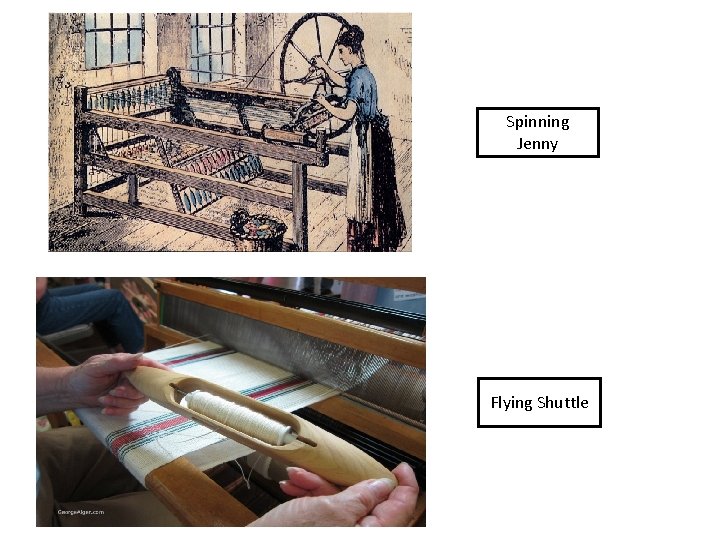
Spinning Jenny Flying Shuttle
Improvements in Transportation • Need for cheap power spurs development of steam engine – Steam pumps had been used during the earlier 1700 s to pump out water from mine shafts – James Watt, a mathematical instrument maker, improved the steam engine – Boulton was an Entrepreneur – a business investor – who paid Watt a salary to create and later innovate working steam engines – More businessmen follow this trend of investing in and marketing new products – with a patent, inventor/investor can make money off the products sold • Robert Fulton builds first steamboat, the Clermont, in 1807 –Transition: ships start to rely on steam power rather than wind propulsion (ships will no longer rely on sails to travel through bodies of water • England’s water transport improved by system of canals that are developed by entrepreneurs - who want easier access/movement for goods that are produced in factories to be shipped elsewhere for purchase – British roads are also improved; companies operate them as toll roads – tolls = more money
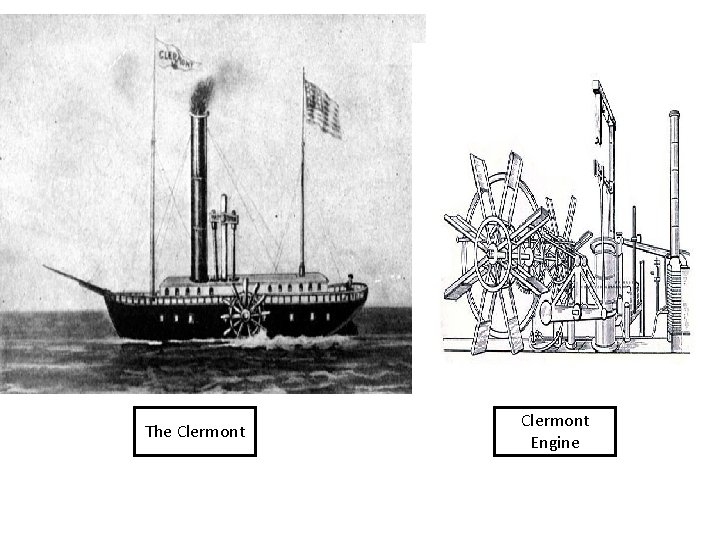
The Clermont Engine
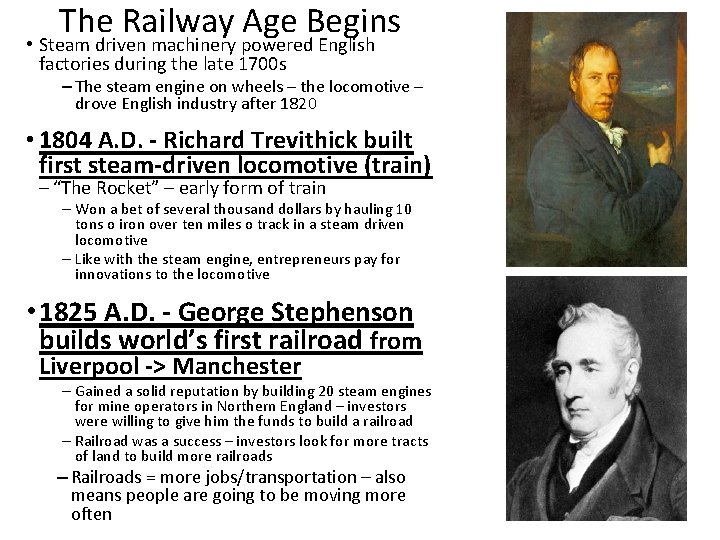
The Railway Age Begins • Steam driven machinery powered English factories during the late 1700 s – The steam engine on wheels – the locomotive – drove English industry after 1820 • 1804 A. D. - Richard Trevithick built first steam-driven locomotive (train) – “The Rocket” – early form of train – Won a bet of several thousand dollars by hauling 10 tons o iron over ten miles o track in a steam driven locomotive – Like with the steam engine, entrepreneurs pay for innovations to the locomotive • 1825 A. D. - George Stephenson builds world’s first railroad from Liverpool -> Manchester – Gained a solid reputation by building 20 steam engines for mine operators in Northern England – investors were willing to give him the funds to build a railroad – Railroad was a success – investors look for more tracts of land to build more railroads – Railroads = more jobs/transportation – also means people are going to be moving more often
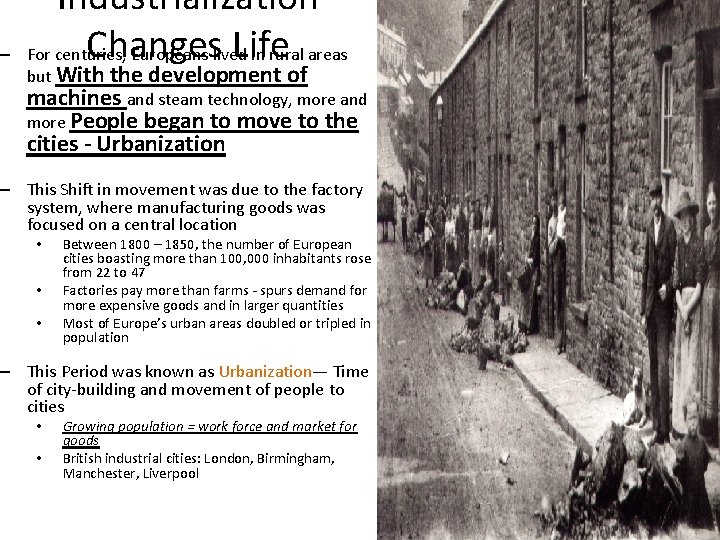
– Industrialization Changes Life For centuries, Europeans lived in rural areas but With the development of machines and steam technology, more and more People began to move to the cities - Urbanization – This Shift in movement was due to the factory system, where manufacturing goods was focused on a central location • • • Between 1800 – 1850, the number of European cities boasting more than 100, 000 inhabitants rose from 22 to 47 Factories pay more than farms - spurs demand for more expensive goods and in larger quantities Most of Europe’s urban areas doubled or tripled in population – This Period was known as Urbanization— Time of city-building and movement of people to cities • • Growing population = work force and market for goods British industrial cities: London, Birmingham, Manchester, Liverpool
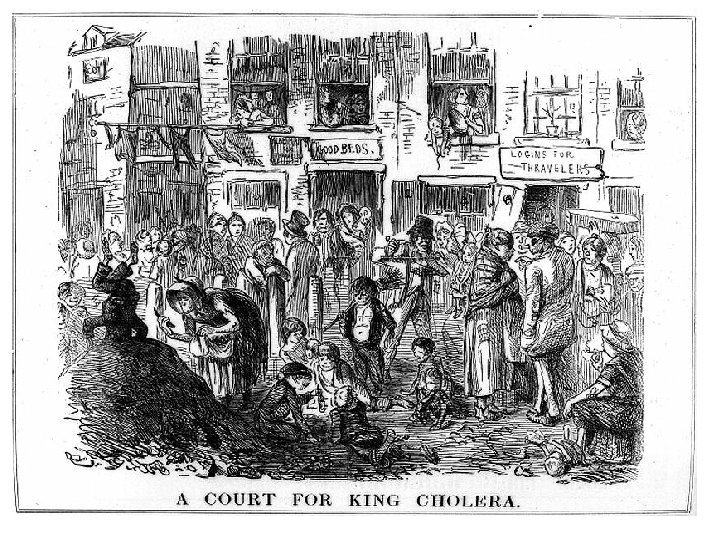
Living Conditions • Because England’s cities grew rapidly, they had no development plans, sanitary codes, or building codes • Cities lacked adequate housing, education and police protection for the people who came from the countryside looking for jobs –Most of the streets were unpaved, had no drains, and garbage piled up in heaps on them –Workers lived in dark, dirty shelters and families piled into one room • Widespread diseases, like tuberculosis and
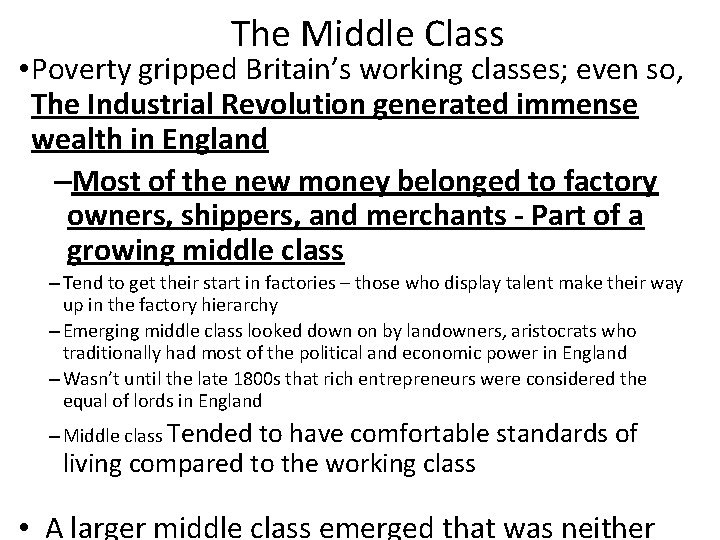
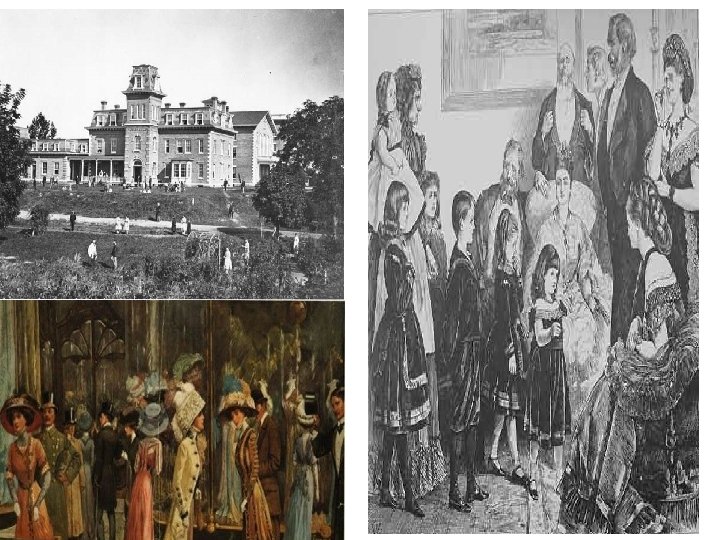
The Middle Class • Poverty gripped Britain’s working classes; even so, The Industrial Revolution generated immense wealth in England –Most of the new money belonged to factory owners, shippers, and merchants - Part of a growing middle class – Tend to get their start in factories – those who display talent make their way up in the factory hierarchy – Emerging middle class looked down on by landowners, aristocrats who traditionally had most of the political and economic power in England – Wasn’t until the late 1800 s that rich entrepreneurs were considered the equal of lords in England – Middle class Tended to have comfortable standards of living compared to the working class • A larger middle class emerged that was neither
- Slides: 14