
Industrial Revolution A View from Below Population Explosion

Industrial Revolution A View from Below

Population Explosion Europe's population grew at unprecedented rates from about 1750 -1914. The factors contributing to population growth: • • Less infant deaths Falling mortality rates Increase in births (the old virtue of prudence gave way to the delights of procreation) Better living conditions Increase of food supply Improved transportation (made it possible to ship grain from areas of plenty to those in need) Plentiful harvest (rising temperatures)
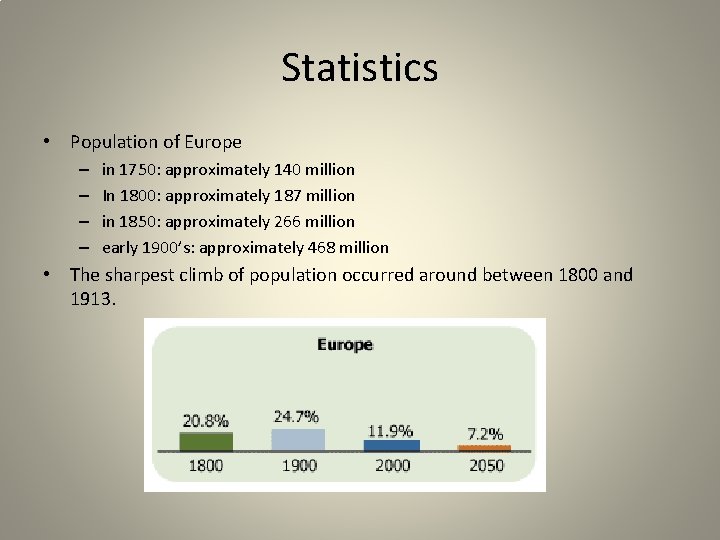
Statistics • Population of Europe – – in 1750: approximately 140 million In 1800: approximately 187 million in 1850: approximately 266 million early 1900’s: approximately 468 million • The sharpest climb of population occurred around between 1800 and 1913.
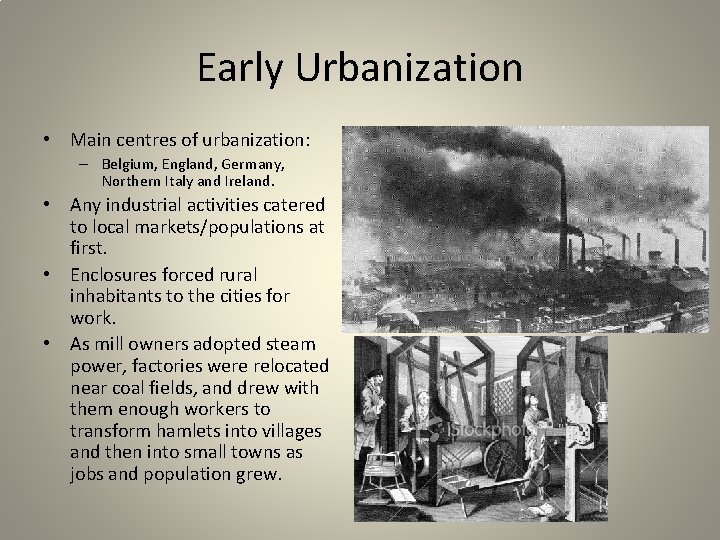
Early Urbanization • Main centres of urbanization: – Belgium, England, Germany, Northern Italy and Ireland. • Any industrial activities catered to local markets/populations at first. • Enclosures forced rural inhabitants to the cities for work. • As mill owners adopted steam power, factories were relocated near coal fields, and drew with them enough workers to transform hamlets into villages and then into small towns as jobs and population grew.
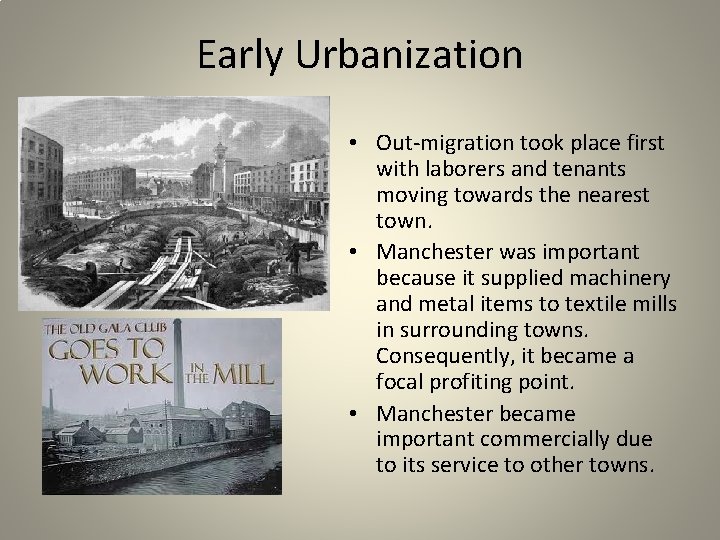
Early Urbanization • Out-migration took place first with laborers and tenants moving towards the nearest town. • Manchester was important because it supplied machinery and metal items to textile mills in surrounding towns. Consequently, it became a focal profiting point. • Manchester became important commercially due to its service to other towns.

Child Labour • During the Industrial Revolution, employers needed cheap labour, so they employed children. • Children worked very long hours, usually between 1416 hours per day. • They only had one break (45 min-1 hour). • They didn’t get to eat their breakfast or supper, except while working. • Their food would often go bad because of the dust in the mill. • The children were beaten if they were working too slow or if they were late. • The work was exhausting, and they were paid next to nothing.
• They were not educated because they worked instead. • The moral standards of the children were lowered. – For example, there was heavy use of obscene language – many of the girls had children around 16 -17 years old (outside of wedlock). • Children endured poor working conditions, which were comparable to those of a slave.
Factory Rules A normal working day was 6: 00 am – 7: 00 pm. Workers were strictly observed. Workers were not allowed to have conversations. If they disobeyed the overseers and officials, they were dismissed. • No workers were able to leave their workplace at anytime. • Every worker was responsible for cleaning up his or her workspace. • If they didn’t have their rulebook, then they were fined. • •
Factory Rules • Advances were granted only to older workers. • Repeated late arrivals would result in dismissal. • Every worker was obliged to report to his superiors any acts of dishonesty or embezzlement on the part of his or her fellow worker. • If a worker reported theft, he or she would be rewarded with 2 dollars. • Watchmen allowed to search workers for stolen food.
Life In Urban Communities • • • Ruled by priests Filthy Disease ridden Overcrowded Deserted at night except for thieves Rich lived in west “They lived upwind to avoid the smells of the poor. ” Poor lived in east
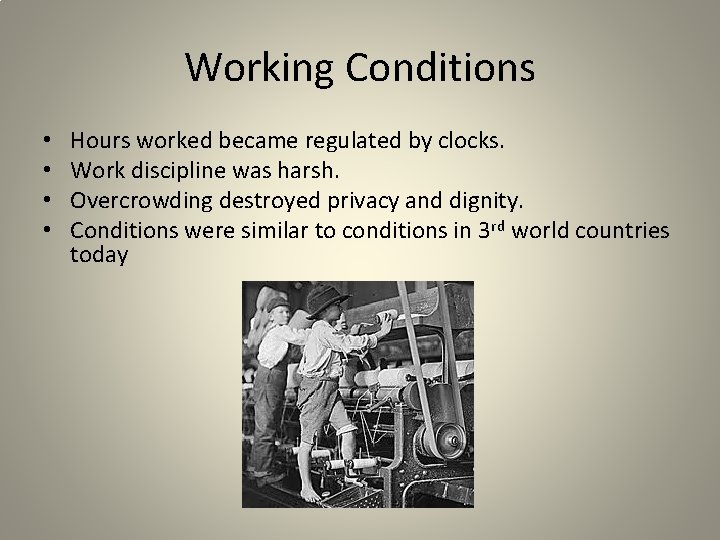
Working Conditions • • Hours worked became regulated by clocks. Work discipline was harsh. Overcrowding destroyed privacy and dignity. Conditions were similar to conditions in 3 rd world countries today
Housing Conditions of the Poor • The rich lived on lower floor of apartment buildings. • Attics and cellars were unheated and unventilated. • People desired to live close to place of employment Population Growth • Cities doubled in population every ten to twelve years. • Limited room became a problem because the infrastructure was unable to keep up with demand.
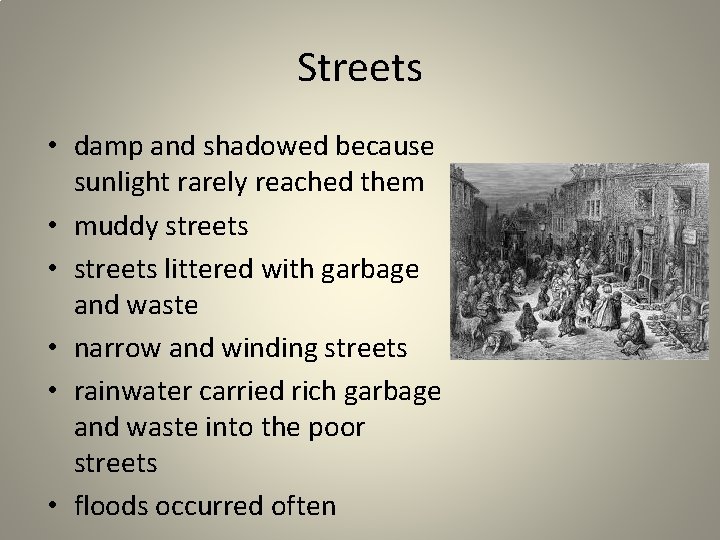
Streets • damp and shadowed because sunlight rarely reached them • muddy streets • streets littered with garbage and waste • narrow and winding streets • rainwater carried rich garbage and waste into the poor streets • floods occurred often
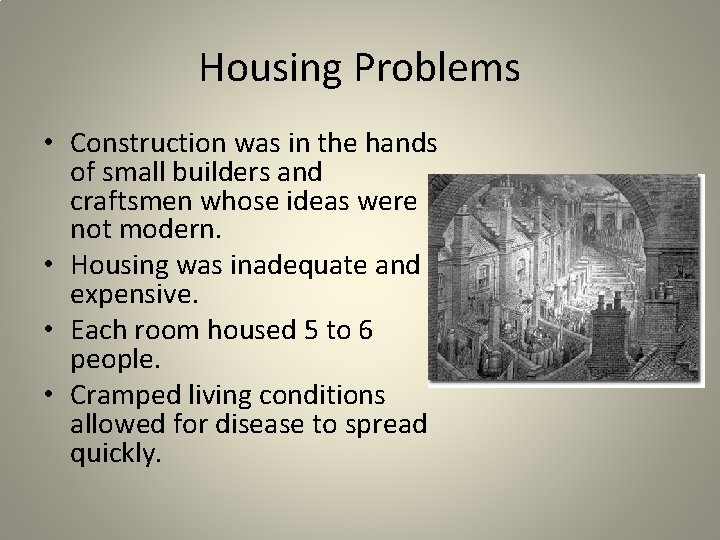
Housing Problems • Construction was in the hands of small builders and craftsmen whose ideas were not modern. • Housing was inadequate and expensive. • Each room housed 5 to 6 people. • Cramped living conditions allowed for disease to spread quickly.
Spread of Disease • small, cramped apartments • air-born disease (tuberculosis, influenza, pneumonia) • lack of public hygiene • water contamination • since several families used the same bathroom (“the hole filled quickly”)
- Slides: 15