
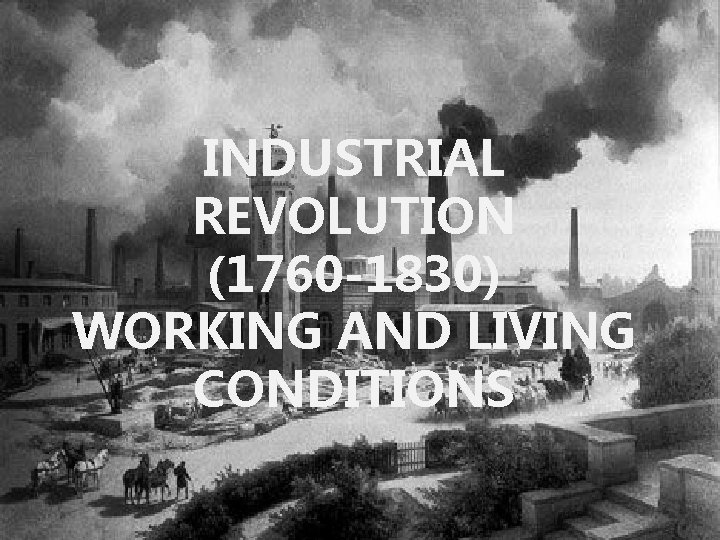
INDUSTRIAL REVOLUTION 1760 1830 WORKING AND LIVING CONDITIONS


- Slides: 15
INDUSTRIAL REVOLUTION (1760 -1830) WORKING AND LIVING CONDITIONS
INDEX • Distribution of raw materials and localisation of factories • Overview of factories • Hierarchy of the society of the Industrial Revolution • Living conditions • The process towards the duties and the rights of workers
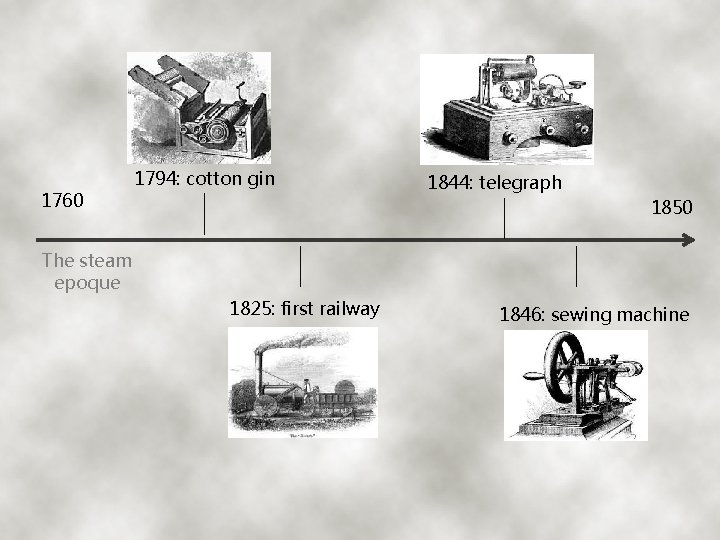
1760 1794: cotton gin 1844: telegraph 1850 The steam epoque 1825: first railway 1846: sewing machine
…Until the first half of XIII Century Proto-factory system Cottage industry The merchant provided the family with raw materials which they worked on their own Small workshops The housemaster and his employees realised the products The final products were then sold by the merchants The commerce was indeed in expansion and also the transportation of the goods inside and outside the country
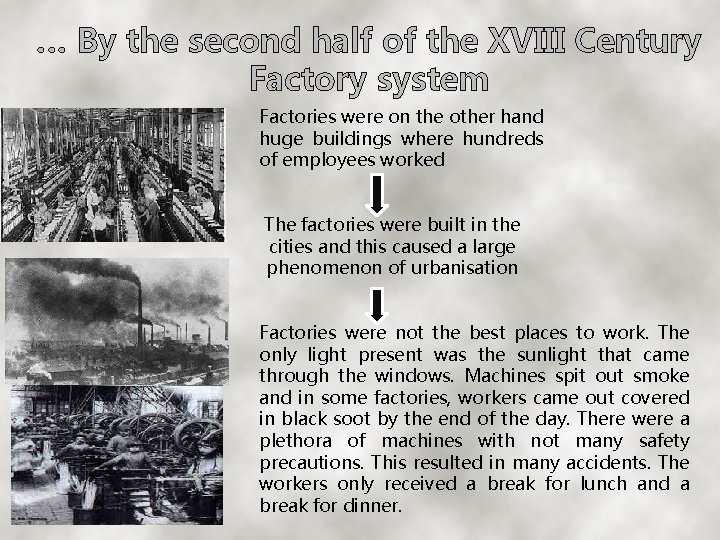
… By the second half of the XVIII Century Factory system Factories were on the other hand huge buildings where hundreds of employees worked The factories were built in the cities and this caused a large phenomenon of urbanisation Factories were not the best places to work. The only light present was the sunlight that came through the windows. Machines spit out smoke and in some factories, workers came out covered in black soot by the end of the day. There were a plethora of machines with not many safety precautions. This resulted in many accidents. The workers only received a break for lunch and a break for dinner.
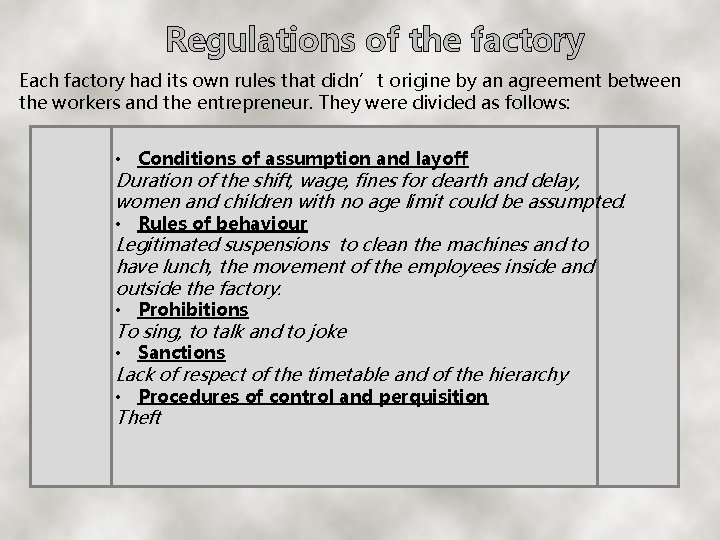
Regulations of the factory Each factory had its own rules that didn’t origine by an agreement between the workers and the entrepreneur. They were divided as follows: • Conditions of assumption and layoff Duration of the shift, wage, fines for dearth and delay, women and children with no age limit could be assumpted. • Rules of behaviour Legitimated suspensions to clean the machines and to have lunch, the movement of the employees inside and outside the factory. • Prohibitions To sing, to talk and to joke • Sanctions Lack of respect of the timetable and of the hierarchy • Procedures of control and perquisition Theft
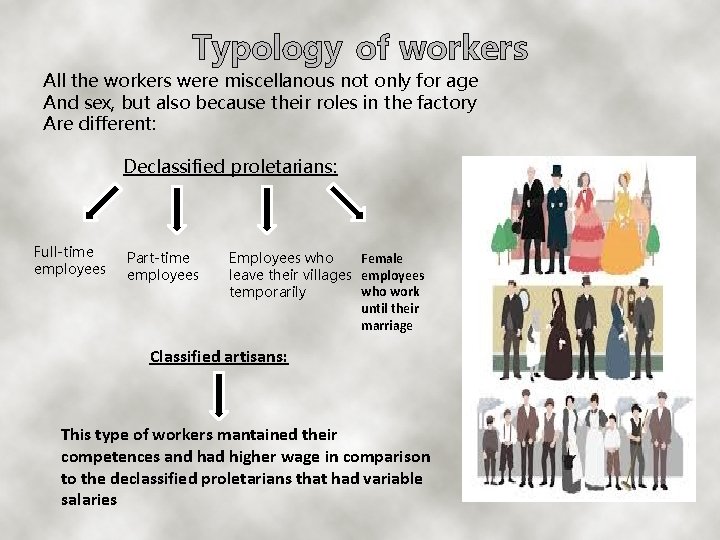
Typology of workers All the workers were miscellanous not only for age And sex, but also because their roles in the factory Are different: Declassified proletarians: Full-time employees Part-time employees Female Employees who leave their villages employees who work temporarily until their marriage Classified artisans: This type of workers mantained their competences and had higher wage in comparison to the declassified proletarians that had variable salaries
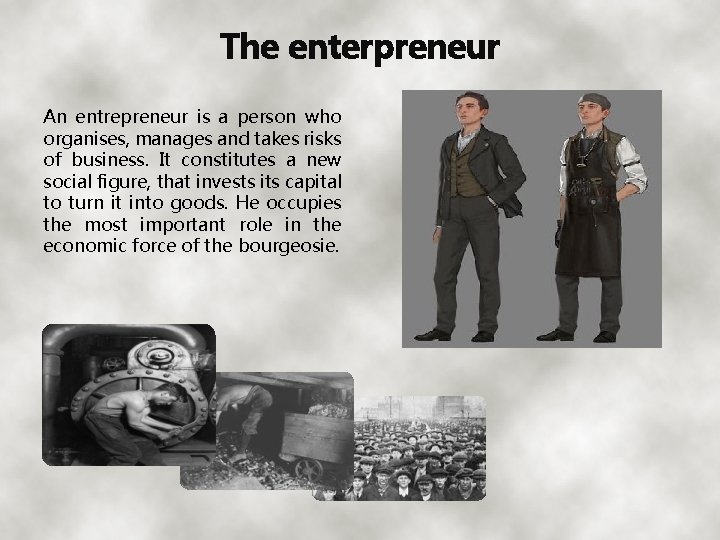
The enterpreneur An entrepreneur is a person who organises, manages and takes risks of business. It constitutes a new social figure, that invests its capital to turn it into goods. He occupies the most important role in the economic force of the bourgeosie.
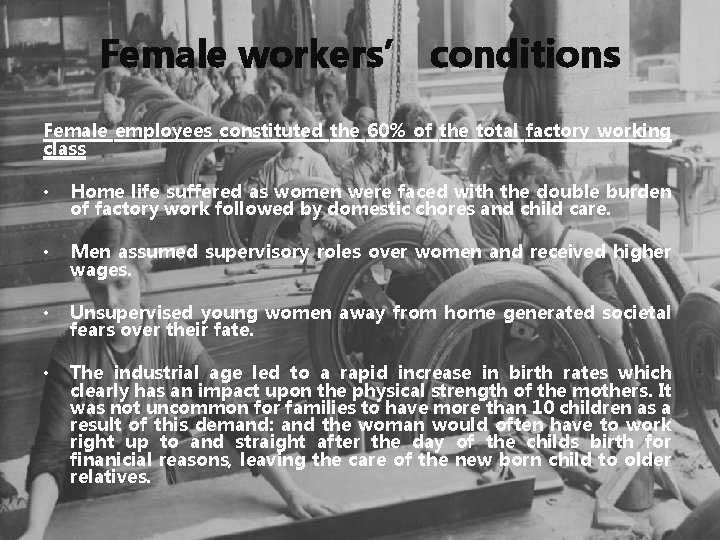
Female workers’ conditions Female employees constituted the 60% of the total factory working class • Home life suffered as women were faced with the double burden of factory work followed by domestic chores and child care. • Men assumed supervisory roles over women and received higher wages. • Unsupervised young women away from home generated societal fears over their fate. • The industrial age led to a rapid increase in birth rates which clearly has an impact upon the physical strength of the mothers. It was not uncommon for families to have more than 10 children as a result of this demand: and the woman would often have to work right up to and straight after the day of the childs birth for finanicial reasons, leaving the care of the new born child to older relatives.
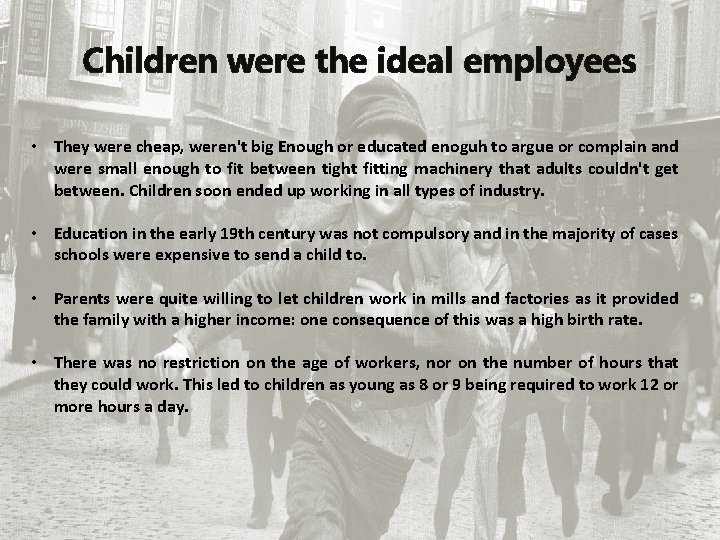
Children were the ideal employees • They were cheap, weren't big Enough or educated enoguh to argue or complain and were small enough to fit between tight fitting machinery that adults couldn't get between. Children soon ended up working in all types of industry. • Education in the early 19 th century was not compulsory and in the majority of cases schools were expensive to send a child to. • Parents were quite willing to let children work in mills and factories as it provided the family with a higher income: one consequence of this was a high birth rate. • There was no restriction on the age of workers, nor on the number of hours that they could work. This led to children as young as 8 or 9 being required to work 12 or more hours a day.
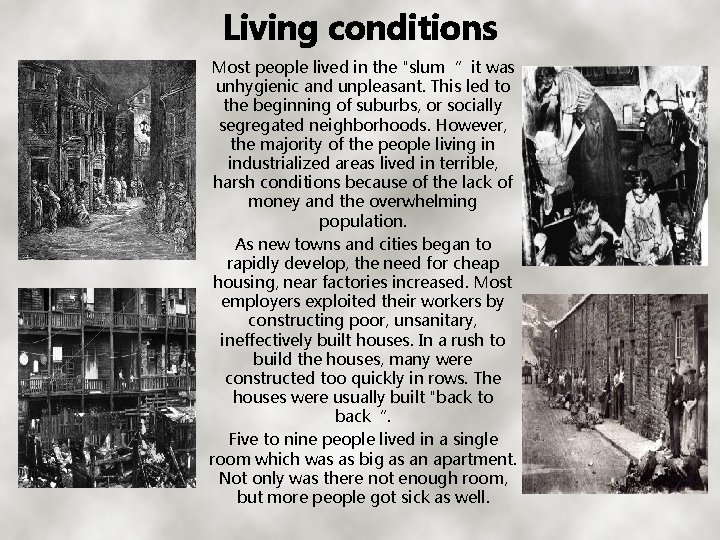
Living conditions Most people lived in the "slum“ it was unhygienic and unpleasant. This led to the beginning of suburbs, or socially segregated neighborhoods. However, the majority of the people living in industrialized areas lived in terrible, harsh conditions because of the lack of money and the overwhelming population. As new towns and cities began to rapidly develop, the need for cheap housing, near factories increased. Most employers exploited their workers by constructing poor, unsanitary, ineffectively built houses. In a rush to build the houses, many were constructed too quickly in rows. The houses were usually built "back to back“. Five to nine people lived in a single room which was as big as an apartment. Not only was there not enough room, but more people got sick as well.
The greatest killer in the cities … Everyone lived in terrible conditions and so close to one another, diseases spread rapidly and lack of medicine and medical care resulted in many deaths. Sanitary arrangements were often non-existent. Many toilets were found outside the houses, as far away as possible because of the horrible smell. The solid waste was usually just thrown in a large pile near their homes. The liquid for the toilets and waste would seep down into the ground and would often contaminate the water supplies. The liquids would carry disease and germs into their drinking water. This picture represents the most frequent disease, cholera.
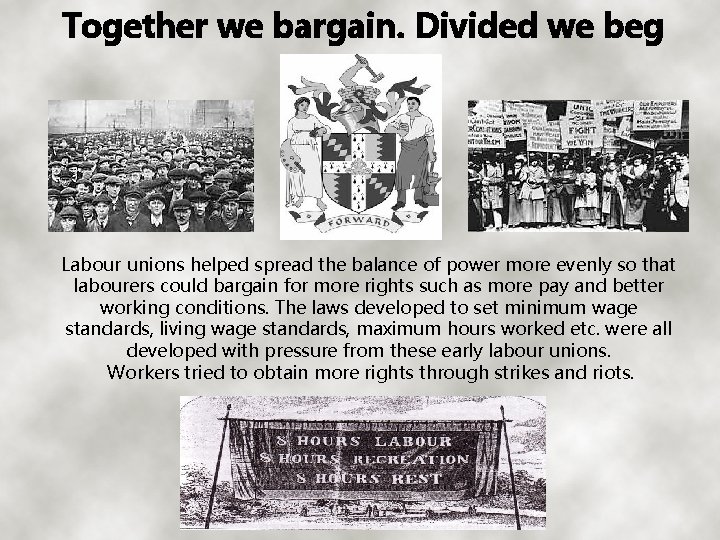
Together we bargain. Divided we beg Labour unions helped spread the balance of power more evenly so that labourers could bargain for more rights such as more pay and better working conditions. The laws developed to set minimum wage standards, living wage standards, maximum hours worked etc. were all developed with pressure from these early labour unions. Workers tried to obtain more rights through strikes and riots.
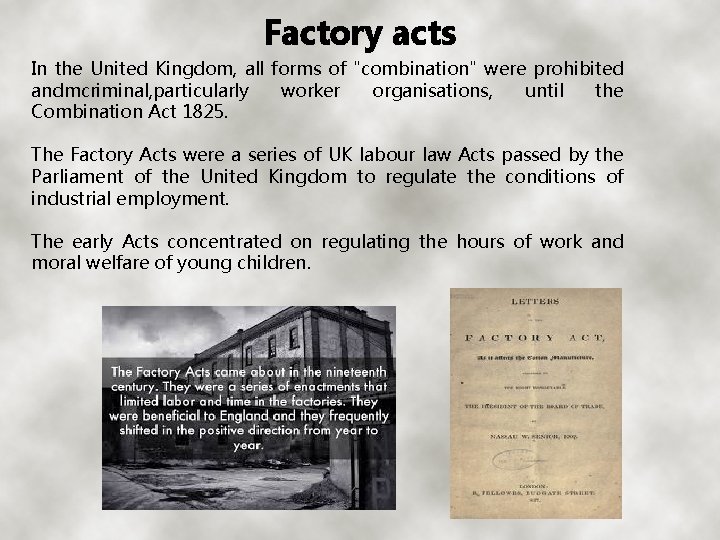
Factory acts In the United Kingdom, all forms of "combination" were prohibited andmcriminal, particularly worker organisations, until the Combination Act 1825. The Factory Acts were a series of UK labour law Acts passed by the Parliament of the United Kingdom to regulate the conditions of industrial employment. The early Acts concentrated on regulating the hours of work and moral welfare of young children.
THANKS FOR THE ATTENTION!!! ANGELINO BENEDETTA GIAQUINTO FILOMENA GUARINO VITTORIA RUOCCO MARIALUISA