
Industrial Radiography Basic Safety Requirements IAEA International Atomic
Industrial Radiography Basic Safety Requirements IAEA International Atomic Energy Agency Day 5 – Lecture 6
Contents • Compound Radiography - Design of enclosure - Effective engineering controls • Equipment Maintenance • Site Radiography Procedures IAEA 2

ALARA • Radiation exposures to be kept As Low As Reasonably Achievable. • Where practicable, to be achieved by means of engineered controls IAEA 3
Compounds (fixed facilities) • Enclosure design • Control of exposure IAEA 4
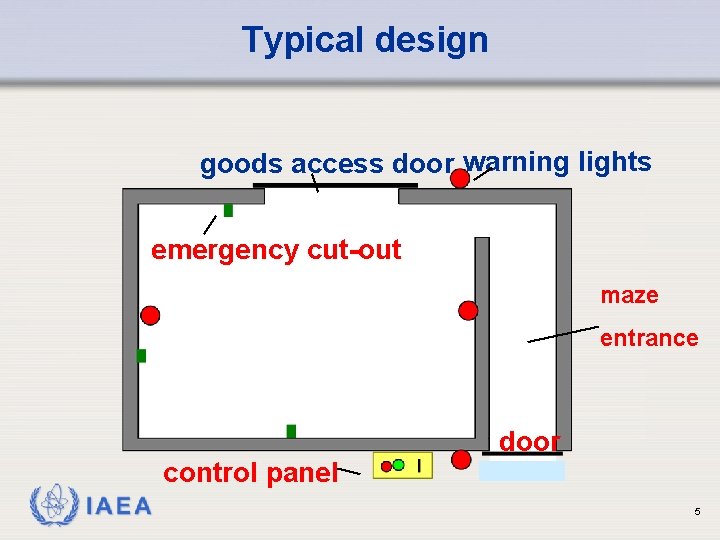
Typical design goods access door warning lights emergency cut-out maze entrance door control panel IAEA 5

Control of exposure Safety systems to prevent access during exposure : • door interlocks • fixed radiation monitors (gamma work) • emergency stops IAEA 6
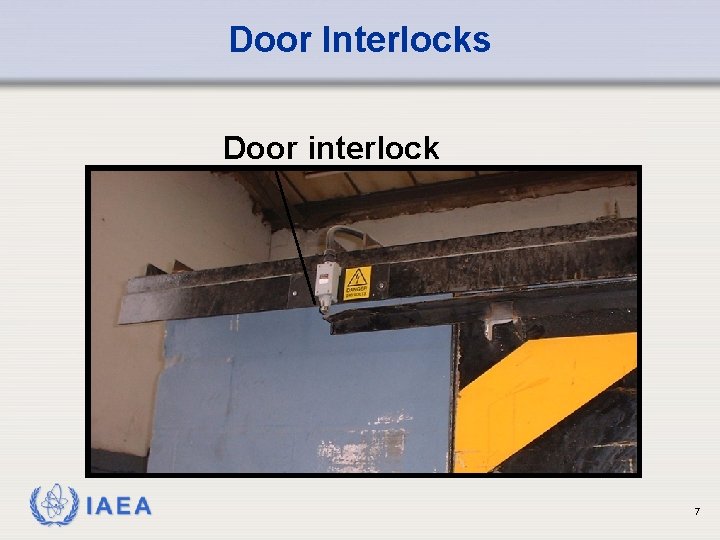
Door Interlocks Door interlock IAEA 7
Door Interlocks • Fail to safety • Not easily defeated • Easy to operate if frequent access required • Guarded interlocks to prevent tampering IAEA 8
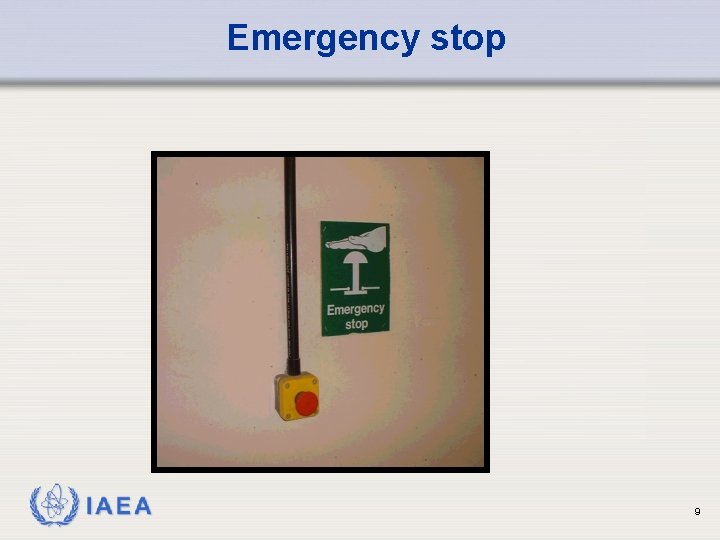
Emergency stop IAEA 9
Emergency stops • button/wire • located so it can be reached without passing primary beam • adequately labelled IAEA 10
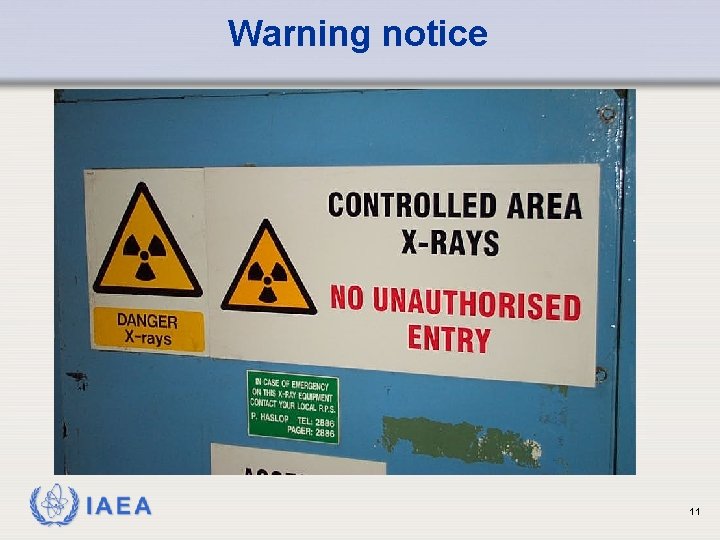
Warning notice IAEA 11
Warning devices • Pre-exposure signal (whistle, klaxon) • Source exposure warning light (flashing) • Notices explaining the meaning of the signals and actions to be taken - local language - inside and outside the compound IAEA 12
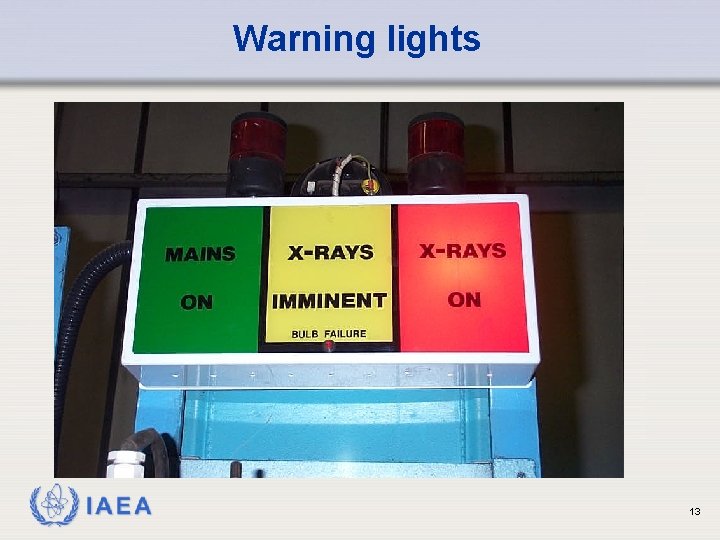
Warning lights IAEA 13
Worker protection Trapped persons should be able to : • leave enclosure, or • take refuge in shielded area, or • communicate with people outside (alarm) IAEA 14
Site Radiography IAEA 15
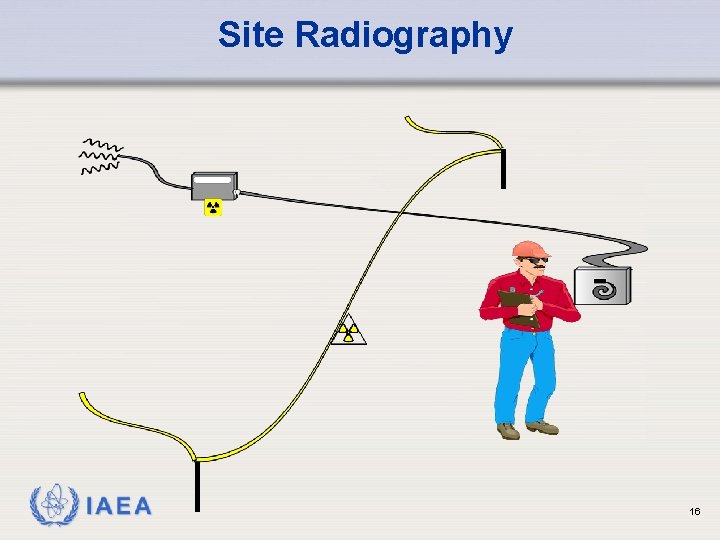
Site Radiography IAEA 16
Site Radiography Procedures 1. Prior to work • Prepare the area, consider : - beam collimation/beam direction - local shielding/ beam stop - Calculate distance of barrier • Advise site management IAEA 17
Site Radiography Procedures 2. During work • Designated controlled area - demarcated boundary - warning notices - boundary patrolled and monitored Effective communication between radiographers in a crew is essential IAEA 18
SAFE WORK PRACTICES The three simple rules to minimize personal radiation doses are: Ø Time: optimize number of exposures and the exposure time Ø Distance: keep as far away as practicable from the radiation sources during an exposure (ensuring adequate access control) Ø Shielding: use collimators or lead sheets (if provided) IAEA 19
General safe work practices • Radiation monitoring of the gamma radiography source container - to ensure that the radiation source is in its fully shielded position • Check that delivery tubes, extension tubes and all fittings are in good condition and are not kinked, cracked or broken. • All maintenance work on the equipment, that is not intended by the manufacturer to be undertaken by the user. • Personal alarm dosemeter & personal monitoring device are used at all times during industrial radiography operations IAEA 20
Safe work practices • The radioactive substance must be immediately returned to its fully shielded position on the completion of the exposure. • Prior to using the equipment, operators must ensure that: • all interlocks, shielding, collimators, signs, barriers and other safety devices are properly positioned; • all persons not involved in the operation are at safe locations; • suitable radiation monitoring equipment (ie a radiation survey meter) is available and in use. IAEA 21
Safe work practices • Equipment which is known to be or suspected of malfunctioning, or is damaged, must not be used. • Industrial radiography must be ceased by returning the radioactive source to its fully shielded position or by deenergising the X-ray tube, as applicable: Ø if a malfunction or suspected malfunction of the equipment occurs during operation; Ø if any person other than the industrial radiographer or assistant industrial radiographer enters a controlled area (where the dose rate exceeds or might exceeds a predetermined dose e. g. 25 Sv/h); or Ø if a radiation survey meter or a personal alarm dosimeter fails to function IAEA 22
Safe work practices Enclosed sites/ partially enclosed site • Before commencing an exposure, the industrial radiographer must visually inspect the site to ensure that it is unoccupied. • All entrances to the fully enclosed site must be locked, or interlocked to an audible and visible alarm, during radiographic exposure. • The radiation dose rate must be periodically measured by the industrial radiographer to ensure that it does not exceed the predetermined dose rates in any accessible area outside the partially enclosed or fully enclosed site. IAEA 23
Safe work practices Open sites • Erect a well defined and clearly visible boundary (using, for example flagged rope) around the site, including above and below the site as necessary. • The boundary must be located such that the maximum dose rate at the boundary is not exceeded. The boundary must be marked with radiation warning signs. • Radiography equipment and the item to be radiographed must be set up so that each of the components, particularly the X-ray tube or the radioactive substance holder (eg. collimator), are immobilized and therefore will not move during exposure. IAEA 24
Safe work practices Prior to using the equipment, industrial radiographers must ensure that: (i) all interlocks, shielding, collimators, signs, barriers and other safety devices are properly positioned; (ii) all persons not involved in the operation are at safe locations; and (iii) suitable radiation monitoring equipment (i. e. a radiation survey meter) is available and in use. (iv) Just prior to commencing an exposure, a warning signal must be given to warn persons within a reasonable distance that an exposure is about to take place. IAEA 25
Safe work practices During exposures • The area within the boundary must be kept under surveillance at all times during exposure to ensure that no person enters it or remains within it. After exposure • Before a site is vacated, the industrial radiographer must ensure, by monitoring, that all radiation sources are locked in the fully shielded condition or switched off, as appropriate, and returned to the store or to the transport vehicle and that all boundary-defining equipment has been removed. IAEA 26
Equipment Maintenance Condition of containers : • clean (no grit/moisture) • shielding intact • warning notices/source details IAEA 27
Equipment Maintenance Condition/operation of wind-out gear: • cable crank • locking key/mechanism • guide tube • connectors IAEA 28
Equipment Maintenance Sources to be leak tested : • indirect wipe of surfaces (guide tube) • direct wipe of source (using specialised equipment) Carried out at intervals : • required by regulatory body, or • recommended by source manufacturer, or • following an incident IAEA 29
Transport of Gamma Radiography Equipment • The source control or shutter mechanism of the source container must be locked in the fully shielded position, and all port plugs must be securely fitted prior to transport. • Before and after transport, radiation monitoring must be carried out to demonstrate that: Ø the useful beam is properly attenuated with the shutter or source control mechanism in the fully shielded position; Ø the attenuated radiation exposure pattern is as expected (compare with the measurement in the radiation source movement record book); and Ø radiation dose rates do not exceed 2000 Sv/h at 5 cm from the external surface, or 100 Sv/h at 1 m from its surface. IAEA 30
Transport Of Gamma Radiography Equipment • If the gamma-radiography source container is packed in an outer shipping container, the source container must be firmly secured within the outer container. • The gamma-radiography source container is to be located in the vehicle so that the radiation dose received by any person traveling in the vehicle is as low as practicable. The maximum dose rate at the position of any person in the vehicle must not exceed 5 Sv/h. IAEA 31
Summary • Compound Radiography - Design of enclosure - Effective engineering controls • Site Radiography Procedures • Equipment Maintenance IAEA 32
- Slides: 32