
Industrial Radiography Accidents lessons learned IAEA International Atomic









- Slides: 29
Industrial Radiography Accidents : lessons learned IAEA International Atomic Energy Agency Day 5 – Lecture 7
Aims and Objectives • Be familiar with typical industrial radiography accidents • Understand specific contributing factors • Be aware of lessons learned from past accidents IAEA 2
Contents • Case histories described • Consequence of each accident • Lessons learned IAEA 3
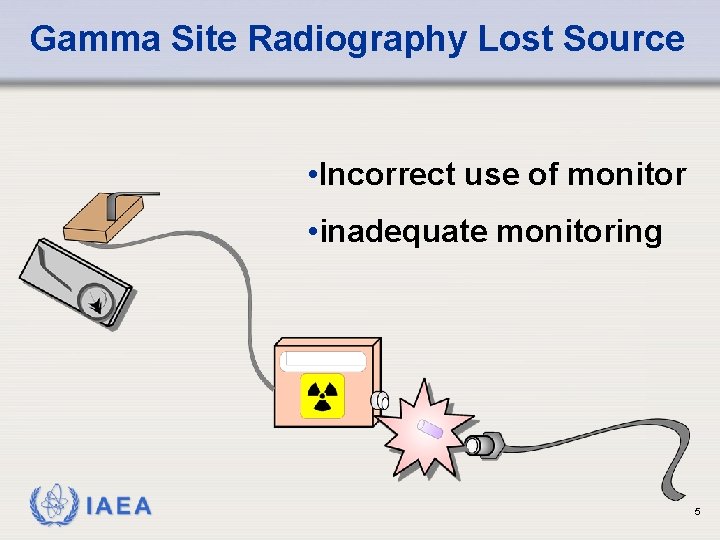
Gamma Site Radiography Lost Source • 550 GBq iridium-192 • source became detached, fell from guide tube • loss was realised after 5 days • 78 persons irradiated • doses ranged from 11 m. Sv to 150 m. Sv IAEA 4
Gamma Site Radiography Lost Source • Incorrect use of monitor • inadequate monitoring IAEA 5
Gamma Site Radiography Defective Equipment • • • 3. 2 TBq iridium-192 source jammed in exposed position no emergency equipment no local rules or exposure warnings IAEA assistance in source recovery 7 persons involved in recovery, all doses < 1. 0 m. Sv IAEA 6
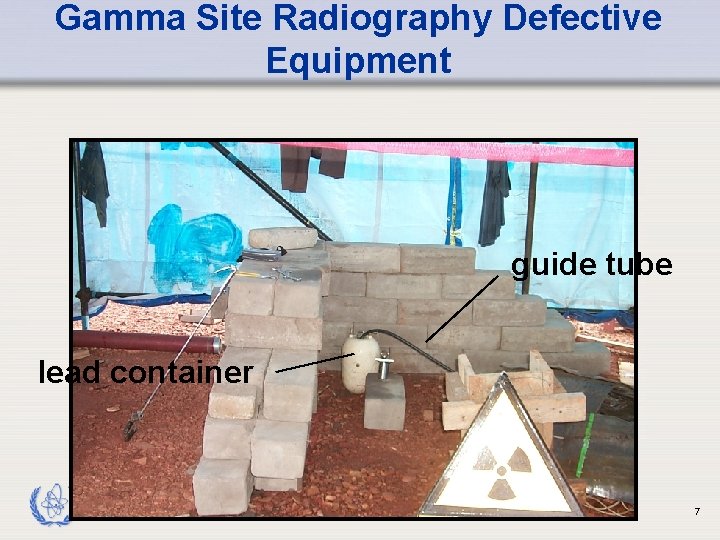
Gamma Site Radiography Defective Equipment guide tube lead container IAEA 7
Gamma Site Radiography Defective Equipment • source activity should be optimized- > 1. 8 TBq for site work should be justified • reasonably foreseeable accidents should be highlighted in prior safety assessments • adequate maintenance of ancillary equipment is essential • site radiography requires • appropriate emergency & ancillary equipment • trained personnel • adequate supervision IAEA 8
X-Ray Site Radiography Localised Exposure • X-Ray Site Radiography Localised Exposure 160 k. V x-rays • No exposure warnings • Fingers exposed to primary beam for ~ 10 seconds • Localised dose of ~ 60 Sv IAEA 9
X-Ray Site Radiography Localised Exposure • periodic checks on safety systems are essential • radiation monitoring is essential • local rules must be observed • personal alarm monitors can lessen the consequences of an accident IAEA 10
Gamma Site Radiography Disconnected Source • 1100 GBq iridium-192 • source became disconnected from the drive cable • source picked up by a member of the public and taken home • source “lost” from March to June • 8 persons died as direct result from exposure to radiation IAEA 11
Radiological Incident in Industrial Radiography February 20 th, 1999 IAEA 12
Incident Synthesis Location Hydroelectric Construction Site in Yanango. Distance from Lima: 300 km (East) District: San Román, Department of Junín. What Happened A non-authorised person unscrewed the screws of the security lock to free the radioactive source of a Gammagraph. No key is needed to remove the source, it can be done with an screwdriver. IAEA 13
Equipment’s Characteristics Security Lock Radionuclide: Ir 1 -92 IAEA Activity Max: 3. 7 TBq 14
Equipment’s Characteristics IAEA With a screwdriver, the safety lock can be removed and so the source is accessible 15
Chronology Welder q 4: 00 pm: A worker (welder) finds the source of gammagraphy (Ir-192) abandoned in a water pipe. He puts it in the back pocket of his trousers. q He works for six hours with the source in his pocket and his assistant nearby q 10: 00 pm: He leaves work, takes a bus and travels home (he felt little pain in his right leg). During his return, he travelled for 30 minutes with 15 people. q q q He thinks that the red skin is due to an insect sting. His wife sat on the trousers for 10 minutes to feed their baby. Two kids slept nearby. 11: 00 pm: The welder, takes the trousers off the room. IAEA 16
Chronology Operator q 10: 30 pm: The operator makes a gammagraphy. The radiation detector doesn’t detect any readings. He assumes the equipment is not working well and stop to have dinner. q 00: 00 am: He enters the water pipe, checks the gammagraphy equipment and finds the no screws nor radioactive source. They start looking for the source. q 1: 00 am: They find the welder in his house (February 21 st). He gets out with the source in his hands. The operator hits the welders hand, throws the source to the street and puts a stone to cover it. q The source is recovered and secured in a container with iron walls 2” thick. IAEA 17
Chronology What was done? Initially, the welder was hospitalised in the Cancer Centre of Lima. He was then sent to the Military Hospital “Precy de Claart” Grave Burns Treatment Centre in France. IAEA 18
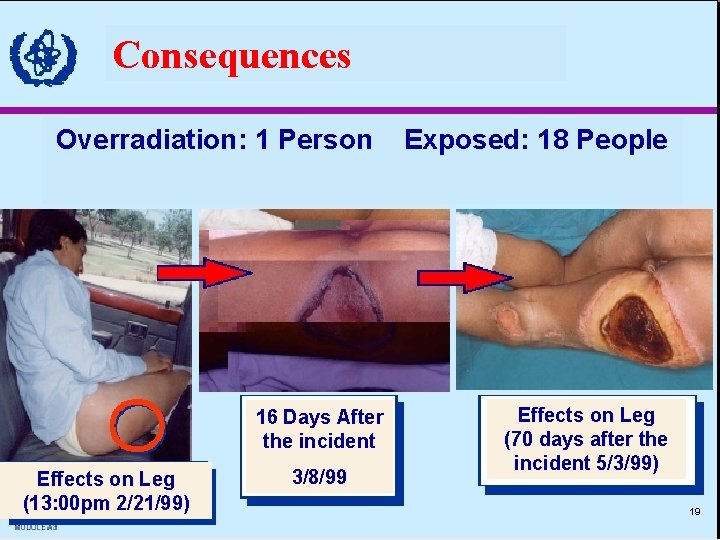
Consequences Overradiation: 1 Person 16 Days After the incident Effects on Leg (13: 00 pm 2/21/99) IAEA 3/8/99 Exposed: 18 People Effects on Leg (70 days after the incident 5/3/99) 19
Consequences Leg Amputation IAEA (10/18/99) Severe Infection 12/14/99 20
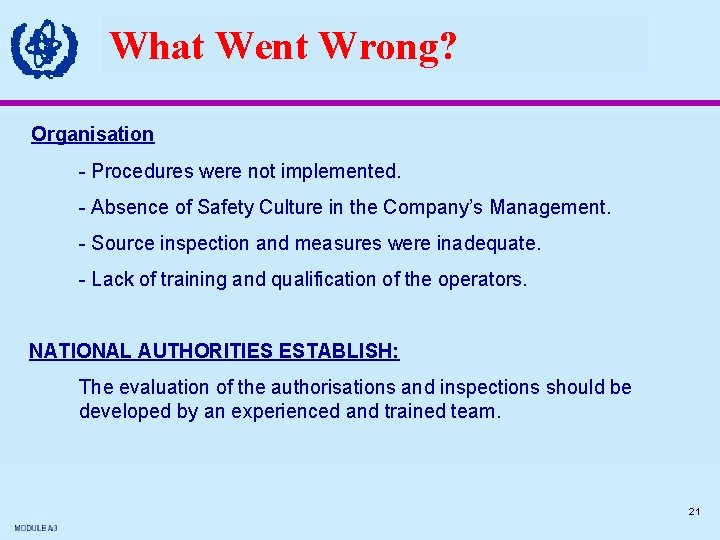
What Went Wrong? Organisation - Procedures were not implemented. - Absence of Safety Culture in the Company’s Management. - Source inspection and measures were inadequate. - Lack of training and qualification of the operators. NATIONAL AUTHORITIES ESTABLISH: The evaluation of the authorisations and inspections should be developed by an experienced and trained team. IAEA 21
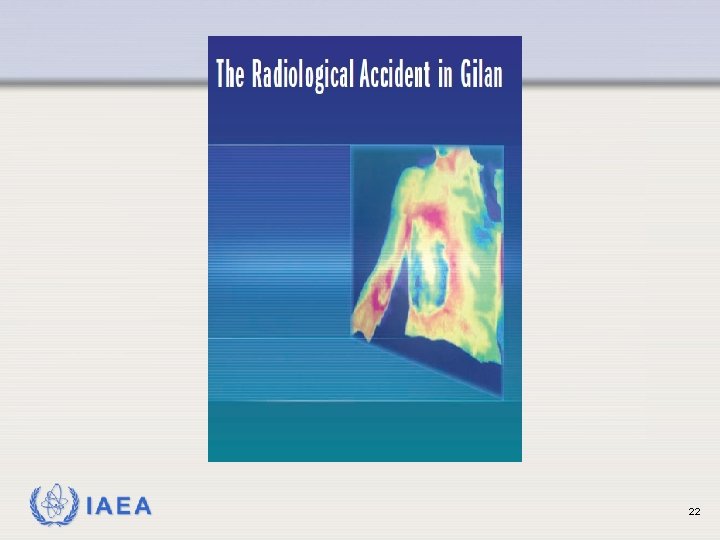
IAEA 22
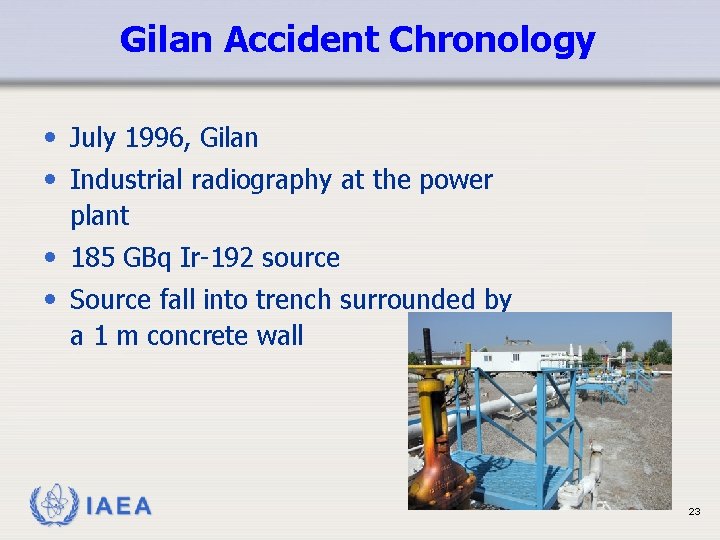
Gilan Accident Chronology • July 1996, Gilan • Industrial radiography at the power plant • 185 GBq Ir-192 source • Source fall into trench surrounded by a 1 m concrete wall IAEA 23
Gilan Accident Chronology • K. Z. plant worker was climbing up a ladder when he noticed a shiny metallic object • He picked it up and put it in pocket • At around 09: 30 he started to experience dizziness, nausea, lethargy and a burning feeling in his chest. • Believing that the object was a possible cause of his symptoms, he put it back IAEA 24
Gilan Accident Chronology • At around 09: 00, the radiographers observed that the source was not visible in the channel of its holder • A search was immediately initiated and the source was found in the trench at approximately 10: 00. • It was recovered and placed in a shielded container, and the Site Manager and the Radiation Protection Officer were informed. IAEA 25
Gilan Accident Chronology • At 13: 00, K. Z. told his colleagues that he was feeling weak and lethargic and he mentioned the strange shiny object that he had found and then put back in the trench. • The Site Manager was informed, and after consulting the Radiation Protection Officer he notified the Atomic Energy Organization of Iran (AEOI), who advised him to send K. Z. to a doctor to have blood samples taken. IAEA 26
Gilan Accident Consequences • Erythema on the right side of his chest extending to the upper abdomen. • Chest lesion continued to expand • Blistering • Estimated whole body dose of about 4. 5 Gy IAEA 27
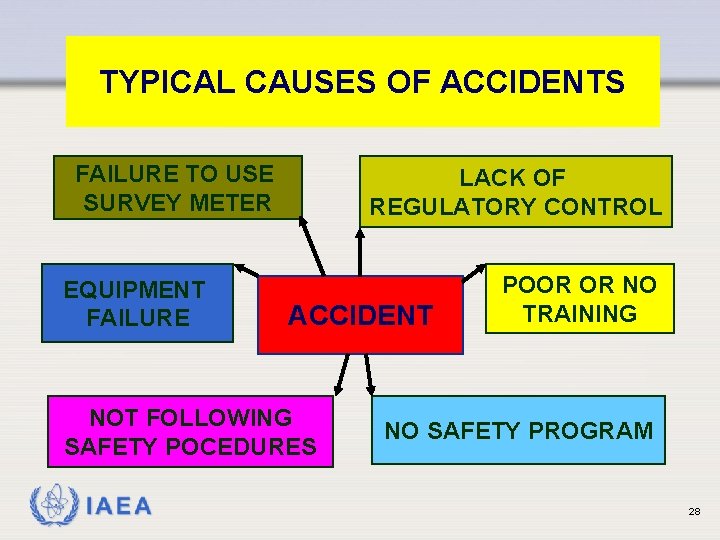
TYPICAL CAUSES OF ACCIDENTS FAILURE TO USE SURVEY METER EQUIPMENT FAILURE LACK OF REGULATORY CONTROL ACCIDENT NOT FOLLOWING SAFETY POCEDURES IAEA POOR OR NO TRAINING NO SAFETY PROGRAM 28
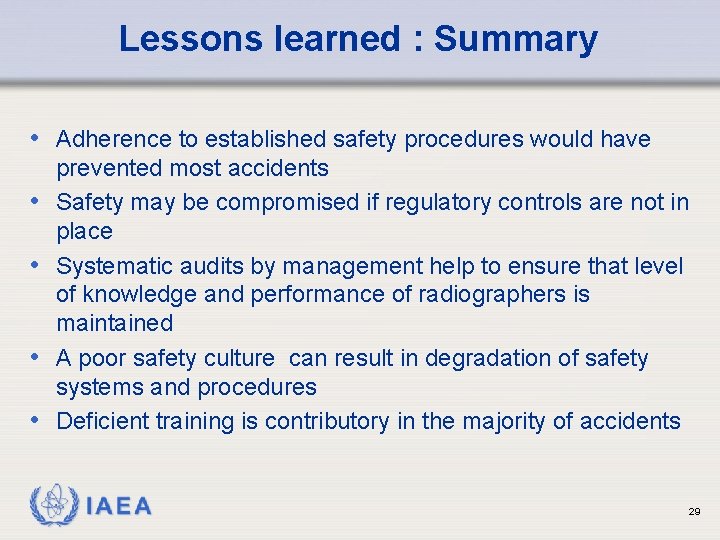
Lessons learned : Summary • Adherence to established safety procedures would have • • prevented most accidents Safety may be compromised if regulatory controls are not in place Systematic audits by management help to ensure that level of knowledge and performance of radiographers is maintained A poor safety culture can result in degradation of safety systems and procedures Deficient training is contributory in the majority of accidents IAEA 29