
Industrial Process Safety Lessons from major accidents and

- Slides: 46
Industrial Process Safety Lessons from major accidents and their application in traditional workplace safety and health Graham D. Creedy, P. Eng, FCIC, FEIC Formerly Senior Manager, Responsible Care® Canadian Chemical Producers’ Association (now Chemistry Industry Association of Canada) gcreedy@canadianchemistry. ca System Safety Society Spring Event May 26, 2011
Overview • How I got into this • The evolution of the philosophy of industrial safety and prevention of major accidents • Some key insights and concepts • How these apply to management of workplace safety in various sectors and at different levels of the organization 2
Some history • 1984 Bhopal accident is wake-up call to chemical industry • Industry responsibility to understand control hazards and risks • Responsible Care launched in Canada – Principles, codes, commitment, tools, support, progress tracking, verification • Major Industrial Accidents Council of Canada 1987 -1999 3
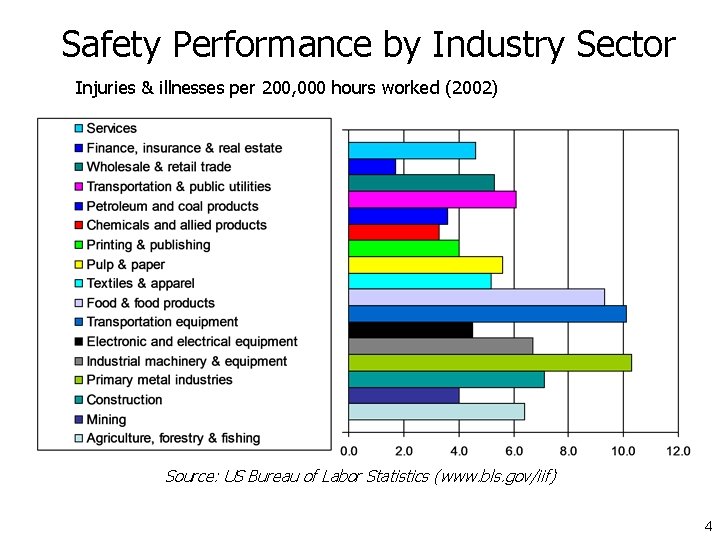
Safety Performance by Industry Sector Injuries & illnesses per 200, 000 hours worked (2002) Source: US Bureau of Labor Statistics (www. bls. gov/iif) 4
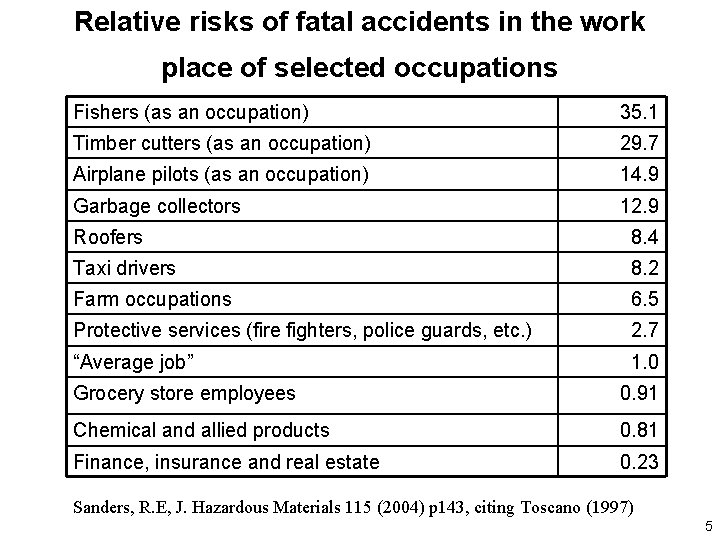
Relative risks of fatal accidents in the work place of selected occupations Fishers (as an occupation) 35. 1 Timber cutters (as an occupation) 29. 7 Airplane pilots (as an occupation) 14. 9 Garbage collectors 12. 9 Roofers 8. 4 Taxi drivers 8. 2 Farm occupations 6. 5 Protective services (fire fighters, police guards, etc. ) 2. 7 “Average job” 1. 0 Grocery store employees 0. 91 Chemical and allied products 0. 81 Finance, insurance and real estate 0. 23 Sanders, R. E, J. Hazardous Materials 115 (2004) p 143, citing Toscano (1997) 5
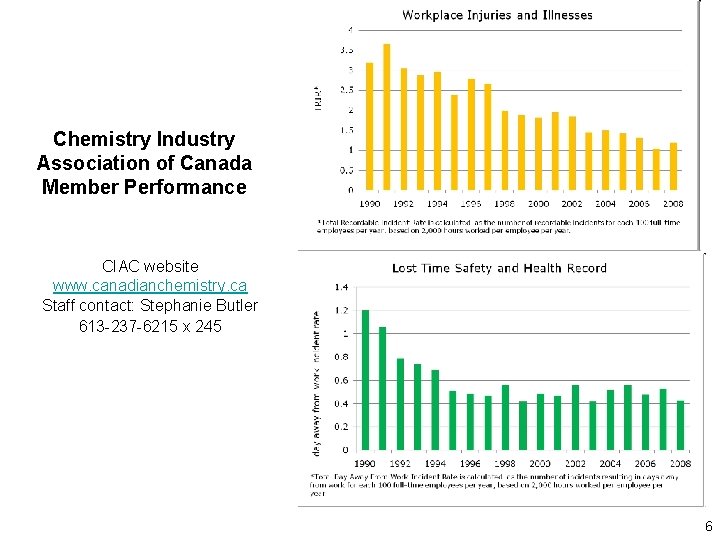
Chemistry Industry Association of Canada Member Performance CIAC website www. canadianchemistry. ca Staff contact: Stephanie Butler 613 -237 -6215 x 245 6
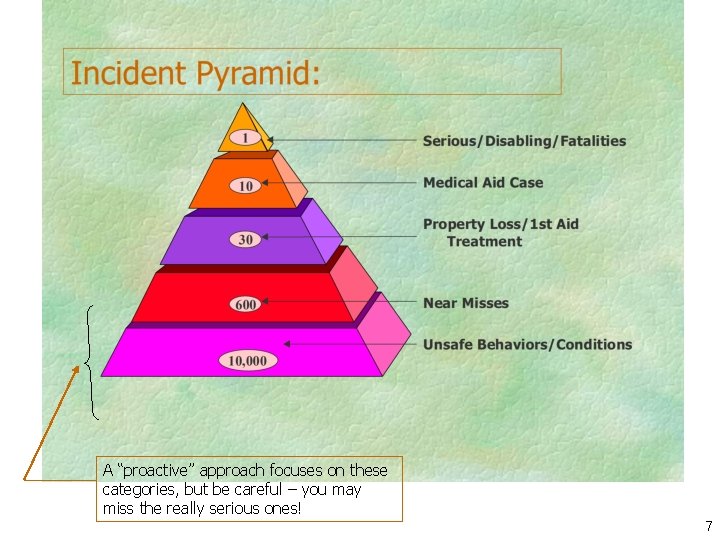
A “proactive” approach focuses on these categories, but be careful – you may miss the really serious ones! 7
Terminology • Process hazard – A physical situation with potential to cause harm to people, property or the environment • Risk (acute) – probability x consequences of an undesired event occurring 8
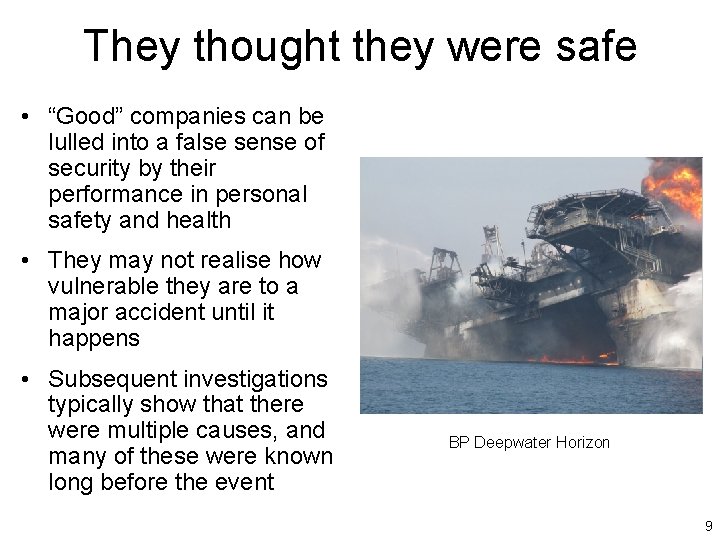
They thought they were safe • “Good” companies can be lulled into a false sense of security by their performance in personal safety and health • They may not realise how vulnerable they are to a major accident until it happens • Subsequent investigations typically show that there were multiple causes, and many of these were known long before the event BP Deepwater Horizon 9
Why and how defences fail • People often assume systems work as intended, despite warning signs • Examples of good performance are cited as representing the whole, while poor ones are overlooked or soon forgotten • Analysis of failure modes and effects should include human and organizational aspects as well as equipment, physical and IT systems 10
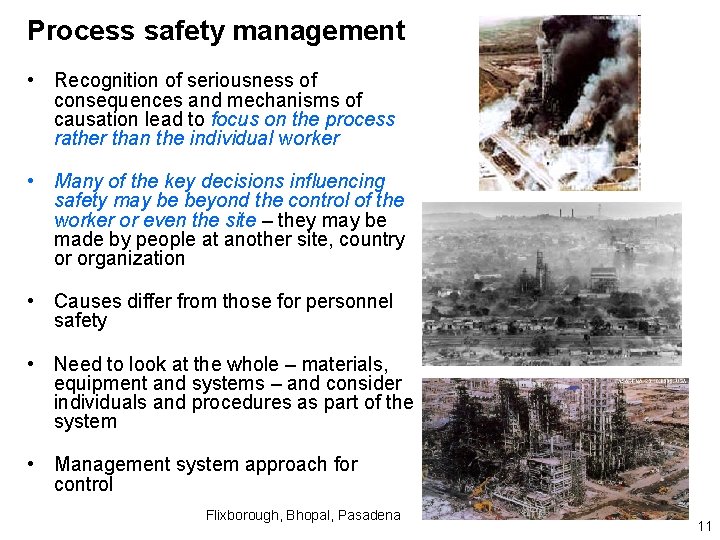
Process safety management • Recognition of seriousness of consequences and mechanisms of causation lead to focus on the process rather than the individual worker • Many of the key decisions influencing safety may be beyond the control of the worker or even the site – they may be made by people at another site, country or organization • Causes differ from those for personnel safety • Need to look at the whole – materials, equipment and systems – and consider individuals and procedures as part of the system • Management system approach for control Flixborough, Bhopal, Pasadena 11
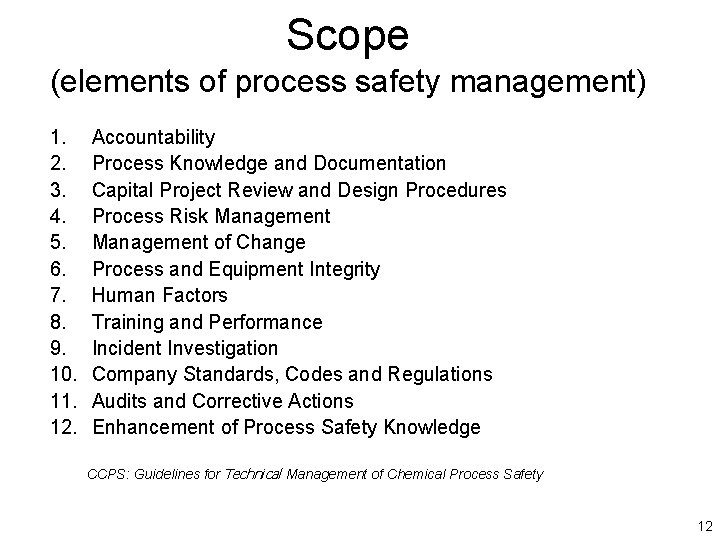
Scope (elements of process safety management) 1. 2. 3. 4. 5. 6. 7. 8. 9. 10. 11. 12. Accountability Process Knowledge and Documentation Capital Project Review and Design Procedures Process Risk Management of Change Process and Equipment Integrity Human Factors Training and Performance Incident Investigation Company Standards, Codes and Regulations Audits and Corrective Actions Enhancement of Process Safety Knowledge CCPS: Guidelines for Technical Management of Chemical Process Safety 12
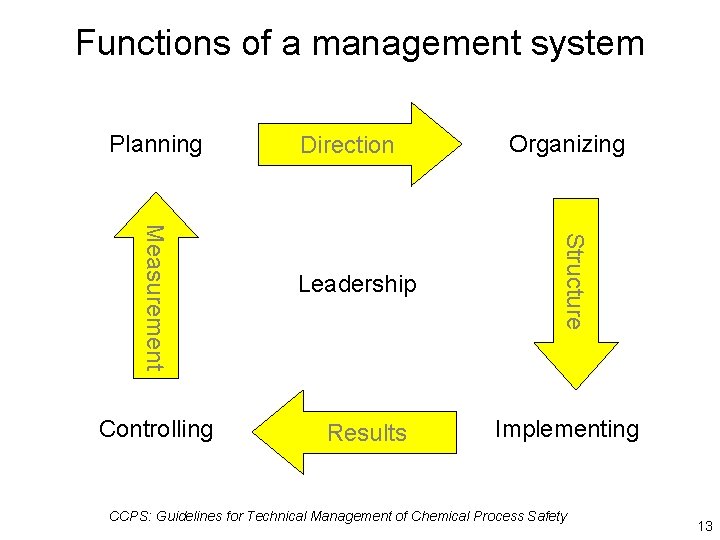
Functions of a management system Planning Leadership Results Organizing Structure Measurement Controlling Direction Implementing CCPS: Guidelines for Technical Management of Chemical Process Safety 13
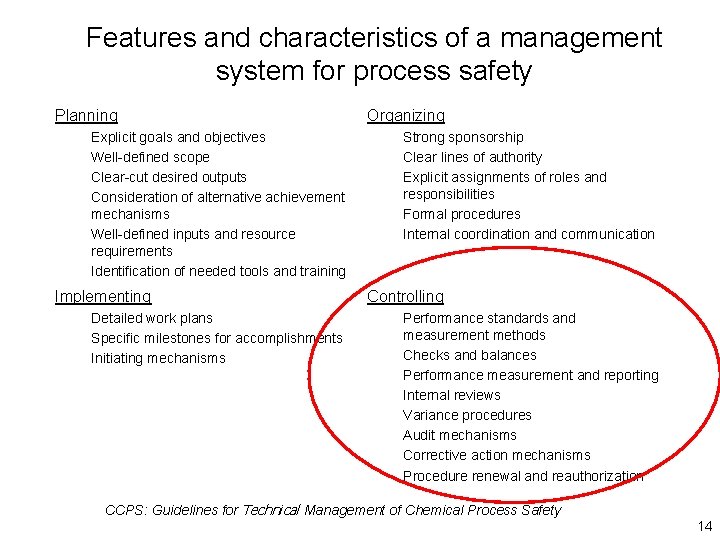
Features and characteristics of a management system for process safety Planning Explicit goals and objectives Well-defined scope Clear-cut desired outputs Consideration of alternative achievement mechanisms Well-defined inputs and resource requirements Identification of needed tools and training Implementing Detailed work plans Specific milestones for accomplishments Initiating mechanisms Organizing Strong sponsorship Clear lines of authority Explicit assignments of roles and responsibilities Formal procedures Internal coordination and communication Controlling Performance standards and measurement methods Checks and balances Performance measurement and reporting Internal reviews Variance procedures Audit mechanisms Corrective action mechanisms Procedure renewal and reauthorization CCPS: Guidelines for Technical Management of Chemical Process Safety 14
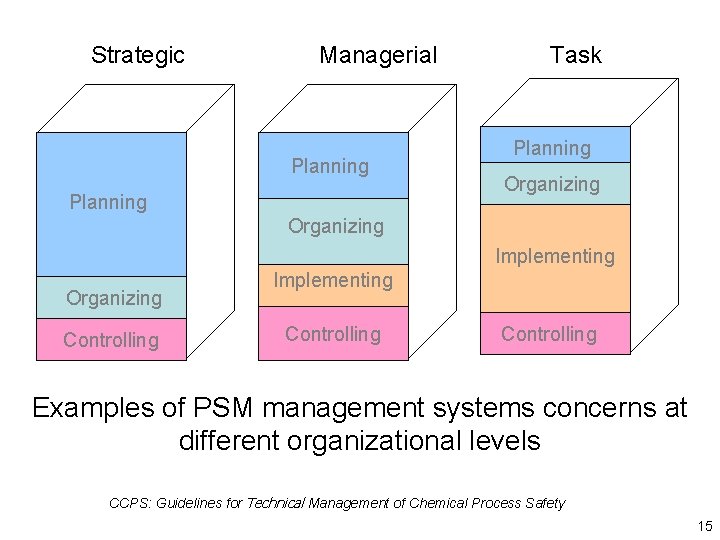
Strategic Managerial Planning Task Planning Organizing Implementing Organizing Controlling Implementing Controlling Examples of PSM management systems concerns at different organizational levels CCPS: Guidelines for Technical Management of Chemical Process Safety 15
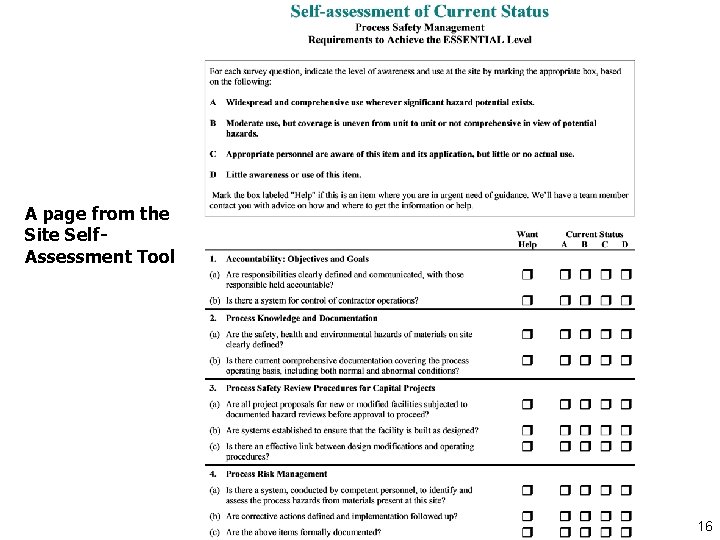
A page from the Site Self. Assessment Tool 16
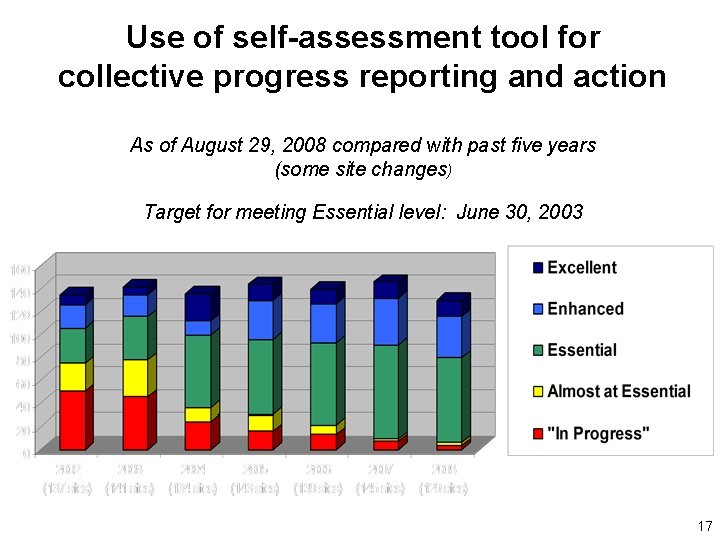
Use of self-assessment tool for collective progress reporting and action As of August 29, 2008 compared with past five years (some site changes) Target for meeting Essential level: June 30, 2003 17
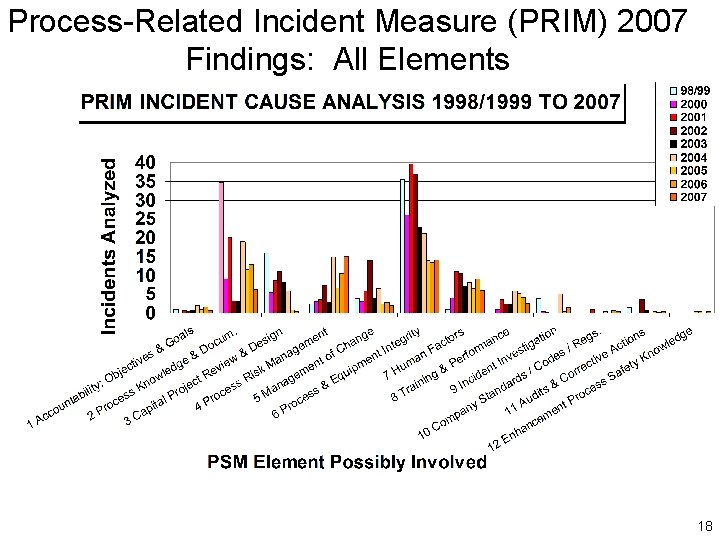
Process-Related Incident Measure (PRIM) 2007 Findings: All Elements 18
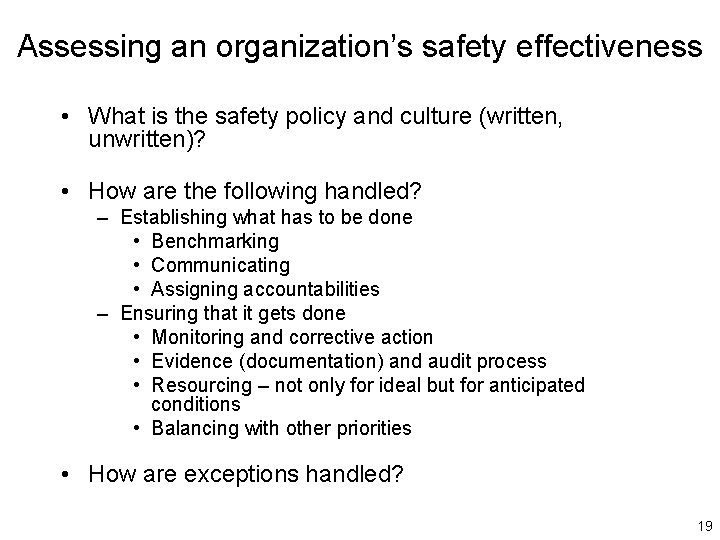
Assessing an organization’s safety effectiveness • What is the safety policy and culture (written, unwritten)? • How are the following handled? – Establishing what has to be done • Benchmarking • Communicating • Assigning accountabilities – Ensuring that it gets done • Monitoring and corrective action • Evidence (documentation) and audit process • Resourcing – not only for ideal but for anticipated conditions • Balancing with other priorities • How are exceptions handled? 19
Consider targets in groups • Those who: – Don’t care – Don’t know (and perhaps don’t know that they don’t know) – Did know, but may have forgotten or could have gaps in application (and perhaps don’t realize it) 20
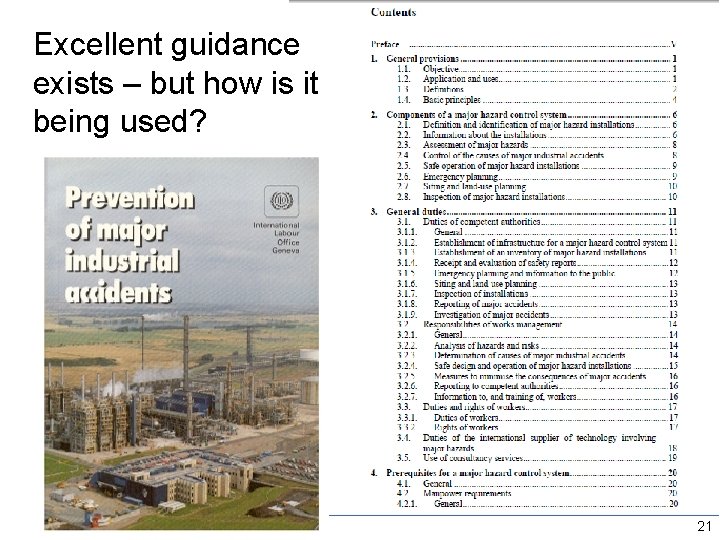
Excellent guidance exists – but how is it being used? 21
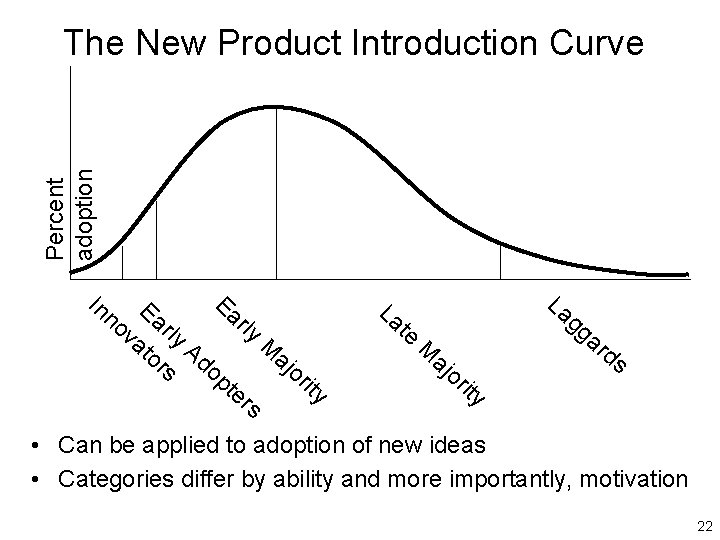
Percent adoption The New Product Introduction Curve Ea E no ar rly va ly M to Ad aj rs o or pt ity er s In La gg La te M aj or ity ar ds • Can be applied to adoption of new ideas • Categories differ by ability and more importantly, motivation 22
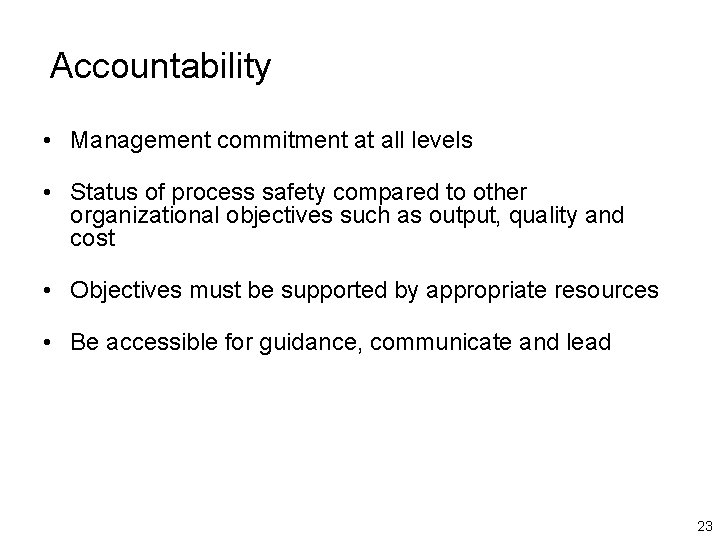
Accountability • Management commitment at all levels • Status of process safety compared to other organizational objectives such as output, quality and cost • Objectives must be supported by appropriate resources • Be accessible for guidance, communicate and lead 23
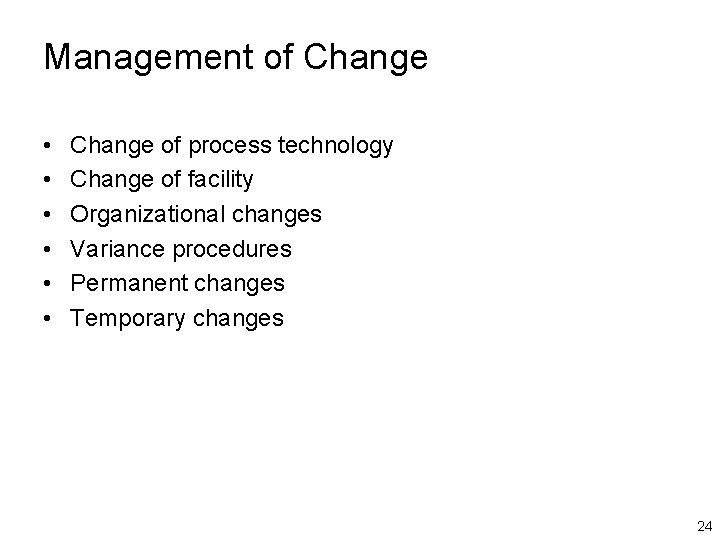
Management of Change • • • Change of process technology Change of facility Organizational changes Variance procedures Permanent changes Temporary changes 24
Process and Equipment Integrity • Design to handle all anticipated conditions, not just ideal or typical ones • Make sure what you get is what you designed (construction, installation) • Test to make sure the design is indeed valid • Make sure it stays that way – Preventative maintenance – Ongoing maintenance – Review • Be especially careful of automatic safeguards 25
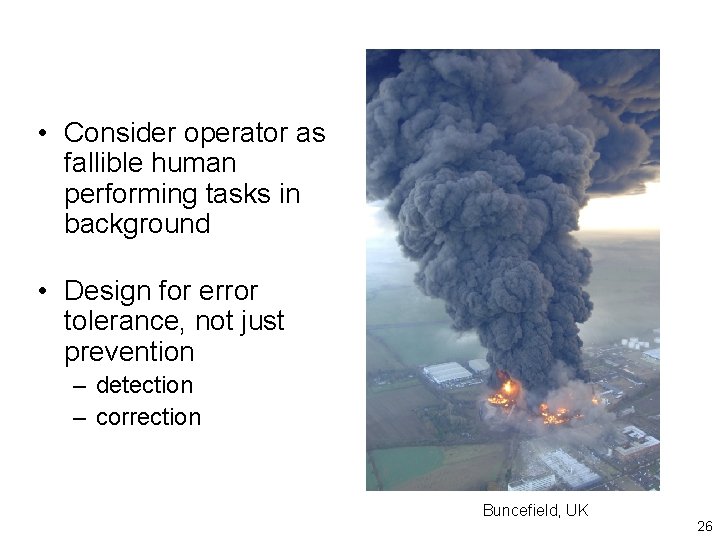
• Consider operator as fallible human performing tasks in background • Design for error tolerance, not just prevention – detection – correction Buncefield, UK 26
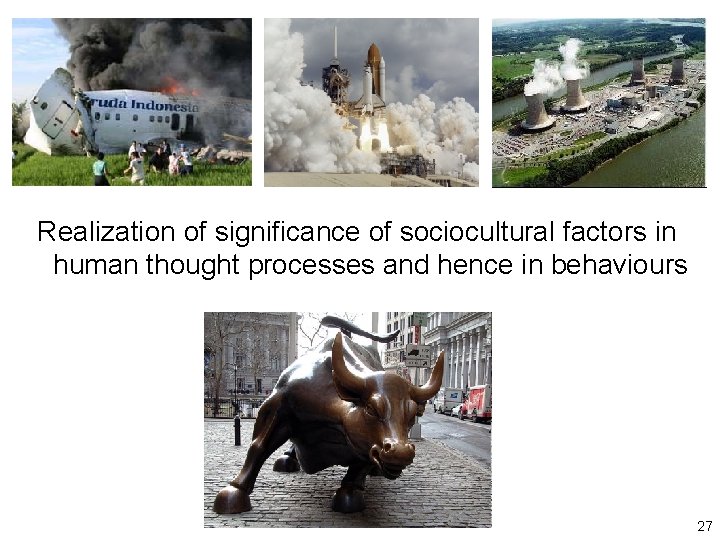
Realization of significance of sociocultural factors in human thought processes and hence in behaviours 27
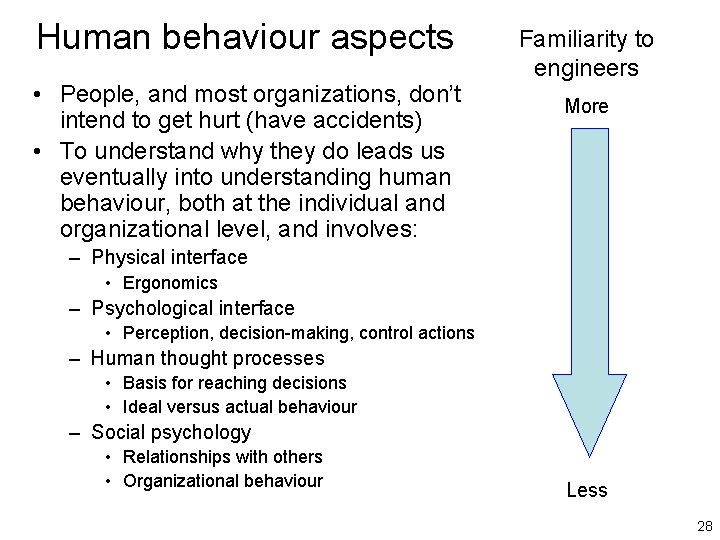
Human behaviour aspects • People, and most organizations, don’t intend to get hurt (have accidents) • To understand why they do leads us eventually into understanding human behaviour, both at the individual and organizational level, and involves: Familiarity to engineers More – Physical interface • Ergonomics – Psychological interface • Perception, decision-making, control actions – Human thought processes • Basis for reaching decisions • Ideal versus actual behaviour – Social psychology • Relationships with others • Organizational behaviour Less 28
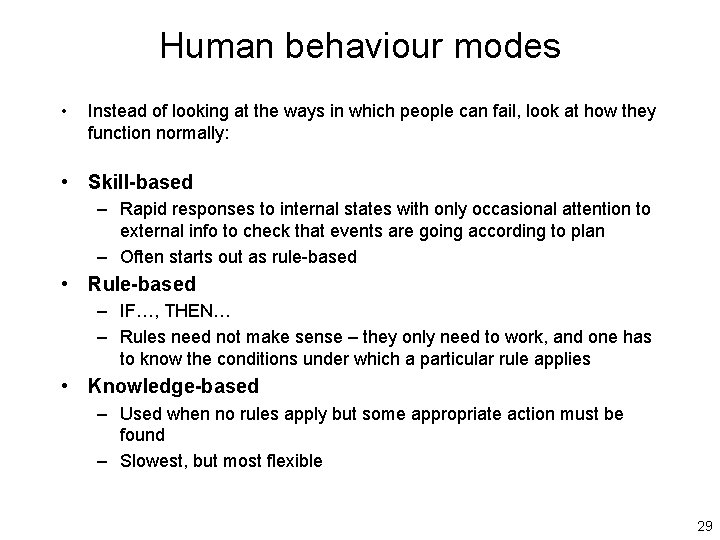
Human behaviour modes • Instead of looking at the ways in which people can fail, look at how they function normally: • Skill-based – Rapid responses to internal states with only occasional attention to external info to check that events are going according to plan – Often starts out as rule-based • Rule-based – IF…, THEN… – Rules need not make sense – they only need to work, and one has to know the conditions under which a particular rule applies • Knowledge-based – Used when no rules apply but some appropriate action must be found – Slowest, but most flexible 29
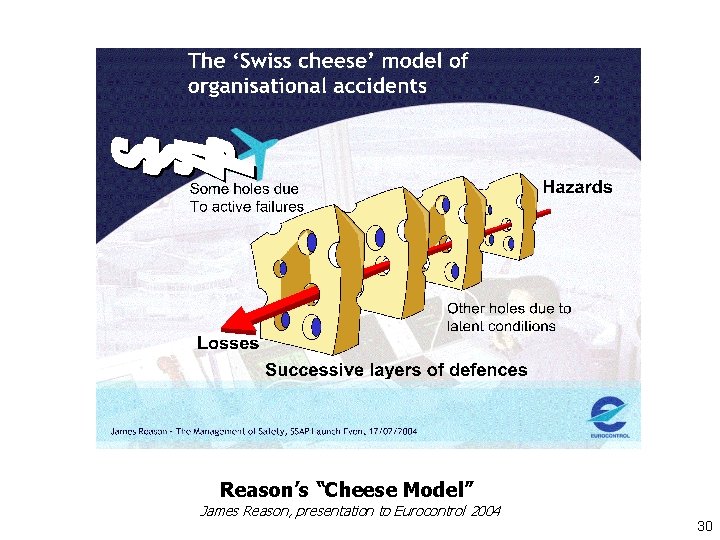
Reason’s “Cheese Model” James Reason, presentation to Eurocontrol 2004 30
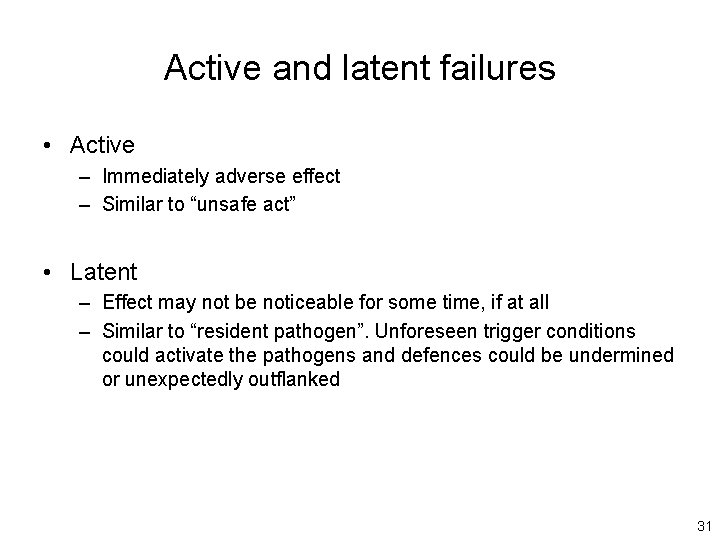
Active and latent failures • Active – Immediately adverse effect – Similar to “unsafe act” • Latent – Effect may not be noticeable for some time, if at all – Similar to “resident pathogen”. Unforeseen trigger conditions could activate the pathogens and defences could be undermined or unexpectedly outflanked 31
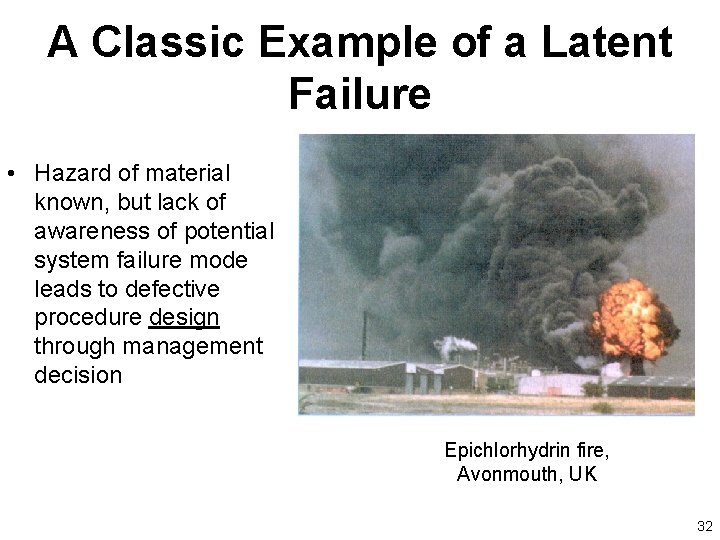
A Classic Example of a Latent Failure • Hazard of material known, but lack of awareness of potential system failure mode leads to defective procedure design through management decision Epichlorhydrin fire, Avonmouth, UK 32
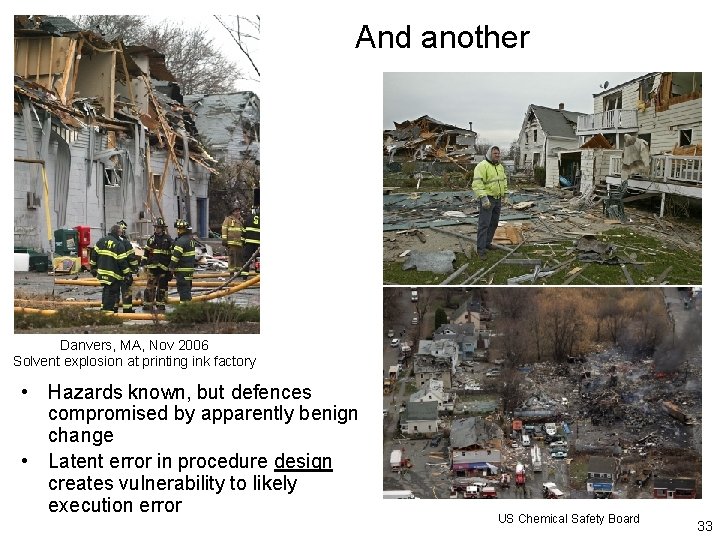
And another Danvers, MA, Nov 2006 Solvent explosion at printing ink factory • Hazards known, but defences compromised by apparently benign change • Latent error in procedure design creates vulnerability to likely execution error US Chemical Safety Board 33
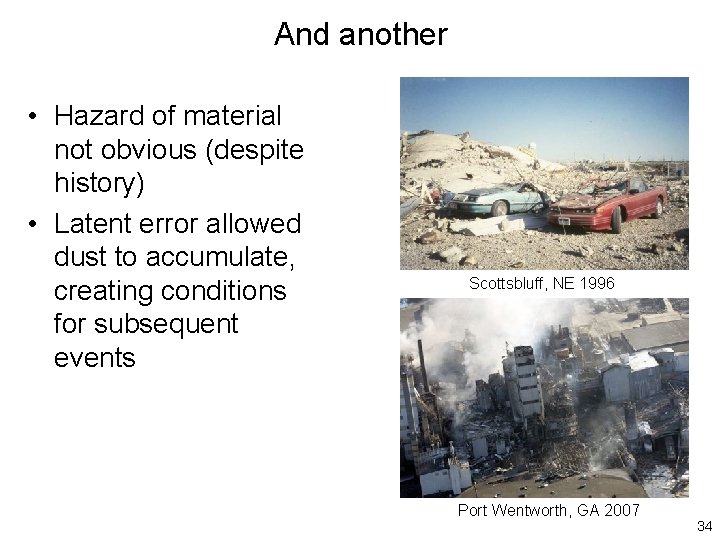
And another • Hazard of material not obvious (despite history) • Latent error allowed dust to accumulate, creating conditions for subsequent events Scottsbluff, NE 1996 Port Wentworth, GA 2007 34
Lessons from other fields • Aerospace and nuclear show significant human and organizational aspects can be even where the obvious signs of failure are technical in nature • Finance shows: – Relevance of such factors without technical distractions – How fast a system can deteriorate once controls are relaxed – How wrong risk assessments can influence bad policy decisions 35
Relevance of organizational factors “The relevance of organizational factors has also been graphically and tragically revealed in the inquiry reports of recent UK transportation and offshore oil disasters. Prior to. . . , senior managers in all the organizations propounded the pre-eminence of safety. They believed in the efficacy of the regulatory system, in the adequacy of their existing programs, and in their confidence of the skills and motivation of their staff. The inquiry reports reveal that their belief in safety was a mirage, their systems inadequate, and operator errors and violations commonplace. The inquiry reports stated that ultimate responsibility lay with complacent directors and managers who had failed to ensure that their good intentions were translated into a practical and monitored reality. Moreover, the weaknesses so starkly revealed were not matters of substantial concern to the regulatory authorities before the accidents. ” HSC, 1993 36
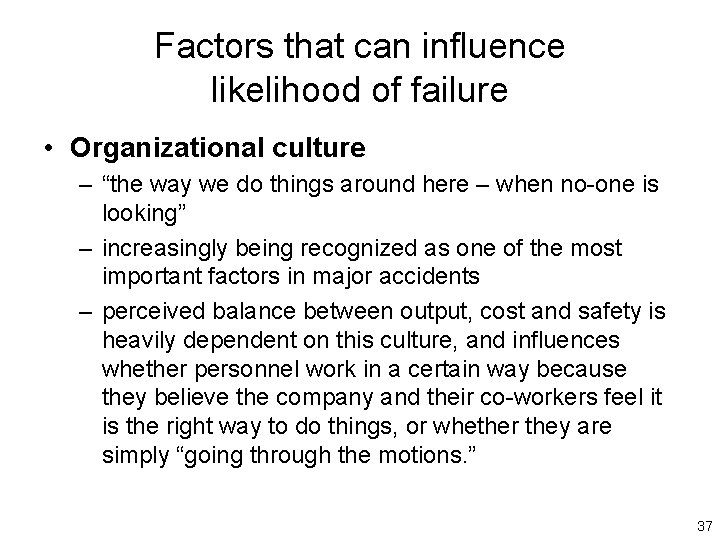
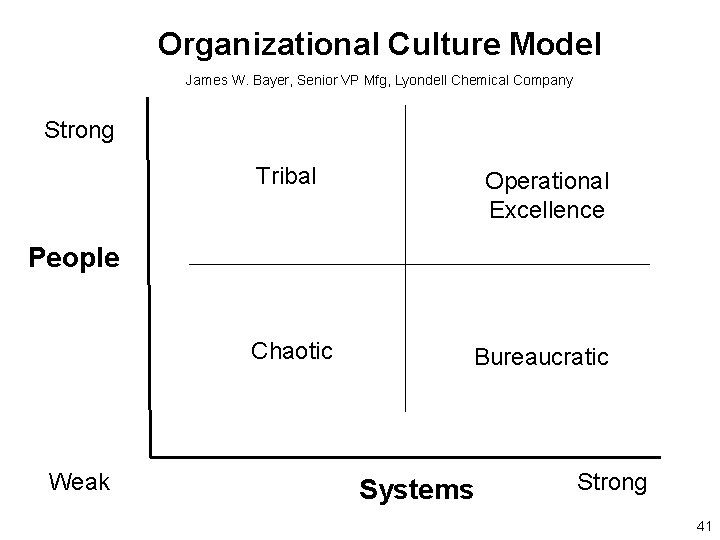
Factors that can influence likelihood of failure • Organizational culture – “the way we do things around here – when no-one is looking” – increasingly being recognized as one of the most important factors in major accidents – perceived balance between output, cost and safety is heavily dependent on this culture, and influences whether personnel work in a certain way because they believe the company and their co-workers feel it is the right way to do things, or whether they are simply “going through the motions. ” 37
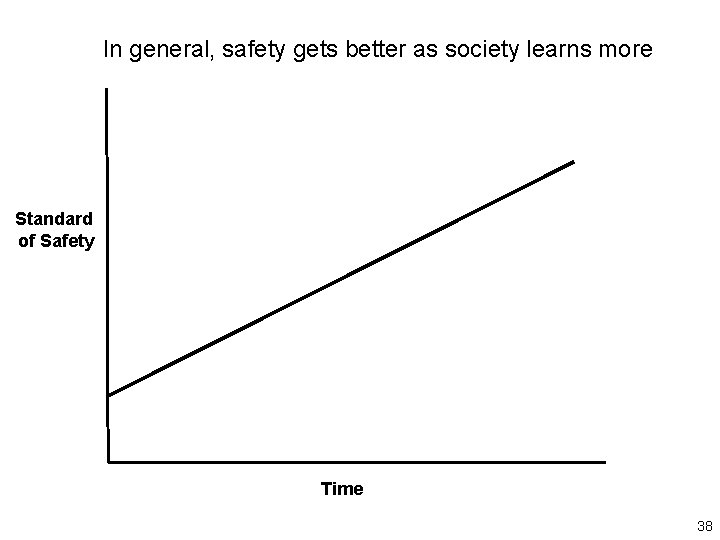
In general, safety gets better as society learns more Standard of Safety Time 38
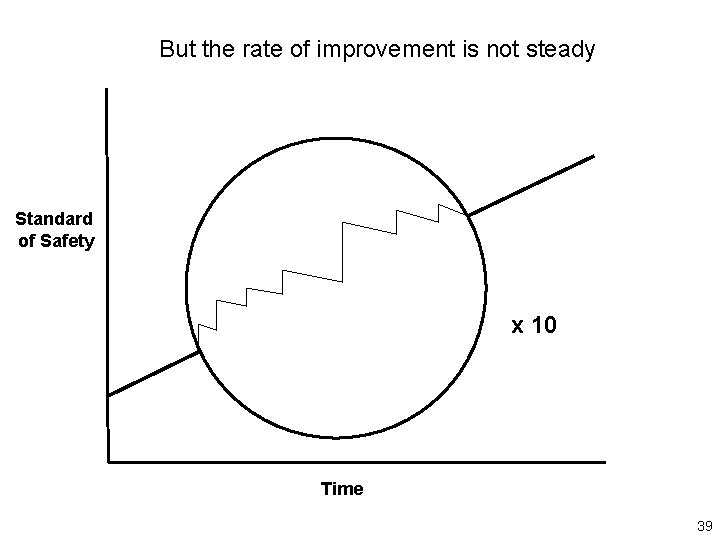
But the rate of improvement is not steady Standard of Safety x 10 Time 39
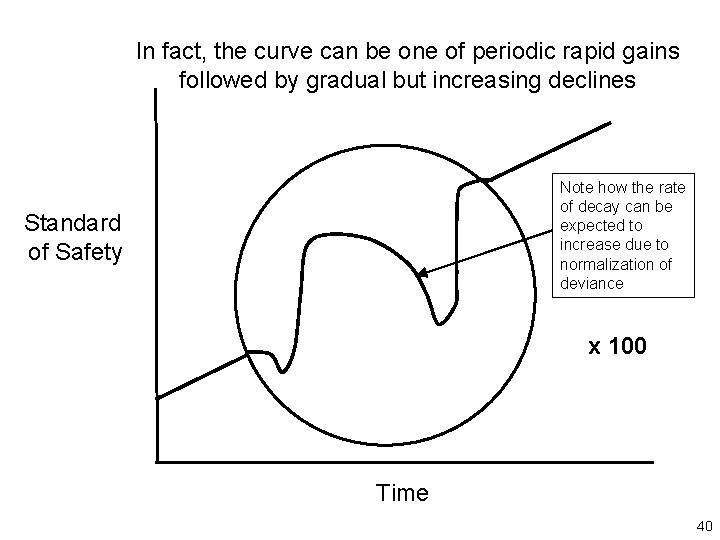
In fact, the curve can be one of periodic rapid gains followed by gradual but increasing declines Note how the rate of decay can be expected to increase due to normalization of deviance Standard of Safety x 100 Time 40
Organizational Culture Model James W. Bayer, Senior VP Mfg, Lyondell Chemical Company Strong Tribal Operational Excellence Chaotic Bureaucratic People Weak Systems Strong 41
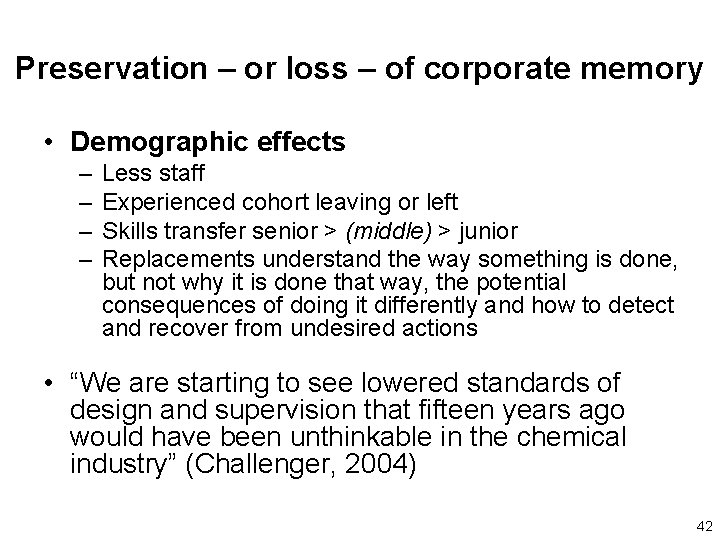
Preservation – or loss – of corporate memory • Demographic effects – – Less staff Experienced cohort leaving or left Skills transfer senior > (middle) > junior Replacements understand the way something is done, but not why it is done that way, the potential consequences of doing it differently and how to detect and recover from undesired actions • “We are starting to see lowered standards of design and supervision that fifteen years ago would have been unthinkable in the chemical industry” (Challenger, 2004) 42
• What does an organization’s investigation of its failures reveal about its: – Culture – Management system? 43
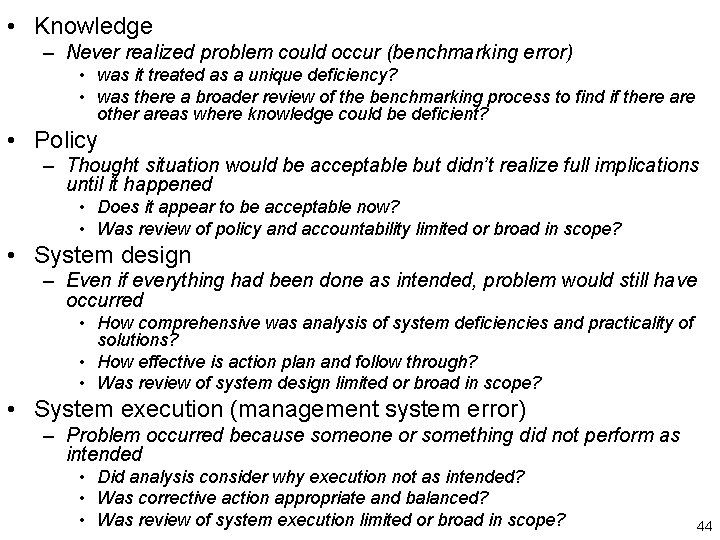
• Knowledge – Never realized problem could occur (benchmarking error) • was it treated as a unique deficiency? • was there a broader review of the benchmarking process to find if there are other areas where knowledge could be deficient? • Policy – Thought situation would be acceptable but didn’t realize full implications until it happened • Does it appear to be acceptable now? • Was review of policy and accountability limited or broad in scope? • System design – Even if everything had been done as intended, problem would still have occurred • How comprehensive was analysis of system deficiencies and practicality of solutions? • How effective is action plan and follow through? • Was review of system design limited or broad in scope? • System execution (management system error) – Problem occurred because someone or something did not perform as intended • Did analysis consider why execution not as intended? • Was corrective action appropriate and balanced? • Was review of system execution limited or broad in scope? 44
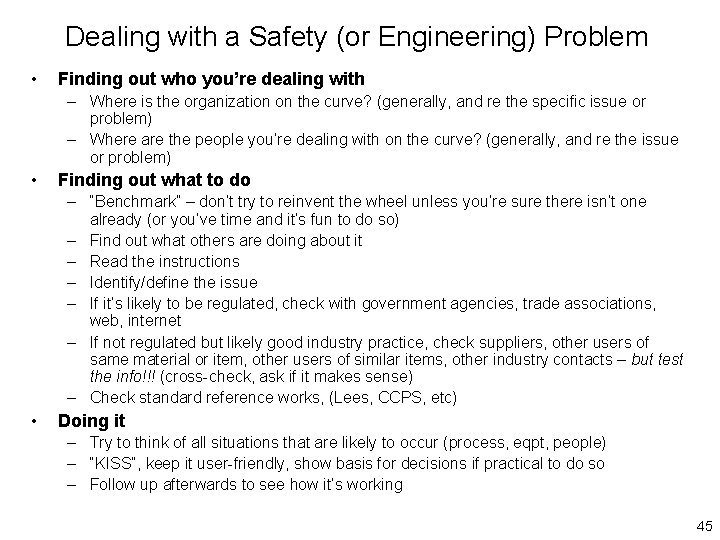
Dealing with a Safety (or Engineering) Problem • Finding out who you’re dealing with – Where is the organization on the curve? (generally, and re the specific issue or problem) – Where are the people you’re dealing with on the curve? (generally, and re the issue or problem) • Finding out what to do – “Benchmark” – don’t try to reinvent the wheel unless you’re sure there isn’t one already (or you’ve time and it’s fun to do so) – Find out what others are doing about it – Read the instructions – Identify/define the issue – If it’s likely to be regulated, check with government agencies, trade associations, web, internet – If not regulated but likely good industry practice, check suppliers, other users of same material or item, other users of similar items, other industry contacts – but test the info!!! (cross-check, ask if it makes sense) – Check standard reference works, (Lees, CCPS, etc) • Doing it – Try to think of all situations that are likely to occur (process, eqpt, people) – “KISS”, keep it user-friendly, show basis for decisions if practical to do so – Follow up afterwards to see how it’s working 45
Questions? 46