
INDUSTRIAL PROCESS CONTROL CONTROL OF HEAT EXCHANGER Nikhilbinoy

INDUSTRIAL PROCESS CONTROL: CONTROL OF HEAT EXCHANGER Nikhilbinoy. C Assistant Professor, ICE Department, N. S. S. College of Engineering, Palakkad.
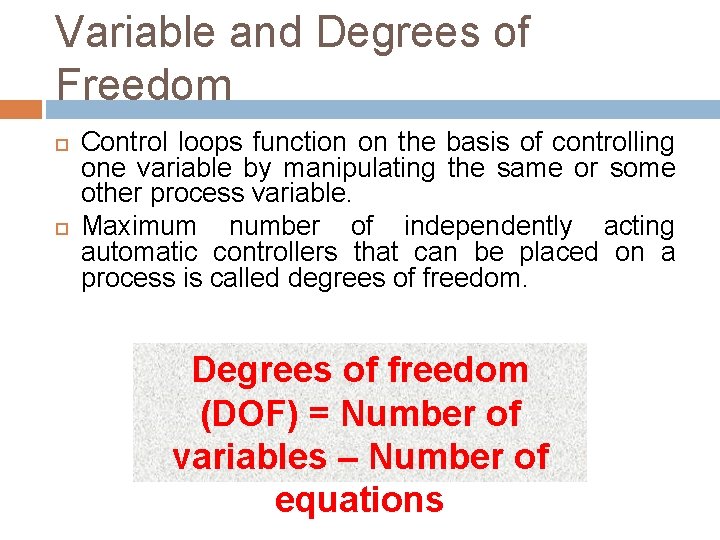
Variable and Degrees of Freedom Control loops function on the basis of controlling one variable by manipulating the same or some other process variable. Maximum number of independently acting automatic controllers that can be placed on a process is called degrees of freedom. Degrees of freedom (DOF) = Number of variables – Number of equations
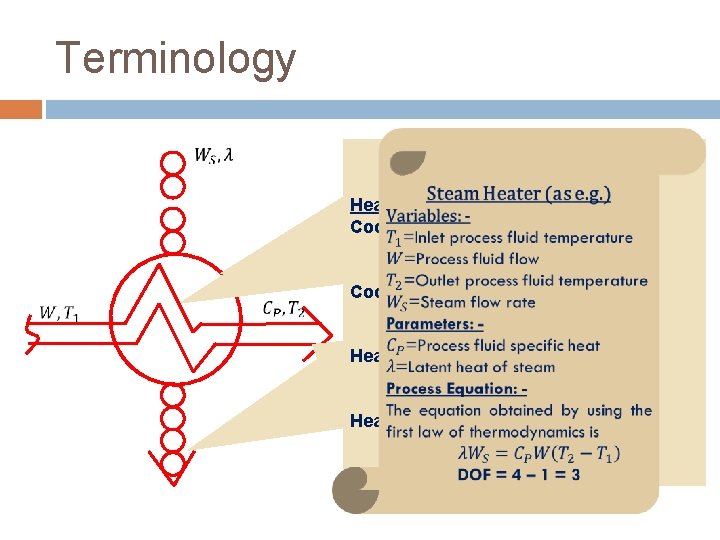
Terminology Types: 1)Transfer Liquid-to-liquid Heat Medium: Cooling exchanger liquid heat Process Medium: heater 2) Steam Process vapour liquid Cooling 3) - Through Condenser Tube: Shell: - Filled whichwith cold hot fluid is flowing 4) Reboiler Heating liquid Process Vapour Heating vapour
Liquid-to-Liquid Heat Exchanger
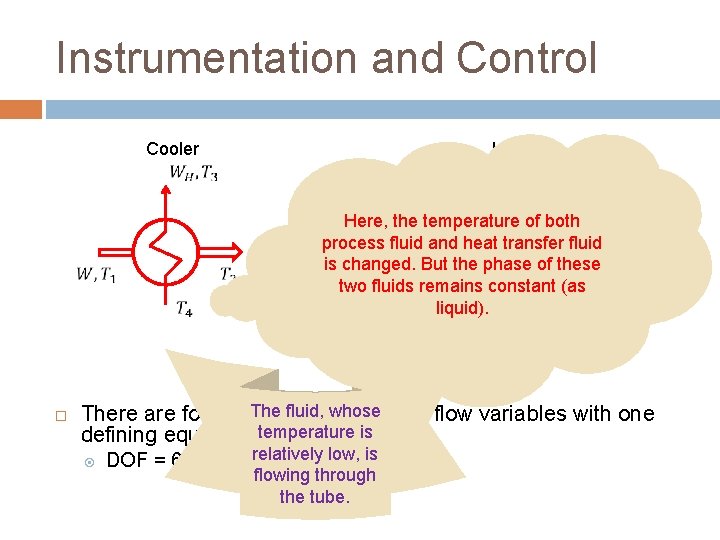
Instrumentation and Control Cooler Heater Here, the temperature of both process fluid and heat transfer fluid is changed. But the phase of these two fluids remains constant (as liquid). The fluid, whose There are four temperature and two flow variables with one defining equation. temperature is DOF = 6 – 1 = 5 relatively low, is flowing through the tube.

Instrumentation and Control TIC TIT TIC Location of CV is desirably at heat transfer medium side. Mounted on the low temperature side. Provided positioner to minimize valve friction effect. Equal percentage valve is recommended, which will maintain control system gain under changing throughput condition. Keep the relationship between valve opening and temperature change constant.
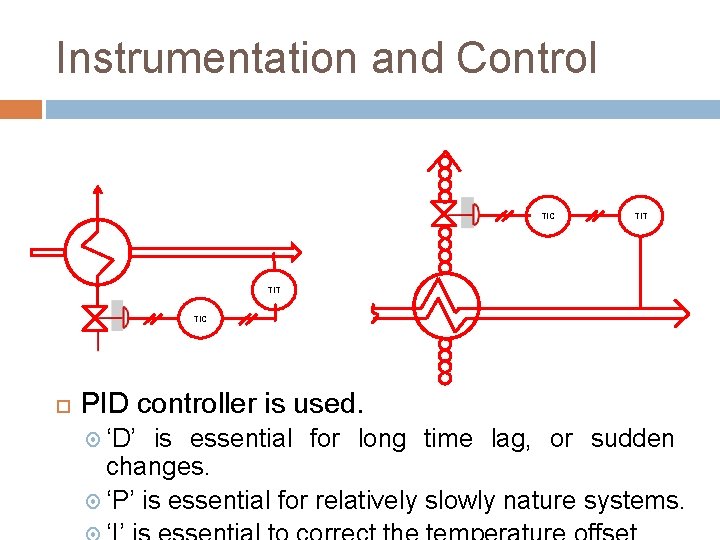
Instrumentation and Control TIC TIT TIC PID controller is used. ‘D’ is essential for long time lag, or sudden changes. ‘P’ is essential for relatively slowly nature systems.
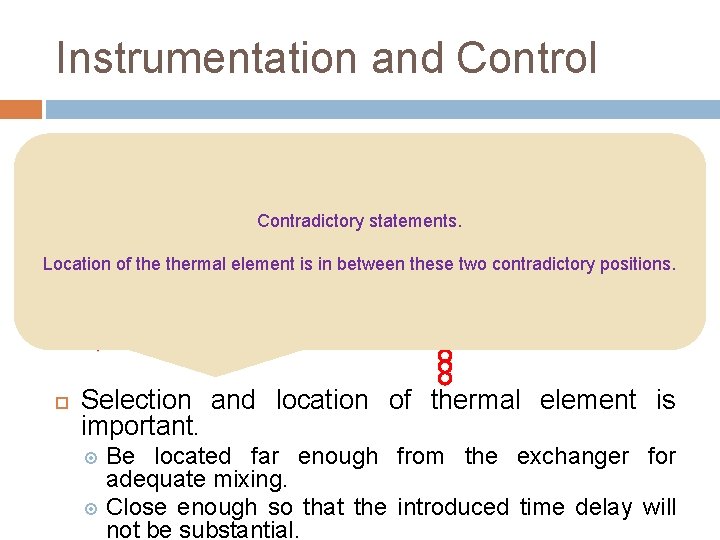
Instrumentation and Control Contradictory statements. TIC TIT Location of thermal element is in between these two contradictory positions. TIT TIC Selection and location of thermal element is important. Be located far enough from the exchanger for adequate mixing. Close enough so that the introduced time delay will not be substantial.
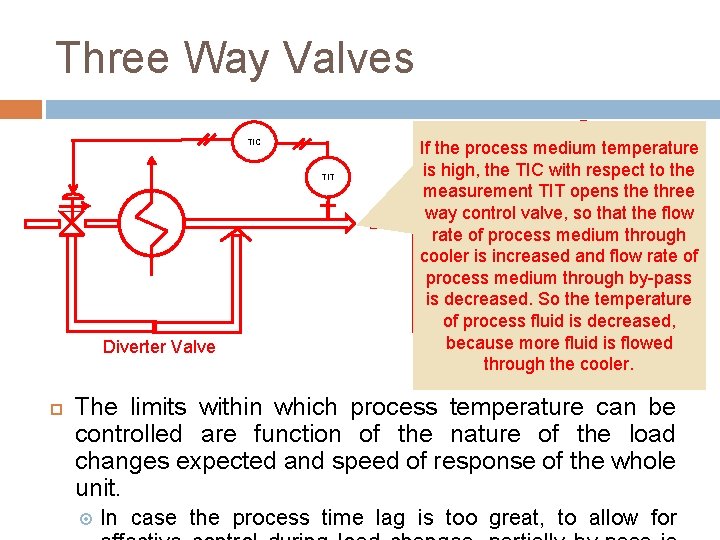
Three Way Valves TIC TIT Diverter Valve If the process medium temperature is high, the TIC with respect to the TIT measurement TIT opens the three way control valve, so that the flow rate of process medium through cooler is increased and flow rate of process medium through by-pass is decreased. So the temperature of process fluid is decreased, because more fluid is flowed Mixing Valve through the cooler. The limits within which process temperature can be controlled are function of the nature of the load changes expected and speed of response of the whole unit. In case the process time lag is too great, to allow for
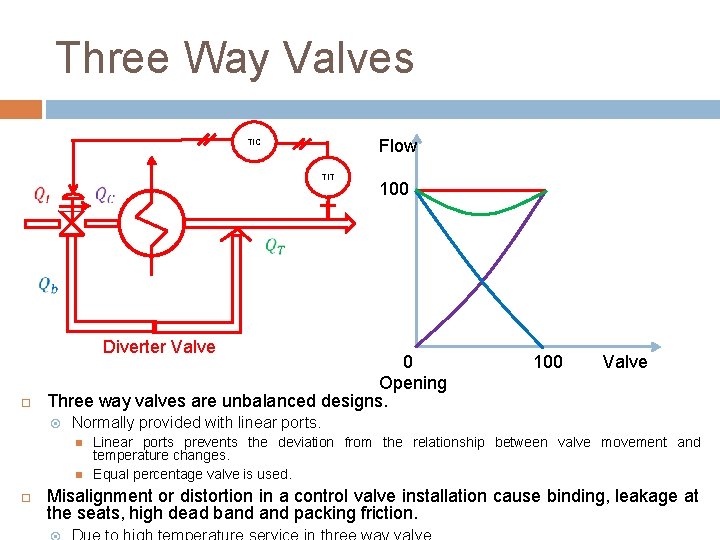
Three Way Valves Flow TIC TIT Diverter Valve 0 Opening Three way valves are unbalanced designs. 100 Valve Normally provided with linear ports. 100 Linear ports prevents the deviation from the relationship between valve movement and temperature changes. Equal percentage valve is used. Misalignment or distortion in a control valve installation cause binding, leakage at the seats, high dead band packing friction.
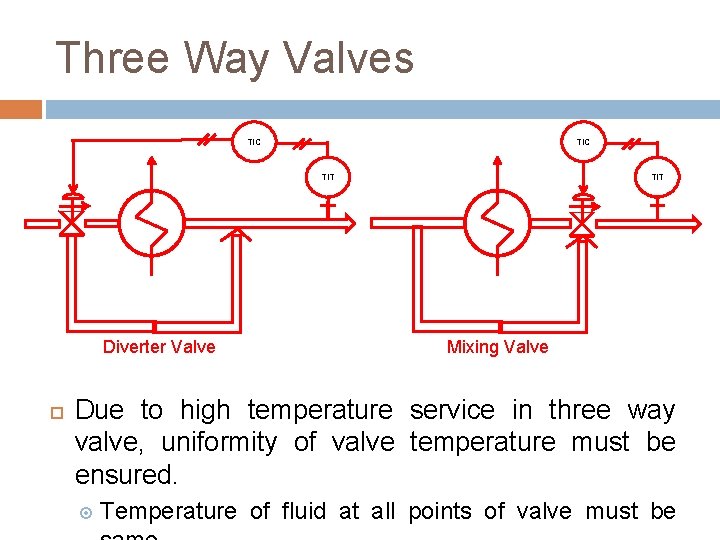
Three Way Valves TIC TIT Diverter Valve TIT Mixing Valve Due to high temperature service in three way valve, uniformity of valve temperature must be ensured. Temperature of fluid at all points of valve must be
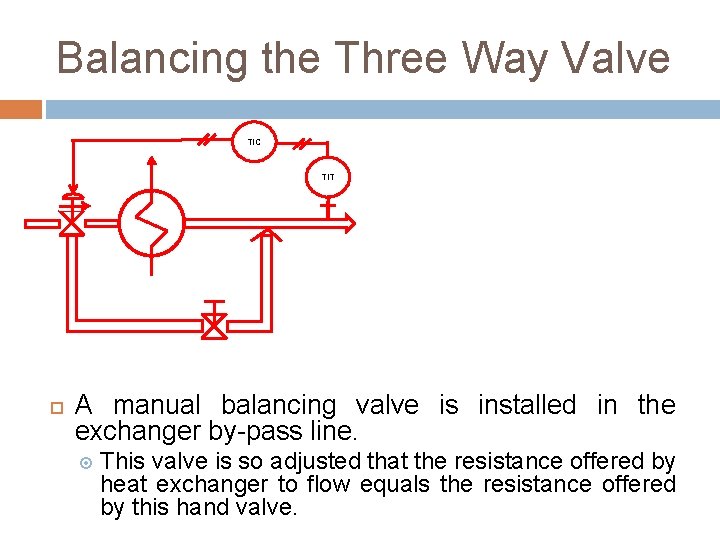
Balancing the Three Way Valve TIC TIT A manual balancing valve is installed in the exchanger by-pass line. This valve is so adjusted that the resistance offered by heat exchanger to flow equals the resistance offered by this hand valve.
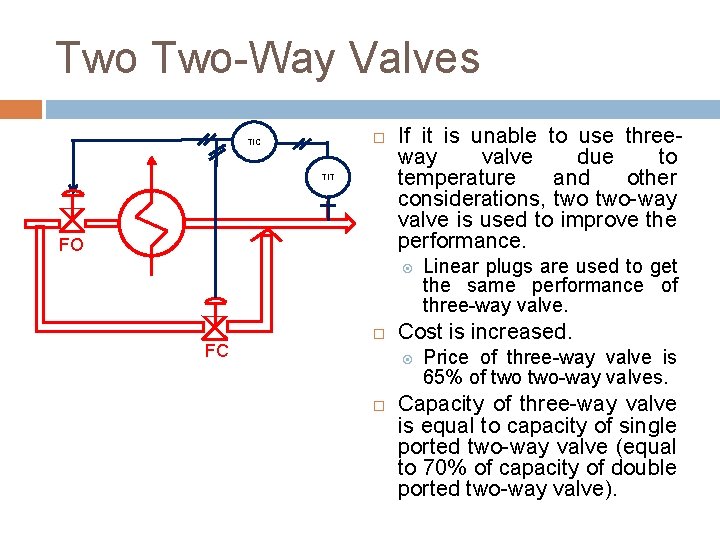
Two Two-Way Valves TIC TIT FO If it is unable to use threeway valve due to temperature and other considerations, two-way valve is used to improve the performance. FC Cost is increased. Linear plugs are used to get the same performance of three-way valve. Price of three-way valve is 65% of two-way valves. Capacity of three-way valve is equal to capacity of single ported two-way valve (equal to 70% of capacity of double ported two-way valve).
Steam Heater q q Loop components, accessories, sensor location and time lag considerations discussed in liquidto-liquid heat exchanger is also applicable here. Use of equal percentage valve is more pronounced here. q High rangeability is required due to high variation in condensate pressure.
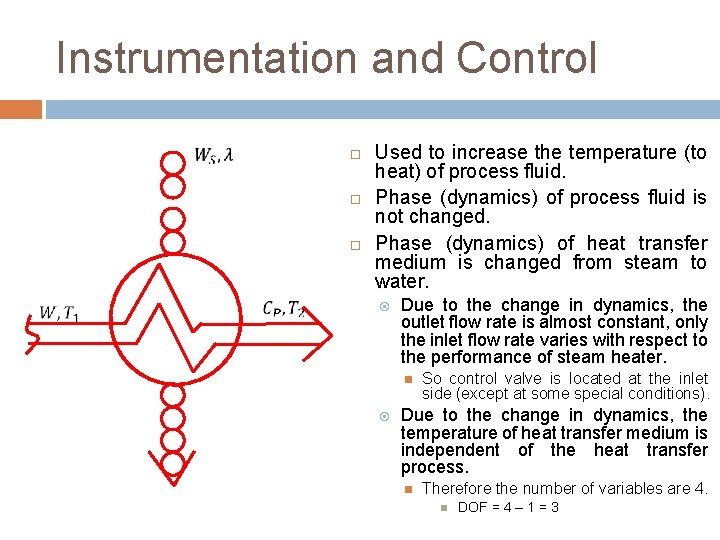
Instrumentation and Control Used to increase the temperature (to heat) of process fluid. Phase (dynamics) of process fluid is not changed. Phase (dynamics) of heat transfer medium is changed from steam to water. Due to the change in dynamics, the outlet flow rate is almost constant, only the inlet flow rate varies with respect to the performance of steam heater. So control valve is located at the inlet side (except at some special conditions). Due to the change in dynamics, the temperature of heat transfer medium is independent of the heat transfer process. Therefore the number of variables are 4. DOF = 4 – 1 = 3
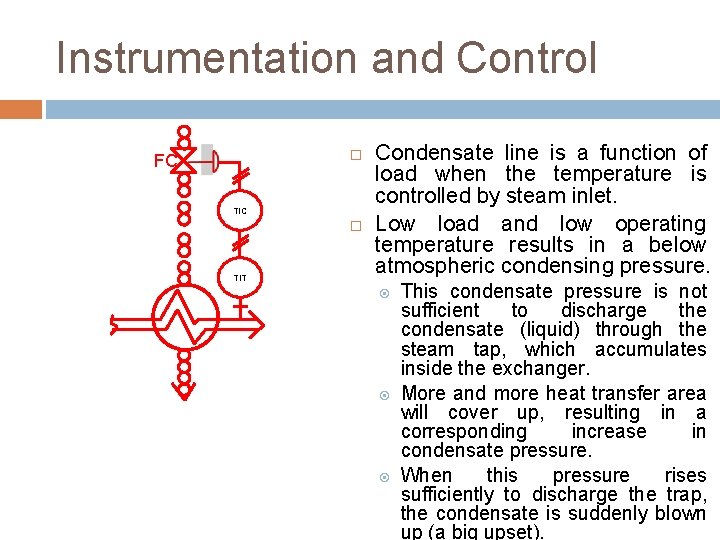
Instrumentation and Control FC TIT Condensate line is a function of load when the temperature is controlled by steam inlet. Low load and low operating temperature results in a below atmospheric condensing pressure. This condensate pressure is not sufficient to discharge the condensate (liquid) through the steam tap, which accumulates inside the exchanger. More and more heat transfer area will cover up, resulting in a corresponding increase in condensate pressure. When this pressure rises sufficiently to discharge the trap, the condensate is suddenly blown up (a big upset).
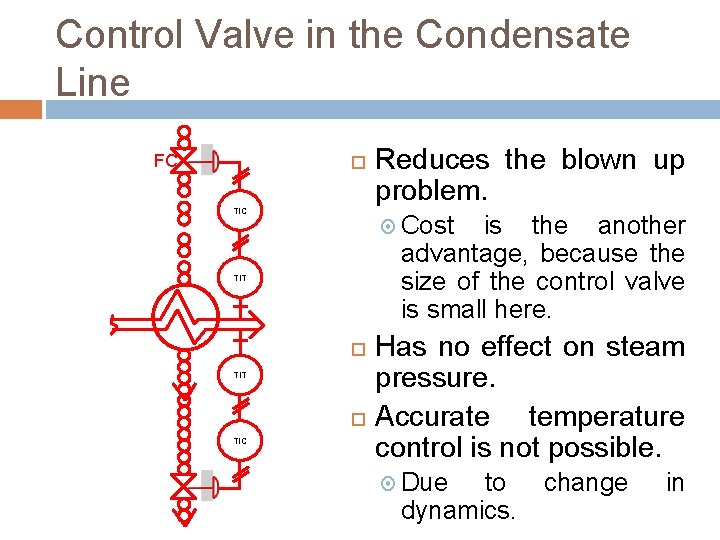
Control Valve in the Condensate Line FC TIC Cost is the another advantage, because the size of the control valve is small here. TIT TIC Reduces the blown up problem. Has no effect on steam pressure. Accurate temperature control is not possible. Due to change dynamics. in
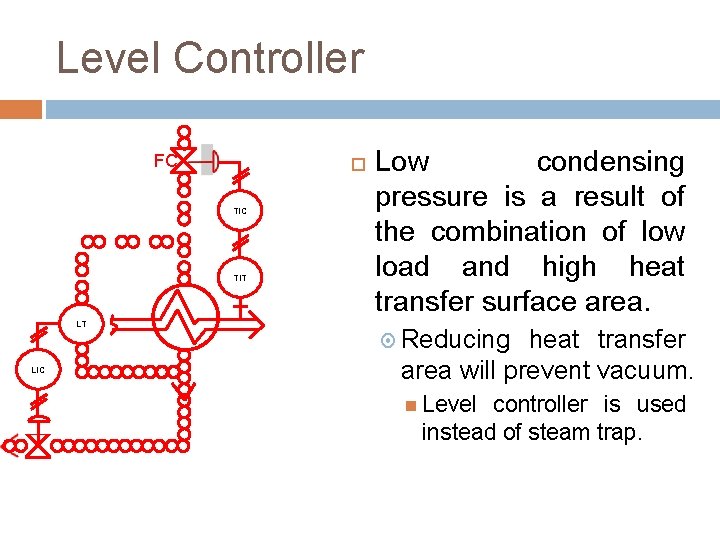
Level Controller FC TIC TIT LT LIC Low condensing pressure is a result of the combination of low load and high heat transfer surface area. Reducing heat transfer area will prevent vacuum. Level controller is used instead of steam trap.
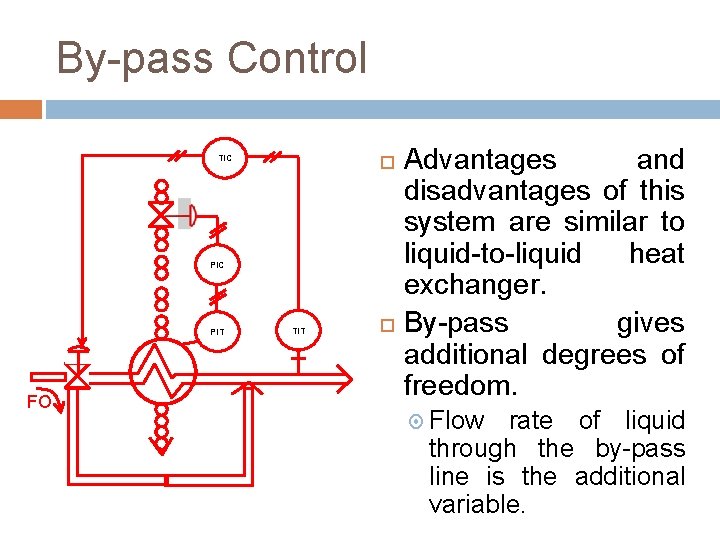
By-pass Control TIC PIT FO TIT Advantages and disadvantages of this system are similar to liquid-to-liquid heat exchanger. By-pass gives additional degrees of freedom. Flow rate of liquid through the by-pass line is the additional variable.
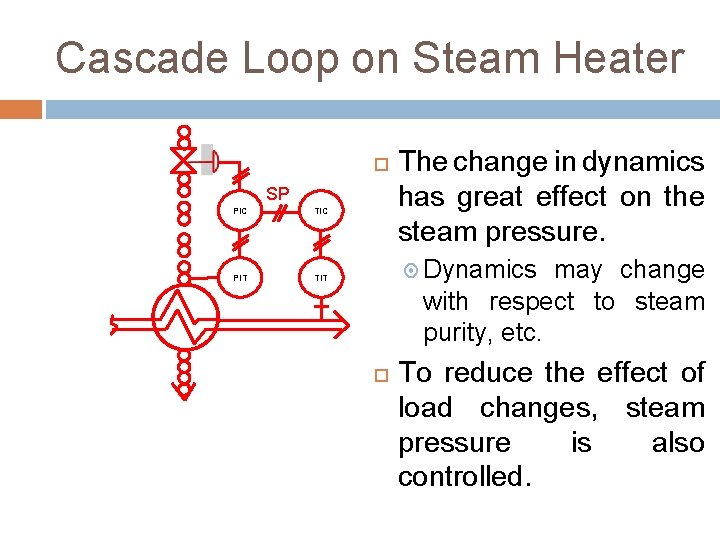
Cascade Loop on Steam Heater SP PIC TIC PIT The change in dynamics has great effect on the steam pressure. Dynamics may change with respect to steam purity, etc. To reduce the effect of load changes, steam pressure is also controlled.
Condenser
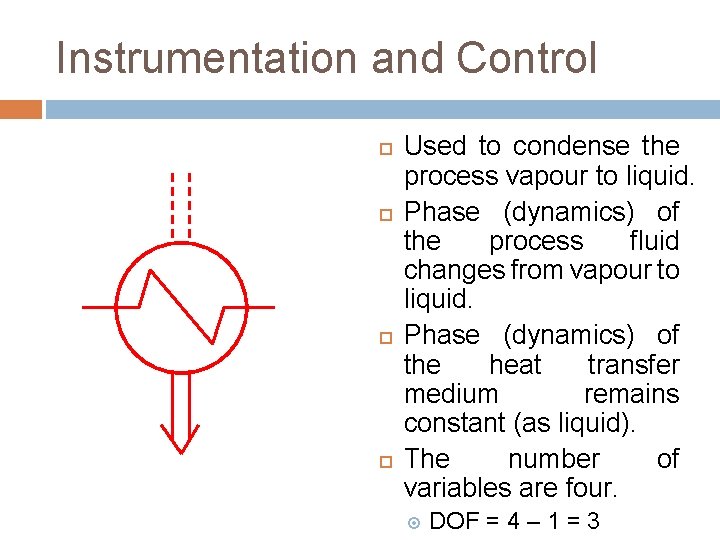
Instrumentation and Control Used to condense the process vapour to liquid. Phase (dynamics) of the process fluid changes from vapour to liquid. Phase (dynamics) of the heat transfer medium remains constant (as liquid). The number of variables are four. DOF = 4 – 1 = 3
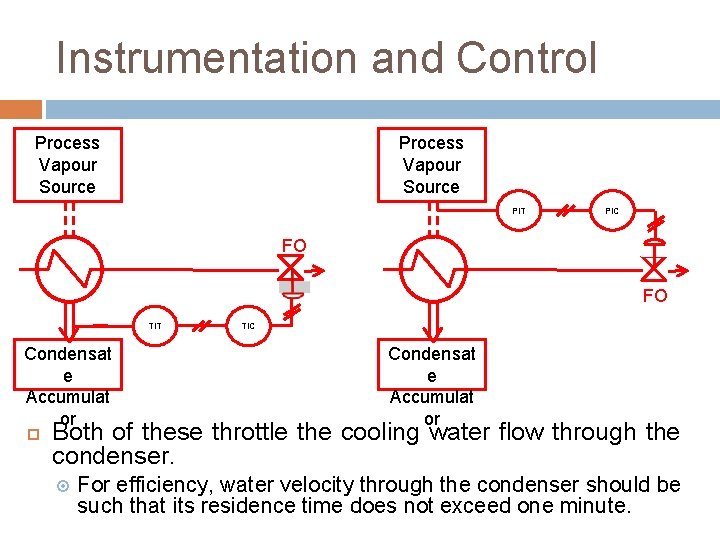
Instrumentation and Control Process Vapour Source PIT PIC FO FO TIT Condensat e Accumulat or TIC Condensat e Accumulat or Both of these throttle the cooling water flow through the condenser. For efficiency, water velocity through the condenser should be such that its residence time does not exceed one minute.
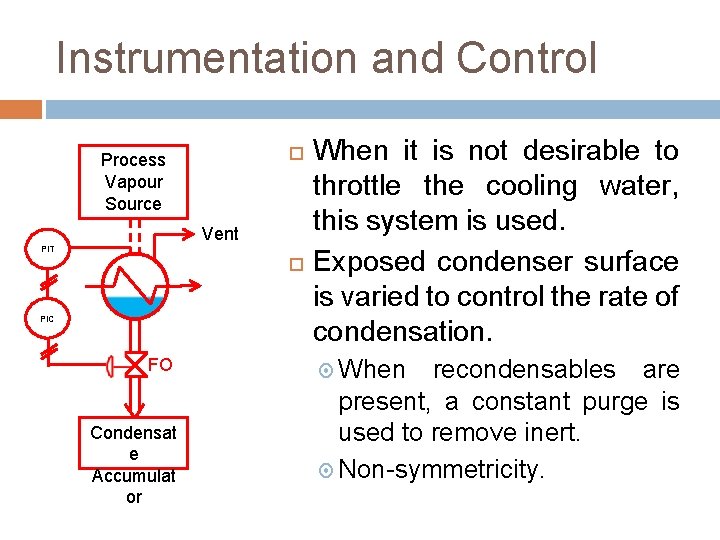
Instrumentation and Control Process Vapour Source Vent PIT PIC FO Condensat e Accumulat or When it is not desirable to throttle the cooling water, this system is used. Exposed condenser surface is varied to control the rate of condensation. When recondensables are present, a constant purge is used to remove inert. Non-symmetricity.
Reboiler and Vaporizer
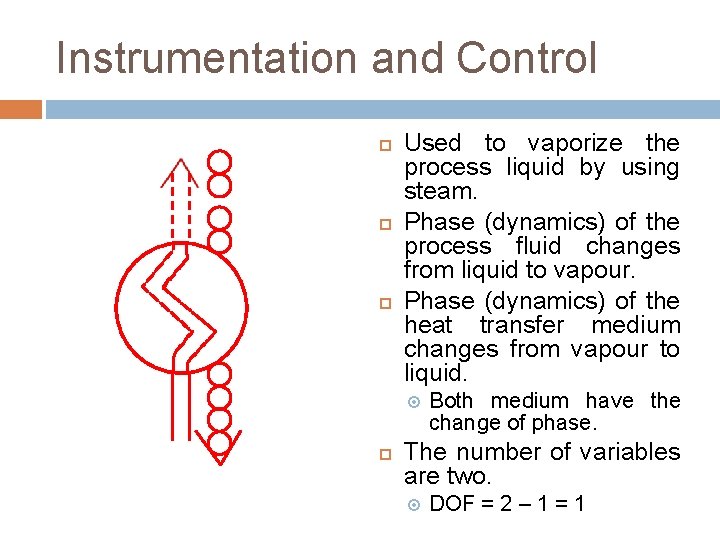
Instrumentation and Control Used to vaporize the process liquid by using steam. Phase (dynamics) of the process fluid changes from liquid to vapour. Phase (dynamics) of the heat transfer medium changes from vapour to liquid. Both medium have the change of phase. The number of variables are two. DOF = 2 – 1 = 1
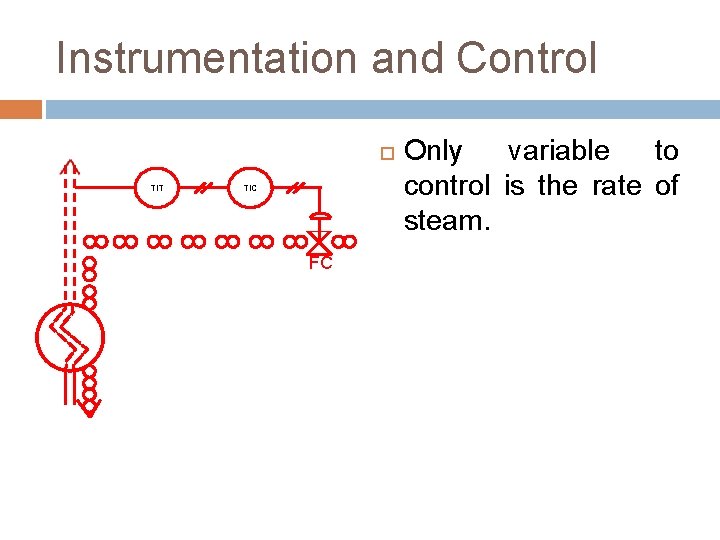
Instrumentation and Control TIT TIC FC Only variable to control is the rate of steam.
Remember? ? ! q Even if not so perfect, the inclusion of bypass will increase the number of degrees of freedom. q Effective for the processes which have a very small DOF.
Thank You
- Slides: 29