
Industrial Ontologies Group Semantic Web The Future Starts
Industrial Ontologies Group Semantic Web: The Future Starts Today “Industrial Ontologies” Group http: //www. cs. jyu. fi/ai/Onto. Group/index. html Agora Center, University of Jyväskylä, 23 May 2003
“Industrial Ontologies” Group: Our History • 1978 -1984 – We took part in development of the first in USSR Industrial Natural Language Processing System “DESTA”, which included semantic analysis and ontologies; ontologies • 1985 -1989 - We took part in development of the first in USSR Industrial Automated Natural Language Programming System “ALISA”, which Enabled Semantic Annotation, Annotation Discovery and Integration of software components (prototype of today's Semantic Web Services concept);
“Industrial Ontologies” Group: Our History • 1990 -1993 – under name of Metaintelligence Lab. we were piloting concept of a Metasemantic Network (triplet-based (meta-)knowledge representation model) – prototype of today’s RDFbased knowledge representation in Semantic Web; Web • 1994 -2000 – various projects with industrial partners, e. g. Meta. Atom – “Semantic Diagnostics of Ukrainian Nuclear Power Stations based on Metaknowledge”; Meta. Human – industrial medical diagnostics expert system based on Metaknowledge”; Jeweler – metamodelling and control of industrial processes, etc. ; got several research grants from Finnish Academy;
“Industrial Ontologies” Group: Our History • 2000 -2001 – we have created branches in Vrije Universiteit Amsterdam (heart of Semantic Web activities in Europe) where now working 5 our former team members, in Jyvaskyla University (several tens of researchers) and established research groups in Kharkov (Ukraine) on Data Mining, Educational Ontologies, Telemedicine, etc. • 2001 -2003 – we took part in Multi. Meet. Mobile Tekes Project, in In. BCT Tekes Project in Tempus EU Compact Project in (or in cooperation with) University of Jyvaskyla where we further promote Semantic Web concepts.
Industrial Ontologies Group: Important Objective • For us there are no doubts about the possibilities, which Semantic Web opens for industry. • that is why one important objective of our activities is to study appropriate industrial cases, collect arguments, launch industrial projects and develop prototypes for the industrial companies to not only believe together with us but also benefit from the Semantic Web.
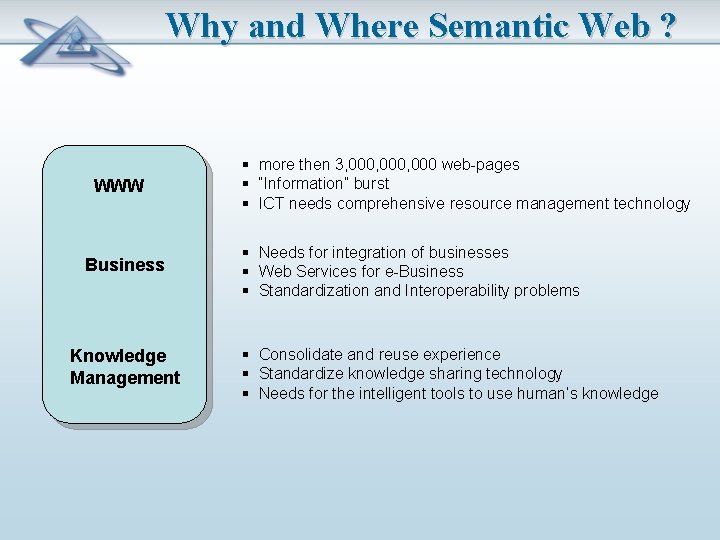
Why and Where Semantic Web ? WWW Business Knowledge Management § more then 3, 000, 000 web-pages § “Information” burst § ICT needs comprehensive resource management technology § Needs for integration of businesses § Web Services for e-Business § Standardization and Interoperability problems § Consolidate and reuse experience § Standardize knowledge sharing technology § Needs for the intelligent tools to use human’s knowledge
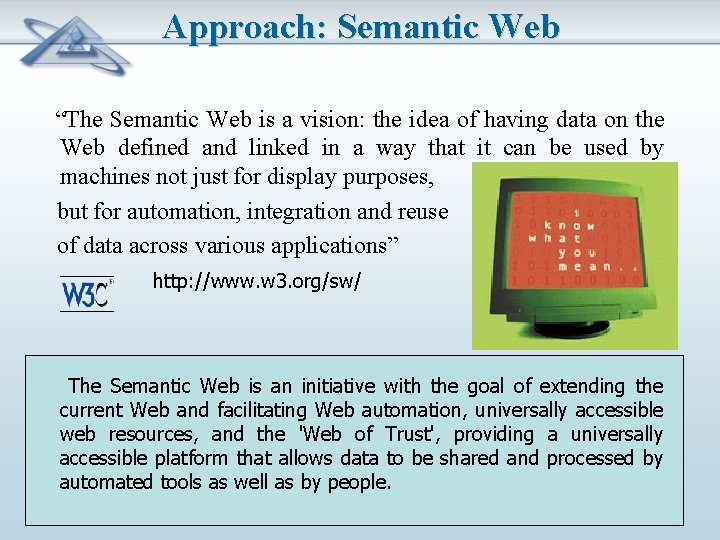
Approach: Semantic Web “The Semantic Web is a vision: the idea of having data on the Web defined and linked in a way that it can be used by machines not just for display purposes, but for automation, integration and reuse of data across various applications” http: //www. w 3. org/sw/ The Semantic Web is an initiative with the goal of extending the current Web and facilitating Web automation, universally accessible web resources, and the 'Web of Trust', providing a universally accessible platform that allows data to be shared and processed by automated tools as well as by people.
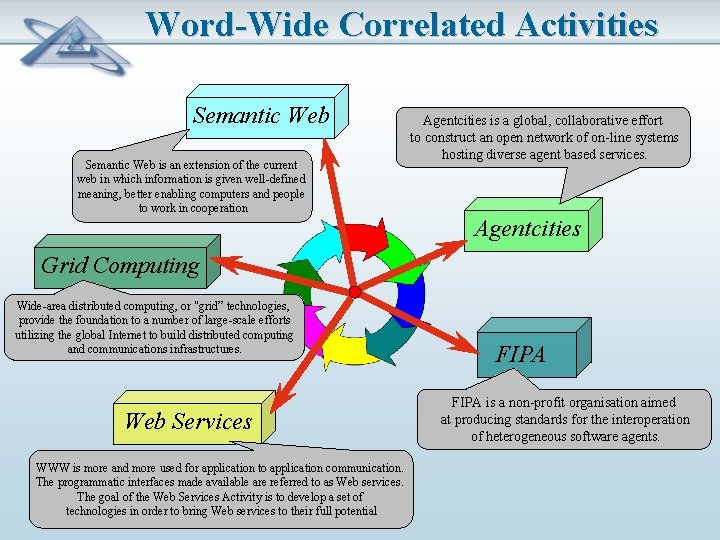
Word-Wide Correlated Activities Semantic Web is an extension of the current web in which information is given well-defined meaning, better enabling computers and people to work in cooperation Agentcities is a global, collaborative effort to construct an open network of on-line systems hosting diverse agent based services. Agentcities Grid Computing Wide-area distributed computing, or "grid” technologies, provide the foundation to a number of large-scale efforts utilizing the global Internet to build distributed computing and communications infrastructures. Web Services WWW is more and more used for application to application communication. The programmatic interfaces made available are referred to as Web services. The goal of the Web Services Activity is to develop a set of technologies in order to bring Web services to their full potential FIPA is a non-profit organisation aimed at producing standards for the interoperation of heterogeneous software agents.
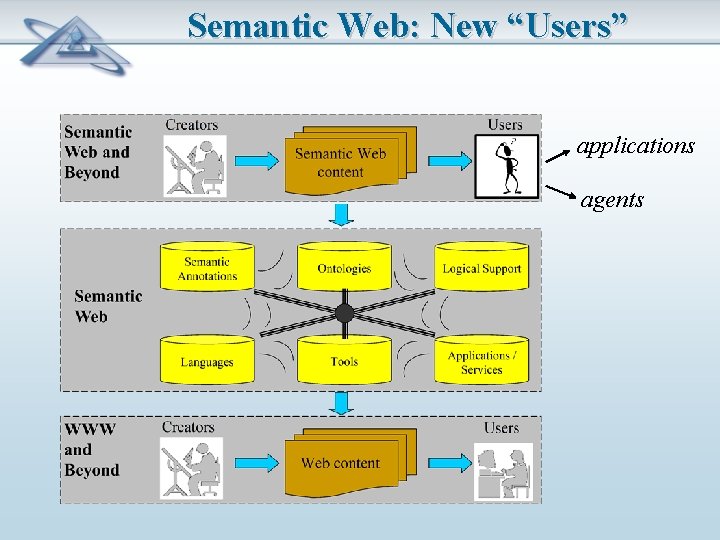
Semantic Web: New “Users” applications agents
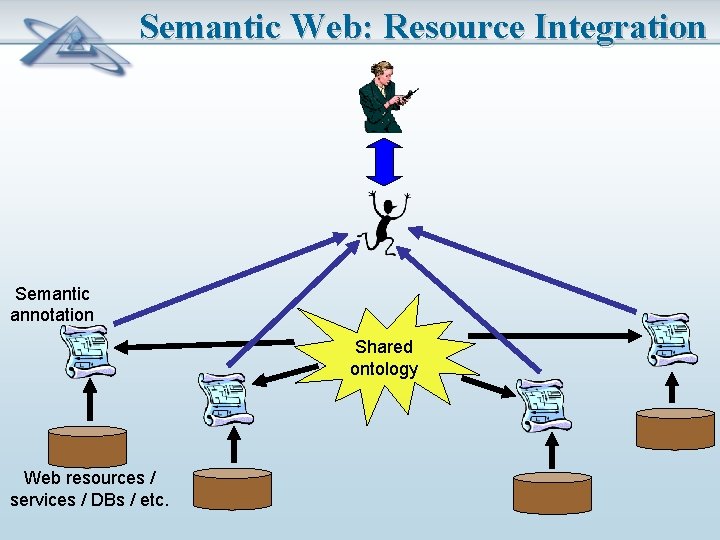
Semantic Web: Resource Integration Semantic annotation Shared ontology Web resources / services / DBs / etc.
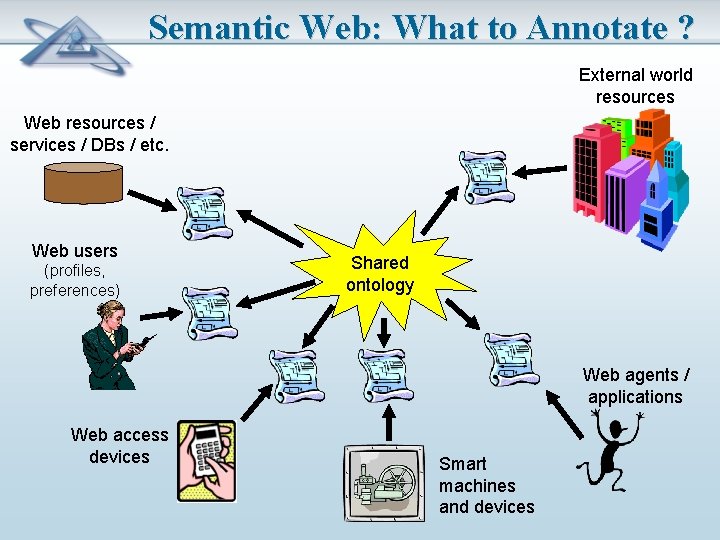
Semantic Web: What to Annotate ? External world resources Web resources / services / DBs / etc. Web users (profiles, preferences) Shared ontology Web agents / applications Web access devices Smart machines and devices
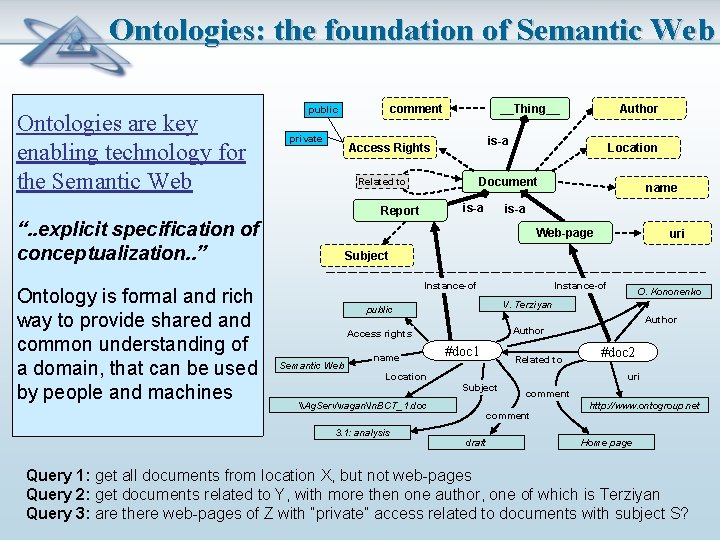
Ontologies: the foundation of Semantic Web Ontologies are key enabling technology for the Semantic Web comment public private Location Document Related to is-a Report Ontology is formal and rich way to provide shared and common understanding of a domain, that can be used by people and machines is-a Access Rights “. . explicit specification of conceptualization. . ” Author __Thing__ name is-a Web-page uri Subject Instance-of public Author Access rights Semantic Web name #doc 1 Related to Location 3. 1: analysis #doc 2 uri Subject \Ag. ServvaganIn. BCT_1. doc O. Kononenko V. Terziyan comment draft http: //www. ontogroup. net Home page Query 1: get all documents from location X, but not web-pages Query 2: get documents related to Y, with more then one author, one of which is Terziyan Query 3: are there web-pages of Z with “private” access related to documents with subject S?
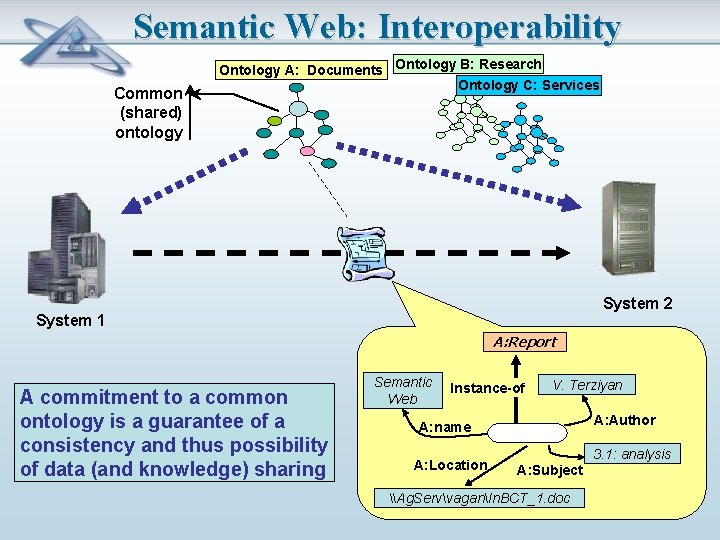
Semantic Web: Interoperability Common (shared) ontology Ontology A: Documents Ontology B: Research Ontology C: Services System 2 System 1 A: Report A commitment to a common ontology is a guarantee of a consistency and thus possibility of data (and knowledge) sharing Semantic Web Instance-of V. Terziyan A: Author A: name A: Location 3. 1: analysis A: Subject \Ag. ServvaganIn. BCT_1. doc
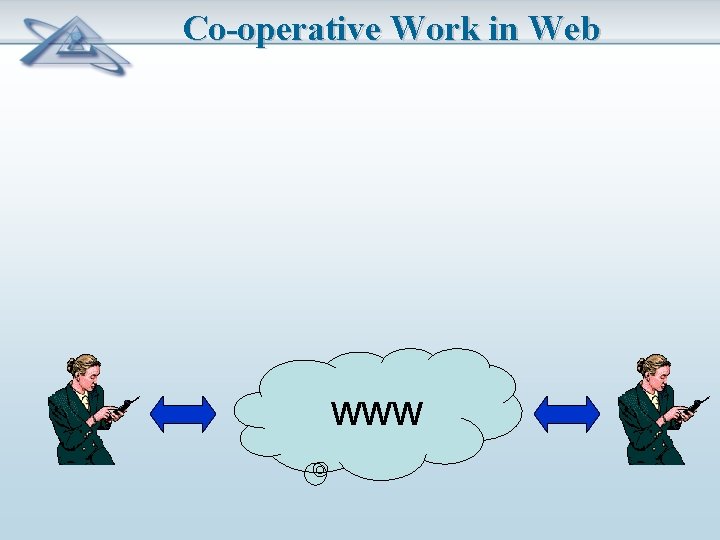
Co-operative Work in Web WWW
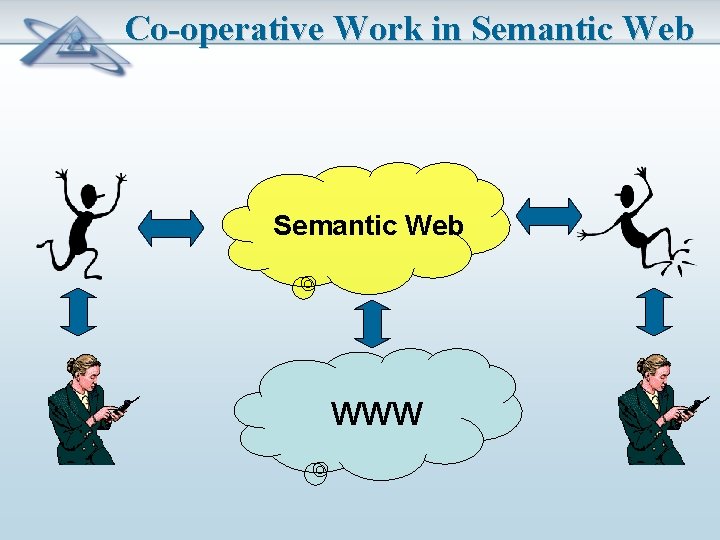
Co-operative Work in Semantic Web WWW
Semantic Web is not Only. . .
… but Also. . .
Industrial Ontologies Group Samples of our Research: “Applications of Semantic Web”
Web Resource/Service Integration: Server-Based Transaction Monitor Web resource / service Server Client wireless TM Transaction Service Web resource / service Server
Web Resource/Service Integration: Mobile Client-Base Transaction Monitor Web resource / service TM wireless Client Server wireless Web resource / service Server
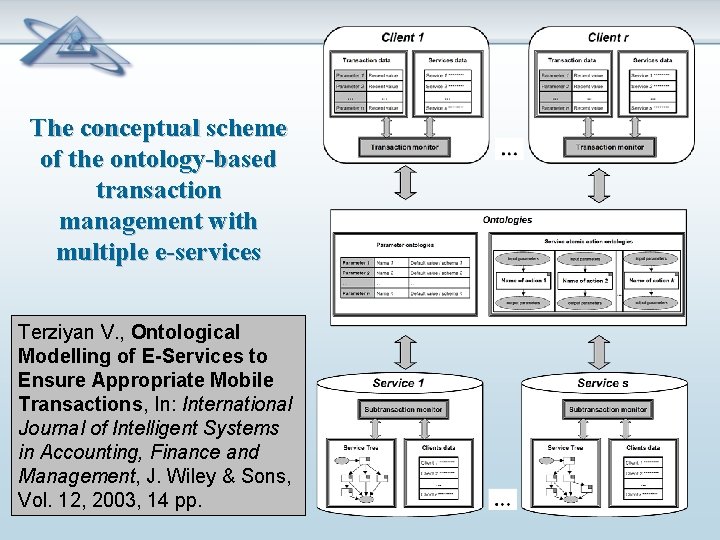
The conceptual scheme of the ontology-based transaction management with multiple e-services Terziyan V. , Ontological Modelling of E-Services to Ensure Appropriate Mobile Transactions, In: International Journal of Intelligent Systems in Accounting, Finance and Management, J. Wiley & Sons, Vol. 12, 2003, 14 pp.
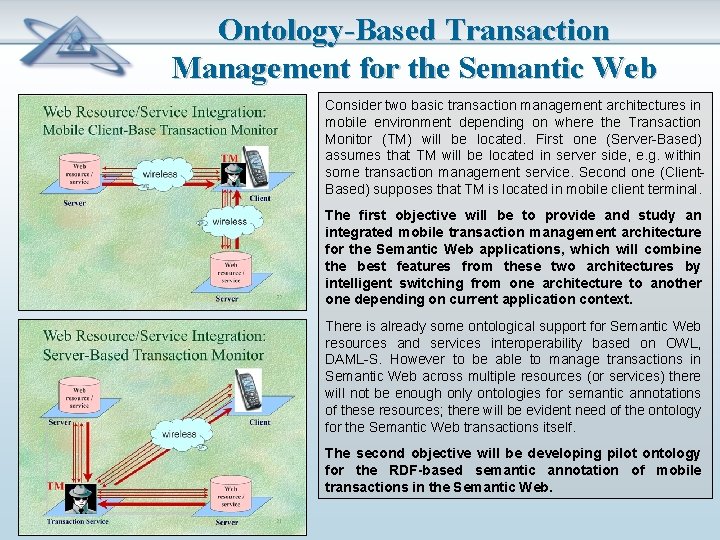
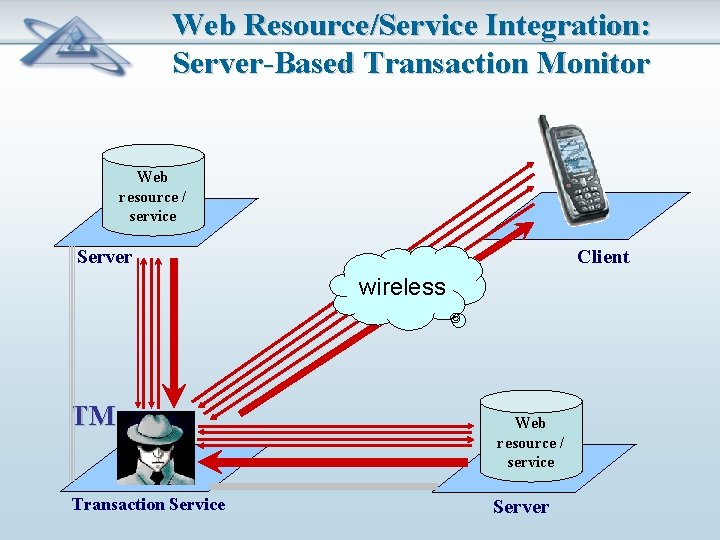
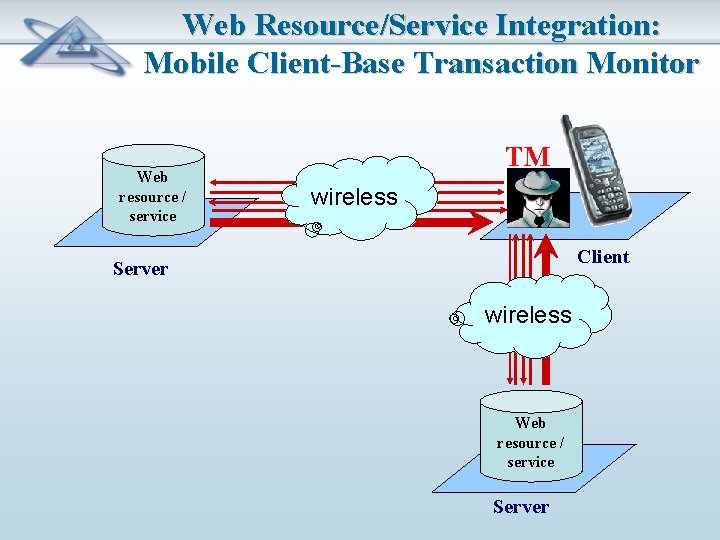
Ontology-Based Transaction Management for the Semantic Web Consider two basic transaction management architectures in mobile environment depending on where the Transaction Monitor (TM) will be located. First one (Server-Based) assumes that TM will be located in server side, e. g. within some transaction management service. Second one (Client. Based) supposes that TM is located in mobile client terminal. The first objective will be to provide and study an integrated mobile transaction management architecture for the Semantic Web applications, which will combine the best features from these two architectures by intelligent switching from one architecture to another one depending on current application context. There is already some ontological support for Semantic Web resources and services interoperability based on OWL, DAML-S. However to be able to manage transactions in Semantic Web across multiple resources (or services) there will not be enough only ontologies for semantic annotations of these resources; there will be evident need of the ontology for the Semantic Web transactions itself. The second objective will be developing pilot ontology for the RDF-based semantic annotation of mobile transactions in the Semantic Web.
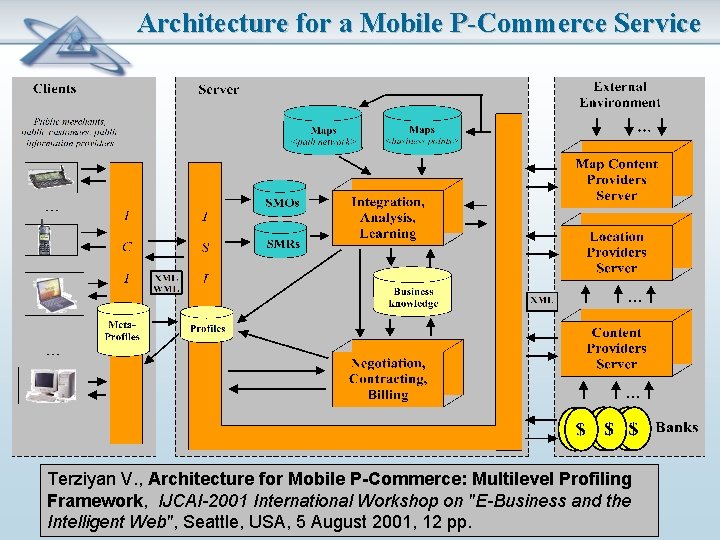
Architecture for a Mobile P-Commerce Service Terziyan V. , Architecture for Mobile P-Commerce: Multilevel Profiling Framework, IJCAI-2001 International Workshop on "E-Business and the Intelligent Web", Seattle, USA, 5 August 2001, 12 pp.
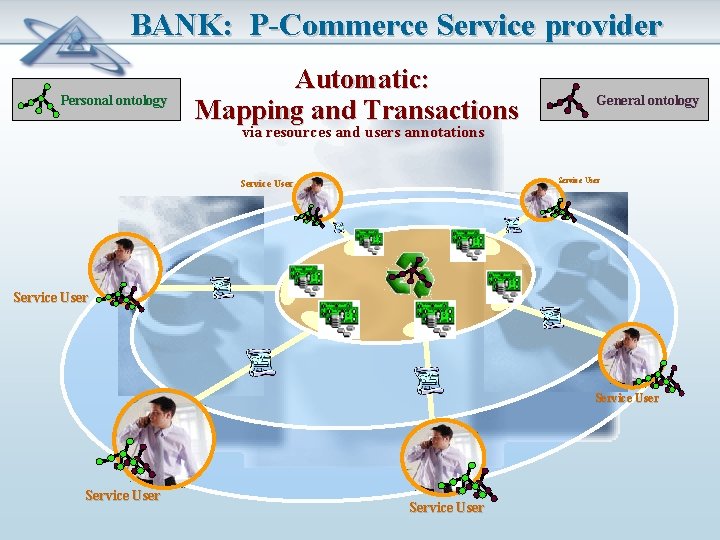
BANK: P-Commerce Service provider Personal ontology Automatic: Mapping and Transactions General ontology via resources and users annotations Service User Service User
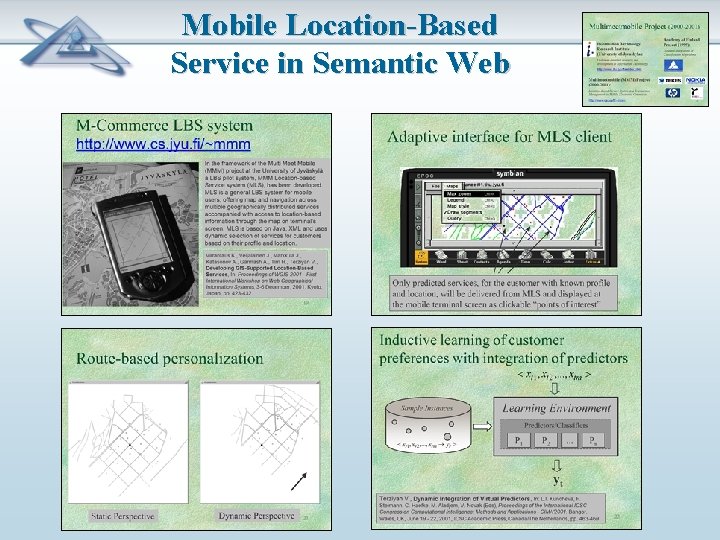
Mobile Location-Based Service in Semantic Web
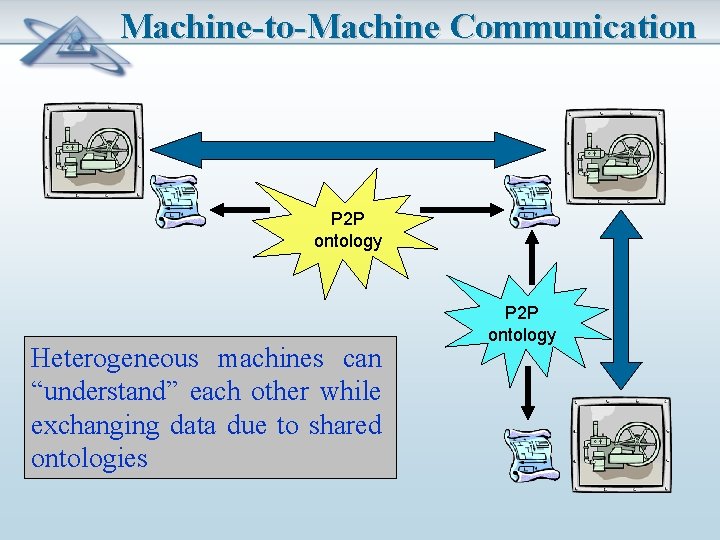
Machine-to-Machine Communication P 2 P ontology Heterogeneous machines can “understand” each other while exchanging data due to shared ontologies P 2 P ontology
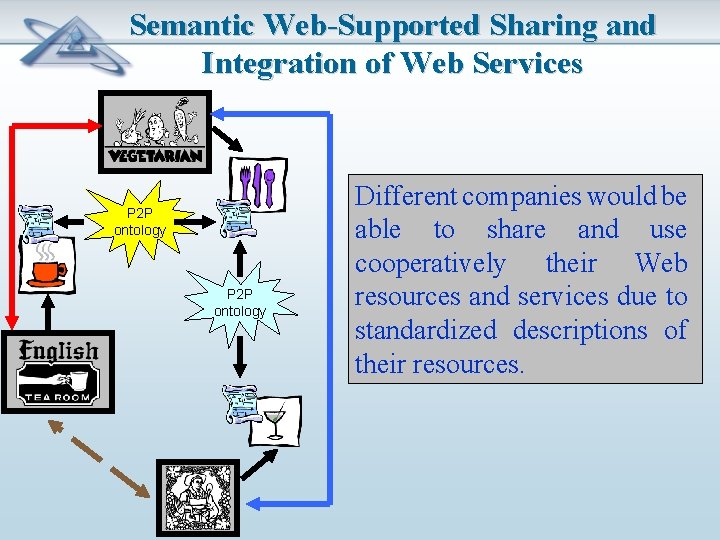
Semantic Web-Supported Sharing and Integration of Web Services P 2 P ontology Different companies would be able to share and use cooperatively their Web resources and services due to standardized descriptions of their resources.
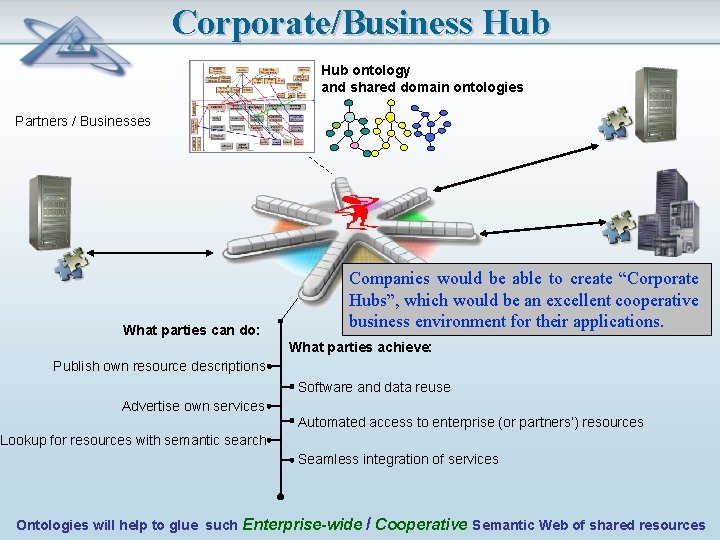
Corporate/Business Hub ontology and shared domain ontologies Partners / Businesses What parties can do: Companies would be able to create “Corporate Hubs”, which would be an excellent cooperative business environment for their applications. What parties achieve: Publish own resource descriptions Software and data reuse Advertise own services Automated access to enterprise (or partners’) resources Lookup for resources with semantic search Seamless integration of services Ontologies will help to glue such Enterprise-wide / Cooperative Semantic Web of shared resources
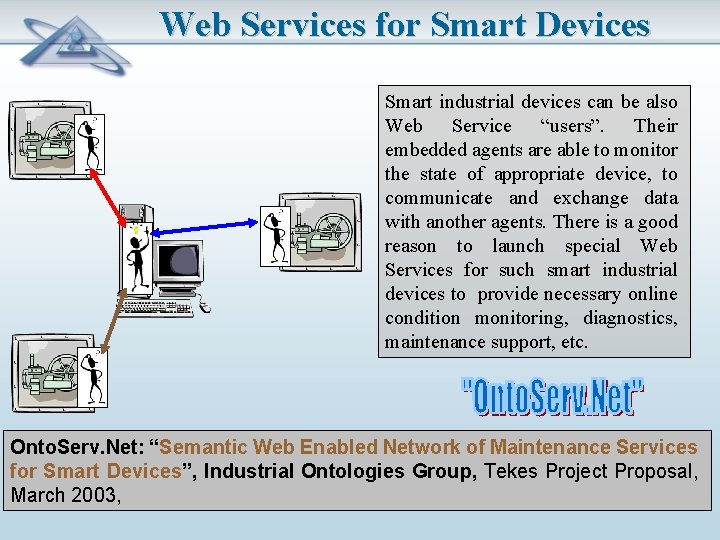
Web Services for Smart Devices Smart industrial devices can be also Web Service “users”. Their embedded agents are able to monitor the state of appropriate device, to communicate and exchange data with another agents. There is a good reason to launch special Web Services for such smart industrial devices to provide necessary online condition monitoring, diagnostics, maintenance support, etc. Onto. Serv. Net: “Semantic Web Enabled Network of Maintenance Services for Smart Devices”, Industrial Ontologies Group, Tekes Project Proposal, March 2003,
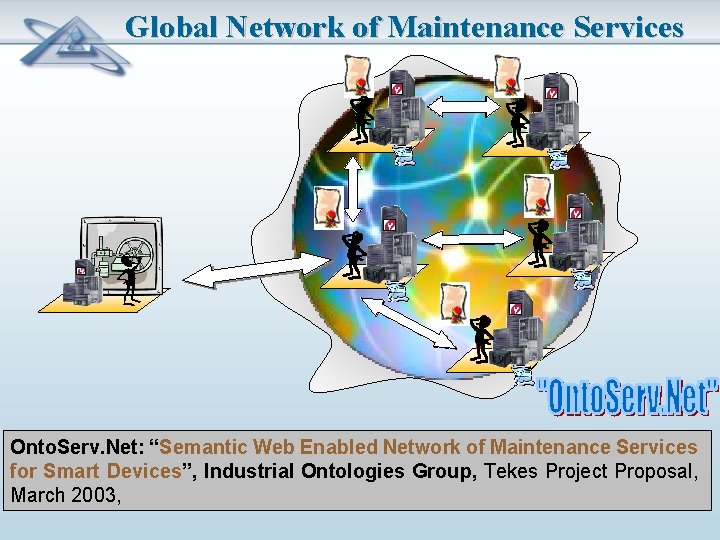
Global Network of Maintenance Services Onto. Serv. Net: “Semantic Web Enabled Network of Maintenance Services for Smart Devices”, Industrial Ontologies Group, Tekes Project Proposal, March 2003,
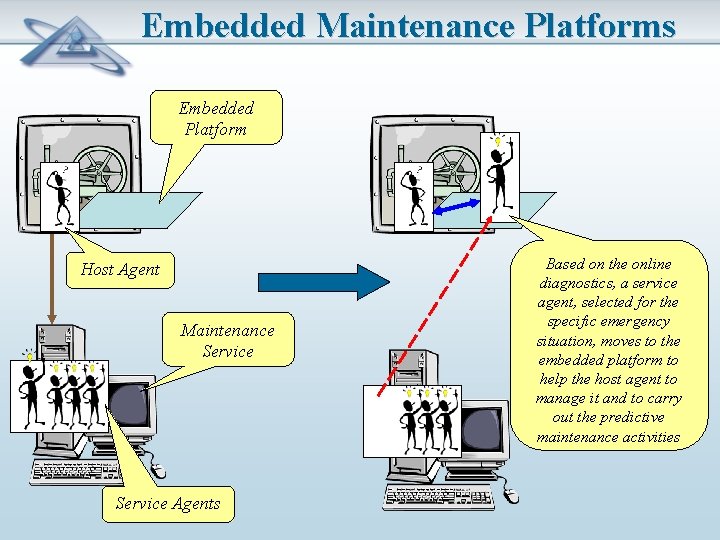
Embedded Maintenance Platforms Embedded Platform Host Agent Maintenance Service Agents Based on the online diagnostics, a service agent, selected for the specific emergency situation, moves to the embedded platform to help the host agent to manage it and to carry out the predictive maintenance activities
Onto. Serv. Net Challenges • New group of Web service users – smart industrial devices • Internal (embedded) and external (Web-based) agent enabled service platforms • “Mobile Service Component” Component concept supposes that any service component can move, be executed and learn at any platform from the Service Network, including service requestor side. • Semantic Peer-to-Peer concept for service network management assumes ontology-based decentralized service network management.
Industrial Ontologies Group Future Plans: “Applications of Wireless Semantic Web” Web
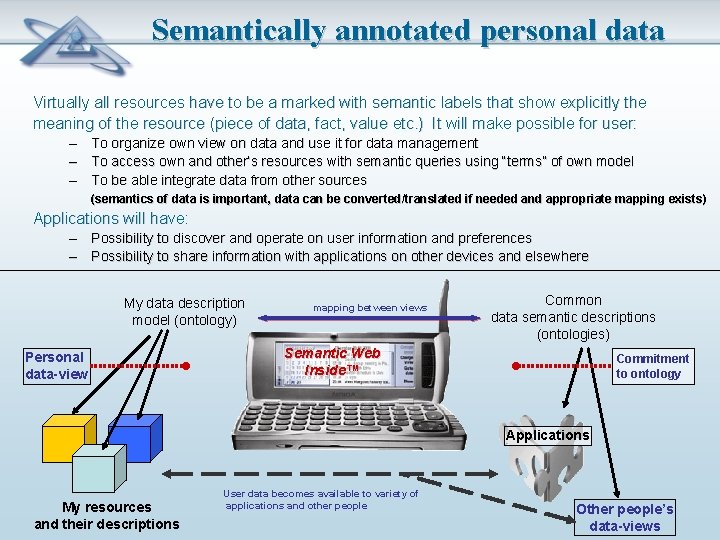
Semantically annotated personal data Virtually all resources have to be a marked with semantic labels that show explicitly the meaning of the resource (piece of data, fact, value etc. ) It will make possible for user: – – – To organize own view on data and use it for data management To access own and other’s resources with semantic queries using “terms” of own model To be able integrate data from other sources (semantics of data is important, data can be converted/translated if needed and appropriate mapping exists) Applications will have: – Possibility to discover and operate on user information and preferences – Possibility to share information with applications on other devices and elsewhere My data description model (ontology) Personal data-view mapping between views Common data semantic descriptions (ontologies) Semantic Web Inside™ Commitment to ontology Applications My resources and their descriptions User data becomes available to variety of applications and other people Other people’s data-views
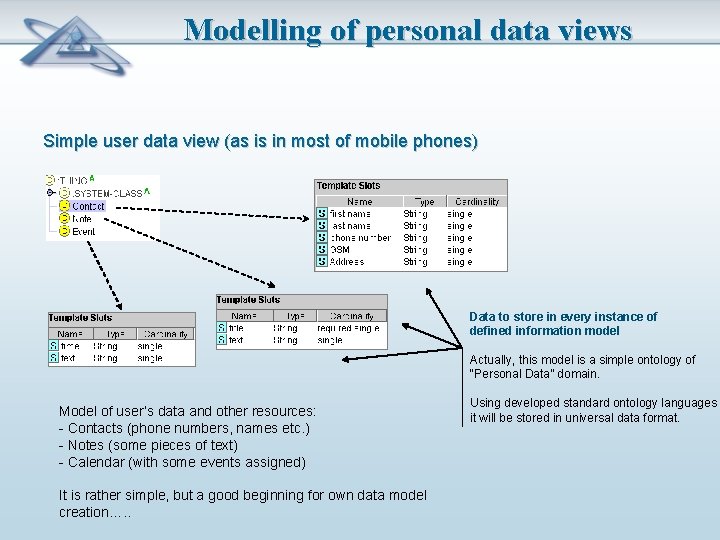
Modelling of personal data views Simple user data view (as is in most of mobile phones) Data to store in every instance of defined information model Actually, this model is a simple ontology of “Personal Data” domain. Model of user’s data and other resources: - Contacts (phone numbers, names etc. ) - Notes (some pieces of text) - Calendar (with some events assigned) It is rather simple, but a good beginning for own data model creation…. . Using developed standard ontology languages it will be stored in universal data format.
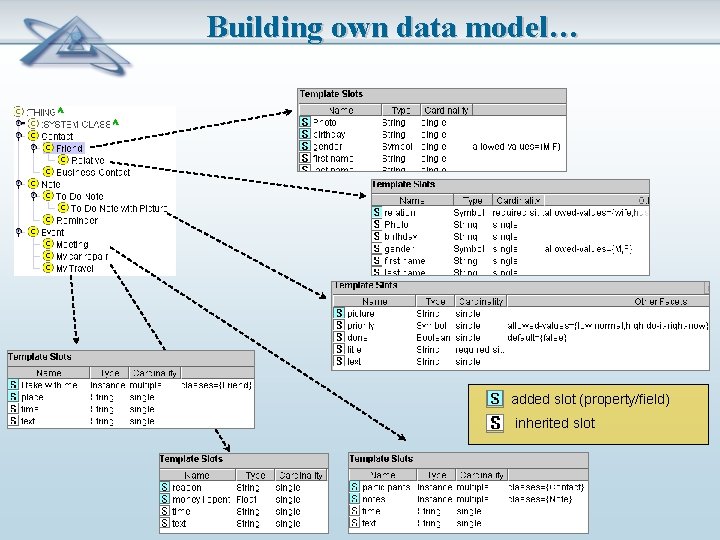
Building own data model… added slot (property/field) inherited slot
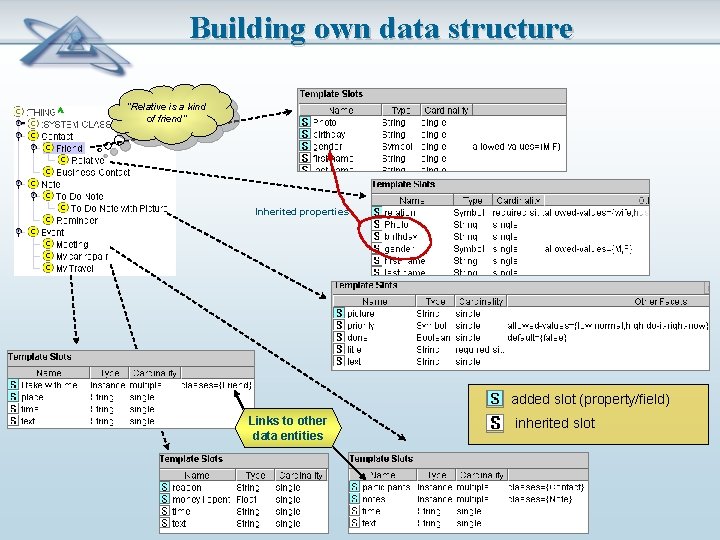
Building own data structure “Relative is a kind of friend” Inherited properties added slot (property/field) Links to other data entities inherited slot
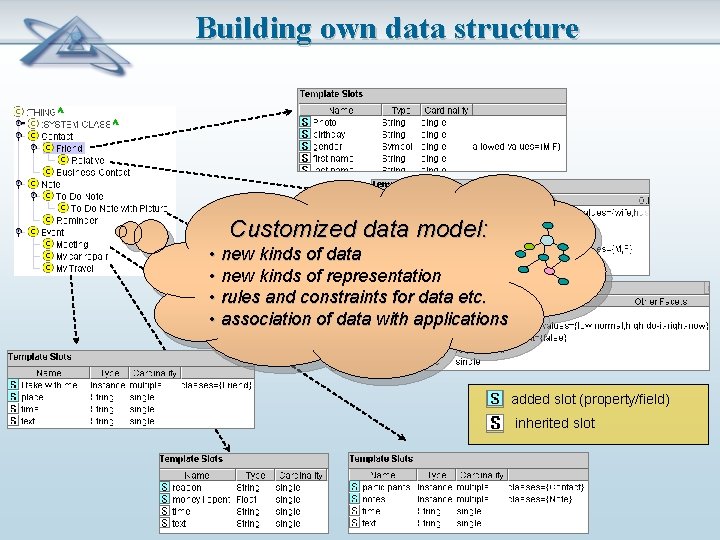
Building own data structure Customized data model: • new kinds of data • new kinds of representation • rules and constraints for data etc. • association of data with applications added slot (property/field) inherited slot
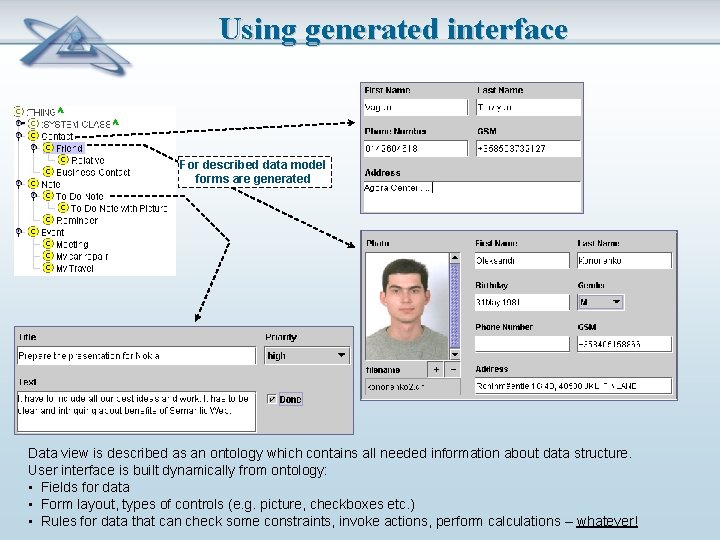
Using generated interface For described data model forms are generated Data view is described as an ontology which contains all needed information about data structure. User interface is built dynamically from ontology: • Fields for data • Form layout, types of controls (e. g. picture, checkboxes etc. ) • Rules for data that can check some constraints, invoke actions, perform calculations – whatever!
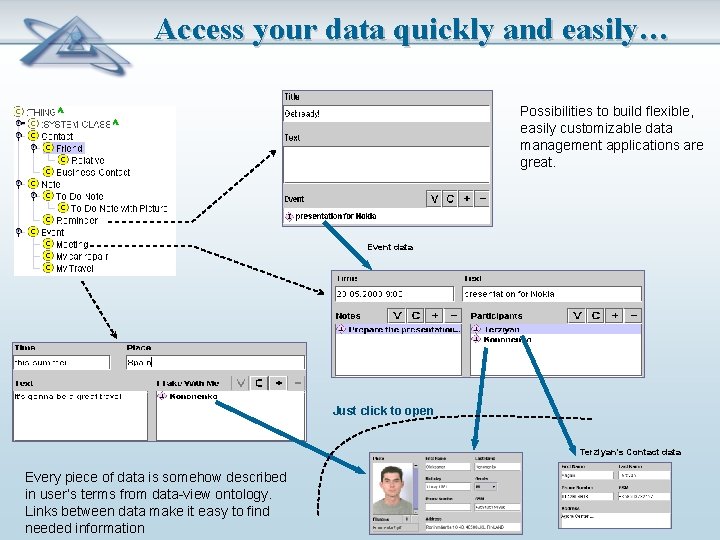
Access your data quickly and easily… Possibilities to build flexible, easily customizable data management applications are great. Event data Just click to open Terziyan’s Contact data Every piece of data is somehow described in user’s terms from data-view ontology. Links between data make it easy to find needed information
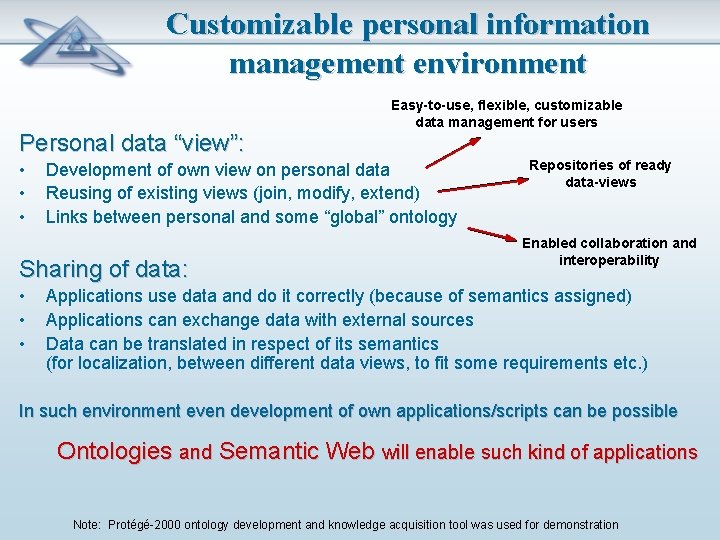
Customizable personal information management environment Personal data “view”: • • • Development of own view on personal data Reusing of existing views (join, modify, extend) Links between personal and some “global” ontology Sharing of data: • • • Easy-to-use, flexible, customizable data management for users Repositories of ready data-views Enabled collaboration and interoperability Applications use data and do it correctly (because of semantics assigned) Applications can exchange data with external sources Data can be translated in respect of its semantics (for localization, between different data views, to fit some requirements etc. ) In such environment even development of own applications/scripts can be possible Ontologies and Semantic Web will enable such kind of applications Note: Protégé-2000 ontology development and knowledge acquisition tool was used for demonstration
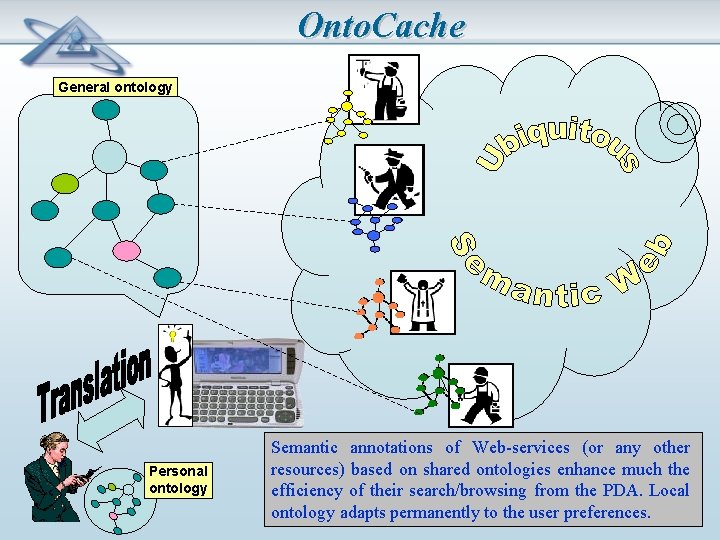
Onto. Cache General ontology Personal ontology Semantic annotations of Web-services (or any other resources) based on shared ontologies enhance much the efficiency of their search/browsing from the PDA. Local ontology adapts permanently to the user preferences.
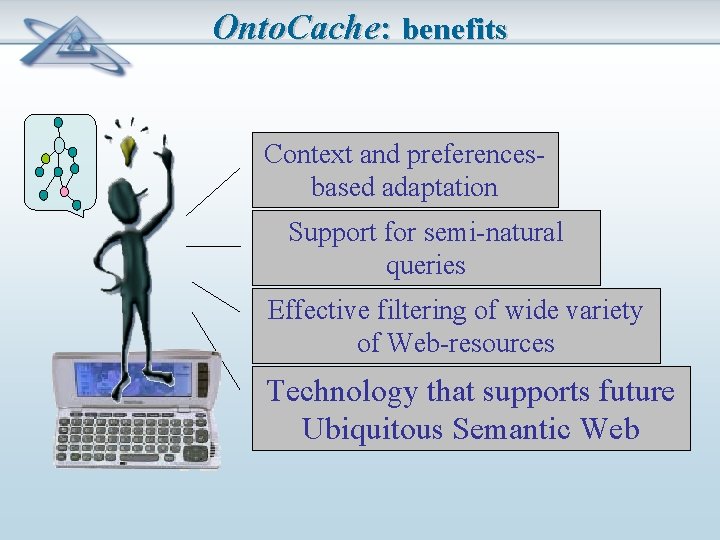
Onto. Cache: benefits Context and preferencesbased adaptation Support for semi-natural queries Effective filtering of wide variety of Web-resources Technology that supports future Ubiquitous Semantic Web
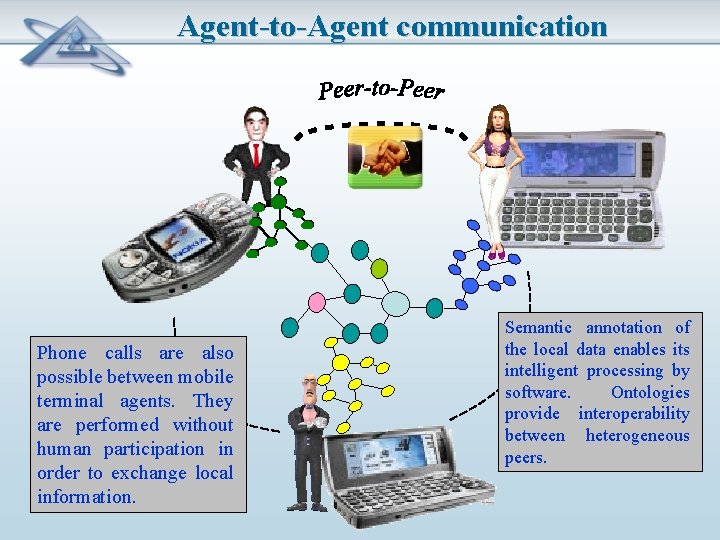
Agent-to-Agent communication Phone calls are also possible between mobile terminal agents. They are performed without human participation in order to exchange local information. Semantic annotation of the local data enables its intelligent processing by software. Ontologies provide interoperability between heterogeneous peers.
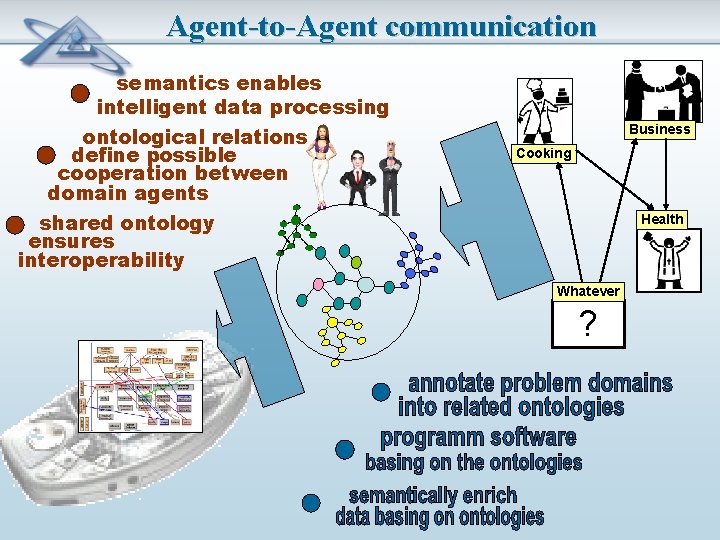
Agent-to-Agent communication semantics enables intelligent data processing ontological relations define possible cooperation between domain agents shared ontology ensures interoperability Business Cooking Health Whatever ?
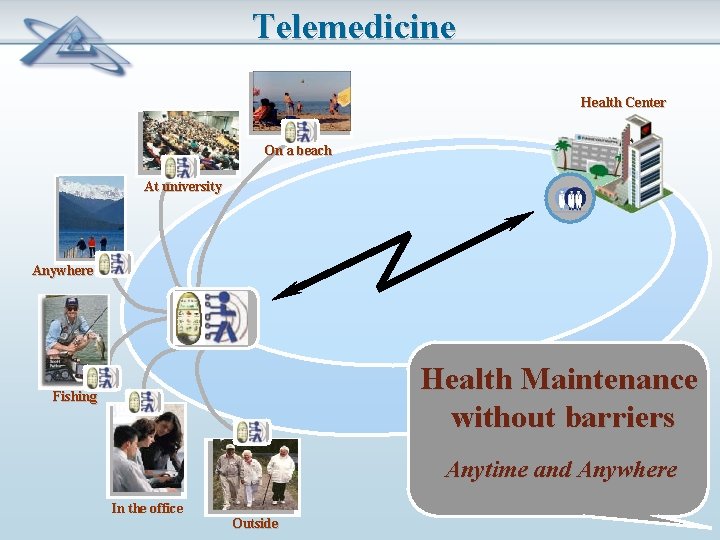
Telemedicine Health Center On a beach At university Anywhere Health Maintenance without barriers Fishing Anytime and Anywhere In the office Outside
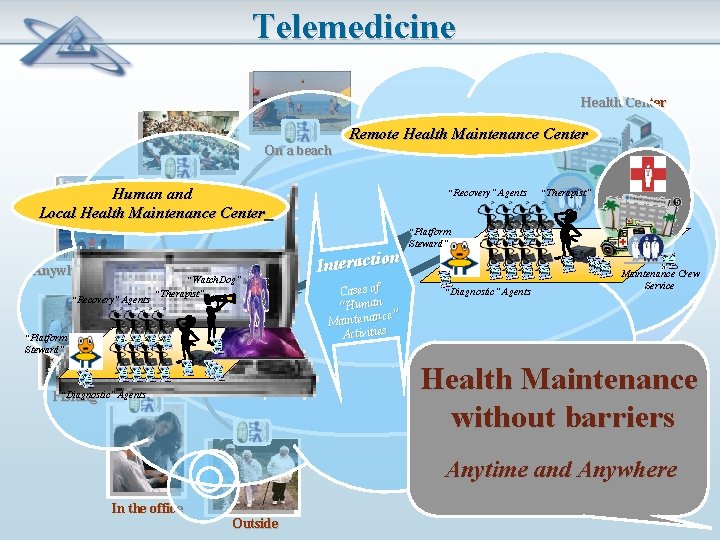
Telemedicine Health Center On a beach Remote Health Maintenance Center At university Human and Local Health Maintenance Center Anywhere “Recovery” Agents “Watch. Dog” “Therapist” “Platform Steward” “Recovery” Agents Interaction Cases of “Human ce” Maintenan Activities “Therapist” “Platform Steward” “Diagnostic” Agents Maintenance Crew Service Health Maintenance without barriers “Diagnostic” Agents Fishing Anytime and Anywhere In the office Outside
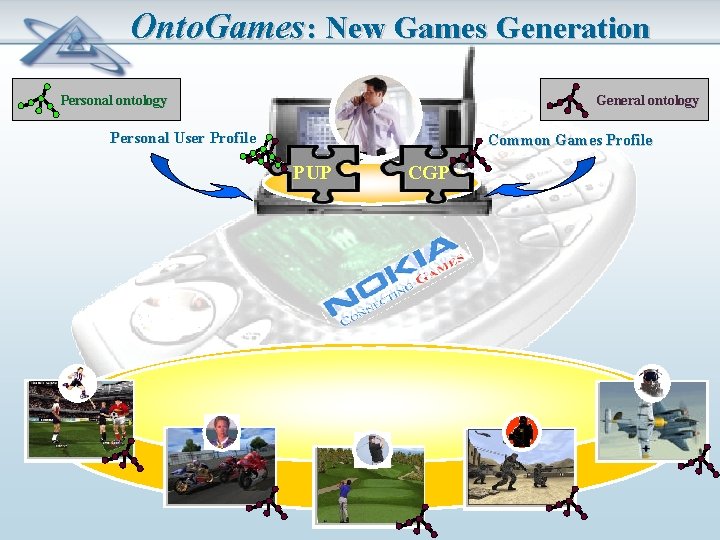
Onto. Games: New Games Generation Personal ontology General ontology Personal User Profile Common Games Profile PUP CGP
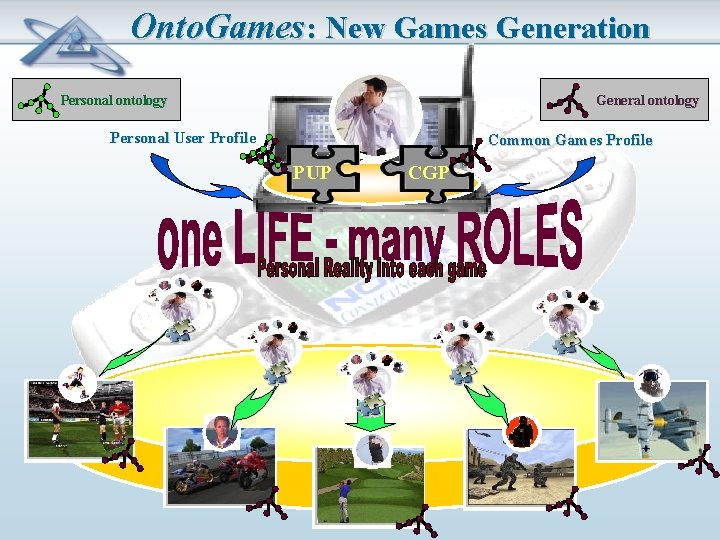
Onto. Games: New Games Generation Personal ontology General ontology Personal User Profile Common Games Profile PUP CGP
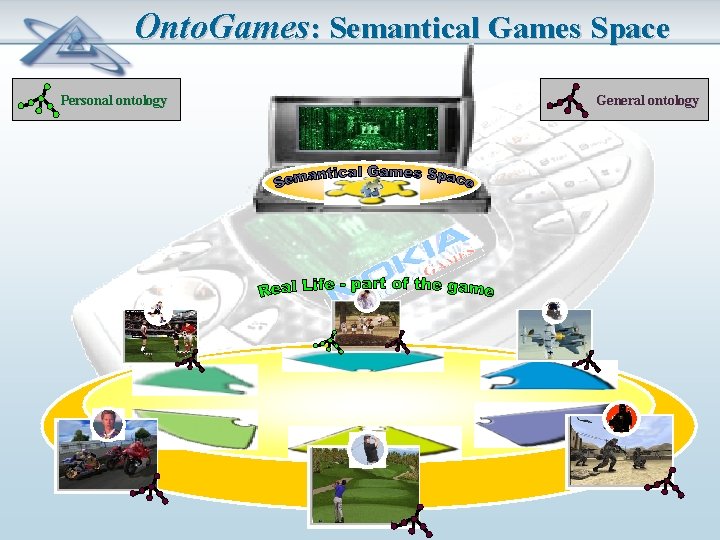
Onto. Games: Semantical Games Space Personal ontology General ontology
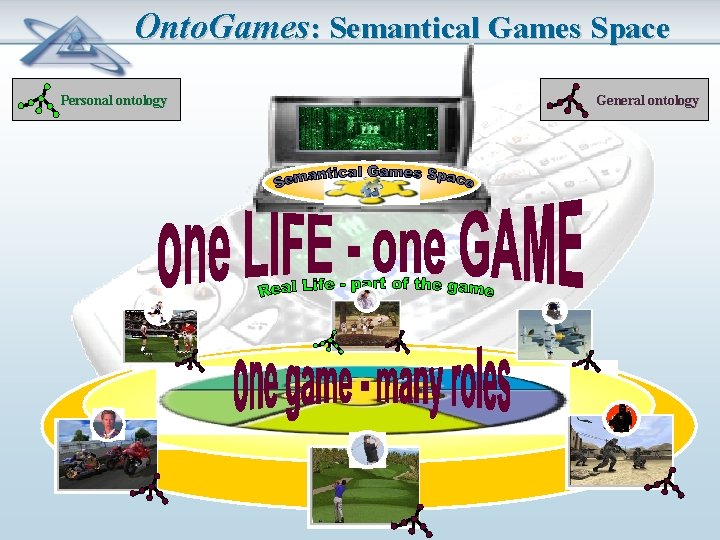
Onto. Games: Semantical Games Space Personal ontology General ontology
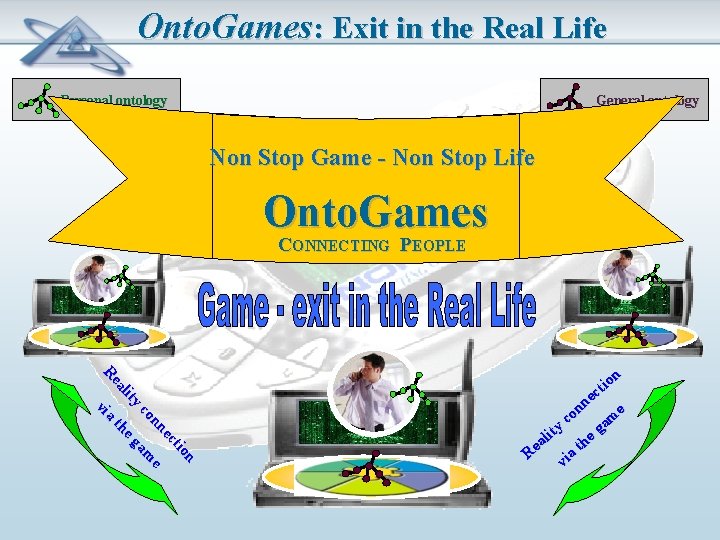
Onto. Games: Exit in the Real Life Personal ontology General ontology Non Stop Game - Non Stop Life Onto. Games CONNECTING PEOPLE n tio ec e nn co am y eg lit th ea a R vi n io t ec n n e m co ga ity e l a th Re via
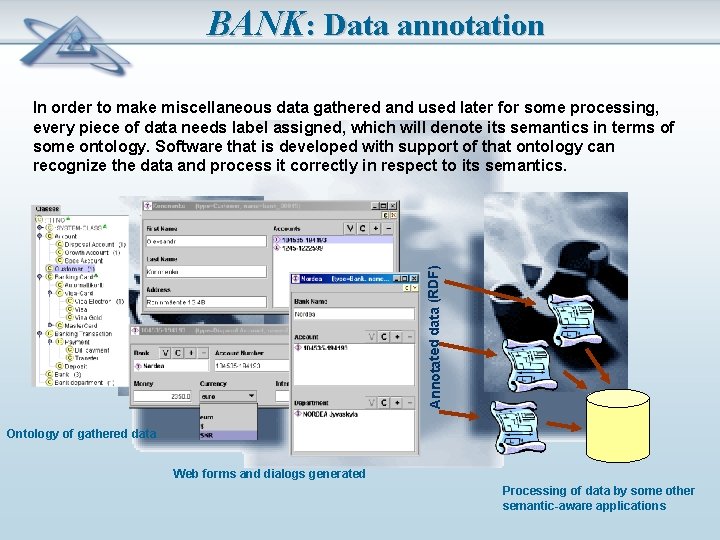
BANK: Data annotation Annotated data (RDF) In order to make miscellaneous data gathered and used later for some processing, every piece of data needs label assigned, which will denote its semantics in terms of some ontology. Software that is developed with support of that ontology can recognize the data and process it correctly in respect to its semantics. Ontology of gathered data Web forms and dialogs generated Processing of data by some other semantic-aware applications
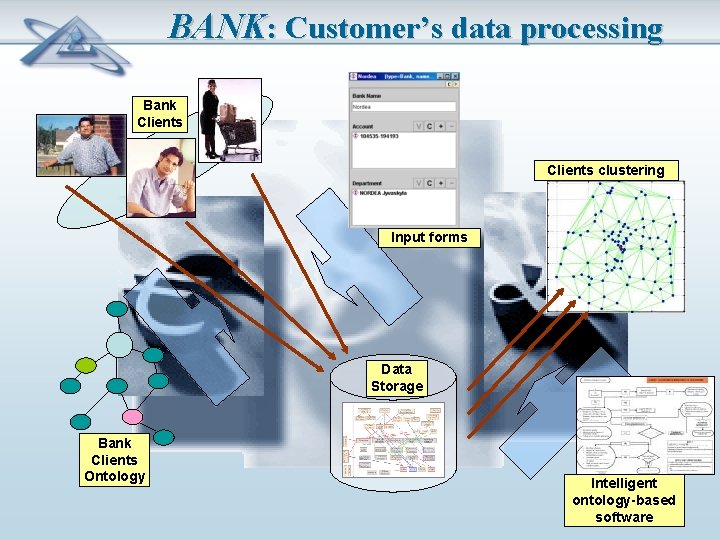
BANK: Customer’s data processing Bank Clients clustering Input forms Data Storage Bank Clients Ontology Intelligent ontology-based software
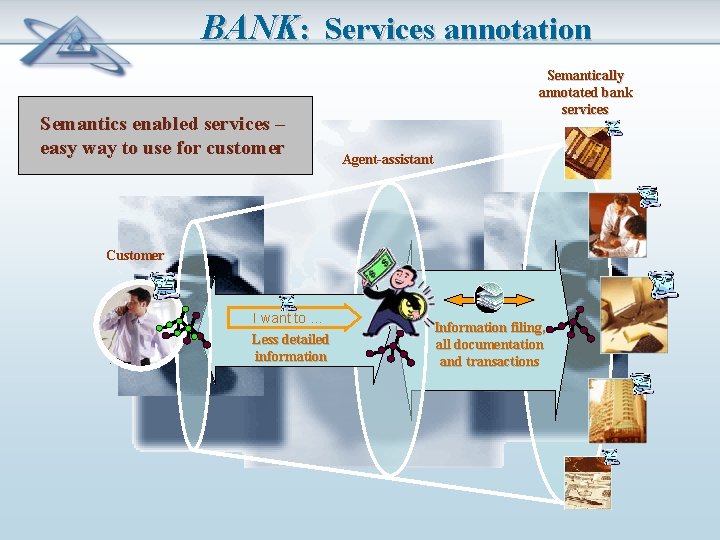
BANK: Services annotation Semantics enabled services – easy way to use for customer Semantically annotated bank services Agent-assistant Customer I want to … Less detailed information Information filing, all documentation and transactions
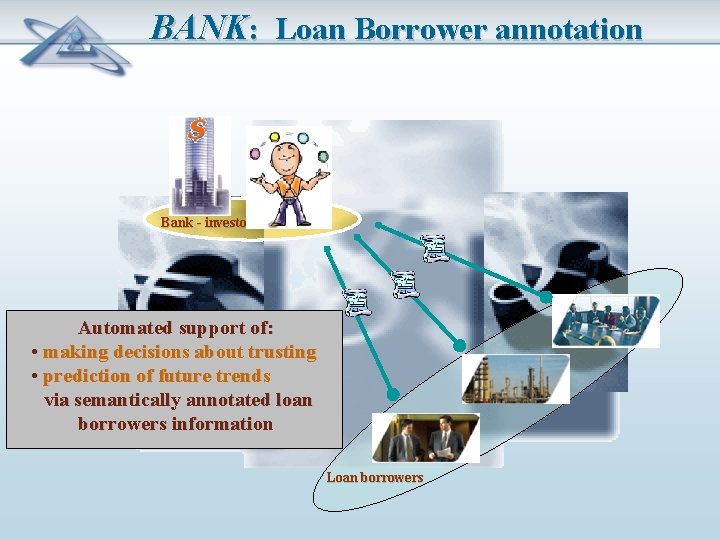
BANK: Loan Borrower annotation Bank - investor Automated support of: • making decisions about trusting • prediction of future trends via semantically annotated loan borrowers information Loan borrowers
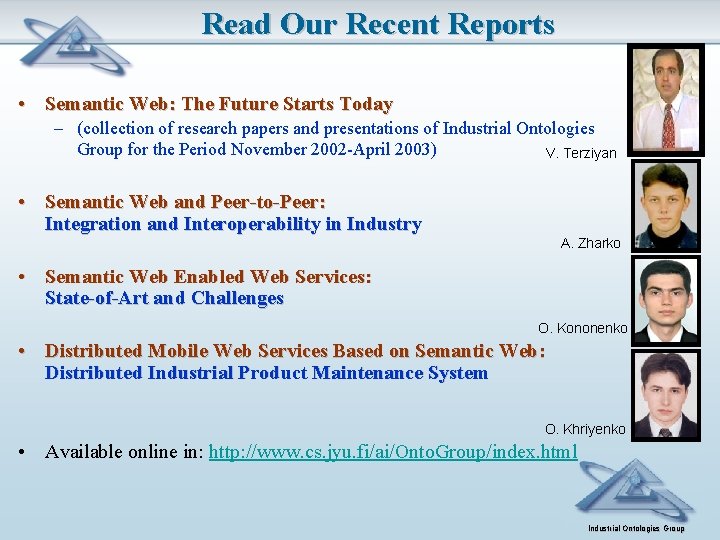
Read Our Recent Reports • Semantic Web: The Future Starts Today – (collection of research papers and presentations of Industrial Ontologies Group for the Period November 2002 -April 2003) V. Terziyan • Semantic Web and Peer-to-Peer: Integration and Interoperability in Industry A. Zharko • Semantic Web Enabled Web Services: State-of-Art and Challenges O. Kononenko • Distributed Mobile Web Services Based on Semantic Web: Distributed Industrial Product Maintenance System O. Khriyenko • Available online in: http: //www. cs. jyu. fi/ai/Onto. Group/index. html Industrial Ontologies Group
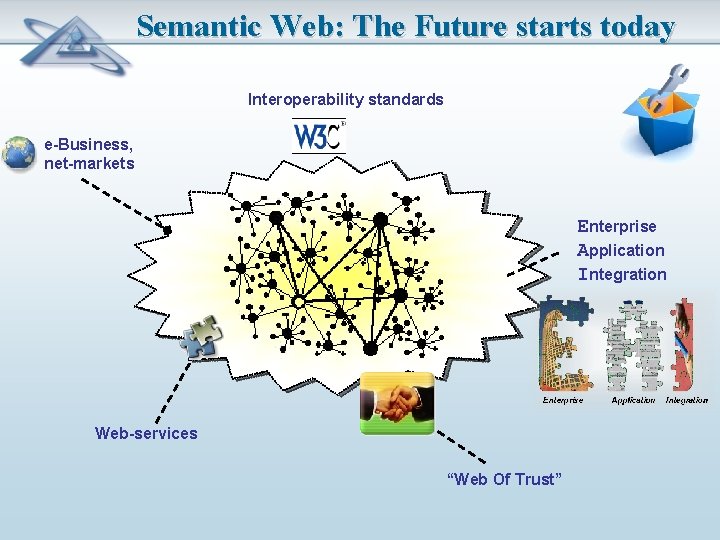
Semantic Web: The Future starts today Interoperability standards e-Business, net-markets Enterprise Application Integration Web-services “Web Of Trust”
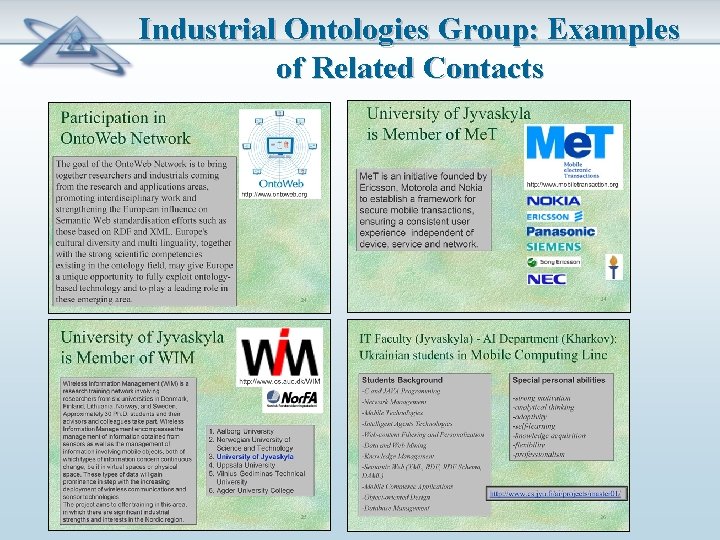
Industrial Ontologies Group: Examples of Related Contacts
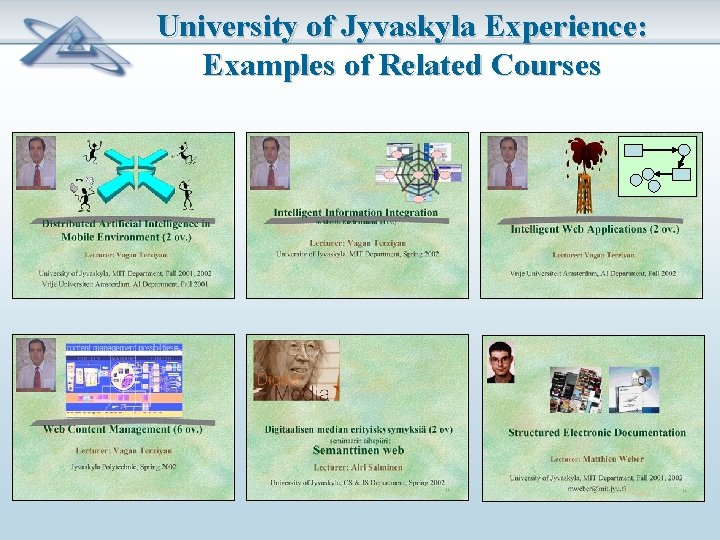
University of Jyvaskyla Experience: Examples of Related Courses
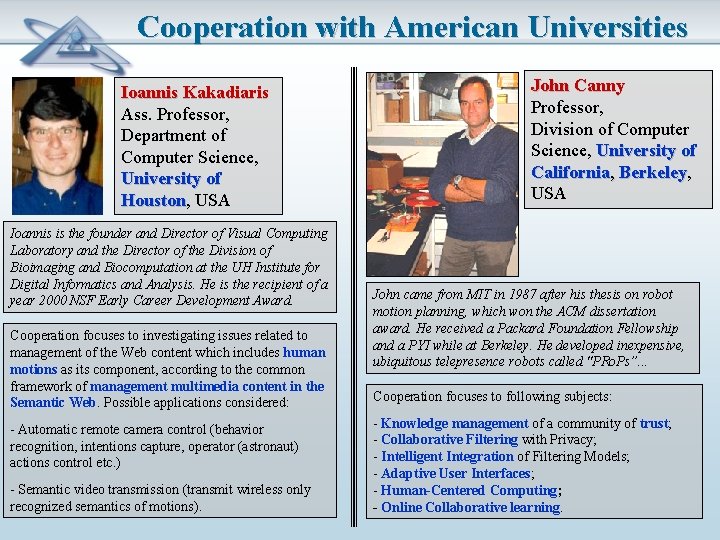
Cooperation with American Universities Ioannis Kakadiaris Ass. Professor, Department of Computer Science, University of Houston, Houston USA Ioannis is the founder and Director of Visual Computing Laboratory and the Director of the Division of Bioimaging and Biocomputation at the UH Institute for Digital Informatics and Analysis. He is the recipient of a year 2000 NSF Early Career Development Award. Cooperation focuses to investigating issues related to management of the Web content which includes human motions as its component, according to the common framework of management multimedia content in the Semantic Web. Possible applications considered: - Automatic remote camera control (behavior recognition, intentions capture, operator (astronaut) actions control etc. ) - Semantic video transmission (transmit wireless only recognized semantics of motions). John Canny Professor, Division of Computer Science, University of California, Berkeley USA John came from MIT in 1987 after his thesis on robot motion planning, which won the ACM dissertation award. He received a Packard Foundation Fellowship and a PYI while at Berkeley. He developed inexpensive, ubiquitous telepresence robots called "PRo. Ps”. . . Cooperation focuses to following subjects: - Knowledge management of a community of trust; - Collaborative Filtering with Privacy; - Intelligent Integration of Filtering Models; - Adaptive User Interfaces; - Human-Centered Computing; - Online Collaborative learning.
Conclusion • Semantic Web is not only a technology as many used to name it; • Semantic Web is not only an environment as many naming it now; • Semantic Web it is a new context within which one should rethink and re-interpret his existing businesses, resources, services, technologies, processes, environments, products etc. to raise them to totally new level of performance… ---------------------Contact: Vagan Terziyan vagan@it. jyu. fi http: //www. cs. jyu. fi/ai/vagan (tel. +358 14 2604618)
- Slides: 62