
Industrial Economics And antitrust The Tetra Pak II
- Slides: 20
Industrial Economics And antitrust The Tetra Pak II case Silvia Compagnoni Evelyn Doering
Introduction The Tetra Pak II case (1991) is about the article 82 infringement, that’s the abuse of a dominant position
Overview /1 Tetra Pak is the world leader in the field of packing of liquid foods (primarily milk and fruit juices) in cartons. Tetra Pak was the leader on two different markets: àOn the aseptic market both for equipments and carton àOn the non-aseptic market both for equipments and cartons
Overview /2 Tetra Pak’s market shares in 1991 à 90% on the aseptic market à 45% on the non-aseptic market
The Commission ’s decision Accusations by the Commission: o. Special contract clauses o. Tied sales o. Geographical price discrimination o. Predatory pricing
The Commission’s decision The relevant market “An undertaking which enjoys a quasimonopoly on certain markets and a leading position on distinct, though closely associated, markets is placed in a situation comparable to that of holding a dominant position on those markets as a whole”
The Commission’s decision Predatory pricing “. . It must be possible to penalize predatory pricing whenever there is a risk that competitors will be eliminated. . ”
The Commission ’s decision According to the Commission, Tetra Pak abused its dominant position, and a fine of ECU 75 million was imposed
Economic analysis Focus on the predatory pricing strategy on the Italian market and on the recoupment test
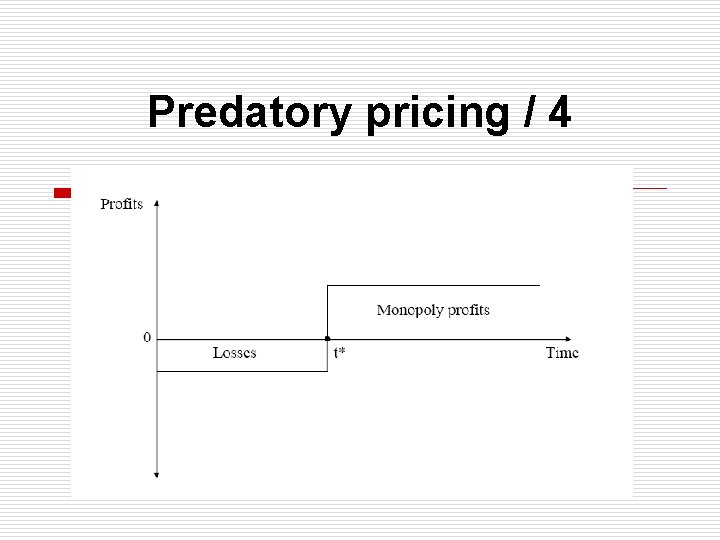
Predatory pricing / 1 It is the practice of offering goods or services at exceptionally low prices in order to drive competitors out of the market
Predatory pricing / 2 Pricing is considered predatory when it cannot be profitable unless competition is eliminated Once a predator has acquired market power, it raises its price above the competitive level to recoup the losses it sustained during the predatory period
Predatory pricing / 3 Predatory Pricing = P < AC o. Positive effects on the consumers welfare in the short run o. Negative effects on the consumers welfare in the long run o. Long run effects are greater than the short run ones, so in the long run predatory pricing has negative effects both on consumers and market competition.
Predatory pricing / 4
Predatory pricing / 5 Evidence of the eliminatory strategy: Tetra Pak sold its non-aseptic cartons on the Italian market at a price 35% below its variable costs. Elopak was not able to set its prices below the breakeven point
Recoupment Test / 1 o. Tetra Pak argued that predatory pricing to be plausible only if losses can be recouped after the competitors exit o. The Commission found that there is no real chance of recoupment-thus it could not be guilty of predation
Recoupment Test / 2 Determines whether the companies predatory strategy would be likely to eliminate and deter competition and whether the company is able to collect at least enough profits to recover the losses sustained during its predatory attack
Recoupment Test / 3 o o o Targeting behaviour likely to harm consumer welfare Screening out cases in which characteristics of the incumbent firm and the market make recoupment implausible Takes into account several aspects not covered by traditional analyses
Recoupment Test / 4 Adequate recoupment does not have to come from the market in which the predation occured But: condemning low pricing without any proof that Tetra Pak would be able to increase its market power is more likely to harm consumer welfare than to advance it.
Conclusions o. Economic analysis showes that the predatory pricing strategy was simply aimed at eliminating competitors o. Despite this, the Commission decision should have been based on a real economic analysis
Conclusions o. Several critics about the Commission decisions: they lack of an economic basis and on solid proofs (ex. Tetra Laval – Sidal Merger) o 2002: economic reform of the EU competition law a central role is given to economic analysis