
Industrial Ecology and its application to Sustainable Production
Industrial Ecology and its application to Sustainable Production and Consumption University of Warwick, 19 th November 2009 Professor Roland Clift Centre for Environmental Strategy University of Surrey President of the International Society for Industrial Ecology Prof Roland Clift, Centre for Environmental Strategy (CES)
Industrial ecology asks us to understand how the industrial system works, how it is regulated, and its interaction with the biosphere; then, on the basis of what we know about ecosystems, to determine how it could be restructured to make it compatible with the way natural ecosystems function. Prof Roland Clift, Centre for Environmental Strategy (CES)
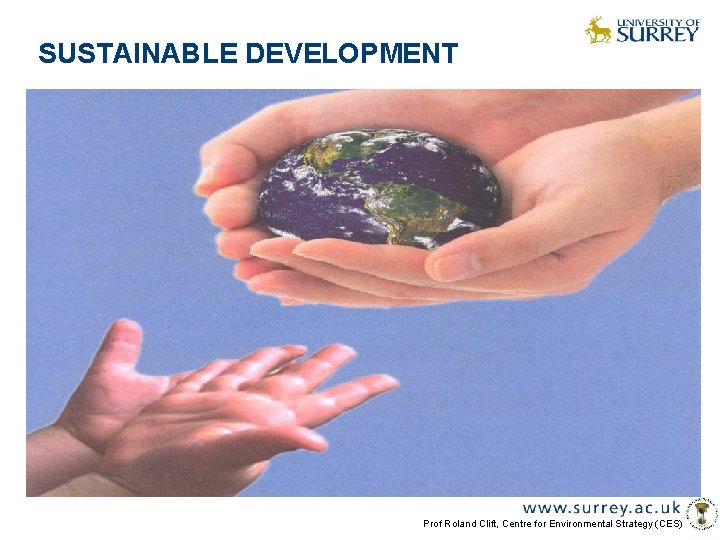
SUSTAINABLE DEVELOPMENT Prof Roland Clift, Centre for Environmental Strategy (CES)
Industrial Ecology is an area of applied research which brings together: • • • Engineering Science Economics Behavioural Sciences etc. Prof Roland Clift, Centre for Environmental Strategy (CES)
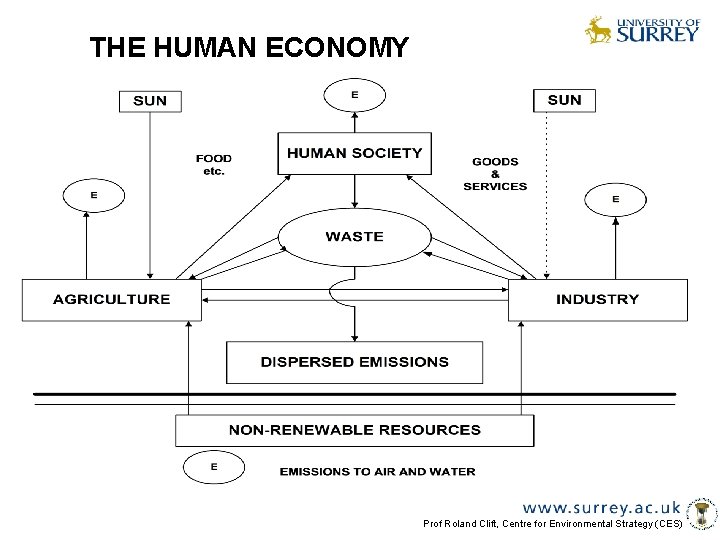
THE HUMAN ECONOMY Prof Roland Clift, Centre for Environmental Strategy (CES)
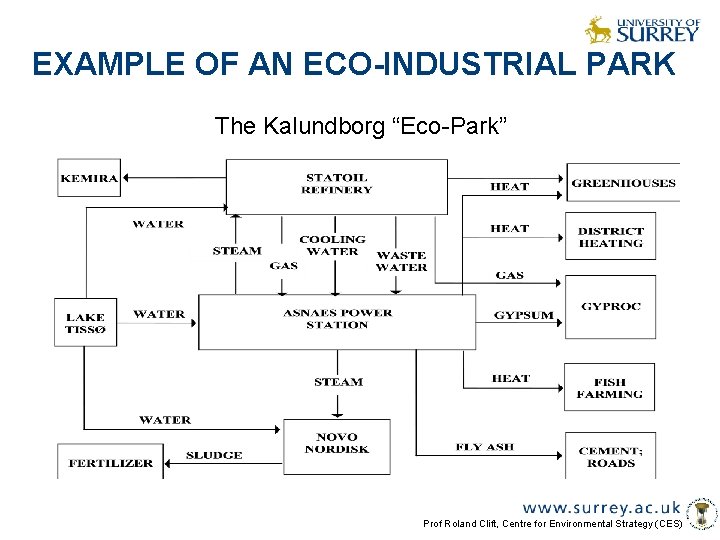
EXAMPLE OF AN ECO-INDUSTRIAL PARK The Kalundborg “Eco-Park” Prof Roland Clift, Centre for Environmental Strategy (CES)
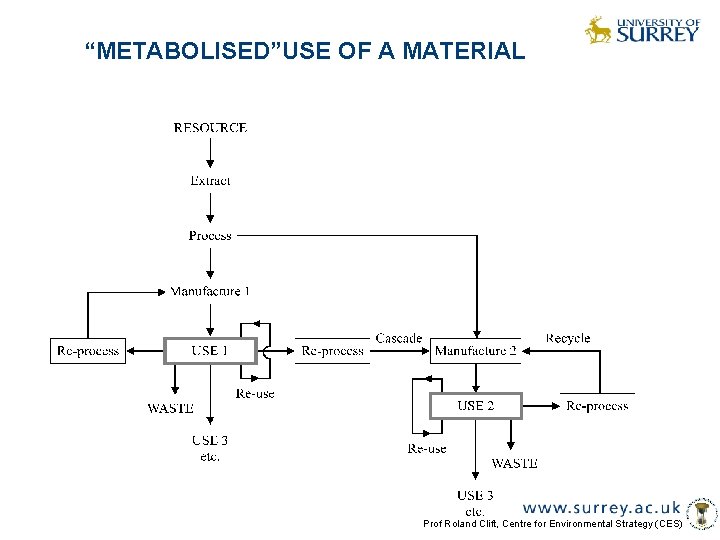
“METABOLISED”USE OF A MATERIAL Prof Roland Clift, Centre for Environmental Strategy (CES)
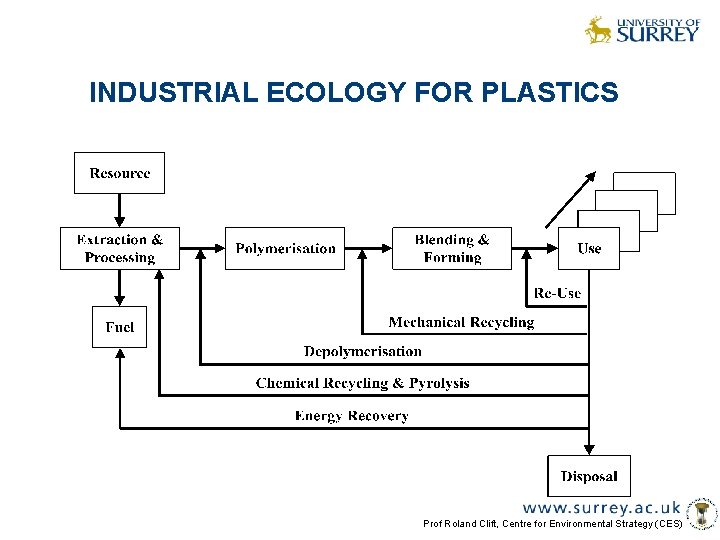
INDUSTRIAL ECOLOGY FOR PLASTICS Prof Roland Clift, Centre for Environmental Strategy (CES)
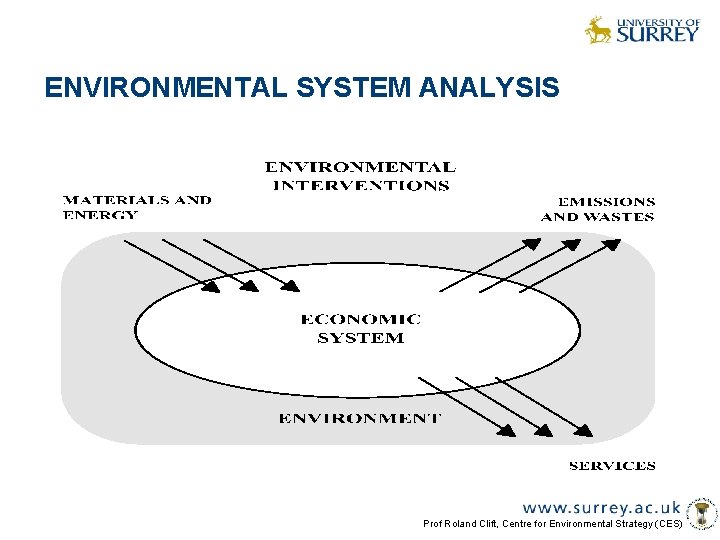
ENVIRONMENTAL SYSTEM ANALYSIS Prof Roland Clift, Centre for Environmental Strategy (CES)
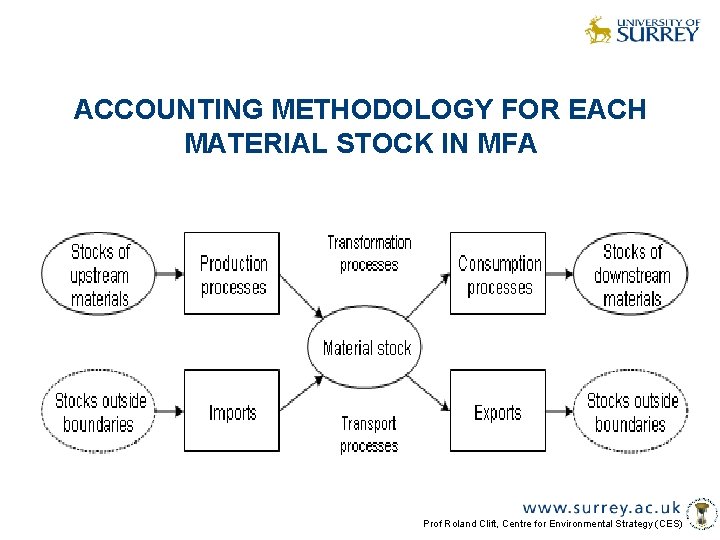
ACCOUNTING METHODOLOGY FOR EACH MATERIAL STOCK IN MFA Prof Roland Clift, Centre for Environmental Strategy (CES)
STOCKS AND FLOWS (1): A flow variable is one that has a time dimension or flows over time (like the flow through a stream). A stock variable is one that measures a quantity at a point in time (like the water in a lake). Income is a flow: wealth is a stock. (adapted from “Economics” by Samuelson and Nordhaus). Prof Roland Clift, Centre for Environmental Strategy (CES)
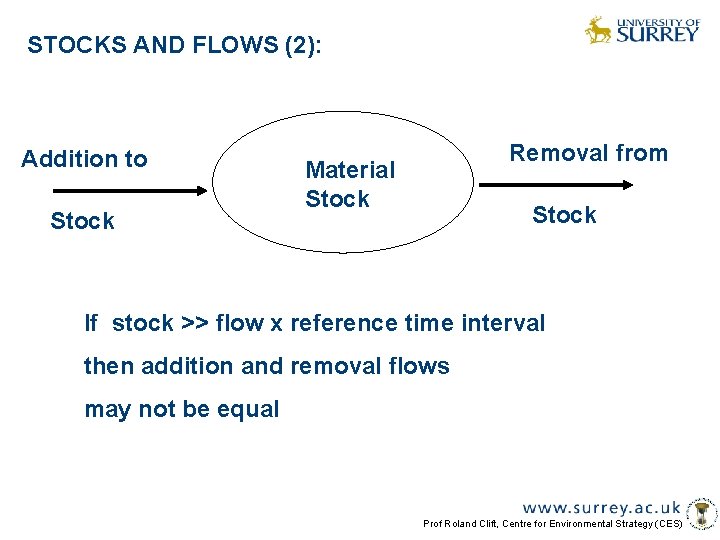
STOCKS AND FLOWS (2): Addition to Stock Removal from Material Stock If stock >> flow x reference time interval then addition and removal flows may not be equal Prof Roland Clift, Centre for Environmental Strategy (CES)
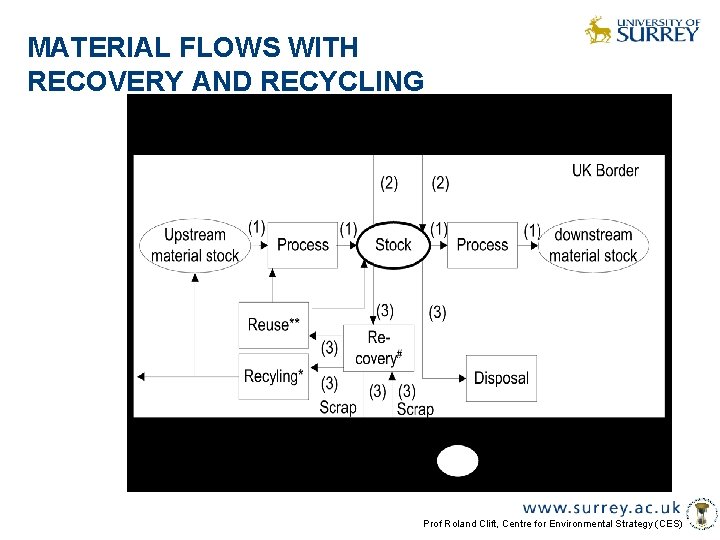
MATERIAL FLOWS WITH RECOVERY AND RECYCLING Prof Roland Clift, Centre for Environmental Strategy (CES)
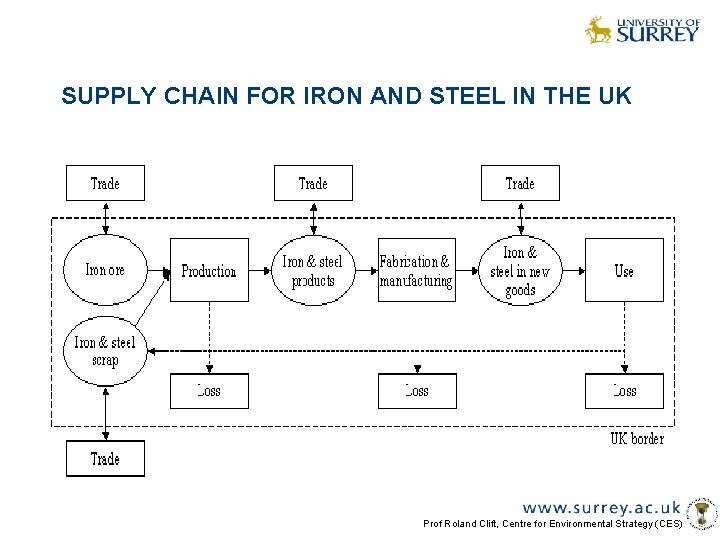
SUPPLY CHAIN FOR IRON AND STEEL IN THE UK Prof Roland Clift, Centre for Environmental Strategy (CES)
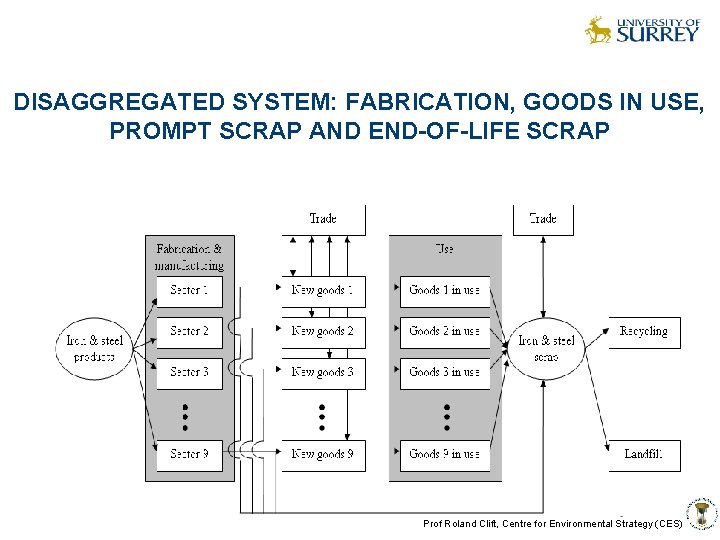
DISAGGREGATED SYSTEM: FABRICATION, GOODS IN USE, PROMPT SCRAP AND END-OF-LIFE SCRAP Prof Roland Clift, Centre for Environmental Strategy (CES)
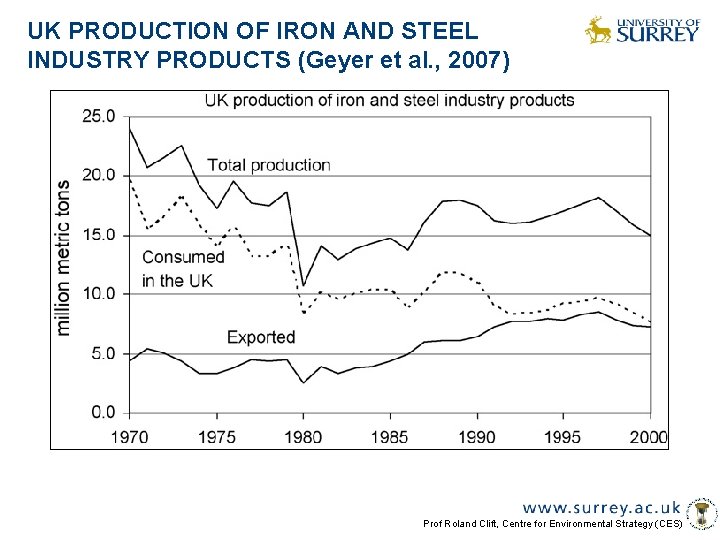
UK PRODUCTION OF IRON AND STEEL INDUSTRY PRODUCTS (Geyer et al. , 2007) Prof Roland Clift, Centre for Environmental Strategy (CES)
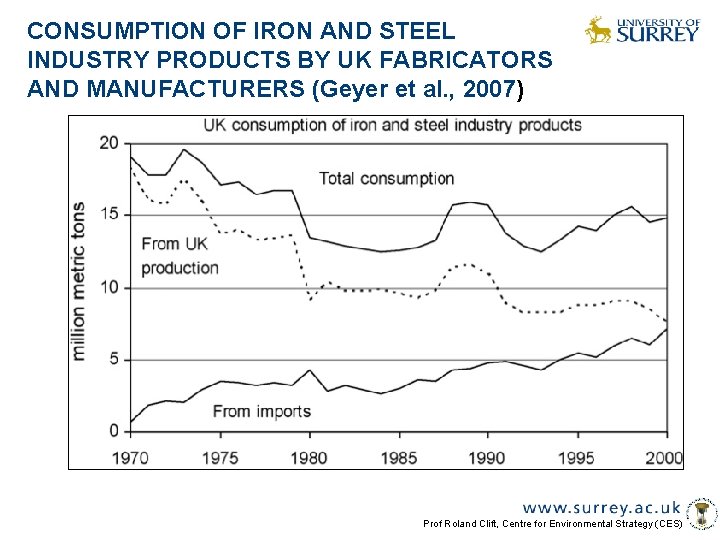
CONSUMPTION OF IRON AND STEEL INDUSTRY PRODUCTS BY UK FABRICATORS AND MANUFACTURERS (Geyer et al. , 2007) Prof Roland Clift, Centre for Environmental Strategy (CES)
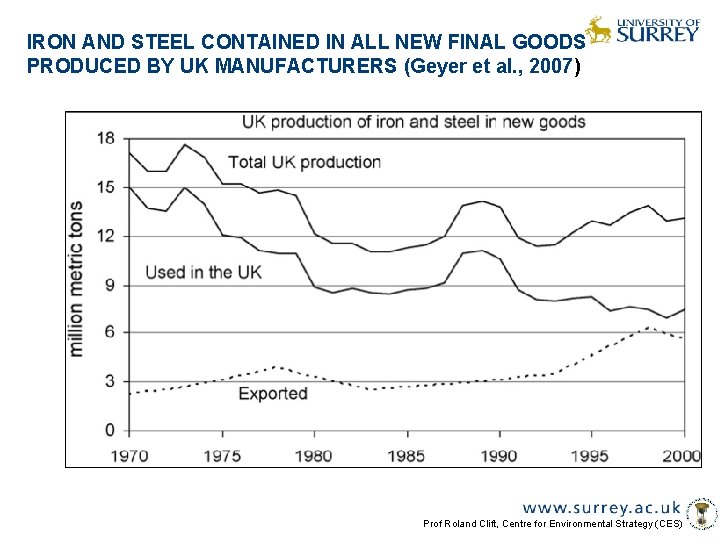
IRON AND STEEL CONTAINED IN ALL NEW FINAL GOODS PRODUCED BY UK MANUFACTURERS (Geyer et al. , 2007) Prof Roland Clift, Centre for Environmental Strategy (CES)
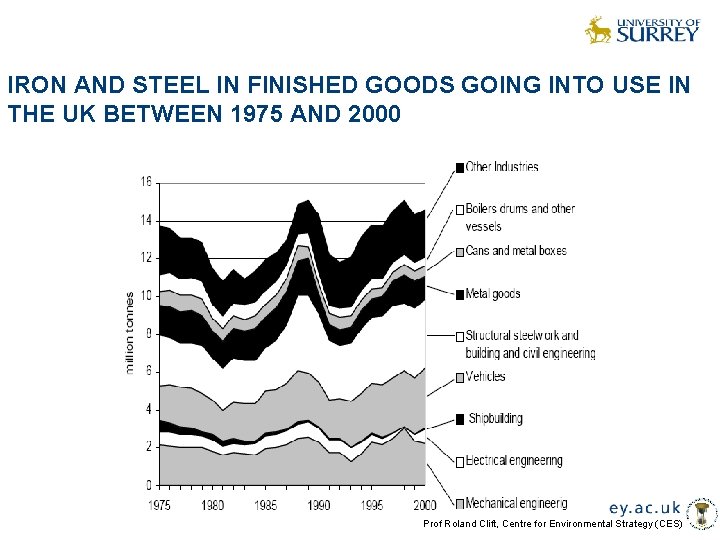
IRON AND STEEL IN FINISHED GOODS GOING INTO USE IN THE UK BETWEEN 1975 AND 2000 Prof Roland Clift, Centre for Environmental Strategy (CES)
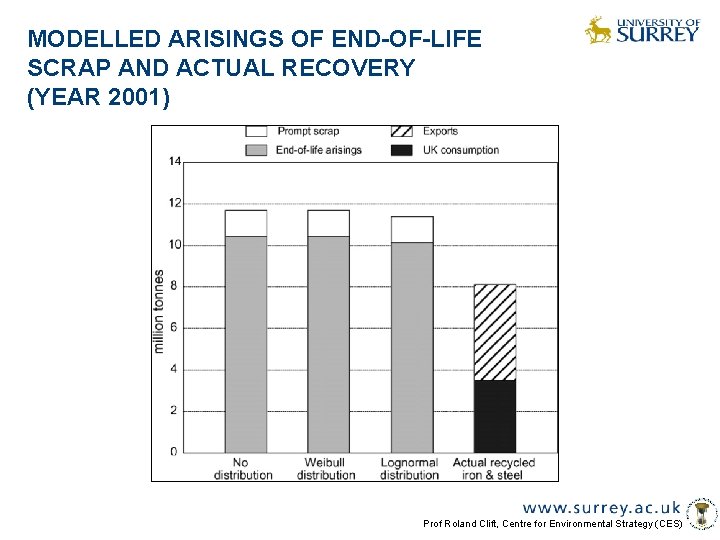
MODELLED ARISINGS OF END-OF-LIFE SCRAP AND ACTUAL RECOVERY (YEAR 2001) Prof Roland Clift, Centre for Environmental Strategy (CES)
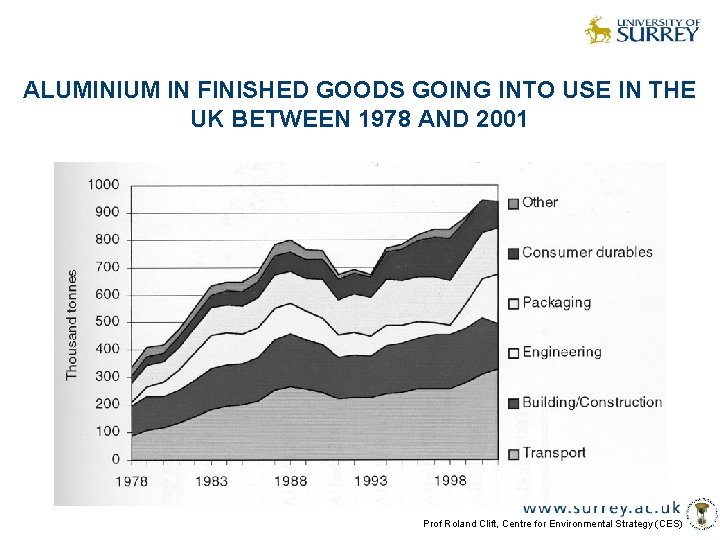
ALUMINIUM IN FINISHED GOODS GOING INTO USE IN THE UK BETWEEN 1978 AND 2001 Prof Roland Clift, Centre for Environmental Strategy (CES)
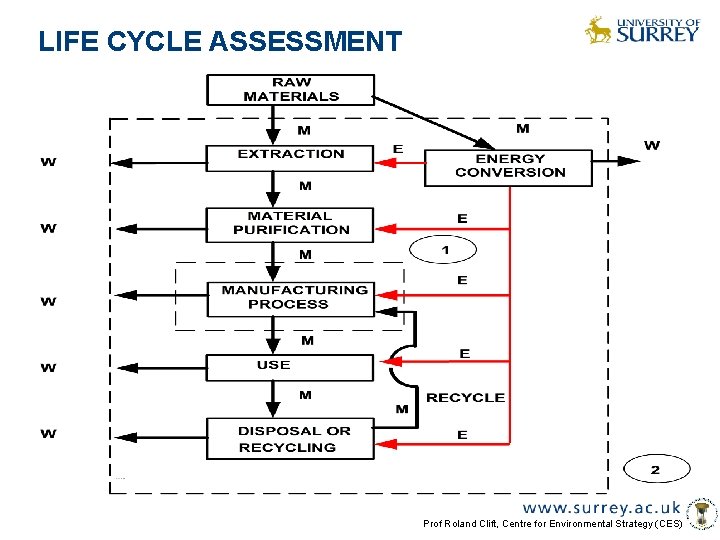
LIFE CYCLE ASSESSMENT Prof Roland Clift, Centre for Environmental Strategy (CES)
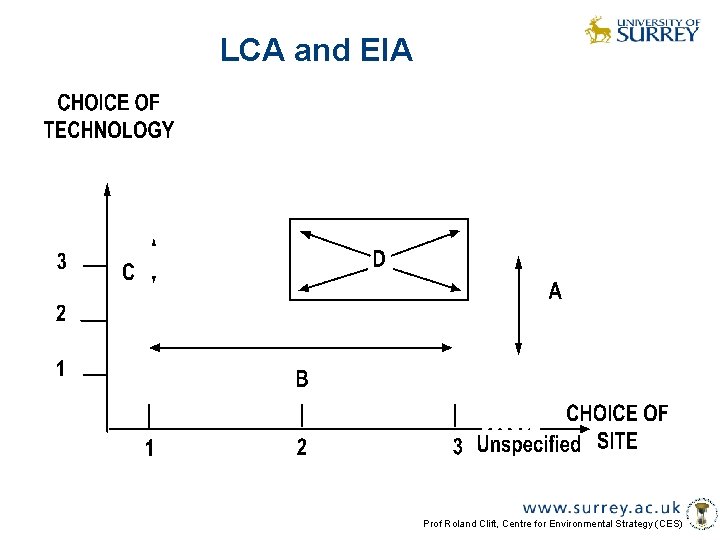
LCA and EIA Prof Roland Clift, Centre for Environmental Strategy (CES)
FOREGROUND SYSTEM: Set of processes whose selection or mode of operation is affected directly by decisions based on the study. BACKGROUND SYSTEM: All other processes which interact directly with the foreground system, usually by supplying material or energy to the foreground or receiving material energy from it. A sufficient (but not necessary) condition for a process or group of processes to be in the background is that the exchange with the foreground takes place through a homogeneous market. Prof Roland Clift, Centre for Environmental Strategy (CES)
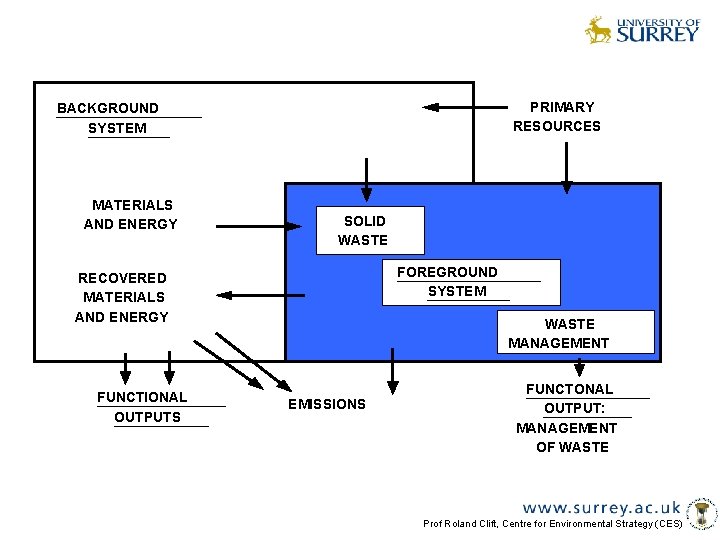
PRIMARY RESOURCES BACKGROUND SYSTEM MATERIALS AND ENERGY SOLID WASTE FOREGROUND SYSTEM RECOVERED MATERIALS AND ENERGY FUNCTIONAL OUTPUTS WASTE MANAGEMENT EMISSIONS FUNCTONAL OUTPUT: MANAGEMENT OF WASTE Prof Roland Clift, Centre for Environmental Strategy (CES)
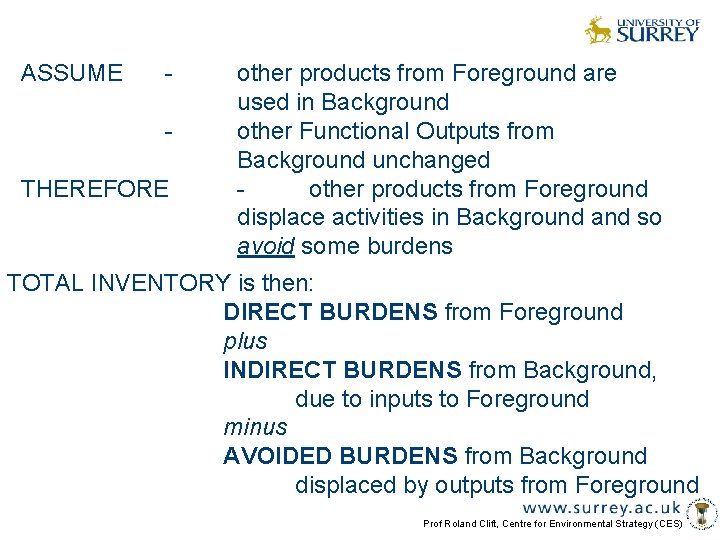
ASSUME - THEREFORE other products from Foreground are used in Background other Functional Outputs from Background unchanged other products from Foreground displace activities in Background and so avoid some burdens TOTAL INVENTORY is then: DIRECT BURDENS from Foreground plus INDIRECT BURDENS from Background, due to inputs to Foreground minus AVOIDED BURDENS from Background displaced by outputs from Foreground Prof Roland Clift, Centre for Environmental Strategy (CES)
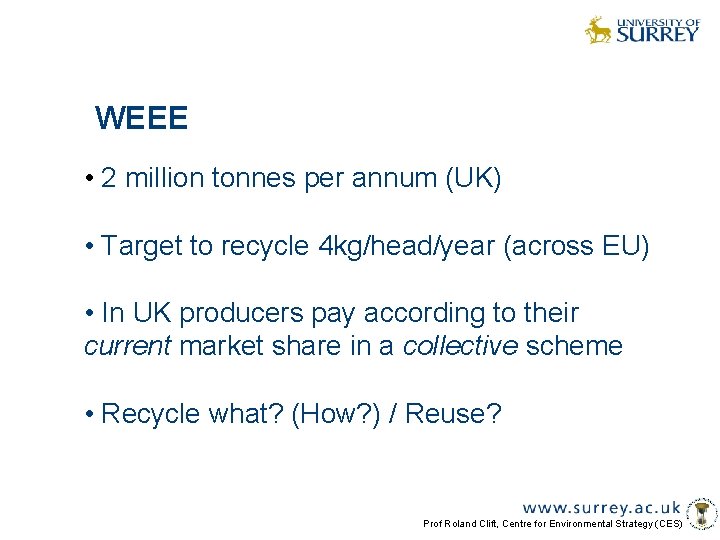
WEEE • 2 million tonnes per annum (UK) • Target to recycle 4 kg/head/year (across EU) • In UK producers pay according to their current market share in a collective scheme • Recycle what? (How? ) / Reuse? Prof Roland Clift, Centre for Environmental Strategy (CES)
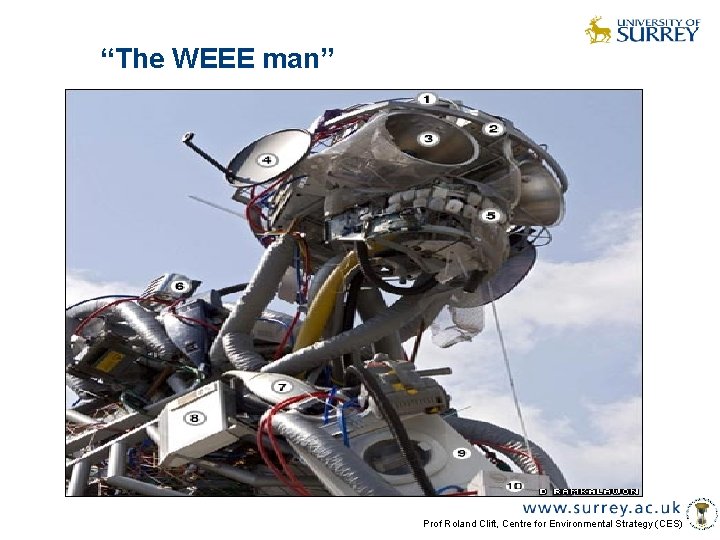
“The WEEE man” Prof Roland Clift, Centre for Environmental Strategy (CES)
POLICY RESPONSE: LONG TERM Move to sustainable materials and energy • Pressure from: - Legislation /fiscal measures - Customers - Scarcity(? ) Prof Roland Clift, Centre for Environmental Strategy (CES)
POLICY RESPONSE: SHORT/MED TERM • (Extended) Producer Responsibility -Initially concentrating on waste management • Integrated Product Policy -Will cover whole life cycle including ‘use’ phase Prof Roland Clift, Centre for Environmental Strategy (CES)
EXTENDED PRODUCER RESPONSIBILITY (EPR) • ‘an environmental policy approach in which a producer’s responsibility for a product is extended to the post consumer stage of the product’s life cycle. ’ (OECD) Prof Roland Clift, Centre for Environmental Strategy (CES)
WHAT EPR AIMS TO DO… • Increase reuse and recycling to reduce waste to landfill • Effect up-stream actions to combat down-stream problems • Make producers financially responsible for ‘their’ waste Prof Roland Clift, Centre for Environmental Strategy (CES)
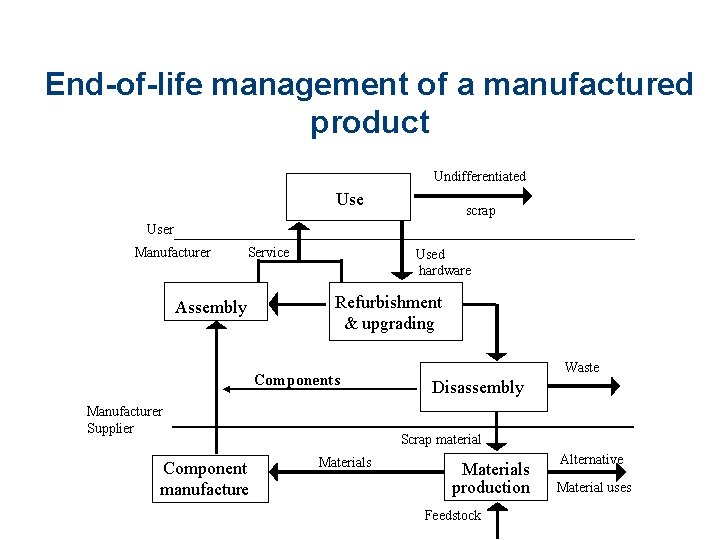
End-of-life management of a manufactured product Undifferentiated Use scrap User Manufacturer Service Assembly Used hardware Refurbishment & upgrading Components Manufacturer Supplier Component manufacture Waste Disassembly Scrap material Materials production Feedstock Alternative Material uses
Must globalisation of trade mean globalisation of waste? Should others suffer from the excrescences of our consumption? Prof Roland Clift, Centre for Environmental Strategy (CES)
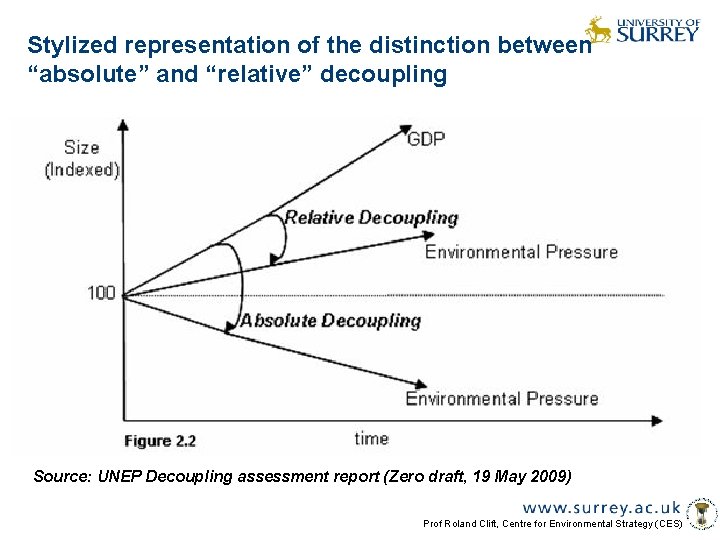
Stylized representation of the distinction between “absolute” and “relative” decoupling Source: UNEP Decoupling assessment report (Zero draft, 19 May 2009) Prof Roland Clift, Centre for Environmental Strategy (CES)
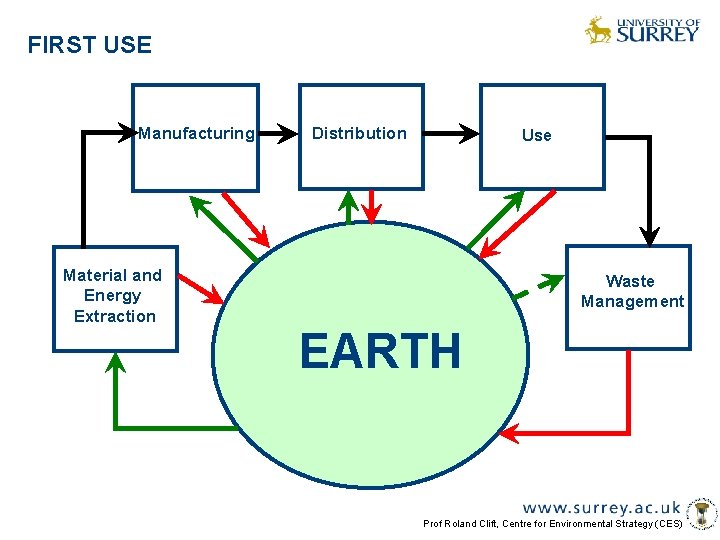
FIRST USE Manufacturing Material and Energy Extraction Distribution Use Waste Management EARTH Prof Roland Clift, Centre for Environmental Strategy (CES)
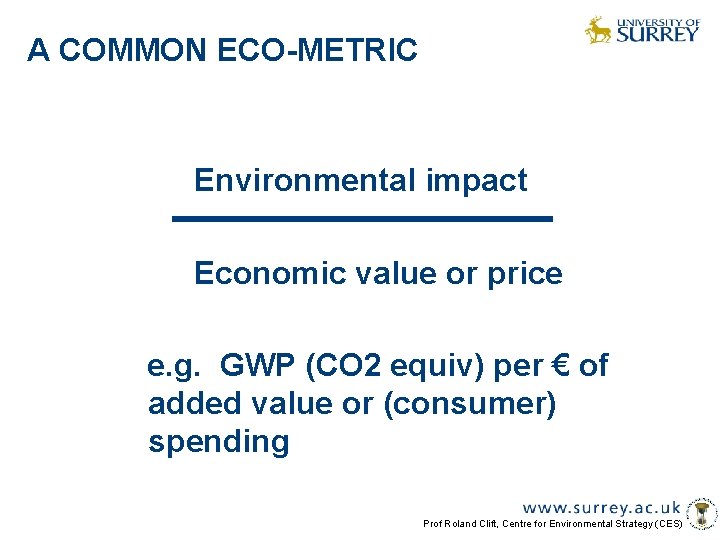
A COMMON ECO-METRIC Environmental impact Economic value or price e. g. GWP (CO 2 equiv) per € of added value or (consumer) spending Prof Roland Clift, Centre for Environmental Strategy (CES)
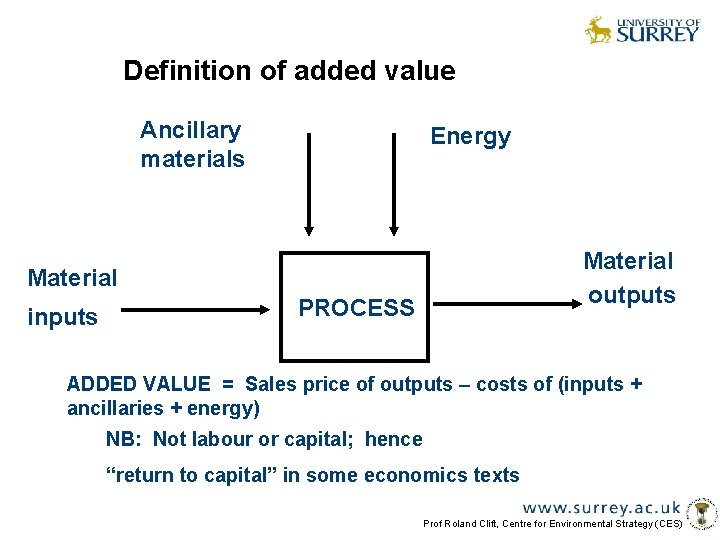
Definition of added value Ancillary materials Energy Material outputs Material inputs PROCESS ADDED VALUE = Sales price of outputs – costs of (inputs + ancillaries + energy) NB: Not labour or capital; hence “return to capital” in some economics texts Prof Roland Clift, Centre for Environmental Strategy (CES)
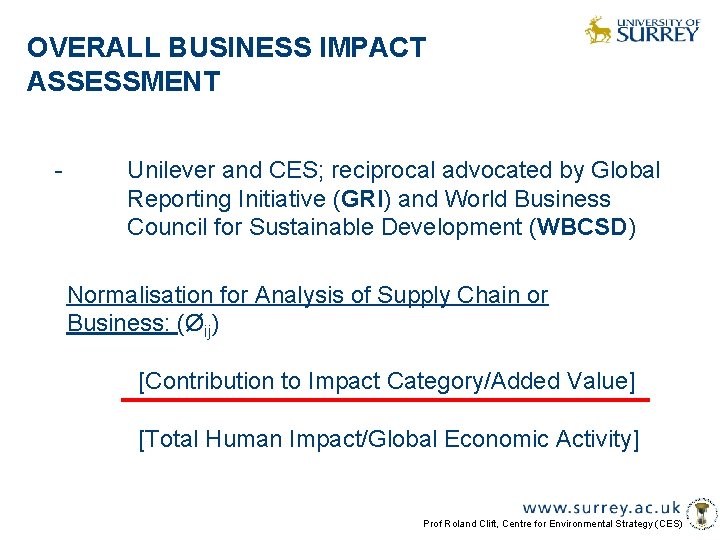
OVERALL BUSINESS IMPACT ASSESSMENT - Unilever and CES; reciprocal advocated by Global Reporting Initiative (GRI) and World Business Council for Sustainable Development (WBCSD) Normalisation for Analysis of Supply Chain or Business: (Øij) [Contribution to Impact Category/Added Value] [Total Human Impact/Global Economic Activity] Prof Roland Clift, Centre for Environmental Strategy (CES)
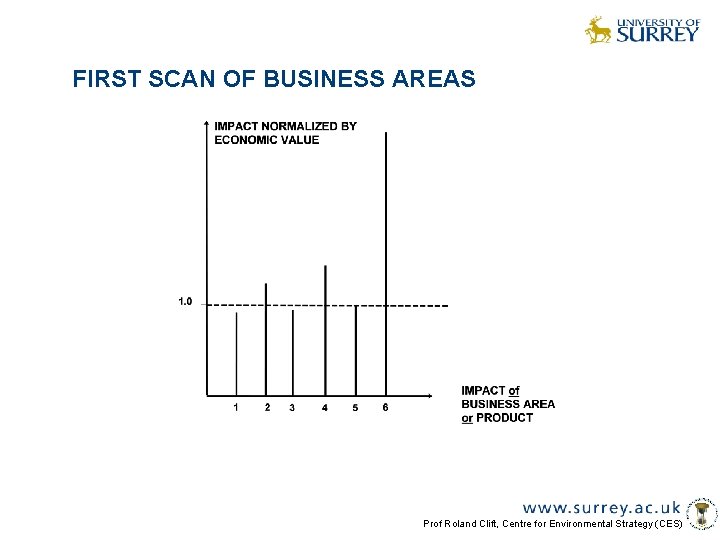
FIRST SCAN OF BUSINESS AREAS Prof Roland Clift, Centre for Environmental Strategy (CES)
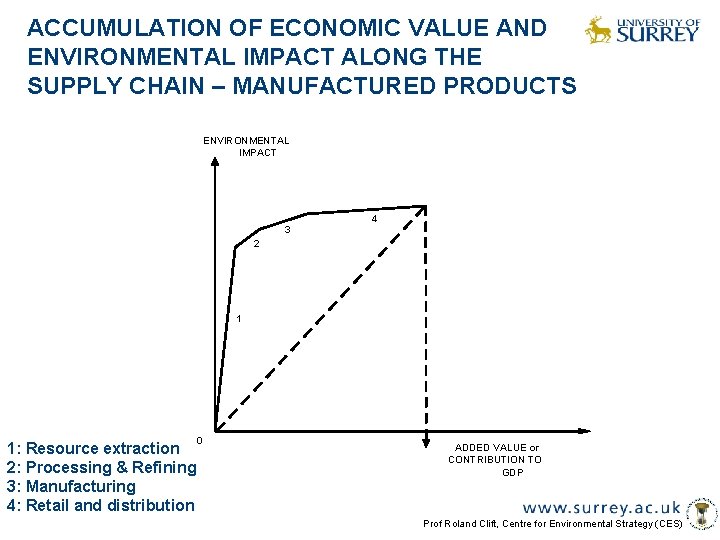
ACCUMULATION OF ECONOMIC VALUE AND ENVIRONMENTAL IMPACT ALONG THE SUPPLY CHAIN – MANUFACTURED PRODUCTS ENVIRONMENTAL IMPACT 3 4 2 1 1: Resource extraction 2: Processing & Refining 3: Manufacturing 4: Retail and distribution 0 ADDED VALUE or CONTRIBUTION TO GDP Prof Roland Clift, Centre for Environmental Strategy (CES)
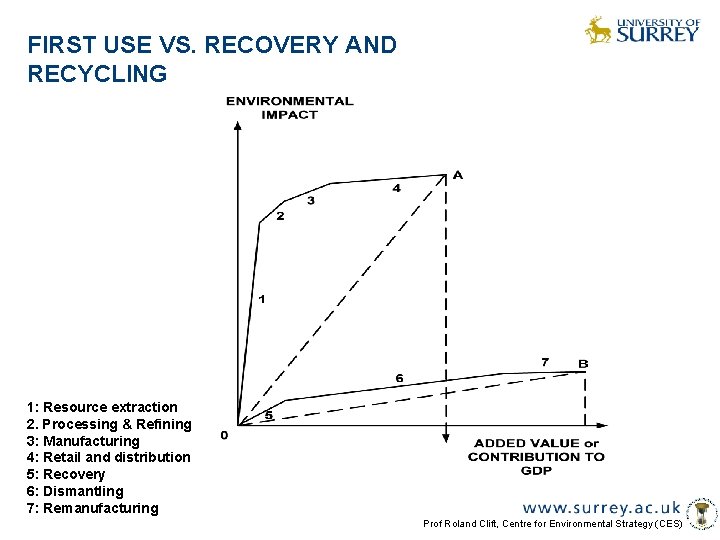
FIRST USE VS. RECOVERY AND RECYCLING 1: Resource extraction 2. Processing & Refining 3: Manufacturing 4: Retail and distribution 5: Recovery 6: Dismantling 7: Remanufacturing Prof Roland Clift, Centre for Environmental Strategy (CES)
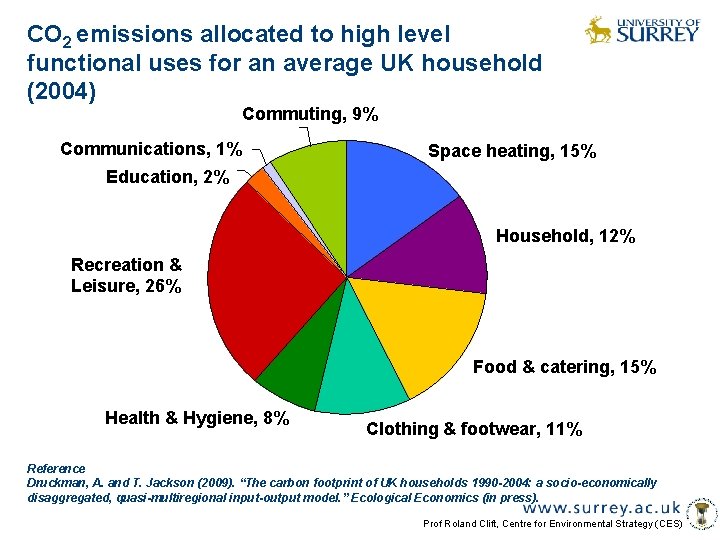
CO 2 emissions allocated to high level functional uses for an average UK household (2004) Commuting, 9% Communications, 1% Space heating, 15% Education, 2% Household, 12% Recreation & Leisure, 26% Food & catering, 15% Health & Hygiene, 8% Clothing & footwear, 11% Reference Druckman, A. and T. Jackson (2009). “The carbon footprint of UK households 1990 -2004: a socio-economically disaggregated, quasi-multiregional input-output model. ” Ecological Economics (in press). Prof Roland Clift, Centre for Environmental Strategy (CES)
Where does this point? A redefinition of quality or luxury… EQUITY includes: – Equity along the supply chain – Equity of access to “environmental services” between affluent and poor This requires consumption in affluent societies to have low environmental impact per dollar spent and to provide social and economic benefits along the supply chain: The “Fair Trade” principle and beyond… Prof Roland Clift, Centre for Environmental Strategy (CES)

Gucci is good for the earth and Angels wear Prada Prof Roland Clift, Centre for Environmental Strategy (CES)
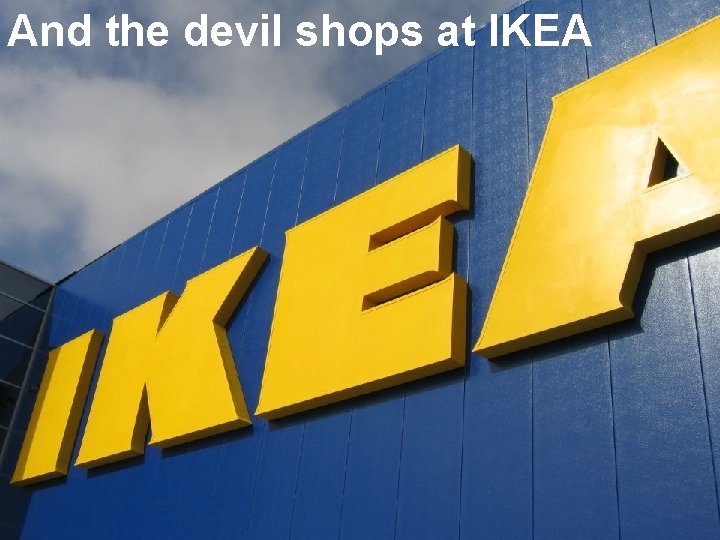
And the devil shops at IKEA Prof Roland Clift, Centre for Environmental Strategy (CES)
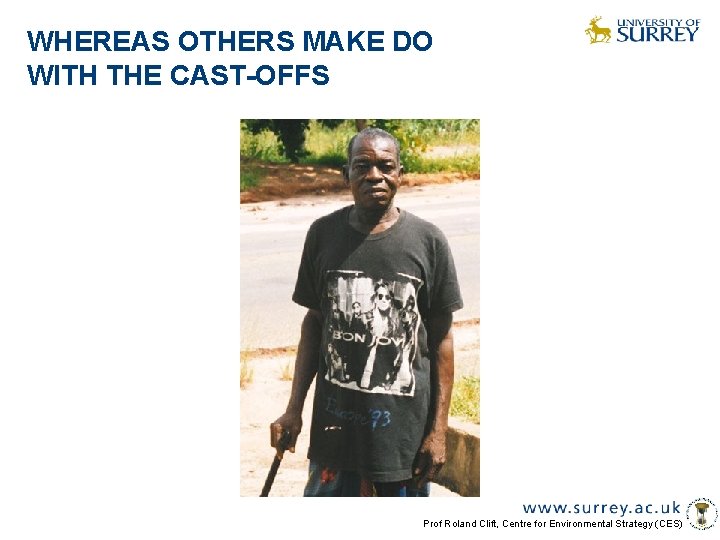
WHEREAS OTHERS MAKE DO WITH THE CAST-OFFS Prof Roland Clift, Centre for Environmental Strategy (CES)
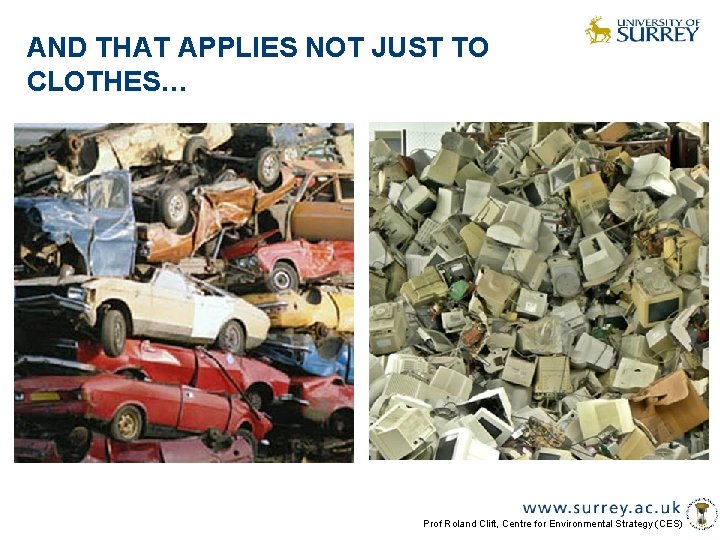
AND THAT APPLIES NOT JUST TO CLOTHES… Prof Roland Clift, Centre for Environmental Strategy (CES)
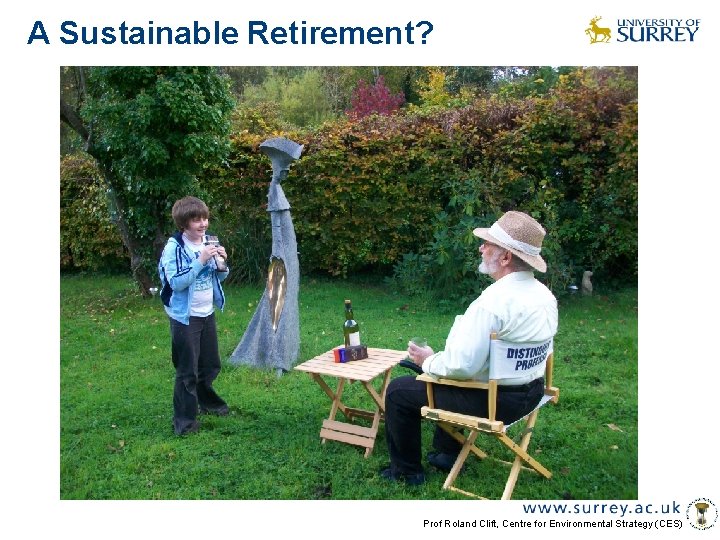
A Sustainable Retirement? Prof Roland Clift, Centre for Environmental Strategy (CES)
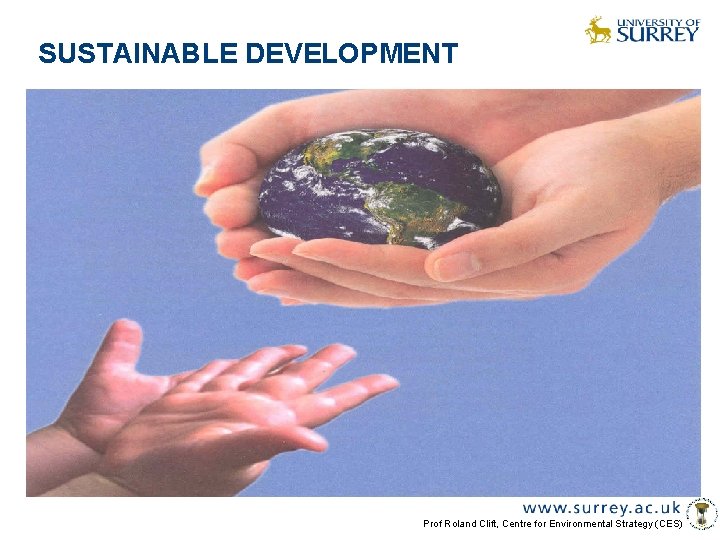
SUSTAINABLE DEVELOPMENT Prof Roland Clift, Centre for Environmental Strategy (CES)
- Slides: 50