
Industrial Design Definition Industrial Design protection is provided

- Slides: 15
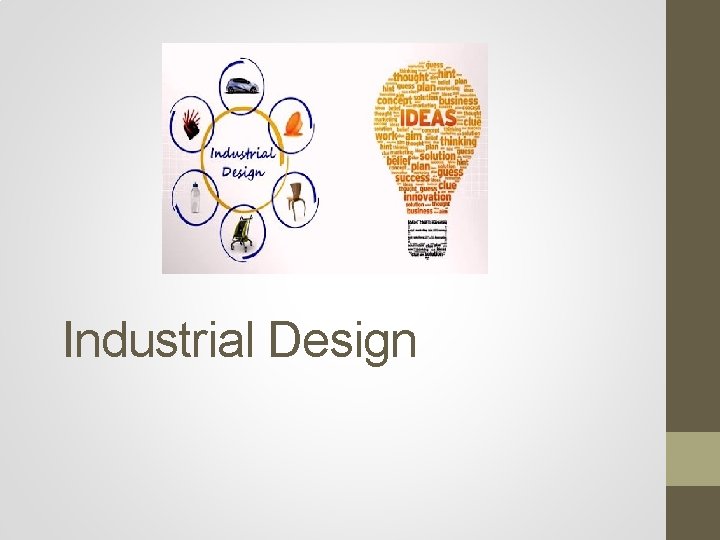
Industrial Design
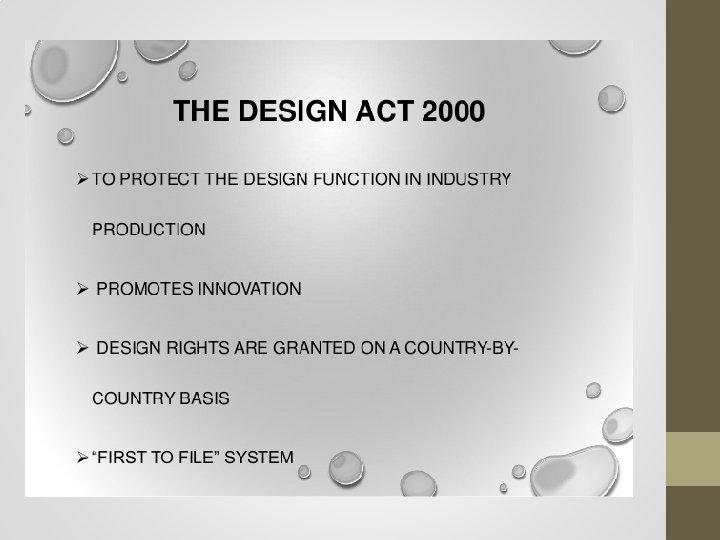
Definition Industrial Design protection is provided for a shape, configuration, surface pattern, colour, or line (or a combination of these), which, when applied to a functional article, produces or increases aesthetics, and improves the visual appearance of the design, be it a two-dimensional or a three-dimensional article. As per Indian Law, under the Design Act of 2000, Industrial Design protection is a type of intellectual property right that gives the exclusive right to make, sell, and use articles that embody the protected design, to selected people only. Protection rights are provided for a period of 10 years. They can then be renewed once for an additional period of 5 years. Design protection provides geographical rights, like Patents and Trademarks do. To obtain Design Protection in India, the same has to be registered in India.
Qualification Criteria The pre-requisites for a design to qualify for protection are as follows: 1 -) It should be novel and original. 2 -) It should be applicable to a functional article. 3 -) It should be visible on a finished article. 4 -) It should be non-obvious. 5 -) There should be no prior publication or disclosure of the design.
Design Protection In principle, the owner of a registered industrial design or of a design patent has the right to prevent third parties from making, selling or importing articles bearing or embodying a design which is a copy, or substantially a copy, of the protected design, when such acts are undertaken for commercial purposes. Industrial designs are applied to a wide variety of products of industry and handicraft items: from packages and containers to furnishing and household goods, from lighting equipment to jewelry, and from electronic devices to textiles. Industrial designs may also be relevant to graphic symbols, graphical user interfaces (GUI), and logos.
In most countries, an industrial design needs to be registered in order to be protected under industrial design law as a “registered design”. In some countries, industrial designs are protected under patent law as “design patents ”. Industrial design laws in some countries grant – without registration – time- and scope limited protection to so-called “unregistered industrial designs”. Depending on the particular national law and the kind of design, industrial designs may also be protected as works of art under copyright law.
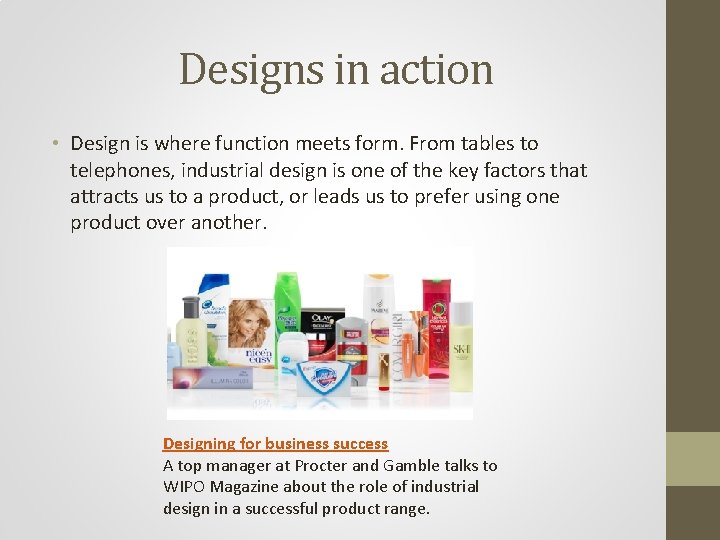
Designs in action • Design is where function meets form. From tables to telephones, industrial design is one of the key factors that attracts us to a product, or leads us to prefer using one product over another. Designing for business success A top manager at Procter and Gamble talks to WIPO Magazine about the role of industrial design in a successful product range.
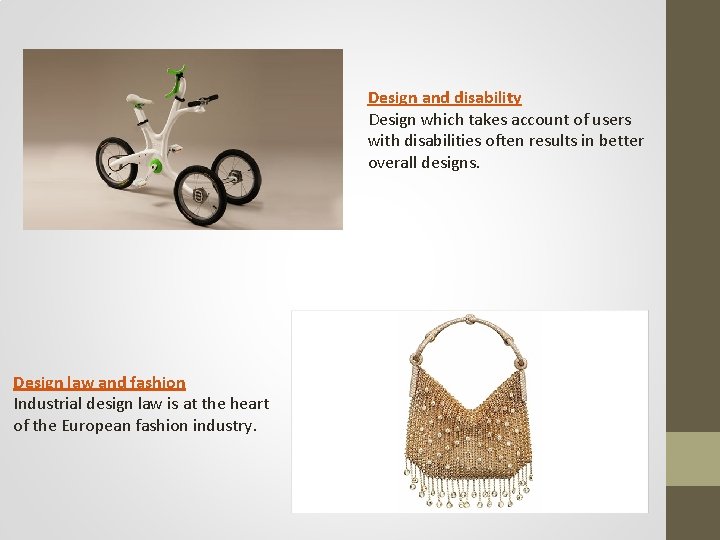
Design and disability Design which takes account of users with disabilities often results in better overall designs. Design law and fashion Industrial design law is at the heart of the European fashion industry.
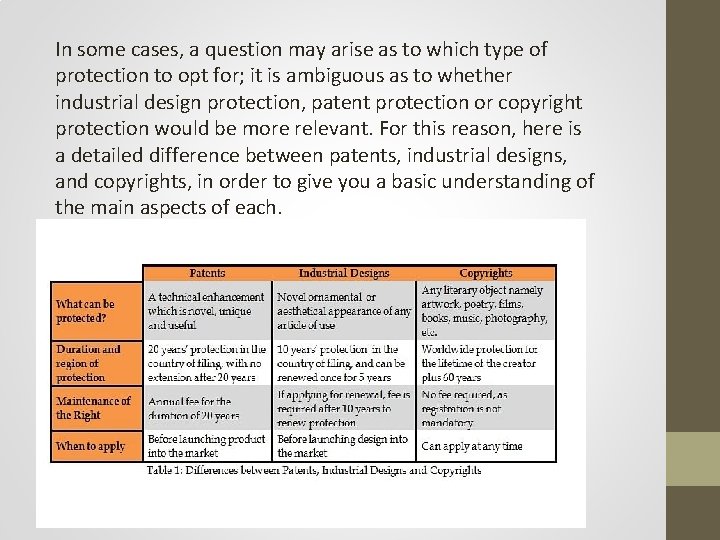
In some cases, a question may arise as to which type of protection to opt for; it is ambiguous as to whether industrial design protection, patent protection or copyright protection would be more relevant. For this reason, here is a detailed difference between patents, industrial designs, and copyrights, in order to give you a basic understanding of the main aspects of each.
Industrial Design Protection In India: The Designs Act, 2000 ("the Act"), is a complete code in itself and protection under it is wholly statutory in nature. It protects the visual design of objects that are not purely utilitarian. Section 2(d) of the Act, defines a Design as: "design" means only the features of shape, configuration, pattern, ornament or composition of lines or colours applied to any article whether in two dimensional or three dimensional or in both forms, by any industrial process or means, whether manual, mechanical or chemical, separate or combined
, which in the finished article appeal to and are judged solely by the eye; but does not include any mode or principle of construction or anything which is in substance a mere mechanical device, and does not include any trade mark as defined in clause (v) of sub-section (1) of section 2 of the Trade and Merchandise Marks Act, 1958 (43 of 1958) or property mark as defined in section 479 of the Indian Penal Code (45 of 1860) or any artistic work as defined in clause (c) of section 2 of the Copyright Act, 1957 (14 of 1957).
Design Rights As in case of any other IP rights, the design registration also bestows a monopolistic right to the Proprietor by which he/she can legally exclude others from reproducing, manufacturing, selling, or dealing in the said registered design without his/her prior consent. The design registration is particularly useful for entities where the shape of the product has aesthetic value and the entity wishes to have exclusivity over the said novel and original design applied to its product(s) or article(s). In addition to the above, the design sought for protection must be new or original, i. e. , not disclosed to the public in India or elsewhere in the world by prior publication or by prior use or in any other way. The design should be significantly distinguishable from designs or combination of designs that are already registered or pre-existing or disclosed to the public. Furthermore, the design should not include any scandalous or
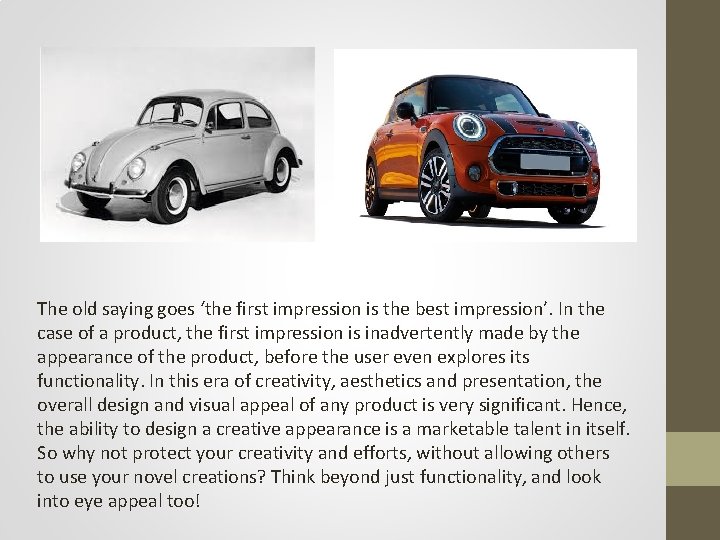
Why should one look into filing for Industrial Design? The outer appearance of a product makes it visually more appealing and attractive. This acts as a value-adding aspect, which in turn increases the marketability of the product. This leads to the need to protect your creation from third parties’ use, in order to prevent them from taking advantage of your rights in this world of competition. In many cases, the design itself becomes the identity of a brand. Some of the most famous examples are Coca Cola’s contour bottle, the contours of the i. Phone/i. Pad/i. Pod, and the shape of the Volkswagen Beetle and the Mini Cooper. When a product’s design is protected, it stops illegitimate products from destroying the brand’s efficacy and safety. Protection of industrial designs also encourages creativity in the manufacturing and industrial sectors, which leads to an expansion in commercial activities.
The old saying goes ‘the first impression is the best impression’. In the case of a product, the first impression is inadvertently made by the appearance of the product, before the user even explores its functionality. In this era of creativity, aesthetics and presentation, the overall design and visual appeal of any product is very significant. Hence, the ability to design a creative appearance is a marketable talent in itself. So why not protect your creativity and efforts, without allowing others to use your novel creations? Think beyond just functionality, and look into eye appeal too!
Thank You