
Industrial demand can be reduced Shift to processes
Industrial demand can be reduced • Shift to processes that use less water – Wastewater recycling – Excess surface water runoff used for recharging aquifers – Patching leaky pipes – Auditing industries – Promoting conservation/education
• Economic approaches to water End government conservation subsidies of inefficient practices – Let the price of water reflect its true cost of extraction • Industrial uses are more profitable than agricultural – Less developed countries suffer • Privatization of water supplies – May improve efficiency – Firms have little incentive to provide access to the poor • Decentralization of water control may conserve water – Shift control to the local level
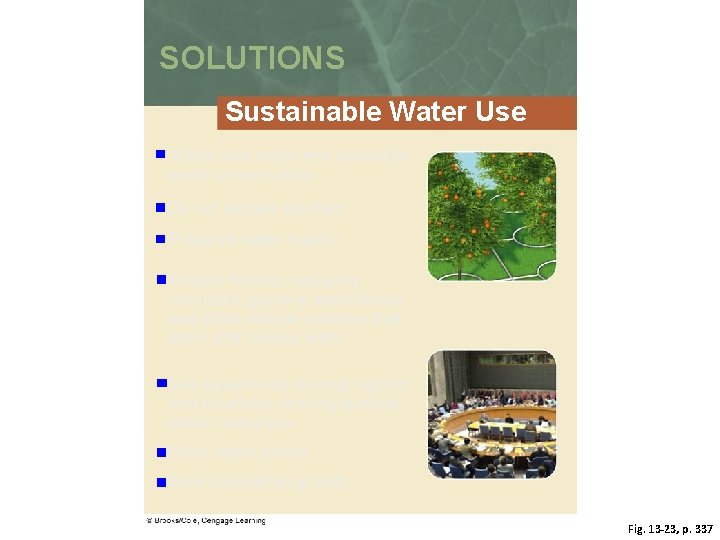
SOLUTIONS Sustainable Water Use Waste less water and subsidize water conservation Do not deplete aquifers Preserve water quality Protect forests, wetlands, mountain glaciers, watersheds, and other natural systems that store and release water Get agreements among regions and countries sharing surface water resources Raise water prices Slow population growth Fig. 13 -23, p. 337
Freshwater pollution andand itsother control • Water for human consumption organisms needs to be… – Disease-free – Nontoxic • Half of the world’s major rivers are seriously depleted and polluted – They poison surrounding ecosystems – Threaten the health and livelihood of people • The invisible pollution of groundwater has been called a “covert crisis” • The United Nations has estimated that by 2025, at least 3 billion of the world’s projected 7. 9 billion people will lack access to
• Nutrient pollution Pollution = the release of matter or energy into the environment that causes undesirable impacts on the health and well-being of humans or other organisms • Nutrient pollution from fertilizers, farms, sewage, lawns, golf courses – Leads to eutrophication • Solutions • • Phosphate-free detergents Planting vegetation to increase nutrient uptake Treat wastewater Reduce fertilizer application
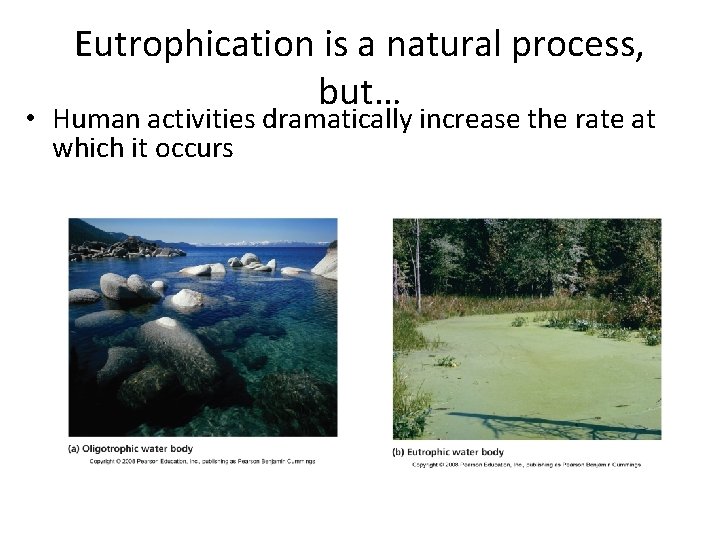
Eutrophication is a natural process, but… • Human activities dramatically increase the rate at which it occurs
Pathogens and waterborne diseases • Enters water supply via inadequately treated human waste and animal waste via feedlots • Causes more human health problems than any other type of water pollution • Currently, 1. 1 billion people are without safe drinking water • Fecal coliform bacteria indicate fecal contamination of water – The water can hold other pathogens, such as giardiasis, typhoid, hepatitis A • Solutions: • Treat sewage • Disinfect drinking water • Public education to encourage personal hygiene • Government enforcement of regulations
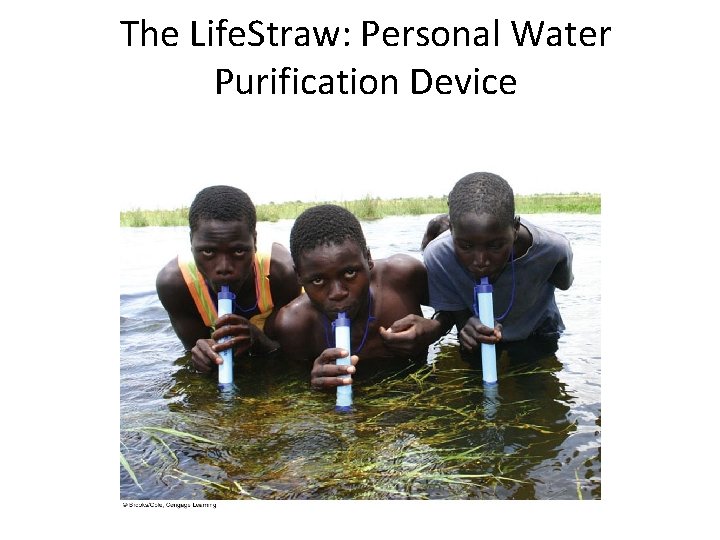
The Life. Straw: Personal Water Purification Device
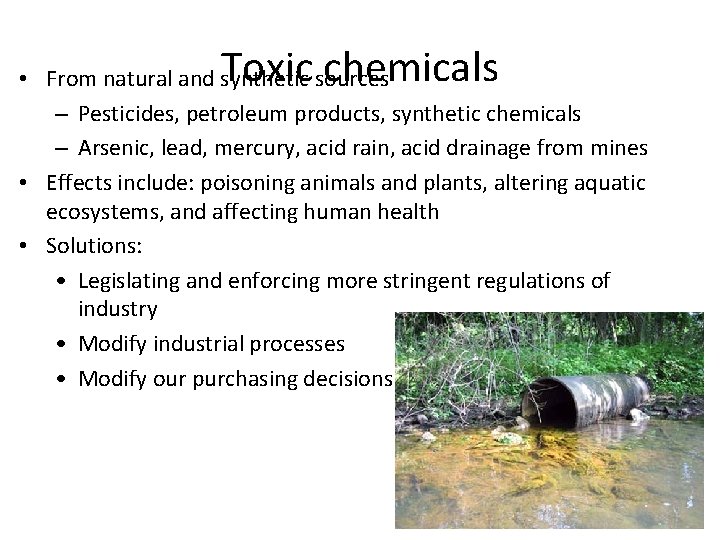
Toxic chemicals • From natural and synthetic sources – Pesticides, petroleum products, synthetic chemicals – Arsenic, lead, mercury, acid rain, acid drainage from mines • Effects include: poisoning animals and plants, altering aquatic ecosystems, and affecting human health • Solutions: • Legislating and enforcing more stringent regulations of industry • Modify industrial processes • Modify our purchasing decisions
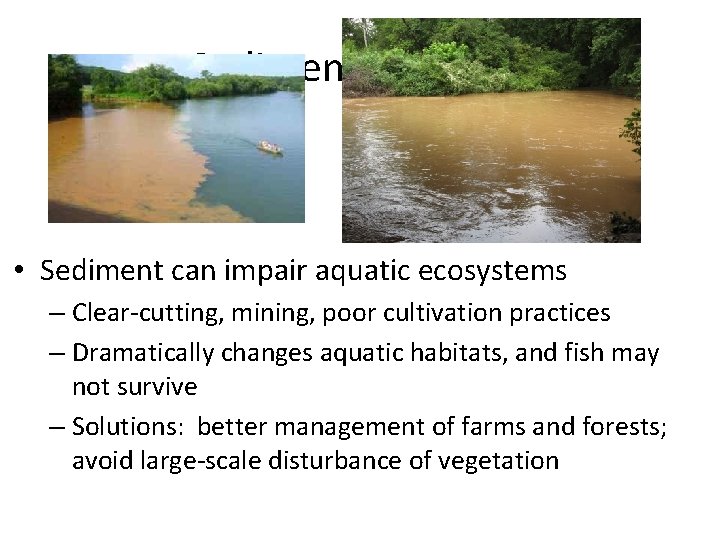
Sediment pollution • Sediment can impair aquatic ecosystems – Clear-cutting, mining, poor cultivation practices – Dramatically changes aquatic habitats, and fish may not survive – Solutions: better management of farms and forests; avoid large-scale disturbance of vegetation
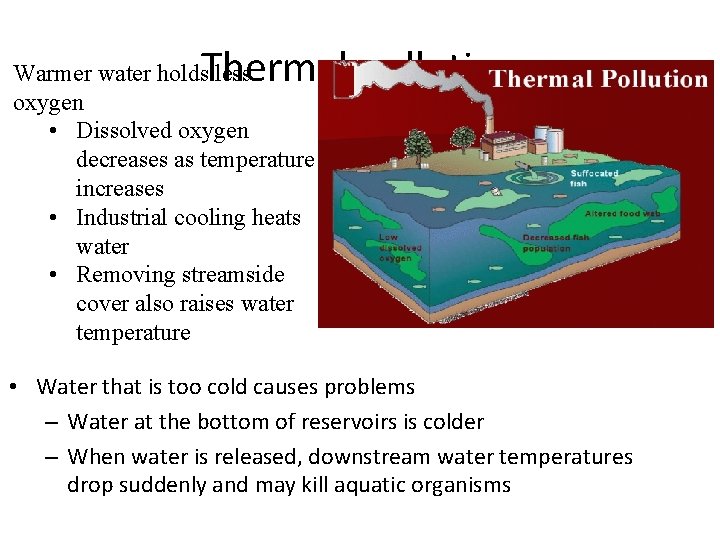
Thermal pollution Warmer water holds less oxygen • Dissolved oxygen decreases as temperature increases • Industrial cooling heats water • Removing streamside cover also raises water temperature • Water that is too cold causes problems – Water at the bottom of reservoirs is colder – When water is released, downstream water temperatures drop suddenly and may kill aquatic organisms
Water Pollution Comes from Point and Nonpoint Sources • Point sources – Located at specific places – Often discharge pollutants through drain pipes, sewer lines – Easy to identify, monitor, and regulate – Examples: factories, sewage treatment plants, underground mines, oil tankers • Nonpoint sources – Broad, diffuse areas – Difficult to identify and control – Expensive to clean up – Examples: runoff of chemicals and sediment from cropland, livestock feedlots, golf courses, parking lots, urban streets
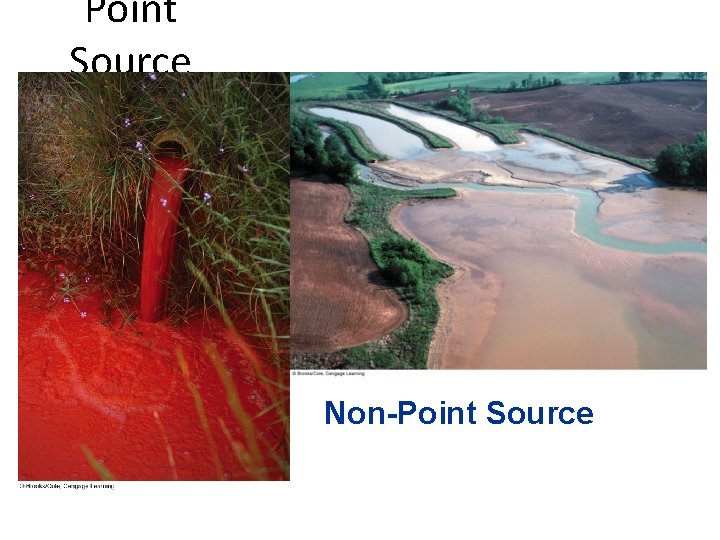
Point Source Non-Point Source
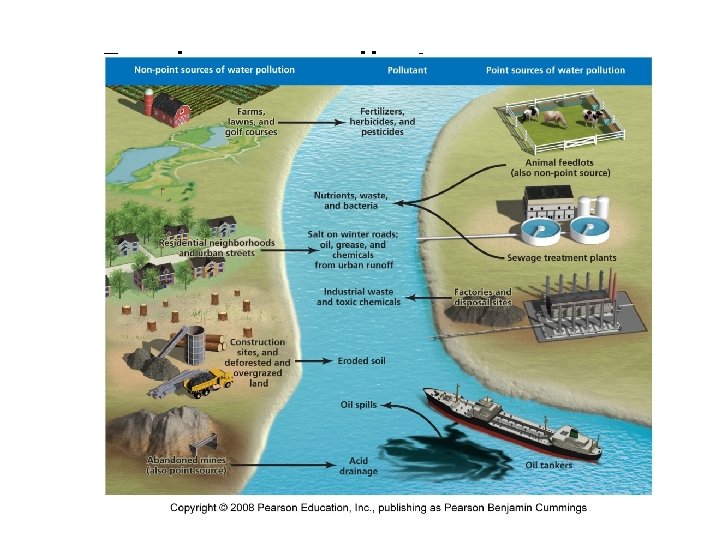
Freshwater pollution sources
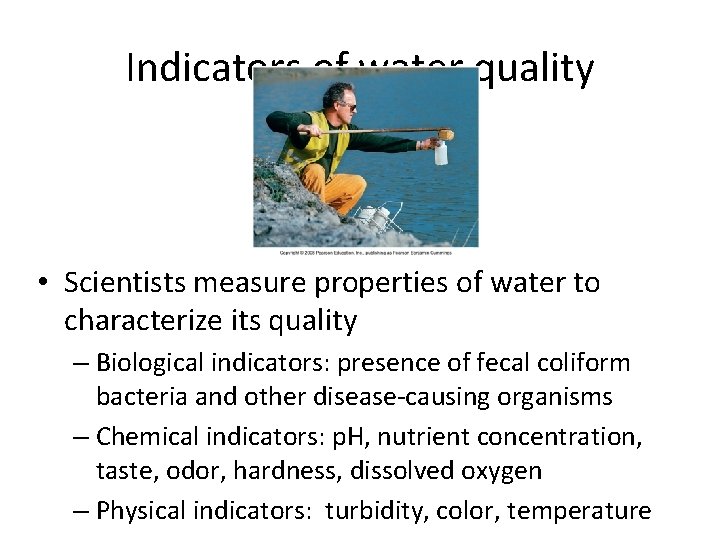
Indicators of water quality • Scientists measure properties of water to characterize its quality – Biological indicators: presence of fecal coliform bacteria and other disease-causing organisms – Chemical indicators: p. H, nutrient concentration, taste, odor, hardness, dissolved oxygen – Physical indicators: turbidity, color, temperature
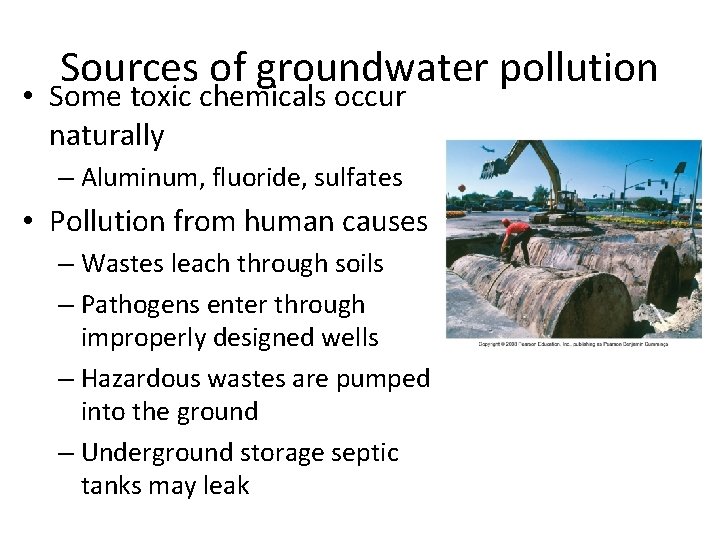
Sources of groundwater pollution • Some toxic chemicals occur naturally – Aluminum, fluoride, sulfates • Pollution from human causes – Wastes leach through soils – Pathogens enter through improperly designed wells – Hazardous wastes are pumped into the ground – Underground storage septic tanks may leak
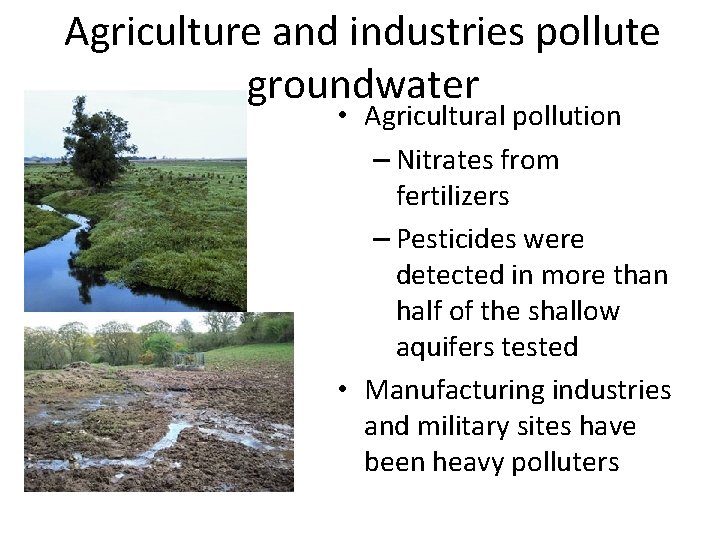
Agriculture and industries pollute groundwater • Agricultural pollution – Nitrates from fertilizers – Pesticides were detected in more than half of the shallow aquifers tested • Manufacturing industries and military sites have been heavy polluters
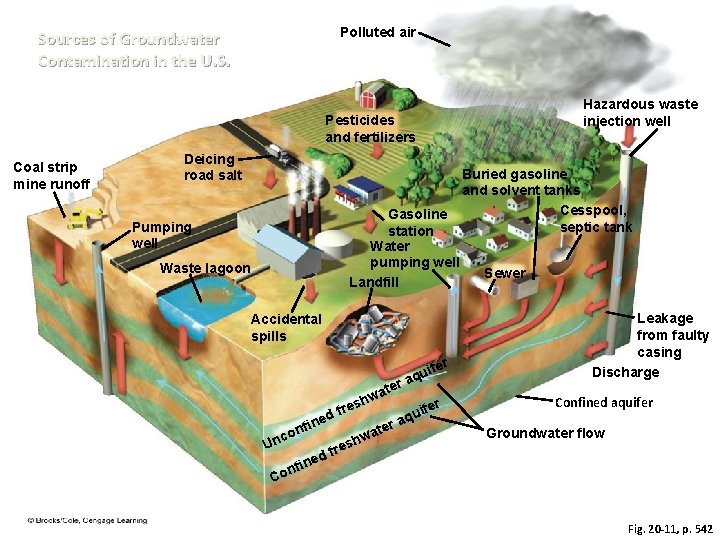
Polluted air Sources of Groundwater Contamination in the U. S. Hazardous waste injection well Pesticides and fertilizers Coal strip mine runoff Deicing road salt Gasoline station Water pumping well Landfill Pumping well Waste lagoon Accidental spills a shw fin n nco U e d ine nf Co re df ter a shw fre ter ifer aqu ifer u q a Buried gasoline and solvent tanks Cesspool, septic tank Sewer Leakage from faulty casing Discharge Confined aquifer Groundwater flow Fig. 20 -11, p. 542
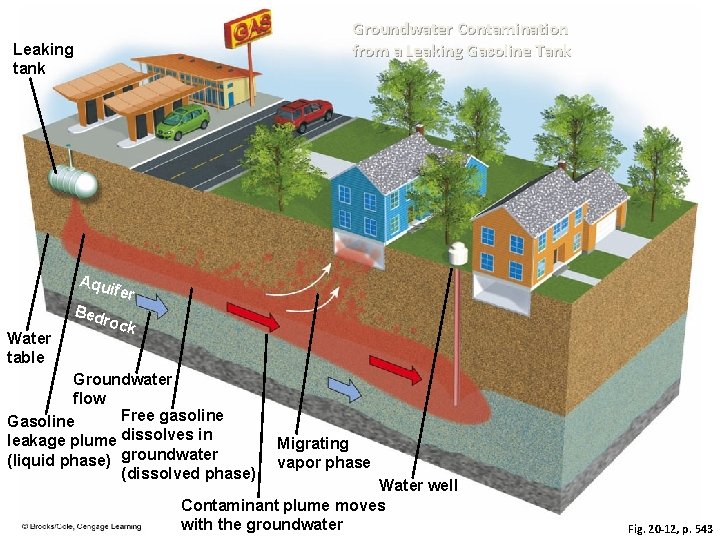
Groundwater Contamination from a Leaking Gasoline Tank Leaking tank Aqui Bed Water table fer rock Groundwater flow Free gasoline Gasoline leakage plume dissolves in (liquid phase) groundwater (dissolved phase) Migrating vapor phase Water well Contaminant plume moves with the groundwater Fig. 20 -12, p. 543
U. S. Water Pollution Laws • The U. S. Clean Water Act (1977) – Mandates the restoration and maintenance of the chemical, physical, and biological integrity of the nation’s waters. – Targeted Industrial Discharges, Addressed Point Source Pollution • Safe Drinking Water Act (1974) – Requires minimum safety standards for community water supplies. EPA sets the standards
• Treating wastewater Wastewater = water that has been used by people in some way – Sewage, showers, sinks, manufacturing, storm water runoff • Septic systems = the most popular method of wastewater disposal in rural areas – Underground septic tanks separate solids and oils from wastewater – The water drains into a drain field, where microbes decompose the water – Solid waste needs to be periodically pumped and landfilled
Municipal sewer systems • In populated areas, sewer systems carry wastewater – Physical, chemical, and biological water treatment • Primary treatment = the physical removal of contaminants in settling tanks (clarifiers) • Secondary treatment = water is stirred and aerated so aerobic bacteria degrade organic pollutants – Water treated with chlorine or ozone is piped into rivers or the ocean
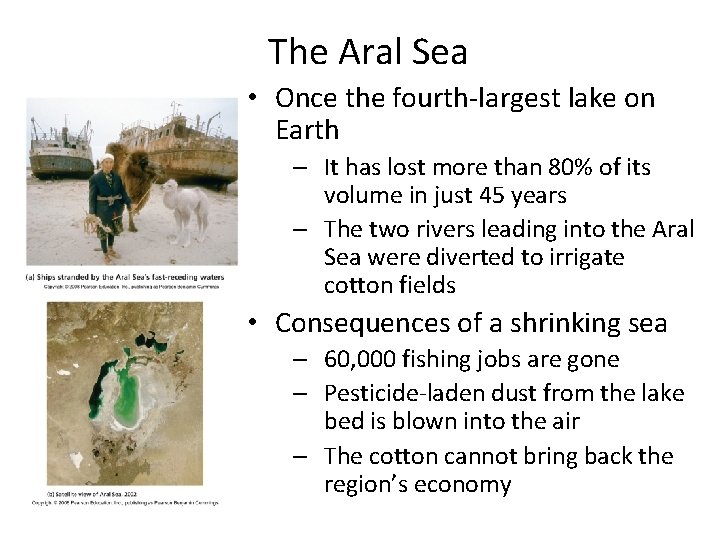
The Aral Sea • Once the fourth-largest lake on Earth – It has lost more than 80% of its volume in just 45 years – The two rivers leading into the Aral Sea were diverted to irrigate cotton fields • Consequences of a shrinking sea – 60, 000 fishing jobs are gone – Pesticide-laden dust from the lake bed is blown into the air – The cotton cannot bring back the region’s economy
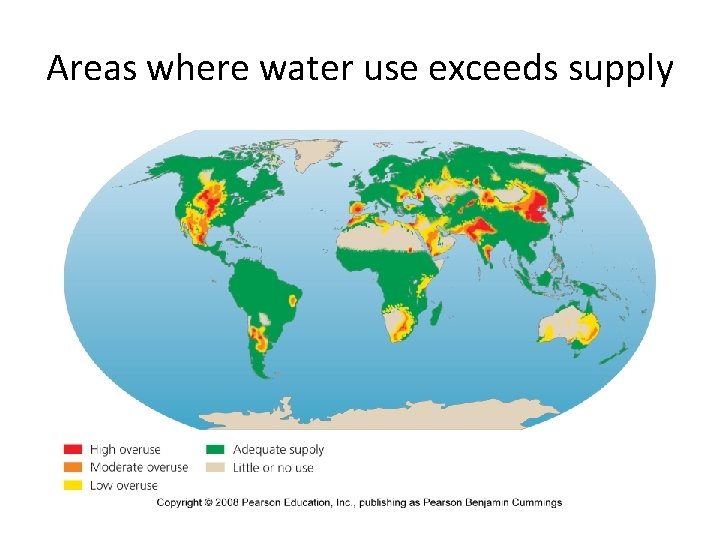
Areas where water use exceeds supply
Will we see a future of water wars? • Freshwater depletion leads to shortages, which can lead to conflict – 261 major rivers cross national borders – Water is a key element in hostilities among Israel, Palestinians, and neighboring countries • Many nations have cooperated with neighbors to resolve disputes
Desalinization “makes” more water • Desalinization = the removal of salt from seawater or other water of marginal quality – Distilling = hastens evaporation and condenses the vapor – Reverse osmosis = forces water through membranes to filter out salts • Desalinization facilities operate mostly in the arid Middle East • It is expensive, requires fossil fuels, and produces concentrated salty water
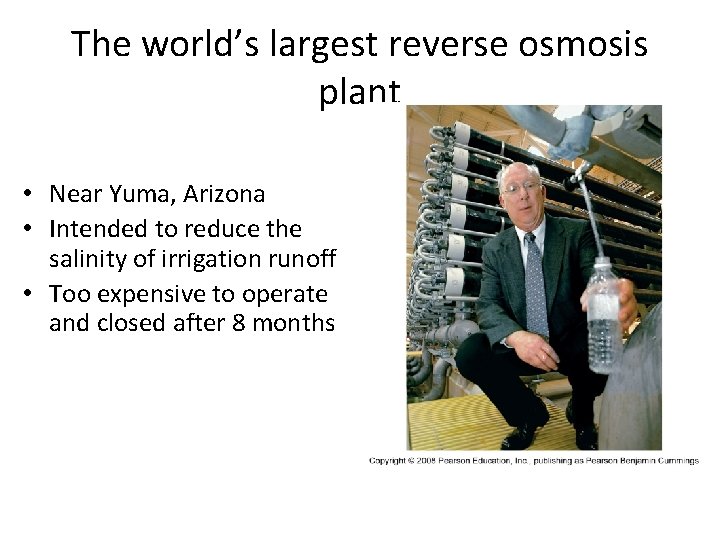
The world’s largest reverse osmosis plant • Near Yuma, Arizona • Intended to reduce the salinity of irrigation runoff • Too expensive to operate and closed after 8 months
Agricultural demand can be reduced • Look first for ways to decrease agricultural demand – Lining irrigation canals – Low-pressure spray irrigation that spray water downward – Drip irrigation systems that target individual plants – Match crops to land climate – Selective breeding and genetic modification to raise crops that require less water
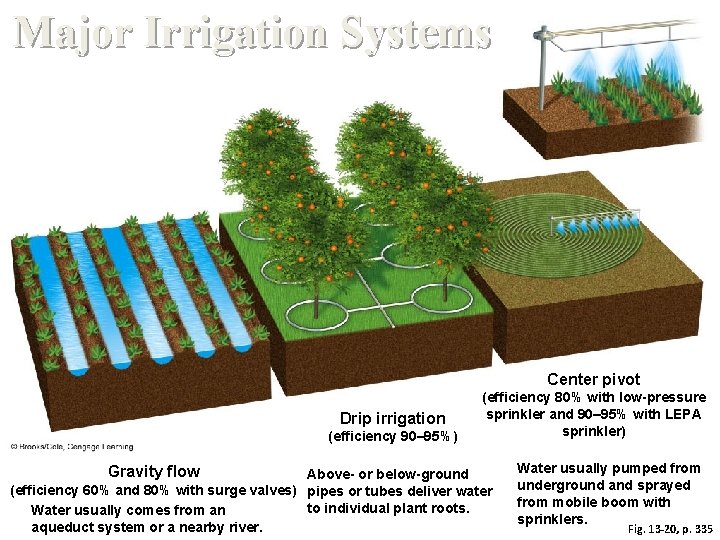
Major Irrigation Systems Center pivot Drip irrigation (efficiency 90– 95%) Gravity flow (efficiency 80% with low-pressure sprinkler and 90– 95% with LEPA sprinkler) Above- or below-ground (efficiency 60% and 80% with surge valves) pipes or tubes deliver water to individual plant roots. Water usually comes from an aqueduct system or a nearby river. Water usually pumped from underground and sprayed from mobile boom with sprinklers. Fig. 13 -20, p. 335
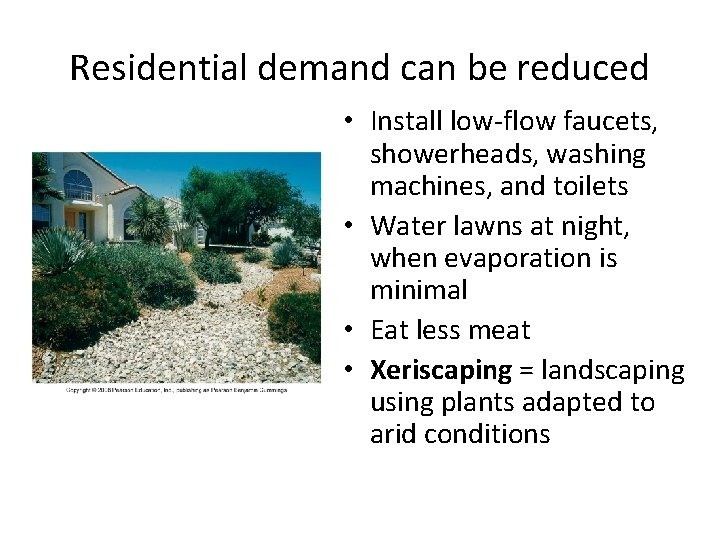
Residential demand can be reduced • Install low-flow faucets, showerheads, washing machines, and toilets • Water lawns at night, when evaporation is minimal • Eat less meat • Xeriscaping = landscaping using plants adapted to arid conditions
Industrial demand can be reduced • Shift to processes that use less water – Wastewater recycling – Excess surface water runoff used for recharging aquifers – Patching leaky pipes – Auditing industries – Promoting conservation/education
• Economic approaches to water End government conservation subsidies of inefficient practices – Let the price of water reflect its true cost of extraction • Industrial uses are more profitable than agricultural – Less developed countries suffer • Privatization of water supplies – May improve efficiency – Firms have little incentive to provide access to the poor • Decentralization of water control may conserve water – Shift control to the local level
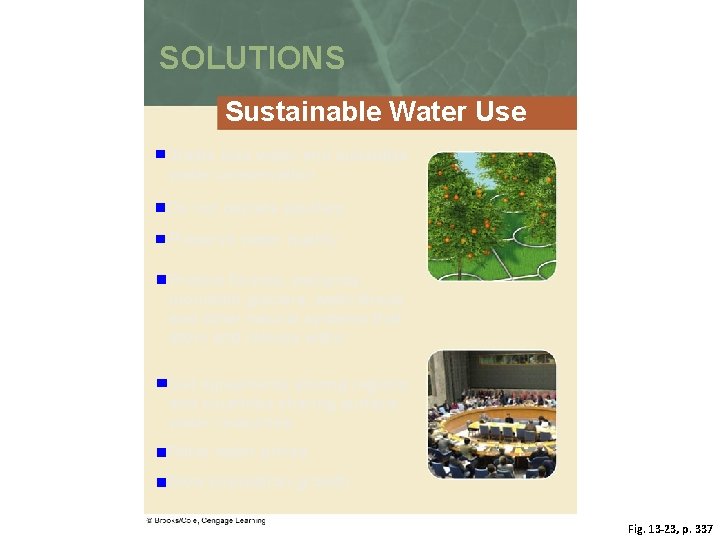
SOLUTIONS Sustainable Water Use Waste less water and subsidize water conservation Do not deplete aquifers Preserve water quality Protect forests, wetlands, mountain glaciers, watersheds, and other natural systems that store and release water Get agreements among regions and countries sharing surface water resources Raise water prices Slow population growth Fig. 13 -23, p. 337
Freshwater pollution andand itsother control • Water for human consumption organisms needs to be… – Disease-free – Nontoxic • Half of the world’s major rivers are seriously depleted and polluted – They poison surrounding ecosystems – Threaten the health and livelihood of people • The invisible pollution of groundwater has been called a “covert crisis” • The United Nations has estimated that by 2025, at least 3 billion of the world’s projected 7. 9 billion people will lack access to
• Nutrient pollution Pollution = the release of matter or energy into the environment that causes undesirable impacts on the health and well-being of humans or other organisms • Nutrient pollution from fertilizers, farms, sewage, lawns, golf courses – Leads to eutrophication • Solutions • • Phosphate-free detergents Planting vegetation to increase nutrient uptake Treat wastewater Reduce fertilizer application
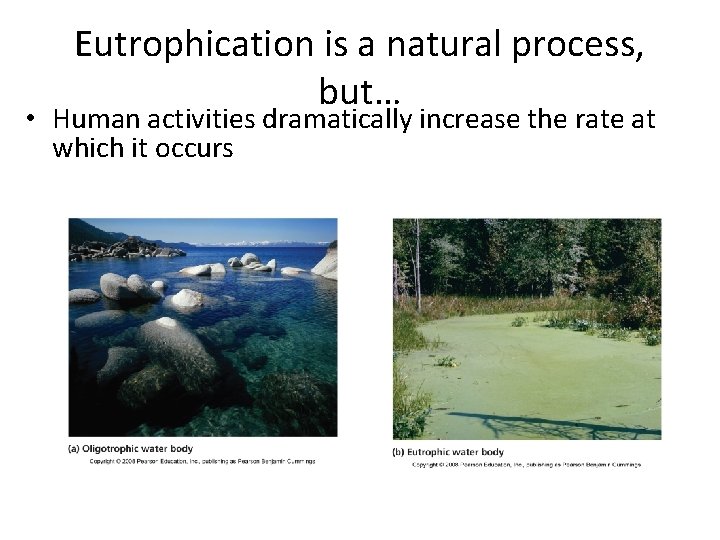
Eutrophication is a natural process, but… • Human activities dramatically increase the rate at which it occurs
Pathogens and waterborne diseases • Enters water supply via inadequately treated human waste and animal waste via feedlots • Causes more human health problems than any other type of water pollution • Currently, 1. 1 billion people are without safe drinking water • Fecal coliform bacteria indicate fecal contamination of water – The water can hold other pathogens, such as giardiasis, typhoid, hepatitis A • Solutions: • Treat sewage • Disinfect drinking water • Public education to encourage personal hygiene • Government enforcement of regulations
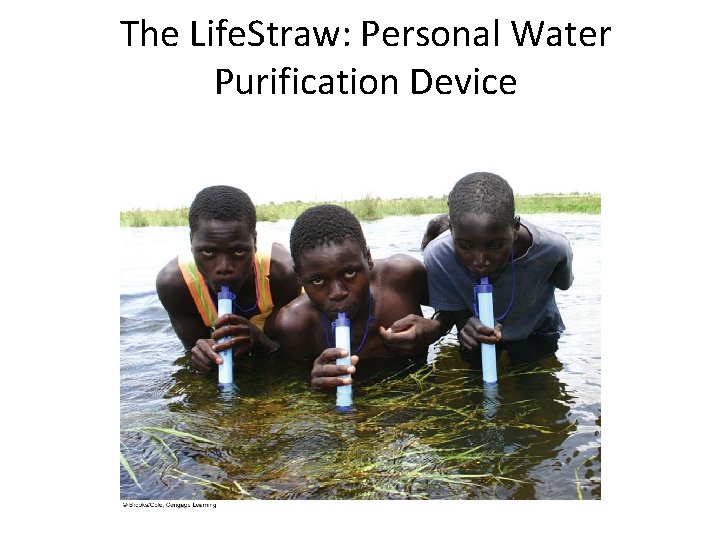
The Life. Straw: Personal Water Purification Device
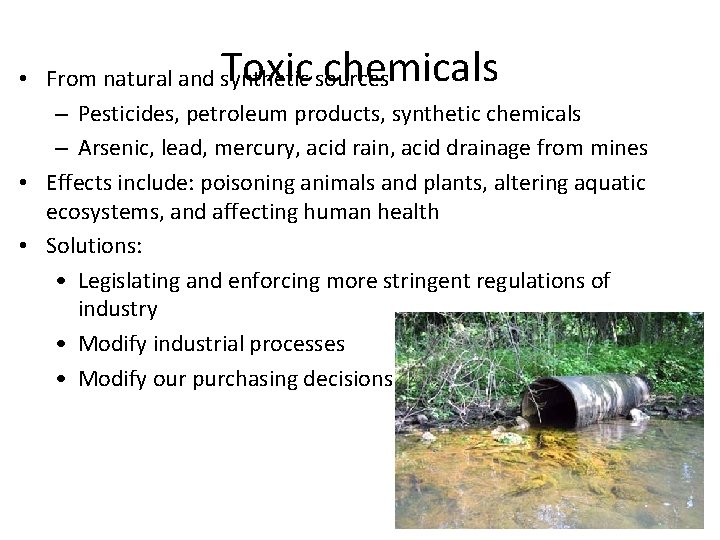
Toxic chemicals • From natural and synthetic sources – Pesticides, petroleum products, synthetic chemicals – Arsenic, lead, mercury, acid rain, acid drainage from mines • Effects include: poisoning animals and plants, altering aquatic ecosystems, and affecting human health • Solutions: • Legislating and enforcing more stringent regulations of industry • Modify industrial processes • Modify our purchasing decisions
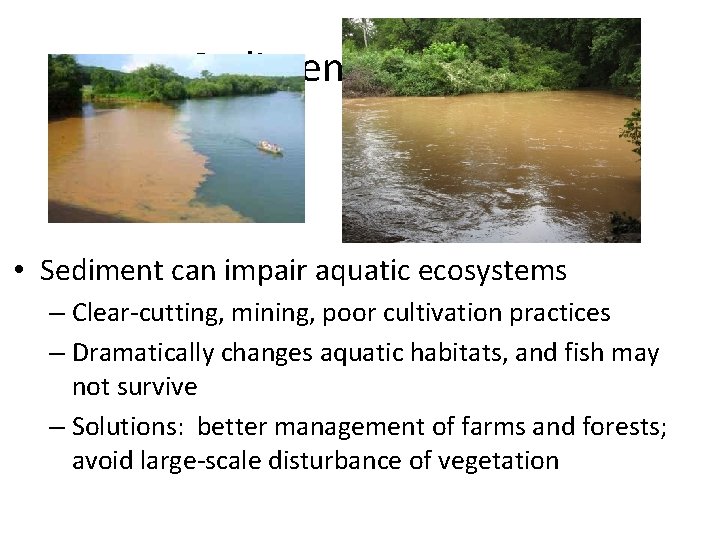
Sediment pollution • Sediment can impair aquatic ecosystems – Clear-cutting, mining, poor cultivation practices – Dramatically changes aquatic habitats, and fish may not survive – Solutions: better management of farms and forests; avoid large-scale disturbance of vegetation
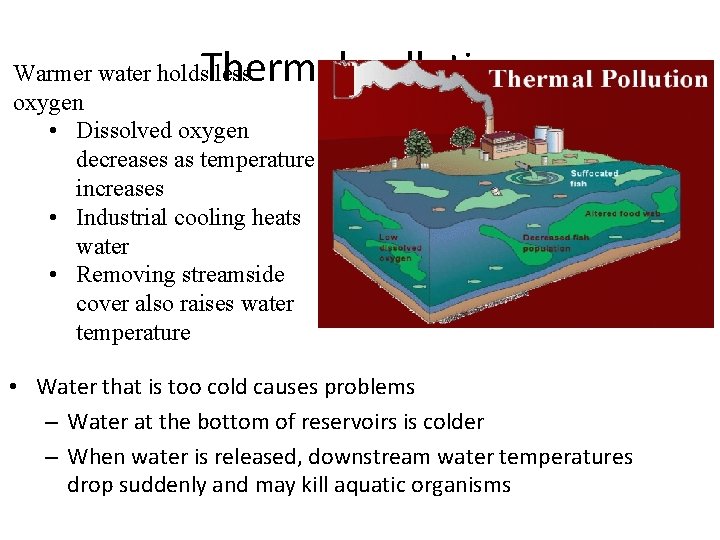
Thermal pollution Warmer water holds less oxygen • Dissolved oxygen decreases as temperature increases • Industrial cooling heats water • Removing streamside cover also raises water temperature • Water that is too cold causes problems – Water at the bottom of reservoirs is colder – When water is released, downstream water temperatures drop suddenly and may kill aquatic organisms
Water Pollution Comes from Point and Nonpoint Sources • Point sources – Located at specific places – Often discharge pollutants through drain pipes, sewer lines – Easy to identify, monitor, and regulate – Examples: factories, sewage treatment plants, underground mines, oil tankers • Nonpoint sources – Broad, diffuse areas – Difficult to identify and control – Expensive to clean up – Examples: runoff of chemicals and sediment from cropland, livestock feedlots, golf courses, parking lots, urban streets
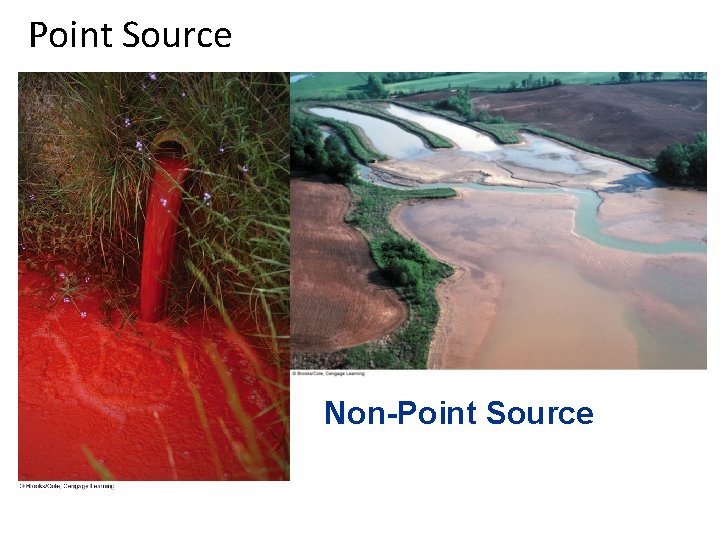
Point Source Non-Point Source
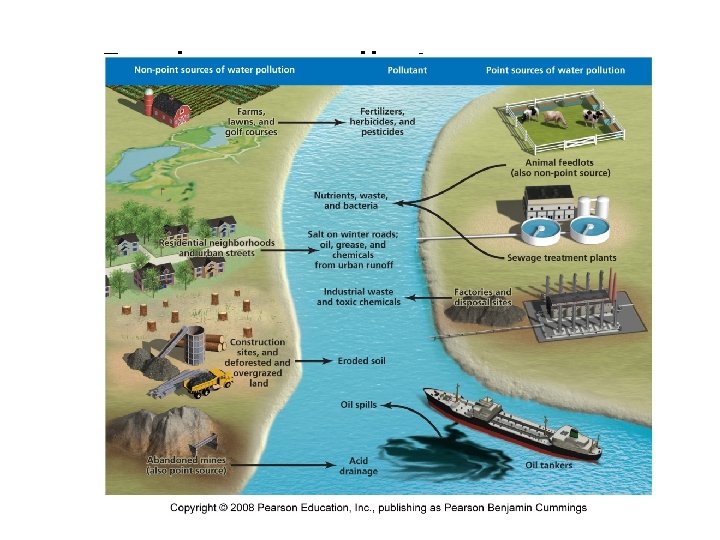
Freshwater pollution sources
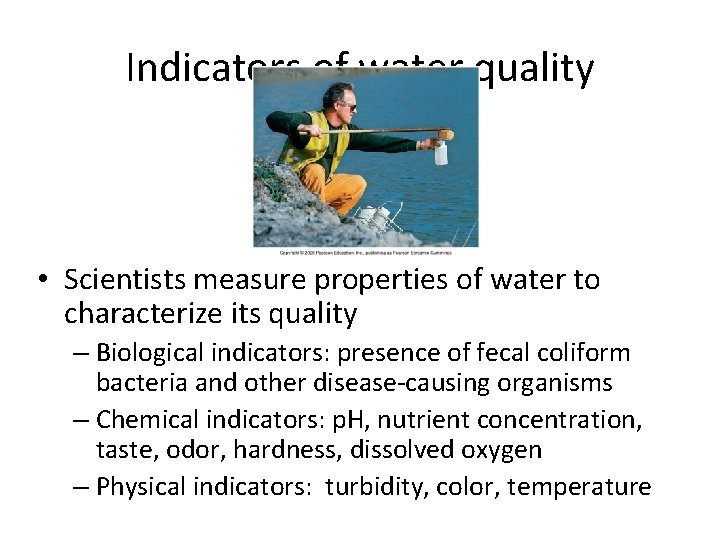
Indicators of water quality • Scientists measure properties of water to characterize its quality – Biological indicators: presence of fecal coliform bacteria and other disease-causing organisms – Chemical indicators: p. H, nutrient concentration, taste, odor, hardness, dissolved oxygen – Physical indicators: turbidity, color, temperature
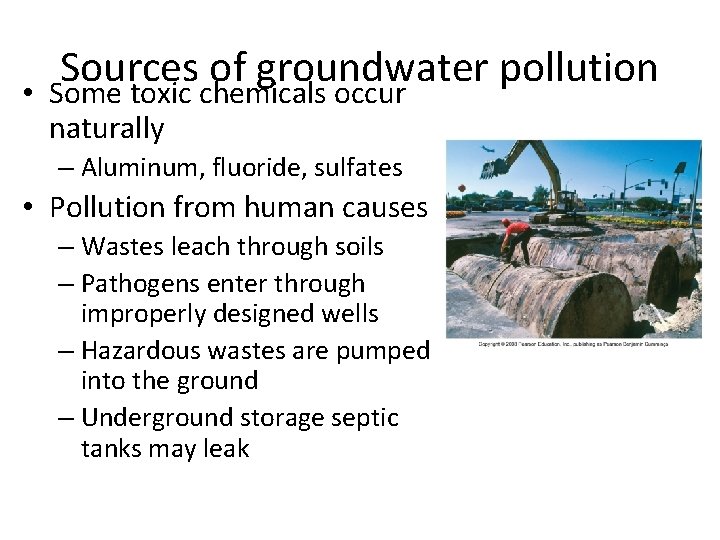
• Sources of groundwater pollution Some toxic chemicals occur naturally – Aluminum, fluoride, sulfates • Pollution from human causes – Wastes leach through soils – Pathogens enter through improperly designed wells – Hazardous wastes are pumped into the ground – Underground storage septic tanks may leak
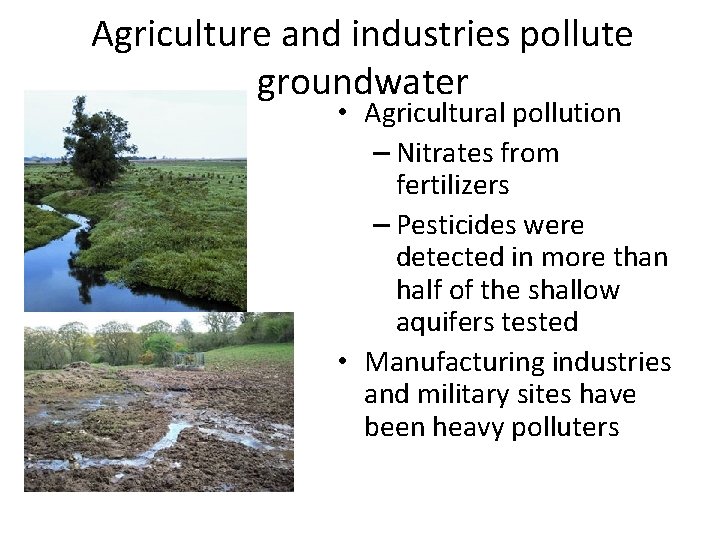
Agriculture and industries pollute groundwater • Agricultural pollution – Nitrates from fertilizers – Pesticides were detected in more than half of the shallow aquifers tested • Manufacturing industries and military sites have been heavy polluters
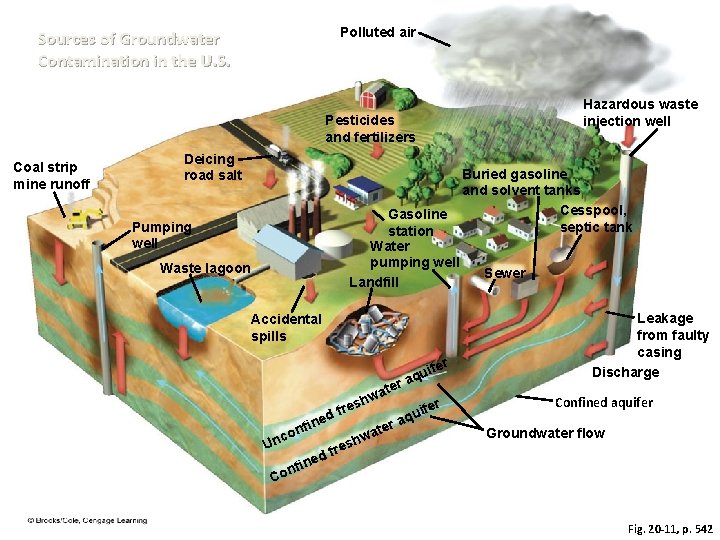
Polluted air Sources of Groundwater Contamination in the U. S. Hazardous waste injection well Pesticides and fertilizers Coal strip mine runoff Deicing road salt Gasoline station Water pumping well Landfill Pumping well Waste lagoon Accidental spills a shw fin n nco U e d ine nf Co re df ter a shw fre ter ifer aqu ifer u q a Buried gasoline and solvent tanks Cesspool, septic tank Sewer Leakage from faulty casing Discharge Confined aquifer Groundwater flow Fig. 20 -11, p. 542
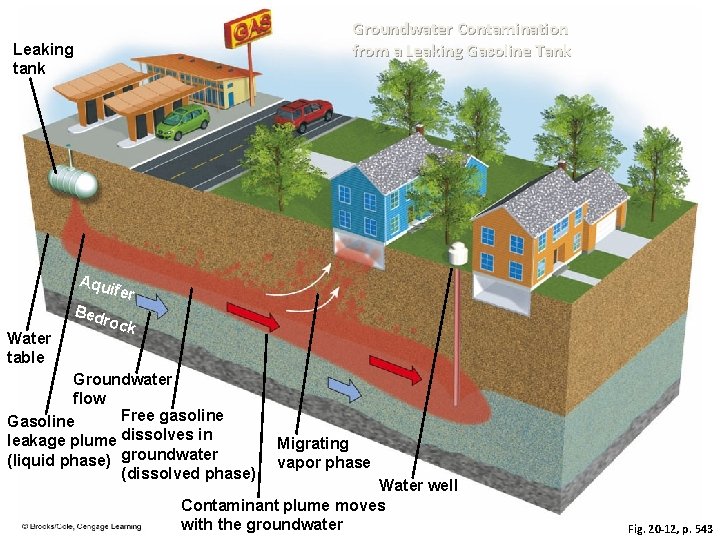
Groundwater Contamination from a Leaking Gasoline Tank Leaking tank Aqui Bed Water table fer rock Groundwater flow Free gasoline Gasoline leakage plume dissolves in (liquid phase) groundwater (dissolved phase) Migrating vapor phase Water well Contaminant plume moves with the groundwater Fig. 20 -12, p. 543
U. S. Water Pollution Laws • The U. S. Clean Water Act (1977) – Mandates the restoration and maintenance of the chemical, physical, and biological integrity of the nation’s waters. – Targeted Industrial Discharges, Addressed Point Source Pollution • Safe Drinking Water Act (1974) – Requires minimum safety standards for community water supplies. EPA sets the standards
Treating wastewater • Wastewater = water that has been used by people in some way – Sewage, showers, sinks, manufacturing, storm water runoff • Septic systems = the most popular method of wastewater disposal in rural areas – Underground septic tanks separate solids and oils from wastewater – The water drains into a drain field, where microbes decompose the water – Solid waste needs to be periodically pumped and landfilled
Municipal sewer systems • In populated areas, sewer systems carry wastewater – Physical, chemical, and biological water treatment • Primary treatment = the physical removal of contaminants in settling tanks (clarifiers) • Secondary treatment = water is stirred and aerated so aerobic bacteria degrade organic pollutants – Water treated with chlorine or ozone is piped into rivers or the ocean – Some reclaimed water is used for irrigation, lawns, or industry
- Slides: 52