
INDUSTRIAL CASE HOMAG Company Profile HOMAG Group AG
- Slides: 27
INDUSTRIAL CASE: HOMAG
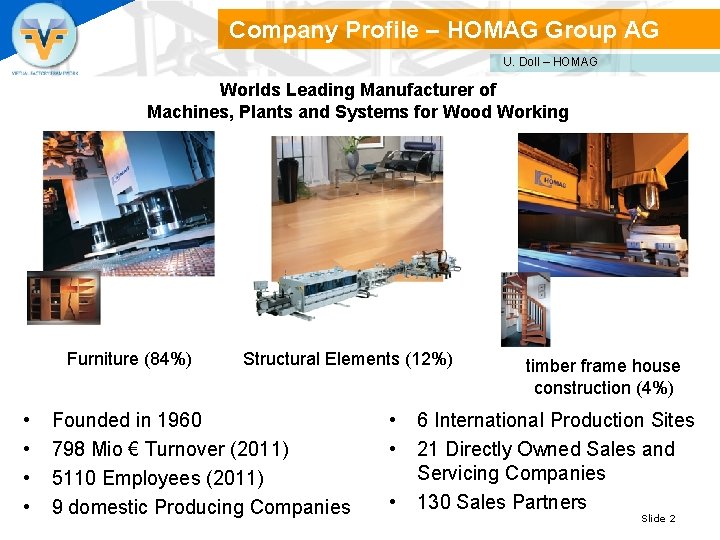
Company Profile – HOMAG Group AG U. Doll – HOMAG Worlds Leading Manufacturer of Machines, Plants and Systems for Wood Working Furniture (84%) • • Structural Elements (12%) Founded in 1960 798 Mio € Turnover (2011) 5110 Employees (2011) 9 domestic Producing Companies • • • timber frame house construction (4%) 6 International Production Sites 21 Directly Owned Sales and Servicing Companies 130 Sales Partners Slide 2
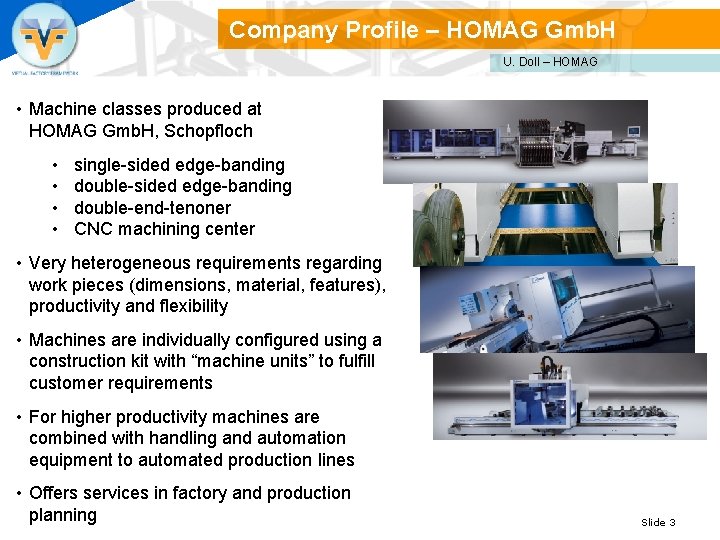
Company Profile – HOMAG Gmb. H U. Doll – HOMAG • Machine classes produced at HOMAG Gmb. H, Schopfloch • • single-sided edge-banding double-end-tenoner CNC machining center • Very heterogeneous requirements regarding work pieces (dimensions, material, features), productivity and flexibility • Machines are individually configured using a construction kit with “machine units” to fulfill customer requirements • For higher productivity machines are combined with handling and automation equipment to automated production lines • Offers services in factory and production planning Slide 3
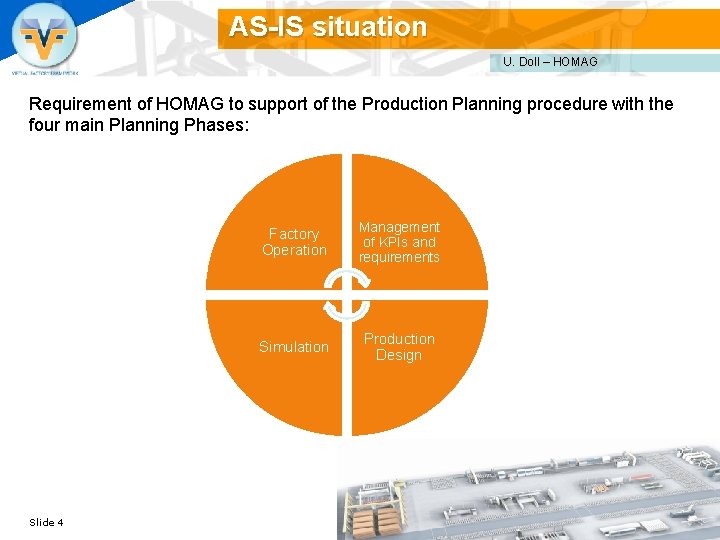
AS-IS situation U. Doll – HOMAG Requirement of HOMAG to support of the Production Planning procedure with the four main Planning Phases: Slide 4 Factory Operation Management of KPIs and requirements Simulation Production Design
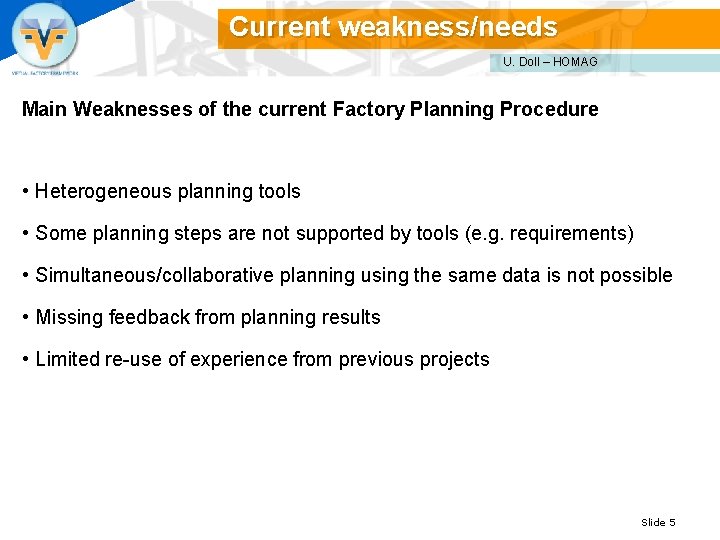
Current weakness/needs U. Doll – HOMAG Main Weaknesses of the current Factory Planning Procedure • Heterogeneous planning tools • Some planning steps are not supported by tools (e. g. requirements) • Simultaneous/collaborative planning using the same data is not possible • Missing feedback from planning results • Limited re-use of experience from previous projects Slide 5
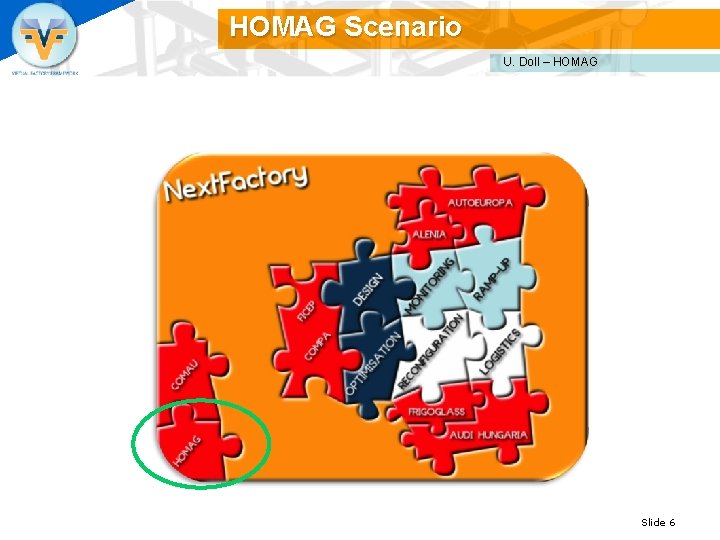
HOMAG Scenario U. Doll – HOMAG Slide 6
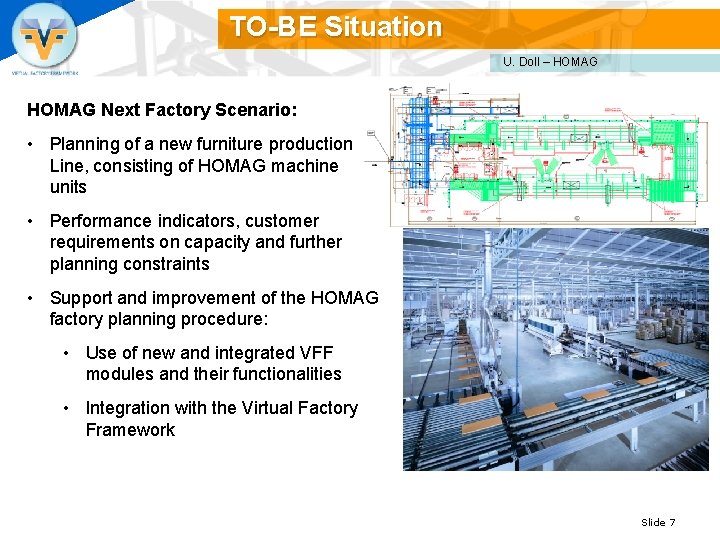
TO-BE Situation U. Doll – HOMAG Next Factory Scenario: • Planning of a new furniture production Line, consisting of HOMAG machine units • Performance indicators, customer requirements on capacity and further planning constraints • Support and improvement of the HOMAG factory planning procedure: • Use of new and integrated VFF modules and their functionalities • Integration with the Virtual Factory Framework Slide 7
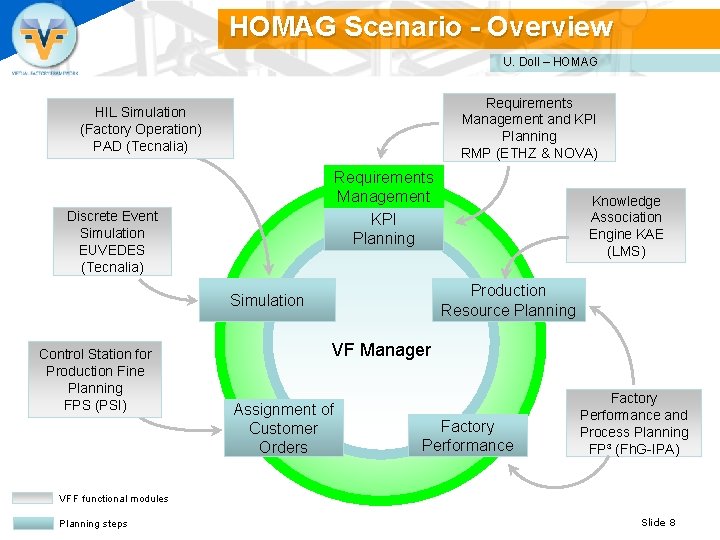
HOMAG Scenario - Overview U. Doll – HOMAG Requirements Management and KPI Planning RMP (ETHZ & NOVA) HIL Simulation (Factory Operation) PAD (Tecnalia) Requirements Management KPI Planning Discrete Event Simulation EUVEDES (Tecnalia) Production Resource Planning Simulation Control Station for Production Fine Planning FPS (PSI) Knowledge Association Engine KAE (LMS) VF Manager Assignment of Customer Orders Factory Performance and Process Planning FP³ (Fh. G-IPA) VFF functional modules Planning steps Slide 8
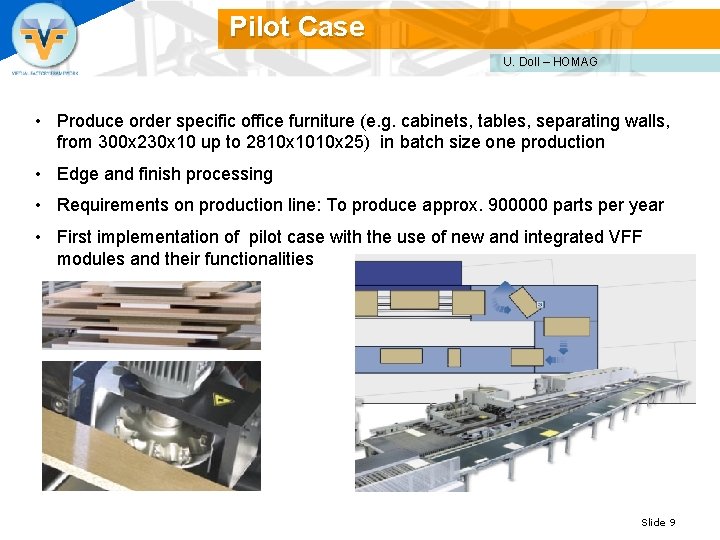
Pilot Case U. Doll – HOMAG • Produce order specific office furniture (e. g. cabinets, tables, separating walls, from 300 x 230 x 10 up to 2810 x 1010 x 25) in batch size one production • Edge and finish processing • Requirements on production line: To produce approx. 900000 parts per year • First implementation of pilot case with the use of new and integrated VFF modules and their functionalities Slide 9
U. Doll – HOMAG * O EM * D Slide 10
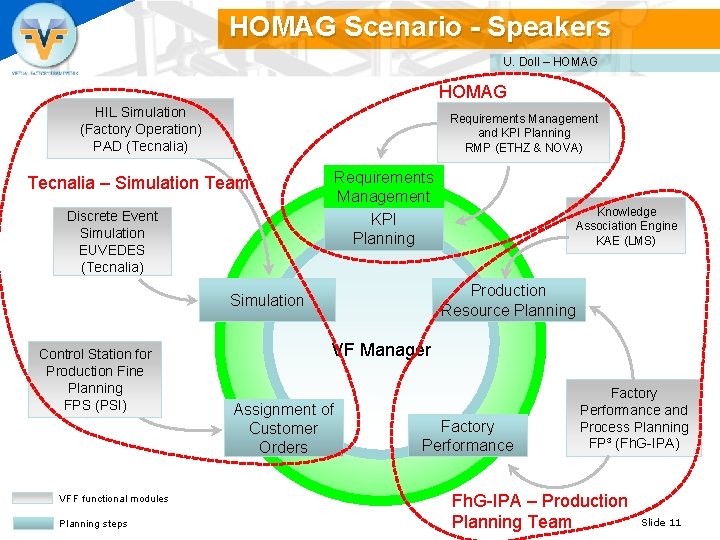
HOMAG Scenario - Speakers U. Doll – HOMAG HIL Simulation (Factory Operation) PAD (Tecnalia) Requirements Management and KPI Planning RMP (ETHZ & NOVA) Tecnalia – Simulation Team Discrete Event Simulation EUVEDES (Tecnalia) Requirements Management KPI Planning Production Resource Planning Simulation Control Station for Production Fine Planning FPS (PSI) VFF functional modules Planning steps Knowledge Association Engine KAE (LMS) VF Manager Assignment of Customer Orders Factory Performance and Process Planning FP³ (Fh. G-IPA) Fh. G-IPA – Production Planning Team Slide 11
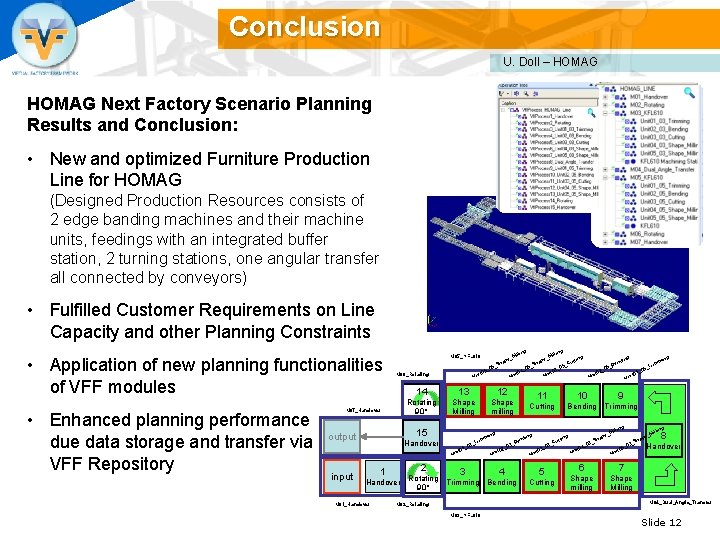
Conclusion U. Doll – HOMAG Next Factory Scenario Planning Results and Conclusion: • New and optimized Furniture Production Line for HOMAG (Designed Production Resources consists of 2 edge banding machines and their machine units, feedings with an integrated buffer station, 2 turning stations, one angular transfer all connected by conveyors) • Fulfilled Customer Requirements on Line Capacity and other Planning Constraints • Application of new planning functionalities of VFF modules • Enhanced planning performance due data storage and transfer via VFF Repository M 05_KFL 610 M 06_Rotating M 07_Handover Un 13 12 Shape milling 2 M 01_Handover g illin _M pe ha S 05_ 5_C _0 t 03 04_ it Un Shape Milling utt _B 05 02_ i Un g din en it Un 11 9 Bending Trimming g 1_0 it 0 3_ m Tri ng ing nd Be 3 Rotating Trimming 90° 2_0 it 0 Un 3_ g ttin Cu 3_ 3_0 it 0 Un 4 5 Bending Cutting mm Tri 5_ 1_0 it 0 Un 10 Cutting mi Un Handover it 14 Handover 1 05_ g illin _M Rotating 90° 15 output input pe ha S 05_ 4_ it 0 Un g illin _M pe ha S 03_ e_M ap h 3_S 5_0 it 0 Un 6 7 Shape milling Shape Milling 8 Handover M 04_Dual_Angle_Transfer M 02_Rotating M 03_KFL 610 Slide 12
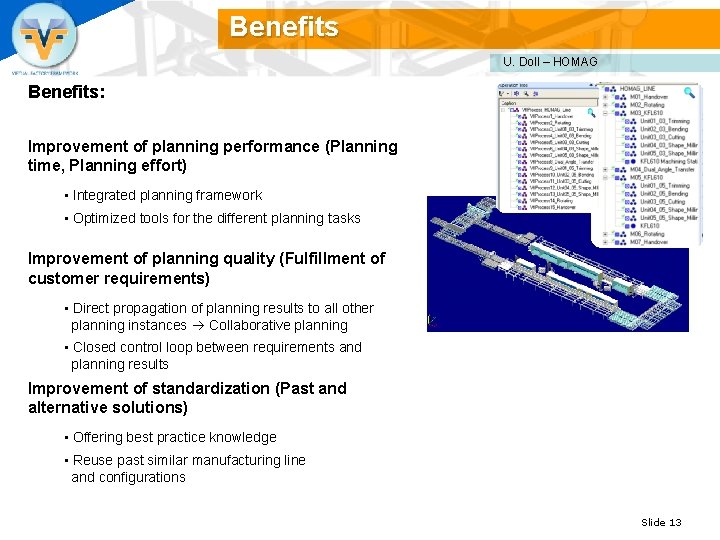
Benefits U. Doll – HOMAG Benefits: Improvement of planning performance (Planning time, Planning effort) • Integrated planning framework • Optimized tools for the different planning tasks Improvement of planning quality (Fulfillment of customer requirements) • Direct propagation of planning results to all other planning instances Collaborative planning • Closed control loop between requirements and planning results Improvement of standardization (Past and alternative solutions) • Offering best practice knowledge • Reuse past similar manufacturing line and configurations Slide 13
U. Doll – HOMAG
* P U K C A *B
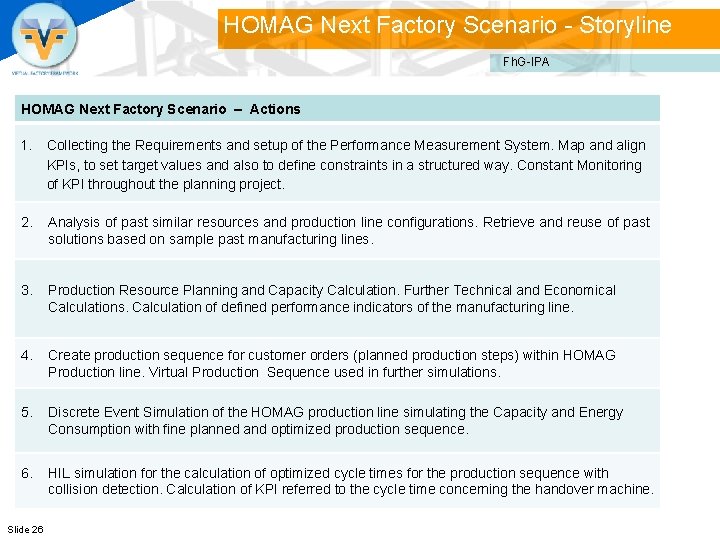
HOMAG Next Factory Scenario - Storyline HOMAG Next Factory Scenario – Actions 1. Collecting the Requirements and setup of the Performance Measurement System. Map and align KPIs, to set target values and also to define constraints in a structured way. Constant Monitoring of KPI throughout the planning project. (ETHZ) 2. Analysis of past similar resources and production line configurations. Retrieve and reuse of past solutions based on sample past manufacturing lines. (LMS) 3. Production Resource Planning and Capacity Calculation. Further Technical and Economical Calculations. Calculation of defined performance indicators of the manufacturing line. (Fh. G-IPA) 4. Create production sequence for customer orders (planned production steps) within HOMAG Production line. Virtual Production Sequence used in further simulations. (PSI) 5. Discrete Event Simulation of the HOMAG production line simulating the Capacity and Energy Consumption with fine planned and optimized production sequence. (Tecnalia) 6. HIL simulation for the calculation of optimized cycle times for the production sequence with collision detection. Calculation of KPI referred to the cycle time. (Tecnalia) Slide 16
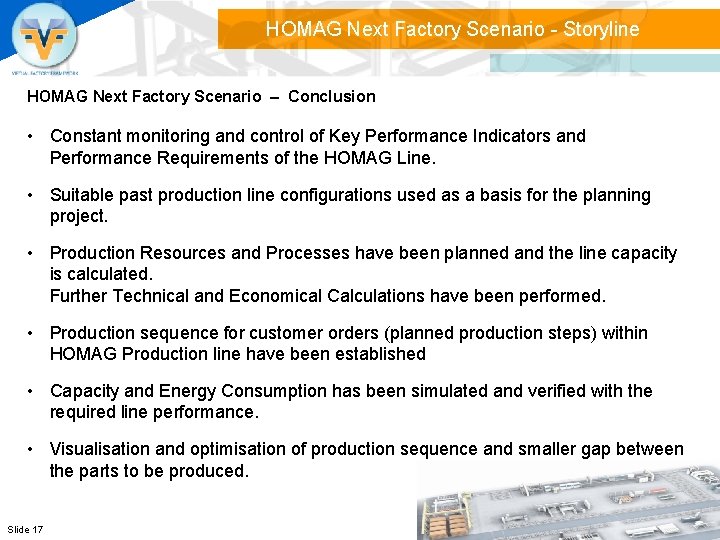
HOMAG Next Factory Scenario - Storyline HOMAG Next Factory Scenario – Conclusion • Constant monitoring and control of Key Performance Indicators and Performance Requirements of the HOMAG Line. • Suitable past production line configurations used as a basis for the planning project. • Production Resources and Processes have been planned and the line capacity is calculated. Further Technical and Economical Calculations have been performed. • Production sequence for customer orders (planned production steps) within HOMAG Production line have been established • Capacity and Energy Consumption has been simulated and verified with the required line performance. • Visualisation and optimisation of production sequence and smaller gap between the parts to be produced. Slide 17
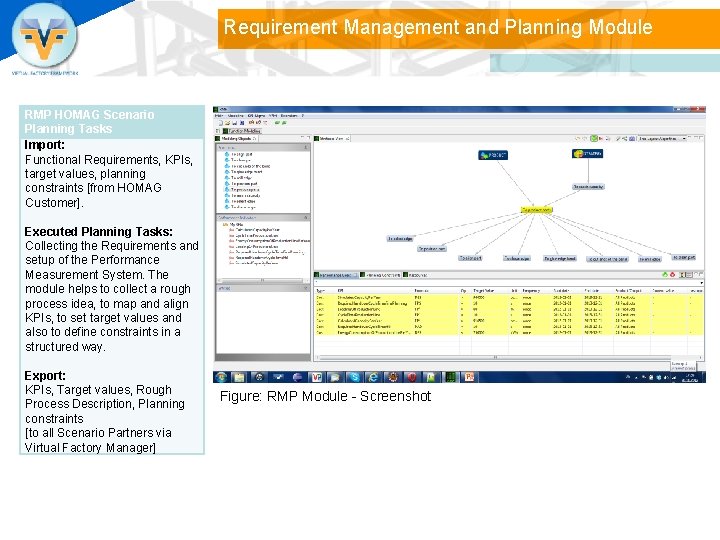
Requirement Management and Planning Module RMP HOMAG Scenario Planning Tasks Import: Functional Requirements, KPIs, target values, planning constraints [from HOMAG Customer]. Executed Planning Tasks: Collecting the Requirements and setup of the Performance Measurement System. The module helps to collect a rough process idea, to map and align KPIs, to set target values and also to define constraints in a structured way. Export: KPIs, Target values, Rough Process Description, Planning constraints [to all Scenario Partners via Virtual Factory Manager] Figure: RMP Module - Screenshot
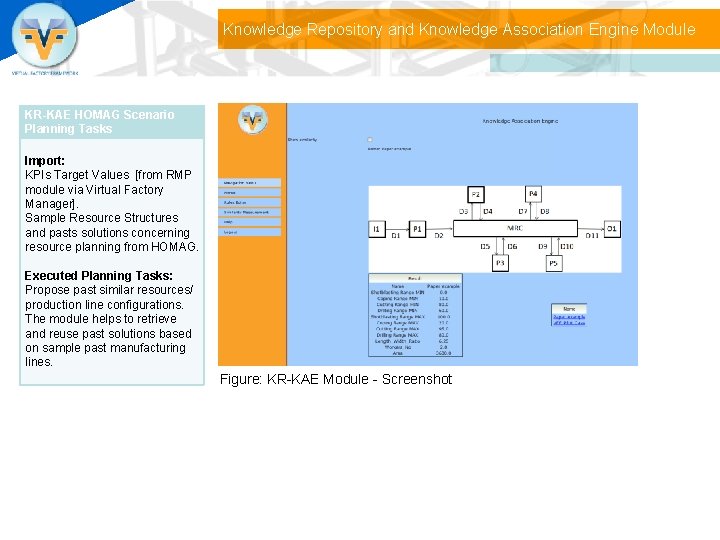
Knowledge Repository and Knowledge Association Engine Module KR-KAE HOMAG Scenario Planning Tasks Import: KPIs Target Values [from RMP module via Virtual Factory Manager]. Sample Resource Structures and pasts solutions concerning resource planning from HOMAG. Executed Planning Tasks: Propose past similar resources/ production line configurations. The module helps to retrieve and reuse past solutions based on sample past manufacturing lines. Figure: KR-KAE Module - Screenshot
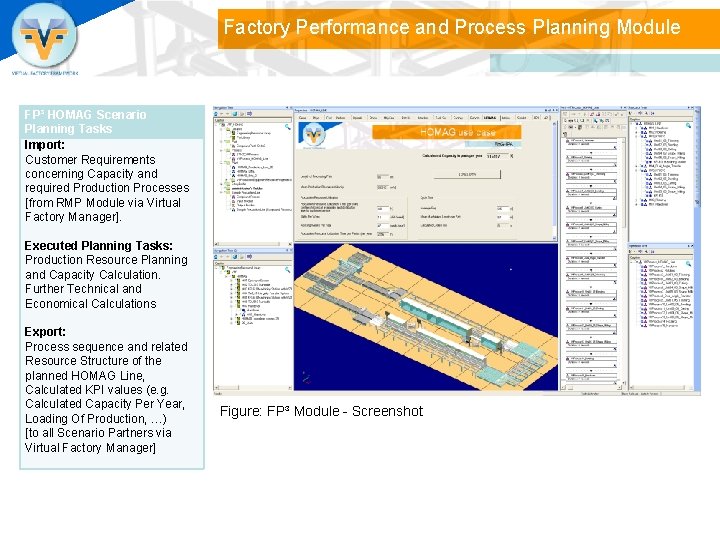
Factory Performance and Process Planning Module FP³ HOMAG Scenario Planning Tasks Import: Customer Requirements concerning Capacity and required Production Processes [from RMP Module via Virtual Factory Manager]. Executed Planning Tasks: Production Resource Planning and Capacity Calculation. Further Technical and Economical Calculations Export: Process sequence and related Resource Structure of the planned HOMAG Line, Calculated KPI values (e. g. Calculated Capacity Per Year, Loading Of Production, …) [to all Scenario Partners via Virtual Factory Manager] Figure: FP³ Module - Screenshot
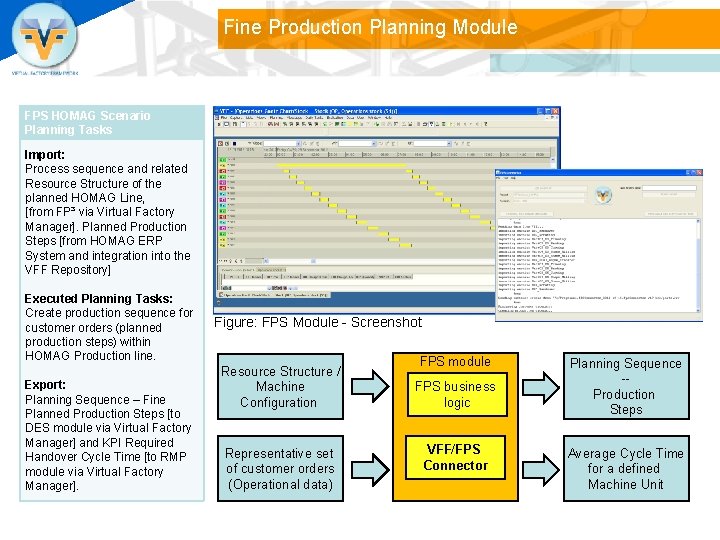
Fine Production Planning Module FPS HOMAG Scenario Planning Tasks Import: Process sequence and related Resource Structure of the planned HOMAG Line, [from FP³ via Virtual Factory Manager]. Planned Production Steps [from HOMAG ERP System and integration into the VFF Repository] Executed Planning Tasks: Create production sequence for customer orders (planned production steps) within HOMAG Production line. Export: Planning Sequence – Fine Planned Production Steps [to DES module via Virtual Factory Manager] and KPI Required Handover Cycle Time [to RMP module via Virtual Factory Manager]. Figure: FPS Module - Screenshot Resource Structure / Machine Configuration Representative set of customer orders (Operational data) FPS module FPS business logic VFF/FPS Connector Planning Sequence -Production Steps Average Cycle Time for a defined Machine Unit
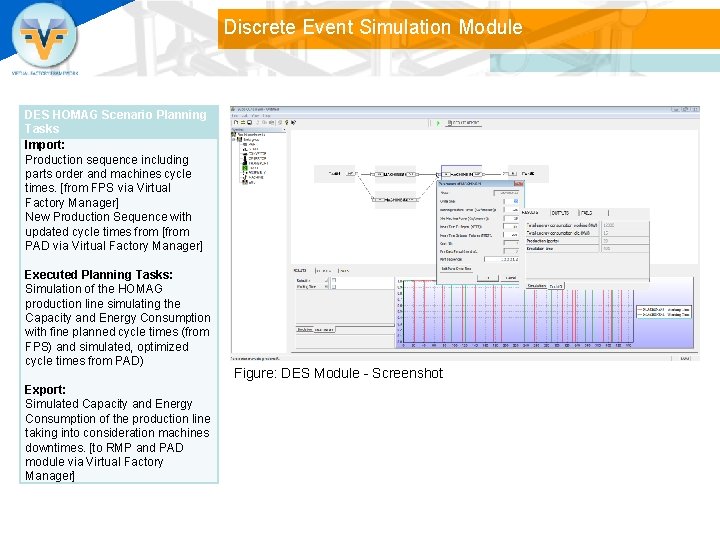
Discrete Event Simulation Module DES HOMAG Scenario Planning Tasks Import: Production sequence including parts order and machines cycle times. [from FPS via Virtual Factory Manager] New Production Sequence with updated cycle times from [from PAD via Virtual Factory Manager] Executed Planning Tasks: Simulation of the HOMAG production line simulating the Capacity and Energy Consumption with fine planned cycle times (from FPS) and simulated, optimized cycle times from PAD) Export: Simulated Capacity and Energy Consumption of the production line taking into consideration machines downtimes. [to RMP and PAD module via Virtual Factory Manager] Figure: DES Module - Screenshot
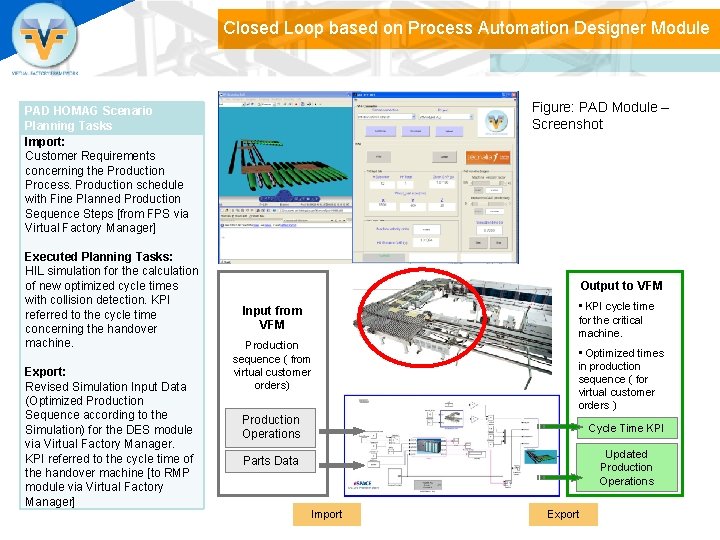
Closed Loop based on Process Automation Designer Module Figure: PAD Module – Screenshot PAD HOMAG Scenario Planning Tasks Import: Customer Requirements concerning the Production Process. Production schedule with Fine Planned Production Sequence Steps [from FPS via Virtual Factory Manager] Executed Planning Tasks: HIL simulation for the calculation of new optimized cycle times with collision detection. KPI referred to the cycle time concerning the handover machine. Export: Revised Simulation Input Data (Optimized Production Sequence according to the Simulation) for the DES module via Virtual Factory Manager. KPI referred to the cycle time of the handover machine [to RMP module via Virtual Factory Manager] Output to VFM • KPI cycle time for the critical machine. Input from VFM Production sequence ( from virtual customer orders) • Optimized times in production sequence ( for virtual customer orders ) Production Operations Cycle Time KPI Updated Production Operations Parts Data Import Export
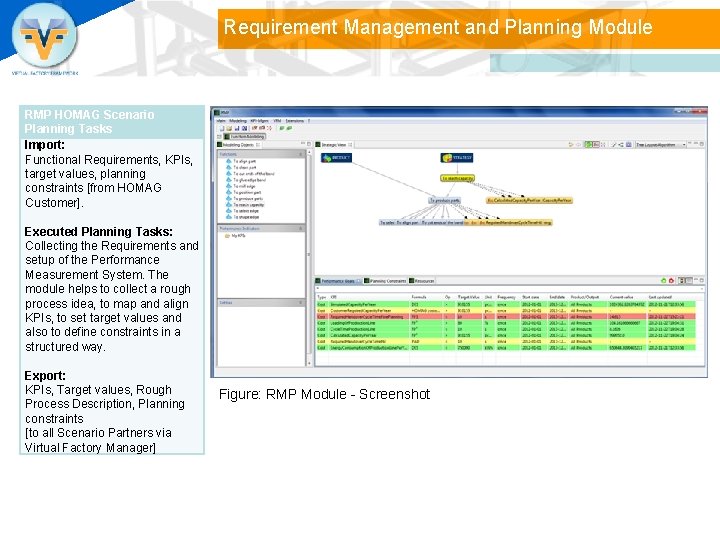
Requirement Management and Planning Module RMP HOMAG Scenario Planning Tasks Import: Functional Requirements, KPIs, target values, planning constraints [from HOMAG Customer]. Executed Planning Tasks: Collecting the Requirements and setup of the Performance Measurement System. The module helps to collect a rough process idea, to map and align KPIs, to set target values and also to define constraints in a structured way. Export: KPIs, Target values, Rough Process Description, Planning constraints [to all Scenario Partners via Virtual Factory Manager] Figure: RMP Module - Screenshot
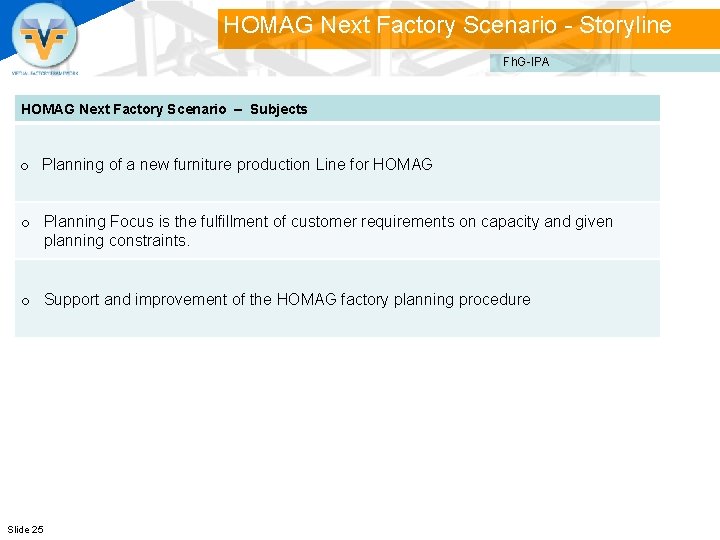
HOMAG Next Factory Scenario - Storyline Fh. G-IPA HOMAG Next Factory Scenario – Subjects o Planning of a new furniture production Line for HOMAG o Planning Focus is the fulfillment of customer requirements on capacity and given planning constraints. o Support and improvement of the HOMAG factory planning procedure Slide 25
HOMAG Next Factory Scenario - Storyline Fh. G-IPA HOMAG Next Factory Scenario – Actions 1. Collecting the Requirements and setup of the Performance Measurement System. Map and align KPIs, to set target values and also to define constraints in a structured way. Constant Monitoring of KPI throughout the planning project. 2. Analysis of past similar resources and production line configurations. Retrieve and reuse of past solutions based on sample past manufacturing lines. 3. Production Resource Planning and Capacity Calculation. Further Technical and Economical Calculations. Calculation of defined performance indicators of the manufacturing line. 4. Create production sequence for customer orders (planned production steps) within HOMAG Production line. Virtual Production Sequence used in further simulations. 5. Discrete Event Simulation of the HOMAG production line simulating the Capacity and Energy Consumption with fine planned and optimized production sequence. 6. HIL simulation for the calculation of optimized cycle times for the production sequence with collision detection. Calculation of KPI referred to the cycle time concerning the handover machine. Slide 26
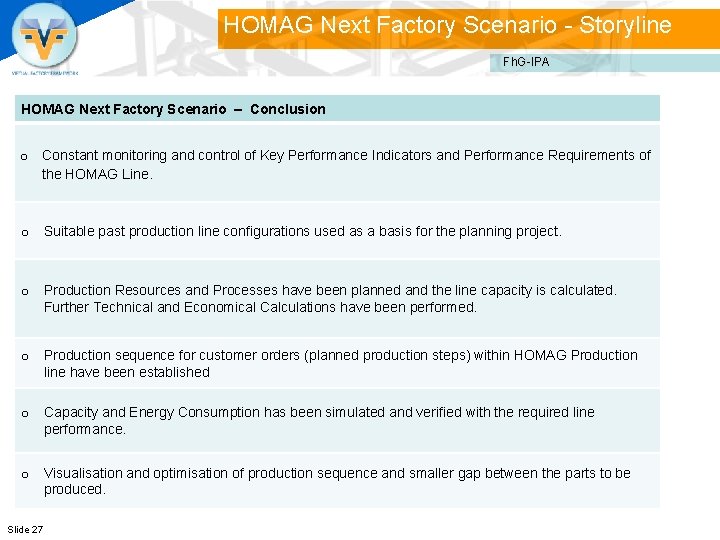
HOMAG Next Factory Scenario - Storyline Fh. G-IPA HOMAG Next Factory Scenario – Conclusion o Constant monitoring and control of Key Performance Indicators and Performance Requirements of the HOMAG Line. o Suitable past production line configurations used as a basis for the planning project. o Production Resources and Processes have been planned and the line capacity is calculated. Further Technical and Economical Calculations have been performed. o Production sequence for customer orders (planned production steps) within HOMAG Production line have been established o Capacity and Energy Consumption has been simulated and verified with the required line performance. o Visualisation and optimisation of production sequence and smaller gap between the parts to be produced. Slide 27