
INDUSTRIAL AUDIOLOGY and HEARING CONSERVATION What You Dont







- Slides: 35
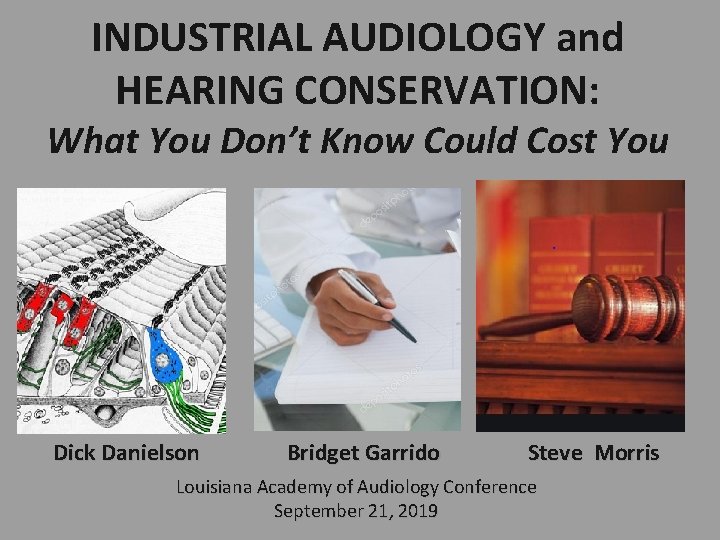
INDUSTRIAL AUDIOLOGY and HEARING CONSERVATION: What You Don’t Know Could Cost You Dick Danielson Bridget Garrido Steve Morris Louisiana Academy of Audiology Conference September 21, 2019
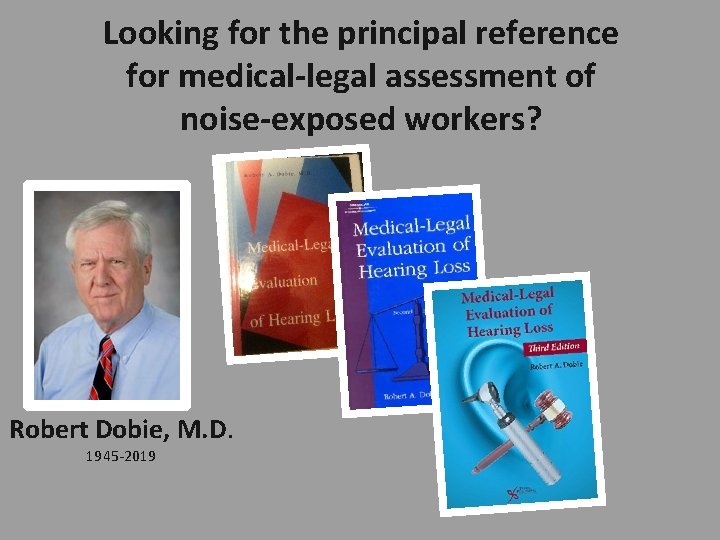
Looking for the principal reference for medical-legal assessment of noise-exposed workers? Robert Dobie, M. D. 1945 -2019
“If you do a good job in hearing conservation and in the medico-legal area, you can do a lot of good for a lot of people, because there are millions of people involved. Contrast that to surgery, where you benefit one person at a time. This is a real win for the patients, through professional involvement in occupational causes of hearing loss. ” Interview with Robert Dobie M. D. , Nat’l Institutes of Health, Audiology Online 2001
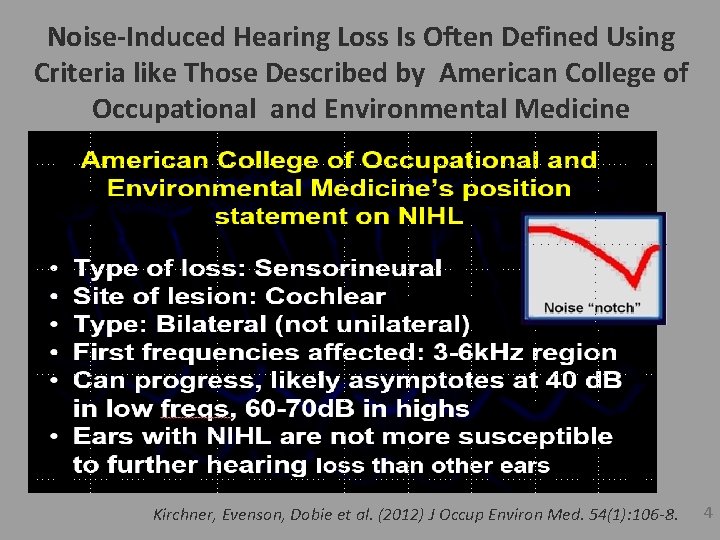
Noise-Induced Hearing Loss Is Often Defined Using Criteria like Those Described by American College of Occupational and Environmental Medicine Kirchner, Evenson, Dobie et al. (2012) J Occup Environ Med. 54(1): 106 -8. 4
Audiometric Notch Fades with Age NOTCH INDEX: The average of thresholds at 2, 3, and 4 k. Hz minus the average of thresholds at 1 and 8 k. Hz in the same ear. (avg 2, 3, 4 k. Hz) - (avg 1, 8 k. Hz) Rabinowitz and Dobie (2006) Ear and Hearing
Why do we see this “audiometric notch” at 4 k. Hz? External Ear Transfer (Quarter wave resonator) INCREASES HIGHS Contraction of Middle Ear Muscles During Middle Ear Reflex INCREASES STIFFNESS, DECREASE LOWS 6
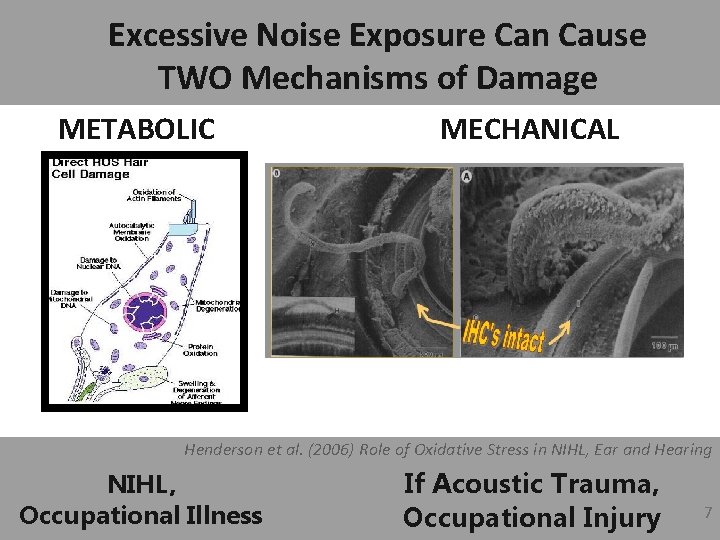
Excessive Noise Exposure Can Cause TWO Mechanisms of Damage METABOLIC MECHANICAL Henderson et al. (2006) Role of Oxidative Stress in NIHL, Ear and Hearing NIHL, Occupational Illness If Acoustic Trauma, Occupational Injury 7
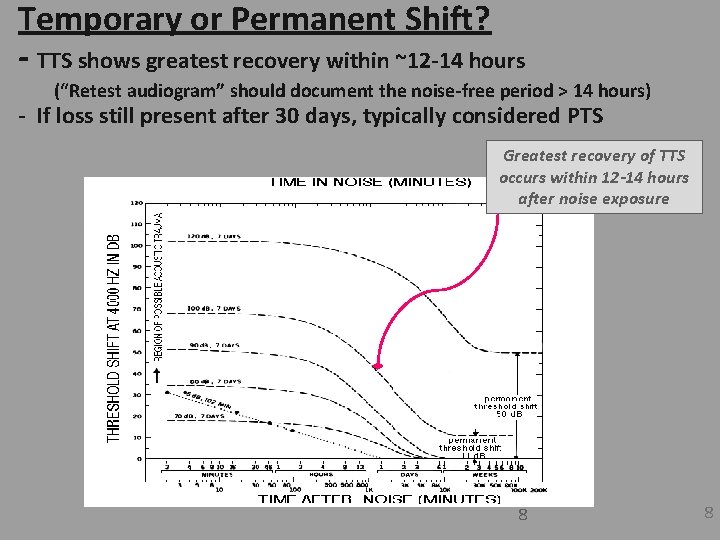
Temporary or Permanent Shift? - TTS shows greatest recovery within ~12 -14 hours (“Retest audiogram” should document the noise-free period > 14 hours) - If loss still present after 30 days, typically considered PTS Greatest recovery of TTS occurs within 12 -14 hours after noise exposure 8 8
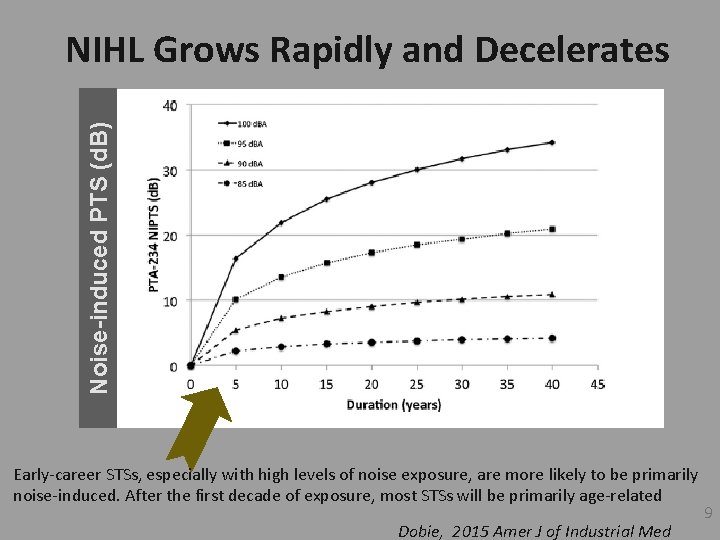
Noise-induced PTS (d. B) NIHL Grows Rapidly and Decelerates Early-career STSs, especially with high levels of noise exposure, are more likely to be primarily noise-induced. After the first decade of exposure, most STSs will be primarily age-related Dobie, 2015 Amer J of Industrial Med 9
OSHA Recordable Hearing Loss, per 29 CFR 1904. 10 (2005) 10
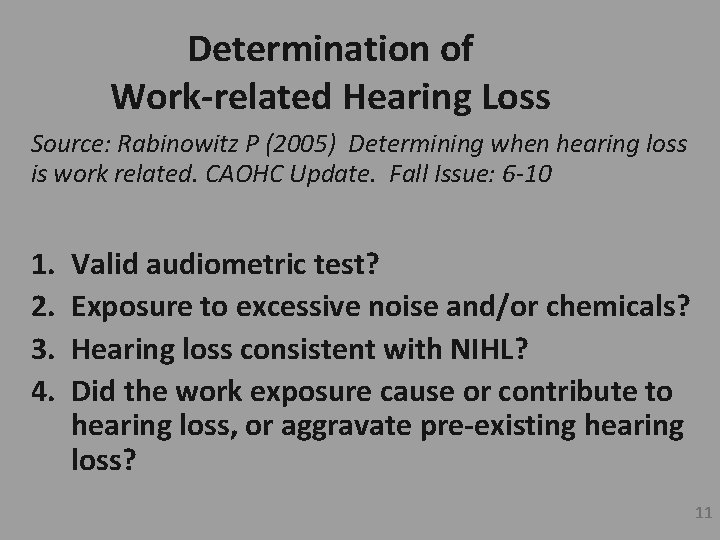
Determination of Work-related Hearing Loss Source: Rabinowitz P (2005) Determining when hearing loss is work related. CAOHC Update. Fall Issue: 6 -10 1. 2. 3. 4. Valid audiometric test? Exposure to excessive noise and/or chemicals? Hearing loss consistent with NIHL? Did the work exposure cause or contribute to hearing loss, or aggravate pre-existing hearing loss? 11
1. Is the audiometric test valid? • Was the test environment adequate? • calibration records, ambient noise levels • Was reliability of test results reported? “good” “fair” “poor” • Did the tester indicate any ear canal obstruction? • Any evidence of malingering? • Were all “OSHA-required” thresholds reported? 12
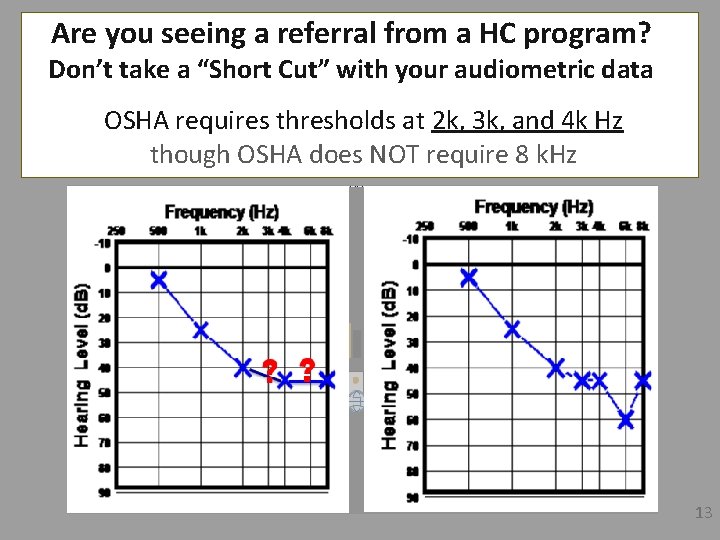
Are you seeing a referral from a HC program? Don’t take a “Short Cut” with your audiometric data OSHA requires thresholds at 2 k, 3 k, and 4 k Hz though OSHA does NOT require 8 k. Hz 13
2. Is the employee exposed to potentially damaging noise (or ototoxic chemicals) at work? • Records of noise and chemical/solvent exposures (ideally, from industrial hygienist, using personal sampling for employee) • Records of hearing protection: type, frequency worn (including fit testing, if available) • Consider impulse noise exposures (>140 d. B Peak? ) e v e t S m o r f , R E T A L MORE ACOEM EVIDENCE-BASED STATEMENT: NIHL Dobie et al. (2003) Journal Occup Environ Med 45(6): 579 -81. 14
3. Is the hearing loss consistent with NIHL, OR is there a medical condition present that can completely explain the loss? • Apply ACOEM Position Statement on NIHL • Audiological testing, medical history, physical examination MOR e v e t S m o r E LATER, f ACOEM EVIDENCE-BASED STATEMENT: NIHL Dobie et al. (2003) Journal Occup Environ Med 45(6): 579 -81. 15 15
4. Considering Steps 1 -3, Did a Work Exposure Either Cause or Contribute to the Hearing Loss, or Significantly Aggravate a Pre-existing Hearing Loss? • Review all evidence, including non-occupational noise exposures • Reach a clinical opinion of “more probable than not” regarding work-relatedness MOR e v e t S m o E LATER, fr ACOEM EVIDENCE-BASED STATEMENT: NIHL Dobie et al. (2003) Journal Occup Environ Med 45(6): 579 -81. 16
Why can’t I find OSHA’s age corrections for these older workers? 17
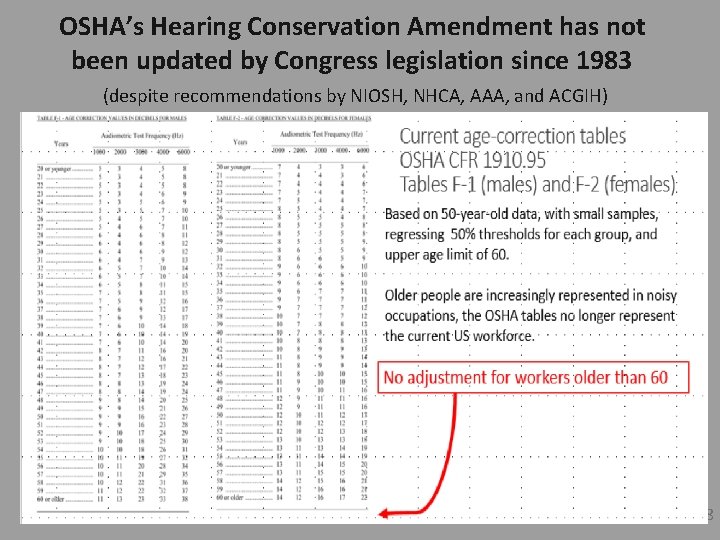
OSHA’s Hearing Conservation Amendment has not been updated by Congress legislation since 1983 (despite recommendations by NIOSH, NHCA, AAA, and ACGIH) 18
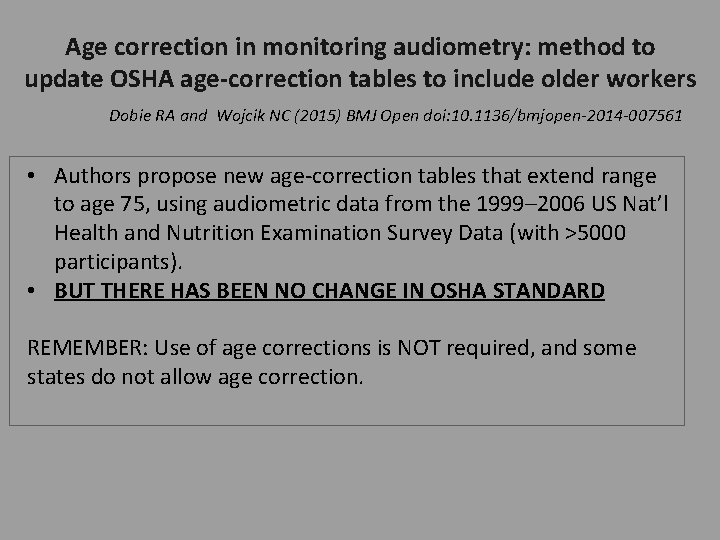
Age correction in monitoring audiometry: method to update OSHA age-correction tables to include older workers Dobie RA and Wojcik NC (2015) BMJ Open doi: 10. 1136/bmjopen-2014 -007561 • Authors propose new age-correction tables that extend range to age 75, using audiometric data from the 1999– 2006 US Nat’l Health and Nutrition Examination Survey Data (with >5000 participants). • BUT THERE HAS BEEN NO CHANGE IN OSHA STANDARD REMEMBER: Use of age corrections is NOT required, and some states do not allow age correction.
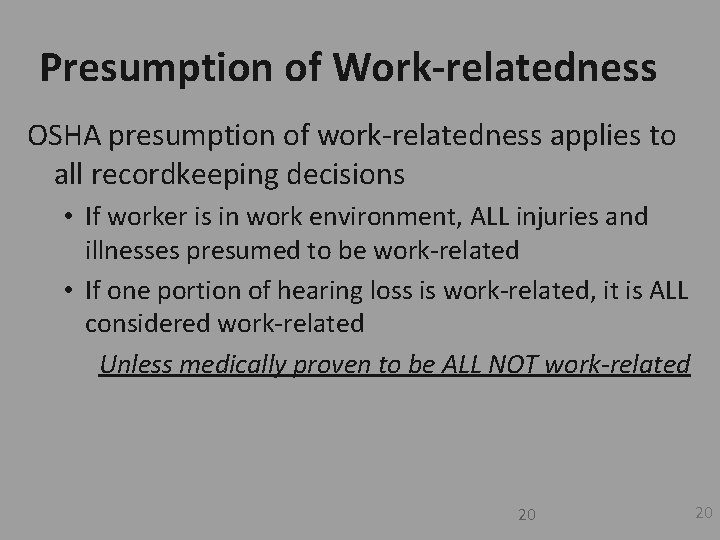
Presumption of Work-relatedness OSHA presumption of work-relatedness applies to all recordkeeping decisions • If worker is in work environment, ALL injuries and illnesses presumed to be work-related • If one portion of hearing loss is work-related, it is ALL considered work-related Unless medically proven to be ALL NOT work-related 20 20
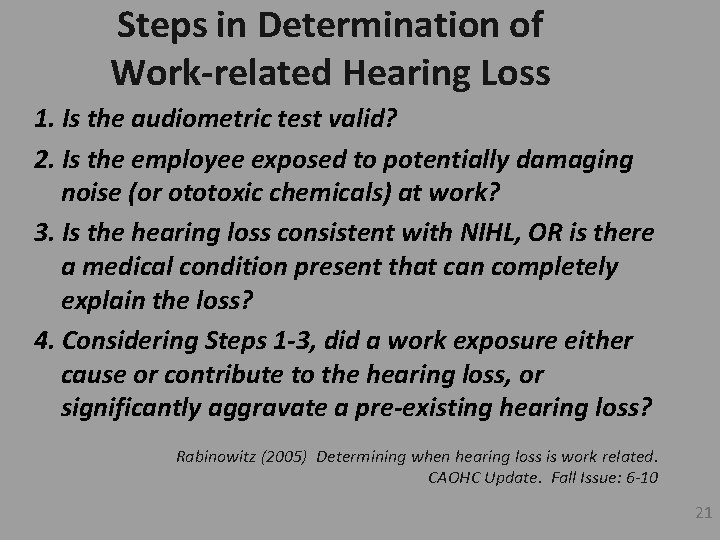
Steps in Determination of Work-related Hearing Loss 1. Is the audiometric test valid? 2. Is the employee exposed to potentially damaging noise (or ototoxic chemicals) at work? 3. Is the hearing loss consistent with NIHL, OR is there a medical condition present that can completely explain the loss? 4. Considering Steps 1 -3, did a work exposure either cause or contribute to the hearing loss, or significantly aggravate a pre-existing hearing loss? Rabinowitz (2005) Determining when hearing loss is work related. CAOHC Update. Fall Issue: 6 -10 21
What is not a noise-induced hearing loss? Case Reviews
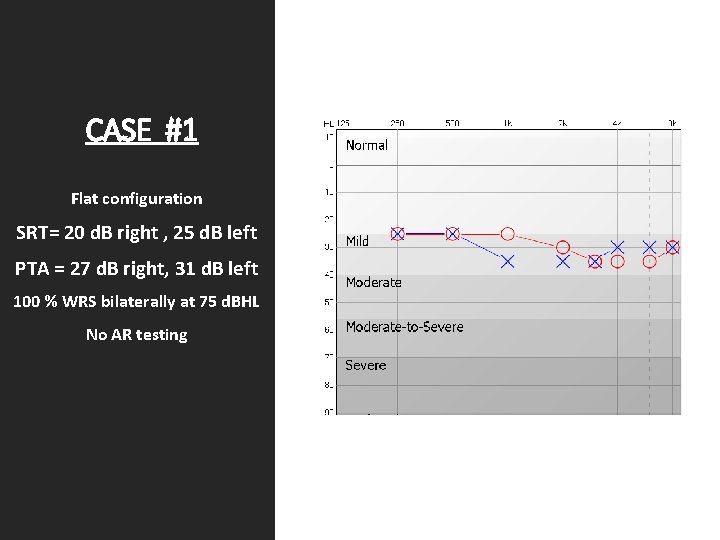
CASE #1 Flat configuration SRT= 20 d. B right , 25 d. B left PTA = 27 d. B right, 31 d. B left 100 % WRS bilaterally at 75 d. BHL No AR testing
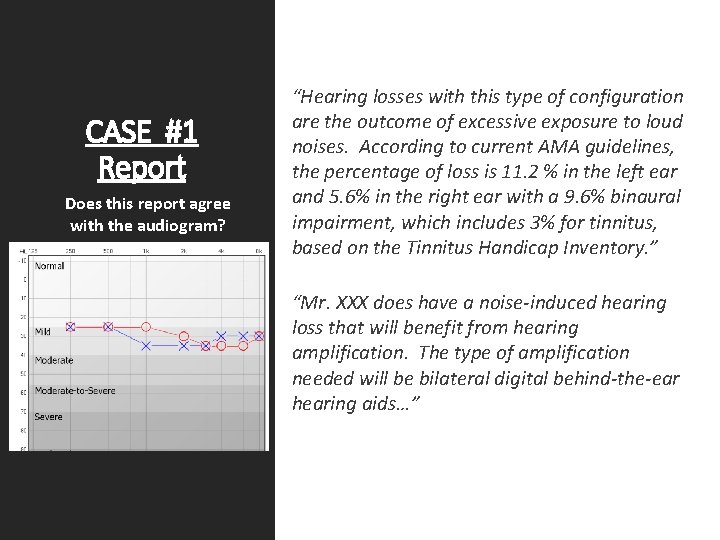
CASE #1 Report Does this report agree with the audiogram? “Hearing losses with this type of configuration are the outcome of excessive exposure to loud noises. According to current AMA guidelines, the percentage of loss is 11. 2 % in the left ear and 5. 6% in the right ear with a 9. 6% binaural impairment, which includes 3% for tinnitus, based on the Tinnitus Handicap Inventory. ” “Mr. XXX does have a noise-induced hearing loss that will benefit from hearing amplification. The type of amplification needed will be bilateral digital behind-the-ear hearing aids…”
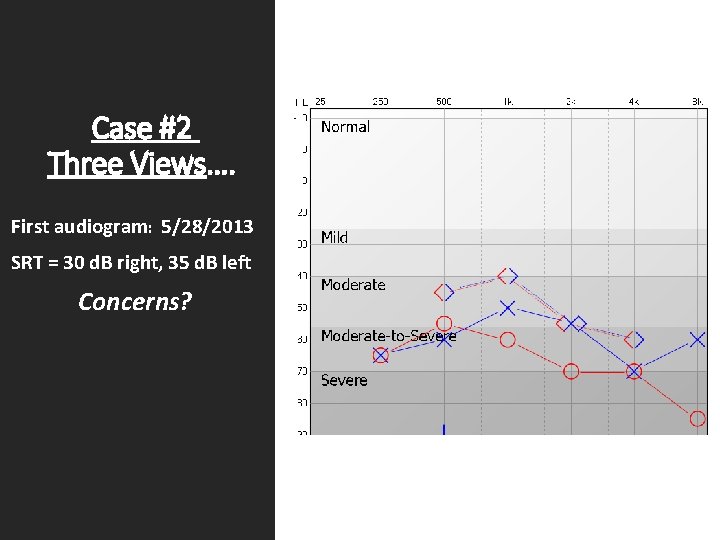
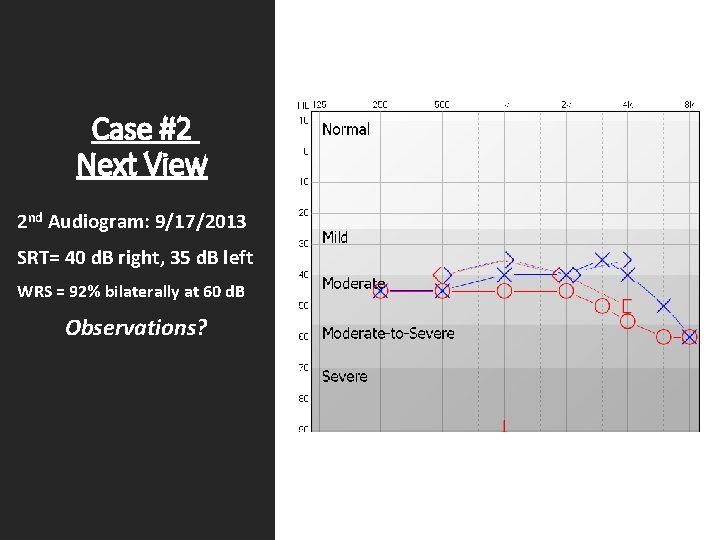
Case #2 Three Views…. First audiogram: 5/28/2013 SRT = 30 d. B right, 35 d. B left Concerns?
Case #2 Next View 2 nd Audiogram: 9/17/2013 SRT= 40 d. B right, 35 d. B left WRS = 92% bilaterally at 60 d. B Observations?
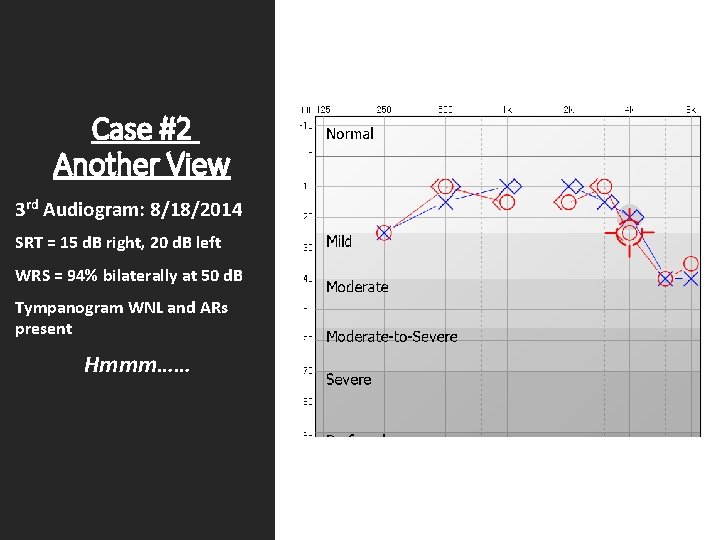
Case #2 Another View 3 rd Audiogram: 8/18/2014 SRT = 15 d. B right, 20 d. B left WRS = 94% bilaterally at 50 d. B Tympanogram WNL and ARs present Hmmm……
Depositions: My thoughts…
What is most important in the Case Review? Hint: it’s not just the audiogram • Patient History – Might be the most critical factor • Comprehensive medical history • Tinnitus— Specific onset, duration, type • Type of hearing protection used (on and off the job) • Type of noise exposure, duration, TWA Consider ALL noise exposure history • Hearing education program (documented) • Any disciplinary action for lack of hearing protection use
Be Prepared… Considerations when involved in medical legal cases • Know your Attorney! (Yours and Theirs) • Educate your Attorney. • However, these are not the Attorneys of old. They may know a great deal about hearing loss and noise. • The opposing Attorney has weeks to research each point of your deposition. • Review your previous depositions. The opposition will have reviewed every word. • Don’t talk too much. Only answer what is asked; “yes/no” answers are preferable. • Don’t be bullied into giving answers with which you are not comfortable. Take your time before each answer.
Is this case a work-related hearing loss?
Case # 3 Baseline: 3/31/1971 On a “Beltone Audiogram” Both ISO and ASA cited…
Comprehensive exam: 4/5/2017 Good SRT - PTA agreement Tympanograms WNL ARs right ear: Absent ARs left ear: Elevated/Absent DPOAEs: Absent bilaterally
Points to consider about this case… • Hearing loss pattern • Extensive shooting - right-handed • Noise exposures on/off job • Significant diabetes • Duration of exposure • Major cardiovascular disease • Type of exposure • TWAs provided by company (low) • Other solvent exposures • Age-related hearing loss
QUESTIONS?