
Indus Valley Civilizations Indus Valley present day India
- Slides: 13
Indus Valley Civilizations • Indus Valley – present day India, Pakistan, & Bangladesh – Natural borders of water (Arabian Sea & Bay of Bengal) and mountains (Himalayas & Hindu Kush) • 3 Rivers central to life – Indus, Ganges, & Brahmaputra • Seasonal Monsoons – N. E. in winter; S. W. in summer – People of Indus plains depend on monsoons and floods for their crops
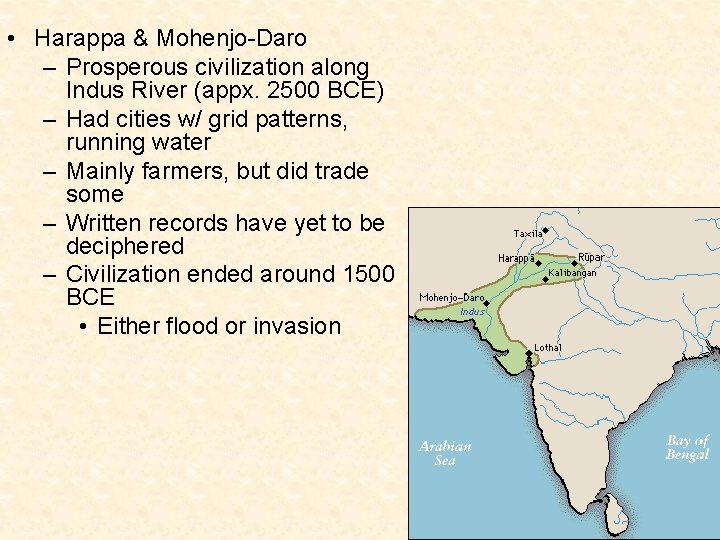
• Harappa & Mohenjo-Daro – Prosperous civilization along Indus River (appx. 2500 BCE) – Had cities w/ grid patterns, running water – Mainly farmers, but did trade some – Written records have yet to be deciphered – Civilization ended around 1500 BCE • Either flood or invasion
Aryans • Beginnings – Indo-European (light skinned) people, invaded from North of the Black sea around 1500 BCE • Life – Loose organization of tribes; led by Rajah (chief) – Cattle was important to early Aryans – used for diet & trade/economy; eventually cows become sacred – Paternalistic society (men dominated) – Sanskrit – early Aryan speech, eventually becomes writing – Vedas – “Books of Knowledge” – tell us about Aryan society & religious beliefs
Caste System • Caste System is the rigid social system of India • Divided into 4 main varnas or social classes – Brahmans (priest) – Kshatriyas (warriors/nobles) – Vaisyas (artisans, common people) – Sudras (unskilled workers, servants) • Each varna is subdivided into smaller groups called jati • Jati formed according to occupation – Some mobility within the varna, but NO MOBILITY from varna to varna • Lowest group (not even identified as a “class”) are the paraih…also known as “untouchables”
Hinduism • Vedas outline a person’s dharma (duties) • Aryan religion was polytheistic, had elaborate rituals (evolves into religion known as Hinduism) • Based on several beliefs and practices – Afterlife based on karma of your spirit – Believed in Upanishads – religious writings that said all living things have a soul (leads to vegetarianism) – All souls are a part of eternal spirit called Brahman Nerguna • Believed in reincarnation, based on your karma from life – Good karma, and you move up in the caste…bad karma and you move down • Goal is to reach moksha – union with the Brahman Nerguna
Buddhism • Many Hindus were dissatisfied with their religion (wanted more spirituality) • Siddhartha Guatama – Born as Kshatriyan Prince appx. 566 BCE – Lived sheltered from pain of the world – Gives up life of luxury at age 29 and wanders India for 7 years looking for meaning of life – Gains enlightenment – becomes known as Buddha (Enlightened One)
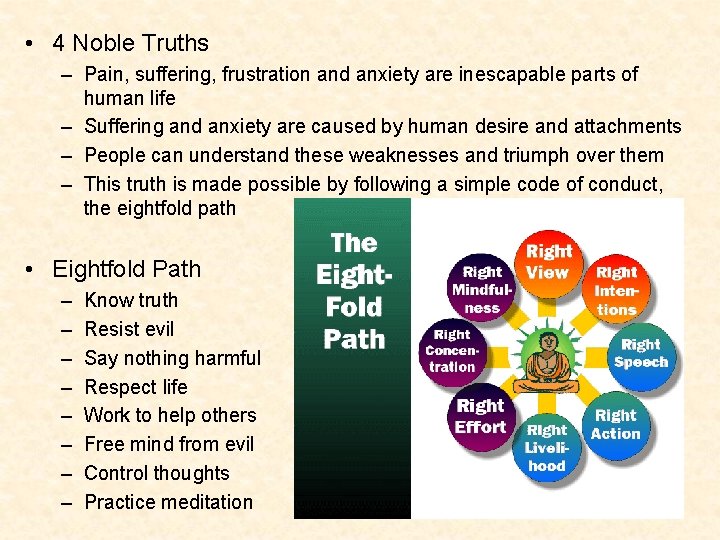
• 4 Noble Truths – Pain, suffering, frustration and anxiety are inescapable parts of human life – Suffering and anxiety are caused by human desire and attachments – People can understand these weaknesses and triumph over them – This truth is made possible by following a simple code of conduct, the eightfold path • Eightfold Path – – – – Know truth Resist evil Say nothing harmful Respect life Work to help others Free mind from evil Control thoughts Practice meditation
Buddhist Beliefs • Buddhists reach nirvana (a state of union with the universe) by mastering Eightfold Path • Buddhists reject the caste system, they believe you can reach enlightenment in any life • Reincarnation still exists, but only for those that don’t reach enlightenment – one could escape the pain of life/rebirth by becoming enlightened • There are 2 major branches of Buddhism – Theravada- close in practice to original Buddhism – Mahayana- they worship Buddha as a divine being & savior
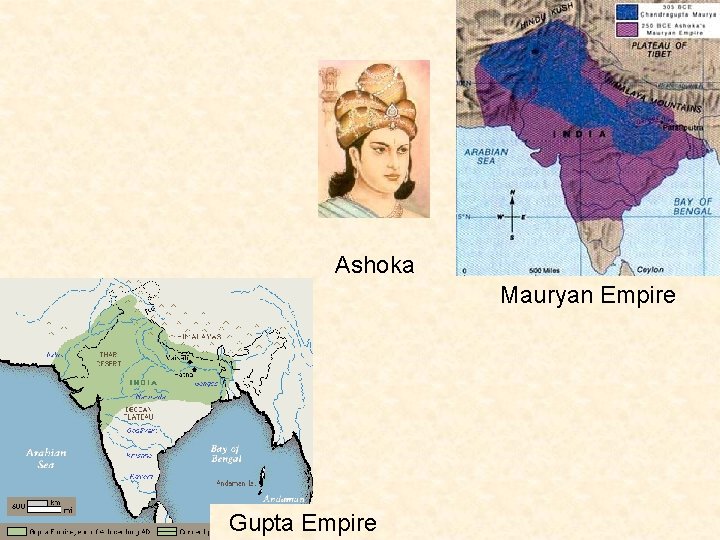
Classical Indian Empires • Mauryan Empire (321 -184 BCE) – Began by Chandragupta Maurya – Largest empire of classical India; had strong army & spy network – Most famous leader was Ashoka • Warlike leader who eventually converts to Buddhism • Provided public support via hospital care, roads & rest stops, etc. • Laws provided in local languages instead of formal Sanskrit • Gupta Empire – Began in 320 CE, lasts until appx. 535 CE – Gupta rulers used marriage & negotiation to increase empire – Known as the “Golden Age” due to intellectual accomplishments • 1 st university system w/ 3 libraries, lecture halls, observatory, etc. • Advances in science including gravity, brain surgery, astronomical observations, the Earth being round, & smallpox inoculation • Mathematical advancements of #1 -9, 0, pi, decimal system, infinity
Ashoka Mauryan Empire Gupta Empire
Modern India • After Gupta – Years of invasions (Muslims, Mongols, Portuguese, etc. ) – Lasts from 700 s CE-1600 s CE • British Rule - Imperialism – British East India Company becomes active in Indian gov’t – Hired Indian soldiers (sepoys) – they revolt in 1857 – Revolt suppressed, British officially take over India with Queen Victoria named “Empress of India” in 1876 (Crown Jewel) • Colonial Rule – Queen appoints viceroy to rule in her place – British try to modernize India • Schools, telegraphs, railroads, postal system, etc. • High taxation; Indians forced to farm cotton (US Civil War) • Millions of Indians starve – Indians treated as 2 nd class people
• Mohandas Gandhi – Also known as Mahatma Gandhi; Indian nationalist & British educated lawyer – Leads independence movement in India with mass civil disobedience (nonviolent protesting) – Gandhi was jailed several times for his protests • Most famous protest was Salt March (1930) – Led the Indian National Congress – Supported British in WWI, but refused to support them in WWII – Independence movement splits • Indian (Hindu) • Modern (Muslim) – India granted Independence from Great Britain in 1947; western India splits and becomes Pakistan (Muslim) – Gandhi assassinated in 1948