
Indus Valley Civilization Began in the Indus River
Indus Valley Civilization Began in the Indus River Valley around the Indus River around 2600 B. C. -1500 B. C.

Mohenjo-Daro & Harappa Indus culture flourished between 2600 -1900 B. C. We know about the culture from studying the ruins of two major cities, Mohenjo-Daro and Harappa. The cities were designed almost exactly alike. Each city had dozens of wide streets. Larger streets were paved with tancolored bricks. The people used ovenbaked bricks to build their homes. Most houses had flat wooden roofs. The houses had enclosed courtyards. Homes had at least one indoor bathroom, wastewater pipes that led outside the city walls, and garbage chutes connected to bins in the streets.
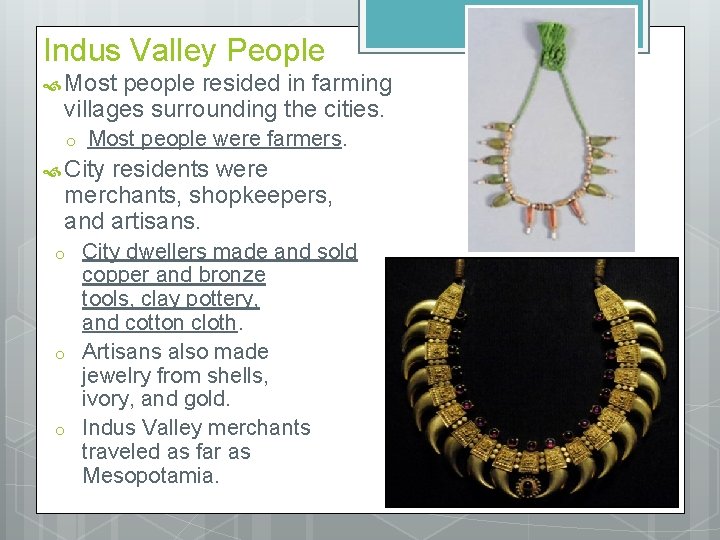
Indus Valley People Most people resided in farming villages surrounding the cities. o Most people were farmers. City residents were merchants, shopkeepers, and artisans. o o o City dwellers made and sold copper and bronze tools, clay pottery, and cotton cloth. Artisans also made jewelry from shells, ivory, and gold. Indus Valley merchants traveled as far as Mesopotamia.
Aryan Migrations and Settlements The people of the Indus Valley began to abandon their cities and villages around 1900 B. C. due to several possible causes. There was a sever drought that lasted hundreds of years that destroyed several crops and causes starvation among the people. Earthquakes and floods killed many more people and changed the course of the Indus River. Groups of people called the Aryans migrated to India and a new civilization soon emerged.
Notebooks What do historians think happened to the Harappans? o o Drought-farm dried up not enough food Earthquake- caused river to flood
Indo-Europeans q The Aryan people was part of a language family known as Indo-European. q q q q A language family is a group of similar languages. Indo-European people lived in central Asia but began migrating to other places. The Aryans raised cattle for meat, milk, and butter. They moved from place to find pastures and water for their cattle. The Aryans were expert horse riders and hunters, as well as fierce warriors. As they moved about, the Aryans sometimes raided nearby villages for food. The Aryans mixed with Indus Valley people and created a new culture. q Aryans adopted a new way of life. q q They settled in one place and became farmers. They saw their herds of cattle as sacred and banned the use of cattle for food.
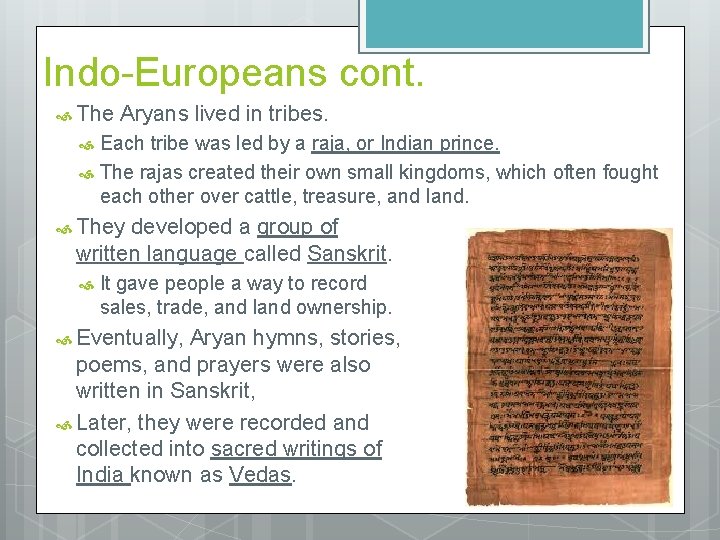
Indo-Europeans cont. The Aryans lived in tribes. Each tribe was led by a raja, or Indian prince. The rajas created their own small kingdoms, which often fought each other over cattle, treasure, and land. They developed a group of written language called Sanskrit. It gave people a way to record sales, trade, and land ownership. Eventually, Aryan hymns, stories, poems, and prayers were also written in Sanskrit, Later, they were recorded and collected into sacred writings of India known as Vedas.
Notebooks Who were the Aryans? o Nomads from Central Asia o Spoke similar languages o Good warriors, expert horse riders and hunters o Arrived in Indus River Valley around 1500 B. C. How did Aryan culture change after they moved to India? o Changed from nomads to farmers o Began to believe cattle were sacred o Developed Sanskrit How did the Aryans get along with each other? o Each group was ruled by a raja o The rajas fought over treasure and cattle

Indian Society v v v v As India’s economy grew, a social class system developed. The four social classes of ancient India are called varnas. People were considered members of the varna into which they were born. The most powerful varnas were the Brahmins and Kshatriyas. The Brahmins were priests and the Kshatriyas were warriors who ran the government and army. Next were the Vaisyas, or commoners, who were usually farmers, craftspeople, and merchants. The Sudras were under the Vaisyas and were manual workers and servants who had few rights. The four varna were divided into thousands of smaller groups called jati. Many jati were based on the type of work a person did and had their own strict rules for diet, marriage, and social customs.
India Society cont. Scholars refer to the varna system as a caste system. Indian social class whose members are restricted in jobs and social associations. In this system, people remain in the same caste or social group for life. At the lowest level of society were the Untouchables who were considered unclean. They were not part of the varna system. They did work that varna Indians would not do, such as collecting trash, skinning animals, and carrying dead bodies.
Notebooks How would being born into a caste affect your life? o o o Affects every aspect of your life Only socialize with those in your caste Only marry within caste Each caste had certain jobs Only work jobs assigned to your caste
Aryan Family Life In ancient India, the family was the center of life. Grandparents, and children lived together in an extended family. The oldest male in the family was in charge of the entire household. Indian men had more rights than women. Males inherited property, unless there were no sons in the family. Men attended school or became priests, while women were educated at home. In India’s leading families, a boy had a guru, or teacher, until he attended school in the city. In India, parents arranged marriages for their children. Boys and girls often married in their teens. People could not get divorced.
- Slides: 12