
Indus Valley Civilization Ancient Roots Indus Valley Civilization
- Slides: 12
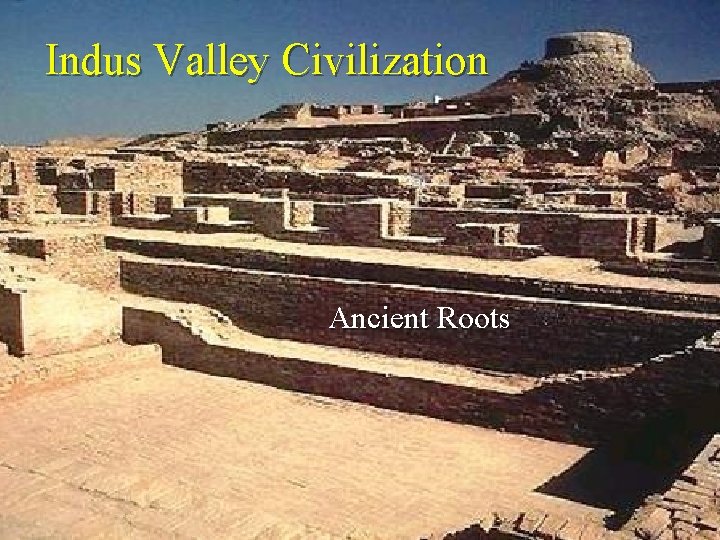
Indus Valley Civilization Ancient Roots
Indus Valley Civilization a Primary Phase Culture n little or no continuity with the following cultures n forgotten until the 19 th Century n – rediscovered by the British
Harappan Culture n Indus valley – – n not desert well-watered and heavily forested 500 miles along the river valley – 10 -20 times larger than Mesopotamia or Egypt
Hydraulic Culture like Egypt and Mesopotamia n agriculture and flood-control n significant industry and trade n cities very common n
Lack of Sources n literate culture – – – we cannot read the writing on bricks and seals did not use paper or clay tablets
Reasonable generalizations rapid development: early 2, 000 s B. C. n roughly contemporary with Egypt and Mesopotamia n early village culture n changing rapidly to urban civilization n
Major Cities n Harappa and Mohenjo-daro – surrounded by smaller cities, towns, and villages one situated in the north n one situated in the south n
Monumental architecture very-large scale building n walled cites, with fortified citadels n always on the same scale n palaces, temples n
Cities very densely populated n houses: two to three stories n every house is laid out the same n
Culture and Society advanced agriculture n surplus production n textiles: wool and cotton n domesticated animals and fish n
Bronze Age technology no swords n spears and bows n stone arrow heads n
Society dominated by priests ? n from the fortified palaces and temples ? n power base: fertility ? n deities: male and female, both nude n bull worship and phallic symbols n