
Inductive Reasoning Unit 1 Lesson 9 Inductive Reasoning


- Slides: 26
Inductive Reasoning Unit 1 Lesson 9
Inductive Reasoning Students will be able to: Make conjectures and build a logical progression of statements to explore the truth of their conjectures; Recognize and use counterexamples Key Vocabulary: Conjecture Counterexamples
Inductive Reasoning Inductive reasoning is a type of reasoning in which you look at a pattern and then make some type of prediction based on the pattern. These predictions are also called conjectures. A conjecture is a statement about what you think will happen based on the pattern you observed.
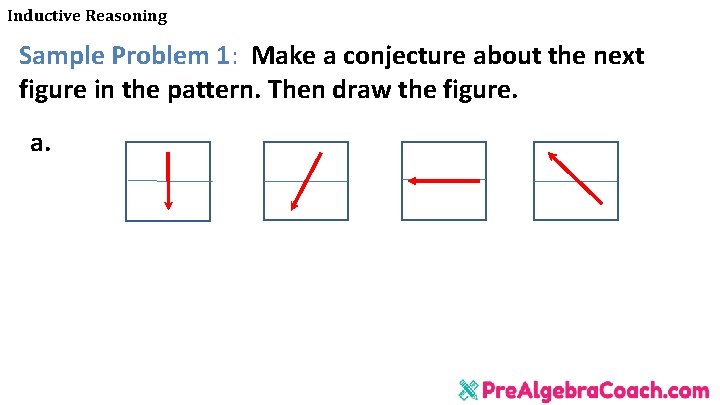
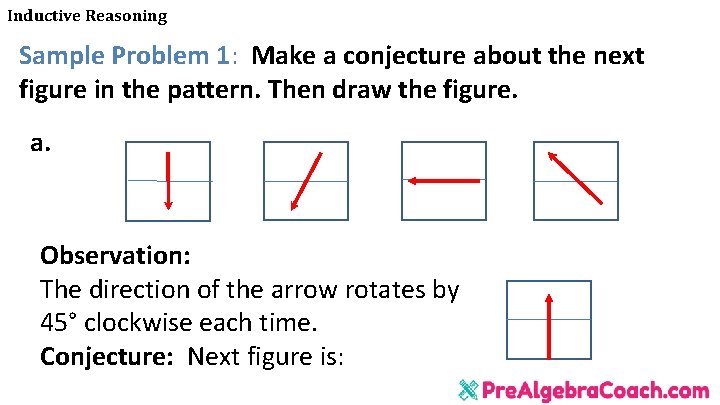
Inductive Reasoning Sample Problem 1: Make a conjecture about the next figure in the pattern. Then draw the figure. a.
Inductive Reasoning Sample Problem 1: Make a conjecture about the next figure in the pattern. Then draw the figure. a. Observation: The direction of the arrow rotates by 45° clockwise each time. Conjecture: Next figure is:
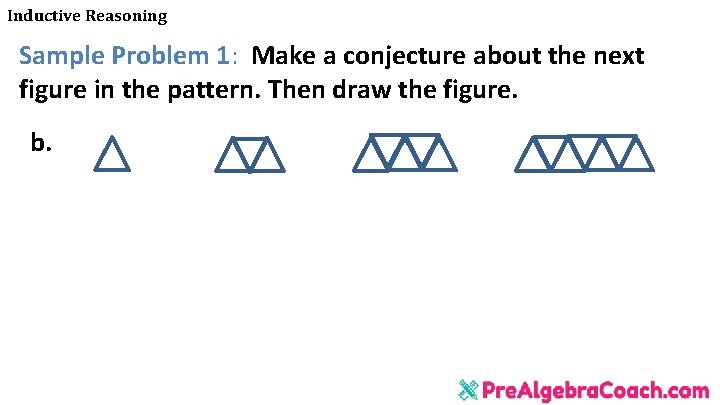
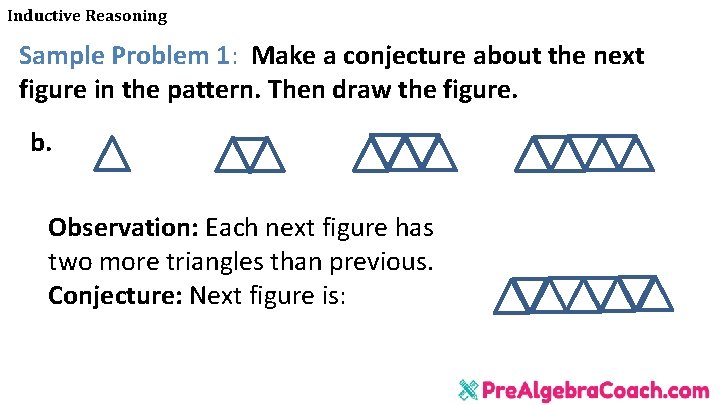
Inductive Reasoning Sample Problem 1: Make a conjecture about the next figure in the pattern. Then draw the figure. b.
Inductive Reasoning Sample Problem 1: Make a conjecture about the next figure in the pattern. Then draw the figure. b. Observation: Each next figure has two more triangles than previous. Conjecture: Next figure is:
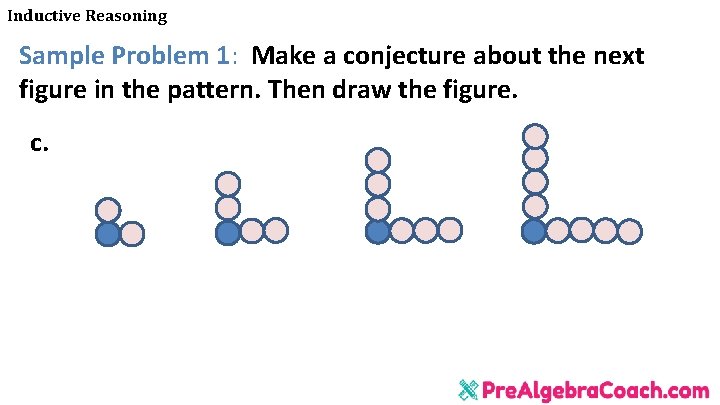
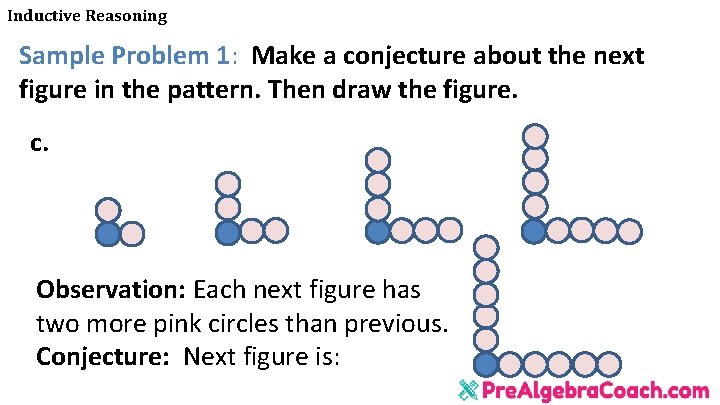
Inductive Reasoning Sample Problem 1: Make a conjecture about the next figure in the pattern. Then draw the figure. c.
Inductive Reasoning Sample Problem 1: Make a conjecture about the next figure in the pattern. Then draw the figure. c. Observation: Each next figure has two more pink circles than previous. Conjecture: Next figure is:
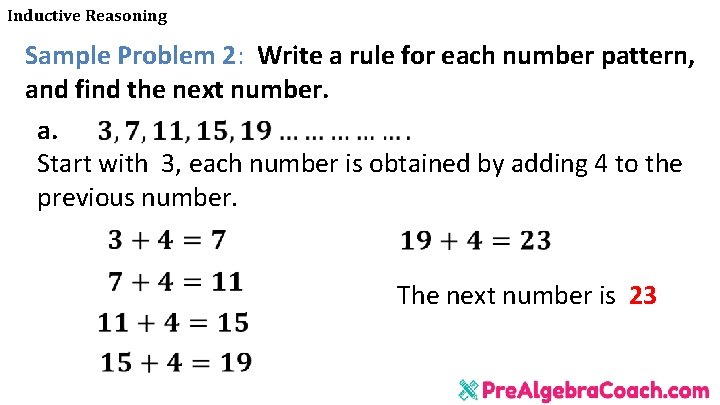
Inductive Reasoning Sample Problem 2: Write a rule for each number pattern, and find the next number. a.
Inductive Reasoning Sample Problem 2: Write a rule for each number pattern, and find the next number. a. Start with 3, each number is obtained by adding 4 to the previous number. The next number is 23
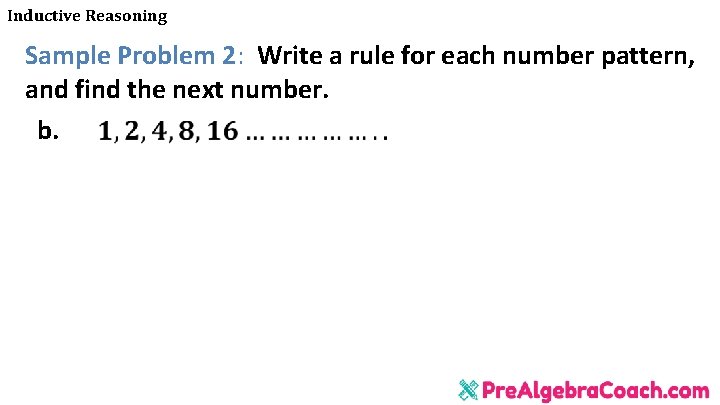
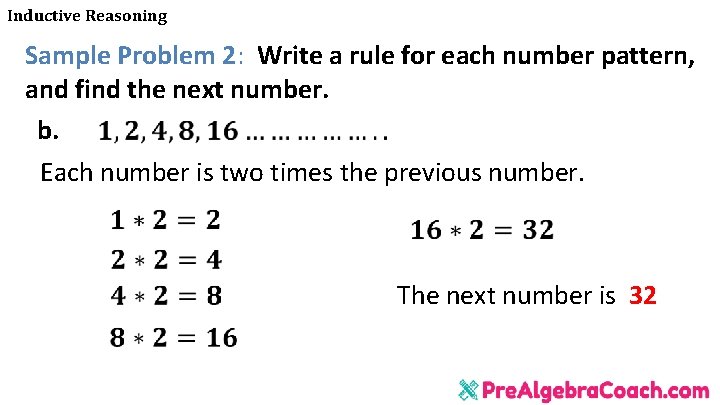
Inductive Reasoning Sample Problem 2: Write a rule for each number pattern, and find the next number. b.
Inductive Reasoning Sample Problem 2: Write a rule for each number pattern, and find the next number. b. Each number is two times the previous number. The next number is 32
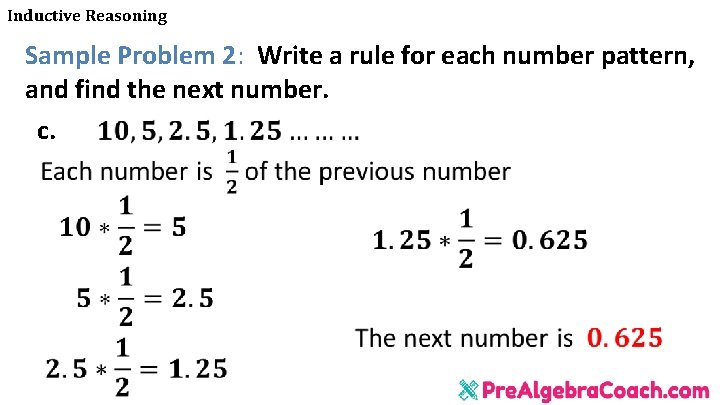
Inductive Reasoning Sample Problem 2: Write a rule for each number pattern, and find the next number. c.
Inductive Reasoning Sample Problem 2: Write a rule for each number pattern, and find the next number. c.
Inductive Reasoning One way to show that a conjecture is not true is to find a counterexample. A counterexample is an instance in which the conjectured pattern does not work. Only one counterexample is needed to prove a conjecture false. A counterexample can be a drawing, a statement, or a number.
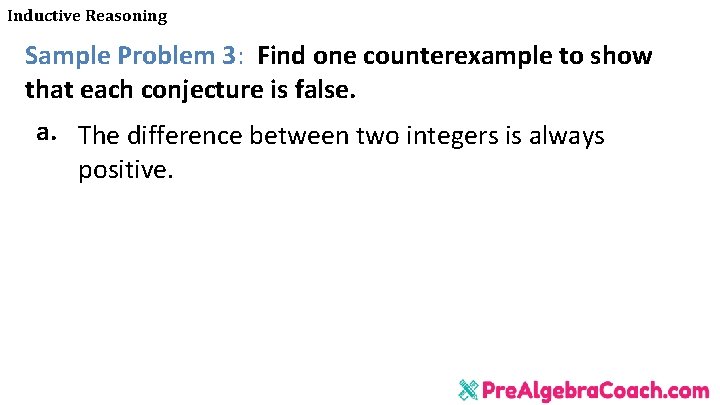
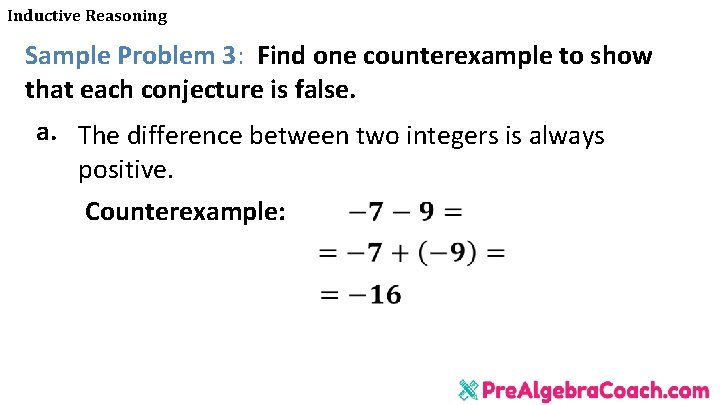
Inductive Reasoning Sample Problem 3: Find one counterexample to show that each conjecture is false. a. The difference between two integers is always positive.
Inductive Reasoning Sample Problem 3: Find one counterexample to show that each conjecture is false. a. The difference between two integers is always positive. Counterexample:
Inductive Reasoning Sample Problem 3: Find one counterexample to show that each conjecture is false. b. All prime numbers are odd integers.
Inductive Reasoning Sample Problem 3: Find one counterexample to show that each conjecture is false. b. All prime numbers are odd integers. Counterexample: 2 is prime number but it is even.
Inductive Reasoning Sample Problem 3: Find one counterexample to show that each conjecture is false. c. If the product of two numbers is positive, then the two numbers must both be positive.
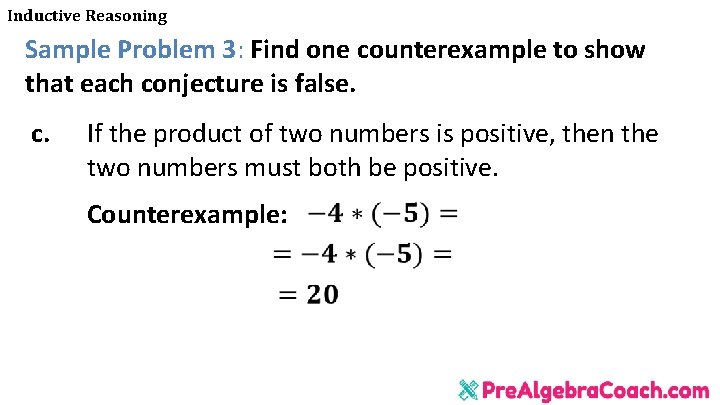
Inductive Reasoning Sample Problem 3: Find one counterexample to show that each conjecture is false. c. If the product of two numbers is positive, then the two numbers must both be positive. Counterexample:
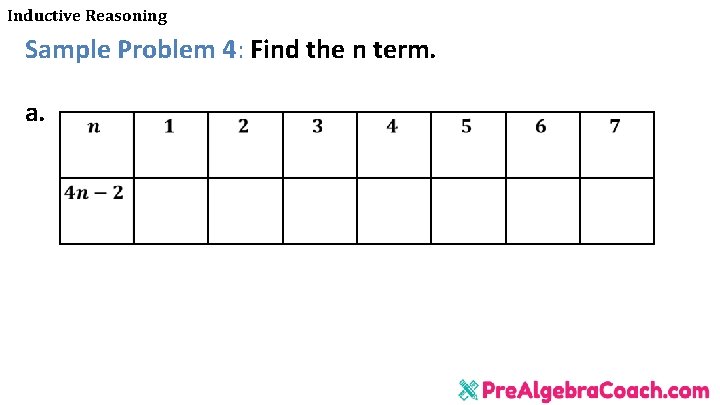
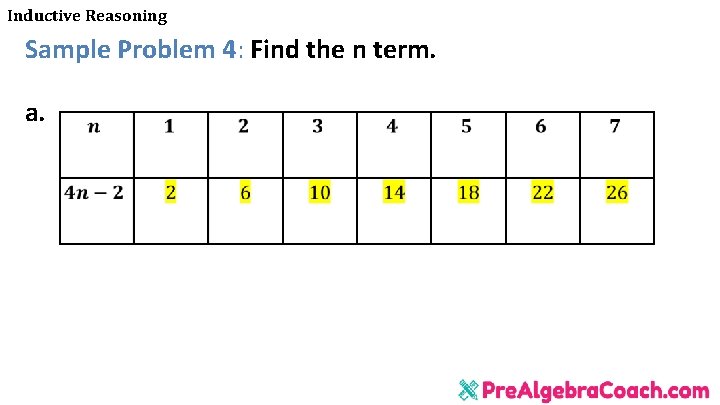
Inductive Reasoning Sample Problem 4: Find the n term. a.
Inductive Reasoning Sample Problem 4: Find the n term. a.
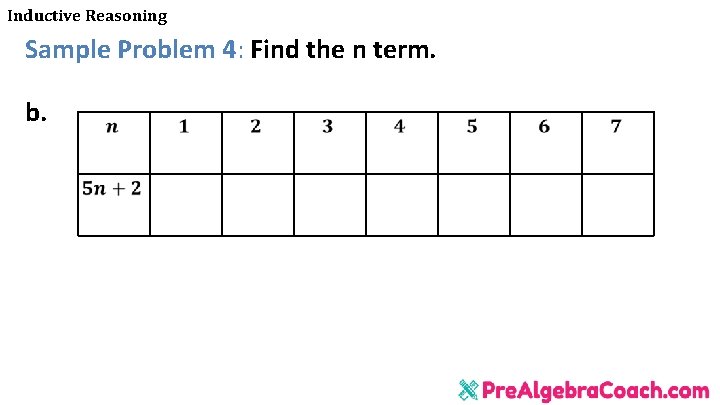
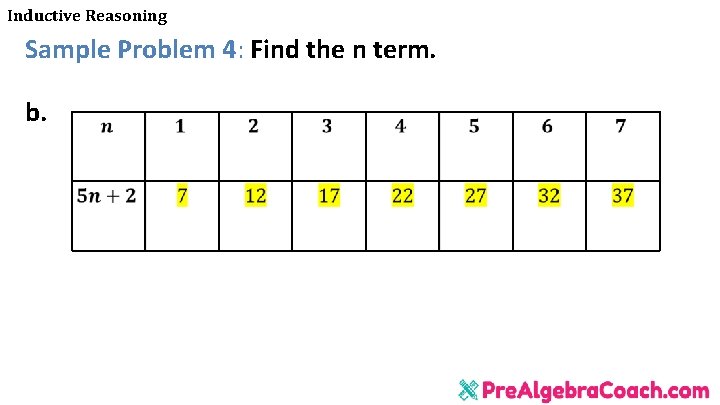
Inductive Reasoning Sample Problem 4: Find the n term. b.
Inductive Reasoning Sample Problem 4: Find the n term. b.