
Inductive Logic Programming for Dummies Anoop Hector EDAM
- Slides: 43
Inductive Logic Programming (for Dummies) Anoop & Hector EDAM Reading Group © 2004
Knowledge Discovery in DB (KDD) “automatic extraction of novel, useful, and valid knowledge from large sets of data” Different Kinds of: • Knowledge – – – Rules Decision trees Cluster hierarchies Association rules Statistically unusual subgroups • Data EDAM Reading Group © 2004 2
Relational Analysis Would it not be nice to have analysis methods and data mining systems capable of directly working with multiple relations as they are available in relational database systems? EDAM Reading Group © 2004 3
Single Table vs Relational DM The same problems still remain. But solutions? More problems: • Extending the key notations • Efficiency concerns EDAM Reading Group © 2004 4
Relational Data Mining : ML : : Relational Data Mining : ILP Initially Binary Classification Now Classification, Regression, Clustering, Association Analysis EDAM Reading Group © 2004 5
ILP? • • • India Literacy Project? International Language Program? Individualized Learning Program? Instruction Level Parallelism? International Lithosphere Program? EDAM Reading Group © 2004 6
ILP Inductive Logic Programming: • Is a sub-area of Machine Learning, that in turn is part of Artificial Intelligence • Uses contributions from Logic Programming and Statistics • Tries to automate the induction processes EDAM Reading Group © 2004 7
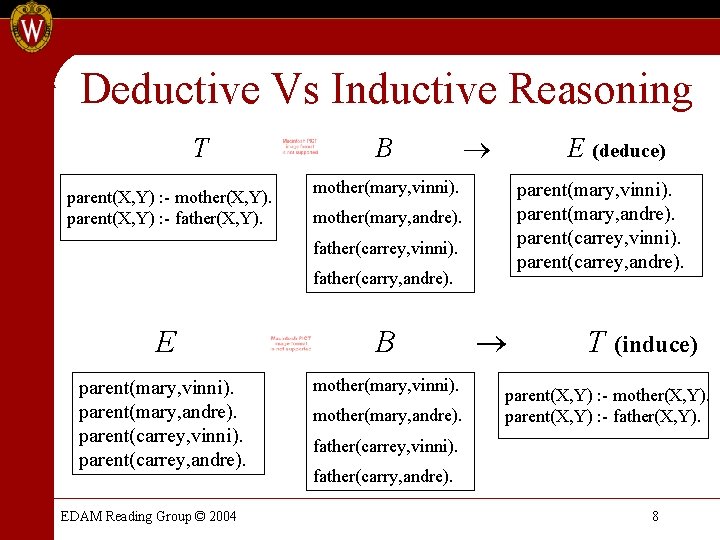
Deductive Vs Inductive Reasoning T parent(X, Y) : - mother(X, Y). parent(X, Y) : - father(X, Y). B E (deduce) mother(mary, vinni). parent(mary, vinni). parent(mary, andre). parent(carrey, vinni). parent(carrey, andre). mother(mary, andre). father(carrey, vinni). father(carry, andre). E B parent(mary, vinni). parent(mary, andre). parent(carrey, vinni). parent(carrey, andre). mother(mary, vinni). EDAM Reading Group © 2004 mother(mary, andre). T (induce) parent(X, Y) : - mother(X, Y). parent(X, Y) : - father(X, Y). father(carrey, vinni). father(carry, andre). 8
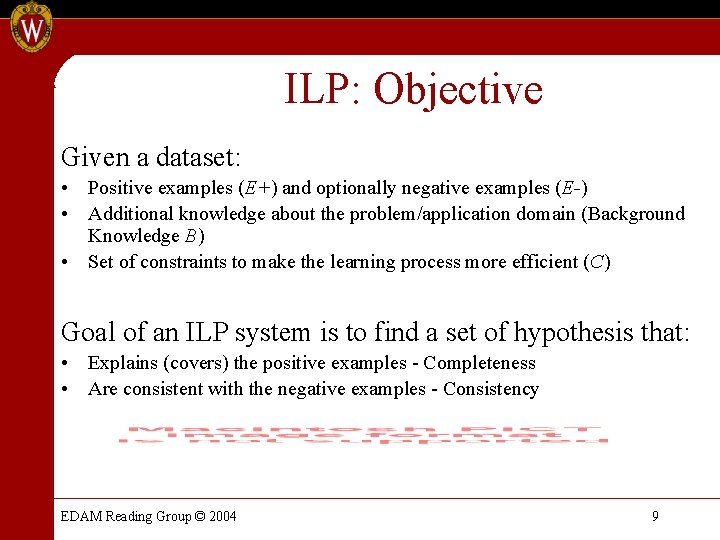
ILP: Objective Given a dataset: • Positive examples (E+) and optionally negative examples (E-) • Additional knowledge about the problem/application domain (Background Knowledge B) • Set of constraints to make the learning process more efficient (C) Goal of an ILP system is to find a set of hypothesis that: • Explains (covers) the positive examples - Completeness • Are consistent with the negative examples - Consistency EDAM Reading Group © 2004 9
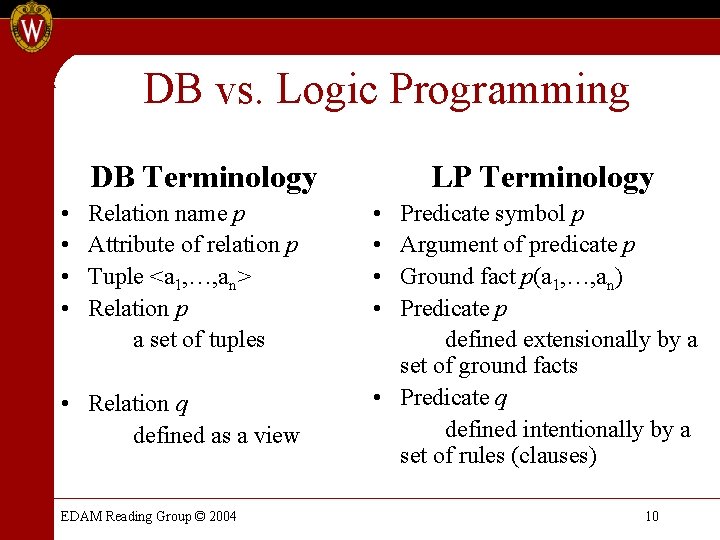
DB vs. Logic Programming DB Terminology • • Relation name p Attribute of relation p Tuple <a 1, …, an> Relation p a set of tuples • Relation q defined as a view EDAM Reading Group © 2004 LP Terminology • • Predicate symbol p Argument of predicate p Ground fact p(a 1, …, an) Predicate p defined extensionally by a set of ground facts • Predicate q defined intentionally by a set of rules (clauses) 10
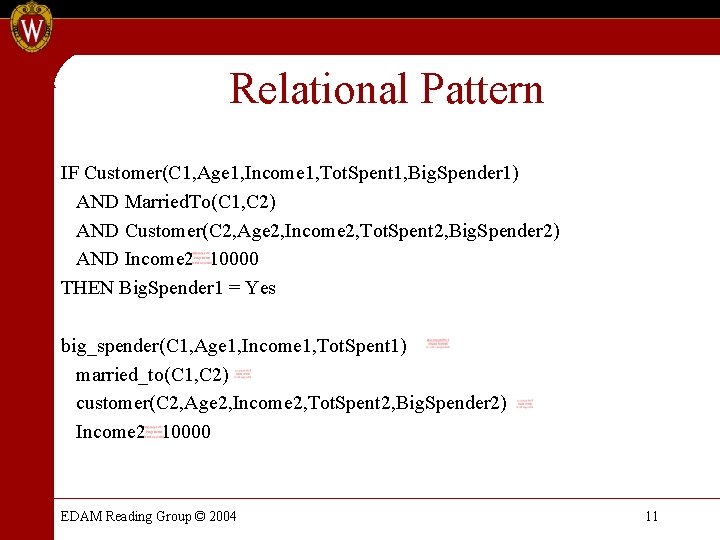
Relational Pattern IF Customer(C 1, Age 1, Income 1, Tot. Spent 1, Big. Spender 1) AND Married. To(C 1, C 2) AND Customer(C 2, Age 2, Income 2, Tot. Spent 2, Big. Spender 2) AND Income 2 10000 THEN Big. Spender 1 = Yes big_spender(C 1, Age 1, Income 1, Tot. Spent 1) married_to(C 1, C 2) customer(C 2, Age 2, Income 2, Tot. Spent 2, Big. Spender 2) Income 2 10000 EDAM Reading Group © 2004 11
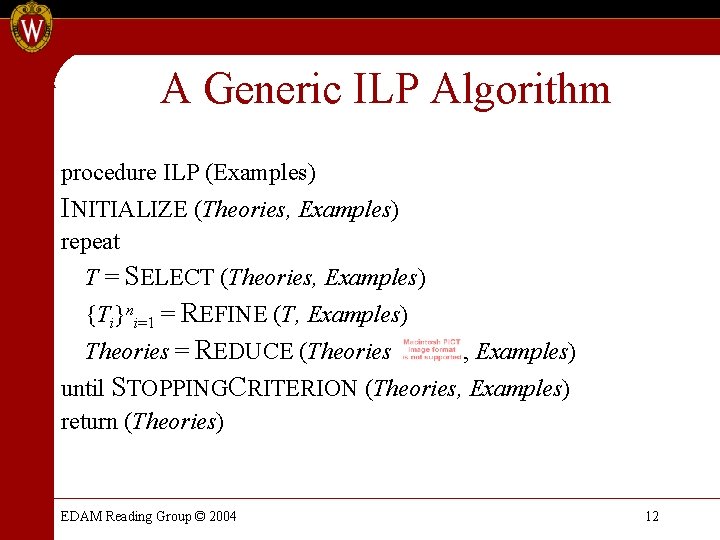
A Generic ILP Algorithm procedure ILP (Examples) INITIALIZE (Theories, Examples) repeat T = SELECT (Theories, Examples) {Ti}ni=1 = REFINE (T, Examples) Theories = REDUCE (Theories Ti, Examples) until STOPPINGCRITERION (Theories, Examples) return (Theories) EDAM Reading Group © 2004 12
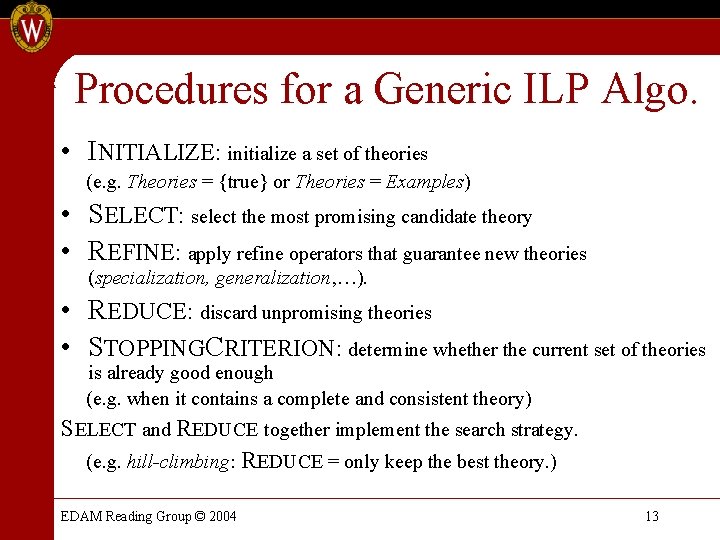
Procedures for a Generic ILP Algo. • INITIALIZE: initialize a set of theories (e. g. Theories = {true} or Theories = Examples) • SELECT: select the most promising candidate theory • REFINE: apply refine operators that guarantee new theories (specialization, generalization, …). • REDUCE: discard unpromising theories • STOPPINGCRITERION: determine whether the current set of theories is already good enough (e. g. when it contains a complete and consistent theory) SELECT and REDUCE together implement the search strategy. (e. g. hill-climbing: REDUCE = only keep the best theory. ) EDAM Reading Group © 2004 13
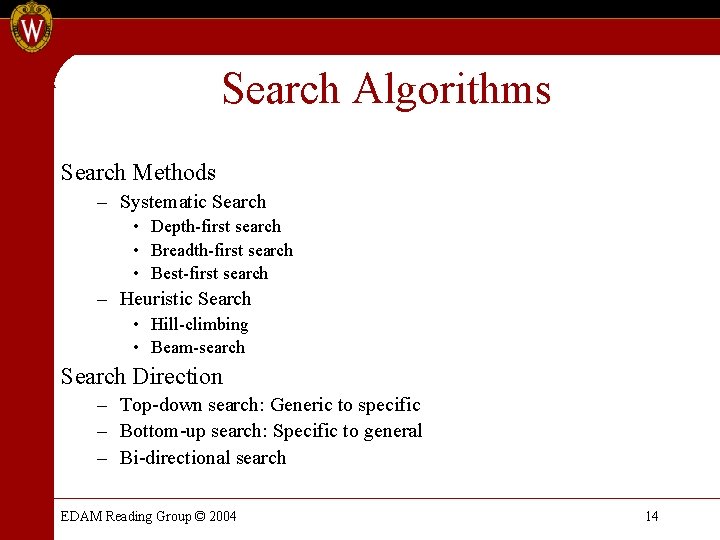
Search Algorithms Search Methods – Systematic Search • Depth-first search • Breadth-first search • Best-first search – Heuristic Search • Hill-climbing • Beam-search Search Direction – Top-down search: Generic to specific – Bottom-up search: Specific to general – Bi-directional search EDAM Reading Group © 2004 14
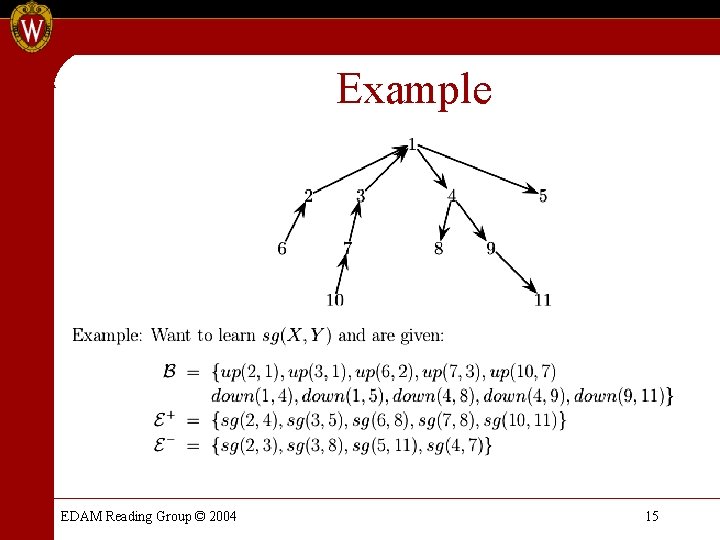
Example EDAM Reading Group © 2004 15
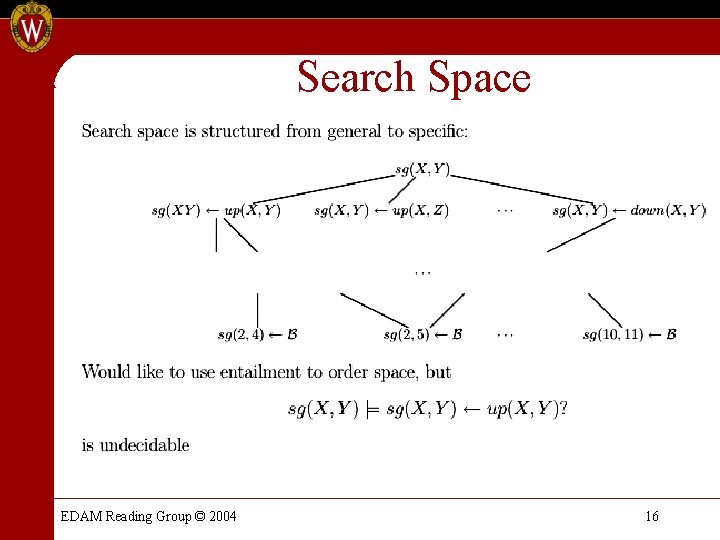
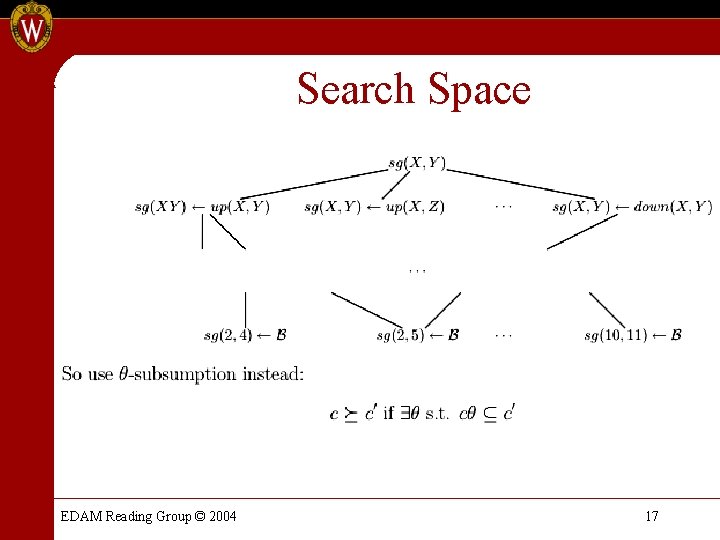
Search Space EDAM Reading Group © 2004 16
Search Space EDAM Reading Group © 2004 17
Search Space as Lattice • Search space is a lattice under -subsumption • There exists a lub and glb for every pair of clauses • lub is ‘least generalization’ • Bottom-up approaches find the lgg of the positive examples EDAM Reading Group © 2004 18
Basics of ILP cont’d • Bottom-up approach of finding clauses leads to long clauses through lgg. • Thus, prefer top-down approach since shorter and more general clauses are learned • Two ways of doing top-down search – FOIL: greedy search using information gain to score – PROGOL: branch-and-bound, using P-N-l to score, uses saturation to restrict search space • Usually, refinement operator is to – Apply substitution – Add literal to body of a clause EDAM Reading Group © 2004 19
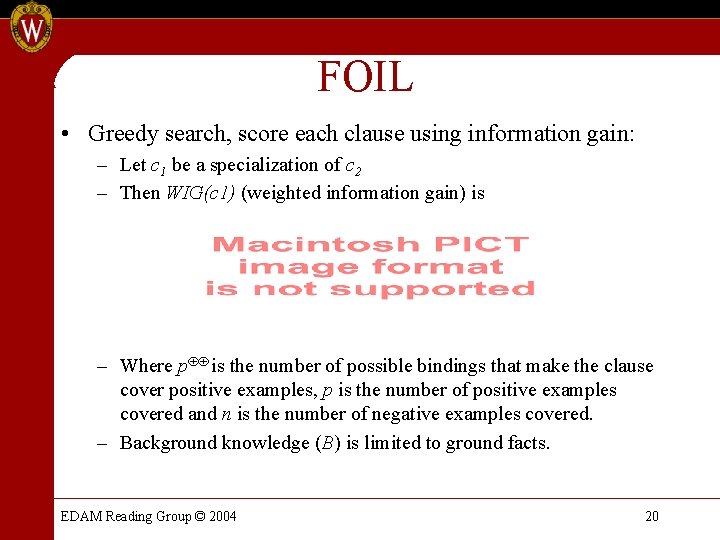
FOIL • Greedy search, score each clause using information gain: – Let c 1 be a specialization of c 2 – Then WIG(c 1) (weighted information gain) is – Where p is the number of possible bindings that make the clause cover positive examples, p is the number of positive examples covered and n is the number of negative examples covered. – Background knowledge (B) is limited to ground facts. EDAM Reading Group © 2004 20
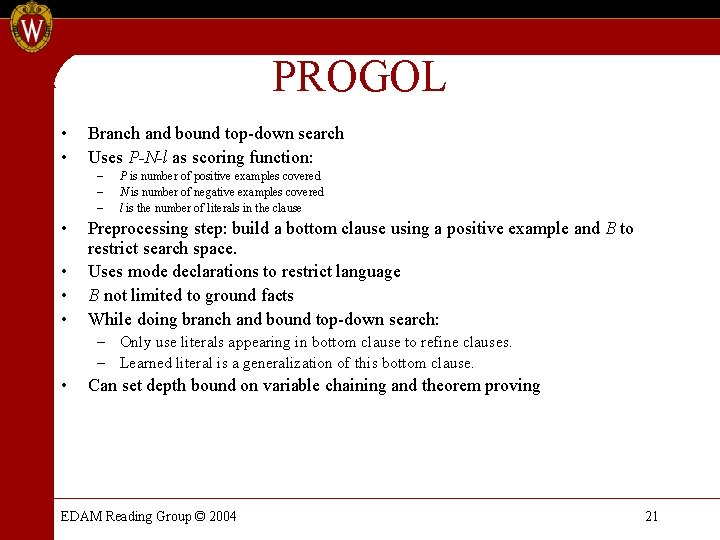
PROGOL • • Branch and bound top-down search Uses P-N-l as scoring function: – – – • • P is number of positive examples covered N is number of negative examples covered l is the number of literals in the clause Preprocessing step: build a bottom clause using a positive example and B to restrict search space. Uses mode declarations to restrict language B not limited to ground facts While doing branch and bound top-down search: – Only use literals appearing in bottom clause to refine clauses. – Learned literal is a generalization of this bottom clause. • Can set depth bound on variable chaining and theorem proving EDAM Reading Group © 2004 21
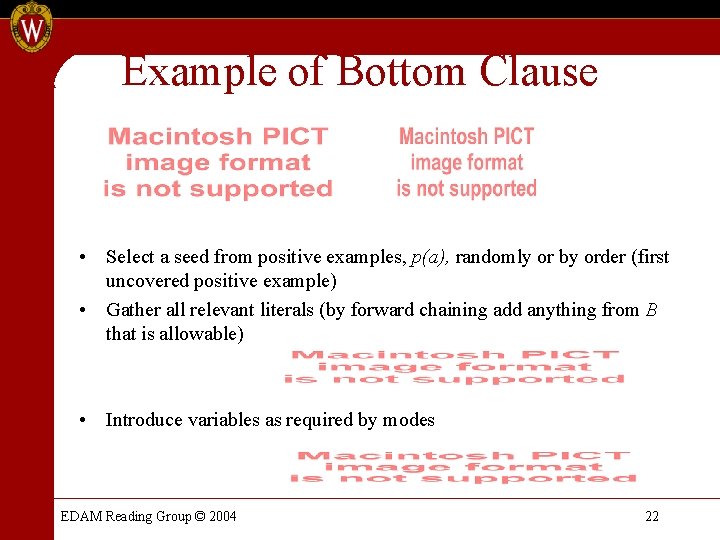
Example of Bottom Clause • Select a seed from positive examples, p(a), randomly or by order (first uncovered positive example) • Gather all relevant literals (by forward chaining add anything from B that is allowable) • Introduce variables as required by modes EDAM Reading Group © 2004 22
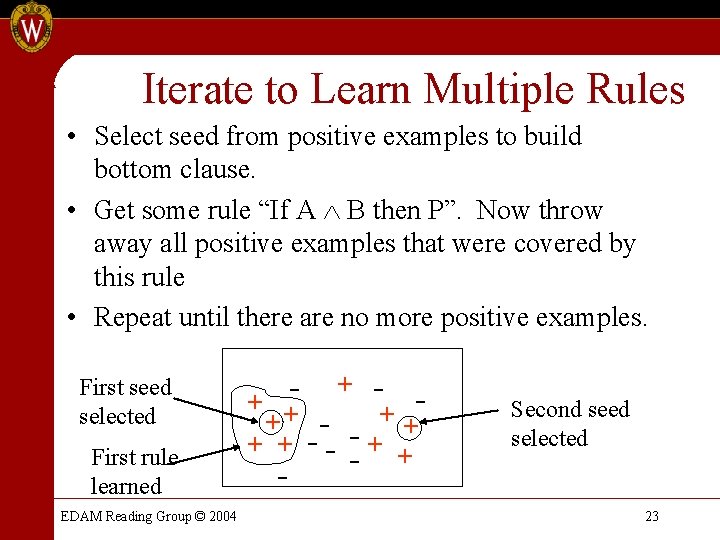
Iterate to Learn Multiple Rules • Select seed from positive examples to build bottom clause. • Get some rule “If A B then P”. Now throw away all positive examples that were covered by this rule • Repeat until there are no more positive examples. First seed selected First rule learned EDAM Reading Group © 2004 + + + -- + + Second seed selected - 23
From Last Time • Why ILP is not just Decision Trees. – Language is First-Order Logic • Natural representation for multi-relational settings • Thus, a natural representation for full databases – Not restricted to the classification task. – So then, what is ILP? EDAM Reading Group © 2004 24
What is ILP? (An obscene generalization) • A way to search the space of First-Order clauses. – With restrictions of course – -subsumption and search space ordering – Refinement operators: • Applying substitutions • Adding literals • Chaining variables EDAM Reading Group © 2004 25
More From Last Time • Evaluation of hypothesis requires finding substitutions for each example. – This requires a call to PROLOG for each example – For PROGOL only one substitution required – For FOIL all substitutions are required (recall the p in scoring function) EDAM Reading Group © 2004 26
An Example: MIDOS • A system for finding statistically-interesting subgroups – Given a population and its distribution over some class – Find subsets of the population for which the distribution over this class is significantly different (an example) – Uses ILP-like search for definitions of subgroups EDAM Reading Group © 2004 27
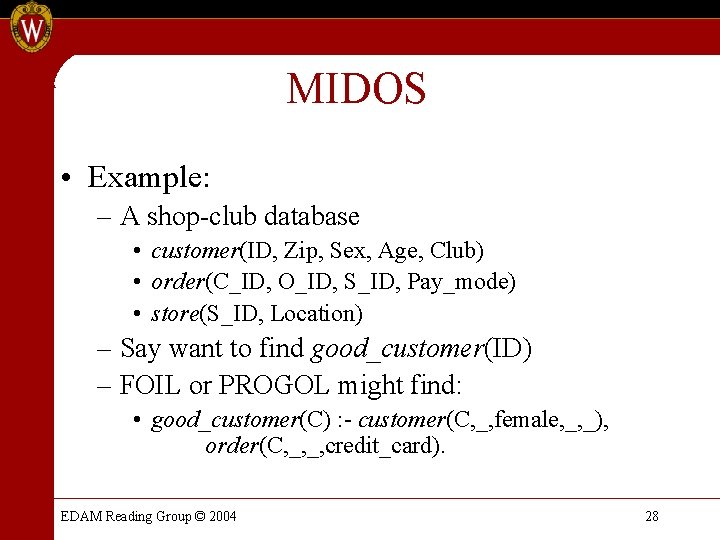
MIDOS • Example: – A shop-club database • customer(ID, Zip, Sex, Age, Club) • order(C_ID, O_ID, S_ID, Pay_mode) • store(S_ID, Location) – Say want to find good_customer(ID) – FOIL or PROGOL might find: • good_customer(C) : - customer(C, _, female, _, _), order(C, _, _, credit_card). EDAM Reading Group © 2004 28
MIDOS • Instead, let’s find a subset of customers that contain an interesting amount of members – Target: [member, non_member] – Reference Distribution: <66. 1%, 33. 9%> 1371 total – customer(C, _, female, _, _), order(C, _, _, credit_card). Distribution: <69. 9%, 30. 1%> 478 total 1. 54 %% EDAM Reading Group © 2004 29
MIDOS • How-to: – Build a clause in an ILP fashion – Refinement operators: • Apply a substitution (to a constant, for example) • Add a literal (uses given foreign link relationships) – Use a score for ‘statistical interest’ – Do a beam search EDAM Reading Group © 2004 30
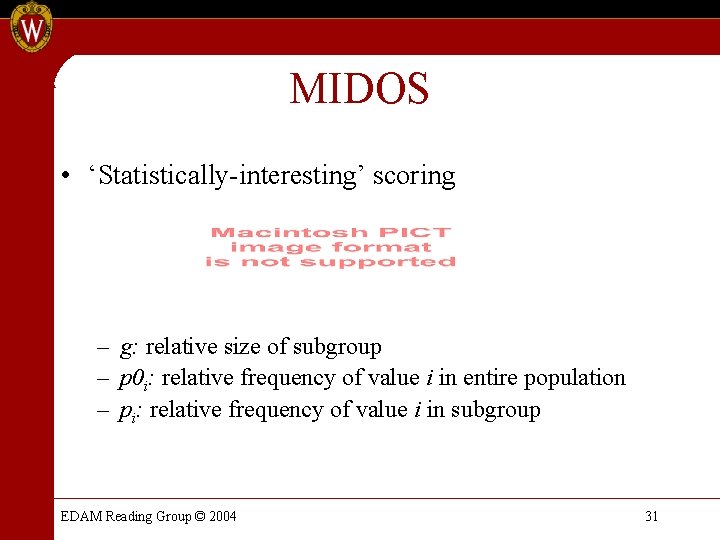
MIDOS • ‘Statistically-interesting’ scoring – g: relative size of subgroup – p 0 i: relative frequency of value i in entire population – pi: relative frequency of value i in subgroup EDAM Reading Group © 2004 31
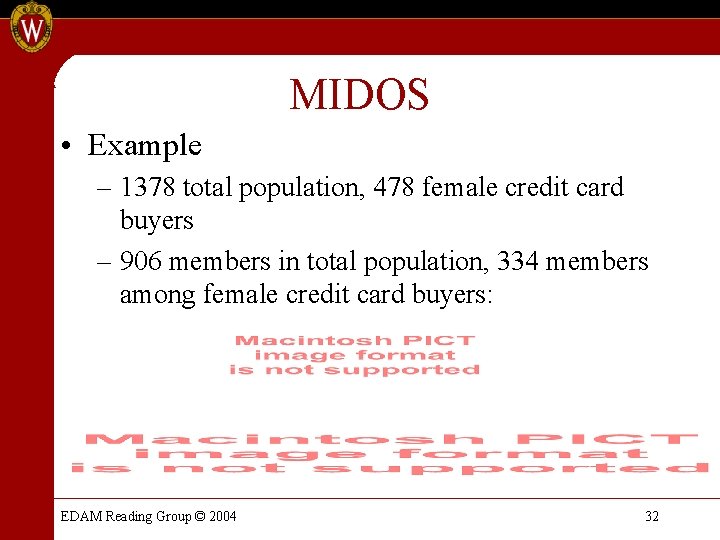
MIDOS • Example – 1378 total population, 478 female credit card buyers – 906 members in total population, 334 members among female credit card buyers: EDAM Reading Group © 2004 32
Scaling in Data Mining • Scaling to large datasets – Increasing number of training examples • Scaling to size of the examples – Increasing number of ground facts in background knowledge [Tang, Mooney, Melville, UT Austin, MRDM (SIGKDD) 2003. ] EDAM Reading Group © 2004 33
BETHE • Addresses scaling to number of ground facts in background knowledge • Problem: PROGOL bottom-clause is too big – This makes search space too big • Solution: don’t build a bottom clause – Use FOIL-like search, BUT – Guide search using some seed example EDAM Reading Group © 2004 34
Efficiency Issues • • • Representational Aspects Search Evaluation Sharing computations Memory-wise scalability EDAM Reading Group © 2004 35
Representational Aspects • Example: – Student(string sname, string major, string minor) – Course(string cname, string prof, string cred) – Enrolled(string sname, string cname) • In a natural join of these tables there is a one-to-one correspondance between join result and the Enrolled table • Data mining tasks on the Enrolled table are really propositional • MRDM is overkill EDAM Reading Group © 2004 36
Representational Aspects • Three settings for data mining: – Find patterns within individuals represented as tuples (single table, propositional) • eg. Which minor is chosen with what major – Find patterns within individuals represented as sets of tuples (each individual ‘induces’ a sub-database) • Multiple tables, restricted to some individual • eg. Student X taking course A, usually takes course B – Find patters within whole database • Mutliple tables • eg. Course taken by student A are also taken by student B EDAM Reading Group © 2004 37
Search • Space restriction – Bottom clauses as seen above • Syntactical biases and typed logic – Modes as seen above. – Can add types to variables to further restrict language • Search biases and pruning rules – PROGOL’s bound (relies on anti-monotonicity of coverage) • Stochastic search EDAM Reading Group © 2004 38
Evaluation • Evaluating a clause: get some measure of coverage – Match each example to the clause: • Run multiple logical queries. – Query optimization methods from DB community • Rel. Algebra operator reordering • BUT: queries for DB are set oriented (bottom-up), queries in PROLOG find a single solution (topdown). EDAM Reading Group © 2004 39
Evaluation • More options – k-locality, given some bindings, literals in a clause become independent: • eg. ? - p(X, Y), q(Y, Z), r(Y, U). • Given a binding for Y, proofs of q and r are independent • So, find only one solution for q, if no solution found for r no need to backtrack. – Relax -subsumption using stochastic estimates • Sample space of substitutions and decide on subsumption based on this sample EDAM Reading Group © 2004 40
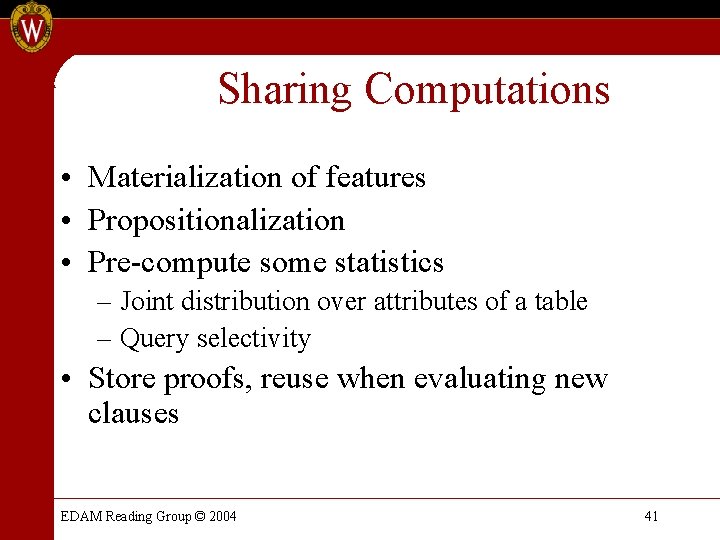
Sharing Computations • Materialization of features • Propositionalization • Pre-compute some statistics – Joint distribution over attributes of a table – Query selectivity • Store proofs, reuse when evaluating new clauses EDAM Reading Group © 2004 41
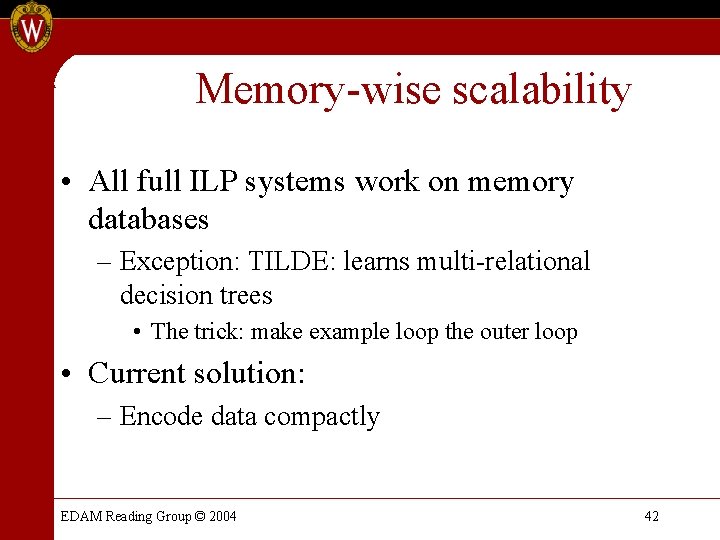
Memory-wise scalability • All full ILP systems work on memory databases – Exception: TILDE: learns multi-relational decision trees • The trick: make example loop the outer loop • Current solution: – Encode data compactly EDAM Reading Group © 2004 42
References • Dzeroski and Lavrac, Relational Data Mining, Springer, 2001. • David Page, ILP: Just Do It, ILP 2000. • Tang, Mooney, Melville, Scaling Up ILP to Large Examples: Results on Link Discovery for Counter Terrorism, MRDM 2003. • Blockeel, Sebag: Scalability and efficiency in multirelational data mining. SIGKDD Explorations 5(1) July 2003 EDAM Reading Group © 2004 43