
Induction Sections 5 1 and 5 2 of
- Slides: 37
Induction Sections 5. 1 and 5. 2 of Rosen 7 th Edition Spring 2019 CSCE 235 H Introduction to Discrete Structures (Honors) Course web-page: cse. unl. edu/~cse 235 h Questions: Piazza
Outline • Motivation • What is induction? – Viewed as: the Well-Ordering Principle, Universal Generalization – Formal Statement – 6 Examples • Strong Induction – Definition – Examples: decomposition into product of primes, gcd CSCE 235 Induction 2
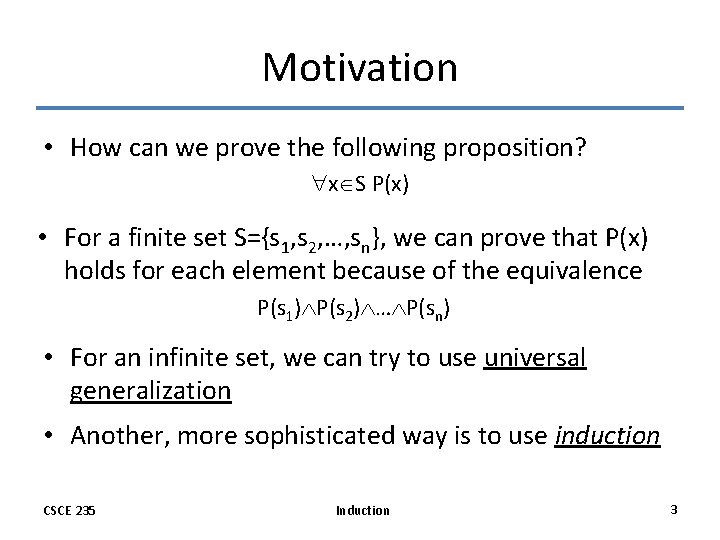
Motivation • How can we prove the following proposition? x S P(x) • For a finite set S={s 1, s 2, …, sn}, we can prove that P(x) holds for each element because of the equivalence P(s 1) P(s 2) … P(sn) • For an infinite set, we can try to use universal generalization • Another, more sophisticated way is to use induction CSCE 235 Induction 3
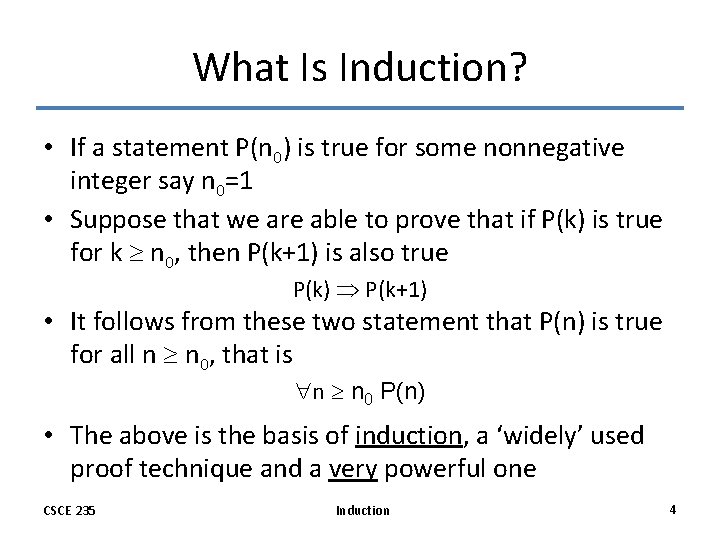
What Is Induction? • If a statement P(n 0) is true for some nonnegative integer say n 0=1 • Suppose that we are able to prove that if P(k) is true for k n 0, then P(k+1) is also true P(k) P(k+1) • It follows from these two statement that P(n) is true for all n n 0, that is n n 0 P(n) • The above is the basis of induction, a ‘widely’ used proof technique and a very powerful one CSCE 235 Induction 4
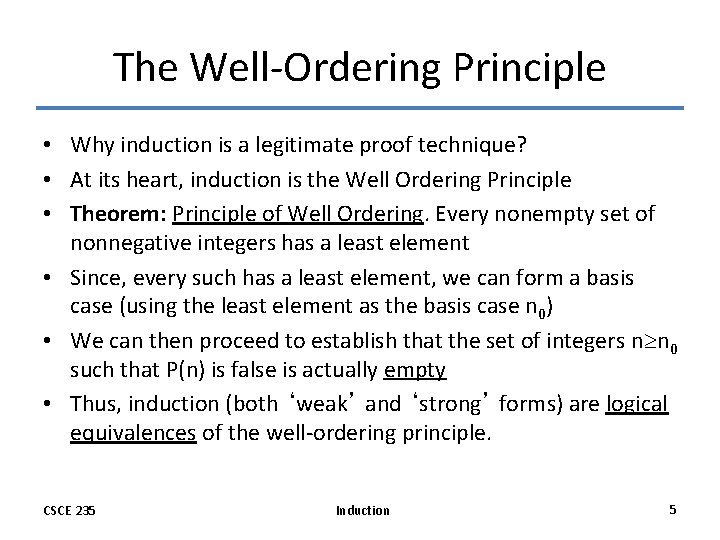
The Well-Ordering Principle • Why induction is a legitimate proof technique? • At its heart, induction is the Well Ordering Principle • Theorem: Principle of Well Ordering. Every nonempty set of nonnegative integers has a least element • Since, every such has a least element, we can form a basis case (using the least element as the basis case n 0) • We can then proceed to establish that the set of integers n n 0 such that P(n) is false is actually empty • Thus, induction (both ‘weak’ and ‘strong’ forms) are logical equivalences of the well-ordering principle. CSCE 235 Induction 5
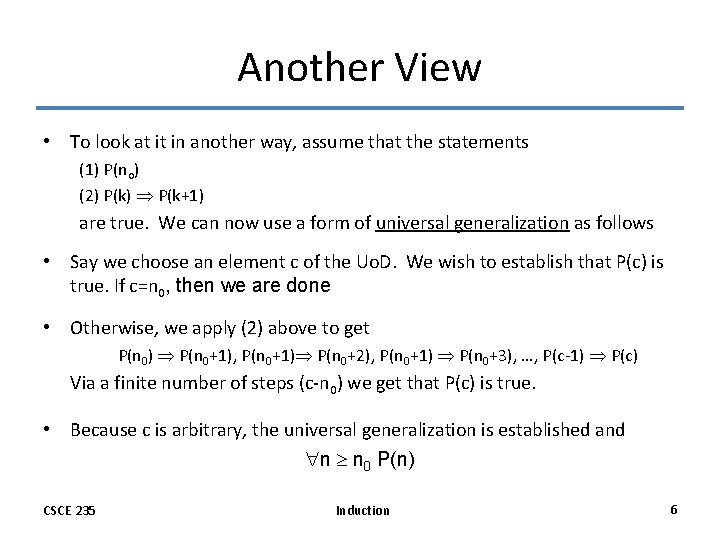
Another View • To look at it in another way, assume that the statements (1) P(no) (2) P(k) P(k+1) are true. We can now use a form of universal generalization as follows • Say we choose an element c of the Uo. D. We wish to establish that P(c) is true. If c=n 0, then we are done • Otherwise, we apply (2) above to get P(n 0) P(n 0+1), P(n 0+1) P(n 0+2), P(n 0+1) P(n 0+3), …, P(c-1) P(c) Via a finite number of steps (c-n 0) we get that P(c) is true. • Because c is arbitrary, the universal generalization is established and n n 0 P(n) CSCE 235 Induction 6
Outline • Motivation • What is induction? – Viewed as: the Well-Ordering Principle, Universal Generalization – Formal Statement – 6 Examples • Strong Induction – Definition – Examples: decomposition into product of primes, gcd CSCE 235 Induction 7
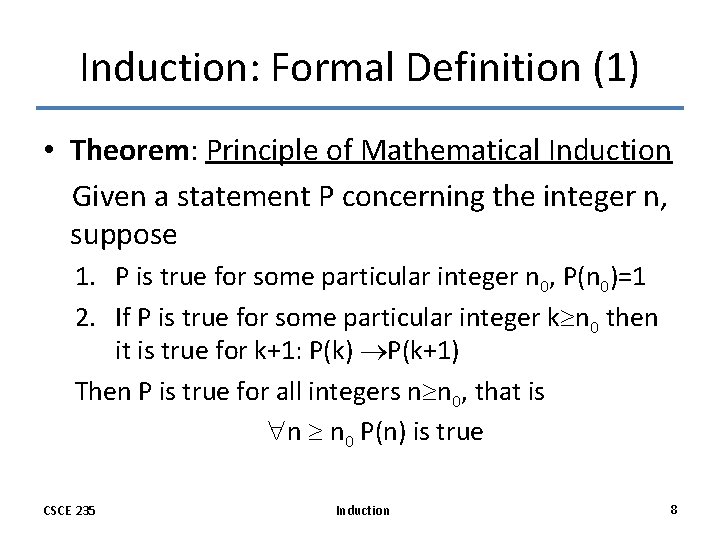
Induction: Formal Definition (1) • Theorem: Principle of Mathematical Induction Given a statement P concerning the integer n, suppose 1. P is true for some particular integer n 0, P(n 0)=1 2. If P is true for some particular integer k n 0 then it is true for k+1: P(k) P(k+1) Then P is true for all integers n n 0, that is n n 0 P(n) is true CSCE 235 Induction 8
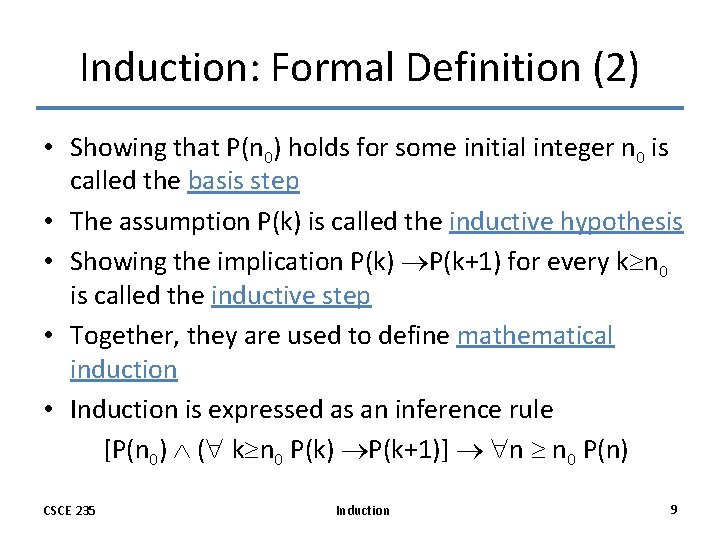
Induction: Formal Definition (2) • Showing that P(n 0) holds for some initial integer n 0 is called the basis step • The assumption P(k) is called the inductive hypothesis • Showing the implication P(k) P(k+1) for every k n 0 is called the inductive step • Together, they are used to define mathematical induction • Induction is expressed as an inference rule [P(n 0) ( k n 0 P(k) P(k+1)] n n 0 P(n) CSCE 235 Induction 9
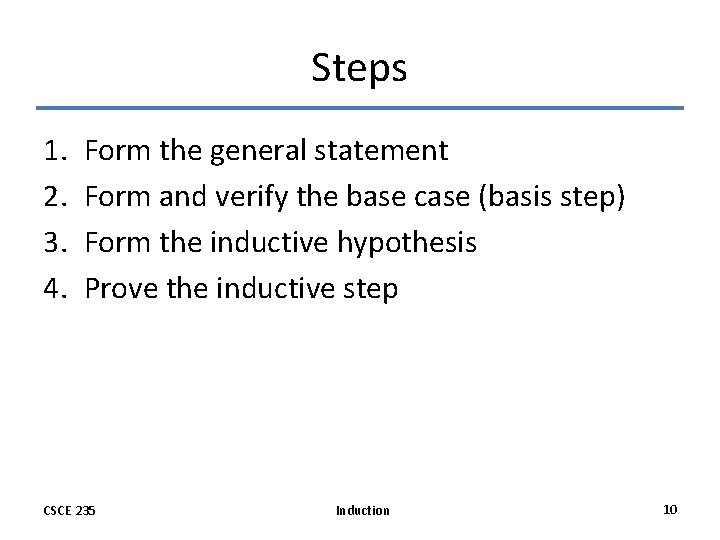
Steps 1. 2. 3. 4. Form the general statement Form and verify the base case (basis step) Form the inductive hypothesis Prove the inductive step CSCE 235 Induction 10
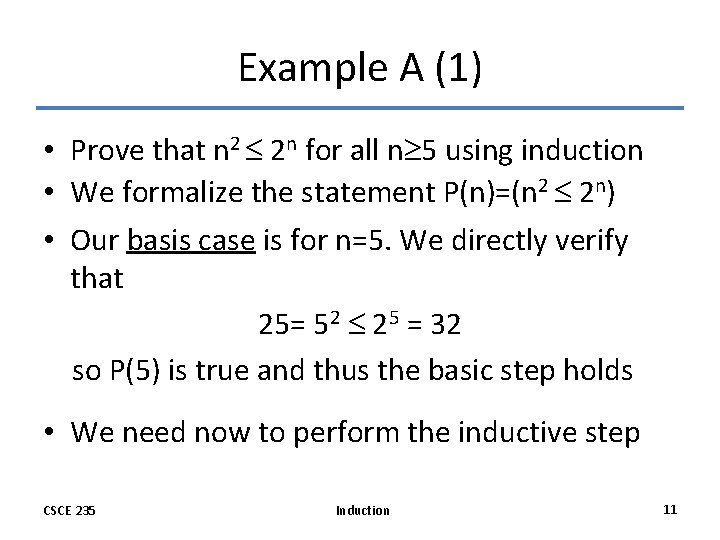
Example A (1) • Prove that n 2 2 n for all n 5 using induction • We formalize the statement P(n)=(n 2 2 n) • Our basis case is for n=5. We directly verify that 25= 52 25 = 32 so P(5) is true and thus the basic step holds • We need now to perform the inductive step CSCE 235 Induction 11
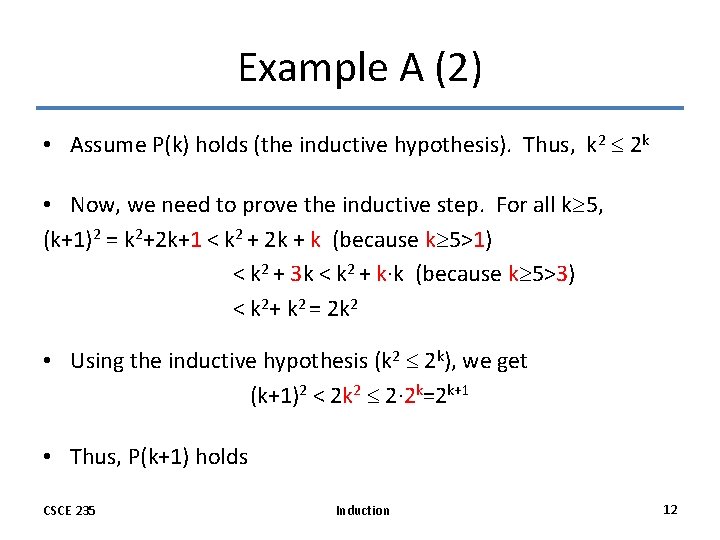
Example A (2) • Assume P(k) holds (the inductive hypothesis). Thus, k 2 2 k • Now, we need to prove the inductive step. For all k 5, (k+1)2 = k 2+2 k+1 < k 2 + 2 k + k (because k 5>1) < k 2 + 3 k < k 2 + k∙k (because k 5>3) < k 2+ k 2 = 2 k 2 • Using the inductive hypothesis (k 2 2 k), we get (k+1)2 < 2 k 2 2∙ 2 k=2 k+1 • Thus, P(k+1) holds CSCE 235 Induction 12
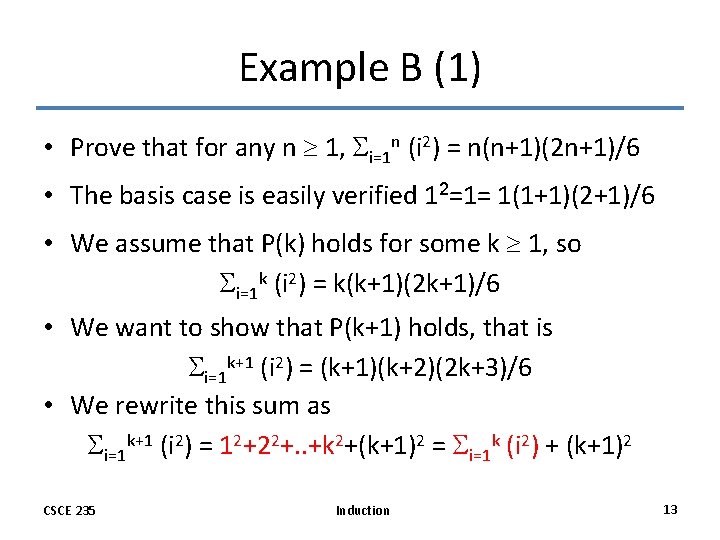
Example B (1) • Prove that for any n 1, i=1 n (i 2) = n(n+1)(2 n+1)/6 • The basis case is easily verified 12=1= 1(1+1)(2+1)/6 • We assume that P(k) holds for some k 1, so i=1 k (i 2) = k(k+1)(2 k+1)/6 • We want to show that P(k+1) holds, that is i=1 k+1 (i 2) = (k+1)(k+2)(2 k+3)/6 • We rewrite this sum as i=1 k+1 (i 2) = 12+22+. . +k 2+(k+1)2 = i=1 k (i 2) + (k+1)2 CSCE 235 Induction 13
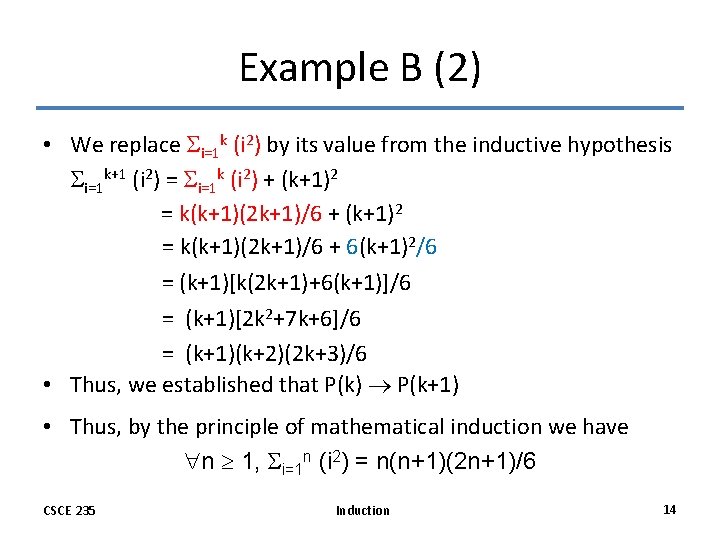
Example B (2) • We replace i=1 k (i 2) by its value from the inductive hypothesis i=1 k+1 (i 2) = i=1 k (i 2) + (k+1)2 = k(k+1)(2 k+1)/6 + 6(k+1)2/6 = (k+1)[k(2 k+1)+6(k+1)]/6 = (k+1)[2 k 2+7 k+6]/6 = (k+1)(k+2)(2 k+3)/6 • Thus, we established that P(k) P(k+1) • Thus, by the principle of mathematical induction we have n 1, i=1 n (i 2) = n(n+1)(2 n+1)/6 CSCE 235 Induction 14
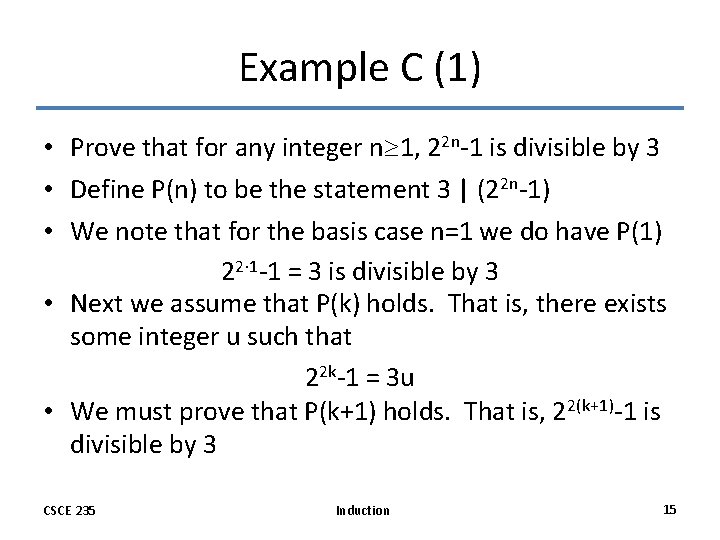
Example C (1) • Prove that for any integer n 1, 22 n-1 is divisible by 3 • Define P(n) to be the statement 3 | (22 n-1) • We note that for the basis case n=1 we do have P(1) 22∙ 1 -1 = 3 is divisible by 3 • Next we assume that P(k) holds. That is, there exists some integer u such that 22 k-1 = 3 u • We must prove that P(k+1) holds. That is, 22(k+1)-1 is divisible by 3 CSCE 235 Induction 15
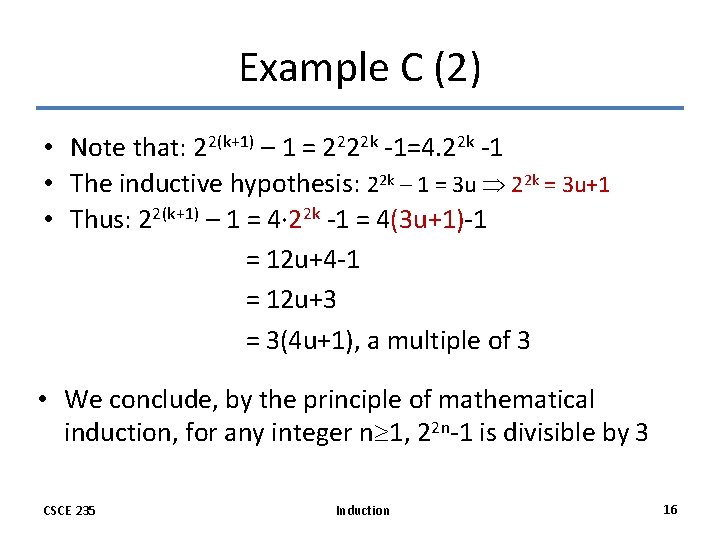
Example C (2) • Note that: 22(k+1) – 1 = 2222 k -1=4. 22 k -1 • The inductive hypothesis: 22 k – 1 = 3 u 22 k = 3 u+1 • Thus: 22(k+1) – 1 = 4∙ 22 k -1 = 4(3 u+1)-1 = 12 u+4 -1 = 12 u+3 = 3(4 u+1), a multiple of 3 • We conclude, by the principle of mathematical induction, for any integer n 1, 22 n-1 is divisible by 3 CSCE 235 Induction 16
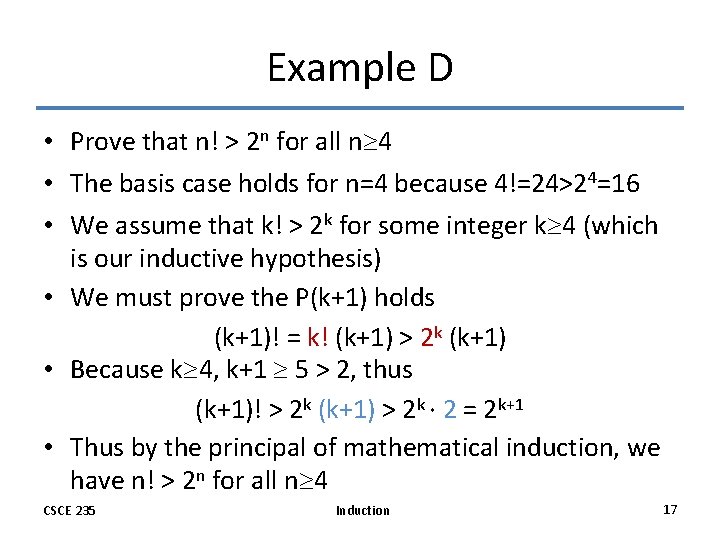
Example D • Prove that n! > 2 n for all n 4 • The basis case holds for n=4 because 4!=24>24=16 • We assume that k! > 2 k for some integer k 4 (which is our inductive hypothesis) • We must prove the P(k+1) holds (k+1)! = k! (k+1) > 2 k (k+1) • Because k 4, k+1 5 > 2, thus (k+1)! > 2 k (k+1) > 2 k ∙ 2 = 2 k+1 • Thus by the principal of mathematical induction, we have n! > 2 n for all n 4 CSCE 235 Induction 17
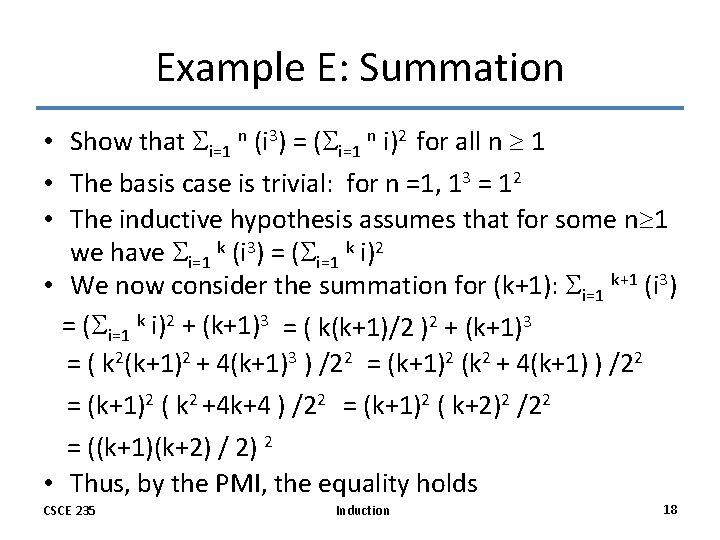
Example E: Summation • Show that i=1 n (i 3) = ( i=1 n i)2 for all n 1 • The basis case is trivial: for n =1, 13 = 12 • The inductive hypothesis assumes that for some n 1 we have i=1 k (i 3) = ( i=1 k i)2 • We now consider the summation for (k+1): i=1 k+1 (i 3) = ( i=1 k i)2 + (k+1)3 = ( k(k+1)/2 )2 + (k+1)3 = ( k 2(k+1)2 + 4(k+1)3 ) /22 = (k+1)2 (k 2 + 4(k+1) ) /22 = (k+1)2 ( k 2 +4 k+4 ) /22 = (k+1)2 ( k+2)2 /22 = ((k+1)(k+2) / 2) 2 • Thus, by the PMI, the equality holds CSCE 235 Induction 18
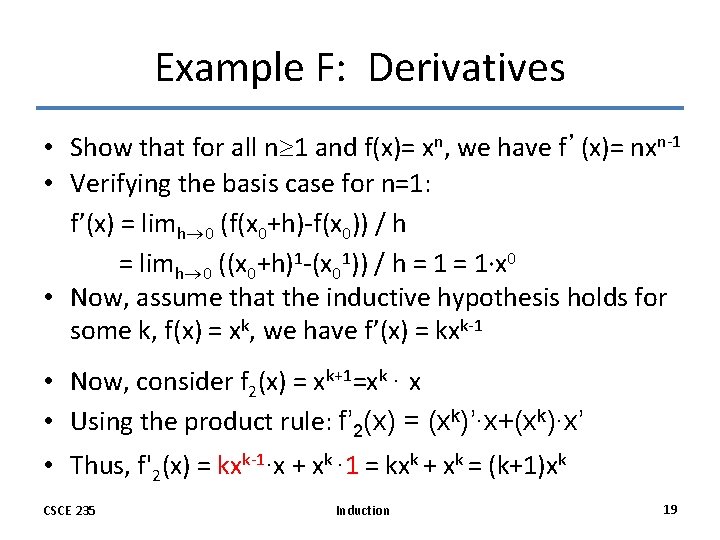
Example F: Derivatives • Show that for all n 1 and f(x)= xn, we have f’(x)= nxn-1 • Verifying the basis case for n=1: f’(x) = limh 0 (f(x 0+h)-f(x 0)) / h = limh 0 ((x 0+h)1 -(x 01)) / h = 1∙x 0 • Now, assume that the inductive hypothesis holds for some k, f(x) = xk, we have f’(x) = kxk-1 • Now, consider f 2(x) = xk+1=xk ∙ x • Using the product rule: f’ 2(x) = (xk)’∙x+(xk)∙x’ • Thus, f'2(x) = kxk-1∙x + xk ∙ 1 = kxk + xk = (k+1)xk CSCE 235 Induction 19
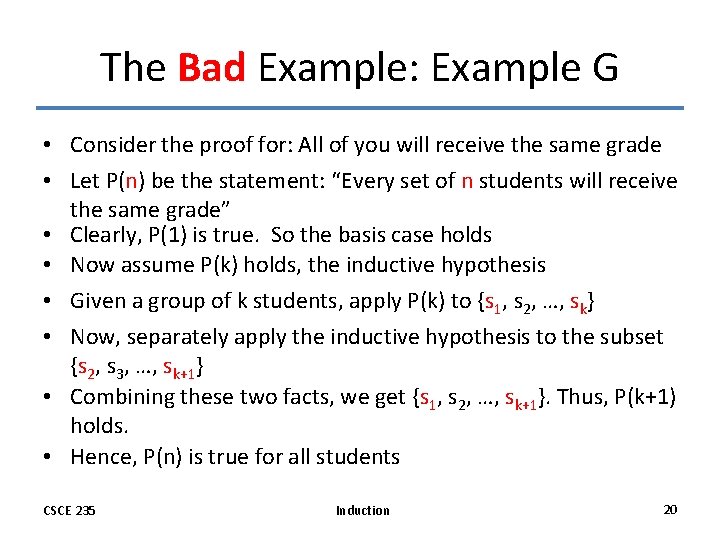
The Bad Example: Example G • Consider the proof for: All of you will receive the same grade • Let P(n) be the statement: “Every set of n students will receive the same grade” • Clearly, P(1) is true. So the basis case holds • Now assume P(k) holds, the inductive hypothesis • Given a group of k students, apply P(k) to {s 1, s 2, …, sk} • Now, separately apply the inductive hypothesis to the subset {s 2, s 3, …, sk+1} • Combining these two facts, we get {s 1, s 2, …, sk+1}. Thus, P(k+1) holds. • Hence, P(n) is true for all students CSCE 235 Induction 20
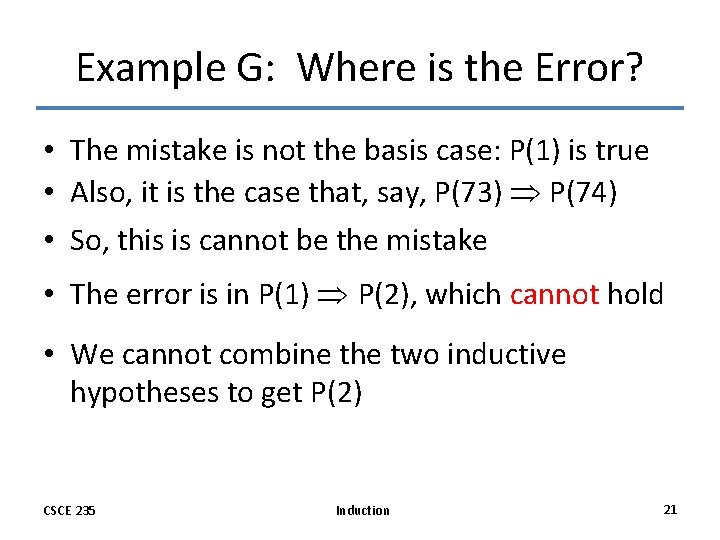
Example G: Where is the Error? • The mistake is not the basis case: P(1) is true • Also, it is the case that, say, P(73) P(74) • So, this is cannot be the mistake • The error is in P(1) P(2), which cannot hold • We cannot combine the two inductive hypotheses to get P(2) CSCE 235 Induction 21
Outline • Motivation • What is induction? – Viewed as: the Well-Ordering Principle, Universal Generalization – Formal Statement – 6 Examples • Strong Induction – Definition – Examples: decomposition into product of primes, gcd CSCE 235 Induction 22
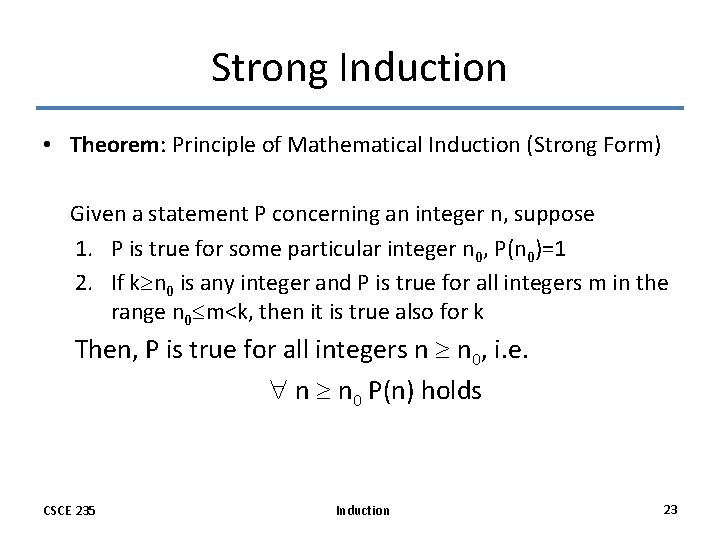
Strong Induction • Theorem: Principle of Mathematical Induction (Strong Form) Given a statement P concerning an integer n, suppose 1. P is true for some particular integer n 0, P(n 0)=1 2. If k n 0 is any integer and P is true for all integers m in the range n 0 m<k, then it is true also for k Then, P is true for all integers n n 0, i. e. n n 0 P(n) holds CSCE 235 Induction 23
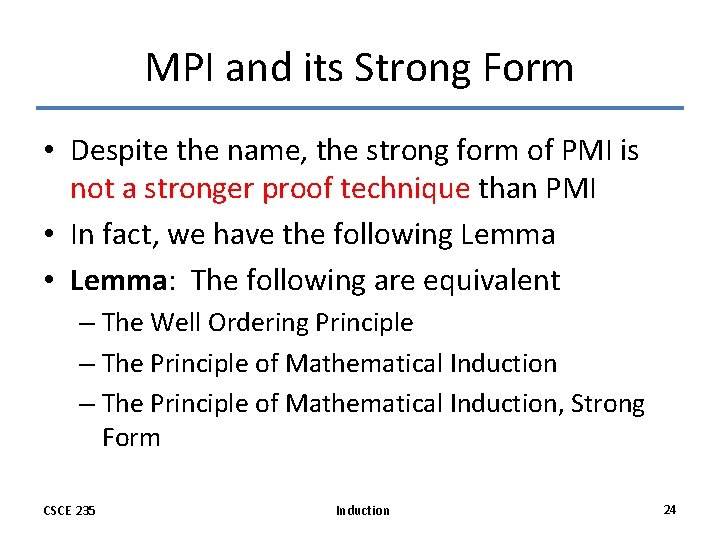
MPI and its Strong Form • Despite the name, the strong form of PMI is not a stronger proof technique than PMI • In fact, we have the following Lemma • Lemma: The following are equivalent – The Well Ordering Principle – The Principle of Mathematical Induction, Strong Form CSCE 235 Induction 24
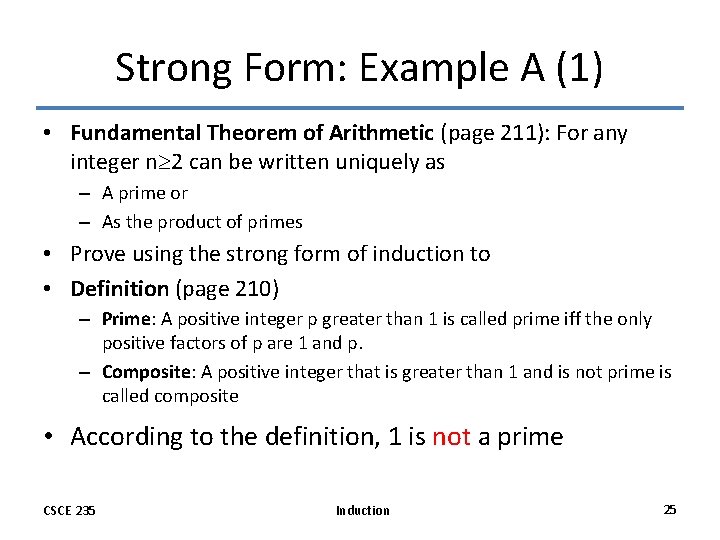
Strong Form: Example A (1) • Fundamental Theorem of Arithmetic (page 211): For any integer n 2 can be written uniquely as – A prime or – As the product of primes • Prove using the strong form of induction to • Definition (page 210) – Prime: A positive integer p greater than 1 is called prime iff the only positive factors of p are 1 and p. – Composite: A positive integer that is greater than 1 and is not prime is called composite • According to the definition, 1 is not a prime CSCE 235 Induction 25
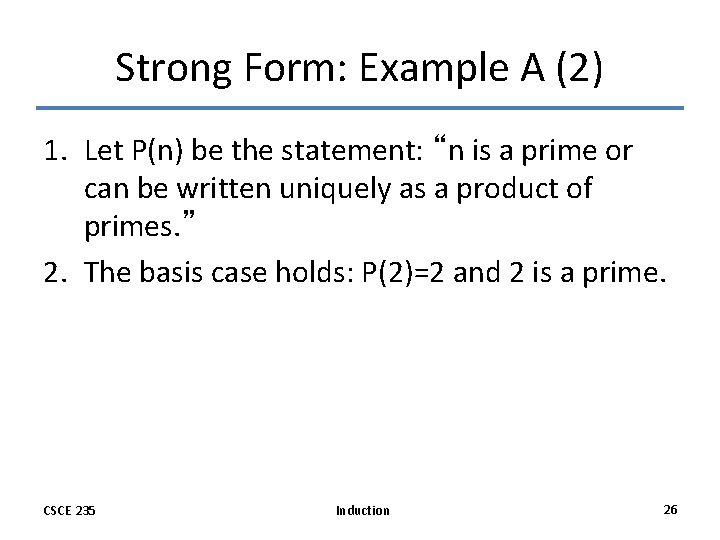
Strong Form: Example A (2) 1. Let P(n) be the statement: “n is a prime or can be written uniquely as a product of primes. ” 2. The basis case holds: P(2)=2 and 2 is a prime. CSCE 235 Induction 26
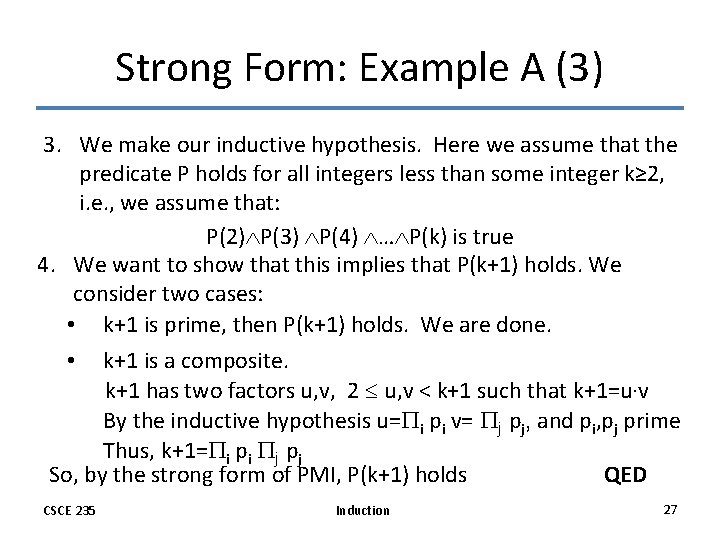
Strong Form: Example A (3) 3. We make our inductive hypothesis. Here we assume that the predicate P holds for all integers less than some integer k≥ 2, i. e. , we assume that: P(2) P(3) P(4) … P(k) is true 4. We want to show that this implies that P(k+1) holds. We consider two cases: • k+1 is prime, then P(k+1) holds. We are done. • k+1 is a composite. k+1 has two factors u, v, 2 u, v < k+1 such that k+1=u∙v By the inductive hypothesis u= i pi v= j pj, and pi, pj prime Thus, k+1= i pi j pj So, by the strong form of PMI, P(k+1) holds QED CSCE 235 Induction 27
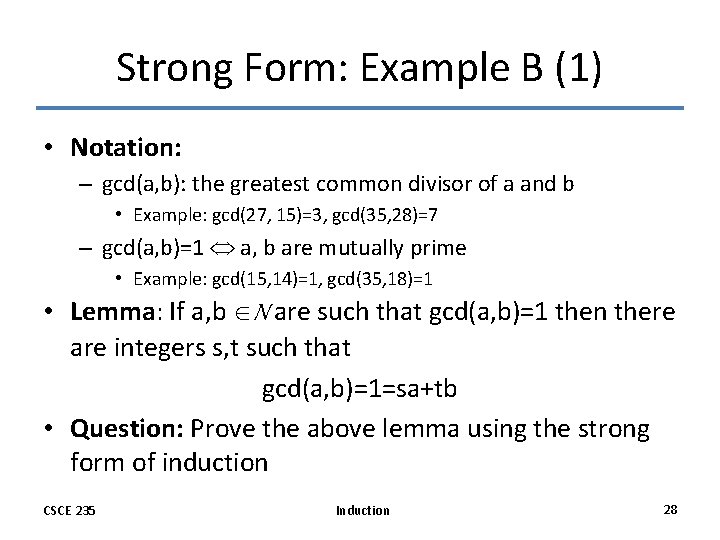
Strong Form: Example B (1) • Notation: – gcd(a, b): the greatest common divisor of a and b • Example: gcd(27, 15)=3, gcd(35, 28)=7 – gcd(a, b)=1 a, b are mutually prime • Example: gcd(15, 14)=1, gcd(35, 18)=1 • Lemma: If a, b N are such that gcd(a, b)=1 then there are integers s, t such that gcd(a, b)=1=sa+tb • Question: Prove the above lemma using the strong form of induction CSCE 235 Induction 28
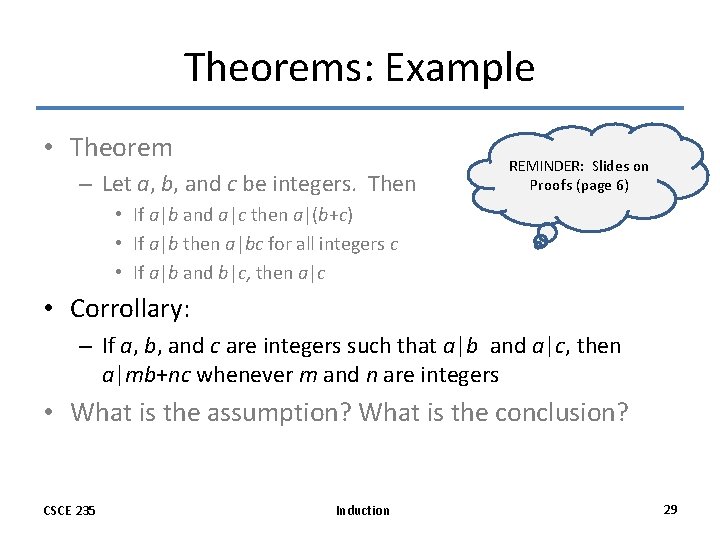
Theorems: Example • Theorem – Let a, b, and c be integers. Then REMINDER: Slides on Proofs (page 6) • If a|b and a|c then a|(b+c) • If a|b then a|bc for all integers c • If a|b and b|c, then a|c • Corrollary: – If a, b, and c are integers such that a|b and a|c, then a|mb+nc whenever m and n are integers • What is the assumption? What is the conclusion? CSCE 235 Induction 29
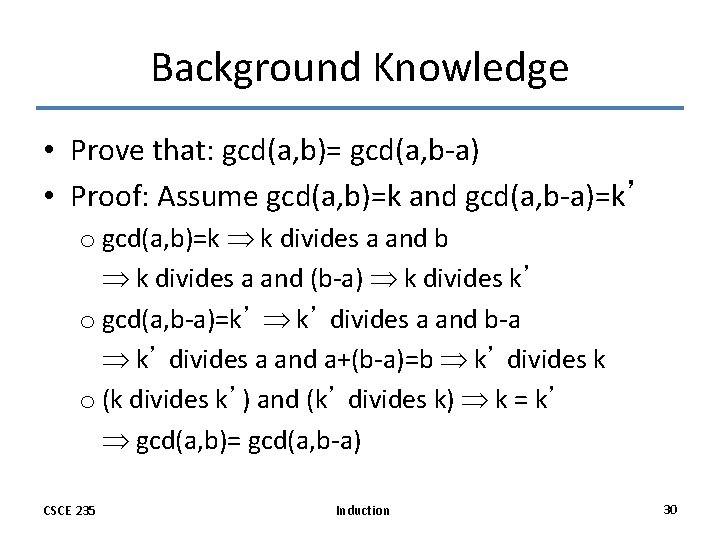
Background Knowledge • Prove that: gcd(a, b)= gcd(a, b-a) • Proof: Assume gcd(a, b)=k and gcd(a, b-a)=k’ o gcd(a, b)=k k divides a and b k divides a and (b-a) k divides k’ o gcd(a, b-a)=k’ k’ divides a and b-a k’ divides a and a+(b-a)=b k’ divides k o (k divides k’) and (k’ divides k) k = k’ gcd(a, b)= gcd(a, b-a) CSCE 235 Induction 30
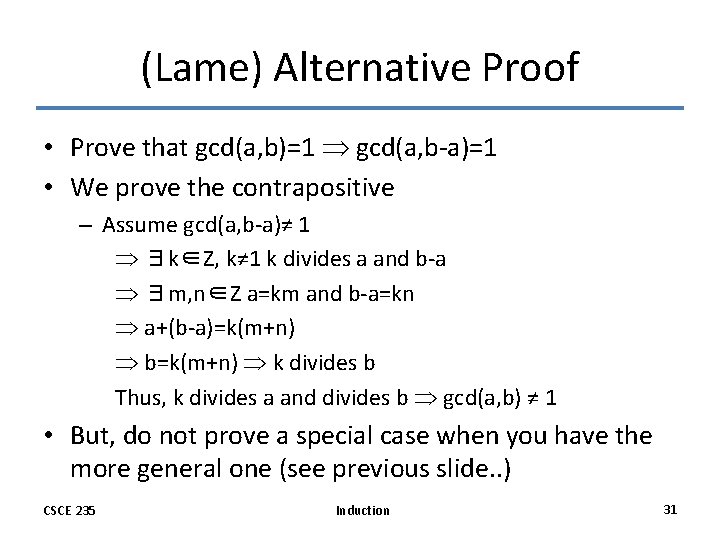
(Lame) Alternative Proof • Prove that gcd(a, b)=1 gcd(a, b-a)=1 • We prove the contrapositive – Assume gcd(a, b-a)≠ 1 ∃k∈Z, k≠ 1 k divides a and b-a ∃m, n∈Z a=km and b-a=kn a+(b-a)=k(m+n) b=k(m+n) k divides b Thus, k divides a and divides b gcd(a, b) ≠ 1 • But, do not prove a special case when you have the more general one (see previous slide. . ) CSCE 235 Induction 31
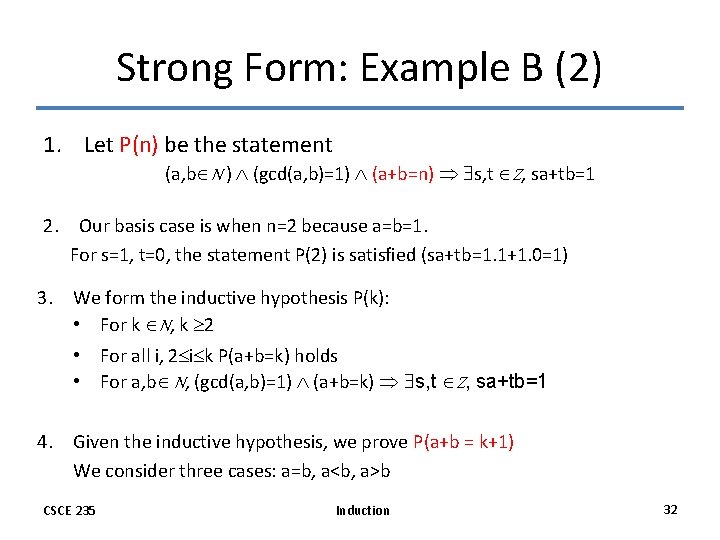
Strong Form: Example B (2) 1. Let P(n) be the statement (a, b N ) (gcd(a, b)=1) (a+b=n) s, t Z, sa+tb=1 2. Our basis case is when n=2 because a=b=1. For s=1, t=0, the statement P(2) is satisfied (sa+tb=1. 1+1. 0=1) 3. We form the inductive hypothesis P(k): • For k N, k 2 • For all i, 2 i k P(a+b=k) holds • For a, b N, (gcd(a, b)=1) (a+b=k) s, t Z, sa+tb=1 4. Given the inductive hypothesis, we prove P(a+b = k+1) We consider three cases: a=b, a<b, a>b CSCE 235 Induction 32
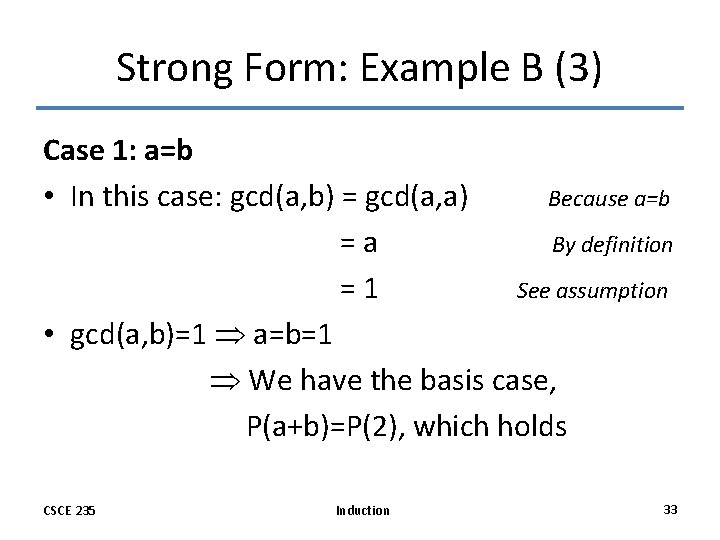
Strong Form: Example B (3) Case 1: a=b • In this case: gcd(a, b) = gcd(a, a) Because a=b =a By definition =1 See assumption • gcd(a, b)=1 a=b=1 We have the basis case, P(a+b)=P(2), which holds CSCE 235 Induction 33
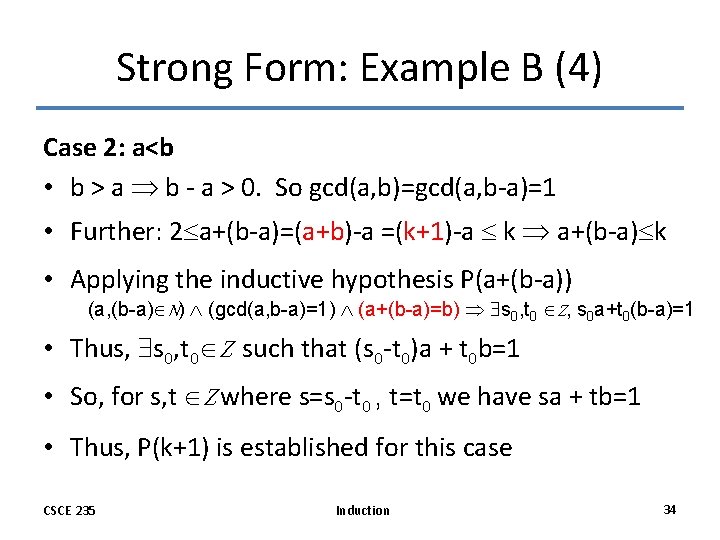
Strong Form: Example B (4) Case 2: a<b • b > a b - a > 0. So gcd(a, b)=gcd(a, b-a)=1 • Further: 2 a+(b-a)=(a+b)-a =(k+1)-a k a+(b-a) k • Applying the inductive hypothesis P(a+(b-a)) (a, (b-a) N) (gcd(a, b-a)=1) (a+(b-a)=b) s 0, t 0 Z, s 0 a+t 0(b-a)=1 • Thus, s 0, t 0 Z such that (s 0 -t 0)a + t 0 b=1 • So, for s, t Z where s=s 0 -t 0 , t=t 0 we have sa + tb=1 • Thus, P(k+1) is established for this case CSCE 235 Induction 34
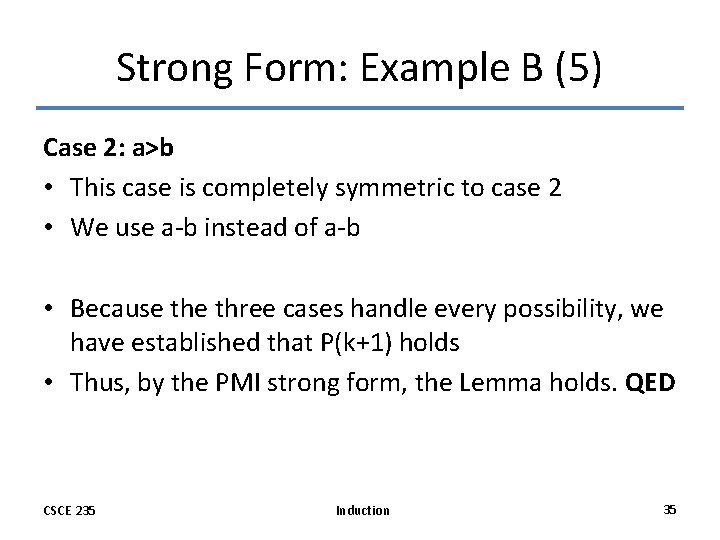
Strong Form: Example B (5) Case 2: a>b • This case is completely symmetric to case 2 • We use a-b instead of a-b • Because three cases handle every possibility, we have established that P(k+1) holds • Thus, by the PMI strong form, the Lemma holds. QED CSCE 235 Induction 35
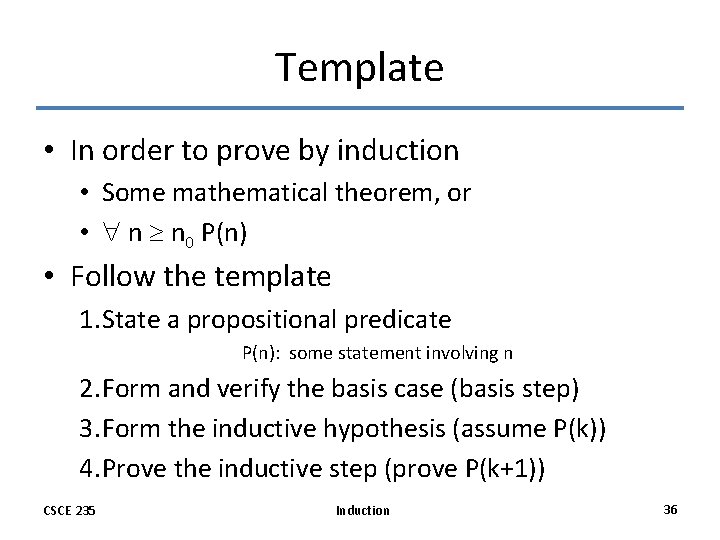
Template • In order to prove by induction • Some mathematical theorem, or • n n 0 P(n) • Follow the template 1. State a propositional predicate P(n): some statement involving n 2. Form and verify the basis case (basis step) 3. Form the inductive hypothesis (assume P(k)) 4. Prove the inductive step (prove P(k+1)) CSCE 235 Induction 36
Summary • Motivation • What is induction? – Viewed as: the Well-Ordering Principle, Universal Generalization – Formal Statement – 6 Examples • Strong Induction – Definition – Examples: decomposition into product of primes, gcd CSCE 235 Induction 37