
Induction of labour Implementing NICE guidance 2 nd
Induction of labour Implementing NICE guidance 2 nd edition – March 2012 NICE clinical guideline 70
Guideline review Guideline issue date: 2008 First review year: 2011 review recommendation • The guideline should not be updated • The guideline will be reviewed again in 2014
What this presentation covers Background Scope Key priorities for implementation Costs and savings Discussion NICE Evidence and NICE Pathway Find out more
Background Induced labour • is a relatively common procedure - around 1 in 5 of deliveries • may be less efficient and more painful • may necessitate further intervention • may increase strain on labour wards

Scope For induction of labour in a hospital-based maternity unit setting, this guideline covers: · clinical indications, methods and timing · the care and information women should be offered · management of complications such as failed induction
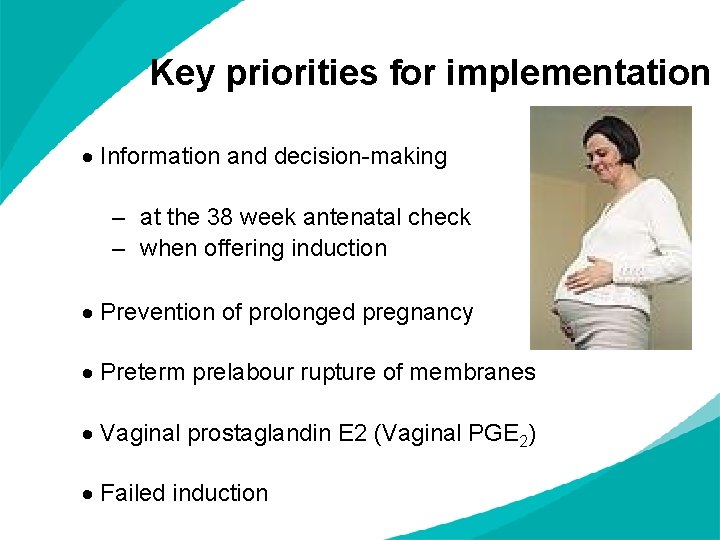
Key priorities for implementation · Information and decision-making – at the 38 week antenatal check – when offering induction · Prevention of prolonged pregnancy · Preterm prelabour rupture of membranes · Vaginal prostaglandin E 2 (Vaginal PGE 2) · Failed induction
At the 38 week antenatal check Tell women that most people will go into labour spontaneously by 42 weeks. Offer all women information about the risks associated with pregnancies that last longer than 42 weeks, and their options.
When offering induction Tell women: · the reasons for induction being offered · when, where and how it could be carried out · arrangements for support and pain relief · alternative options · risks, benefits and methods of induction · that it may not work, and subsequent options
Prevention of prolonged pregnancy Women with uncomplicated pregnancies should usually be offered induction of labour between 41 and 42 weeks taking into account the woman’s preferences and local circumstances. When a vaginal examination is carried out to assess the cervix, the opportunity should be taken to offer the woman a membrane sweep.
Preterm prelabour rupture of membranes If this occurs after 34 weeks, the maternity team should discuss with the woman: · the risks to her and her baby · local availability of facilities before a decision is made about whether to induce labour, using vaginal PGE 2.
Vaginal PGE 2 is the preferred method of induction of labour, unless there are specific clinical reasons for not using it. It should be administered as gel, tablet or controlledrelease pessary. Costs may vary over time, and trusts/units should take this into consideration when prescribing vaginal PGE 2.

Failed induction: 1 If induction fails, healthcare professionals should discuss this with the woman and provide support. The woman’s condition and the pregnancy in general should be fully reassessed. Fetal wellbeing should be assessed using electronic fetal monitoring.

Failed induction: 2 The subsequent management options include: · a further attempt to induce labour (the timing should depend on the clinical situation and the woman’s wishes) · caesarean section
Costs and savings The guideline on induction of labour is unlikely to result in a significant change in resource use in the NHS Correct at 2008 Costs and savings have not been updated for the 2 nd edition
Discussion What changes are needed to our appointment scheduling to allow enough time to offer the recommended information to women? How can we improve women’s experience of induction of labour? What changes to shift patterns and booking appointments could we make to offer morning inductions?
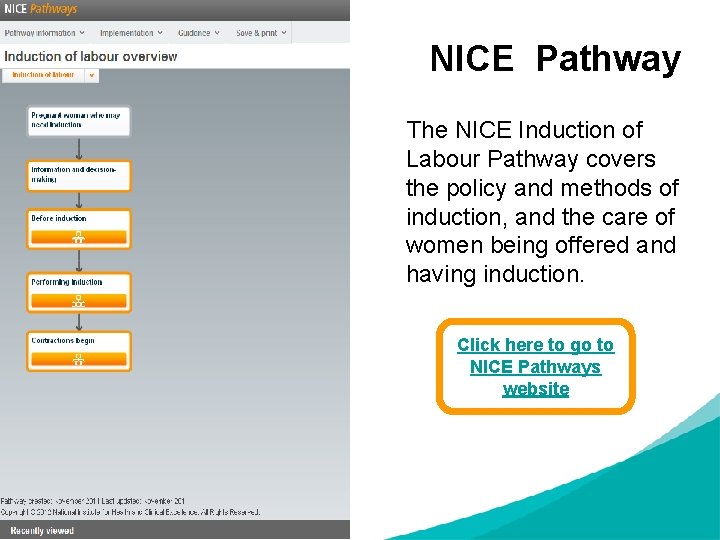
NICE Pathway The NICE Induction of Labour Pathway covers the policy and methods of induction, and the care of women being offered and having induction. Click here to go to NICE Pathways website
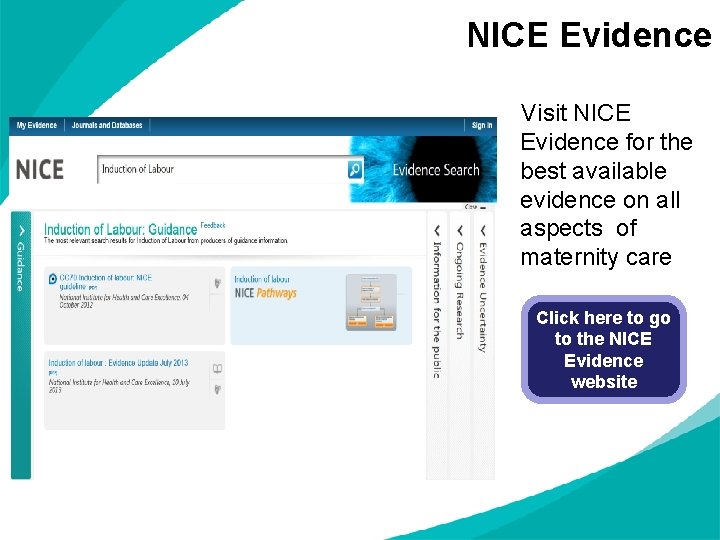
NICE Evidence Visit NICE Evidence for the best available evidence on all aspects of maternity care Click here to go to the NICE Evidence website
Quality standard • In 2014 NICE published a quality standard on induction of labour. This quality standard covers the induction of labour in hospital outpatient or inpatient settings. • The quality standard consists of 3 quality statements and can be found at: http: //www. nice. org. uk/guidance/qualitystandards/qual itystandards. jsp
Find out more Visit www. nice. org. uk/CG 70 for: • • • the guideline the quick reference guide ‘Understanding NICE guidance’ costing statement audit support questionnaire for women
What do you think? Did the implementation tool you accessed today meet your requirements, and will it help you to put the NICE guidance into practice? We value your opinion and are looking for ways to improve our tools. Please complete this short evaluation form. If you are experiencing problems accessing or using this tool, please email implementation@nice. org. uk To open the links in this slide set right click over the link and choose ‘open link’
- Slides: 20