
Induction of Decision Trees by Ross Quinlan Papers
“Induction of Decision Trees” by Ross Quinlan Papers We Love Bucharest Stefan Alexandru Adam 27 th of May 2016 Tech. Hub
Short History on Classification Algorithms • Perceptron (Rosenblatt, Frank 1957) • Pattern Recognition using K-NN (1967) • Top down induction of decision trees (1980’s) • Bagging (Breiman 1994) • Boosting • SVM
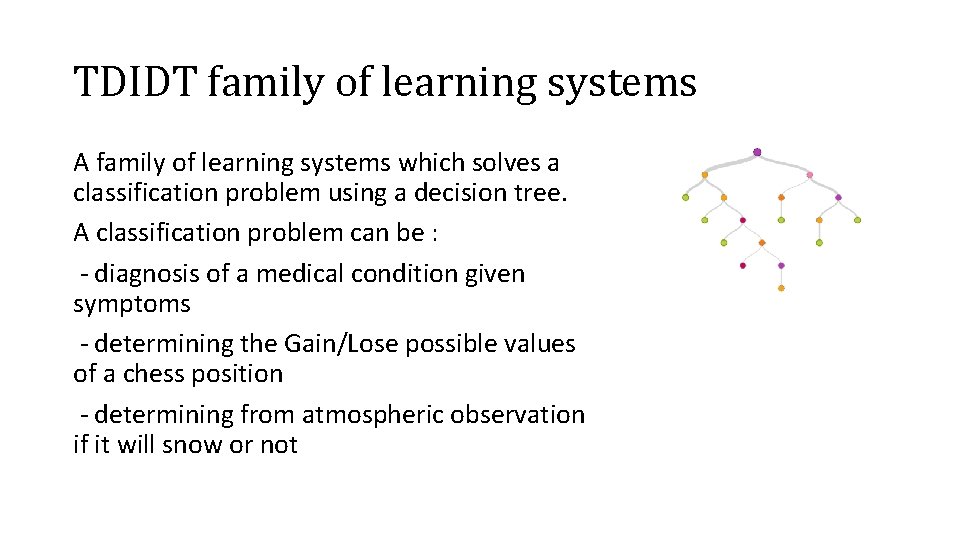
TDIDT family of learning systems A family of learning systems which solves a classification problem using a decision tree. A classification problem can be : - diagnosis of a medical condition given symptoms - determining the Gain/Lose possible values of a chess position - determining from atmospheric observation if it will snow or not
TDIDT family of learning systems Decision trees are a representation of a classification • The root is labelled by an attribute • Edges are labelled by attribute values • Each leaf is labelled by a class • Is a collection of decision rules Classification is done by traversing the tree from the root to the leaves.
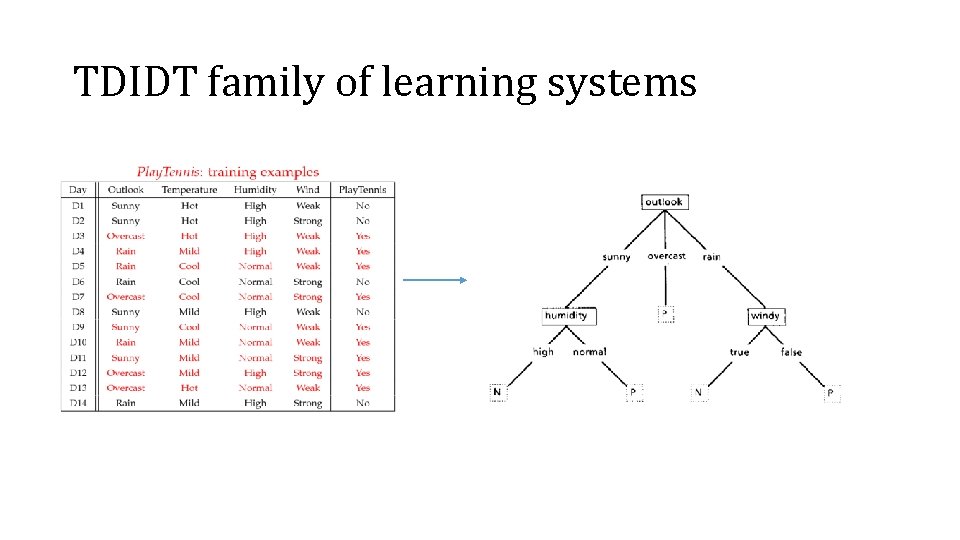
TDIDT family of learning systems
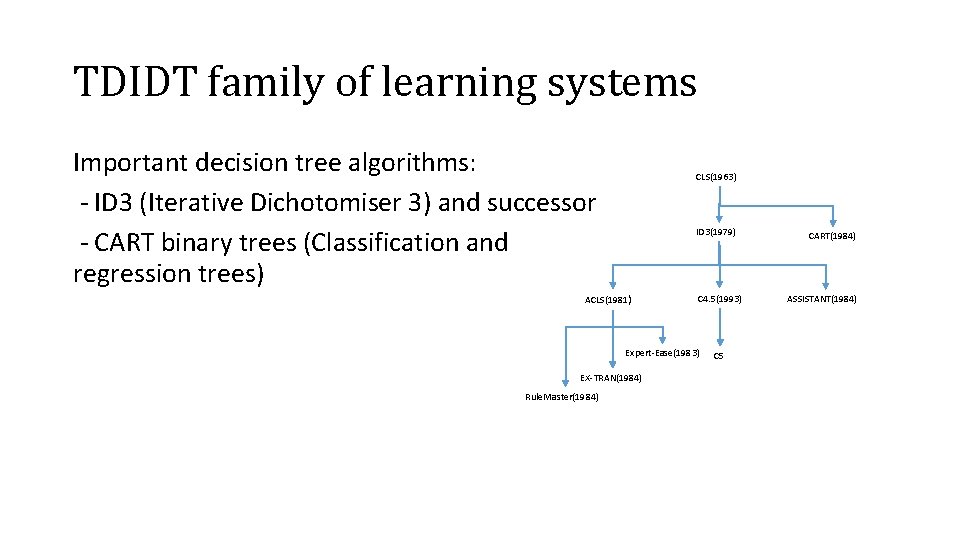
TDIDT family of learning systems Important decision tree algorithms: - ID 3 (Iterative Dichotomiser 3) and successor - CART binary trees (Classification and regression trees) CLS(1963) ID 3(1979) ACLS(1981 ) C 4. 5(1993) Expert-Ease(1983) EX-TRAN(1984) Rule. Master(1984) C 5 CART(1984) ASSISTANT(1984)
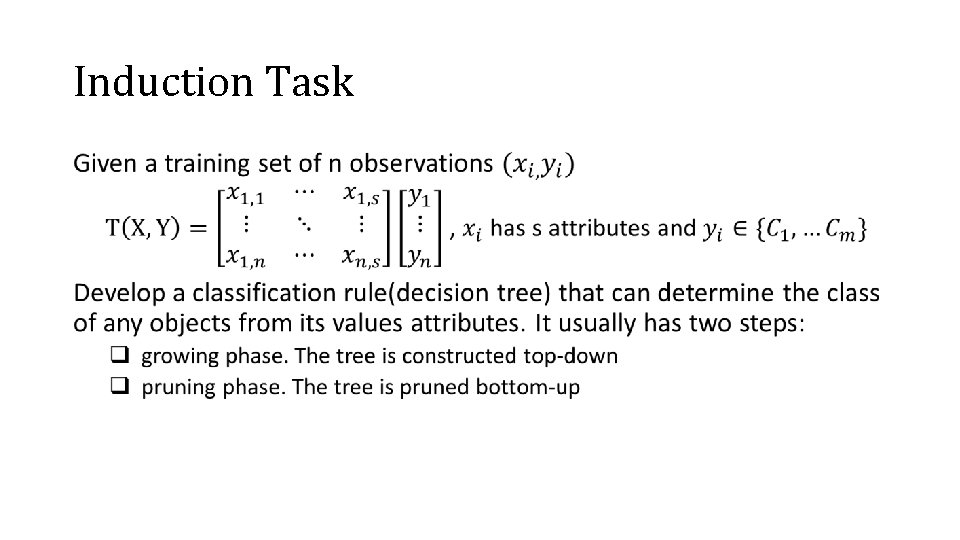
Induction Task •
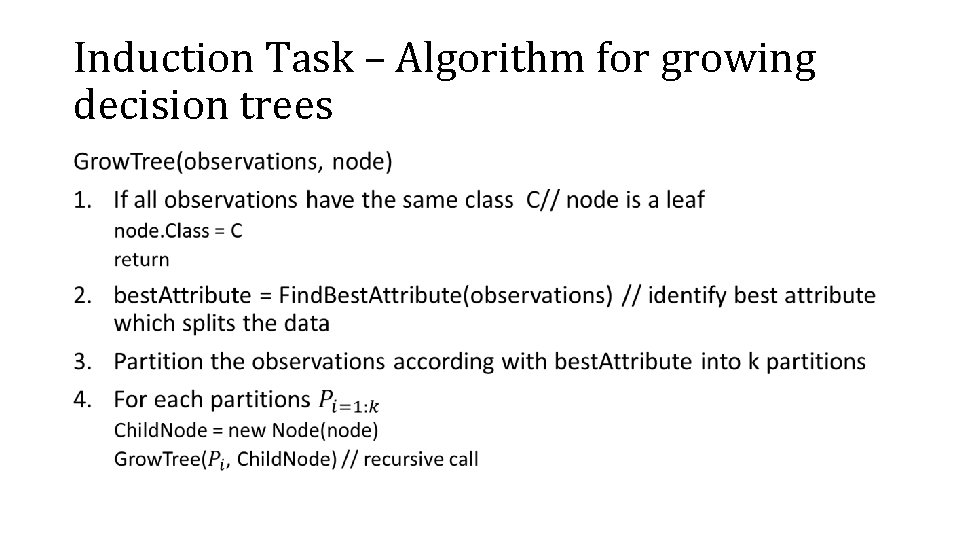
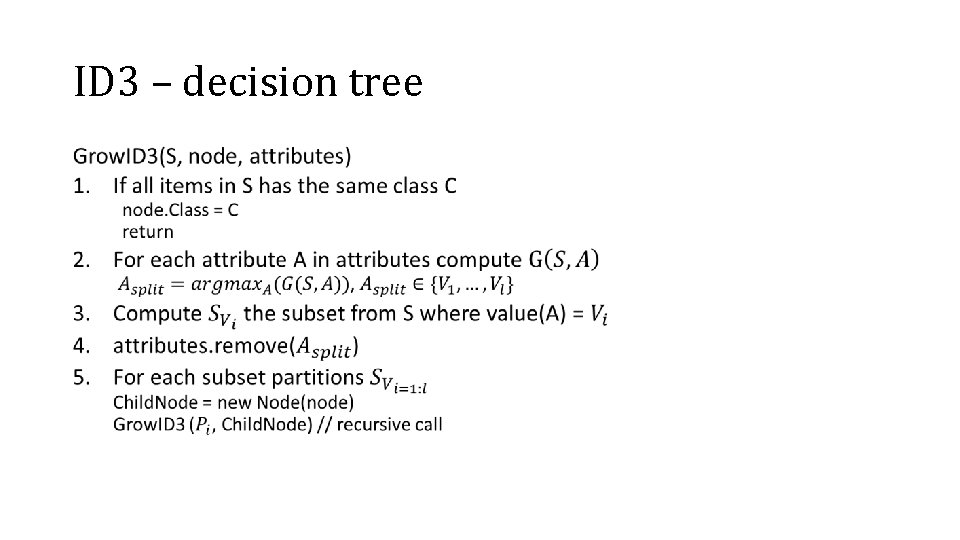
Induction Task – Algorithm for growing decision trees •
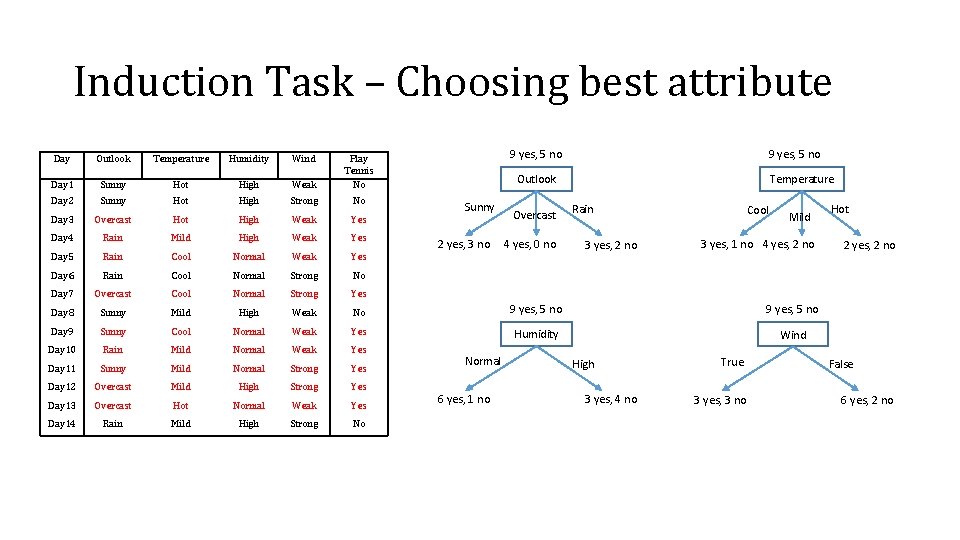
Induction Task – Choosing best attribute 9 yes, 5 no Day Outlook Temperature Humidity Wind Day 1 Sunny Hot High Weak Play Tennis No Day 2 Sunny Hot High Strong No Day 3 Overcast Hot High Weak Yes Day 4 Rain Mild High Weak Yes Day 5 Rain Cool Normal Weak Yes Day 6 Rain Cool Normal Strong No Day 7 Overcast Cool Normal Strong Yes Day 8 Sunny Mild High Weak No 9 yes, 5 no Day 9 Sunny Cool Normal Weak Yes Humidity Wind Day 10 Rain Mild Normal Weak Yes Day 11 Sunny Mild Normal Strong Yes Day 12 Overcast Mild High Strong Yes Day 13 Overcast Hot Normal Weak Yes Day 14 Rain Mild High Strong No Outlook Sunny 2 yes, 3 no Normal 6 yes, 1 no Overcast 4 yes, 0 no Temperature Rain 3 yes, 2 no High 3 yes, 4 no Cool Mild 3 yes, 1 no 4 yes, 2 no True 3 yes, 3 no Hot 2 yes, 2 no False 6 yes, 2 no
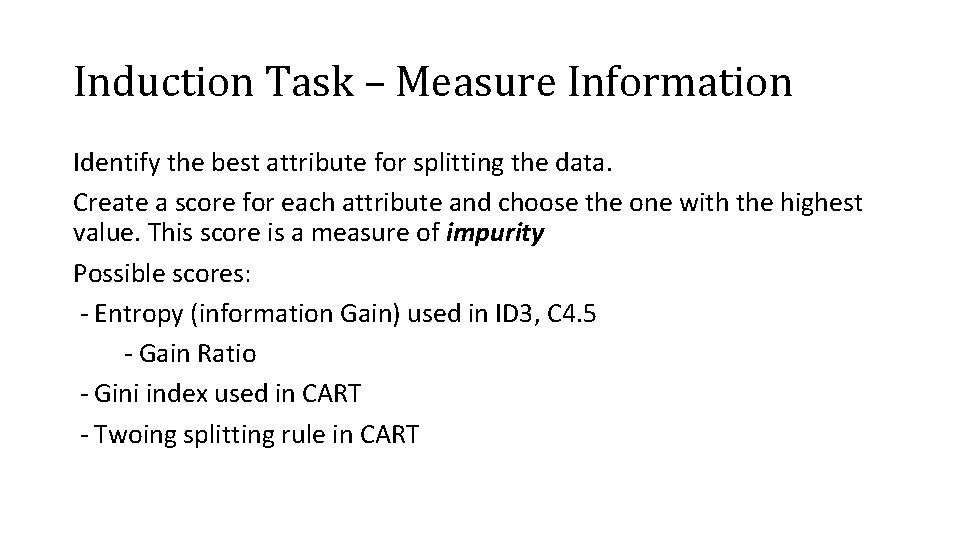
Induction Task – Measure Information Identify the best attribute for splitting the data. Create a score for each attribute and choose the one with the highest value. This score is a measure of impurity Possible scores: - Entropy (information Gain) used in ID 3, C 4. 5 - Gain Ratio - Gini index used in CART - Twoing splitting rule in CART
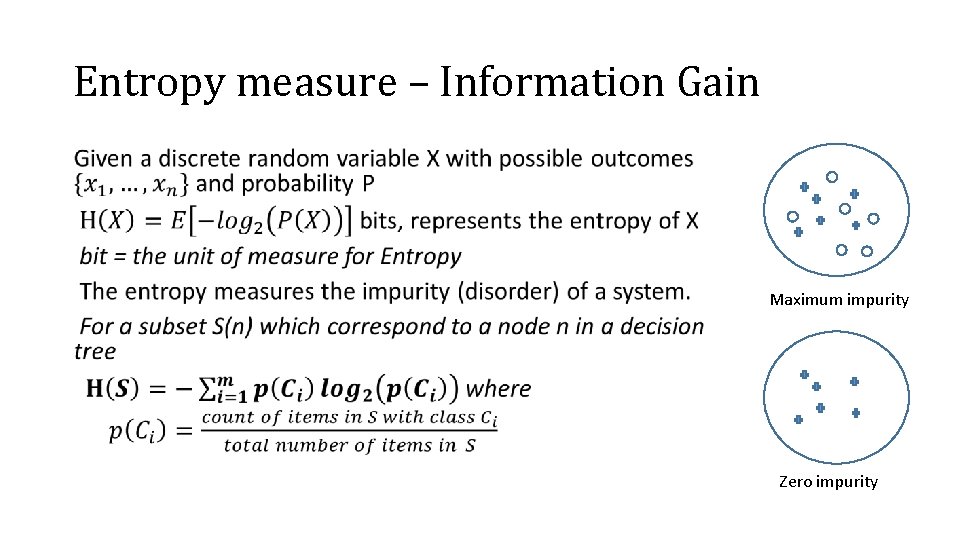
Entropy measure – Information Gain • Maximum impurity Zero impurity
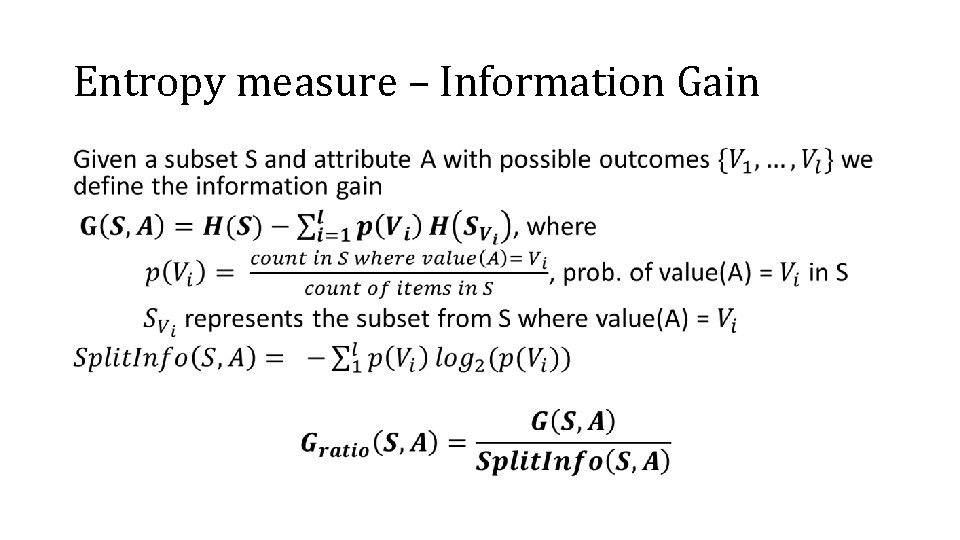
Entropy measure – Information Gain •
ID 3 – decision tree •
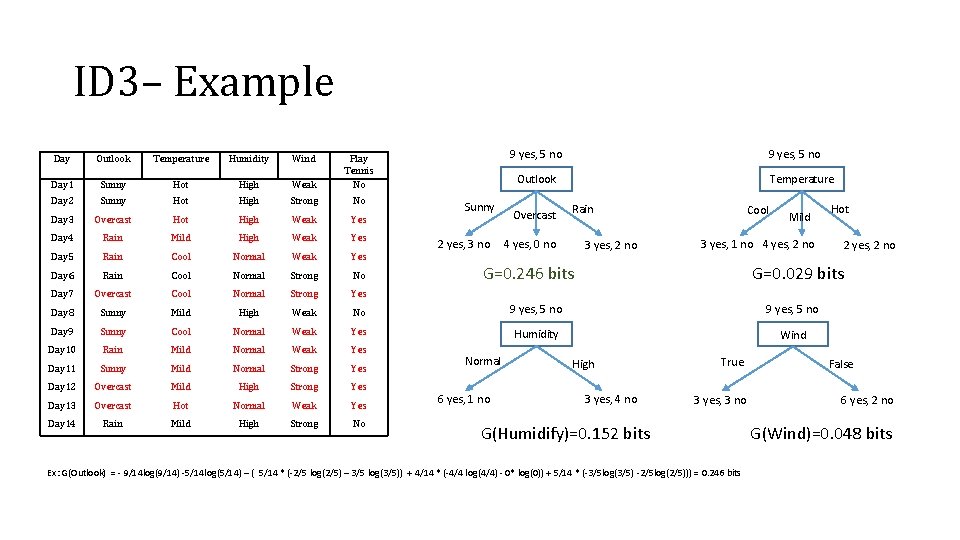
ID 3– Example 9 yes, 5 no Day Outlook Temperature Humidity Wind Day 1 Sunny Hot High Weak Play Tennis No Day 2 Sunny Hot High Strong No Day 3 Overcast Hot High Weak Yes Day 4 Rain Mild High Weak Yes Day 5 Rain Cool Normal Weak Yes Day 6 Rain Cool Normal Strong No Day 7 Overcast Cool Normal Strong Yes Day 8 Sunny Mild High Weak No 9 yes, 5 no Day 9 Sunny Cool Normal Weak Yes Humidity Wind Day 10 Rain Mild Normal Weak Yes Day 11 Sunny Mild Normal Strong Yes Day 12 Overcast Mild High Strong Yes Day 13 Overcast Hot Normal Weak Yes Day 14 Rain Mild High Strong No Outlook Sunny 2 yes, 3 no Overcast Temperature Rain 4 yes, 0 no 3 yes, 2 no Cool 3 yes, 1 no 4 yes, 2 no 6 yes, 1 no Hot 2 yes, 2 no G=0. 029 bits G=0. 246 bits Normal Mild High 3 yes, 4 no True 3 yes, 3 no G(Humidify)=0. 152 bits Ex: G(Outlook) = - 9/14 log(9/14) -5/14 log(5/14) – ( 5/14 * (-2/5 log(2/5) – 3/5 log(3/5)) + 4/14 * (-4/4 log(4/4) - 0* log(0)) + 5/14 * (-3/5 log(3/5) -2/5 log(2/5))) = 0. 246 bits False 6 yes, 2 no G(Wind)=0. 048 bits
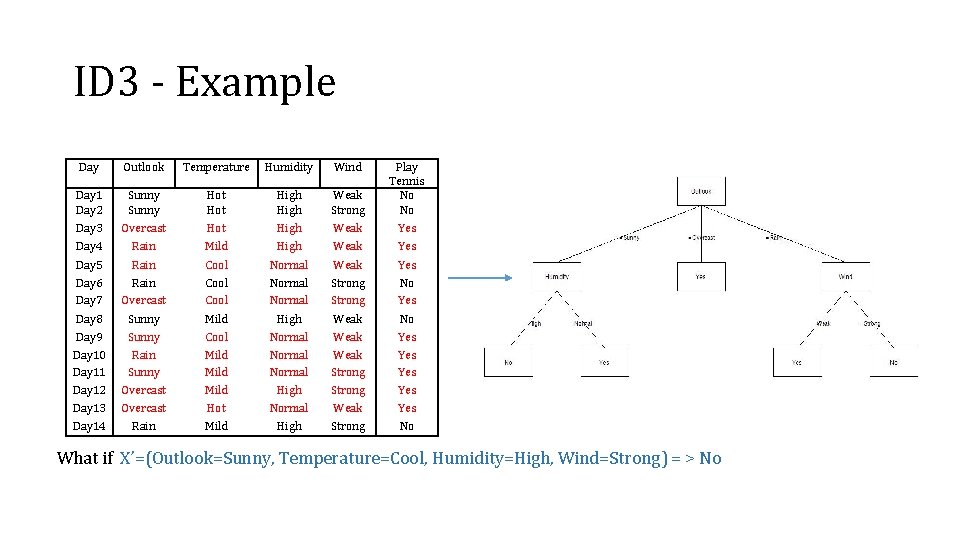
ID 3 - Example Day Outlook Temperature Humidity Wind Day 1 Day 2 Sunny Hot High Weak Strong Play Tennis No No Day 3 Day 4 Overcast Rain Hot Mild High Weak Yes Day 5 Rain Cool Normal Weak Yes Day 6 Day 7 Rain Overcast Cool Normal Strong No Yes Day 8 Day 9 Day 10 Day 11 Day 12 Day 13 Day 14 Sunny Rain Sunny Overcast Rain Mild Cool Mild Hot Mild High Normal High Weak Strong Weak Strong No Yes Yes Yes No What if X’=(Outlook=Sunny, Temperature=Cool, Humidity=High, Wind=Strong) = > No
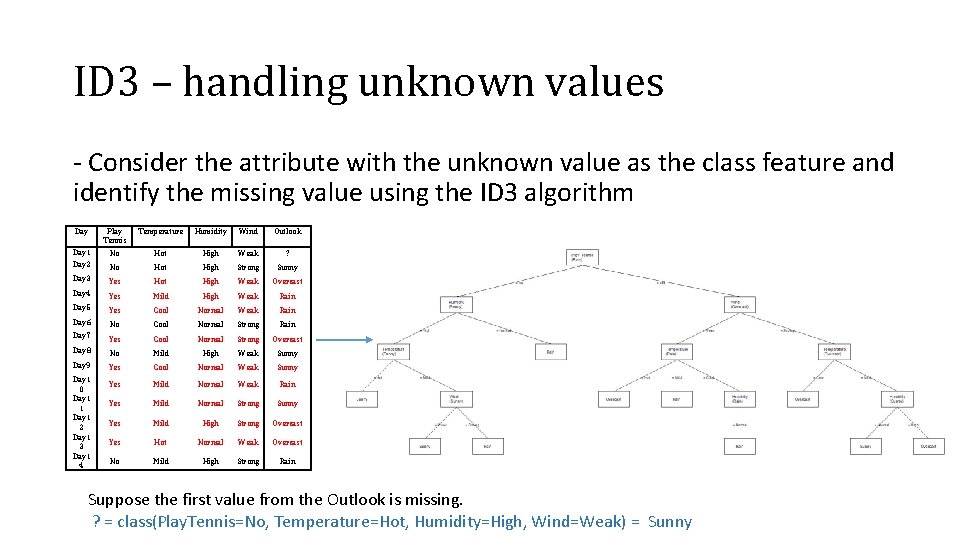
ID 3 – handling unknown values - Consider the attribute with the unknown value as the class feature and identify the missing value using the ID 3 algorithm Day Play Tennis Temperature Humidity Wind Outlook Day 1 Day 2 No Hot High Weak ? No Hot High Strong Sunny Day 3 Yes Hot High Weak Overcast Day 4 Yes Mild High Weak Rain Day 5 Yes Cool Normal Weak Rain Day 6 No Cool Normal Strong Rain Day 7 Normal Strong Overcast Yes Cool Day 8 No Mild High Weak Sunny Day 9 Yes Cool Normal Weak Sunny Yes Mild Normal Weak Rain Yes Mild Normal Strong Sunny Yes Mild High Strong Overcast Yes Hot Normal Weak Overcast No Mild High Strong Rain Day 1 0 Day 1 1 Day 1 2 Day 1 3 Day 1 4 Suppose the first value from the Outlook is missing. ? = class(Play. Tennis=No, Temperature=Hot, Humidity=High, Wind=Weak) = Sunny
ID 3 – overfitting To avoid overfitting the negligible leaves are removed. This mechanism is called pruning. Two types of pruning: • Pre-Pruning - is not so efficient but is fast because is done in the growing process - based on thresholds like (maximum depth, minimum items classified by a node ) • Post – Pruning - done after the tree is grown - prunes the leaves in the error rate order (much more efficient)
ID 3 - summary • Easy to implement • Doesn’t tackle the numeric values (C 4. 5 does) • Creates a split for each Attribute value (CART trees are binary tree) • C 4. 5 the successor of ID 3 was considered the first algorithm in the “Top 10 Algorithms in Data Mining” paper published by Springer LNCS in 2008
Decision tree – real life examples • Biomedical engineering (decision trees for identifying features to be used in implantable devices) • Financial analysis (e. g Kaggle Santander customer satisfaction) • Astronomy(classify galaxies, identify quasars, etc. ) • System Control • Manufacturing and Production (quality control, semiconductor manufacturing, etc. ) • Medicine(diagnosis, cardiology, psychiatry) • Plant diseases (CART was recently used to assess the hazard of mortality to pine trees) • Pharmacology (drug analysis classification) • Physics (particle detection)
Decision tree - conclusions • Easy to implement • Top classifier used in ensemble learning (Random Forest, Gradient boosting, Extreme Trees) • Widely used in practice • When trees are small they are easy to understand
- Slides: 20